



Uncategorized
Is Mamdani bad or good for Jews? Here’s how not to tell
What will Zohran Mamdani’s mayoralty mean for New York City’s Jews?
Much ink was spilled on that question during Mamdani’s campaign. But now that he is actually in office, there are two approaches we can use in assessing his performance in tackling antisemitism.
The first involves focusing on signals. We saw this method used extensively in expressions of concern during Mamdani’s campaign. His refusal to condemn the phrase “globalize the intifada” on a podcast, for example, was taken as a signal that he would not be serious about fighting antisemitism.
The second involves looking at how the new mayor actually shows up for Jews — a tactic that means taking a longer view of his ability to navigate the complicated and painful issues facing Jewish communities.
The first approach has already been used widely in Mamdani’s first days in office.
On Jan. 1, Mamdani overturned a host of executive orders that his predecessor, former Mayor Eric Adams, had put into place, some of which were relevant to antisemitism and Israel. This included revoking the city’s use of the International Holocaust Remembrance Alliance definition of antisemitism.
Critics of that definition say that it threatens to chill legitimate criticism of Israel. (The IHRA definition includes, among possible examples of antisemitism, actions like “denying the Jewish people their right to self-determination, e.g., by claiming that the existence of a State of Israel is a racist endeavor.”) And some Jews argue that it insists on a limited understanding of Jewish identity for political purposes.
But to some, Mamdani’s revocation of the Adams order enshrining that definition was an important signal — one that cemented a sense that he does not take Jewish safety or wellbeing seriously.
“Removing protections is a dangerous move, especially on day one. Jewish New Yorkers deserve security, not a delete button,” ADL chief Jonathan Greenblatt posted. “Despite the eloquent rhetoric, actions like this speak far, far louder than words.”
Israel’s foreign ministry wrote, “This isn’t leadership. It’s antisemitic gasoline on an open fire.” And William Daroff, head of the Conference of Presidents of Major American Jewish organizations, said Mamdani’s move was “a troubling indicator of the direction in which he is leading the city, just one day at the helm.”
But there is little evidence that adopting the IHRA definition of antisemitism has done anything to actually quell antisemitism, despite a broad push to have it embraced by universities, states and the federal government.
Which raises the question: When we broadly interpret individual acts as symbols of a deeper intention, what do we miss?
At the same time Mamdani overturned every executive order signed by Adams since late September 2024, when Adams was indicted on corruption charges, he announced that he will keep the Office to Combat Antisemitism — which Adams founded — open. That office liaises between the city and its Jews on safety and security, and will make recommendations to Mamdani on public education efforts around antisemitism.
What if we asked practical, rather than symbolic, questions in response to those day one actions?
Not “how outraged should we be by the revocation of the IHRA definition?” but “will that revocation actually change how safe Jews are?” Or: What will the functions of the Office to Combat Antisemitism actually look like under Mamdani? How will the office track antisemitism? What will it do differently under Mamdani than under Adams? What will public education on antisemitism in Mamdani’s New York look like?
Mamdani revoked an Adams order that gave the police commissioner — currently Jessica Tisch — the responsibility to evaluate proposals for regulating protests outside houses of worship. (Mamdani was criticized for his response to a November protest outside Park East Synagogue.) But he put in place a new order that authorized the Police Department and Law Department to conduct similar reviews.
Concerned Jews could ask how those departments will handle this role differently, and what the new mayor will do with their proposals.
And beyond that: Which Jewish communities will Mamdani engage with, and what will he offer them in terms of practical action? How will he demonstrate a commitment to Jewish New Yorkers, in all their pluralism and diversity? If other officials in New York engage in antisemitic conspiracy theories, how will he react to them?
What will it look like when he celebrates holidays with Jewish New Yorkers? When he inevitably disagrees with various Jewish New Yorkers, how will his administration try to communicate across differences?
Taking this second approach could come with downsides. Polling shows that New York Jews continue to be deeply anxious about their future under Mamdani, and are eager for quick answers on what they can expect for the next four years. Evaluating the real impact of his performance does not offer concise opportunities for a headline or a statement offering those responses. It’s a slower and more boring kind of proof to collect.
But it has upsides, too. The answers would be slower to come, but they would reflect not just strong feelings around what could happen, but what is actually happening. They would be nuanced. And maybe they would lead to a stronger sense of safety and security, too.
The post Is Mamdani bad or good for Jews? Here’s how not to tell appeared first on The Forward.
Uncategorized
Mozambique’s only synagogue has been keeping Judaism alive in the country for a century
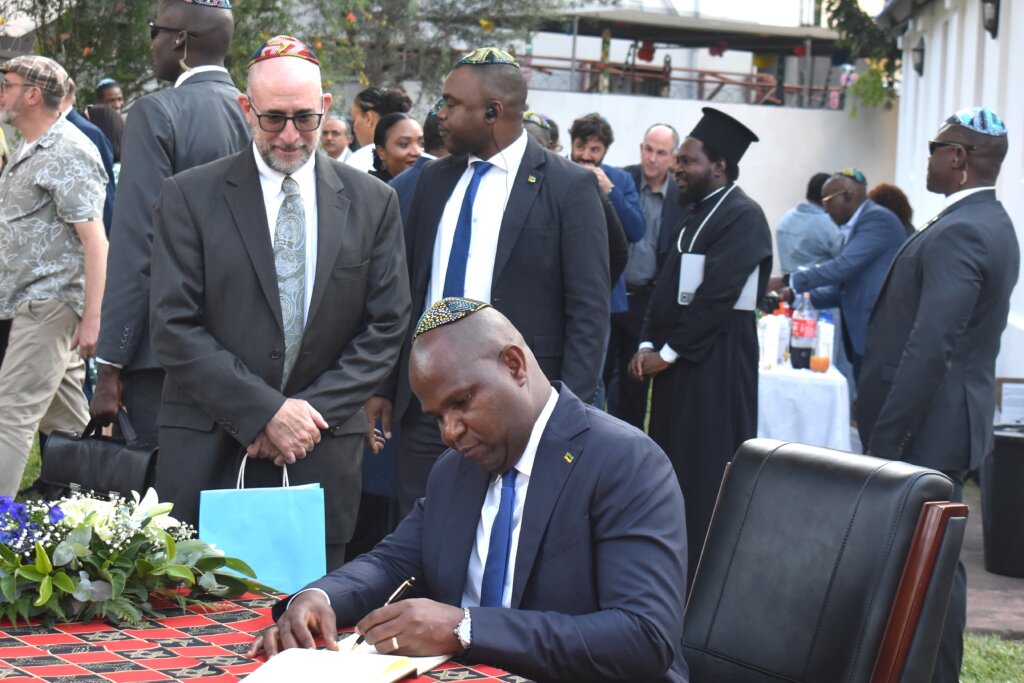
Inside the Honen Dalim synagogue in Maputo, Mozambique, a security team of men in suits wearing colorful kippot swept the inside of the small chapel, while members and visitors milled about on the lawn outside. Security had to be thorough; the president was coming.
For the rest of the city, it was a normal day. The sidewalks near the synagogue were crowded with vendors selling clothes, fruit and candy. Across the street, students hung out in the courtyard of the technical college the Instituto Comercial de Maputo. But for the city’s small Jewish community, it was a momentous occasion.
On June 11, Honen Dalim celebrated the centenary of the synagogue, which was officially inaugurated on Aug. 29, 1926. Congregation leaders and government officials gave speeches. Camera crews from three different TV stations — including the Mozambican state news channel — crowded in the small chapel to capture every moment.

Lay leader Marcos Vaena told me that celebrating the synagogue is not just about the building, but what it represents for Mozambique’s Jewish community, which consists of only a couple dozen families.
“It’s a sense of pride and historical heritage,” he said, adding that the synagogue has endured “profound changes in society — the liberation struggle that the country went through, the independence movement — and it still remains.”
It hasn’t been easy to keep the synagogue alive for a century, but Honen Dalim’s small congregation has persisted without a permanent rabbi or any local Jewish institutions to rely on.
Maputo is a multicultural city with a history of religious partnership, and the celebration’s 100 attendees were a diverse mix of government officials and community members. Among them were the country’s Christian president, Daniel Chapo, whose election in 2024 was marred by accusations of corruption and fatal clashes between security forces and protesters. Across the aisle, sat the German ambassador to Mozambique Ronald Münch and Sheik Aminudin, the President of the Islamic Council of Mozambique. Manuela Soeiro, Honen Dalim’s longest member and “the mother of Mozambican theater,” spoke about being involved with the synagogue since in the 1940s.

Longtime lay leader Samuel Levy gave an opening speech in Portuguese on the spirit of religious tolerance in Mozambique. Rabbi Moshe Silberhaft, chief rabbi of the African Jewish Congress, which supports Jewish communities in Sub-Saharan Africa, and AJC president Nahum Gorelick recited from Psalm 92 — which describes the fruitful life granted to those who are devoted to God — in Hebrew and English. The crowd sang “Hosi Katekisa Afrika,” a Tsonga version of a hymn meaning “God Bless Africa.” Around 50 more people watched on Zoom.

“This date is much more than a chronological milestone,” Chapo said in his speech. “We recognize, with appreciation and admiration, the enduring presence of the Jewish community in the religious, historical, and cultural fabric of our country, Mozambique.”
A long Jewish history
Although the synagogue is 100 years old, the presence of Jews in Mozambique dates back even further. Levy, a New York-born lawyer who has been part of the congregation since the ‘90s, told me the oldest grave in Maputo’s Jewish cemetery, located a few blocks from the synagogue, dates back to 1899.
Global events have always shaped Honen Dalim’s story. Levy said some of the earliest Jews migrated to Maputo due to the Witwatersrand Gold Rush that began in 1886 and helped develop Johannesburg, South Africa. Maputo — known then as Lourenço Marques, after the Portuguese explorer — was critical in the export process due to its coastal location, making it an ideal location for Jewish merchants.
Early Jewish arrivals came from around the world — including Morocco, Lithuania, the United Kingdom, and Portugal, which ruled Mozambique from 1505 to 1975 — often by way of South Africa. In 1906, they established themselves as a community under the name Honen Dalim — meaning “He who is charitable to the poor” — and prayed in each other’s homes.
During the Second Boer War in South Africa, which lasted from 1899 to 1902, the chief rabbi of Johannesburg, Joseph Herman Hertz, was expelled for his pro-British leanings and opposition to the government’s restrictions on Jews and Roman Catholics. During his years-long expulsion — the next time he came to South Africa, it was as the Chief Rabbi of the United Kingdom in 1920 — he spent a few days in Lourenço Marques and encouraged the Jews there to finally build a synagogue.


Levy said the “community waxes and wanes” but that many hundreds were there during the Second World War. Because Portugal was a neutral country, Mozambique was a place where European Jews could find refuge, although they didn’t have full economic freedom and suffered from religious segregation.
Manuela Soeiro, who founded the first Mozambican theater troupe Mutumbela Gogo in 1986, told me at the centenary celebration about her experiences being a Jew at a Salesian Catholic boarding school in the ‘40s and ‘50s. When the nuns saw her hug her Jewish grandfather, they made her and her two sisters sleep in a cold bathtub as punishment for engaging with “the devil.”
After World War II, many Jews immigrated from Mozambique to South Africa, which was experiencing an economic boom.
The Jewish community took another hit when, in 1975, Mozambique gained independence from Portugal due to the Front for the Liberation of Mozambique’s (FRELIMO) successful guerilla campaign. A communist government led by President Samora Machel took over and restricted religious practice.
“All of the religious buildings, not only the synagogue — mosques, churches, everything — was expropriated by the government,” Levy told me.

The majority of the Portuguese in Mozambique left, some by force and some by choice, and many Jews were among those who emigrated. The country was hit hard by economic destabilization. Concrete shells of building projects abandoned by Portuguese builders after independence dot the city skyline.
Only two years after independence, the country’s socialist and anti-communist factions waged a civil war that ravaged the country for 15 years. Honen Dalim’s synagogue fell into disrepair and became a warehouse for the Red Cross.
The synagogue’s address ties the building both to the country’s colonial and post-independence eras. Avenida 24 de Julho — July 24th Street — was named after the date in 1875 when Portugal took full possession of Maputo. Exactly 100 years later, on July 24, Machel nationalized almost every sector of Mozambican society.
Revitalizing the community
Nuno Soeiro remembers his mom Manula continuing to look after the synagogue, along with his uncles, even though they weren’t allowed to practice religion there in the communist era.
“Some people from the American embassy, they used to do some lessons,” Nuno Soeiro told me, saying they went to embassy officials’ houses to observe Jewish holidays.

In 1989, the synagogue had an unexpected savior: Alkis Macropolous, a Greek, and not Jewish, businessman. His Jewish colleagues in Johannesburg encouraged him to help preserve the building. He ensured that the dilapidated structure was not torn down and arranged for an ad to be placed in the paper asking for any remaining Jews to claim the synagogue — and they did. The defeat of the communist government in 1990 — which was replaced by a presidential republic — allowed religious communities to be active again.
When Samuel Levy arrived in 1993, the synagogue didn’t have enough people for a minyan and wasn’t having official services, but on Saturday afternoons, Jewish and non-Jewish members gathered together to sing folk songs. Although it wasn’t a traditional service, Levy found it spiritually fulfilling.
“Those songs were maybe the most simplest prayers I’ve ever heard,” Levy told me. “But also the deepest.”
For Larry and Diane Herman, Conservative Jews from Detroit who arrived in Maputo in 1999, practicing Judaism without a large community was nothing new. Larry’s work as an economist took them around the globe, including to Burkina Faso, Chad, Niger and Uganda.
“We were the center of the Jewish community in Ouagadougou from 1975 to 1977, which simply means the three or four or five other Jewish Peace Corps volunteers,” Larry told me.
The Hermans took on leadership roles and Diane put together a spiral-bound siddur for services that includes prayers in Hebrew, English and Portuguese. They wrote a prayer for Mozambique based on the prayer for the country found in many U.S. prayer books. Levy also led services, even while away.
Natalie Tenzer-Silva, who moved from South Africa to Mozambique with her family in 1993, told me Levy would send cassette recordings of Kol Nidre when he couldn’t be there to lead High Holiday services himself.
“He would blow the shofar over a cell phone or send a recording of it,” Tenzer-Silva said. “He really is the pillar, making sure that we have all the writings and the readings and all of that ready for the holidays and for the Friday nights.”

The Hermans were the only Shabbat-observant and kosher members of the synagogue at the time. To buy kosher food, they went to Johannesburg, often bringing things back for the congregation. These imports were critical around Passover, when the Hermans hosted seders at their home, sometimes for as many as 50 people.
Not big enough to have a full executive board or leadership team, the synagogue members had to set their own guidelines.
“We sat for like four hours trying to hash out the rules,” Diane Herman said.
“When you already don’t have a minyan of Jews, let alone males, and you’ve got all these intermarried couples, what do you do about the spouse? And what do you do about these people who aren’t Jewish at all, but want to participate?” said Diane. “We hashed out how to create a community there. It was fascinating.”
“When Jews come there from other places, they realize if they’re going to give any expression to their Jewish identity, they need to work on it,” Levy said. “If you want your kids to know something, well, you’re going to have to start a Sunday school or really participate in it. If you want the holidays to happen, you’re going to have to organize to import matzo and kosher wine for Passover because we can’t make it.”
Rebuilding the synagogue
Considered one of the poorest countries in the world, Mozambique attracts many people from abroad who work in diplomacy, aid, or international development. As more Jews arrived to work in these sectors, it became clear the synagogue needed physical improvements.
“When I arrived, there were poles supporting the roof,” Tenzer-Silva told me. “And every time we would go to services, if the wind blew, my children would think the roof was going to fall in.”
Larry Herman remembered one Shabbat where a corner did fall in — and another where a rat fell from the rafters.
In 2009, congregant Juliana Becker decided she wanted a bat mitzvah — the first to happen in the country — and turned to Larry for tutoring. A Torah was brought in from South Africa, since the synagogue lacked its own, and 125 people attended from Maputo and from abroad. The event prompted Honen Dalim’s leaders to successfully file for official recognition from the government in 2010, making them the legal owners of the synagogue.
Five years later, in preparation for the bar mitzvah of Tenzer-Silva’s older son, Jordan, the congregation decided to replace the roof. But this could not be done safely without updating the walls and flooring. Tenzer-Silve said what was originally supposed to be a $25,000 bill became more than $120,000.
With help from the local community, and friends and family abroad, Honen Dalim managed to raise the money — just in the nick of time for Jordan.
“The Friday of his bar mitzvah, they had finished painting the walls,” Tenzer-Silva said.

In 2013, Honen Dalim held a rededication ceremony celebrating the rebuild. Ann Harris, then-President of the African Jewish Congress, and Rabbi Moshe Silberhaft gave the congregation a kosher Sefer Torah — something they had lacked before. Other faith leaders and government representatives attended, including then-Minister of Justice Maria Benvinda Levi, who now serves as the country’s Prime Minister and has Jewish ancestry.
Multiple members of Honen Dalim described the environment of Maputo as extremely tolerant and supportive of the Jewish community.
“The entire time I lived in Mozambique, I wore a kippah on the streets and never had any problems,” Larry Herman told me.

Many attribute this respect for religion to the role faith leaders played in dissuading violence during the civil war. A wing of the city’s central church is dedicated to Pope John Paull II, who made a famed visit in 1988 advocating for peace. Ultimately, the Catholic lay movement, the Community of Sant’Egisio, brokered peace. Tenzer-Silva and others remarked that the civil war made people tired of conflict.
Honen Dalim is part of the COREM — the Council of Religions in Mozambique. Its President, Moisés Chiziane, spoke at the centenary event, urging continued coexistence.
“Peace is not built only by the absence of conflicts,” he said. “Peace is built by respect, listening, acceptance of diversity and recognition of the dignity of every human being.”
Levy told me Honen Dalim has hosted a Muslim adult study group at the synagogue to learn about Jewish practices, such as putting on tefillin.

“The people who run the different faith organizations,” Levy said, “they make it an article of faith that they need to actively get along — not tolerate, but learn about the faith of other people.”
In recent years, a branch of ISIS has established itself in the northern part of Mozambique, displacing local residents and leaving other religious groups — and non-affiliated Muslims — fearful of being attacked. But Natalie Tenzer-Silva said that type of extremism has not been seen in Maputo.
“It won’t come down south,” she told me confidently. “People wouldn’t tolerate it.”
A tenuous position
Although the community is still active, members described Honen Dalim as “fragile.” Tenzer-Silva said there could be anywhere “between three and 12 people” at a Friday service — the turnout isn’t big or consistent. They also lack the type of programming that bigger synagogues offer.
“I would like to take my kids to synagogue to learn Hebrew,” Nuno Soeiro said. “We don’t have that.”
Individuals like Levy can help organize lessons for kids like Soeiro’s daughter to be on track to become bar or bat mitzvahs. But the number of people with that type of knowledge is limited.
According to Levy, COVID was “a big blow to the Jewish community.”
“At that point we had Sunday school with eight kids,” he said. “After that, things kind of became a little more tenuous and they’re a little more tenuous today, but we try to keep going.”
The congregation’s reliance on expats also puts it in a delicate position. Synagogue leaders say only around a third of congregants are permanent residents. While some expats find a permanent home in Maputo, others leave due to work or family. After 16 years in Maputo, the Hermans left and now live in Los Angeles. Levy divides his time between Maputo and Dubai, although all three help manage things from a distance.
The recent cuts to USAID programs to Mozambique will likely diminish the number of American Jews who have jobs that require them to move there. And a hidden debt scandal in the mid-2010s that cost the country nearly $2.2 billion broke the trust of investors from around the world who may have sent Jewish employees to Mozambique.
“A lot of the international community withdrew support for many years,” Marcos Vaena said. “It was 10 years of economic crisis.”
Vaena, who grew up in Brazil in a Sephardic family with Turkish roots, first moved to Maputo in 2006 as a UN volunteer for a development program. He left in 2010 to work in other developing countries, but returned in 2024. He told me he saw “a diminished community” compared to the Honen Dalim he’d left behind. He decided to start leading Shabbat services a couple times a month.

“I wanted to make sure that my kids have continued exposure to a Jewish tradition and education,” he said.
It’s not just expats, however, who want a more formal way to be involved in Judaism.
“There’s a regular interest from Mozambicans that are seeking spiritual connection through Judaism,” Vaena said. “But then you need, I think, a more structured process and support for those who are there.”
“There were a lot of people who had been happy to convert, and that just wasn’t possible,” Diane Herman added. “There was no rabbi around.”
“We have a lot of people who were, I call, ‘lovers of Zion’ as opposed to Jews,” Larry Herman told me. “They were some of the biggest supporters.” He recounted what happened when he and Diane lost their fathers. ”Both of us went to the funerals in the United States and came back, and we were in our period of mourning — it was the non-Jews who supported us by coming to every service.”
There is also no mikveh, the ritual bath needed for conversions. Diane said some people go to South Africa for the rite, but they tend to be those with money. In a country where half of all workers earn less than 60,000 Metical a year — less than $1,000 — it’s not a viable option for the vast majority of Mozambicans.
Rabbi Moshe Silberhaft, chief rabbi for the AJC, occasionally helps the congregation with critical events, but Silberhaft serves nine different countries and cannot be everywhere at once. Tenzer-Silva told me that bringing in a permanent rabbi for such a small congregation would be difficult, especially with the lack of kosher food options. Vaena said he himself has considered seminary training.
“That experience leading the services and being more engaged on a daily basis has really brought me a lot of joy,” he said.
Perseverance
Despite the struggles the community faces, the 100th anniversary ceremony did not feel like a pity party for a dying congregation. Kids ran around the lawn during the reception, which was stocked with bagels and cakes from a kosher caterer in South Africa. Tenzer-Silva’s son Jordan, who’s in his late twenties now, helped usher people at the event and recited “Tzadik Katamar” alongside other synagogue leaders. The younger generation of the synagogue is small, but present.

And those who have moved away don’t really leave Honen Dalim behind. From Los Angeles, Larry Herman serves as the president of the Friends of the Jewish Community of Mozambique, helping garner international support for Honen Dalim. Although he and his wife haven’t lived in Maputo in 10 years, they spoke of it with great reverence.
“It’s a wonderful community,” Larry said. “I’m very proud of it.”
Honen Dalim continues to welcome new members and serve as a place where Jewish visitors can have a home. Members told me that travelers have come from America, Paris, Israel and other parts of the world. For Jews who end up in Maputo — whether for a few days, a few years, or the rest of their lives — Honen Dalim serves as a vital source of community. Several people said they had never been more Jewish than they had been in Mozambique.
“May the next hundred years be of peace, prosperity, and abundant blessings for all,” Chapo said toward the end of his speech. Although his words were practically all in Portuguese, he closed with a message Jews around the world could understand: “Shalom. Shalom. Shalom.”
The post Mozambique’s only synagogue has been keeping Judaism alive in the country for a century appeared first on The Forward.
Uncategorized
More US Jews feel ‘politically homeless’ than ever. What are we to do?
The news that most Jewish adults don’t feel comfortable in either major political party is not a death knell for American Jewish political participation. It’s a rallying cry.
Most American Jews feel politically unrepresented by both parties, an Associated Press-NORC Center for Public Research poll released this week found. That survey only confirms what every conversation I’ve had with Jewish friends lately gets around to: a new sense of political homelessness, combined with fears of increasing antisemitism.
Only 15% of respondents say the Democratic Party supports Jewish people in the United States “extremely” or “very” well, and 41% say it supports them “not very well” or “not at all.” Views of the Republicans are slightly worse — about half say the party doesn’t really support Jews.
What the poll shows is an undeniable slide in both parties on an issue many Jews still care deeply about, Israel, as well as the feeling that too much anti-Israel sentiment bleeds into antisemitism.
The poll found 63% of Jewish adults consider antisemitism an extremely or very serious problem, and 77% say prejudice has increased since the Hamas attack of Oct. 7, 2023. Only 38% of Americans overall share that level of concern. The gap between how seriously Jews perceive the threat and how seriously the broader public does only compounds our sense that we’ve been abandoned by civic institutions, and no longer fit neatly within the party system.
At first glance, the fact that American Jews feel less attached to either political party isn’t unusual. A growing number of all Americans are turned off by the two major parties, according to a May New York Times poll, which found that 43% of voters were dissatisfied with both parties.
But a major source of party dissatisfaction, the Times poll found, was, yep, America’s relationship with Israel. Among dissatisfied voters, 80% opposed economic and military aid to Israel. That includes 38% of Republicans and Republican-leaning independents who said they wanted the party to distance itself from Israel. That’s what Vice President JD Vance meant when he recently said — warned? — that, “Israel’s opinions matter, but fundamentally they are separate.”
So a shrinking share of Americans in both parties supports Israel — while roughly six in 10 American Jews say Israel is central to who they are. That’s the squeeze. No wonder we feel unsupported.
It’s tempting to litigate why this gap exists. You could argue that it’s not fair. You could argue a dozen other countries behave worse than Israel, or that Qatari and Chinese money have poisoned American minds and infected the algorithms, or that the antipathy toward Israel and Zionism has always been and will always be about Jew-hatred.
Still: this is where we are in 2026, and we can’t will the facts away. So where, politically, do Jews turn? How do we pick a lane when they all seem to lead to dead ends?
One option is to leave. In the past, the somewhat glib answer to “where should we go?” if Jews wanted to run away — or were kicked out — was, of course, Israel. American Jews who kept one bag packed by the door — even if figuratively — saw the Jewish state as a refuge.
But our relationship with Israel as it is now is complicated. Putting aside the fact that a country that has weathered years of war and terror is hardly a refuge, American Jews are deeply unhappy with the current Israeli government. The AP poll found that 4 in 10 Jewish adults think the U.S. is too supportive of Israel, and that among American Jews, New York City Mayor Zohran Mamdani is more popular than Israeli Prime Minister Benjamin Netanyahu.
If there is no flight, there is only fight.
That’s what former Chicago Mayor Rahm Emanuel was doing in Tel Aviv this week with a speech in which he called for a “fundamentally new and different approach” to U.S.-Israel relations. He was not fighting against Israel, but fighting for his party — the Democrats — to demand more of it. He talked about his emotional ties to Israel — something the majority of American Jews share — as well as his critiques.
And it’s why sharp criticism of his speech came from both sides of the aisle. On the right, Jonathan Tobin at JNS called the speech a recycling of “the persistent delusion of failed policies,” and Peter Savodnik at The Free Press wrote that Emanuel “bows to the left.” Meanwhile, the left accused Emanuel of placing too much blame on the Palestinians for corruption and intransigence, and for trying to stake out a pro-Israel position within the Democratic Party.
Emanuel didn’t pick a lane, which is why people who hold such disparate ideologies are all upset with him. Instead, he carved a new one. He embraced a politics so critical of Israel that it would have been anathema in mainstream Democratic circles until very recently. That’s not a bad thing. His idea — which is really an idea promoted by the progressive pro-Israel lobbying group J Street — is that the U.S. should push Israel, the Palestinians and the Arab nations toward a “23 state solution” that recognizes Palestinian rights and integrates Israel fully into the Middle East. As far-fetched as it seems now, it is also more pragmatic and optimistic than anything the far left or right have to offer.
Emanuel showed one option for how to decouple support for a strong, secure Israel from support for the disastrous direction in which the country’s leaders are taking it. He showed how to love Israel as an American Jew, warts and all. His position is highly critical of the country’s current leadership and direction — as are the majority of Israelis, by the way — but out of concern for its security and democracy, not out of objection to its existence. It’s a position that recognizes the rights of all peoples between the river and the sea to security and self-determination. It moves beyond blame to solutions.
The right response to American Jews’ sense of political abandonment is for candidates who care about our community — and despite our dismay, there are many — to pivot, like Emanuel, to making creative cases for the future. Come with a vision, come with a plan, come with a path that offers the chance of a better life for the millions of Jews and Arabs who live there and aren’t going anywhere. Come with a pitch that shows American Jews that the full complexity of our concerns matters, and that your parties are capable of adapting to meet this moment.
That’s the fight that has to happen. Don’t wait for a lane to open. Pick a party, and start opening one.
The post More US Jews feel ‘politically homeless’ than ever. What are we to do? appeared first on The Forward.
Uncategorized
UK Jewish groups express concern as the likely next PM criticizes Israel over Gaza
(JTA) — Andy Burnham, who is on track to become Britain’s next prime minister following Keir Starmer’s resignation last month, apologized for his party’s handling of the aftermath of the Oct. 7, 2023, Hamas mass killings in Israel, saying that it should have done more to push for a ceasefire and called for exerting greater pressure on the Jewish state today.
His comments prompted a joint response from the Board of Deputies of British Jews and the Jewish Leadership Council, which said they had contacted his team to express “significant concerns” about his remarks.
Burnham made his comments in a video statement on Thursday in response to questions from the public. Burnham is likely to become the next prime minister after gaining the overwhelming support of sitting Labour members of Parliament. To date no one has challenged him for the party’s leadership ahead of a July 17 deadline.
“I know many people feel that at the start of Israel’s military action in Gaza, my party didn’t get it right, and I am sorry about that,” he said. He added that he supported further sanctions on Israelis involved in the violence in Gaza, measures to ban trade with Israeli settlements and restrictions on arms licenses to Israel, saying there was “increasing evidence that war crimes appear to have been committed.”
He also condemned increased antisemitism in Britain, and said that tackling antisemitism did not contradict holding Israeli Prime Minister Benjamin Netanyahu’s government to account.
His comments came as lawmakers across the political spectrum have pushed for increased condemnation of Israel and sanctions on the country.
“The unbearable suffering in Gaza is a scar on our collective conscience,” Burnham said. “The killing of innocent Palestinians, including children,” was “completely unacceptable,” he added, declaring that Britain had to do more to “put pressure on the Israeli government.”
He described the country as “too slow to call for a ceasefire” and that “we must now do more to strengthen our approach” as “Israel continues to violate the ceasefire agreement killing innocent Palestinians.”
In their response, the Board and JLC said they shared “concern for the humanitarian situation in the Gaza Strip” but stated that the conflict “cannot be understood without reference to the role of Hamas not only in launching the conflict but in perpetuating the war through the holding of hostages, war-fighting entirely from within the civilian population, and [their] ongoing refusal to cede power and disarm, in line with the 20 point peace plan.”
They added that the conflict also could not be understood without reference to Hamas’ regional backers and allies, including Iran and Hezbollah. Burnham addressed none of this in his comments.
Burnham did, however, reiterate his condemnation of Hamas, describing the Oct. 7 attacks as “monstrous,” stressing that he denounced them “as strongly today as I did in the immediate aftermath.”
He said that he also condemned “the increase in appalling antisemitic attacks here in the U.K. and those who seek to divide our communities by targeting Jewish people.”
“I felt first-hand the anxiety in our Jewish community and the very real threat they face,” the former mayor of Greater Manchester said, referring to the Yom Kippur 2025 attack on the city’s Heaton Park synagogue in which two people were killed.
The Board and JLC welcomed Burnham’s “zero tolerance approach to antisemitism” and affirmed his assertion that “there is no contradiction between fighting antisemitism and disagreeing with actions of the Israeli government.”
However, they said, “Antisemitism cannot be confronted without addressing all its drivers,” arguing that in Britain that includes “Islamist, far left and far right extremists who go beyond criticism of the Israeli government to a place of hatred directed at Jews and Israelis.”
Their joint statement pointed out that Burnham knew “first hand the links between hatred of Israel, antisemitic extremism and deadly violence against British Jews,” adding that, “in a country in which antisemitism has become more normalized, more extreme and more violent, we call on our leaders to show the utmost care in their rhetoric in relation to the conflict.”
This article originally appeared on JTA.org.
The post UK Jewish groups express concern as the likely next PM criticizes Israel over Gaza appeared first on The Forward.
