


Uncategorized
He could have avoided persecution in Nazi Germany — he got bar mitzvahed instead
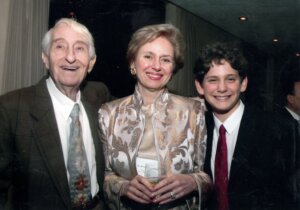
When Nazi Germany enacted the Nuremberg Laws on Sept. 15, 1935, being a Jew suddenly meant losing citizenship and the basic rights that came with it. But that same week Gerd “Pips” Phillipsohn — born to a German-Jewish father and Aryan mother — chose to embrace his Jewish identity with a bar mitzvah.
The Nuremberg laws stipulated that a Mischling — a child with one Aryan parent and one Jewish parent — born before September 1935 was considered to be a citizen of the Reich. However, once Pips became a bar mitzvah, he forfeited that status and was considered a full Jew.
Pips, who miraculously survived the Holocaust and became an immigrant success story in America, is the subject of Half-Jew — Full Life by Georgette Bennett. Bennett, a sociologist and founder of the humanitarian organization the Multifaith Alliance, first met Pips, her mother’s cousin, in New York in 1952, when she was five years old and straight off the boat from France with her parents, both Holocaust survivors. When Bennett’s father died one year later, Pips became her father figure for the rest of her life.
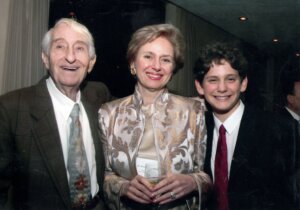
Before he died in 2015, Pips gave her recordings of his sessions with a psychiatrist and the permission to write a book about his story, which she did in painstaking detail that makes the reader feel like they, too, have known Pips their whole life. Although Bennett knew much of Pips’ story already, the process of writing the book gave her a new perspective.
“It wasn’t until I read through the transcripts of all of his audio tapes that the story developed much more meaning to me because yes, it was in his own words, but in the kind of detail that even stunned his psychiatrist,” Bennett told me in an interview. “I understood him in a whole new way.”
Born in Berlin in 1922, Pips was raised by two fairly non-religious parents; his mom went to church at Christmastime and his father attended synagogue only for the High Holy Days. It was antisemitism that actually pushed Pips towards embracing his Jewish identity. Bennett writes that when Pips was six, his religion teacher’s assertion that Jews were Christ-killers prompted him to stop attending the class. After Jews were banned from German youth groups, he joined a Jewish youth organization instead. His whole life was suddenly Jewish and he thought that becoming a bar mitzvah would help him fit in socially — plus, he knew he knew his parents would buy him a new bike.
Pips later fell in love with a childhood friend, Ilse Rosenthal, and went into hiding with her after her family was given a notice of deportation. After a few months on the run, they were caught by the SS and separated. Pips eventually ended up at Grosse Hamburger Strasse, a prison and deportation site, and Ilse was sent to Auschwitz where she died.
Although Pips’ prison was known as the last stop for Jews bound for Auschwitz, he managed to survive through the end of the war.
“Not only did he suffer persecution at the hands of the Nazis, he lost everything,” Bennett said. “But they saved his life on several occasions.”
Prisoners were forced to work, and Pips once fixed windows for a woman he referred to in the tapes as Frau Heim, an employee in the Gestapo’s records department. When she learned he had been chosen to be deported to Auschwitz, she slipped his file behind a filing cabinet so the order couldn’t be processed.
But despite this and other occasional acts of kindness, prejudice never ceased. After Frau Heim saved his life, Pips witnessed her playing happily with her dog next to a truck full of Jews bound for Auschwitz. Bennett told me that Heim wasn’t “completely oblivious to what’s happening to these people” and had “zero empathy” for most Jews. But she knew Pips had an Aryan mother.
“When it came to him, she had a lot of empathy,” Bennett said. “She didn’t really see him as a Jew.”
While imprisoned, Pips met Olga, a Transylvanian deportee who escaped the death march from Auschwitz, and they married in 1945. Two years later, they immigrated to the United States, where Pips Americanized his name to Gerald Phillips. In just under two decades, Pips went from waiting tables in the Catskills to being a partner in Globe Photos, one of the largest picture agencies in the world at the time. The couple became wealthy enough to live at 860 UN Plaza, where fellow residents included Robert Kennedy, Truman Capote and Angela Lansbury.
Despite surviving impossible odds, Pips never considered himself a remarkable person.
“I think he may have been judging himself in relation to other people who achieved great things, who raised children,” Bennett said. “He didn’t see himself as having done any of those things.”
Regardless of whether or not Pips considered his life extraordinary, Bennett believes it holds important lessons.
“It’s a story about how a normal society can descend into the worst kind of autocracy and brutality,” Bennett said. “It’s a story about identity and the price that we pay for our identity.”
“It’s also about denial, you know, our ability to be in denial as we see the world collapsing around us,” Bennett added. “We see a lot of that going on today.”
Bennett noted that when Pips watched Brownshirts march down the street and heard that Jews were banned from working in the press, he wasn’t able to process the implications this had for him or his family.
“He was a very self-centered guy, which I think was part of his secret to survival,” Bennett said. “He never saw himself as a hero. And I don’t see him as a hero either. He saw himself as a survivor.”
Half-Jew — Full Life will be published by Skyhorse Publishing on January 27.
The post He could have avoided persecution in Nazi Germany — he got bar mitzvahed instead appeared first on The Forward.
Uncategorized
From one Australian deli, he built a shopping empire. His parents taught him what to do with its riches.
I first learned about Sir Frank Lowy at the Australian Museum in Sydney. Alongside an opalized plesiosaur skeleton and a 19th-century rug made of 75 platypus skins, there was a brief account of a Czechoslovakian Holocaust survivor who went on to become Australia’s richest man. It was a bizarre way to discover that the origins of the ubiquitous Westfield shopping malls lay in the Levi family from the tiny pre-War Jewish community of Fiľakovo on the Hungarian/Slovakian border.
In 2018, Sir Frank sold the company he ran with his three sons David, Peter and Steven and moved to Israel. At that point, Queen Elizabeth II had already made Lowy a Knight Bachelor and Australia’s Governor-General had appointed him Companion of the Order of Australia, Australia’s highest honor. Then, in 2024, as Lowy was receiving Israel’s highest civilian award, the Israeli Presidential Medal of Honor, a production marketing team was charged with making a short introductory film about him.
Over the next year, that film grew into To Be a Jew: Frank Lowy in his own words, a new feature-length documentary by Sarit Asnapi. A film about one of Australia’s most successful businessmen could easily have become an inventory of 50 years of deals. Asnapi, known for My Sister’s Keeper (2023) about the ultra-Orthodox community, though, frames the film using the attacks of Oct. 7 that deeply affected Lowy. Talking to me, he teared up at the thought of his young relatives who were brutally murdered at Kibbutz Be’eri, comparing them to his Slovakian cousins murdered in the Shoah. Asnapi shows what Pinchas “Frantisek” Levi — the boy who lost his father in the Holocaust — carried into Frank Lowy’s later life.
When I met him in his New York apartment overlooking Central Park, Lowy told me about an episode during the war that didn’t quite make it to the film. While his older siblings illegally worked around Budapest, he and his mother were relatively safe, though hungry, in the international ghetto. At midnight, his brother sometimes brought food to the building where they were living so that Frank, then a boy, could carry the parcel upstairs to the crowded apartment. His mother would open it, set it out on the table, and invite everyone to eat.
“I protested,” Lowy told me. There were perhaps 30 people in a flat intended for three or four, and he could see how little food they had. What, he wanted to know, would they eat tomorrow?
“Tomorrow, God will provide.” his mother told him.
Lowy, who is now a spry 95, about to turn 96, built and sold Westfield, the shopping center company whose name is familiar to millions of Americans; helped remake Australian soccer; and founded major synagogues and think tanks in both Australia and Israel. But when he describes the principle behind his philanthropy, he returns to that apartment: “When you have a little, give a little. When you have a lot, give a lot.”
We began, though, with soccer. I’m a Leeds United supporter and his son Peter is now a director of the club. Lowy’s connection to the game goes back much further: to Fiľakovo, where his father took him to watch the local team on Sundays. On a return visit years later, Lowy sought out the spot by the field where his father Hugo, who was murdered in Auschwitz, had sat.
Lowy, his mother and his siblings survived. After the war, he went to Palestine, fought in Israel’s War of Independence and, in 1952, reunited with his family in Australia. He told me that on his first weekend in Sydney, he was back at a soccer ground, watching Hakoah, the Jewish club founded by immigrants on the model of the legendary Austrian team, Hakoah Vienna.
Years after that first Sunday at Hakoah, Lowy — who was president of the club from 1969-to-1988 — was asked to help overhaul Australian football. The sport had devoted supporters, but it was a “Volksport” where clubs often carried the national identities and rivalries of immigrant communities. Lowy recalled matches at which hostility in the stands overwhelmed what was happening on the field. He wanted a league that those communities could enjoy together with the rest of Australia.
After being approached by the Australian premier to transform the sport in that country, Lowy led the national governing body from 2003 to 2015. Under his chairmanship, the A-League began in 2005 with Australian city clubs taking over from the Macedonian, Italian, Croatian, Jewish, and other clubs that had preceded them. As well as refashioning the league, Lowy helped the “Socceroos” national team take on a pan-Australian character. With “the kick that united a nation,” John Aloisi’s successful penalty against Uruguay meant that Australia qualified for the 2006 World Cup, its first appearance in 32 years. It was a moment that transformed soccer’s standing in Australia from a niche sport into a mainstream powerhouse.
Soccer isn’t just a hobby for Lowy. In the wake of December 2025’s Bondi Beach massacre, he wrote to the Royal Commission on Antisemitism, suggesting the same principles he used to change the profile of the sport as a potential solution to the blight of rising antisemitism in the country.
He does not pretend that running a league supplies a complete answer to hatred. He does believe that people can change the public life of a country by building institutions, speaking openly and refusing to retreat.
“In soccer, we didn’t try to take people’s ethnic identity away; we worked to stop the expression of ethnic conflict in public. Similarly, it is probably not possible to eradicate a dislike of Jews, but it is possible to help people understand why, in Australian society, the public outpouring of this aversion is not right.”
The persistence of soccer in Lowy’s life fascinated me. So did the contrast between Hakoah, a place where immigrants could keep something of their old lives, and the more broadly Australian game Lowy later helped build. He did not see a contradiction. His early businesses had already taught him what could happen when people from different places found a reason to gather.
After finding factory work on arrival in a burgeoning immigrant Australia, Lowy took a job making sandwiches. Soon, he and fellow immigrant John Saunders opened a delicatessen in the Western Sydney suburb of Blacktown. “The delicatessen was very successful because we were the only ones that were selling continental goods,” he told me, “And the Russians, the Slovaks, and all the people that came were hungry for that. Because in Australia, then, a sandwich meant white bread, a slice of cheese, and white bread on top of it.” So their customers included Europeans from all over, who missed the food they had known before emigrating. The partners bought “Australia’s second espresso machine” and Lowy remembers the Italian workers queuing for coffee on Sunday mornings
One afternoon, an acquaintance told Lowy he was building shops nearby. Lowy, as he avers is the case throughout his career, was “aware and alert.” How does what I observe affect me? What can I do about it? With whom can I take action? So he went back inside and asked Saunders a question that would recur throughout our conversation: Why don’t we do the same? They began with a few shops in Sydney. In 1959, they opened their first proper shopping center in Australia, and in 1977, their first shopping center in America – in Trumbull, Connecticut.
Lowy describes this habit of noticing an opening, then acting on it, as “active optimism.” It is an appealing phrase, though his version has less to do with expecting things to turn out well and more to do with moving into an area and being open to pivot with partners to change goals and maximize success. He spoke of watching for dangers as closely as opportunities, and of the financial crises the company had to survive. He also spoke with unusual ease about the help he received: Saunders, bankers who stood by the business, and colleagues he chose well. “Alone you cannot succeed,” he said.
Lowy is similarly unwilling to make his Jewishness less visible for the comfort of others. He told me that he objected when newspapers called him a “Jewish businessman” in stories where another man’s religion would never have appeared. He wanted to be known as a businessman on the same terms as anyone else. At the same time, wanted no one to mistake who he was.
“I carried the Jewish flag,” he told me. Does he still? “All the time.”
For all his talk of building things, Lowy’s memories of Jewish life begin with what his parents did for people who had little power. Before the war, traveling Jews looking for money far from home in Poland or Carpathia would often sleep for free in the synagogue. On Friday nights, the rabbi would see whether any heads of household would take them in for meals. Lowy remembers that his father would bring these travelers home, and even seat them at the head of the family table, even when other hosts might have put them in the kitchen.
He founded the Lowy Institute, an international policy organization to combat what he saw as Australian isolation. By providing world class, original “policy-relevant research from an Australian perspective,” it can bring Australia into international conversations. Sometimes, that means bringing world leaders to speak in Sydney, or by convening meetings across the world under an Australian umbrella.
In a similar vein, in 2006, he became chairman of Israel’s Institute for National Security Studies, one of the world’s leading security think tanks. He described his private support for Jewish causes, including Holocaust commemoration, Tel Aviv University and the Australian Jewish Communal Appeal (JCA) as something he learned at home, from those meals and from the coins his mother put into a Jewish National Fund box at their home on Fridays.
The documentary follows Lowy as he reflects on nearly a century of Jewish life and visits communities devastated by the Oct. 7 attacks. Its title sounds definitive, but, when we spoke, Lowy was still working out what he wanted people to take from the film. He hoped some might follow his example in giving to others. He hoped, too, that telling a Jewish story openly might do some good.
Near the end of our conversation, Lowy said he was “a Jew, body and soul, Israeli on top of it.” After his journeys to Budapest, Tel Aviv, Sydney, Trumbull and New York, it was a strikingly simple account of himself. I thought again of the boy carrying food up the stairs, anxious about tomorrow, and of his mother setting a place for everyone anyway.
His mother and his father had both shown young Pinchas how to take pride in sharing food with strangers but it took an adult Frank Lowy to bring diverse people together at a massive scale no matter what their differences: whether it was through food at a deli, politics at a think tank, crowds at soccer games, or shoppers at malls across the world.
To Be a Jew: Frank Lowy in his own words, will screen at the Marlene Meyerson JCC Manhattan on Sept. 29, and there will be a Q&A with Sir Frank Lowy afterwards.
The post From one Australian deli, he built a shopping empire. His parents taught him what to do with its riches. appeared first on The Forward.
Uncategorized
They settled in a city where 200,000 Jews thrived. After Kristallnacht, her family fled and she stayed behind.
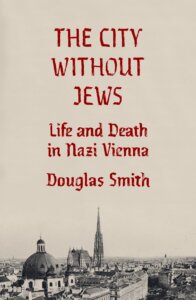
The City Without Jews: Life and Death in Nazi Vienna
By Douglas Smith
FSG, 560 pages, $37
Several years ago, the historian Douglas Smith, who has won wide recognition for his several books on modern Russia, turned his attention to Vienna and its Jewish community during the rise and fall of the Third Reich. During his research, he discovered the recently published diary and letters of Mignon Langnas (née Rottenberg), one of the few Jews who remained and survived in Vienna under Nazi rule. Gripped by Langnas’ experience of events we have difficulty even now of fully grasping, Smith decided to center his book on this remarkable woman.
It was a brilliant choice: Smith’s new book, The City Without Jews: Life and Death in Nazi Vienna, seamlessly weaves Langnas’ story with the wider account of how Vienna, home to the largest Jewish population of any city in the German-speaking world with nearly 200,000 inhabitants, was declared by Nazi officials, with only slight exaggeration, as Judenrein.

From its fin-de-siècle brilliance in the late 1800s to its fin-des-juifs darkness in the mid-1930s, Vienna was home to both illustrious Jews like Sigmund Freud and Gustav Mahler as well as notorious antisemites like the influential politician Georg von Schönerer and Karl Lueger, the city’s mayor from 1897 to his death in 1910. But antisemitism was a worldview that extended far beyond a political elite. Smith underscores the countless acts of spontaneous antisemitism that erupted in Vienna following the 1938 Anschluss, when Jews were forced to scrub anti-Nazi graffiti from sidewalks and carry pro-Nazi placards. The American journalist and historian William Shirer, on a visit to the city, reported that the Viennese, “usually so soft and sentimental, were behaving worse than the Germans, especially towards Jews.”
Of course, what followed was unspeakably worse. The rapid and rapacious process of Aryanization by the Viennese shocked even German Nazi officials, who hurriedly issued a series of laws and warnings against “wild Aryanization.” The lurid logic of Aryanization, in turn, beggared the Jewish community, making the resolution of the “Jewish question” even more imperative for the Third Reich.
Adolph Eichmann, recently arrived in Vienna, created the Central Office for Jewish Emigration and placed Josef Löwenherz, the director of the Viennese Jewish Community, at its head. Though Löwenherz’s actions were condemned by some survivors after the war, Smith echoes the Holocaust scholar Doron Rabinovici’s conclusion that, while Löwenherz was “co-opted” by the Nazi state, he nevertheless acted courageously in impossible circumstances, saving the lives of tens of thousands of Viennese Jews.
Smith’s account of the evolution of the Final Solution in Vienna, based on an impressive familiarity with primary and secondary sources, manages to be both cogent and comprehensive. What makes his narrative truly compelling, though, is how well he weaves the life of Mignon Langnas into the wider story. Upon settling in Vienna, her family quickly learned German, thoroughly immersed themselves in the literary culture and, despite recurring spasms of antisemitism, thought of Vienna as their home. As Smith observes, the parents’ very choice of “Mignon” as their daughter’s German name, rather than her Hebrew name of Mamcze, signaled their embrace of Viennese Kultur. In 1928, the young woman married Leon Langnas, also a Polish immigrant with whom she had two children, Georg and Manuela. Though they struggled financially, they had no reason to believe that their lives, along with their extended families, would not continue to improve.
Of course, this belief was shattered by the birth of the Third Reich and death of the Austrian Republic. As the prospect of annexation by Nazi Germany loomed, the deep reserves of Austrian antisemitism seeped then burst into public life. In Vienna, the violence of Kristallnacht was far greater and gruesome than in Germany, with dozens of synagogues and thousands of Jewish businesses destroyed, several thousand Jewish residents arrested, and at least 27 Jews murdered and dozens more who took their own lives. As Joachim Fest, a biographer of Hitler, concluded, Kristallnacht was “successful only in Vienna.”

This event persuaded the Langnas family that they had to leave. While fires lit the streets along which roving bands sought out Jews, SS officers came to the Langnas apartment to arrest Leon. He succeeded to hide that night and, at Mignon’s urging, eventually made his way to New York after nearly a year of travails and travels. Mignon then managed the Herculean task of completing the paperwork for the children, who joined Leon in 1940, but refused to leave her parents who could not secure the necessary money and visa.
At this point, alone and anguished, Mignon began the journal that serves as Smith’s window into her life. Over the next four years, what remained of her family, friends, and neighbors were gradually “extracted” — the term of art for the round-up and deportation of Jews by either the SS or Jewish “stewards” employed by the Central Office. Though both of her ailing parents died, Mignon managed to survive through pure luck and sheer will. She leapt at the chance to train as a nurse, a position that not only helped save her from the relentless wave of extractions, but no doubt helped save the lives of many of her patients.
During the final months of the war, when she worked twelve-hour shifts at the Children’s Hospital and Vienna was pounded daily by Allied air strikes, Mignon adopted a mantra: “Don’t think — just don’t think.” If she did allow herself a thought, it was that she wanted to live and see her husband and own children. When the city was liberated in April 1945, slightly more than 5,000 Jews — either employed by the Central Office or married to gentiles — had survived including Mignon, who had lost more than fifty family members. But there was an insurmountable distance between survival and revival.
In June 1946, Mignon arrived in the port of New York City and rejoined her family. Yet she had become a stranger to them — after six years in the US, the children had forgotten not just their German, but mostly their mother as well, and they had become strangers to one another. As she wrote to a cousin, “We are all broken people and nothing happy or bright can resonate in us anymore. I have to cry so much.”
Three years later, Mignon, ill and unable to leave her bed, was admitted to Gotham Hospital where she died a few weeks later. Yet thanks to Douglas Smith’s masterful account, it is not just the horrors Mignon experienced but also the humanity she embodied that will continue to resonate with the reader.
The post They settled in a city where 200,000 Jews thrived. After Kristallnacht, her family fled and she stayed behind. appeared first on The Forward.
Uncategorized
Could a convert’s kid play Jewish geography?
It was, I think, some small measure of divine consolation that the most dispersed minority on the planet got a little game to bring us back together. Yes, I’m talking about Jewish geography — that special small-talk ritual that often follows when two Jews meet for the first time.
It’s a precious thing, finding out that the stranger from across the country is in fact related to your old day-school pal…or went to camp with his sister…or dunked on him one time in a gap-year program basketball tournament. These connections, however stretched, mark our closeness, placing us somewhere on a giant tree of shared Jewish ancestry that, presumably, begins at Sinai.
But Jewish geography never played that way for me. My dad converted — no Jewish friends or family there — and my mom’s relatives were non-observant, leaving me with dangerously few character references outside of my synagogue and day school class. We didn’t do Pesach programs or Camp Ramah — we didn’t even shul-hop. So on NCSY Shabbatons or at Hillel dinners, when everyone else knew someone who knew someone, I didn’t. Like the converts of the biblical desert, I felt I’d always be pitching my tent on the fringes.
Everything changed one day earlier this year when, doomscrolling on X, I came across a post from a user with my last name. I’ve never met another Keene I wasn’t related to, so I followed my curiosity to her profile. Her bio (it’s since changed) read something like: “Best-selling author. Feminist. Jew.” Gobsmacked, I followed her.
A few minutes later, a message arrived. “Holy s—,” Meg wrote, “are we the only two Jews on earth with the last name Keene?” I guess writing for a Jewish publication gave me away. Over DMs, she told me she lived with her husband and two kids in the Bay Area; like my dad, she had converted from Christianity. Her Keene ancestors hailed from the antebellum South; I told her mine fought for the North. We soon pieced together that we were both descended from Mayflower folks — believe it or not, the same one.
At some point, we realized this was the least Jewish game of Jewish geography that’s ever been played. Of course, playing at all was new for both of us. “Because talking about being a convert is discouraged,” Meg said, “and honestly because most people who talk about being converts converted 5 minutes ago, not 20 years, I end up just sitting quietly during Jewish geography convos. I find it interesting that people generally don’t notice.”
A few days later, we picked up the conversation over the phone, when I learned that she made her name writing about wedding planning but had since pivoted to fiction. She’d finished a novel — but was having trouble getting it out, she said, because her characters had been deemed too Jewish by publishers. (Not long after our call, Cousin Meg launched her own imprint, Meg Keene Books, to take the Big Five head on.)
Still, not all the Jewish Keenes were accounted for. A few months later, Meg told me she’d found another. Andrew Keene lives in Tel Aviv, and — here’s a real twist — he didn’t convert. Instead, Andrew told me over LinkedIn this week, his ancestors were Cohens who changed their name. I’d met Kanes, Kahns and Katzes who were at one point Cohens, but never Keenes. Well, unless I counted myself — after all, Cohen is my mother’s maiden name.
Andrew, whose family hails from Wisconsin, said he wasn’t sure how Cohen had become Keene, or why. “But I do know my grandfather had an uncle, Louis Cohen.” Funny he should say so: I’m named after one. His Louis Cohen worked for Pabst Brewing; mine was a dentist. Andrew’s visiting LA next month, and we’re trying to drag Meg down here for a Jewish Keene summit.
I should caveat that my newfound Jewish geography has come at a price. There had been one nice thing about being the sole Jewish Keene family, which was the illusion of brand control. I grew up believing that whatever name recognition Jewish Keenes achieved would begin with our family of five — what could be, unburdened by what has been. Then, this week, I got a text I had never received before: Are you related to Meg Keene?
The answer’s kind of a long story, but it dates back to Sinai.
The post Could a convert’s kid play Jewish geography? appeared first on The Forward.
