


Uncategorized
Orthodox Jewish groups have been quiet about ICE. This Minneapolis rabbi wasn’t.
When the heads of major Jewish denominations co-signed a letter last week criticizing “in the strongest possible terms” the conduct of Immigration and Customs Enforcement in Minneapolis, Orthodox Judaism was conspicuously absent. Neither the Orthodox Union nor Agudath Israel of America — the two leading Orthodox umbrella organizations — has commented on the mass deployment of ICE and Border Patrol officers to the city.
There’s a reason Orthodox leaders might be choosing their words carefully — condemning ICE would put them at odds with not only a sizable chunk of their membership. Unlike members of the Reform, Conservative and Reconstructionist movements, Orthodox Jews — who represent about a tenth of the American Jewish population — lean heavily conservative, with about three-quarters supporting President Donald Trump in the 2024 election. (The Orthodox Union and Agudath Israel did not respond to separate inquiries.)
There was, however, at least one Orthodox rabbi willing to criticize ICE in public. Rabbi Max Davis, who leads the Minneapolis synagogue Darchei Noam Congregation, was one of 49 Jewish leaders to sign a Jan. 16 letter from the Minnesota Rabbinical Association, which said ICE was “wreaking havoc across our state” and which resolved to “bear witness and make a difference.”
I called Davis to learn more about why he signed and what he’s seeing on the ground. He also spoke about congregants who have been pepper sprayed or arrested at protests, how he approaches politics at the pulpit of an Orthodox shul, why he rejects the Holocaust comparisons some are making and how he’s tried to make a difference.
The interview below has been edited for length and clarity.
The Forward: Why did you sign this letter?
Rabbi Max Davis: It felt like a very reasonable, very carefully thought out response to the present situation. I know that there are many within the shul who are looking for some leadership in this moment, and signing was a drop in the bucket compared to what some people are doing.
By the same token, I know that there are other perspectives within my own shul and certainly within the broader Orthodox community, and I strongly believe that it’s not the role of a rabbi to police his congregants’ politics. In our shul, we learn from and respect each other, and there’s an incredible amount of wisdom and life experience beyond my own. So I signed with caution, but with quite a feeling of disappointment and anger in the events unfolding downtown, and the loss of life in particular.
I’m probably the only Orthodox rabbi in the Minnesota Rabbinical Association, and there have been statements issued that I have not signed. But this one was an opportunity I was not going to miss.
What’s been the reaction at Darchei Noam to your signing the letter?
I got several yasher koachs (plaudits) privately. Those who may disagree, I think were and are being polite. There’s definitely been some pushback about politics entering our shul. But I haven’t heard much about the letter specifically. I don’t think anyone was terribly surprised that I signed it.
More broadly, what are things like in your community right now?
Within our kehilla (congregation), there’s a diversity of opinion. But mostly what I’m hearing is deep sorrow and frustration and anger and pain — particularly from those who watch the videos, who are acquainted with individuals suffering directly from the ongoing operations, or who have watched what the operations have been doing to our city and to our community.
Have you seen what’s happening firsthand?
There’s someone in our extended community who just got out of jail and called me about 10 minutes ago to give me a heads up. We have a couple of people in the community who have been pepper sprayed. We have people in the community who have been very active in supply drives and driving children to school because their parents are afraid to come out.
Instead of buying stuff at the sort of generic supermarket I thought I might as well make the money count where people are hurting the most. So I went a couple weeks ago to try and pick up some kiddush supplies down at one of the large Latino markets that I know has taken quite a hit. I was pretty much the only customer. It was a very sad place.
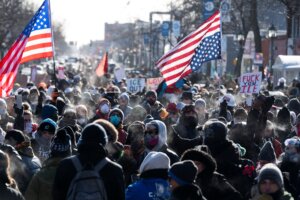
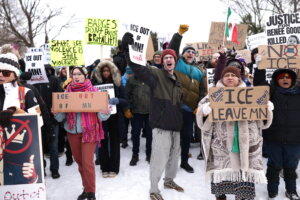
So in those regards, I’ve seen what’s going on. I was down at the march last Erev Shabbos (Jan. 16). It was minus-10 degrees. There were 50,000 people out there in the streets and thousands more in the skyways and in the buildings that we could see. You see banners and signs hanging onto highways. You see people clustered at intersections with signs and upside-down American flags. There’s a tremendous amount of anger out there.
What’s it like to be living through that?
It’s heartening and it’s disheartening. It’s disheartening that it feels necessary; it’s heartening to see community coming together. It’s disheartening to see signs comparing the federal government and ICE to Nazi Germany; I find that, as a Jew, deeply offensive and ignorant. And by the same token, I find all of the messages around community and common decency to be a beautiful sight.
It’s not to say that I have any solutions to the more fundamental politics. I’m not saying that the country doesn’t have an immigration problem. But I do know that you can’t watch the video of Alex Pretti, the ICU nurse from the VA hospital, you can’t watch the video of Renee Good in her car and how that unfolded — shootings on streets and in neighborhoods that I know — you can’t watch that and not be highly disturbed and moved.
Have you addressed this moment at all from the pulpit?
I have definitely mentioned it in a couple of drashos (sermons). A couple of weeks ago, I spoke about ignoring the broader humanity and the plight of our neighbors at our own moral peril. Nechama Leibowitz sees a progression in Moshe’s interventions, first on behalf of another Jew against the Egyptian, then for a Jew against another Jew, and finally, with the daughters of Yitro at the well, between two non-Jewish parties. It was a good base for talking about doing what we can, when we can, to be an ohr l’goyim (a light unto the nations). I don’t think I said the word “ICE,” but there was no mistake about the subject matter — I think Renee Good had been shot like two days earlier.
With drashos, I’ve tried to be a little bit more tempered and restrained, because I think a lot of people come to hear Torah and inspiration and political issues are risky business. I’m also careful because I don’t want to ruin people’s Shabbos in other ways. Everyone has so much of this all week long, and I know some people look forward to Shabbos just to take a break. I’ve been told by some people that I’ve been too pareve, and by others that it’s been too much. So maybe I’m succeeding or failing everybody at the same time.
You mentioned the Nazi comparisons. Why do you take offense to those in this context?
That was industrialized murder, and concentration camps — there’s not a word to describe the evil of what that was. That was just exponentially more horrific. And it disturbs me to no end — although I am not surprised to see people make this comparison and I get where they’re coming from — how lightly the Holocaust and the evils of Nazi Germany seem to be treated when people want to trot out a paradigm of evil.
Why did it feel important to you to patronize the Latino grocery store?
I feel for these communities, where these are honest, legitimate, hard working businesses, and they watch their customer base all but dry up — that includes people who are here legally, employees who are here legally. But there are so many stories of individuals who are being racially profiled or being picked up by mistake.
I was very angry about the story of a Laotian man who, in front of his family and children, was pulled out of the shower into 10-degree weather and bundled off into an ICE vehicle and driven around for an hour before they figured out that he was here legally and had no criminal record. He was let go without so much as an apology. He’s got a wife and small children — and I’ve got a wife and kids, you know? This kind of thing is absolutely unacceptable. And unfortunately, it doesn’t seem like that was such an outlier case. And that’s not an America that I believe in.
The post Orthodox Jewish groups have been quiet about ICE. This Minneapolis rabbi wasn’t. appeared first on The Forward.
Uncategorized
Evan Gershkovich’s prison memoir begins with a Soviet Jewish exodus
A few days after Russian security agents arrested Wall Street Journal reporter Evan Gershkovich on a trip in March 2023, his lawyers showed him a slip of paper with messages from home. He was being held alone, in what Russian prisons call “quarantine:” two weeks without a cellmate before joining the general population. His eyes went straight to the note from his mother.
Soon he would start getting kosher food, Ella Milman wrote, and then added: “If you come home with sidelocks, I’ll understand.”
It was a joke, and a very Jewish one. Gershkovich grew up in a secular family of Soviet émigrés, where being Jewish had more to do with family history and dark humor than with religious practice. His mother was ribbing him that a few weeks of kosher prison food might send him home looking like a yeshiva boy.
Sitting across from the investigator building his espionage case, Gershkovich grinned. His mother, he realized, still had her sense of humor, and that was exactly what he needed.
The kosher food wasn’t a joke. That night, with Passover days away, a local rabbi sent him stacks of matzo.
The scene appears in This Cursed Beautiful Land: A Russian-American Story, Gershkovich’s memoir of his arrest, his 16 months behind bars and his release in the most elaborate U.S.-Russia prisoner swap since the Cold War. The book was published Tuesday.
Most of the coverage is about the prison. But Jewish history runs through the book from its first pages. Gershkovich’s great-grandfather was arrested during Stalin’s purges and vanished. His mother was laughed out of a journalism school application once the clerk saw her passport. And when he moved to Moscow as a young reporter, a Russian coworker needled him with an old stereotype about Jews and money.
The family that left
Gershkovich was born in New Jersey in 1991, two months before the Soviet Union fell apart. His parents had come over in 1979. Thousands of Soviet Jews were leaving at the time, helped by a U.S. law that linked trade with Moscow to whether its citizens were allowed to emigrate.
His mother flew out of Leningrad with her mother and ended up in Detroit. His father’s family came from Odessa and settled in Brighton Beach, the Brooklyn neighborhood people call Little Odessa. In those years, his father later joked, Soviet Jews who ran into each other on the street skipped the hellos and just asked where the other was going.
For his father’s side, the decision was easy. Gershkovich’s great-grandfather was arrested in 1937, at the height of Stalin’s purges, and never seen again. His grandfather Mark spent years moving from city to city, afraid of being targeted next, and later dreaded the day his own son would be drafted into the Soviet army.
A Jew on paper
Gershkovich’s mother, Ella, was born in 1957, a few years after the “doctors’ plot,” a Stalin-era campaign that accused Jewish physicians of conspiring to kill Soviet leaders. One of the doctors caught up in it had been a neighbor in her family’s communal apartment.
Her father had wanted to name her Etya, after his late sister. Worried that an obviously Jewish name would draw attention, her mother pushed for Ella instead. It didn’t matter. The family name Milman gave her away, and Soviet passports listed each citizen’s ethnicity. Hers said “Jew.”
Ella dreamed of becoming a writer. When she applied to the journalism department at Leningrad State University, the woman taking her application glanced at her passport and laughed. She studied shipbuilding instead, listened to the Rolling Stones, and heard rumors that the Kremlin planned to deport Jews to Birobidzhan, a remote Soviet region near the Chinese border that had apparently been set up as a Jewish homeland.
When she finally emigrated to America at 22, she sewed a pair of gold earrings from her late father into her skirt’s waistband to get them past customs. Once the plane took off, she couldn’t stop laughing and crying.
A generation later, her son became the journalist she wasn’t allowed to be, and then a prisoner of the state that had turned her away.
Ella and her husand settled in Princeton, New Jersey, where Gershkovich and his sister spent Saturday mornings with a Russian tutor, and holidays meant trips to the Russian groceries and Uzbek grills of Brighton Beach. Gershkovich came to think of himself as Jewish-Russian-American. Russia’s war in Ukraine later forced him to ask why that label had never included Ukraine, given that his father’s family came from Odessa.
The empty chair
In 2017, Gershkovich moved to Moscow to report for The Moscow Times. On one of his first days, he asked a colleague when staff got paid. She laughed and told him his Odessan roots were showing, a jab about Jews and money that served as his introduction to Russian workplace culture.
On a later trip to Odessa, he visited a Jewish museum that displayed a 1953 Soviet propaganda article from the doctors’ plot era. It claimed that the Joint, the New York-based Jewish relief organization, was a front for American intelligence. Gershkovich recalls thinking that Moscow was getting paranoid again, while hoping things hadn’t gotten that bad. A few years later, Russia accused him of spying for the United States.
Gershkovich’s arrest came a week before Passover. That spring, many American Jews left an empty seat for him at their Seders, and activists later sent him letters for Rosh Hashanah. Both gestures deliberately echoed the movement to free Soviet Jewry, the same campaign that had helped free his parents. Natan Sharansky, the most famous Soviet Jewish dissident, who was himself released in a 1986 prisoner swap, advocated publicly for his release.
In July 2024, two weeks after a Russian court sentenced Gershkovich to 16 years in a maximum-security prison, he was freed in a prisoner exchange in Ankara, Turkey. Jewish groups celebrated, and the Orthodox Union posted the traditional blessing thanking God for freeing captives.
His great-grandfather was taken in 1937 and never came home. Eighty-seven years later, his great-grandson did.
The post Evan Gershkovich’s prison memoir begins with a Soviet Jewish exodus appeared first on The Forward.
Uncategorized
More Michigan Jews sign a petition pressuring El-Sayed on Israel. Will it matter?
(JTA) — ANN ARBOR – The activists on the Zoom supporting Abdul El-Sayed knew they faced an uphill climb when it came to persuading their fellow Jewish Democrats to overcome their concerns about the Michigan Senate candidate and vote for their party’s nominee despite his strong disapproval of Israel.
Two progressive Jews, former Biden administration appointee Sam Bagenstos and Detroit Jews for Justice co-founder Hayley Sakwa, made the Jewish case for the candidate to a sometimes skeptical, sometimes combative crowd of around 30 people on Sunday night.
Sakwa and Bagenstos urged voters to prioritize the chance to put a check on the larger Trump agenda – including heavy immigration crackdowns and the rightward tilt of the federal judiciary – given that the Michigan seat could help determine who controls the legislative chamber.
But their appeal wasn’t enough for several of the people on the call, who less than two days later would sign on to the “Nonnegotiables” petition. Spearheaded by a group of Michigan Jewish clergy, the open letter calls for El-Sayed to moderate his views on Israel and affirm more vocal support for Jews in politics as a condition for earning their votes.
The 17 new names to the petition, shared with the Jewish Telegraphic Agency ahead of their release on Tuesday morning, include state Rep. Noah Arbit, the founder of the Michigan Jewish Democratic Caucus.
Arbit recently gave a speech denouncing antisemitism on the floor of the Michigan House and has been critical of El-Sayed publicly: After progressive Jews recently hosted the candidate for a Rosh Hashanah dinner at their house, the representative accused them of “tokenism.” (Arbit declined to comment to the Jewish Telegraphic Agency.)
Other new names on the list include an elected University of Michigan regent and prominent local attorney, as well as several board members of the Jewish Democratic caucus, which itself is not endorsing a candidate in the race.
Concerns raised on the Sunday night Zoom call included El-Sayed’s opposition to Iron Dome funding for Israel and his earlier campaigning with anti-Israel streamer Hasan Piker, whom he has since distanced himself from. Some said they were worried he could open a door to a more hostile Democratic Party for Jews.
“With Abdul it sort of feels like letting a fox into the henhouse,” one said.
“I refuse to be anyone’s dhimmi,” another wrote in the chat, referring to a term for non-Muslims living under Islamic rule.
Yet any pressure Jewish Democratic critics of El-Sayed hope to place on the candidate are partly balanced out by the work of those such as Sakwa, who along with other Jewish liberals has to date secured 900 signatures pledging to vote for El-Sayed. A competing letter of Jewish voters pledging to back his Republican challenger, former U.S. Rep. Mike Rogers, has picked up 524.
At the same time, the broader Democratic Party has ramped up its efforts to get elected officials in line behind the nominee. The El-Sayed campaign has yet to respond publicly to the “Nonnegotiables,” and with little more than a month to go before Election Day, it might not need to.
Former Vice President Kamala Harris campaigned with El-Sayed last week in Detroit, and the liberal-leaning editorial board of the Detroit Free Press, the state’s largest daily newspaper, endorsed the former county health director over the weekend.
The Free Press wrote that its own endorsement was against an “extremist” — referring to Rogers and President Donald Trump — in language that one bloc of Jewish voters also used to refer to their own decision to vote for Rogers over El-Sayed.
In addition, Michigan Attorney General Dana Nessel, who is Jewish and has fiercely criticized El-Sayed for his past comments about Jews and Israel, endorsed and appeared with the candidate on a local liberal podcast hosted by a Jewish woman to project unity.
“There is no choice,” Nessel said.
But the conversation demonstrated that tensions still remain even with many Jewish Democrats who have thrown in their lot with El-Sayed.
“Is there space for a Jewish Zionist like myself?” she asked him. “Is there space for us in the big tent of the Democratic Party?”
“I believe in a big tent,” he answered. “I am committed to having a tent where we march in lock step on the 95% of issues that we agree on.”
But the attorney general, who cited the risk of antisemitic threats as the reason she skipped the party convention earlier this year, wasn’t done.
“The question many of us have is: Are you seeking our votes?” Nessel asked El-Sayed. “Do they matter to you?”
“Yes,” the candidate responded. “If you trust that I’ll lead well for the community, even if there’s an issue on which we deeply disagree, then I hope I can earn your vote.” Later, El-Sayed said, “I look forward to working” on the Jewish American Security Act, a bipartisan bill to institute new Jewish security measures, including in synagogues and on college campuses.
“We’ve had an uptick in antisemitism, and it is critical to protect Jewish Americans,” El-Sayed said.
As with Nessel, El-Sayed’s candidacy is pushing other Jewish Democrats to perform a difficult two-step: pushing for the party platform and against Trump, without getting too close to the candidate himself.
The Jewish Democratic Council of America, whose CEO, Halie Soifer, is a Michigan native, is also not endorsing in the race. Yet Soifer told JTA, “Jewish voters will support Democrats in large numbers in the midterms, including in Michigan.” She predicted that Rogers wouldn’t earn more than one-quarter of the Jewish vote.
“Jewish voters recognize that a vote for any Republican in 2026 is a vote for Donald Trump,” Soifer told JTA over text. “We know Jewish voters are a critical component of a winning Democratic coalition.”
Decky Alexander, who chairs the Michigan Jewish Democratic Caucus, pointed to consistently high Democratic voting records for Jews in arguing that Jews still matter to the party’s coalition. She also favorably noted the Democratic National Committee’s recent announcement that it would establish a “Jewish American Council,” to convene in 2027.
“We can’t be distilled down to one vote or one idea,” Alexander told JTA.
One part of the state’s Jewish Democratic bloc unlikely to support El-Sayed: members of Temple Israel, the country’s largest Reform congregation. Speaking to the national publication The Free Press last week, several members, including a preschool teacher who was in the building when it was attacked in March, said El-Sayed’s apology for his earlier remarks about the temple was insufficient and that they couldn’t bring themselves to vote for him.
“No thinking Jew could vote for Abdul El-Sayed,” a former temple president told The Free Press.
None of the synagogue’s clergy signed the “Nonnegotiables” letter, or any other Jewish letter circulating about El-Sayed. But one of the temple’s rabbis told congregants in a Kol Nidre sermon that they had a say in drafting it, stating, “Our full participation in American political life is also non-negotiable.”
“No one should have to pass a test about Israel to be welcomed into a coalition on a campus or in a political party,” Rabbi Josh Bennett told his congregation, which had convened in the Temple Israel building for the High Holidays for the first time since the March attack. Rabbi Jen Lader, also of Temple Israel, recently testified before Congress to advocate for the Jewish American Security Act.
As Rogers has looked to win over dissatisfied Jews to his campaign, he has also moved toward El-Sayed on at least one issue tangentially related to Israel: opposition to the war in Iran. Initially a supporter of the war, Rogers in recent days has said he thinks it should “end quickly.”
El-Sayed, meanwhile, has raised eyebrows of his own in recent days. He dithered on denouncing the Iranian regime when urged to by an Iranian Christian college student, and appeared at a Dearborn fundraiser with Osama Siblani, a local Arab-American activist and newspaper publisher who once stated at a rally, “We are not going to be intimidated by staying silent when they say Hamas is a terrorist organization.”
The “Nonnegotiables” petition was launched earlier this month by a group of more than a dozen Michigan Jewish clergy after a series of apologies by El-Sayed to Jewish audiences for past comments he had made about the Temple Israel attack. The candidate needs to do more to earn the community’s confidence, the campaign’s organizers have told JTA.
“A large number of Jews haven’t decided how they will vote,” David Kramer, the caucus’s vice chair and one of the new signers, told JTA about the letter’s potential influence. “I speak to these people every day. Regardless of how they vote, Michigan Jews want and deserve to feel safe and have a seat at the table.”
As the Zoom call wrapped, some of the assembled Jews said they would vote for El-Sayed, even if reluctantly. Alexander of the state’s Jewish Democratic Caucus, who signed the letter supporting him, told the crowd the candidate has nothing to hide, even if they don’t like what he says.
“He’s basically stated what he believes,” she said. “And you have to decide if that’s the word for you.”
This article originally appeared on JTA.org.
The post More Michigan Jews sign a petition pressuring El-Sayed on Israel. Will it matter? appeared first on The Forward.
Uncategorized
Irish national soccer team won’t shake hands with Israel after win
(JTA) — It only took 25 minutes of play for the Irish national soccer team to build a 3-0 lead over Israel in the countries’ UEFA Nations League B match on Sunday. But there were decades of bad blood that preceded Ireland’s shutout victory in a game dominated more by the geopolitics of the Gaza war than about sports. One soccer writer described it as “arguably one of the most contentious football matches of this century.”
At the match, held in a mostly empty stadium in the neutral site of Debrecen, Hungary, the Irish players wore black armbands and bowed their heads in protest during the Israeli national anthem. There were no pre- or postgame handshakes, and one Irish player declined to participate altogether, citing his “personal belief that the killing of innocent people is wrong.”
Ireland’s soccer federation did not reserve tickets for its fans, and the country’s public broadcaster scaled back its coverage of the game. The teams are set to meet again on Oct. 4 in Serbia, this time with Ireland as the “home” team.
Ireland and Israel have a long history of icy relations. Ireland became the first member of the European Union to call for an independent Palestinian country in 1980, and was among the first of the Western European countries to recognize an official Palestinian state in 2024. Israel closed its embassy in Dublin in response. Irish Prime Minister Micheál Martin has rejected claims that his country’s sharp criticism of Israel bleeds into antisemitism.
In the months leading up to Sunday’s match, Ireland’s football governing body faced intense pressure to boycott the match. At a meeting in July, the Football Association of Ireland voted 75-32, with three abstentions, in favor of proceeding with the match, “while acknowledging the strength of feeling regarding support for Palestine.” The motion also noted that a boycott would come with UEFA sanctions, both financial and competitive: In League B matches, mid-tier nations seek to advance to the top division and boost their chances of qualifying for the quadrennial World Cup tournament. The Irish team itself also held a last-minute vote over whether to participate.
Earlier this month, more than 160 Irish athletes and sports figures signed an open letter calling on the national team to pull out of the match. The signatories included former Irish national team head coach Brian Kerr — who had led Ireland to a 2-2 draw against Israel in a 2005 match in Dublin that also took place amid protests.
Former Irish national team star Kevin Kilbane also authored a column in The Irish Times, writing, “Ireland should not play Israel. Not in Dublin, not in Hungary, not in Serbia. Not when Israel is committing genocide.” Israel denies the charge of genocide.
There were also a number of public barbs exchanged between leaders of the two countries and their football associations.
At a press conference last week, Irish coach Heimir Hallgrímsson replied to questions about the match by saying, “We are not playing with genocide, we are playing against genocide. We are playing against Israel; we are not playing with Israel.”
Israel’s football association responded to that comment with a post on X, writing, “We have contributed to the world and humanity in countless fields, earning an impressive number of Nobel Prizes along the way. Unfortunately, we have not yet found a cure for stupidity, ignorance and hypocrisy displayed by the @IrelandFootball team coach. We’re not playing with ignorance, hypocrisy and stupidity. We’re playing against the coach who embodies them.”
That drew a rebuke from Martin, who told reporters, “They are unacceptable remarks and should be withdrawn.”
And on Sunday, the morning of the match, Israeli Foreign Minister Gideon Sa’ar posted a lengthy tweet referencing the 1939 Irish squad that gave a Nazi salute before a game against the German national team.
“Almost 90 years have passed. Ireland’s unique talent for finding itself on the wrong side of history remains intact,” Sa’ar wrote. “Back then, they gave the Nazi salute. This time, they stand on the side of Palestinian terrorism. Above the black armbands the Irish players will wear tonight flies the black flag of jihadism.”
After the match, Israeli captain Manor Solomon said the Irish players who bowed their heads during the Israeli anthem “don’t interest me.”
“We have a country 10 times better than theirs, stronger, an amazing country with amazing people,” said Solomon, who plays in the English Championship league. “We are proud to wear the team shirt and to be Israelis. We are proud of our state and of our soldiers. [The Irish] can play all their tricks. We are Israelis and love the country. And that will always be the case.”
The post Irish national soccer team won’t shake hands with Israel after win appeared first on The Forward.
