


Uncategorized
A Millennial rabbi built a synagogue where others have closed. Her maverick ideas are becoming a model.
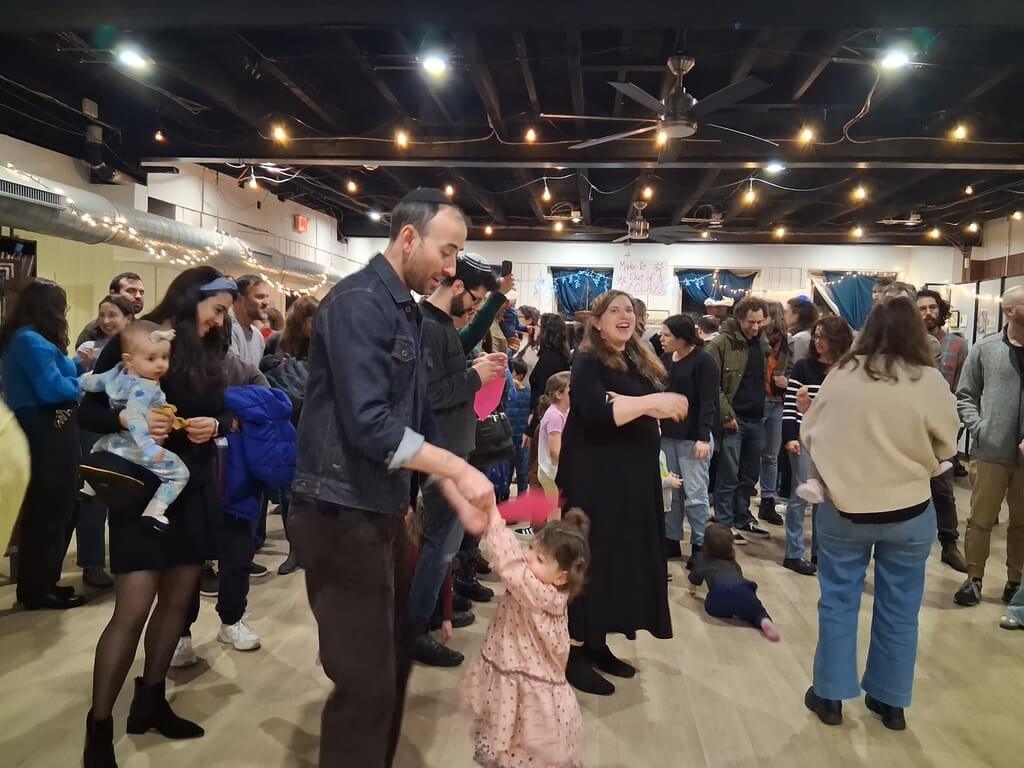
SOUTH PHILADELPHIA — On a cold weeknight, a few dozen people packed into a synagogue that defies every conventional rule of American Jewish life.
It is Orthodox and led by a woman. Its sanctuary is divided not into two sections, but three: men, women, and a small area for nonbinary congregants. It has no mandatory dues. And instead of struggling to survive, it is expanding so quickly that it has already outgrown its building.
Founded in 2019, the South Philadelphia Shtiebel has become a closely watched experiment in American Judaism — an urban congregation built from scratch in a neighborhood where no new synagogue had taken root in decades, and where most religious institutions had long since retreated to the suburbs.
A century ago, the idea of an Orthodox synagogue thriving in South Philadelphia would not have seemed unusual at all. In the early 1900s, the neighborhood was home to an estimated 150,000 Jews — mostly immigrants — packed into row houses within walking distance of work, markets and extended family.
Jewish life revolved not around grand sanctuaries but around dozens of small, informal prayer spaces known in Yiddish as shtiebels. More than a hundred of them dotted South Philadelphia’s blocks, often tucked into storefronts or private homes, intimate rooms where daily life and religious life blurred together.
Most of those shtiebels disappeared long ago, casualties of suburban flight and institutional consolidation. The South Philadelphia Shtiebel takes its name from that vanished landscape not as a reenactment, but as a wager.
The timing could easily have sunk the project. The Shtiebel launched only months before the COVID-19 pandemic upended communal life. Yet even during lockdown, around 40 people were still showing up each Shabbat. When the small Vespa scooter shop where the congregation first gathered became untenable due to the pandemic, the community improvised — meeting in backyards, public spaces and parking lots. Today, the congregation leases a two-story industrial building.
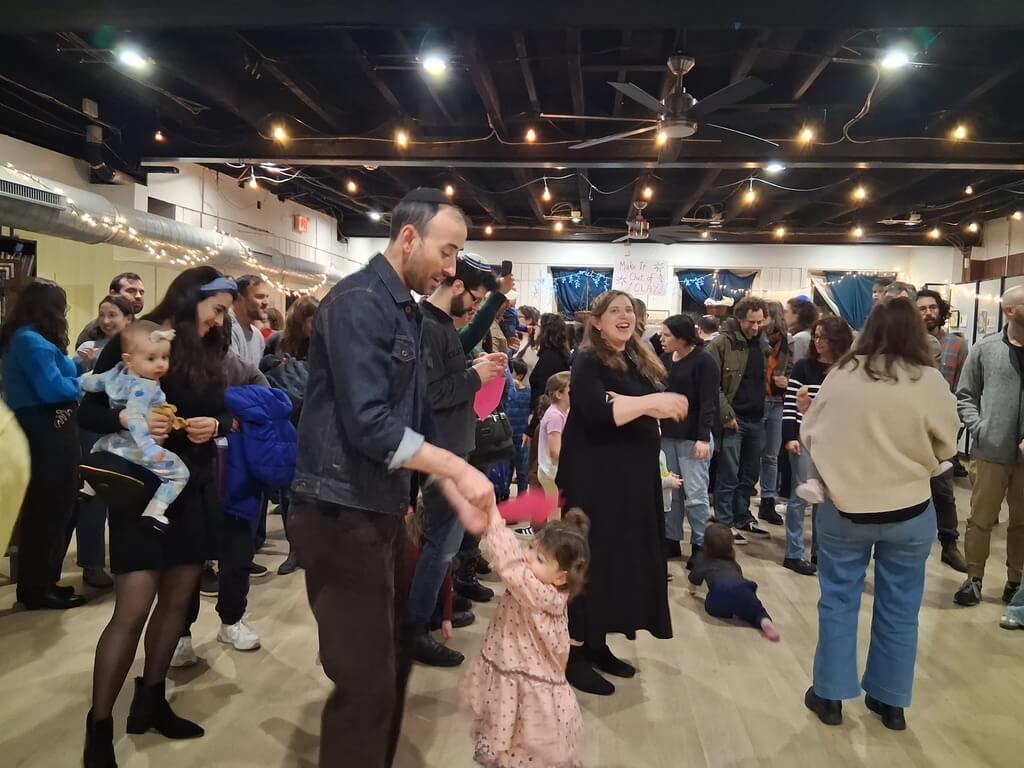
On a typical Shabbat morning, the sanctuary fills with roughly 175 people — a mix of young families, retirees, longtime Orthodox congregants and people still learning the prayers. And as attendance has grown, the question facing the Shtiebel is no longer whether it works, but what happens next, and whether this kind of community can scale without losing what makes it feel human.
What has emerged here is not a nostalgia project, but a congregation aligned with the DIY attitude of how people now choose institutions: voluntarily, relationally, and on their own terms.
Its growth has not been accidental. It reflects a series of choices — about space, ritual, leadership and belonging — made deliberately by its founder.
Welcoming the LGBTQ+ community
Rabbanit Dasi Fruchter grew up in Silver Spring, Maryland, the granddaughter of a rabbi who served pulpits across the country. She arrived in Philadelphia single and actively pursuing solo parenthood, but embraced the nonlinear turns of that journey, which led her to connect with and marry Daniel Krupka, a software engineer who had been serving as the congregation’s gabbai. Together they are raising a growing family.
She was ordained at Yeshivat Maharat, the Modern Orthodox seminary in the Bronx, and also holds a dual master’s degree from New York University in Jewish Studies and nonprofit management. She has been trained in community organizing, with an emphasis on relationships over programs.
She launched the Shtiebel with an acute awareness of how easily people fall through the cracks of Jewish life — not because they lack commitment, but because the systems around them are built for someone else.
“The approach here is that everybody is enough,” said Fruchter, 36. “We value the fact that you’re here and we’re not looking around at who’s not.”
Around 15% of the congregation identifies as LGBTQ+, Fruchter said. It’s a figure she offers not as a marker of ideology, but as a reflection of who has found their way into the room. That ethic is visible before a word is spoken. The sanctuary’s three sections all center around the bimah and are separated by a mechitza, or barrier, that still allows everyone to see, and hear, what is happening.
Fruchter is careful about how she describes the choice. It is not, she insists, an attempt to flatten difference or sidestep halacha, Jewish law, but an effort to acknowledge everyone. “We’re not trying to create a perfect solution,” she said. “We’re trying to create a place where people don’t have to disappear in order to pray.”
For Soren Simcha Barnett, a nonbinary congregant who uses they/them pronouns, that distinction mattered. When Barnett, 28, first arrived in early 2022, the idea of praying behind a mechitza was unfamiliar — and uncomfortable. “That would have been a red line for me,” they said. They had grown up in a Conservative synagogue and had never experienced gender-segregated prayer.
Still, they stayed.
What drew Barnett back was that they were taken seriously. They learned the melodies. On Shabbat mornings, they stand close enough to the action to help when the Torah is lifted off the bimah, hands ready, just in case. “I love being in the thick of it,” Barnett said. “We’re literally not in the margins.”
That sense of belonging, Barnett said, came with limits, though. About six months after they began attending regularly, Barnett asked Fruchter about expanding ritual roles for nonbinary congregants, such as leading services. Fruchter said no, a decision rooted in her reading of halacha.
“That hurt,” Barnett said. “I really wanted to be able to do everything I’m capable of.” But again, the disappointment did not send them away.
What mattered, they said, was not the answer but the process: that the question was taken seriously, and that the boundary was named rather than ignored. Barnett stayed. “I was willing to grapple with the complexity,” they said.
If Barnett’s story is about negotiation, Gary Saft’s is about commitment.
Saft, 35, a gabbai and the head of the Shteibel’s volunteer security team, is broad-shouldered, bearded, and impossible to miss. He grew up Reform and spent years assuming traditional Judaism had no place for him. “I didn’t see where I fit,” Saft said.
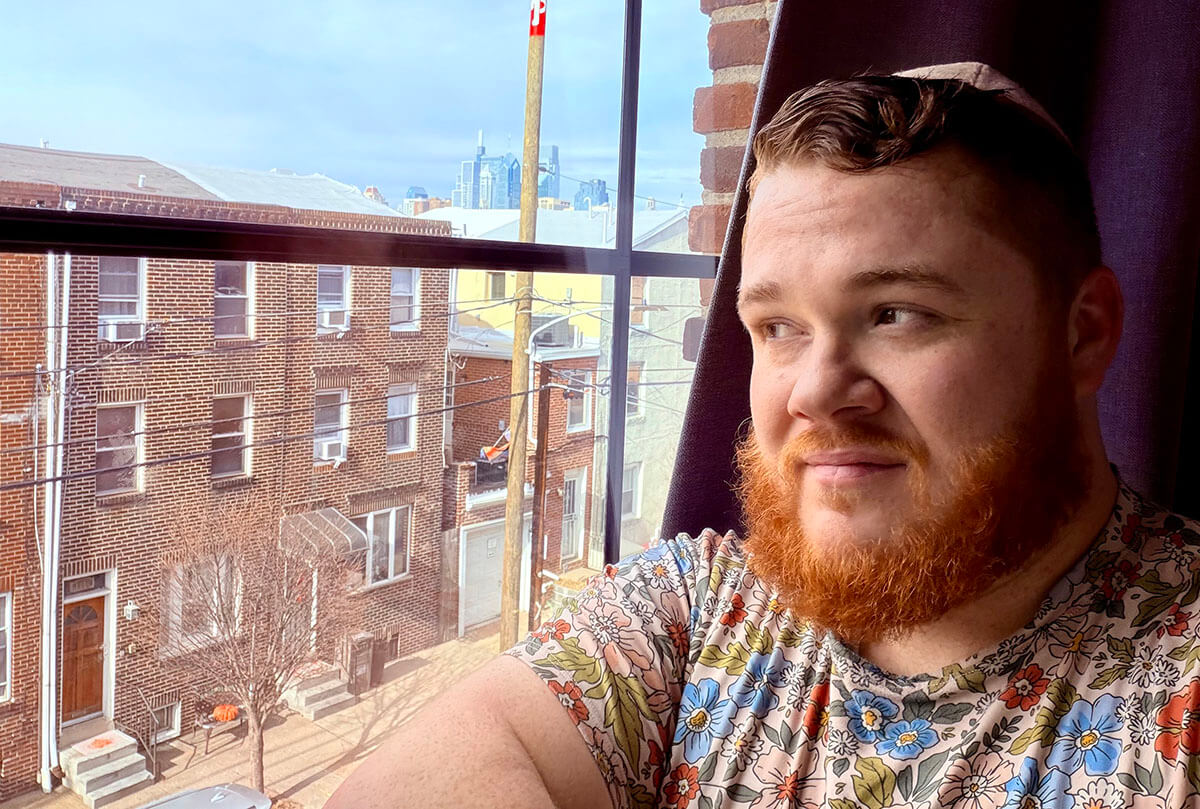
Saft began searching for a community after his father died in 2020, and he found it at the Shtiebel. Today, Saft prays daily, keeps kosher, walks to shul, and helps run services. “This shul is now a huge part of my life,” he said.
A sense of belonging
By all accounts, what holds the community together, more than anything else, is song.
For many congregants, music is the primary way in. Even those still learning Hebrew can participate fully, buoyed by a group that carries them along. Fruchter’s own voice is strong and steady, but it rarely stands alone. She sings with the room, not over it. Over time, congregants say, that has changed who feels comfortable raising their voice. Women sing loudly. So do people who might once have stayed quiet. Authority here is not projected; it circulates.
Lisa Levy, 66, a three-time cancer survivor, moved to Philadelphia after decades in New York City. She arrived newly retired and living alone. She describes herself as “conservadox” — committed to Orthodoxy, but wary of rigid lines.
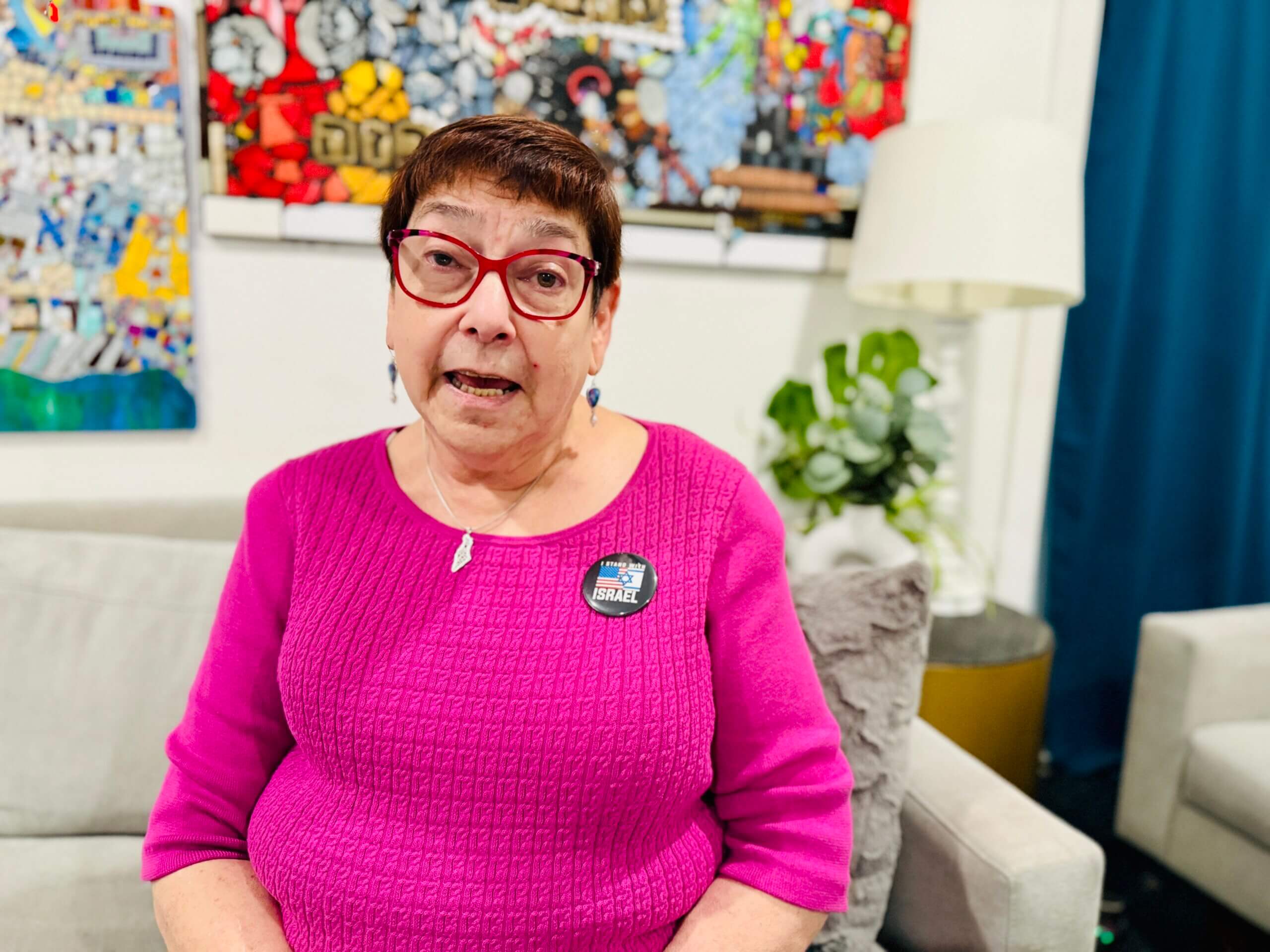
What she did not encounter, she said, was pressure. “There are no dues,” Levy said. “You pay what you can afford. No questions.”
For Levy, that mattered. Many synagogues, she said, quietly assume a level of financial stability that leaves some people on the margins — especially older congregants or those navigating illness. At the Shtiebel, presence itself felt like the baseline contribution. “It’s more like a minyan than a shul,” said Levy, who lives three blocks away.
For Jamie Goldberg, 33, the Shtiebel became real when she started showing up pregnant.
Goldberg began attending in mid-2022, just before the birth of her first daughter. She and her husband, Stuart, had grown up in Reform and Conservative settings and spent years searching for something that felt both serious and accessible. “I learned the traditional prayers in my late 20s,” she said. “I didn’t grow up knowing how to follow along.”
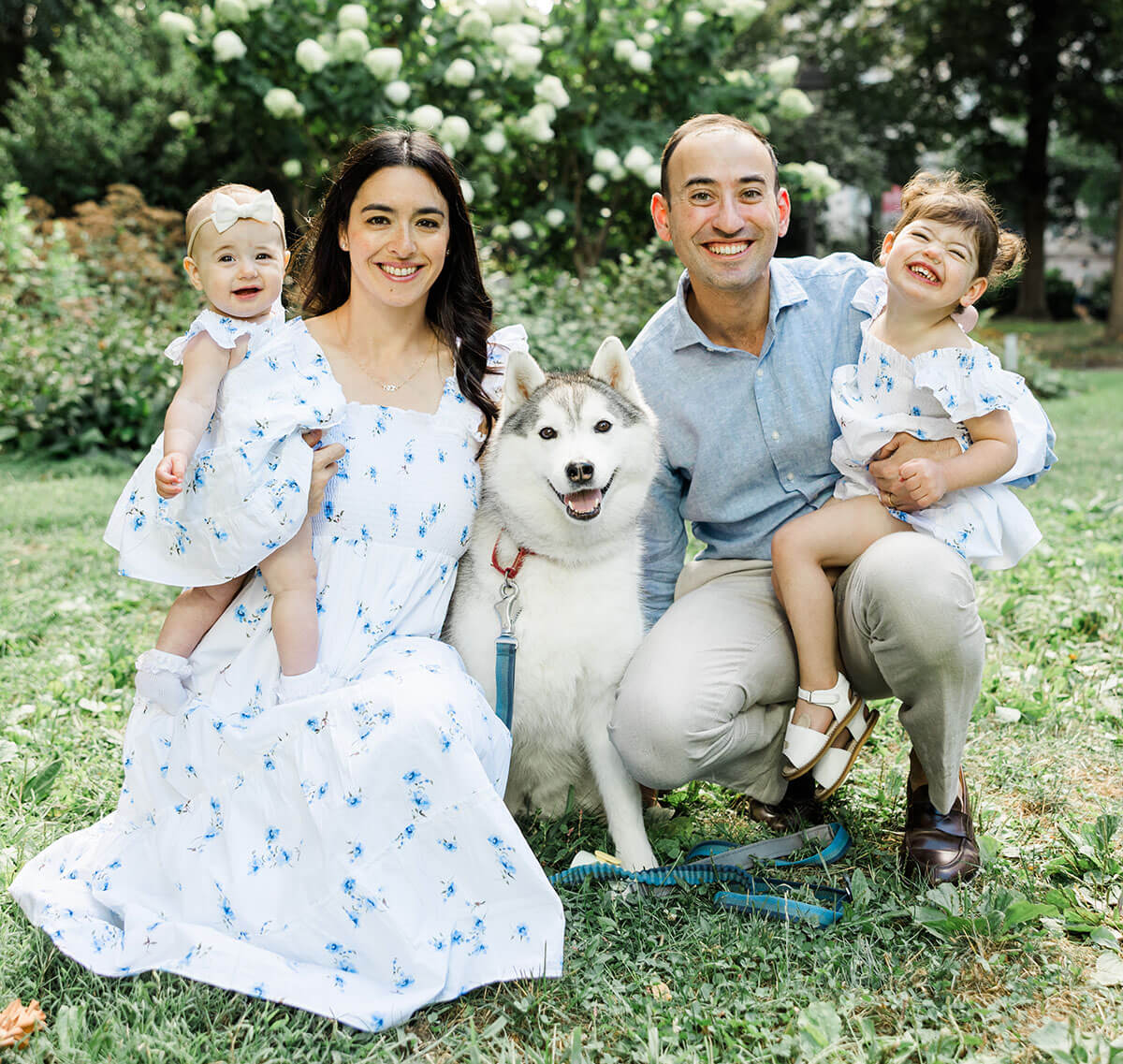
Now she has two young daughters and serves on the Shtiebel’s advisory board. In the past year alone, she said, roughly two dozen babies have been born into the community. On Shabbat afternoons, families spill out to nearby playgrounds after naps, an informal ritual that has become its own gathering. Growth here is not abstract. It is measured in strollers.
That future comes with questions. There is no Jewish day school in South Philadelphia. Families will eventually have to drive children to the suburbs or help invent something new. After years of the Shtiebel’s children’s programming being volunteer-run, it’s now supported by a mix of people in paid positions and community members.
“It’s a place where people can grow,” she said.
Where the conversation never stops
During the week, the sense of belonging migrates online. The Shtiebel uses Slack, the messaging platform, as its connective tissue: organizing meal trains, coordinating who will read the Torah at services, sharing names of people who are ill and need prayers, checking in on each other, offering extra seats at Shabbat tables. There is no need for a printed directory or a hallway bulletin board.
Steve Schauder noticed that immediately.
Schauder, 61, the executive director of the Jewish Relief Agency, moved to South Philadelphia last spring after what he called a “trial Shabbat.” He had previously been a dues-paying member of synagogues across denominations. What struck him here was not just the warmth, but the infrastructure beneath it. “It never stops,” he said of the Slack messages. “I wander on every day, just to take a look.”
Schauder was also struck by what didn’t happen at the Shtiebel. The synagogue is intentionally apolitical. It’s careful about keeping partisan politics out of communal spaces. Congregants span the ideological spectrum, he said, and that diversity is treated as a given rather than a problem to solve. “You can walk in there whatever your background and politics are,” Schauder said.
On a Shabbat morning, a Donald Trump voter might be sitting next to a Zohran Mamdani supporter. What matters is not agreement, but a choice, Schauder said, to prioritize what he called “joyful Judaism” over the culture wars that have fractured so many other institutions.
The Shtiebel has taken shape amid the quiet collapse of many American institutions — houses of worship, unions, neighborhood associations — leaving fewer places where people are expected to encounter one another across differences.
In that sense, the congregation is not only a Jewish experiment but a civic one: an attempt to rebuild habits of shared life in a society that has grown increasingly siloed, polarized, and private. What happens inside the Shtiebel — negotiating disagreement, making room for difference, choosing presence over purity — mirrors a broader struggle over whether communities can still hold together without demanding sameness.
But Fruchter bristles at the idea that the Shteibel’s success can be reduced to a program, platform or politics. What she calls the synagogue’s “secret sauce” is not a tool so much as a discipline: “It’s being intentional about seeing and witnessing everybody with what they need,” she said.
Sometimes that attention registers in small ways. A congregant mentions liking Dr Pepper; it shows up at the kiddush they sponsor. Other times it demands structural work: rethinking seating for those with sensory needs, slowing down ritual explanations, or redesigning space so people who would otherwise drift away can stay. None of it is scalable in the abstract. All of it requires time, memory, and a willingness to keep revising.
“Folks who are stepping up and stepping in not only feel belonging,” Fruchter said, “but that they’re really being seen, cared for and nurtured.”
A model, and its limits
What Fruchter built has also reshaped the landscape beyond South Philadelphia. At a moment when many American synagogues are shrinking, consolidating, or aging in place, the Shtiebel has become an unlikely case study in what Jewish life looks like when it grows outward rather than inward.
But growth, Fruchter is quick to note, does not automatically produce stability.
Instead of mandatory dues, the Shtiebel operates on what she calls an NPR-style model, funded through voluntary monthly support. About 120 households currently donate each month, she said — including some supporters who don’t live in South Philadelphia but believe in the mission. Those recurring contributions cover about a quarter of the annual budget. The rest comes from a mix of larger individual gifts — typically in the $10,000 to $25,000 range — and national grants supporting the Shtiebel’s work, including initiatives around Orthodox feminism and efforts to reimagine synagogue life.
The result is a congregation that looks robust from the outside, but still operates like a lean startup on the inside. In its early years, Fruchter lived in the synagogue to keep costs down. “I think what happens with that kind of growth is that the infrastructure struggles to keep up,” she said.
One constant challenge, she added, is perception. “Sometimes we’re seen as being very flush because of our success.” The reality, she said, is more fragile: building governance, raising money, and maintaining a physical space while attendance climbs — all at once. “That footing takes time,” she said.
That tension, between visibility and vulnerability, is part of what other Jewish leaders have been watching closely.
Rabbanit Leah Sarna, the spiritual leader of Kehillat Sha’arei Orah in the Philadelphia suburbs, credits the Shtiebel with shifting expectations.
“In Philly, Dasi really normalized the idea of a Modern Orthodox shul led by a woman,” Sarna said. When her own congregation went searching for a spiritual leader and hired her in 2024, she said, opening the role to women did not trigger the kind of upheaval it might have elsewhere. Fruchter even spoke at Sarna’s installation. “By then,” Sarna said, “people had spent a Shabbat at Dasi’s shul. It wasn’t theoretical anymore.”
Sarna said that because the Shtiebel has no membership dues, inclusion comes first, and fundraising never really stops. “That model means you’re constantly in a fundraising stance,” Sarna said.
In a neighborhood of young professionals who want to live urban lives, and not decamp to the suburbs, Fruchter’s approach has been especially powerful. The two congregations, Sarna said, have even developed what she called “purposeful handoffs,” directing people to the other as life circumstances change: city to suburbs, suburbs to city. Rather than competing, they function as part of a shared ecosystem.
Much of the Shtiebel’s cohesion still runs through Fruchter herself — a concentration of responsibility that has fueled its growth, and may yet test its limits. Asked whether the Shtiebel model could be replicated elsewhere, Sarna paused. The structure, she said, might travel. The person at the center of it might not. “You need someone who’s as talented and warm and magnetic as she is,” Sarna said. “That part is the least replicable.”
The greater Philadelphia area, where the Jewish population hovers around 350,000 people, may be uniquely suited to such experiments. “America was founded here,” Sarna said. “It’s the birthplace of ideas.”
The experiment has, perhaps, yet another advantage. Chaim Saiman, a law professor at Villanova University in Philadelphia and a thought leader in the Modern Orthodox movement, believes congregations like the Shtiebel should also be seen as competing with Conservative shuls for a slice of the membership who may be looking for something more traditional.
“These sorts of shuls are often born on the decay of mainstream Conservative shuls, which are not growing or are hemorrhaging,” Saiman said. “There’s a market for a community with liberal sensibilities but whose liturgy and Shabbat and kosher practices are more traditional.”
The challenge ahead
For Fruchter, those dynamics are less abstract than personal. Many of the people who find their way to the Shtiebel arrive with long Jewish histories — years in Conservative congregations, half-finished religious journeys, fluency in tradition paired with frustration at the structures around it.
They haven’t rejected Judaism so much as struggled to find a community that fit the way they were living. The work of the Shtiebel, she said, has been to meet those people where they are, and then ask what kind of community they are willing to build together.
“In a shul today,” she said, “we shouldn’t bolt chairs to the floor.”
The post A Millennial rabbi built a synagogue where others have closed. Her maverick ideas are becoming a model. appeared first on The Forward.
Uncategorized
Evan Gershkovich’s prison memoir begins with a Soviet Jewish exodus
A few days after Russian security agents arrested Wall Street Journal reporter Evan Gershkovich on a trip in March 2023, his lawyers showed him a slip of paper with messages from home. He was being held alone, in what Russian prisons call “quarantine:” two weeks without a cellmate before joining the general population. His eyes went straight to the note from his mother.
Soon he would start getting kosher food, Ella Milman wrote, and then added: “If you come home with sidelocks, I’ll understand.”
It was a joke, and a very Jewish one. Gershkovich grew up in a secular family of Soviet émigrés, where being Jewish had more to do with family history and dark humor than with religious practice. His mother was ribbing him that a few weeks of kosher prison food might send him home looking like a yeshiva boy.
Sitting across from the investigator building his espionage case, Gershkovich grinned. His mother, he realized, still had her sense of humor, and that was exactly what he needed.
The kosher food wasn’t a joke. That night, with Passover days away, a local rabbi sent him stacks of matzo.
The scene appears in This Cursed Beautiful Land: A Russian-American Story, Gershkovich’s memoir of his arrest, his 16 months behind bars and his release in the most elaborate U.S.-Russia prisoner swap since the Cold War. The book was published Tuesday.
Most of the coverage is about the prison. But Jewish history runs through the book from its first pages. Gershkovich’s great-grandfather was arrested during Stalin’s purges and vanished. His mother was laughed out of a journalism school application once the clerk saw her passport. And when he moved to Moscow as a young reporter, a Russian coworker needled him with an old stereotype about Jews and money.
The family that left
Gershkovich was born in New Jersey in 1991, two months before the Soviet Union fell apart. His parents had come over in 1979. Thousands of Soviet Jews were leaving at the time, helped by a U.S. law that linked trade with Moscow to whether its citizens were allowed to emigrate.
His mother flew out of Leningrad with her mother and ended up in Detroit. His father’s family came from Odessa and settled in Brighton Beach, the Brooklyn neighborhood people call Little Odessa. In those years, his father later joked, Soviet Jews who ran into each other on the street skipped the hellos and just asked where the other was going.
For his father’s side, the decision was easy. Gershkovich’s great-grandfather was arrested in 1937, at the height of Stalin’s purges, and never seen again. His grandfather Mark spent years moving from city to city, afraid of being targeted next, and later dreaded the day his own son would be drafted into the Soviet army.
A Jew on paper
Gershkovich’s mother, Ella, was born in 1957, a few years after the “doctors’ plot,” a Stalin-era campaign that accused Jewish physicians of conspiring to kill Soviet leaders. One of the doctors caught up in it had been a neighbor in her family’s communal apartment.
Her father had wanted to name her Etya, after his late sister. Worried that an obviously Jewish name would draw attention, her mother pushed for Ella instead. It didn’t matter. The family name Milman gave her away, and Soviet passports listed each citizen’s ethnicity. Hers said “Jew.”
Ella dreamed of becoming a writer. When she applied to the journalism department at Leningrad State University, the woman taking her application glanced at her passport and laughed. She studied shipbuilding instead, listened to the Rolling Stones, and heard rumors that the Kremlin planned to deport Jews to Birobidzhan, a remote Soviet region near the Chinese border that had apparently been set up as a Jewish homeland.
When she finally emigrated to America at 22, she sewed a pair of gold earrings from her late father into her skirt’s waistband to get them past customs. Once the plane took off, she couldn’t stop laughing and crying.
A generation later, her son became the journalist she wasn’t allowed to be, and then a prisoner of the state that had turned her away.
Ella and her husand settled in Princeton, New Jersey, where Gershkovich and his sister spent Saturday mornings with a Russian tutor, and holidays meant trips to the Russian groceries and Uzbek grills of Brighton Beach. Gershkovich came to think of himself as Jewish-Russian-American. Russia’s war in Ukraine later forced him to ask why that label had never included Ukraine, given that his father’s family came from Odessa.
The empty chair
In 2017, Gershkovich moved to Moscow to report for The Moscow Times. On one of his first days, he asked a colleague when staff got paid. She laughed and told him his Odessan roots were showing, a jab about Jews and money that served as his introduction to Russian workplace culture.
On a later trip to Odessa, he visited a Jewish museum that displayed a 1953 Soviet propaganda article from the doctors’ plot era. It claimed that the Joint, the New York-based Jewish relief organization, was a front for American intelligence. Gershkovich recalls thinking that Moscow was getting paranoid again, while hoping things hadn’t gotten that bad. A few years later, Russia accused him of spying for the United States.
Gershkovich’s arrest came a week before Passover. That spring, many American Jews left an empty seat for him at their Seders, and activists later sent him letters for Rosh Hashanah. Both gestures deliberately echoed the movement to free Soviet Jewry, the same campaign that had helped free his parents. Natan Sharansky, the most famous Soviet Jewish dissident, who was himself released in a 1986 prisoner swap, advocated publicly for his release.
In July 2024, two weeks after a Russian court sentenced Gershkovich to 16 years in a maximum-security prison, he was freed in a prisoner exchange in Ankara, Turkey. Jewish groups celebrated, and the Orthodox Union posted the traditional blessing thanking God for freeing captives.
His great-grandfather was taken in 1937 and never came home. Eighty-seven years later, his great-grandson did.
The post Evan Gershkovich’s prison memoir begins with a Soviet Jewish exodus appeared first on The Forward.
Uncategorized
More Michigan Jews sign a petition pressuring El-Sayed on Israel. Will it matter?
(JTA) — ANN ARBOR – The activists on the Zoom supporting Abdul El-Sayed knew they faced an uphill climb when it came to persuading their fellow Jewish Democrats to overcome their concerns about the Michigan Senate candidate and vote for their party’s nominee despite his strong disapproval of Israel.
Two progressive Jews, former Biden administration appointee Sam Bagenstos and Detroit Jews for Justice co-founder Hayley Sakwa, made the Jewish case for the candidate to a sometimes skeptical, sometimes combative crowd of around 30 people on Sunday night.
Sakwa and Bagenstos urged voters to prioritize the chance to put a check on the larger Trump agenda – including heavy immigration crackdowns and the rightward tilt of the federal judiciary – given that the Michigan seat could help determine who controls the legislative chamber.
But their appeal wasn’t enough for several of the people on the call, who less than two days later would sign on to the “Nonnegotiables” petition. Spearheaded by a group of Michigan Jewish clergy, the open letter calls for El-Sayed to moderate his views on Israel and affirm more vocal support for Jews in politics as a condition for earning their votes.
The 17 new names to the petition, shared with the Jewish Telegraphic Agency ahead of their release on Tuesday morning, include state Rep. Noah Arbit, the founder of the Michigan Jewish Democratic Caucus.
Arbit recently gave a speech denouncing antisemitism on the floor of the Michigan House and has been critical of El-Sayed publicly: After progressive Jews recently hosted the candidate for a Rosh Hashanah dinner at their house, the representative accused them of “tokenism.” (Arbit declined to comment to the Jewish Telegraphic Agency.)
Other new names on the list include an elected University of Michigan regent and prominent local attorney, as well as several board members of the Jewish Democratic caucus, which itself is not endorsing a candidate in the race.
Concerns raised on the Sunday night Zoom call included El-Sayed’s opposition to Iron Dome funding for Israel and his earlier campaigning with anti-Israel streamer Hasan Piker, whom he has since distanced himself from. Some said they were worried he could open a door to a more hostile Democratic Party for Jews.
“With Abdul it sort of feels like letting a fox into the henhouse,” one said.
“I refuse to be anyone’s dhimmi,” another wrote in the chat, referring to a term for non-Muslims living under Islamic rule.
Yet any pressure Jewish Democratic critics of El-Sayed hope to place on the candidate are partly balanced out by the work of those such as Sakwa, who along with other Jewish liberals has to date secured 900 signatures pledging to vote for El-Sayed. A competing letter of Jewish voters pledging to back his Republican challenger, former U.S. Rep. Mike Rogers, has picked up 524.
At the same time, the broader Democratic Party has ramped up its efforts to get elected officials in line behind the nominee. The El-Sayed campaign has yet to respond publicly to the “Nonnegotiables,” and with little more than a month to go before Election Day, it might not need to.
Former Vice President Kamala Harris campaigned with El-Sayed last week in Detroit, and the liberal-leaning editorial board of the Detroit Free Press, the state’s largest daily newspaper, endorsed the former county health director over the weekend.
The Free Press wrote that its own endorsement was against an “extremist” — referring to Rogers and President Donald Trump — in language that one bloc of Jewish voters also used to refer to their own decision to vote for Rogers over El-Sayed.
In addition, Michigan Attorney General Dana Nessel, who is Jewish and has fiercely criticized El-Sayed for his past comments about Jews and Israel, endorsed and appeared with the candidate on a local liberal podcast hosted by a Jewish woman to project unity.
“There is no choice,” Nessel said.
But the conversation demonstrated that tensions still remain even with many Jewish Democrats who have thrown in their lot with El-Sayed.
“Is there space for a Jewish Zionist like myself?” she asked him. “Is there space for us in the big tent of the Democratic Party?”
“I believe in a big tent,” he answered. “I am committed to having a tent where we march in lock step on the 95% of issues that we agree on.”
But the attorney general, who cited the risk of antisemitic threats as the reason she skipped the party convention earlier this year, wasn’t done.
“The question many of us have is: Are you seeking our votes?” Nessel asked El-Sayed. “Do they matter to you?”
“Yes,” the candidate responded. “If you trust that I’ll lead well for the community, even if there’s an issue on which we deeply disagree, then I hope I can earn your vote.” Later, El-Sayed said, “I look forward to working” on the Jewish American Security Act, a bipartisan bill to institute new Jewish security measures, including in synagogues and on college campuses.
“We’ve had an uptick in antisemitism, and it is critical to protect Jewish Americans,” El-Sayed said.
As with Nessel, El-Sayed’s candidacy is pushing other Jewish Democrats to perform a difficult two-step: pushing for the party platform and against Trump, without getting too close to the candidate himself.
The Jewish Democratic Council of America, whose CEO, Halie Soifer, is a Michigan native, is also not endorsing in the race. Yet Soifer told JTA, “Jewish voters will support Democrats in large numbers in the midterms, including in Michigan.” She predicted that Rogers wouldn’t earn more than one-quarter of the Jewish vote.
“Jewish voters recognize that a vote for any Republican in 2026 is a vote for Donald Trump,” Soifer told JTA over text. “We know Jewish voters are a critical component of a winning Democratic coalition.”
Decky Alexander, who chairs the Michigan Jewish Democratic Caucus, pointed to consistently high Democratic voting records for Jews in arguing that Jews still matter to the party’s coalition. She also favorably noted the Democratic National Committee’s recent announcement that it would establish a “Jewish American Council,” to convene in 2027.
“We can’t be distilled down to one vote or one idea,” Alexander told JTA.
One part of the state’s Jewish Democratic bloc unlikely to support El-Sayed: members of Temple Israel, the country’s largest Reform congregation. Speaking to the national publication The Free Press last week, several members, including a preschool teacher who was in the building when it was attacked in March, said El-Sayed’s apology for his earlier remarks about the temple was insufficient and that they couldn’t bring themselves to vote for him.
“No thinking Jew could vote for Abdul El-Sayed,” a former temple president told The Free Press.
None of the synagogue’s clergy signed the “Nonnegotiables” letter, or any other Jewish letter circulating about El-Sayed. But one of the temple’s rabbis told congregants in a Kol Nidre sermon that they had a say in drafting it, stating, “Our full participation in American political life is also non-negotiable.”
“No one should have to pass a test about Israel to be welcomed into a coalition on a campus or in a political party,” Rabbi Josh Bennett told his congregation, which had convened in the Temple Israel building for the High Holidays for the first time since the March attack. Rabbi Jen Lader, also of Temple Israel, recently testified before Congress to advocate for the Jewish American Security Act.
As Rogers has looked to win over dissatisfied Jews to his campaign, he has also moved toward El-Sayed on at least one issue tangentially related to Israel: opposition to the war in Iran. Initially a supporter of the war, Rogers in recent days has said he thinks it should “end quickly.”
El-Sayed, meanwhile, has raised eyebrows of his own in recent days. He dithered on denouncing the Iranian regime when urged to by an Iranian Christian college student, and appeared at a Dearborn fundraiser with Osama Siblani, a local Arab-American activist and newspaper publisher who once stated at a rally, “We are not going to be intimidated by staying silent when they say Hamas is a terrorist organization.”
The “Nonnegotiables” petition was launched earlier this month by a group of more than a dozen Michigan Jewish clergy after a series of apologies by El-Sayed to Jewish audiences for past comments he had made about the Temple Israel attack. The candidate needs to do more to earn the community’s confidence, the campaign’s organizers have told JTA.
“A large number of Jews haven’t decided how they will vote,” David Kramer, the caucus’s vice chair and one of the new signers, told JTA about the letter’s potential influence. “I speak to these people every day. Regardless of how they vote, Michigan Jews want and deserve to feel safe and have a seat at the table.”
As the Zoom call wrapped, some of the assembled Jews said they would vote for El-Sayed, even if reluctantly. Alexander of the state’s Jewish Democratic Caucus, who signed the letter supporting him, told the crowd the candidate has nothing to hide, even if they don’t like what he says.
“He’s basically stated what he believes,” she said. “And you have to decide if that’s the word for you.”
This article originally appeared on JTA.org.
The post More Michigan Jews sign a petition pressuring El-Sayed on Israel. Will it matter? appeared first on The Forward.
Uncategorized
Irish national soccer team won’t shake hands with Israel after win
(JTA) — It only took 25 minutes of play for the Irish national soccer team to build a 3-0 lead over Israel in the countries’ UEFA Nations League B match on Sunday. But there were decades of bad blood that preceded Ireland’s shutout victory in a game dominated more by the geopolitics of the Gaza war than about sports. One soccer writer described it as “arguably one of the most contentious football matches of this century.”
At the match, held in a mostly empty stadium in the neutral site of Debrecen, Hungary, the Irish players wore black armbands and bowed their heads in protest during the Israeli national anthem. There were no pre- or postgame handshakes, and one Irish player declined to participate altogether, citing his “personal belief that the killing of innocent people is wrong.”
Ireland’s soccer federation did not reserve tickets for its fans, and the country’s public broadcaster scaled back its coverage of the game. The teams are set to meet again on Oct. 4 in Serbia, this time with Ireland as the “home” team.
Ireland and Israel have a long history of icy relations. Ireland became the first member of the European Union to call for an independent Palestinian country in 1980, and was among the first of the Western European countries to recognize an official Palestinian state in 2024. Israel closed its embassy in Dublin in response. Irish Prime Minister Micheál Martin has rejected claims that his country’s sharp criticism of Israel bleeds into antisemitism.
In the months leading up to Sunday’s match, Ireland’s football governing body faced intense pressure to boycott the match. At a meeting in July, the Football Association of Ireland voted 75-32, with three abstentions, in favor of proceeding with the match, “while acknowledging the strength of feeling regarding support for Palestine.” The motion also noted that a boycott would come with UEFA sanctions, both financial and competitive: In League B matches, mid-tier nations seek to advance to the top division and boost their chances of qualifying for the quadrennial World Cup tournament. The Irish team itself also held a last-minute vote over whether to participate.
Earlier this month, more than 160 Irish athletes and sports figures signed an open letter calling on the national team to pull out of the match. The signatories included former Irish national team head coach Brian Kerr — who had led Ireland to a 2-2 draw against Israel in a 2005 match in Dublin that also took place amid protests.
Former Irish national team star Kevin Kilbane also authored a column in The Irish Times, writing, “Ireland should not play Israel. Not in Dublin, not in Hungary, not in Serbia. Not when Israel is committing genocide.” Israel denies the charge of genocide.
There were also a number of public barbs exchanged between leaders of the two countries and their football associations.
At a press conference last week, Irish coach Heimir Hallgrímsson replied to questions about the match by saying, “We are not playing with genocide, we are playing against genocide. We are playing against Israel; we are not playing with Israel.”
Israel’s football association responded to that comment with a post on X, writing, “We have contributed to the world and humanity in countless fields, earning an impressive number of Nobel Prizes along the way. Unfortunately, we have not yet found a cure for stupidity, ignorance and hypocrisy displayed by the @IrelandFootball team coach. We’re not playing with ignorance, hypocrisy and stupidity. We’re playing against the coach who embodies them.”
That drew a rebuke from Martin, who told reporters, “They are unacceptable remarks and should be withdrawn.”
And on Sunday, the morning of the match, Israeli Foreign Minister Gideon Sa’ar posted a lengthy tweet referencing the 1939 Irish squad that gave a Nazi salute before a game against the German national team.
“Almost 90 years have passed. Ireland’s unique talent for finding itself on the wrong side of history remains intact,” Sa’ar wrote. “Back then, they gave the Nazi salute. This time, they stand on the side of Palestinian terrorism. Above the black armbands the Irish players will wear tonight flies the black flag of jihadism.”
After the match, Israeli captain Manor Solomon said the Irish players who bowed their heads during the Israeli anthem “don’t interest me.”
“We have a country 10 times better than theirs, stronger, an amazing country with amazing people,” said Solomon, who plays in the English Championship league. “We are proud to wear the team shirt and to be Israelis. We are proud of our state and of our soldiers. [The Irish] can play all their tricks. We are Israelis and love the country. And that will always be the case.”
The post Irish national soccer team won’t shake hands with Israel after win appeared first on The Forward.
