


Uncategorized
A Millennial rabbi built a synagogue where others have closed. Her maverick ideas are becoming a model.
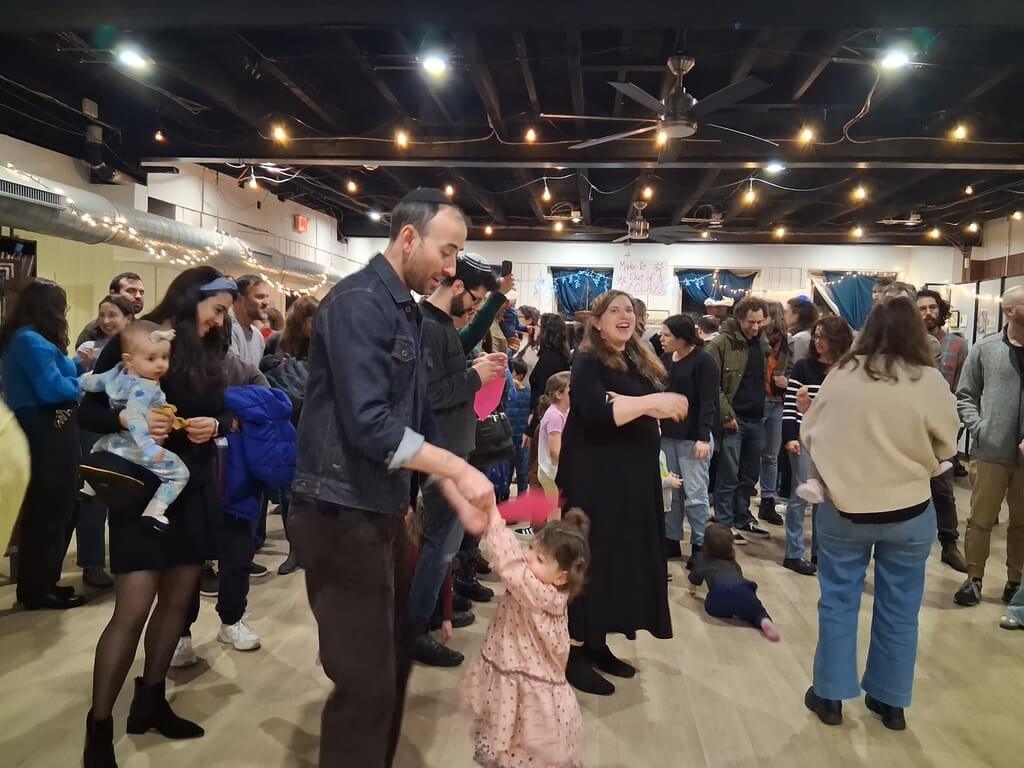
SOUTH PHILADELPHIA — On a cold weeknight, a few dozen people packed into a synagogue that defies every conventional rule of American Jewish life.
It is Orthodox and led by a woman. Its sanctuary is divided not into two sections, but three: men, women, and a small area for nonbinary congregants. It has no mandatory dues. And instead of struggling to survive, it is expanding so quickly that it has already outgrown its building.
Founded in 2019, the South Philadelphia Shtiebel has become a closely watched experiment in American Judaism — an urban congregation built from scratch in a neighborhood where no new synagogue had taken root in decades, and where most religious institutions had long since retreated to the suburbs.
A century ago, the idea of an Orthodox synagogue thriving in South Philadelphia would not have seemed unusual at all. In the early 1900s, the neighborhood was home to an estimated 150,000 Jews — mostly immigrants — packed into row houses within walking distance of work, markets and extended family.
Jewish life revolved not around grand sanctuaries but around dozens of small, informal prayer spaces known in Yiddish as shtiebels. More than a hundred of them dotted South Philadelphia’s blocks, often tucked into storefronts or private homes, intimate rooms where daily life and religious life blurred together.
Most of those shtiebels disappeared long ago, casualties of suburban flight and institutional consolidation. The South Philadelphia Shtiebel takes its name from that vanished landscape not as a reenactment, but as a wager.
The timing could easily have sunk the project. The Shtiebel launched only months before the COVID-19 pandemic upended communal life. Yet even during lockdown, around 40 people were still showing up each Shabbat. When the small Vespa scooter shop where the congregation first gathered became untenable due to the pandemic, the community improvised — meeting in backyards, public spaces and parking lots. Today, the congregation leases a two-story industrial building.
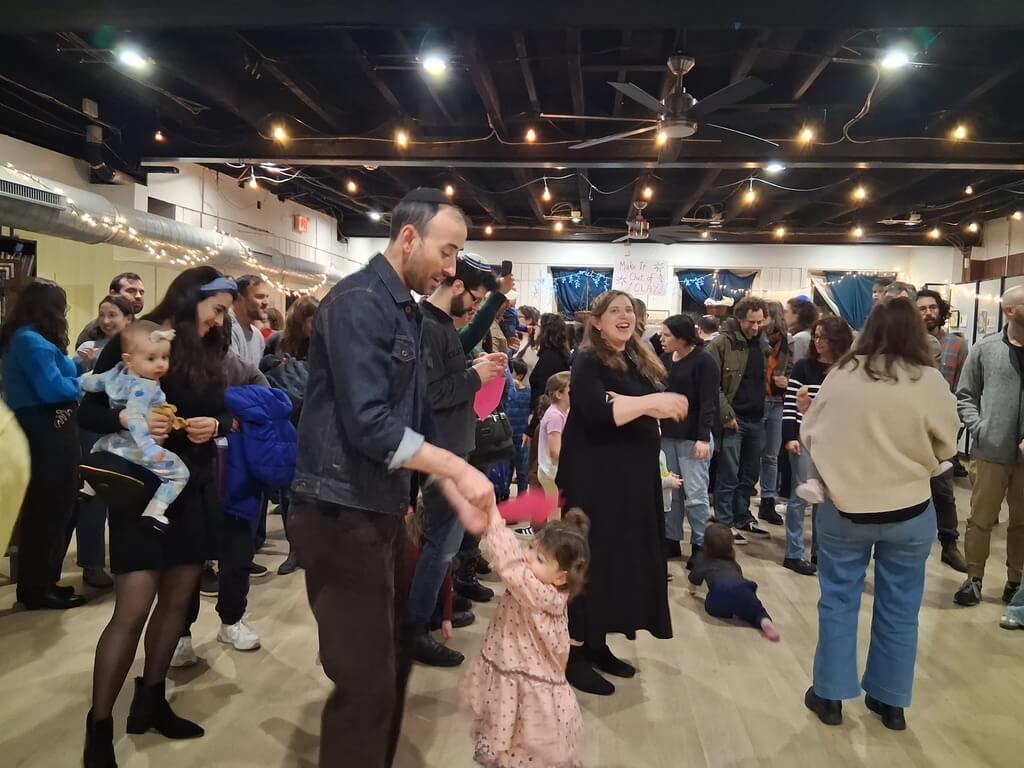
On a typical Shabbat morning, the sanctuary fills with roughly 175 people — a mix of young families, retirees, longtime Orthodox congregants and people still learning the prayers. And as attendance has grown, the question facing the Shtiebel is no longer whether it works, but what happens next, and whether this kind of community can scale without losing what makes it feel human.
What has emerged here is not a nostalgia project, but a congregation aligned with the DIY attitude of how people now choose institutions: voluntarily, relationally, and on their own terms.
Its growth has not been accidental. It reflects a series of choices — about space, ritual, leadership and belonging — made deliberately by its founder.
Welcoming the LGBTQ+ community
Rabbanit Dasi Fruchter grew up in Silver Spring, Maryland, the granddaughter of a rabbi who served pulpits across the country. She arrived in Philadelphia single and actively pursuing solo parenthood, but embraced the nonlinear turns of that journey, which led her to connect with and marry Daniel Krupka, a software engineer who had been serving as the congregation’s gabbai. Together they are raising a growing family.
She was ordained at Yeshivat Maharat, the Modern Orthodox seminary in the Bronx, and also holds a dual master’s degree from New York University in Jewish Studies and nonprofit management. She has been trained in community organizing, with an emphasis on relationships over programs.
She launched the Shtiebel with an acute awareness of how easily people fall through the cracks of Jewish life — not because they lack commitment, but because the systems around them are built for someone else.
“The approach here is that everybody is enough,” said Fruchter, 36. “We value the fact that you’re here and we’re not looking around at who’s not.”
Around 15% of the congregation identifies as LGBTQ+, Fruchter said. It’s a figure she offers not as a marker of ideology, but as a reflection of who has found their way into the room. That ethic is visible before a word is spoken. The sanctuary’s three sections all center around the bimah and are separated by a mechitza, or barrier, that still allows everyone to see, and hear, what is happening.
Fruchter is careful about how she describes the choice. It is not, she insists, an attempt to flatten difference or sidestep halacha, Jewish law, but an effort to acknowledge everyone. “We’re not trying to create a perfect solution,” she said. “We’re trying to create a place where people don’t have to disappear in order to pray.”
For Soren Simcha Barnett, a nonbinary congregant who uses they/them pronouns, that distinction mattered. When Barnett, 28, first arrived in early 2022, the idea of praying behind a mechitza was unfamiliar — and uncomfortable. “That would have been a red line for me,” they said. They had grown up in a Conservative synagogue and had never experienced gender-segregated prayer.
Still, they stayed.
What drew Barnett back was that they were taken seriously. They learned the melodies. On Shabbat mornings, they stand close enough to the action to help when the Torah is lifted off the bimah, hands ready, just in case. “I love being in the thick of it,” Barnett said. “We’re literally not in the margins.”
That sense of belonging, Barnett said, came with limits, though. About six months after they began attending regularly, Barnett asked Fruchter about expanding ritual roles for nonbinary congregants, such as leading services. Fruchter said no, a decision rooted in her reading of halacha.
“That hurt,” Barnett said. “I really wanted to be able to do everything I’m capable of.” But again, the disappointment did not send them away.
What mattered, they said, was not the answer but the process: that the question was taken seriously, and that the boundary was named rather than ignored. Barnett stayed. “I was willing to grapple with the complexity,” they said.
If Barnett’s story is about negotiation, Gary Saft’s is about commitment.
Saft, 35, a gabbai and the head of the Shteibel’s volunteer security team, is broad-shouldered, bearded, and impossible to miss. He grew up Reform and spent years assuming traditional Judaism had no place for him. “I didn’t see where I fit,” Saft said.
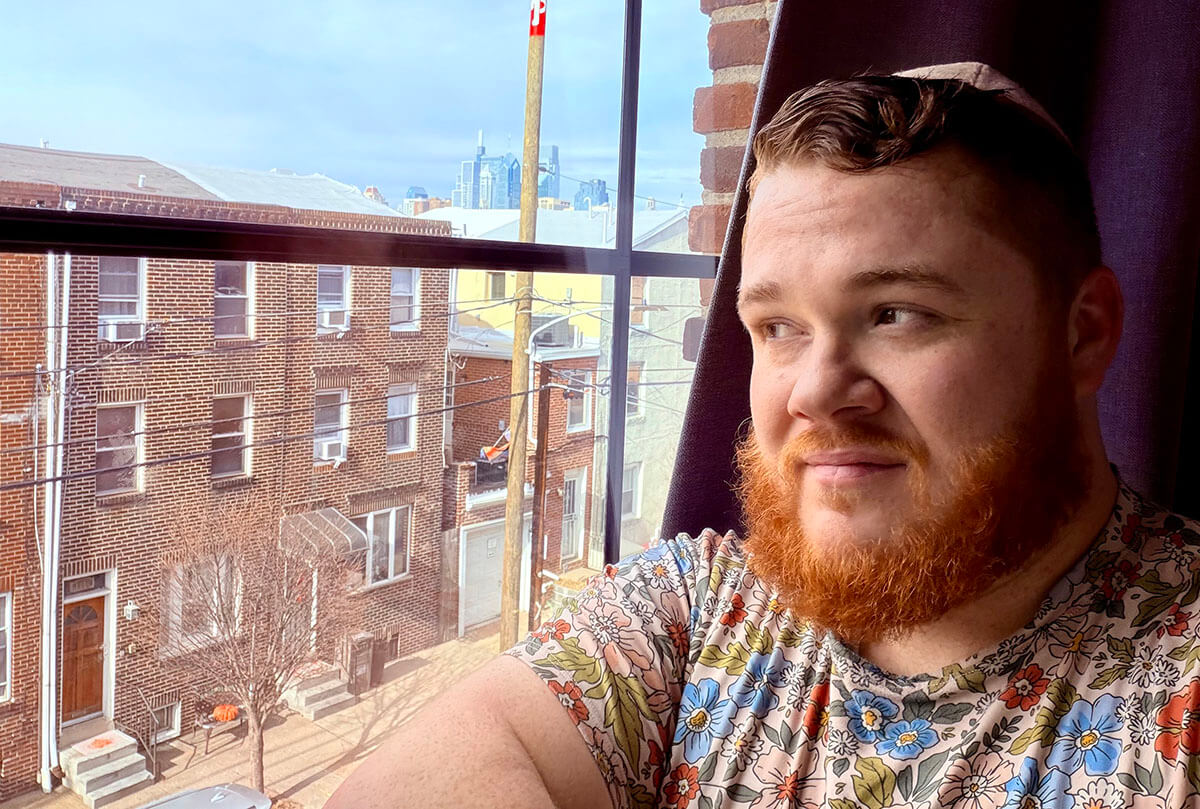
Saft began searching for a community after his father died in 2020, and he found it at the Shtiebel. Today, Saft prays daily, keeps kosher, walks to shul, and helps run services. “This shul is now a huge part of my life,” he said.
A sense of belonging
By all accounts, what holds the community together, more than anything else, is song.
For many congregants, music is the primary way in. Even those still learning Hebrew can participate fully, buoyed by a group that carries them along. Fruchter’s own voice is strong and steady, but it rarely stands alone. She sings with the room, not over it. Over time, congregants say, that has changed who feels comfortable raising their voice. Women sing loudly. So do people who might once have stayed quiet. Authority here is not projected; it circulates.
Lisa Levy, 66, a three-time cancer survivor, moved to Philadelphia after decades in New York City. She arrived newly retired and living alone. She describes herself as “conservadox” — committed to Orthodoxy, but wary of rigid lines.
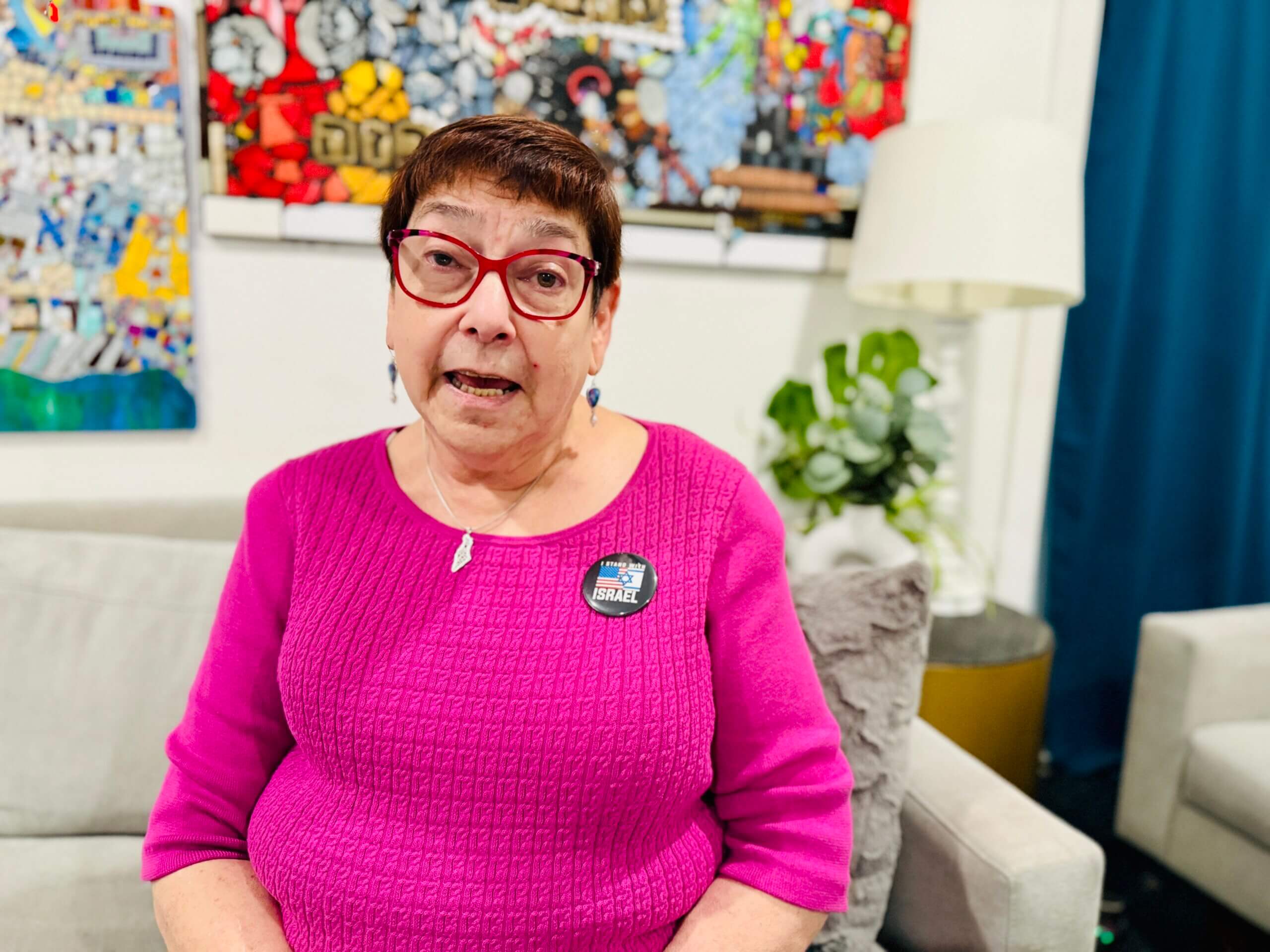
What she did not encounter, she said, was pressure. “There are no dues,” Levy said. “You pay what you can afford. No questions.”
For Levy, that mattered. Many synagogues, she said, quietly assume a level of financial stability that leaves some people on the margins — especially older congregants or those navigating illness. At the Shtiebel, presence itself felt like the baseline contribution. “It’s more like a minyan than a shul,” said Levy, who lives three blocks away.
For Jamie Goldberg, 33, the Shtiebel became real when she started showing up pregnant.
Goldberg began attending in mid-2022, just before the birth of her first daughter. She and her husband, Stuart, had grown up in Reform and Conservative settings and spent years searching for something that felt both serious and accessible. “I learned the traditional prayers in my late 20s,” she said. “I didn’t grow up knowing how to follow along.”
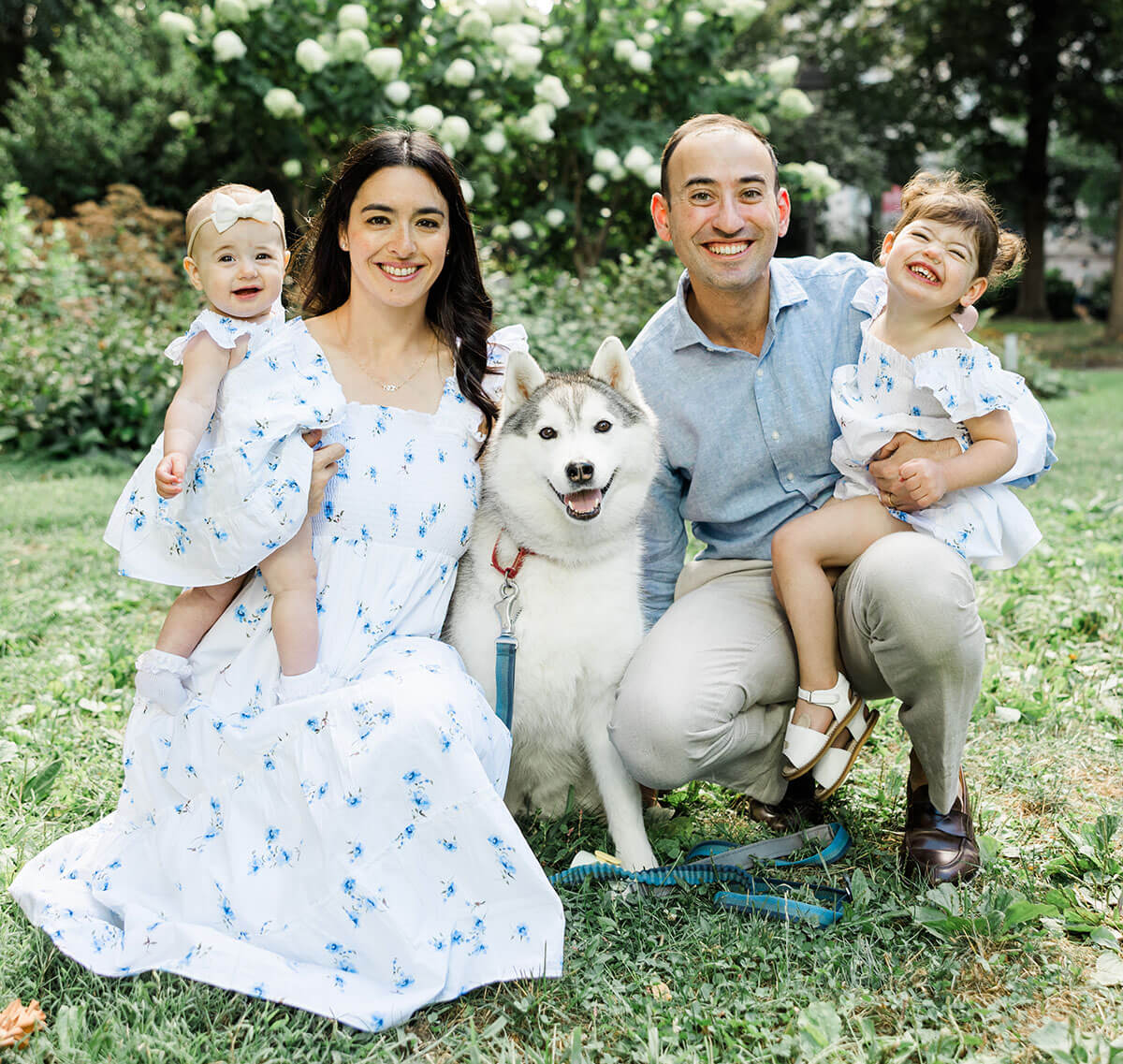
Now she has two young daughters and serves on the Shtiebel’s advisory board. In the past year alone, she said, roughly two dozen babies have been born into the community. On Shabbat afternoons, families spill out to nearby playgrounds after naps, an informal ritual that has become its own gathering. Growth here is not abstract. It is measured in strollers.
That future comes with questions. There is no Jewish day school in South Philadelphia. Families will eventually have to drive children to the suburbs or help invent something new. After years of the Shtiebel’s children’s programming being volunteer-run, it’s now supported by a mix of people in paid positions and community members.
“It’s a place where people can grow,” she said.
Where the conversation never stops
During the week, the sense of belonging migrates online. The Shtiebel uses Slack, the messaging platform, as its connective tissue: organizing meal trains, coordinating who will read the Torah at services, sharing names of people who are ill and need prayers, checking in on each other, offering extra seats at Shabbat tables. There is no need for a printed directory or a hallway bulletin board.
Steve Schauder noticed that immediately.
Schauder, 61, the executive director of the Jewish Relief Agency, moved to South Philadelphia last spring after what he called a “trial Shabbat.” He had previously been a dues-paying member of synagogues across denominations. What struck him here was not just the warmth, but the infrastructure beneath it. “It never stops,” he said of the Slack messages. “I wander on every day, just to take a look.”
Schauder was also struck by what didn’t happen at the Shtiebel. The synagogue is intentionally apolitical. It’s careful about keeping partisan politics out of communal spaces. Congregants span the ideological spectrum, he said, and that diversity is treated as a given rather than a problem to solve. “You can walk in there whatever your background and politics are,” Schauder said.
On a Shabbat morning, a Donald Trump voter might be sitting next to a Zohran Mamdani supporter. What matters is not agreement, but a choice, Schauder said, to prioritize what he called “joyful Judaism” over the culture wars that have fractured so many other institutions.
The Shtiebel has taken shape amid the quiet collapse of many American institutions — houses of worship, unions, neighborhood associations — leaving fewer places where people are expected to encounter one another across differences.
In that sense, the congregation is not only a Jewish experiment but a civic one: an attempt to rebuild habits of shared life in a society that has grown increasingly siloed, polarized, and private. What happens inside the Shtiebel — negotiating disagreement, making room for difference, choosing presence over purity — mirrors a broader struggle over whether communities can still hold together without demanding sameness.
But Fruchter bristles at the idea that the Shteibel’s success can be reduced to a program, platform or politics. What she calls the synagogue’s “secret sauce” is not a tool so much as a discipline: “It’s being intentional about seeing and witnessing everybody with what they need,” she said.
Sometimes that attention registers in small ways. A congregant mentions liking Dr Pepper; it shows up at the kiddush they sponsor. Other times it demands structural work: rethinking seating for those with sensory needs, slowing down ritual explanations, or redesigning space so people who would otherwise drift away can stay. None of it is scalable in the abstract. All of it requires time, memory, and a willingness to keep revising.
“Folks who are stepping up and stepping in not only feel belonging,” Fruchter said, “but that they’re really being seen, cared for and nurtured.”
A model, and its limits
What Fruchter built has also reshaped the landscape beyond South Philadelphia. At a moment when many American synagogues are shrinking, consolidating, or aging in place, the Shtiebel has become an unlikely case study in what Jewish life looks like when it grows outward rather than inward.
But growth, Fruchter is quick to note, does not automatically produce stability.
Instead of mandatory dues, the Shtiebel operates on what she calls an NPR-style model, funded through voluntary monthly support. About 120 households currently donate each month, she said — including some supporters who don’t live in South Philadelphia but believe in the mission. Those recurring contributions cover about a quarter of the annual budget. The rest comes from a mix of larger individual gifts — typically in the $10,000 to $25,000 range — and national grants supporting the Shtiebel’s work, including initiatives around Orthodox feminism and efforts to reimagine synagogue life.
The result is a congregation that looks robust from the outside, but still operates like a lean startup on the inside. In its early years, Fruchter lived in the synagogue to keep costs down. “I think what happens with that kind of growth is that the infrastructure struggles to keep up,” she said.
One constant challenge, she added, is perception. “Sometimes we’re seen as being very flush because of our success.” The reality, she said, is more fragile: building governance, raising money, and maintaining a physical space while attendance climbs — all at once. “That footing takes time,” she said.
That tension, between visibility and vulnerability, is part of what other Jewish leaders have been watching closely.
Rabbanit Leah Sarna, the spiritual leader of Kehillat Sha’arei Orah in the Philadelphia suburbs, credits the Shtiebel with shifting expectations.
“In Philly, Dasi really normalized the idea of a Modern Orthodox shul led by a woman,” Sarna said. When her own congregation went searching for a spiritual leader and hired her in 2024, she said, opening the role to women did not trigger the kind of upheaval it might have elsewhere. Fruchter even spoke at Sarna’s installation. “By then,” Sarna said, “people had spent a Shabbat at Dasi’s shul. It wasn’t theoretical anymore.”
Sarna said that because the Shtiebel has no membership dues, inclusion comes first, and fundraising never really stops. “That model means you’re constantly in a fundraising stance,” Sarna said.
In a neighborhood of young professionals who want to live urban lives, and not decamp to the suburbs, Fruchter’s approach has been especially powerful. The two congregations, Sarna said, have even developed what she called “purposeful handoffs,” directing people to the other as life circumstances change: city to suburbs, suburbs to city. Rather than competing, they function as part of a shared ecosystem.
Much of the Shtiebel’s cohesion still runs through Fruchter herself — a concentration of responsibility that has fueled its growth, and may yet test its limits. Asked whether the Shtiebel model could be replicated elsewhere, Sarna paused. The structure, she said, might travel. The person at the center of it might not. “You need someone who’s as talented and warm and magnetic as she is,” Sarna said. “That part is the least replicable.”
The greater Philadelphia area, where the Jewish population hovers around 350,000 people, may be uniquely suited to such experiments. “America was founded here,” Sarna said. “It’s the birthplace of ideas.”
The experiment has, perhaps, yet another advantage. Chaim Saiman, a law professor at Villanova University in Philadelphia and a thought leader in the Modern Orthodox movement, believes congregations like the Shtiebel should also be seen as competing with Conservative shuls for a slice of the membership who may be looking for something more traditional.
“These sorts of shuls are often born on the decay of mainstream Conservative shuls, which are not growing or are hemorrhaging,” Saiman said. “There’s a market for a community with liberal sensibilities but whose liturgy and Shabbat and kosher practices are more traditional.”
The challenge ahead
For Fruchter, those dynamics are less abstract than personal. Many of the people who find their way to the Shtiebel arrive with long Jewish histories — years in Conservative congregations, half-finished religious journeys, fluency in tradition paired with frustration at the structures around it.
They haven’t rejected Judaism so much as struggled to find a community that fit the way they were living. The work of the Shtiebel, she said, has been to meet those people where they are, and then ask what kind of community they are willing to build together.
“In a shul today,” she said, “we shouldn’t bolt chairs to the floor.”
The post A Millennial rabbi built a synagogue where others have closed. Her maverick ideas are becoming a model. appeared first on The Forward.
Uncategorized
Why is the biggest soccer team in the world talking about Joseph Goebbels?
The biggest rivalry in international soccer — between Real Madrid and FC Barcelona — has erupted in recent months, as Madrid pushes the Spanish soccer federation to punish Barca for alleged referee bribery.
But the ugly sparring between the clubs took an unexpected turn last week when Spanish league president Javier Tebas entered the fray with a shocking comparison.
“Real Madrid’s management directs an orchestra of mouthpieces and Real Madrid TV leads the singing,” Tebas wrote Oct. 15 on X. “Their score is always the same: select the plays that suit them, repeat the grievance, feed the suspicion, and point fingers at the enemies.
“That method recalls propaganda mechanisms exploited by Goebbels, Nazi Germany’s minister of propaganda: systematic repetition, construction of an enemy, and subordination of facts to the narrative.”
Real Madrid, which has employed such stars as Cristiano Ronaldo and David Beckham, condemned the remark with a statement calling for Tebas’ resignation both from the Spanish league, La Liga, and the Royal Spanish Football Federation, where Tebas serves as vice president.
“Real Madrid C. F. considers it absolutely intolerable and extraordinarily serious that someone holding two positions of utmost responsibility in Spanish football resorts to a comparison with the propaganda methods of the Nazi regime to discredit our club, its management, and its television,” the club wrote Oct. 16.Tebas has thus far refused to resign or even take down the post, and has defended his critique by pointing to other Spanish leaders who have made similar comparisons in the past.
The Goebbels controversy comes amid growing concerns about antisemitism in Spain, including in sports, where thousands of protesters blocked an Israeli-branded cycling team from competing in the Vuelta race last year.
The bribery accusations against Barcelona first surfaced in 2023, when it was revealed the club had paid millions of dollars to companies linked to the former vice president of the Spanish refereeing body, José María Enríquez Negreira. A Spanish court dismissed the bribery charges in 2024, but the investigation continued, and earlier this month Madrid submitted a tranche of documents it said proved the bribery claims.
The conflict between the club and Tebas dates back at least to 2021, when Madrid club president Florentino Perez spearheaded a breakaway international league that would have threatened Spanish competition. Barcelona had also agreed to join the so-called Super League, but the plan was scuttled after enormous backlash from fans across the continent.
Joseph Goebbels, one of Hitler’s most devoted followers, led the German Propaganda Ministry after the Nazi party came to power in 1933. He and his wife died by suicide in 1945 after killing their six children with cyanide.
The post Why is the biggest soccer team in the world talking about Joseph Goebbels? appeared first on The Forward.
Uncategorized
Israel’s election may hinge on whether Netanyahu’s opposition will accept Arab support
Israel’s approaching election is developing into an extraordinary paradox: Prime Minister Benjamin Netanyahu, whose government presided over the catastrophe of Oct. 7 and whose record since has been a succession of security failures, assaults on democracy, capitulations to Haredi interests and international embarrassments, may yet survive politically because his opponents cannot bring themselves to accept the parliamentary support of Israel’s Arab citizens.
The polls have tightened, the opposition has conducted a strangely timid campaign, and U.S. President Donald Trump’s endorsement of Netanyahu over the weekend introduces an unpredictable element into a contest that should by any reasonable accounting be a referendum on utter failure. Yet given the picture emerging in the polls, the decisive question is whether the opposition’s leaders possess the courage to reach out to the one-fifth of Israelis who are Arabs – who are expected to vote in very high numbers on Oct. 27.
Since 1973, Israel’s classic center-left has never secured an election-day parliamentary majority without the seats of Arab parties. Yitzhak Rabin’s victory in 1992, for example, depended on a parliamentary balance that included Arab representatives, whose support later became essential to his government’s survival. By most credible polls, that is the picture that emerges now, and with that support, the opposition could become a comfortable majority of close to 70 of the 120 Knesset seats.
But things are not so simple. In 2020, most of the Joint Arab List – an alliance of Arab parties in Israel – recommended opposition leader Benny Gantz for prime minister, producing a numerical majority that collapsed because several opposition lawmakers simply could not stomach the prospect. But the Naftali Bennett-Yair Lapid government that removed Netanyahu in 2021 included the Arab party Ra’am, demonstrating that cooperation across this divide was possible even among politicians with profound disagreements about national identity and the question of a Palestinian state.
Throughout these episodes, the challenge was the elementary democratic principle that the votes of Arab citizens should carry precisely the same weight as those of Jewish citizens. And yet there are complications with these political alliances: the Arab parties are not “Zionist” – and more relevantly, they have real difficulty in a situation that involves conflict with the Palestinians, who are their non-citizen brothers and sisters.
Netanyahu has spent years exploiting the discomfort of his opponents with this reality, transforming the prospect of Arab political influence into a weapon against anyone seeking to replace him. During this election, his campaign has placed particular pressure on Gadi Eisenkot, the former IDF chief of staff, portraying any government of his, if it’s dependent on Arab parties, as compromised from the outset.
Eisenkot, Naftali Bennett and other opposition leaders are trying to win over former right wing voters who may have tired of Netanyahu’s endless scandals and failures – but those voters also have serious reservations about the Arab parties. So their prevarications are not hard to understand.
There is, of course, a double standard: Netanyahu routinely counts on the ultra-Orthodox parties, whose demands for military exemptions, public subsidies and educational autonomy have profound consequences for Israel’s security, economic resilience and civic solidarity. Their representatives are treated as legitimate negotiating partners whose seats belong automatically in the right-wing bloc, even when, indeed, they call themselves non-Zionist.
Arab political leaders are now offering the opposition passive support in parliament for free, meaning they do not even demand a seat at the government table. According to all credible polls, the opposition plus the Arab parties should have a comfortable majority after the Oct. 27 vote.
Mostly Muslim, with Christian communities and the distinct Druze population, these citizens share aspects of the language, culture and historical grievances of the surrounding Arab world while participating in the institutions, economy and daily life of the Jewish state. Two stories convey this complexity.
The first: A wounded Jewish reservist, a new immigrant and Technion engineer, was driving toward a hospital for treatment of a hand injured during service in Lebanon when police stopped him for speeding last year. As the Maariv newspaper’s columnist Ben Caspit reported, the reservist presented documentation of his medical circumstances, yet the officers, who were Jewish, issued a fine and delayed him despite the potential danger to his injured finger, behaving at times with an astonishing lack of consideration.
The case eventually reached a court, where the fine was canceled in a ruling that criticized the enforcement as falling short of reasonable, proportionate and fair administrative discretion. The judge was Rasha Saadi Atamna, an Arab woman whose decision recognized the wounded soldier’s service and circumstances while holding an institution of the Israeli state accountable to its own standards. It was a recognition denied by fellow Jews.
The second: On the morning of Oct. 7, 2023, Youssef Ziadna, a Bedouin minibus driver from Rahat who had dropped off a group of young people at the Nova music festival, showed extraordinary courage.
When Hamas launched its massacre, one of his passengers called desperately for help, and Ziadna drove toward the festival, entering an area where gunmen were murdering civilians and vehicles were fleeing in panic. Near the Gaza border communities, a man running from the slaughter warned him to proceed no further, and moments later gunfire sent Ziadna and others diving into a roadside ditch.
The danger was clear, the route home was available, and every ordinary instinct of self-preservation pointed toward escape. Ziadna instead continued toward the festival, found the people who had summoned him, collected other terrified and wounded Israelis and eventually squeezed roughly 30 passengers into a minibus designed for 14. Drawing on his knowledge of the terrain, he drove across fields and away from the gunmen, with other fleeing Israelis following behind him.
The people Ziadna carried to safety were Jewish Israelis, while his own Bedouin community was suffering murder and abduction in the same assault. Speaking to Israel Radio during Oct. 7 commemorations, he explained his decision in words that deserve to resonate far beyond the immediate story of his heroism: “I could have turned around and did a U-turn, but my conscience wouldn’t let me. I am a human being first. We have to live together in this very fine country of ours.”
The election, of course, will be decided by parliamentary arithmetic rather than inspiring anecdotes, and the stakes extend well beyond the composition of the next coalition.
Consider the government’s continuing failure to confront Jewish terrorism in the West Bank, where extremist settlers have now assaulted an American journalist and European diplomats in successive days. Heidi Levine, a Washington Post photographer whom I have known for decades, was brutally beaten while covering the Palestinian olive harvest, suffering injuries requiring surgery.
The following day, settlers attacked European diplomats and a French mayor near the Christian village of Taybeh. Netanyahu’s response was to question the evidence, emphasize the diplomats’ failure to coordinate with the army and suggest a campaign to smear settlers. Such indulgence of violent extremists disgraces Israel and accelerates its international isolation.
Trump’s endorsement this weekend of Netanyahu may influence some voters, but the fundamental choices belong to Israelis.
Let’s hope they are more thoughtful than to listen to the U.S. president and reelect a leader who would endanger lives by continuing to block an Oct. 7 inquiry, redouble efforts to instill an elected dictatorship, continue to absolve the Haredim of military duty, do nothing to stem the disgrace of Jewish terrorism, and hasten the onset of global economic sanctions upon the Jewish state.
The post Israel’s election may hinge on whether Netanyahu’s opposition will accept Arab support appeared first on The Forward.
Uncategorized
Bob Dylan is changing his lyrics and his set list; what is he trying to tell us?
Nobel Prize-winning rock poet Bob Dylan once famously wrote, “You don’t need a weatherman to know which way the wind blows” (in his 1965 song “Subterranean Homesick Blues”). That may have formerly been the case, but it didn’t stop Dylan from kicking off his “Lights of Autumn Tour” in Oslo on Saturday, Oct. 17, with a setlist chock full of warnings about floods and extreme weather — a veritable apocalypse of natural disasters. He even rewrote some lines in one of his most famous and beloved songs, “Tangled Up in Blue,” to make the weather a new character in the song.
Playing “Tangled Up in Blue” in concert for the first time since 2018, Dylan revised a few verses. Where he originally sang “I had a job in the great north woods working as a cook for a spell” to kick off the third verse, Dylan instead sang “Way up in the frozen woods, teardrops touch the sky / The leaves are falling one by one, and the moments passing by,” in keeping with the “Lights of Autumn” theme. (It should be noted that Dylan has been rewriting and changing the lyrics to “Tangled” at least since 1984, when he also included the song on his opening concert of a European tour.) “Way up in the frozen woods” may also refer to Dylan’s hometown of Hibbing, Minnesota, which is so far north that you can practically see Canada from there.
On Saturday, Dylan continued to rewrite that third verse with the line “Sometimes I get so tired, sometimes I’m getting away / Lucky you found another, tomorrow’s another day.” In a clever twist, Dylan inserts the new word “lucky” into the number, which recalls the phrase “I can’t help it if I’m lucky” from the song “Idiot Wind,” also found on the 1975 album Blood on the Tracks where “Tangled Up in Blue” originated. “Lucky” also resurfaced as a cryptic moniker for Dylan himself when, in the superstar group the Traveling Wilburys that included George Harrison, Tom Petty, and Roy Orbison — all of whom took new names ending in “Wilbury” — Dylan opted for “Lucky Wilbury.” He can’t help it, indeed!
Dylan kicked off another rewritten verse with the phrase, “Things were gettin’ to cost too much,” leaving one to wonder if this was a pre-midterm election reference to the state of the U.S. economy and therefore an implicit criticism of the MAGA leader and his acolytes. Dylan also revised the music somewhat, slowing the tempo of what was once a mid-tempo rocker to a rubato ballad; he also inserted a minor chord that doesn’t exist in the original.
As noted, Dylan’s 19-song setlist included copious references to weather disasters. “The Man in the Long Black Coast” opens with the line “Crickets are chirpin’, the water is high,” and refers to trees that are “bent over backwards from a hurricane breeze.” The aptly titled “Crash on the Levee (Down in the Flood),” which he performed for the first time in over two decades, includes the lines:
Crash on the levee, mama
Water’s gonna overflow
Swamp’s gonna rise
No boat’s gonna row….
If you go down in the flood
It’s gonna be your own fault…”
Even Dylan’s choice of cover tunes seemed oriented toward the apocalyptic theme. For the first time ever, Dylan sang a Randy Newman song in concert. Keeping with the flood theme, he chose Newman’s “Louisiana 1927,” which recounts one of the worst floods ever to strike the U.S.
What’s happened down here is that the wind have changed
Clouds roll in from the north, and it starts to rain
Rained real hard, it rained for a real long time
Six feet of water in the streets of Evangeline
River rose all day, the river rose all night
Some people got lost in the flood, some people got away all right
Dylan also covered “Share Your Love” — originally recorded by Bobby “Blue” Bland in 1963 but also recorded and performed by Dylan’s former backup group, The Band — which kicks off with the line “Well, it’s an ill wind that blows no good.”
But Dylan didn’t have to go far from his own catalog to rack up mentions of climate insanity. He performed “Tryin’ to Get to Heaven,” which includes the lines “The air is getting hotter, there’s a rumbling in the skies / I’ve been wading through the high muddy water, with the heat rising in my eyes.” In “You Ain’t Goin’ Nowhere,” Dylan sang, “Clouds so swift, rain won’t lift / Gate won’t close, railings froze / Get your mind off wintertime, you ain’t goin’ nowhere.” And on “I’ve Made Up My Mind to Give Myself to You,” the seasonally appropriate narrator says, “I saw the first fall of snow, I saw the flowers come and go.”
Dylan’s tour continues tonight (Oct. 19) in Gothenburg, Sweden, before making its way through Denmark, Germany, Belgium, Switzerland, Italy, Slovenia, and Austria, and concluding in the UK in November and early December. The forecast for Sweden tonight is clear, but later in the week, the weather report says there’s a chance of a hard rain.
The post Bob Dylan is changing his lyrics and his set list; what is he trying to tell us? appeared first on The Forward.
