


Uncategorized
Why the Super Bowl antisemitism ad uses a familiar slur
To the editors:
The sticky note cruelly slapped on a high school student’s backpack didn’t have to say “Dirty Jew.”
It could have been any one of dozens of other antisemitic slurs, and believe me, throughout my life and current line of work, I’ve seen and heard them all. At the Blue Square Alliance Against Hate, our Command Center closely tracks the spread of antisemitism online, in all its pernicious forms.
In his piece for the Forward about our new Super Bowl ad, PJ Grisar argues that the ad misses the mark by using “Dirty Jew,” characterizing it as old-fashioned and out of touch with the heavily coded, meme-driven ways students typically express antisemitism today.
We’ve seen all of those slurs gaining traction among younger people that Grisar gave as examples of how kids hate today.
But we didn’t pull “Dirty Jew” out of the history books. In creating the ad, the Blue Square Alliance made a conscious decision to follow the research. Our decisions are based on data, from the one billion social media posts we analyze daily, to our semi-annual 7,000-participant survey on American sentiment toward Jews and antisemitism, to our multi-stage audience testing that is foundational to our creative development.
Here’s the hard data: With nearly 500 million social media impressions since 2023, “Dirty Jew” is a slur that has managed to penetrate all corners of American discourse. Worse yet, its usage online has increased by 174% in the past three years, growing at a significantly higher rate than other slurs. And sadly, the last few years have seen more than a few disturbing and real incidents of the scenario in the ad play out in real life. In U.S. high schools. Right now. Not 1950.
This data-guided approach drove our selection of “Dirty Jew” among all the possible antisemitic slurs as the one to appear on the sticky note. Even though at first glance this phraseology may seem dated, it’s actually timeless and ubiquitous — scarily — and is even outpacing other slurs in frequency of use.
So, whether you’re a Boomer, Millennial or Gen Z, there’s no subtlety to what this ad is showing you: this is antisemitism, pure and simple. And, as Grisar acknowledges in his piece, the challenge of storytelling within a 30-second ad window requires a clear, unambiguous message. In that short time, clarity beats complexity.
It was also important to us to use the high school setting and focus our ad on a younger demographic because that is where we have seen the most concerning trends in antisemitism data. Our most recent survey data shows that Gen Z is three times more likely to witness antisemitism than older generations, and yet nearly twice as likely to say it is not a problem.
At the heart of this campaign is Blue Square Alliance’s dedication to addressing another data point: more than 100 million Americans say they are unengaged in the collective effort to stand up against anti-Jewish hate. We have spent the past few years closely studying this segment, and our surveys show that unengaged Americans often don’t know Jewish Americans, they aren’t familiar with antisemitism (their news feeds and social feeds don’t share the awful stories that we all know too well), and they don’t think antisemitism is a significant problem. Importantly, they don’t feel personal or societal pressure to be an ally.
That’s exactly why we’re using the Super Bowl — a cultural touchstone for the entire country — to raise awareness and model allyship. We test all of our ads, including “Sticky Note” and our earlier ads like “Tony,” specifically with this target audience. What we’re seeing is promising.
Among the unengaged, exposure to our messaging measurably shifts attitudes: viewers become 36% more familiar with recent antisemitic incidents and 41% more likely to see antisemitism as a major problem in the United States. And the impact doesn’t stop at awareness — it moves people to act. After seeing our ads, unengaged viewers are 27% more likely to say they would speak up when they witness antisemitism.
And our work to cultivate allies extends far beyond the television screen. We complement our social media, outdoor and audio campaigns with on-the-ground bridge-building to strengthen connections with Americans across communities and reach those who have not yet been meaningfully involved in this issue. Over the past year, we’ve expanded our programs to bring more people into the conversation, like our partnership with UNCF and Hillel International, now on a 14-stop “Unity Dinner” tour, to connect Black and Jewish students on campuses nationwide. And last fall, we joined with the Appeal of Conscience Foundation to launch “Stand Up Sunday,” an interfaith effort that mobilized hundreds of thousands of congregants across the nation to reject antisemitism and all faith-based hate.
Our founder, Robert Kraft, created the Blue Square Alliance Against Hate in 2019 because he recognized that reversing the rise in antisemitism would require both awareness and empathy.
With “Sticky Note,” we’re showing what it means to be an upstander and giving Americans a clear, accessible way to step off the sidelines. We won’t simply win over the unengaged through displays of toughness and bravado alone, as some people have suggested. To reach the unengaged majority, you have to meet them where they are — not where we, as a deeply committed Jewish community, already stand.
The post Why the Super Bowl antisemitism ad uses a familiar slur appeared first on The Forward.
Uncategorized
I want to rescue the word Zionism. We cannot reduce a vast Jewish idea to the politics of the moment.
On Rosh Hashanah, I spoke about my predecessor Rabbi Alexander Kohut. He was the renowned European scholar who gave his first sermon here in 1885 and began with the Gomel prayer, thanking God for bringing him safely to America, to this promised land.
I need to tell you how the rest of that sermon went down. Our new German-speaking rabbi proceeded to warn our congregation about the changes he saw happening in American Judaism that threatened our connection to the Jewish people as a whole.
Two years earlier, when Hebrew Union College ordained its first class of American-trained Reform rabbis, its celebratory dinner included littleneck clams and shrimp salad: the infamous Trefa Banquet. It was a provocative declaration that American Jews were no longer bound by archaic laws that separated us from our neighbors.
Kohut cautioned that discarding tradition would leave Judaism a skeleton “without spirit and heart.” If every Jew could simply pick which rules to follow, what would hold us together as a people?
Kohut illustrated this point with a famous Midrashic parable. A group of people are traveling together on a boat. When one passenger begins drilling a hole beneath his seat, the others cry out, “What are you doing?” He responds, “Why do you care? The hole is only under my seat.” Kohut’s sermon sent shock waves through the Jewish community.
The next Shabbat, Rabbi Kaufmann Kohler, the leading voice of radical Reform, answered from his own pulpit just eight blocks uptown, arguing, “Judaism is a living faith, not a religion confined to dead letters.” For weeks, the two rabbis traded sermons before packed pews. The Kohut–Kohler debates even made the front page of The New York Times.
Later that year, Kohler helped author the Pittsburgh Platform, defining the principles of a new American Reform Judaism. Its most consequential statement was not about kashrut or ritual garb but about peoplehood, declaring, “We consider ourselves no longer a nation, but a religious community.”
America had offered Jews a radical promise: you could be fully Jewish and fully American. With America gratefully embraced as our new nation, Judaism could just be our religion, like our Protestant neighbors’ down the street. It was liberating, but it also amputated a part of Jewish identity that had been essential for thousands of years.
Of course, Judaism is a religious practice. But for centuries, it was also our law and calendar, our language and literature. Jewish identity runs through how we speak and argue and tell a joke, and through that inexplicable pull that, when something happens to a Jew we have never met in a place far away, we somehow feel it happened to us.
The 20th-century philosopher Martin Buber understood why. Most religions, he noted, begin with an individual revelation. A prophet or a spiritual teacher has an encounter and shares it with others. But Judaism’s defining religious encounter is different. At Sinai, revelation happens to an entire people. Buber wrote, “In the hour of faith, the group becomes a nation. Only as a nation can it hear what it is destined to hear.” Jewish faith and peoplehood cannot be pulled apart.
But we kept trying. Modernity asked us to check a box. Religion, race, nationality: What are we?
The author Dara Horn gives the best answer I’ve heard. She says, “It’s not complicated. It’s just old. Jews are a joinable tribal group with a shared history, homeland, and culture.” That’s a whole sentence in English, but in Hebrew, it’s just two letters: Am. We are Am Yisrael, the people Israel.
Around the turn of the 20th century, just as Reform Jews were loosening their claim on nationhood, Europe told our Jewish brethren, “Not so fast.” Pogroms swept through the Russian Empire. Political movements in Germany demanded the rollback of Jewish rights. Vienna, the glittering capital of European culture, elected an openly antisemitic mayor. And in France, Alfred Dreyfus, a Frenchman by birth, language, and military service, discovered that to his accusers, he was simply a Jew.
Europe kept asking what was called the Jewish Question: What to do with the Jews? Could they assimilate enough to belong, or would they always remain strangers in the lands they called home?
Jewish leaders began asking a different question: How can we take our future into our own hands? Different Jews gave radically different answers. Their answers came to be called Zionism.
The political Zionist Theodor Herzl asked, “How do we save the Jews?” His answer was sovereignty. Jews could no longer depend on the tolerance of other nations for our safety.
The cultural Zionist Ahad Ha’am pushed back: “What good is saving the Jews if we fail to save Judaism?” His answer was cultural renewal, a Hebrew spiritual and cultural center that could renew Jewish life everywhere.
The Labor Zionist A.D. Gordon pushed the question further: But what kind of Jews are we trying to become? His answer was labor. Jews would become rooted again by working the soil, remaking not only a homeland but ourselves.
The religious Zionist Rav Kook asked, “How can this national rebirth also be a spiritual rebirth?” His answer was redemption. By rebuilding Jewish national life, even secular pioneers participated in a sacred process larger than they understood.
There was never just one Zionism, and there still isn’t today. Early Zionists disagreed about every aspect of the state they hoped to build. Zionism was a family argument about how an ancient people takes responsibility for its future.
Journalist Haviv Rettig Gur has defined Zionism as a rescue project, because underlying all of those competing visions was one urgent conviction: There has to be somewhere in the world where we do not need another nation’s permission to live as Jews.
The Holocaust made that need undeniable. Even after the world witnessed the Nazis’ machinery of extermination, hundreds of thousands of survivors languished in displaced persons camps because most nations still refused to take us in. Later, more than 800,000 Jews were expelled from Arab and Muslim countries such as Iraq, Libya, and Iran, erasing Jewish communities that had endured for thousands of years.
And in the 1990s, Israel took in over a million Jews fleeing persecution from the former Soviet Union, and tens of thousands of Ethiopian Jews escaping famine and civil war. After the founding of the State of Israel, Jewish survival never again had to depend on whether someone else would open the door.
And that brings me to a rescue project for our generation. I want to rescue the word Zionism.
A Jewish Federation survey earlier this year grabbed my attention. Nine out of 10 American Jews believe Israel has a right to exist as a Jewish and democratic state. Nine out of 10. But only a third of us are willing to call ourselves Zionists. Why does that matter? Because when a majority of Jews reject the name Zionist, it obscures just how mainstream support for the Jewish state and attachment to Jewish peoplehood is for Jews.
Zionism, simply put, is the belief that the Jewish people have a right to self-determination in our ancestral homeland. If you believe Israel should exist as a Jewish state, you are already standing inside the Zionist argument.
Let me tell you why I am a Zionist. To me, Zionism is what becomes possible when the Jewish people can fully shape our own lives. In Israel, Jews not only live from January to December, but from Nisan to Adar, from Rosh Hashanah to Tisha B’Av. Children order ice cream in the language of our prophets. Jews have built amazing universities and hospitals where Jewish and Palestinian citizens study side by side and save lives together. Engineers make the desert bloom one drip at a time. And we live again in a land toward which Jews in exile have directed our prayers for 2,000 years.
With that return comes the responsibility to build a society worthy of our deepest Jewish values, always striving for peace. And because I know how essential safety and self-determination are for my people, my Zionism cannot deny those same fundamental rights to another. Palestinians, too, must live with dignity, security, and freedom in that land. That, too, is my Zionism.
Today, I’m not addressing the one in 10 Jews who reject the very idea of a Jewish state, though my door and this synagogue remain open to you. I’m speaking to the majority of Jews who believe in the Jewish state but refuse the Zionist name. And you’ve told me why.
You’ve said, “I don’t want to call myself a Zionist because I can’t support the Israeli government’s or military’s treatment of the Palestinians.” But Zionism is older and larger than any government. Dissent, even contempt for an Israeli leader or policy, does not place you outside Zionism. It puts you alongside Israelis who have filled the streets for years protesting their own government because of their Zionism.
You’ve said, “I’m ashamed of Israeli extremists who commit crimes in the name of religious Zionism.” But all of us should be appalled by extremist settler violence. No one should stand in the same camp with racist ministers who excuse or enable this Hillul Hashem, this desecration. Hundreds of prominent Zionists, including prime ministers, former IDF generals, and heads of the Mossad and Shin Bet, have all condemned this Jewish terrorism and demanded an end to the violence and displacement in the West Bank.
You’ve said Zionism has become a slur, “She’s a Zionist” is now shorthand for colonialism, racism, apartheid, even genocide. But these words have a history. In the 1960s, Soviet propaganda deliberately recast the Jewish national liberation movement as a colonialist and imperialist project, while using anti-Zionism to oppress Soviet Jews, even sponsoring a 1975 UN resolution equating Zionism with racism. The label Zionist has been weaponized against Jews for more than half a century.
We cannot reduce a vast Jewish idea to the politics of the moment. As British writer Howard Jacobson says, “Zionism is not a country or a system of government. Zionism is an expression of a people’s soul. It is a longing and a necessity, a utopian fantasy. It’s an understanding of history and a solution, an act of reasoning, an act of despair, a prayer, a poem, and a song.”
And since when do we Jews let other people do our naming for us? If we refuse the Zionist name because others have smeared it, or because some have stained it with violence, we hand the word to its most fanatical followers and its most hostile opponents. We abandon the Zionists working every day to build a more just, secure, and peaceful Israel for all its inhabitants. And we surrender a word that has carried the dreams, sacrifices, and hopes of Am Yisrael for generations.
One of our young Central members spent the last year in Israel, and he said his time there both increased his love for the Israeli people and his disgust for the current government. He’s not the type to join in protests, but on Fridays he traveled to the West Bank to accompany Palestinian shepherds and farmers so they could work with less fear of harassment or violence from settlers. Israeli groups call this “protective presence.” This young man called it his Zionism.
I especially want the next generation to know that claiming Zionism means believing in Jewish sovereignty and insisting that it’s not exempt from our tradition’s moral demands. It means seeing clearly where Israel has been a beacon and a blessing, and where it has failed to live up to the values stated in its own Declaration of Independence: freedom, justice, and peace, and equal rights for all its citizens.
When we fall short of our promise, as every person and every nation does, the Jewish response is not abandonment. It is teshuvah, a return to who we are meant to be. That is what Yom Kippur asks of us. Teshuvah requires honest accounting and change. But the goal of teshuvah is not shaming. Teshuvah is fundamentally an act of hope, the hope of return.
When the Israelites first returned to Jerusalem in the sixth century BCE after their first exile, they sang.
“When God returned us to Zion, we were like dreamers.” They couldn’t believe it. They were living inside what once seemed impossible: to be back in their land.
Zionism has always required that kind of imagination. Theodor Herzl looked at a scattered, vulnerable people and imagined us sovereign again in our ancestral homeland, saying, “Im tirtzu, ein zo agadah. If you will it, it is no dream.” Less than half a century later, the State of Israel was born. Impossible, until it happened.
And after the 1973 Yom Kippur War, Israelis regarded Egypt as their most formidable enemy, and the vast majority of Israelis did not believe peace was possible. But soon thereafter, Israel’s mightiest adversary became the first Arab state to make peace with it. Impossible, until it happened.
And in recent memory, after 738 days of despair and fear that we would never see every hostage out of Gaza, on Simchat Torah, two years after their kidnapping, every last living hostage came home. It was a miracle made possible by the relentless work of so many and the prayers of Am Yisrael from around the world. Impossible, until it happened.
Im tirtzu, ein zo agadah. If you will it, it is no dream.
There is so much that still feels impossible in Israel right now. But if our history teaches us anything, it’s not to underestimate what is yet to come, or our responsibility to help shape it.
Rabbi Kohut served this congregation around the time of the birth of the modern Zionist movement. His message to us in 1885 is no less true today. We Jews are in the same boat. Half of the Jews of the world live in the State of Israel. No Jew should say, “Why should I care? The hole is only under their seat.” We cannot walk away from the most important sovereign project of the Jewish people. We must proudly claim the name Zionist and take our place in the unfolding story of Am Yisrael.
The post I want to rescue the word Zionism. We cannot reduce a vast Jewish idea to the politics of the moment. appeared first on The Forward.
Uncategorized
Canadian leaders condemn shooting outside Ontario synagogue at the start of Yom Kippur
(JTA) — Canadian leaders have condemned a shooting outside the Sons of Jacob synagogue in Belleville, Ontario, at the start of Yom Kippur that left a police officer seriously injured and forced the congregation to cancel services on the holiest day of the year.
“Jewish people must be able to practice their faith safely. They deserve to live their Jewish lives proudly, freely, and openly,” Canadian Prime Minister Mark Carney wrote on X on Monday.
Ontario Premier Doug Ford joined in the condemnation with his own X post. “I’m disgusted by the shooting that took place outside the Sons of Jacob Synagogue,” he wrote. “My thoughts are with the Jewish community in Belleville and across Ontario, who have every right to gather and worship safely and without fear.”
At a press conference on Monday, Belleville’s deputy police chief Sheri Meeks identified the shooter as Shawn Ward, 29, from the neighboring city of Quinty West and the injured officer as Constable Jeff Smith.
The incident occurred at 7:10 p.m. Sunday, according to brief statements by the Belleville Police Service and the Special Investigations Unit (SIU). Belleville is a little more than 100 miles east of Toronto.
Both Meeks and SIU spokesperson Kristy Denette gave details of the gun battle that unfolded outside the synagogue, which is located at the corner of a residential street of single family homes.
The synagogue posted on social media that “there were no injuries of anyone inside the building.”
Ward allegedly arrived at the scene in a truck with a shotgun and fired at Smith, who was stationed outside the synagogue. Smith returned fire and as did a second officer who arrived at the scene.
Some 20 to 30 shoots were fired, with some hitting nearby vehicles and homes, Denette said, explaining that Ward was now in “life-threatening condition” at a hospital. Meeks added that Smith was in a hospital’s intensive care unit with serious injuries but was expected to recover.
There is a team of four investigators and two forensic investigators who are speaking to witnesses and looking through surveillance and body camera video footage, Denette explained.
A CBC report showed footage of Smith’s black unmarked vehicle parked outside the synagogue, which is now riddled with bullets, and explained that Ward’s truck was parked just across the street.
Synagogue president Norm Weddum recalled the attack for the CBC, explaining that he was ushering worshippers into the sanctuary to start the Yom Kippur services when they heard noises that sounded like “boom, boom.”
When it became clear it was gunfire, everyone ran into the synagogue auditorium and closed the doors, recalled Weddum as he described yelling at everyone to “hit the floor.”
Once the gunfire stopped, he and a number of members went to the synagogue doors and saw the impact of the gun battle and the evacuation of the shooter and the police officer from the scene by ambulance. After the attack, he said, police also entered the synagogue.
Weddum said he believed the gunman had intended to attack the synagogue but was thwarted by Smith, who had been in an unmarked vehicle.
At the press conference on Monday, a reporter asked Denette if the incident could be considered a “terrorist attack aimed at the Jewish community.”
She responded that said “common sense would say that probably was the case,” but that her department’s investigation was limited to the exchange of fire and that the Belleville police were looking at motive.
Meeks characterized it as a hate crime in a statement she made at the press conference aimed at the Jewish community.
“We recognize the concern and uncertainty many may be feeling, particularly given that this occurred near the Sons of Jacob synagogue during one of the holiest days in the Jewish faith. Let me be very clear: Antisemitism, hate and violence have no place in our community,” Meeks said.
“Every person deserves to feel safe when attending a place of worship, gathering with loved ones or participating in community life,” she stated.
There are increased patrols and heightened police presence through the city, including houses of worship, Meeks added.
A number of Canadian politicians spoke out on X against the attack, including opposition leader Pierre Poilievre and Toronto Mayor Olivia Chow.
This article originally appeared on JTA.org.
The post Canadian leaders condemn shooting outside Ontario synagogue at the start of Yom Kippur appeared first on The Forward.
Uncategorized
There’s nothing Jewish about this classic American comedy — except just about everything
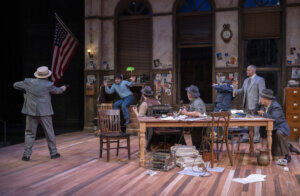
Ben Hecht and Charles MacArthur’s 1928 Chicago newsroom comedy The Front Page was so famous that when Harry J. Romanoff died in 1970, his New York Times obit referenced it. And in a 1986 review of a revival with John Lithgow as the conniving editor Walter Burns and Richard Thomas as the ruthless reporter Hildy Johnson, Frank Rich asked: “is there anyone who hasn’t seen The Front Page?”
Staged by George S. Kaufman and produced by Jed Harris, the original ran at the Times Square Theater for 276 performances. It has had many lives, including Howard Hawks’ fantastic 1940 screwball comedy, His Girl Friday. Hawks brilliantly turned the bromance into a he-she love story, casting Cary Grant as Walter Burns and Rosalind Russell as Hildy. He also softened the script so that it passed The Hays Office — the film censorship bureau named for ex-Postmaster General Will H. Hays.
The play’s many admirers include Walter Kerr, another New York Times critic, who, writing about a 1969 revival, memorably described it as ” like a watch that laughed.” David Mamet praised Hecht and MacArthur’s satire in several places, once calling it “arguably the best American play.” Tennessee Williams wrote that it “uncorseted the American theater,” and Kenneth Tynan and Tom Stoppard loved it.
Hecht, who, according to researcher Jesse Tisch in an essay on Medium, did the majority of the writing, died in 1964 and our century seems more ambivalent about the play. Some critics loved the 2016 Broadway version, which Jesse Green, then of New York Magazine, said had been pieced together from several scripts. That production’s all-star cast, including Nathan Lane as Walter Burns and John Lithgow as Hildy did not prevent the late Terry Teachout from calling it “toothless.”
Part of the play’s slide may be related to the demise of legacy journalism. Chicago is down to two newspapers from the seven of the era of The Front Page. And part may be style. The long, crowded scenes lack the propulsive energy of a lot of streaming-influenced drama and the characters lack the tormented interiority many theater audiences have come to expect.

Now, the first major production in ten years — by the playwright Jeffrey Hatcher, best known for Compleat Female Stage Beauty, which became a film starring Billy Crudup, and for a 2022 stage adaptation of Dial M For Murder — has opened Northlight Theatre’s inaugural season at their $33 million building in Evanston.
Set in a crummy press room in the Criminal Justice Building in Chicago, The Front Page was the first Broadway show about zany, wisecracking journos and the corrupt politicians they took down. About to quit the paper, get married and move to Buffalo, Hildy Johnson stumbles onto death row inmate Earl Williams’ jailbreak. Walter Burns wrangles Hildy into covering one last scoop.
The play uses many sources, some of which contradict each other. In Chicago, Hecht had both devoured and befriended the Jewish comics of the day. He loved clowns, including The Marx Brothers. The Cocoanuts, the 1924 Marx Brothers’ Broadway madcap vehicle that George S. Kaufman wrote and directed and Irving Berlin wrote music for anticipates certain elements of The Front Page. Set in a resort hotel instead of a newsroom, its crime and con-filled ambiance and fast-talking shyster characters seem like a prequel to Hecht’s drama.

But The Front Page also came out of the imagination of a first-generation American Jew who came of age in the 1910s. Born in 1893 in New York, Hecht moved west with his Russian immigrant parents, settling at age ten in Racine, Wisconsin. He arrived in Chicago when he was 16, became a journalist and hung out with figures in that city’s Literary Renaissance, most of whom were not Jewish.
Hecht had an enduring but tormented friendship with the writer Max Bodenheim, who was raised Jewish. It began with the men collaborating on plays and starting a modernist magazine, The Chicago Literary Times and descended into each satirizing the other in novels. Even worse, Bodenheim seemed to become Hecht’s evil twin. Like Hecht, Bodenheim was a provocateur. Like Hecht, he moved to New York. But where Hecht flourished, Bodenheim crashed into poverty. Hecht helped him financially. But he couldn’t save him. In 1954, Bodenheim and his third wife were brutally murdered in their apartment.
If Bodenheim was a daredevil, Hecht was a fabricator. He embellished his nonfiction, including chunks of his 1921 and 1922 column for The Chicago Daily News, ‘1,001 Nights in Chicago.’ Hecht’s Chicago peers mostly tolerated his provocations and fabulations. But as he grew famous, they became less tolerant. Writing in 1973, after Hecht’s death, Norman Mailer wrote that he was “never a writer to tell the truth when a concoction could put life in his prose.”

And yet to say that The Front Page is just an embellishment seems wrong. It is based in real life. Jazz Age Chicago had plenty of newspapermen, (some Jewish) who regularly impersonated people with accents, tall tales, and disguises to get stories. The city was full of Jewish criminals too, like Ike Bloom, who ran Midnight Frolics Cafe, a nightclub Hecht frequented. But the central characters Hecht and MacArthur used as models for The Front Page were not Jewish. Walter Burns is based on Walter Howell, a famously Machiavellian editor. The death row murderer Earl Williams is based on Tommy O’Connor, a convicted murderer who was never captured after he escaped the county jail in 1921.
Though Hecht didn’t write The Front Page until he left Chicago for New York in 1924, he continued to identify with the city — or at least his version of the city. In Hollywood where he won his first Academy Award for the silent gangster film, Underworld, he wrote dozens of movies including Notorious, Scarface, Twentieth Century, Design for Living, and Wuthering Heights and ghostwrote Gone With The Wind, Stage Coach, and A Star is Born. “He invented 80% of what is used in Hollywood movies today,” Jean-Luc Godard said in 1968.
Hecht liked to say that “he became a Jew at 39” in the late 30s, when he took up anti-Hitler activism. He wrote polemics entreating Americans to pay attention to Hitler and pageants, such as one staged in Madison Square Garden, encouraging the country to attack Germany. As the scholar Liesl Olsen has written, he was “a heroic truth-teller who demanded that his country act decisively during modern history’s blackest hour.”

But recent biographers have complicated the idea of Hecht’s Jewishness as a midlife discovery. In the words of one, Adina Hoffman, he was “divided,” the man who grew up hearing Yiddish. And he was, like a lot of Jews of his generation, not observant, instead using journalism and the performing arts to express his Jewishness. In his Chicago days, literature and theater were his response to literary friends (and enemies) characterizing his Jewishness in one way or another.Carl Sandburgaffectionately referred to him as the “Jewish Huck Finn.” Ezra Pound (less affectionately) called him “Rabbi Ben Hechtenberg.”
Hecht had to protect himself, either by acting tough, or by submerging himself in characters and fantasies. So he turned to theater. In Chicago, he wrote plays with Sherwood Anderson and then with the founder of The Goodman Theatre, Kenneth Sawyer Goodman. In New York, he briefly hung out with the Algonquin Table set, many of whom dabbled in theater. But it was not a mutual admiration society. Dorothy Parker complained about his “smiling and swaggering savageries” and Alexander Woolcott wrote, “Hecht’s favorite character in literature is the disconcerting little boy who, when the King paraded in the imaginary robe, cried out: ‘But he hasn’t got anything on!’” Even the actor George Jessel, meeting Hecht during a rehearsal of The Front Page, described him as a yokel “wearing a loud red tie and a shirt that might have been used as a stage curtain for a troupe of very gay midgets.”
In The Front Page, Hecht and MacArthur wrote a play that, with its profanity and cynicism towards politicians and journalists, initially attracted the attention of the police, who sent stenographers to note the supposedly pornographic dialogue. But nothing much came of the outrage except that the play became a hit. Nearly 100 years later, the classic vehicle seems, at first glance anyway, more charming than shocking.
The new production is directed by Northlight Artistic Associate Director BJ Jones, who was an official artistic associate at Skokie’s now-defunct National Jewish Theater in the 1980s and 1990s.
Jones sees The Front Page’s legacy in 20th century Jewish writers, especially ones with a Chicago connection — David Mamet’s scurrilous language, Larry Gelbart’s rat a tat dialogue in M*A*S*H.
Reading The Front Page now you also might get the sense of a Jewish play manqué: its outsider characters, its energy, its cynicism. Jeffrey Hatcher, who adapted it, says. “It’s Jewish in the same way as you could say about Irving Berlin, ‘there’s nothing Jewish about him except for everything he says.’ You feel it in the razzamatazz of the talk.”
Here are the first lines of the original 1928 script, in which the guys are playing poker:
The Card Players: crack it for a dime….by me…I stay…me too….I’m behind again…I was even a couple of minutes ago… papers…three…two…three to the dealer.
The scene is urban melting pot! Jazz! Vaudeville! As Hatcher puts it: “The play is chock full of Irishmen, Wasps, Presbyterians. But Jews are not there except in the style and verve of the language.” For his part, he names Officer Jacobi, who in the original is “voice from jail yard.” And he adds Abramovitz, an offstage journo.
Hatcher also wisely kept the gender-flipped casting from Howard Hawks’ His Girl Friday, in which star reporter, Hildy Johnson, was played by Rosalind Russell. He whittles down the play from three acts to two and the cast from 23 to 13. And he cleaned up some of the slurs. Like Hildy calling Jacobi “pickle nose” and the word “sissy.”
He did, however, keep “Polack Mike.” “We don’t want to blunt the knife so that it’s a butter knife,” he said.
Still, there is something constricted in The Front Page. The long scenes are sometimes funny, but also cruel, this world where nepotism and corruption rule, violence is king, and an editor and a politician manipulate everyone. If Hecht’s divided Jewishness led to his outsider take on Chicago journalism, his world can also seem hollow.
In the famous last scene, Walter lets Hildy go off to get married and even gives the happy couple his watch. The minute they leave, he calls his henchman to get the police to arrest them. And then he delivers the fabulous last line as if he himself even believes it: “The son of a bitch stole my watch!”
In 1928 the phrase “son of a bitch” shocked audiences. Now it seems quaint. But the vignette made me consider how the play takes people’s selfishness and cruelty for granted. Those in charge are so glib about the lives of others, including those they supposedly love. It barely seems like a comedy anymore; it’s too real.
*
The post There’s nothing Jewish about this classic American comedy — except just about everything appeared first on The Forward.
