


Local News
What impact have the shootings in Toronto and the war with Iran had on Winnipeggers?
By BERNIE BELLAN (Posted March 11) I suppose that many of you have been wondering where I’ve been the past couple of months. After all, I’ve barely been writing any articles – although I have been working behind the scenes, editing articles contributed to the Jewish Post by other writers.
But, I had been rather content to lay back and enjoy the sun in Mexico – where I’ve been the past six weeks, without bothering to write anything.
Then, on Monday, March 9, I received an email from someone in Toronto asking me whether I’d be interested in interviewing three members of Toronto’s Jewish community with an eye toward writing something about how recent attacks on Toronto synagogues had impacted that community.
I replied that I was somewhat interested in doing that, but I wanted to situate any story I might write in a larger context, i.e., how has Winnipeg’s Jewish community itself been impacted by what happened in Toronto – when three different synagogues had been shot at in the space of five days, beginning in late February with a shooting at a Reform synagogue and culminating with two attacks on two other synagogues on March 8. (As of the time of writing there have been no arrests reported in any of the incidents.)
The person in Toronto who sent me the email asking whether I’d be writing about what happened in Toronto did follow up with quotes from two of the individuals whom she had asked whether I’d be interested in interviewing. (I had asked her to do the legwork on conducting any interviews since I wasn’t sure how pertinent what the interviewees might have to say would be to this story).
Here is what one of the interviewees, Sylvan Adams, President of the World Jewish Congress Israel Chapter, had to say, in reaction to the shootings at the three synagogues: “The nearly daily shooting this week at the synagogues in Toronto is part of a pattern of violence against the Canadian Jewish community. This is entirely alarming and must be stopped, rather than the weak statements we’ve been hearing for far too long from our Prime Ministers, beginning with Trudeau, who never failed to equate Islamophobia after every antisemitic incident. More recently, we’ve heard empty words from Prime Minister Carney, who is simply going through the motions. This would not happen if attacks were against ANY other community. Moreover, these acts of violence should concern far more than the Jewish community alone. When Jewish houses of worship and other institutions come under attack, it is a warning sign for every democratic society. History has shown that what starts with the Jews never finishes with the Jews. These violent antisocial acts are an attack on our way of life. It is part of the war between western civilization and medieval barbarism.”
Whoo boy! Why don’t you come out and say what you really think about the Liberal government, Sylvan?
Now, as if that weren’t harsh enough – in terms of attacking the federal government for not doing enough to protect Canadian Jews, I received an email from an organization called Tafsik, about which this paper had reported when they held an event in Winnipeg last winter. The email was headlined: “The Police REFUSE To Protect The Jewish Community, So Who Should?”
It goes on to say that “For months, we have been told to rely on police and politicians. Yet the results speak for themselves. Police statements multiply; political promises abound. But Jewish institutions and synagogues remain exposed, Jewish businesses are attacked, Jewish schools shot at and Jewish families are left wondering who is actually responsible for their protection.”
What are the solutions Tafsik recommends: “There are roughly 100 synagogues in Toronto and Thornhill area. A practical and financially feasible security model could involve deploying approximately 35 off-duty police officers rotating between institutions on unpredictable schedules. Such a system would ensure a constant professional presence while preventing potential attackers from predicting which locations are protected at any given time.
“The cost would be approximately:
~$100 per hour per off-duty officer
~$2,400 per officer per day
~35 officers rotating year-round
Total annual cost: approximately $30.6 million.”
But, if that seems a little too expensive, Tafsik also recommends a second possibility: “Demand your advocacy organization, CIJA, to lobby the government to permit licensed Jewish security organizations, such as Magen Herut and Shomrim, to obtain firearm carrying permits for trained personnel. Allowing properly vetted and licensed guards to operate in this capacity could significantly reduce costs compared to relying on police officers for security, while still improving protection for Jewish institutions and businesses.”
Great – now we’ll have armed Jewish security guards protecting Jewish institutions. The problem is how does an armed security guard or even a policeman stop someone with a high-powered rife, who can fire from hundreds of metres away, from shooting at a synagogue? All the synagogues fired at had security cameras. Still no arrests though. Doesn’t that tell you that whoever wants to take a shot at a synagogue is taking careful steps to make sure they’re not caught on camera?
The person in Toronto who asked me whether I’d be interested in writing about the Toronto situation sent me one more quote though, this time from a Holocaust survivor by the name of Sol Nayman:
“My wife Queenie and I went to Shul on Shabbat morning. And we can’t go through the main door – we were told to take the side door. We didn’t know what was happening – we saw some boarding up, so we thought maybe there was an accident. And then during davening one of the members of our security team told us what had happened Friday night.
“It’s horrible. Just horrible, horrible, horrible. What we’ve been through, and we don’t know when it will end.
“It’s been all over the news. I’ve had call and emails from friends in Israel, and Scotland.
“And you know, it’s not the first time. I try to remind our people that Zachor appears in the Torah by over 200 times. So we remember. We remember Pharaoh. We remember Amalek. We remember Haman. We remember Hitler… and the Khomeinis and the others.
“But at the end of the day, we will be the ones who survive. And this year, I’ll be on the March of the Living, which will be, combined with other trips to Poland, my 11th journey. And, having turned a young 90, I will hope to keep on going as long as long as I can!”
I like that spirit of defiance, but when it comes to the allusions to past cases where individuals wanted to wipe out the Jews – well, I can understand the emotional reaction but hey, let’s keep it in perspective: A gunshot through a synagogue door or window doesn’t mean someone wants to wipe out the Jews.
Okay – tensions are high in Toronto. That much is clear from everything you’ve read thus far. But, what about Winnipeg? I’ve been wondering.
Are members of the Jewish community in Winnipeg as much on edge as Jews in Toronto apparently are?
On Monday, the federal government announced that it was providing an additional $10 million to enhance security for Jewish institutions across Canada: “The federal government is earmarking $10 million to help Jewish communities bolster security at their gathering places after two Toronto-area synagogues were struck with gunfire.
“The money dispensed through the federal Canada Community Security Program is meant to help protect Jewish places of worship, schools, child care centres, overnight camps and other institutions.
“The program offers organizations at risk of hate-motivated crimes money for security equipment and hardware, such as protective barriers and window and door reinforcements.”
The Saturday, March 7 Free Press also reported that “Winnipeg police said they are increasing patrols around synagogues and Jewish community spaces in an effort to provide ‘reassurance’ to the local community.
“ ‘We haven’t received any similar types of associated threats, WPS Const. Dani McKinnon said Saturday. We’ve taken these types of precautions many times before, because we do have a large community we want to support. And this type of message resonates across Canada.’
But, haven’t we heard quite a few times before that the WPS is heightening patrols around Jewish institutions – especially since October 7, 2023? Does that mean they decrease patrols at some point – perhaps when things seem to be a little calmer?
The article went on to quote vice-president of the Centre for Israel and Jewish Affairs in Manitoba and Saskatchewan Gustavo Zentner, who said Saturday “Canada’s leaders ‘must be absolutely clear that it is outrageous for Canadian communities to face violence because of events happening abroad.’
“ ‘No more ‘thoughts and prayers’ — we need to see urgent action,” Zentner told the Free Press. ‘All levels of government must move immediately to address the escalating security demands of communities targeted by this wave of violence. Resources should flow quickly and distributed directly to communities most at risk.’
What more “resources” woulld want to see Gustavo did not say. But the Jewish Federation did hire a new community security director, William Sagel, earlier this year. In an article written about Sagel, Myron Love quoted Sagel as saying he wanted to emulate the model of security adopted by the Toronto and Montreal Jewish communities. suggesting that the Jewish community in Winnipeg “can learn from the national network and security networks already established in Montreal and Toronto to provide security and peace of mind for community members.” (I’m not so sure how that observation jives with what just happened in Toronto though.)
In the same Free Press article of March 7, Federation CEO Jeff Lieberman added his own two cents, observing that “Attacks like those in Toronto are deeply troubling.
“ ‘Incidents like these are meant to intimidate the Jewish community and make people feel unsafe in their places of worship. Canadians should be alarmed that synagogues in this country are once again being targeted with gunfire.
“ ‘We are in regular contact with our security partners and with the Winnipeg Police Service. While we do not comment on specific security measures, the safety of our community remains our highest priority, and we are continually refining our policies, procedures, and infrastructure. We appreciate WPS increasing patrols and their ongoing efforts to help protect synagogues and Jewish community institutions across our city.’ “
But, there was another question that loomed in my mind: How are average Winnipeg Jews reacting in terms of their day to day behaviour?
To answer that question I sent inquiries to representatives of a number of different organizations, including the Jewish Federation, CIJA, Shaarey Zedek and Etz Chaim congregations, and the Chabad-Lubavitch.
I asked each of them what they’ve been hearing from members of the Jewish community? Are people more frightened now – especially with what happened in Toronto – along with what’s going on in the Middle East? Has synagogue attendance been affected in any perceivable manner? I wondered. Perhaps it’s even gone up – as synagogue goers want to show solidarity with other members of the community?
We did receive a response from a spokesperson for the Jewish Federation in answer to my question: What is the mood among Jewish Winnipeggers at the moment:
” From what we’re seeing across the community, people are certainly aware of what’s happening elsewhere and there is concern – understandably so. But we are not seeing people withdraw from Jewish life or avoid community spaces.
“In fact, attendance at programs and services has remained strong. As you noted with the Purim celebration at Chabad, people continue to show up. In some cases, people are attending out of a sense of determination to not to let those who seek to intimidate us, or deter Jewish life, dictate whether or how we gather.
“At the same time, there is a heightened sense of vigilance. Many organizations are improving their procedures and security measures, and our Community Security Director, William Sagel, is working with them to refine policies, strengthen infrastructure, and coordinate with security and law enforcement (where appropriate).
“So the mood we’re seeing is both awareness and resolve. People appreciate that security is being taken seriously and understand the precautions, but they are not allowing incidents elsewhere to deter them from showing up and participating in Jewish life here in Winnipeg.
Rabbi Avrohom Altein of Chabad also responded to my questions, writing in an email: “Generally, we have had growing numbers of people for events. Purim – we had 230 people at our Purim Seudah and many at each Megillah Reading. We do have security at large events and the police stopped by today to say that they will do regular checking.
“But the world is open today, so news of what happens elsewhere does affect people all over.
“We try to encourage Jews to support each other and strengthen their connection to Mitzvos because that is our true identity. When we try to hide who we are, we lose respect from others. And when we are proud and strong as Jews and support each other, we are safer and earn Hashem’s protection and brochos.”
I responded to Rabbi Altein that I had attended a number of Chabad events in Puerto Vallarta. One of them was called “Shabbat 400” – where 400 Jews gathered together one Friday evening. That event was organized by local Chabad Rabbi Shneur Hecht – along with his dynamic wife, Mushkie.
During the event Rabbi Hecht told attendees that it had been very difficult to find a venue willing to host an event of that size – because of security concerns. There was security at the event – and it went off without a hitch, but it was an indication that the threat of violence against Jews is of worldwide concern. (Ironically, only a week later, violence did break out in Puerto Vallarta, but that had nothing to do with Jews – it was the Jalisco cartel reacting to the killing of their leader, El Mencho.)
The local Chabad does have a couple of police stationed outside when events are occurring there, but what struck me was that the name “Chabad” is displayed prominently outside the building, which is located on a main thoroughfare in Puerto Vallarta. I would have thought the sign would be somewhat more discreet. It does present a juicy target for anyone who wants to send a message by attacking Jews.
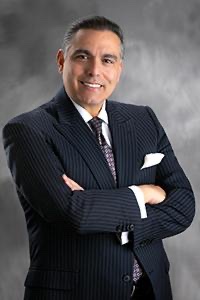
We also spoke with Rabbi Carnie Rose, spiritual leader of Shaarey Zedek Congregation. We asked him what the mood was among Shaarey Zedek members – in light of the recent triple shootings in Toronto and what is, at the time of writing, the war raging in the Middle East.
During the interview Rabbi Rose highlighted the Jewish community’s dual experience of concern over resurgent antisemitism and war, balanced by strong interfaith support and enhanced security measures. The community’s determination not to be intimidated by threats of violence reflects resilience, he suggested, while proactive engagement through, for example, school outreach and tangible safety steps, such as increased police collaboration fosters hope for “a better tomorrow,” he said.
Rabbi Rose suggested that congregation members are “concerned and worried,” but not surprised. They view large centres like Toronto as distant, but acknowledged the gravity of antisemitism, noting that it has become less muted recently. Rabbi Rose expressed sadness but not shock, stating, “There are folks out there who don’t like us, and they’re gonna take their… shots.”
Despite antisemitism, Rabbi Rose indicated that he was “profoundly heartened” by support that the congregation has received from varied – and disparate elements of the community. He cited as examples: “Older ladies” visiting the synagogue to show support; members of the Islamic community offering to “make a circle around the synagogue to protect people”; and schools requesting talks on Judaism to address questions like “why do people not like the Jewish people?”
Insofar as how congregants have been reacting to the war with Iran, Rabbi Rose observed that there are people both in and outside the Jewish community who are unhappy with the war, but the community stood in solidarity with monarchists at a recent rally (with Jewish flags). Rabbi Rose himself said that he believes Israel should not withdraw prematurely from the fighting, as “gains would dissipate quickly.”
We asked Rabbi Rose whether there have been enhanced security measures taken at the synagogue recently. He noted an increased police presence, saying that visible security has intensified, including police patrol cars greeting attendees after a large funeral (unprecedented in Rabbi Rose’s eight to nine months in the role, he observed).
He added that there has been a large police presence at events with 250+ people, citing as examples a public school teacher training session on antisemitism that included a synagogue tour and mini-Judaism course, also recent Purim gatherings.
Rabbi Rose described collaboration with Winnipeg Police Service as “excellent, and he expressed a “deep debt of gratitude.”








Local News
Quick action by archivist Ava Garfinkel saves Jewish Heritage Centre of Western Canada archives from disaster
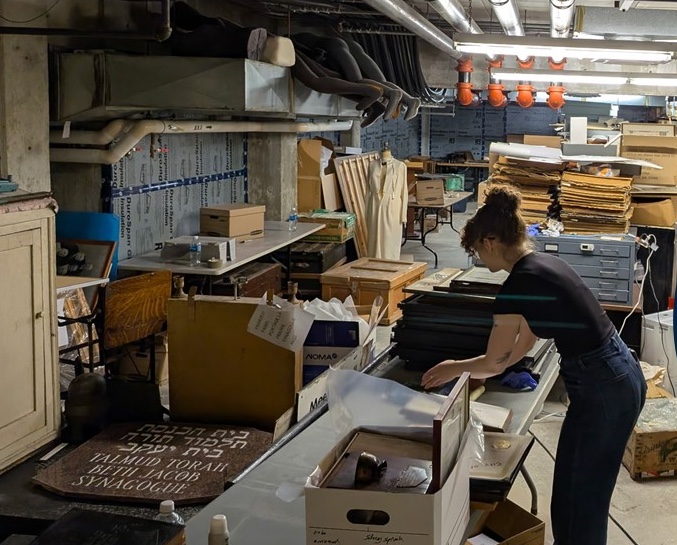
By MYRON LOVE The downpour that struck our city on Tuesday, June 9, left a trail of basement flooding and other damage in its wake. As reported elsewhere in this issue of the Post, Temple Shalom, our community’s Reform Congregation, has been forced to relocate its services to other venues because of water damage that has made its building unusable for the foreseeable future.
Another of our institutions that was affected by the storm is the Asper Jewish Community Campus – and specifically the lower level, where the Jewish Heritage Centre of Western Canada stores a good portion of its archives. It was the quick action of archivist Ava Garfinkel and her brother, Max, as well as a number of volunteers in the following days – and the miracle of modern technology – that saved those archives from destruction.
“This was a potentially devastating and irreversible crisis,” notes Belle Jarniewski, the JHCWC’s executive director. “Thanks to the quick and diligent work of our staff and a team of kind volunteers, we were able to implement an emergency disaster plan, separate the affected material and move the damp archives to a frozen storage facility within 48 hours. These crucial actions successfully saved the archive, avoiding any mold growth that would have spread throughout the entire collection at a rapid pace, eventually destroying even the parts of our collection that were left untouched by the flood.”
Jarniewski reports that Garfinkel reached out to conservators across Canada for help. The frozen materials have now been transferred to an out-of-province facility where they will be vacuum freeze-dried in a restoration process overseen by a conservator.
“Our dry and unaffected archives and artifacts were also quickly removed from the basement and brought upstairs to be stored in several places around the Campus,” Jarniewski says. “The directors of the Gray Academy and the Asper Community Campus were kind enough to offer us the space we required to temporarily store our collections.
“The JHC Archive,” she points out, “preserves the precious history and physical memory of our community, also that of the communities across Western Canada and Northwestern Ontario whose histories have been entrusted to us. It dates back to the late 1800s. Information about the delicate, old, and irreplaceable items is frequently accessed by students, researchers, educators, genealogists, and community members. Simply put, the archive constitutes the very heart and memory of our community.”
Jarniewski recounts that when the Campus first opened almost 30 year ago, several rooms on the first floor were specifically designed with climate control suitable for an archive or museum. But, as different community needs arose, the archives were moved out of the specialized spaces and into the basement.
“With space at a premium in the building, we have had to do our best with the cards we were dealt,” she says.
For security and other reasons, Jarniewski points out, moving the JHCWC archive out of the Asper Campus has never been a viable option. “Our museum, our offices, and the other half of our archive are all firmly situated in this building on the main floor,” she notes. “We work within our basement archive daily and we rely on the safety that the security within the Asper Campus affords us.”
To prevent this kind of near disaster again, she added, the lower level storage area has to be renovated for safety while maintaining the standards of practices for long-term preservation. “We have already put a plan into motion for more effective humidity control and the sealing of the room,” Jarniewski reports.
“All of our textual records must be placed in specialized archival enclosures, our artifacts must be re-boxed/wrapped according to their individual preservation needs, and we must purchase adequate shelving that will keep our collections away from the ground and the walls while allowing for effective air circulation. These protective measures will be costly, requiring specialized materials, but they are necessary.”
The overall estimated budget for this project, Jarniewski says, is approximately $100,000. So far, she reports, the JHCWC has received a quarter of that amount through donations..
She expresses the hope that Post readers will consider donating to this essential project so that the JHCWC can continue protecting the priceless history of Western Canadian Jewry for generations to come. A tax receipt will be provided to all donors.
“With the funding in place, we should be able to have everything in place in less than six months,” Jarniewski says.
Readers who may want to consider donating to the JHCWC in support of this vital project can either phone 204 478-8590 or go online to jewishheritage@jhcwc.org. Donations can also be made online though Canada Helps: https://www.canadahelps.org/en/charities/jewish-heritage-centre-of-western-canada-inc/
Local News
A response to Isha Khan’s op-ed in the August 1st, 2026 issue of the Winnipeg Free Press
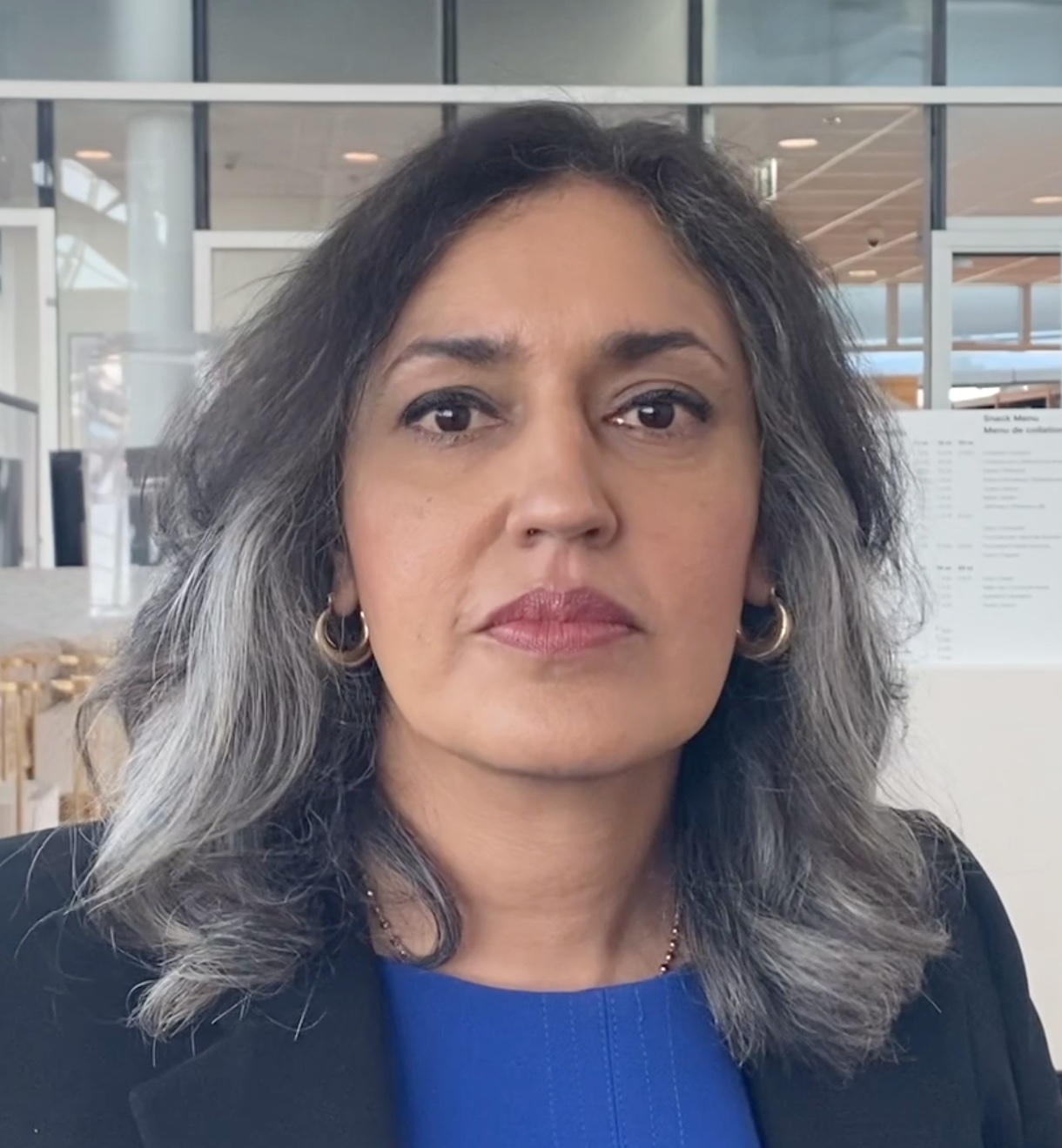
By SIMONE COHEN SCOTT Ed. note: Isha Khan is the CEO of the Canadian Museum for Human Rights. In the August 1st issue of the Winnipeg Free Press Ms. Khan wrote an op-ed defending the museum’s decision to mount the exhibit titled “Palestine Uprooted: Nakba Past and Present.” The Free Press has published many letters about the exhibit, but some readers of that paper are frustrated that their letters were not published. We were asked by Simone Cohen Scott whether we would print a letter that she had sent to the Free Press, but which was not published.
Since there is always room on this website to publish as many articles as we’d like, we agreed to publish Simone’s letter, which follows here:
Isha Khan states in her op-ed piece that the choices of what to exhibit, what to examine, what to feature, were made according to certain parameters, which she called a “framework.” What, specifically, comprised this so-called framework? It is obviously exclusive of elements relative to the history of the period displayed. She said the purpose of the exhibit was….”to promote reflection and dialogue.” Reflection and dialogue about what? Did the Arabs who left the area know that the United Nations had offered them a state too? If they had known, would they have wanted to accept? If, given the choice, would they have stayed and lived beside the Jews? Or, did they indeed, want five Arab nations to attack the Jews? Such questions as these would have promoted “reflection and dialogue.”
What is the understanding implicit in the exhibit? Khan quotes from a banner that hangs in the museum: Article 1 of the Universal Declaration of Human Rights, “We are all born free and equal in dignity and rights.” Should the Jews have rights? If so, what should they be? May they have a state? When a people is attacked by 5 nations, as Israel was in 1948, wherein lie the human rights?
Why did Khan’s advisors choose to use the word Nakba in the exhibit title? The original use of the Arab word ‘nakba’, meaning disaster, was intended to depict, that in spite of being assured by the Arab/Islamic leaders that it would be a quick war and that they would win, that did not happen. The word disaster was meant to mean the shock and the disappointment. The real disaster, or tragedy, ‘Nakba’ if you will, is that the Arab/Islamic countries in the world, (and there are plenty of them), have refused to welcome refugees of a war their own leaders chose to start. They have allowed these displaced persons to stagnate in UNRWA, an industry in itself. Where are the stories of the people in UNRWA housing? Another group it would have been enlightening to hear from is today’s Israeli Arab population – the doctors, dentists, nurses, lawyers, judges, entrepreneurs, business moguls and more, the descendants of those who stayed in the country in 1948, who had and whose offspring have had the same opportunities as every Israeli citizen. There is much easily accessible research that has been neglected in the preparation of this exhibit. This blatant lack of effort is shameful.
Kahn explained, when asked, that the context of the conflict of the time is too complex to have been included. Is she saying that people who go to museums can’t handle broad, multi-faceted ideas… that she deliberately designed a walk-though soundbite, not a process for mind-expanding grasp of history?
Simone Cohen Scott,
(sent to the Free Press August 13th, 2026)
Post script from Bernie Bellan: This website has never refused to carry any post that may be critical of the CMHR, despite what some readers of this website might think. We do allow comments to articles, but anyone commenting through our “Comment” portal has to register by giving their name and email address so that we can confirm they are a real person. In addition, we welcome longer contributions from readers. Many of the posts you will find on this website come from regular contributors, such as Henry Srebrnik. If you have something you’d like us to consider publishing – and the only criteria are that it be reasonably well written and void of slanderous remarks, email to us at jewishp@mymts.net.
Local News
Young Winnipegger Dr. Yale Michaels receives $550,000 Canadian Cancer Society research grant
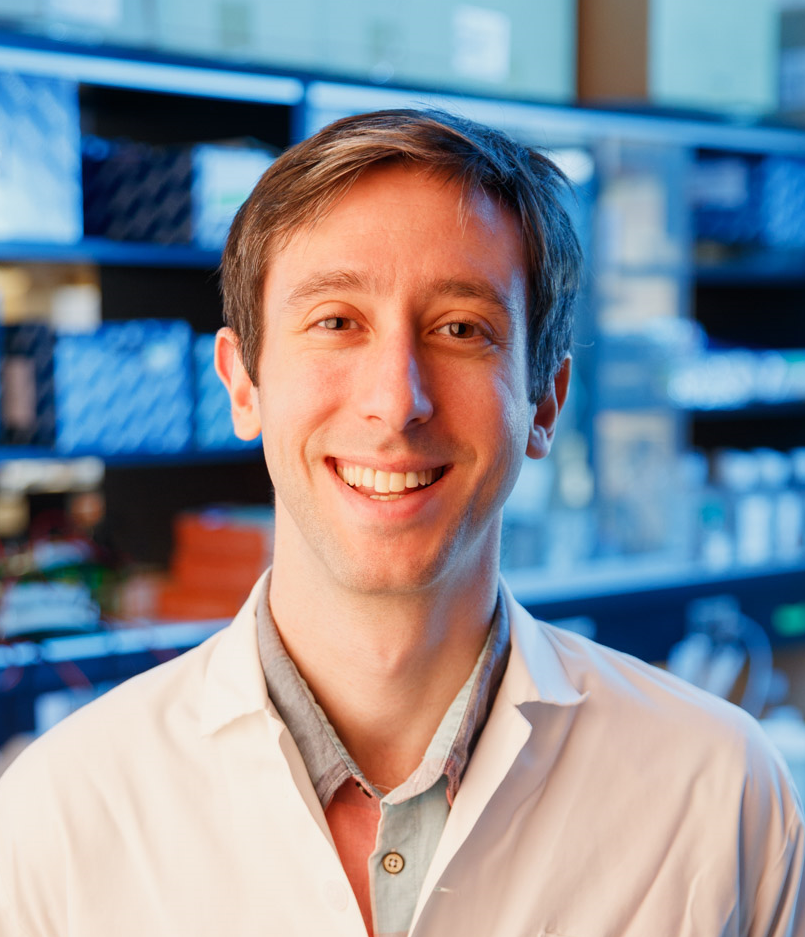
By MYRON LOVE It has been shown on many occasions that a teacher can have an outsized role in shaping a young person’s life. Dr. Yale Michaels’ life story is one example.
During a recent interview with the young cancer researcher – the son of John Michaels and Karen Stern – Yale recounted how a Grade 7 teacher at Grant Park High School was largely responsible for his decision to pursue a medical career in medicine.
The young Michaels attended Brock Corydon Elementary School and was a long time Massad camper. In junior high school at Grant Park, however, he recounts, “I was having a tough time staying on task. Thankfully, my Grade 7 science teacher suggested that I might find it interesting volunteering to help in a cancer research lab. He had a contact and got me in. I loved it. It was a good fit for me. I never looked back.”
Michaels (whose zaida, Leon Michaels, was a leading cardiologist here) spent much of his free time during his high school years volunteering in the lab. After graduation, he enrolled in Harvard –with help from the university’s financial aid program – where he earned his Bachelor’s degree. He followed that up with a Ph.D. from Oxford in 2019, followed by three years as a post-doctoral Fellow – before returning to Winnipeg in 2023 to work at Cancer Care Manitoba, as well as teach at the University of Manitoba.
“I enjoyed my time both at Harvard and Oxford,” he says. “What made England even more enjoyable is that Yale has family there. His grandparents – Leon and Joan Michaels – were born and raised in London and Yale’s time there overlapped for a few months with his brother Jamie (about whom there was a story in a July issue of the Post), who earned his Master’s Degree in Creative Writing at the University of London.
This past June, the young researcher learned that he was to be the recipient of a $550,000 Canadian Cancer Society Emerging Scholar Research Grant, covering five years of research.
Michaels’ field of research focuses on new ways of combating blood cancers – specifically in the new area of immunotherapy. He is being aided in his research by lab tech Dana Segal and graduate student Serena Dembowksi.
Michaels adds that he is collaborating with a number of other researchers from Winnipeg – and throughout Canada, including Drs. Harinad Maganti, David Szwajcer, Jody Haigh, Versha Banerji, and David Knapp.
Using the patient’s own immune cells – specifically CAR T cells -to treat blood cancers was first approved in 2017, Michaelsreports. “The treatment has shown itself to be really successful. Many patients go into remission and some may have the potential to be cured.”
One of the drawbacks, he explains, is that the treatment is prohibitively expensive. Each dose costs about $500,000 U.S.
“What we are trying to do in my lab and elsewhere is find a way to greatly reduce the cost,” he explains. “It becomes a matter of scale. Other drugs used in treating cancer can be produced in amounts of 1,000 doses per production run. But right now CAR T therapy is made on a one-off basis with an individual manufacturing run for each patient. We are attempting to instead make CAR T cells from stem cells – which can be grown in large quantities. We are trying to use genetic engineering to manipulate them so that they can be administered safely to patients.
“We (Michaels and fellow researchers) are making good progress in this area,” he adds.
He cautions that the research is still in the formative stages and that clinical trials are still several years away. “Our research so far though has shown that our treatment would seem to be effective at killing cancer cells,” he reports. “This grant from the Canadian Cancer Society will help us to further that research.”
Outside of work, Michaels notes, much of his time is spent with his family – Dr. Allison Marmel and their two-year-old daughter, Rose.
(Ed. note: We should note that Yale Michaels was also the punter for the Harvard University football team – by far his greatest achievement.)
