


Uncategorized
When a Jewish Landmark Disappears, So Does Jewish Presence

The Contemporary Jewish Museum. Photo: screenshot.
Another major Jewish institution has collapsed – and the implications reach far beyond San Francisco.
The Contemporary Jewish Museum (CJM) has closed and is selling its building. What was once a bold, architecturally striking institution in the heart of downtown will soon be something else entirely. Another civic space repurposed. Another cultural anchor lost.
I loved seeing that building. Designed by Daniel Libeskind, it was bold, unmistakable, and confident – right off Yerba Buena Gardens in the heart of the city. It stood prominently, not tucked away or obscured, but fully visible. It sent a simple but powerful message: Jewish life belongs in the civic fabric. For me, it was a symbol of pride.
And now it is gone.
The explanations offered are familiar. Attendance declined by roughly 50 percent from 2019 to 2023–2024. Revenue fell. In the fiscal year ending June 2024, expenses outpaced revenue by more than $5.9 million. Leadership acknowledged that the building itself had become “beyond our capacity” to maintain.
All of that may be true. But it is not sufficient.
Institutions do not simply collapse because conditions change. They collapse because they fail to respond to changing conditions with clarity, discipline, and purpose. And when a flagship Jewish cultural institution disappears in one of the wealthiest and most philanthropic regions in the country, it is worth asking not only what happened, but what it says about us.
At one level, this is a story of institutional failure. The museum expanded into a large and expensive footprint – a 63,000-square-foot facility completed in 2008 at a cost of $47 million in a city already becoming more difficult to sustain. It relied on a fragile mix of philanthropy and foot traffic in a downtown that was hollowing out even before COVID accelerated the trend. The museum was still carrying roughly $27 million in outstanding construction debt. When those pressures intensified, there appears to have been no clear plan to right-size the institution, refocus its mission, or rethink its role in a changing cultural landscape.
Instead, the result was a slow drift toward insolvency – followed by closure.
But the deeper problem is not simply managerial. It is cultural. And it was visible in the year before the closure, when the museum found itself caught in an episode that illustrated just how far it had drifted from its core identity.
In spring 2024, the museum mounted its first major open-call exhibition of California Jewish artists. Seven of the accepted artists withdrew their work in a coordinated protest, demanding that the museum commit to BDS – the Boycott, Divestment, and Sanctions movement against Israel – and divest from all funding associated with the Jewish state. The museum rejected those demands. But rather than confidently reaffirming its identity as a Jewish cultural institution, it hesitated publicly, left blank spaces on its walls where the withdrawn works would have hung, and framed the episode as a “complicated moment.” It was a moment that revealed an institution uncertain of what it stood for.
Too many institutions in recent years have confused relevance with purpose. In an effort to remain current, they have chased trends, embraced fashionable programming, and diluted the very identity that made them distinctive. In doing so, they have weakened the case for their own existence – both to the public and to their donors.
Jewish institutions are not immune to this drift. When they lose clarity about who they are and what they are meant to do, they risk becoming interchangeable with any number of other cultural organizations. And interchangeable institutions are far easier to abandon.
The museum’s collapse also raises uncomfortable questions about the direction of Jewish giving. The Jewish Federation Bay Area manages more than $2 billion in assets and provided millions in grants in fiscal year 2023 alone. The Bay Area is home to some of the most generous Jewish philanthropists in America. If a flagship institution like this cannot be sustained in that environment, the problem is not a lack of resources. It is a question of priorities.
Much contemporary giving is directed toward causes, programs, and initiatives – often important ones. But less attention is paid to sustaining the shared institutions that give Jewish life visibility, continuity, and public meaning. Museums, cultural centers, and communal spaces do not always produce immediate or measurable outcomes. But they create something more enduring: a sense of presence.
The board chair told reporters that the building “does not define the museum.” And perhaps he is right, technically. The executive director expressed optimism about a smaller, reimagined future. That deserves acknowledgment. But what has been lost in the interim – the physical presence, the civic statement, the visibility – cannot simply be reimagined back into existence. Presence is not just programmatic. It is architectural. It is spatial. It is the fact of a building that stands in the middle of a great city and says: we are here.
Places like the Contemporary Jewish Museum did something rare. They connected past and present, insiders and outsiders, tradition and creativity. They offered a space where Jewish life could be explored without precondition – neither purely religious nor purely academic, but deeply cultural and civic at once. They were not simply museums. They were part of the infrastructure of Jewish public life.
The disappearance of such institutions is especially troubling given what is happening in the broader culture. The ADL recorded 9,354 antisemitic incidents in 2024, the highest level since tracking began in 1979 – a staggering 893 percent increase over the past decade. The FBI simultaneously recorded the highest number of anti-Jewish hate crimes since it began reporting data in 1991. A majority of American Jewish college students report feeling uncomfortable or unsafe on campus because they are Jewish.
At a moment like this, the disappearance of visible Jewish institutions sends precisely the wrong signal. It suggests contraction when presence is needed. It risks normalizing a quieter, less visible Jewish public life.
It is also worth noting that the CJM’s collapse is part of a wider pattern in San Francisco’s struggling cultural sector – the Mission Cultural Center for Latino Arts, California College of the Arts, and the nearby Mexican Museum have all faced severe financial distress in recent years. This context matters. The CJM did not fail in a vacuum. But it is not exculpatory, either. What distinguishes the institutions that endure is usually not better luck. It is clearer purpose and stronger accountability.
When an institution like this collapses in a wealthy and engaged community, it is rarely because no one cared. It is because no one felt ultimately responsible for ensuring that it endured. Not the board. Not the donors. Not the broader community.
Everyone assumes someone else will step in. And no one does.
That is the accountability failure. And it is correctable – if the community chooses to correct it.
The sale of the Contemporary Jewish Museum should not be treated as a local story or an isolated failure. It is a signal, one that should prompt concrete action.
Jewish philanthropists and federations should dedicate a meaningful portion of their giving specifically to sustaining cultural institutions – not just causes and programs, but the physical and civic infrastructure of Jewish life. Boards of Jewish institutions should be held to explicit accountability for institutional survival, not just programmatic innovation. And Jewish communities in every major city should ask, right now, whether their flagship cultural institutions are financially sound – and what they would do if they were not.
If the CJM survives in some smaller, reimagined form, that would be welcome. But the larger lesson stands regardless: Jewish presence in American public life is not self-sustaining. It requires deliberate investment, disciplined governance, and a community willing to prioritize endurance over the fashions of the moment.
Some institutions are easy to replace. Others are not.
The Contemporary Jewish Museum was more than a museum. It was a statement.
And its disappearance should force us to ask whether we are still willing to make such statements – or whether, slowly and quietly, we are allowing them to disappear.
Samuel J. Abrams is a professor of politics at Sarah Lawrence College and a senior fellow at the American Enterprise Institute.
Uncategorized
Car Torched in Antwerp in Suspected Antisemitic Attack, Says Belgian Official

A Jewish man rides past Belgian army personnel patrolling a street as part of a deployment of soldiers outside Jewish institutions in Antwerp and Brussels following attacks at Jewish sites in Belgium and other European countries, in Antwerp, Belgium, March 23, 2026. Photo: REUTERS/Yves Herman
The torching of a car overnight in Antwerp, for which two minors were arrested, is being treated as a suspected antisemitic attack, a Belgian official said on Tuesday.
European countries including Belgium, the Netherlands, and Britain have witnessed incidents targeting the Jewish community since the United States and Israel launched their war on Iran on Feb. 28.
Belgium on Monday deployed soldiers on the streets of its biggest cities to bolster security at Jewish sites including synagogues and schools.
A spokesperson for the Antwerp prosecutor said an investigation was under way, and that the two suspects had been arrested shortly before midnight on Monday, moments after the attack.
They said a video circulating on social media that purportedly showed the arson attack appeared authentic and was part of the investigation. Reuters did not independently verify the video.
Over the past two weeks, synagogues have been attacked in Liege, Belgium, and in the Dutch city of Rotterdam, as well as a Jewish school in Amsterdam. In Britain, counter-terrorism officers are leading an investigation into an attack on Jewish community ambulances.
“There must be a thorough investigation and decisive action to put an end to this climate of intimidation before it spirals further,” Israel’s ambassador to Belgium, Idit Rosenzweig-Abu, said on X.
The SITE Intelligence website said an Iran-aligned multinational militant collective called Islamic Movement of the People of the Right Hand had claimed responsibility for the attack near a synagogue in Golders Green, London.
It said the group had been behind the fires in Liege, Rotterdam, and Amsterdam.
Mark Rowley, London’s police chief, said the claim was one of the lines of inquiry being pursued.
Uncategorized
Iran Toughens Negotiating Stance Amid Mediation Efforts, Sources Say

Iranian Foreign Minister Abbas Araqchi speaks during a press conference following talks with Russian Foreign Minister Sergei Lavrov in Moscow, Russia, Dec. 17, 2025. Photo: REUTERS/Ramil Sitdikov/Pool
Iran’s negotiating posture has hardened sharply since the war began, with the Islamic Revolutionary Guard Corps (IRGC) exerting growing influence over decision-making, and it will demand significant concessions from the United States if mediation efforts lead to serious negotiations, three senior sources in Tehran said.
In any talks with the US, Iran would not only demand an end to the war but concessions that are likely red lines for US President Donald Trump – guarantees against future military action, compensation for wartime losses, and formal control of the Strait of Hormuz, the sources said.
Iran would also refuse to negotiate any limitations to its ballistic missile program, they said, an issue that had been a red line for Tehran during the talks that were taking place when the US and Israel launched their attack last month.
Trump said on Monday that Washington had already had “very, very strong talks” with Tehran more than three weeks into the war, but Iran has publicly denied this.
The three senior sources said Iran had only had preliminary discussions with Pakistan, Turkey, and Egypt over whether the groundwork existed for talks with the United States over ending the war.
A European official said on Monday that, while there had been no direct negotiations between Iran and the US, Egypt, Pakistan, and Gulf states were relaying messages. A Pakistani official and a second source also said on Monday that direct talks on ending the war could be held in Islamabad this week.
Pakistan‘s prime minister said on Tuesday he was willing to host talks between the US and Iran on ending the war in the Gulf, a day after Trump postponed threats to bomb Iranian power plants, saying there had been “productive” talks.
However, the US was expected to deploy thousands of troops from the elite 82nd Airborne Division to the Middle East, two people familiar with the matter told Reuters on Tuesday, adding to the massive military buildup in the region and fueling fears of a prolonged conflict.
In a post on X, Prime Minister Shehbaz Sharif said Pakistan welcomed and fully supported ongoing efforts to pursue dialogue to end the war.
“Subject to concurrence by the US and Iran, Pakistan stands ready and honored to be the host to facilitate meaningful and conclusive talks for a comprehensive settlement,” he said.
A Pakistani government source said discussions on a meeting were at an advanced stage and if it did happen, “a big ‘if,’” it would take place within a week. Pakistan has long-standing ties to neighboring Iran‘s Islamic Republic and has been building a relationship with Trump.
If any such talks were arranged, Iran would send Parliament Speaker Mohammad Baqer Qalibaf and Foreign Minister Abbas Araqchi to attend, the three Iranian sources said, cautioning that any decisions would ultimately lie with the hardline IRGC.
Iran’s use of ballistic missiles and its ability to effectively close the Strait of Hormuz, through which about a fifth of the world’s oil and liquefied natural gas usually flows, have been its most effective responses to the US-Israeli strikes.
It could not agree to give these up without leaving itself defenseless against further attacks, analysts say.
Inside Iran, domestic concerns are also constraining Tehran’s maneuvering room in negotiations, the senior Iranian sources said.
These concerns included the greater clout of the Revolutionary Guards, uncertainty at the top of the system, with the new Supreme Leader Mojtaba Khamenei having not yet appeared in photographs or video since his appointment, and a public narrative of resilience in the war.
Uncategorized
The JCPOA’s Sunset Has Arrived — and Iran Just Proved It
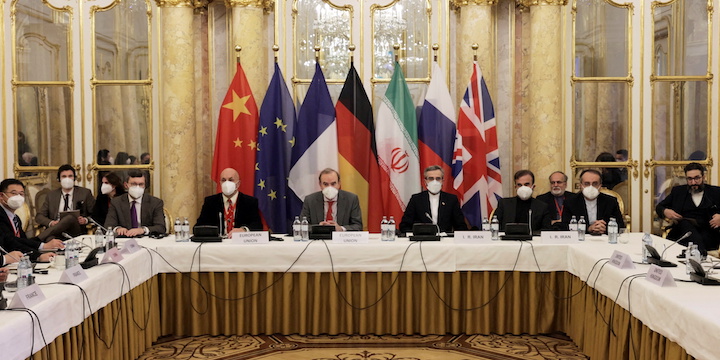
Deputy Secretary General of the European External Action Service (EEAS) Enrique Mora and Iran’s chief nuclear negotiator Ali Bagheri Kani and delegations wait for the start of a meeting of the JCPOA Joint Commission in Vienna, Austria December 17, 2021. EU Delegation in Vienna/EEAS. Photo: Handout via REUTERS
On the night of March 20-21, 2026, Iran launched two ballistic missiles at the joint US-UK base on Diego Garcia, an atoll in the Indian Ocean nearly 4,000 kilometers from Iranian territory. One failed in flight; the second was intercepted. Neither struck the base.
Iran’s Foreign Minister had stated weeks earlier that Tehran had deliberately capped its missile range at 2,000 kilometers. The gap between that claim and this week’s launch is not merely a military story. It is the story of the Iran nuclear deal (known as the Joint Comprehensive Plan of Action — JCPOA), and a direct answer to the question dividing Western foreign policy for a decade: what happens when the world tries to engage diplomatically with Iran?
On July 14, 2015, President Obama announced the JCPOA, and declared: “This deal is not built on trust. It is built on verification. We will be in a position to know if Iran is violating the deal.”
In 2026, that verification looks like a missile fired at a base 4,000 kilometers away, when Iran claimed its range limit was half that distance.
The Iran nuclear deal rested on a core assumption: that Tehran had come clean about its military history. The exposure of Iran’s nuclear archive by the Mossad, presented by Prime Minister Netanyahu in 2018, proved otherwise. Tehran had transferred its ambitions to a classified track, preserving its knowledge base intact and waiting for the restrictions to expire.
The JCPOA’s sunset clauses tell the story plainly. In October 2020, the UN arms embargo expired, allowing Iran to legally purchase tanks and aircraft from Russia and China. In October 2023, all restrictions on Iran’s ballistic missile and drone programs expired. In October 2025, the nuclear file was removed from the UN Security Council’s agenda.
Obama acknowledged this in an April 7, 2015 NPR interview with Steve Inskeep: in years 13 through 15, breakout times would shrink toward zero. The deal bought time. The question was always what that time would be used for.
The financial consequences were immediate. Iran gained access to over $100 billion in frozen assets. EU-Iran trade peaked at 20.7 billion euros in 2017. Airbus signed a $19 billion aircraft deal. TotalEnergies signed a $5 billion energy contract. Iran’s GDP grew 12.5 percent in 2016, per IMF data.
When asked in April 2016 whether this windfall would empower the Revolutionary Guard Corps, President Obama, speaking to Jeffrey Goldberg for The Atlantic’s “The Obama Doctrine,” argued that Iran’s infrastructure needs were too vast to leave room for IRGC expansion.
The evidence did not support that premise. The precision-guided munitions transferred to Hezbollah, the drones supplied to the Houthis, and the missile program that reached Diego Garcia were not funded by a government that ran short of money for domestic investment. The capital was fungible, and a revolutionary government proved capable of allocating it accordingly.
In that same interview, Obama called on Saudi Arabia and Iran to share the neighborhood, treating their rivalry as symmetrical rather than as a confrontation between a US partner and a state committed to violently reordering the region.
Within the administration, JCPOA preservation had become the flagship foreign policy achievement, generating a powerful institutional logic: any action risking Iranian withdrawal had to be weighed against losing the agreement. Governments in Jerusalem and Riyadh did not need to be told that escalation carried costs in Washington. Tehran read the architecture with precision. The years between 2015 and 2018 were among the most consequential in the construction of Iran’s regional proxy network.
The deal’s defenders argue, correctly, that it extended Iran’s nuclear breakout time from roughly two months to approximately one year, and that the 2018 withdrawal accelerated the nuclear advances it was meant to prevent. Iran today enriches uranium to 60 percent, a level prohibited under the agreement. These are factual claims.
The harder question is whether the framework was ever capable of a durable outcome. The sunset clauses suggest it was not designed to be. It was designed to buy time. In effect, it risked enabling Iran to reach a nuclear arsenal with international legitimacy. In such a scenario, the Middle East would face a new reality in which Iran possesses nuclear capability and reshapes the regional balance of deterrence. The missiles fired at Diego Garcia offer one answer.
Obama said in 2015 that the best outcome was to place Iran inside a box. The execution rested on assumptions that the nuclear archive, the proxy wars, and the Diego Garcia launch have each challenged in turn.
The next framework will need a different foundation: one that does not schedule its own obsolescence, does not assume capital flows moderate revolutionary ideology, and does not treat military responses to Iranian aggression as threats to diplomatic progress. Building it, before the current conflict forces the question under far worse conditions, is the most urgent task in Western foreign policy today.
Sagiv Steinberg is the CEO of the Jerusalem Center for Security and Foreign Affairs (JCFA), a leading Israeli research institute. He has an extensive background in senior leadership positions across the Israeli and global media landscape.