



Uncategorized
Group of Writers, Artists Urges Others to Boycott New York City’s Historic 92NY for Its Support of Israel

The 92nd Street Y (now known as 92Y) on New York’s Upper East Side. Photo: Ajay Suresh via Wikimedia Commons.
A group of anti-Israel artists and writers has launched an initiative urging creatives to boycott the New York institution 92NY, formally known as the 92nd Street Y, because the historic nonprofit community center has hosted cultural and political figures who support Israel.
The collective, called 92NO, wrote on its website that the 92NY “stage and venue is tainted by [its] actions throughout the genocide.”
In a statement explaining the group’s formation, members said their frustration with the 92NY started in October 2023, when it canceled a scheduled talk with Pulitzer Prize-winning novelist Viet ُThanh Nguyen that was organized by 92NY’s Unterberg Poetry Center. The event was called off after the author signed an open letter that criticized Israel and called for an immediate ceasefire in the Gaza Strip and an arms embargo on the Jewish state.
The same open letter accused Israel of “ethnic cleansing,” “genocide,” and the “occupation of Palestine.” It condemned “the deliberate killing of civilians,” without denouncing by name the Hamas terrorist organization, which led a deadly assault in southern Israel on Oct. 7, 2023, which started the conflict in Gaza. The letter was published shortly after the start of the Israel-Hamas war.
The cancellation of Nguyen’s event resulted in several writers withdrawing their own scheduled appearances from the 92NY and resignations from staff members. The 92NY venue paused events as part of its literary series “given recent staff resignations.” Seth Pensky, CEO of the 92NY, defended the decision at the time in an interview with New York Magazine and refuted accusations of “censorship.”
Nguyen has previously expressed support for the boycott, divestment, and sanctions (BDS) movement against Israel, and in 2024, he joined over 1,000 prominent authors in vowing to boycott Israeli cultural institutions, including publishers.
In its statement, 92NO noted that after the Nguyen event was canceled, 92NY organized “a series of public events boosting cultural and political support for Israel” that featured figures such as former Israeli Prime Minister Yair Lapid, journalist Bari Weiss, former US special envoy for monitoring and combating antisemitism Deborah Lipstadt, actress Debra Messing, and “various Israeli military, cultural, and academic figures.” The protest group accused 92NY of expressing a “clear bias and support for Israel’s ongoing assault on Gaza.”
“Throughout 2025 and into 2026, 92NY has continued to platform aggressively pro-Israel public figures,” the coalition stated, before listing featured speakers including journalist Bret Stephens, US Rep. Ritchie Torres, novelist Dara Horn, Israeli activist Hen Mazzig – whom the group labeled as an “Israeli propagandist” — Israeli journalists Ronen Bergman and Nadav Eyal, Bernard-Henri Lévy, New York Police Commissioner Jessica Tisch, former White House National Security Adviser Jake Sullivan, and Palantir CEO Alex Karp.
The group specifically accused Sullivan of having “outright complicity in the Gaza genocide,” and claimed he is “one of the chief architects and cheerleaders for Israel’s assault on Gaza.” 92NY also called Karp a “tech world Zionist Bond villain” and criticized Horn for “repeated genocide and apartheid denial.” They claimed Torres is “funding Israel’s genocide in Gaza” because he supports the US providing military aid to the longtime ally and took issue with his “obsessive pro-Israel posting on social media.”
“Nearly three dozen scheduled artists have withdrawn from events at 92NY,” 92NO said in conclusion. “Local activists gather regularly in front of the building to picket against the pro-war, pro-genocide speakers platformed on the 92NY stage. In April 2026, 92NO officially launched, calling on artists to refuse to allow their names and works to be used to launder the reputation of 92NY.”
92NY did not immediately respond to The Algemeiner‘s request for comment about 92NO.
On the 92NY.org Policy Page, the center has a section titled “Regarding Israel.”
“We reaffirm that, as we curate our programming going forward, we will continue to welcome a broad range of viewpoints to our platform, including welcoming people who are critical of Israel, as long as they have not and do not actively call for the destruction of the State of Israel or question its legitimacy,” the policy states. The institution also notes on its website that it will “work to avoid giving platform to hate speech of any kind, including misogyny, transphobia, homophobia, racism, Islamophobia, and, of course, antisemitism.”
Uncategorized
Israel-Lebanon Ceasefire Extended by Three Weeks, Trump Says

Smoke rises after an Israeli strike, amid escalating hostilities between Israel and Hezbollah, as the US-Israeli conflict with Iran continues, in southern Lebanon, March 24, 2026. Photo: REUTERS/Stringer
U.S. President Donald Trump on Thursday said in a post on Truth Social the ceasefire between Israel and Lebanon will be extended by three weeks.
Trump posted on social media that he and several top officials in his administration met with Israeli and Lebanese representatives in the Oval Office.
“The Meeting went very well! The United States is going to work with Lebanon in order to help it protect itself from Hezbollah,” Trump said, referring to the Iran-backed Lebanese terrorist group which Israel was fighting before a temporary truce was reached earlier this month.
“The Ceasefire between Israel and Lebanon will be extended by THREE WEEKS,” the president added. “I look forward in the near future to hosting the Prime Minister of Israel, [Benjamin] Netanyahu, and the President of Lebanon, Joseph Aoun. It was a Great Honor to be a participant at this very Historic Meeting!”
The US-mediated ceasefire, which was set to expire on Sunday, has yielded a significant reduction in violence, but attacks have continued in southern Lebanon, where Israeli troops have seized a self-declared buffer zone.
Hezbollah says it has “the right to resist” occupying forces.
Wednesday marked Lebanon‘s deadliest day since the ceasefire took effect on April 16.
Hostilities between Hezbollah and Israel reignited on March 2, when the terrorist group opened fire in support of Tehran in the regional war. The ceasefire in Lebanon emerged separately from Washington’s efforts to resolve its conflict with Tehran, though Iran had called for Lebanon to be included in any broader truce.
Hezbollah said it carried out four operations in south Lebanon on Wednesday, saying they were a response to Israeli strikes.
Nearly 2,500 people have been killed in Lebanon since Israel went on the offensive in response to Hezbollah’s March 2 attack, according to Lebanese authorities. Israeli officials say the vast majority of those killed have been Hezbollah terrorists.
Israel is occupying a belt of the south that extends 5 to 10 km (3 to 6 miles) into Lebanon, saying it aims to shield northern Israel from attacks by Hezbollah, which has fired hundreds of rockets during the war.
The Lebanese government has opened direct contacts with Israel despite strong objections from Hezbollah, which was established by Iran’s Revolutionary Guards in 1982.
Lebanese President Joseph Aoun had said Beirut’s envoy to Thursday’s talks in Washington, Lebanese ambassador to the US Nada Moawad, would seek a ceasefire extension and a halt to demolitions being carried out by Israel in villages in the south.
A Lebanese official said Beirut wants a ceasefire extension as a prerequisite for talks to expand beyond the ambassadorial level to the next phase, in which Lebanon would push for an Israeli withdrawal, the return of Lebanese detained in Israel, and a delineation of the land border.
Israel says its objectives in the talks with Lebanon include securing the dismantlement of Hezbollah and creating conditions for a peace deal. Israel has sought to make common cause with the Lebanese government over Hezbollah, which Beirut has been seeking to disarm peacefully for the past year.
US Secretary of State Marco Rubio attend Thursday’s meeting along with Vice President JD Vance and the US ambassadors to Israel and Lebanon. Israel was represented by its ambassador to Washington, Yechiel Leiter.
Rubio hosted the first meeting between Leiter and Moawad on April 14 – the highest-level contact between Lebanon and Israel in decades.
Washington has denied any link between its Lebanon mediation and diplomacy over the Iran war.
Hezbollah says the Lebanon ceasefire was the result of Iranian pressure rather than US mediation.
Aoun has cited goals including halting Israeli attacks on Lebanon and securing the withdrawal of Israeli troops.
Uncategorized
Germany’s Hesse Moves to Criminalize Denial of Israel’s Right to Exist Amid Rising Antisemitism

Anti-Israel protesters march in Germany, March 26, 2025. Photo: Sebastian Willnow/dpa via Reuters Connect
The German state of Hesse is preparing to introduce legislation that would criminalize denying Israel’s right to exist, as authorities move to confront a surge in anti-Israel demonstrations and a growing tide of antisemitic rhetoric and attacks that have intensified pressure on Jewish communities across the country.
On Thursday, Hesse Minister-President Boris Rhein and Justice Minister Christian Heinz of the center-right Christian Democratic Union (CDU) announced the new initiative in the western German state, saying they plan to bring the draft law before the Bundesrat, the legislative chamber known as the Federal Council where Germany’s 16 state governments are represented, next month.
The proposed legislation would close what officials describe as a legal loophole by explicitly criminalizing the denial of Israel’s right to exist, with penalties of up to five years in prison or a fine, aligning it with existing provisions that punish Holocaust denial.
“This legislation sends a very clear signal to Jewish people in Germany that we stand firmly by their side, that their protection is our responsibility, and that we are serious about it,” Rhein said at a press conference.
Under current German law, denying Israel’s right to exist is not explicitly a criminal offense, though it can in some cases be prosecuted as incitement to hatred, meaning the legal framework does not directly outlaw calls for Israel’s elimination.
Benjamin Graumann, chairman of the board of the Jewish community in Frankfurt, welcomed the initiative, saying it marks an important step toward stronger protection for Jewish life in Germany.
“Since Oct. 7, 2023, we have experienced outbreaks of antisemitism that have surpassed our worst nightmares. And we hope that this law will help to better protect Jewish life,” Graumann said, referring to the Hamas-led invasion of and massacre across southern Israel more than two years ago.
Like most countries across Europe and the broader Western world, Germany has seen a shocking rise in antisemitic incidents over the last two years, in the wake of the Oct. 7 atrocities.
According to recently released figures, the number of antisemitic offenses in the country reached a record high in 2025, totaling 2,267 incidents, including violence, incitement, property damage, and propaganda offenses.
By comparison, officially recorded antisemitic crimes were significantly lower at 1,825 in 2024, 900 in 2023, and fewer than 500 in 2022, prior to the Oct. 7 atrocities.
Officials warn that the real number of antisemitic crimes is likely much higher, as many incidents go unreported.
In another attempt to address rising antisemitism, authorities in the eastern German state of Brandenburg last year introduced a new requirement that applicants for citizenship must affirm Israel’s right to exist, a policy that took effect on June 1 for those seeking naturalization and a German passport.
Uncategorized
Israel Taps Christian Envoy After Jailing Soldiers for Smashing Jesus Statue
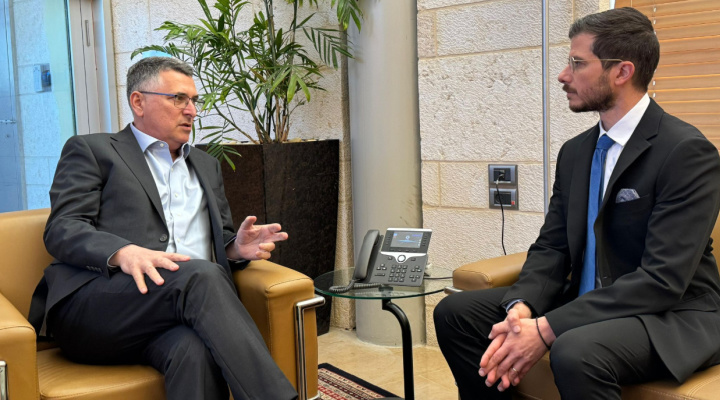
Israeli Foreign Minister Gideon Sa’ar, left, and Geroge Deek, Israel’s newly appointed special envoy to the Christian world. Photo: Screenshot
Israel’s foreign minister said Thursday he had appointed former ambassador George Deek as a special envoy to the Christian world, amid a series of recent incidents involving Christian sites and leaders that have left ties strained.
Foreign Minister Gideon Sa’ar said the new role would focus on deepening Israel’s ties with Christian communities worldwide. Deek, who served as Israel’s ambassador to Azerbaijan and was the country’s first Christian ambassador, brings nearly two decades of diplomatic experience to the post. The appointment comes following fragile ceasefires with both Iran and its Lebanese terror proxy Hezbollah.
Minister of Foreign Affairs @gidonsaar Appointed @GeorgeDeek as Special Envoy to the Christian World
Minister of Foreign Affairs Gideon Sa’ar has appointed George Deek as Special Envoy to the Christian World. The appointment is intended to deepen Israel’s ties with Christian… pic.twitter.com/GvCQPucywO
— Israel Foreign Ministry (@IsraelMFA) April 23, 2026
It follows tensions in Jerusalem last month, when authorities initially prevented the Latin Patriarch of Jerusalem, Cardinal Pierbattista Pizzaballa, from entering the Church of the Holy Sepulchre to conduct Palm Sunday prayers, citing wartime restrictions and security concerns. The episode, which came days after an Iranian missile attack struck near the church, triggered anger in Italy and among Catholic leaders, eventually prompting Israeli Prime Minister Benjamin Netanyahu to issue a reversal allowing the Latin Patriarch to hold services “as he wishes.”
Deek’s appointment also comes days after an Israeli soldier was filmed smashing a statue of Jesus in a village in southern Lebanon, footage that circulated widely and drew condemnation. The soldier and the individual who filmed the act were both sentenced to 30 days in prison and removed from combat duty, according to the military. The incident prompted a rare, swift response from across Israel’s political and military leadership, underscoring concerns about the potential diplomatic fallout.
Following the completion of an initial examination regarding a photograph published earlier today of an IDF soldier harming a Christian symbol, it was determined that the photograph depicts an IDF soldier operating in southern Lebanon.
The IDF views the incident with great… https://t.co/U6P3x8KWBb
— Israel Defense Forces (@IDF) April 19, 2026
The military said it deeply regretted the incident, stressing that its operations in Lebanon are directed at Hezbollah and other militant groups, not civilians. It moved quickly to install a replacement statue in the southern Lebanese village, called Debel, though that was later swapped out for a replica of the original, arranged by the Italian UNIFIL contingent after residents of Debel reportedly objected to receiving one from the IDF.
In this instance too, Netanyahu intervened, saying he was “stunned and saddened” to learn of the incident.
“I condemn the act in the strongest terms,” he wrote on X on Monday. “Military authorities are conducting a criminal probe of the matter and will take appropriately harsh disciplinary action against the offender.”
Christian activist Maj. (res.) Shadi Khalloul, a one-time Knesset candidate who founded the Israeli Christian Aramaic Association, called the act “reprehensible,” but emphasized that the response from Israeli authorities had been decisive.
“These soldiers represent themselves. They do not represent the spirit of the IDF or the spirit of the state,” he said.
Khalloul contrasted the response with what he described as a lack of accountability in parts of the Middle East where violence against churches and Christian communities is met with silence or denial.
“The steps taken were very good,” he said. “The state didn’t evade responsibility, as most countries do, but made a strong and unequivocal statement, one that not only educates but also shows the beautiful spirit of Israel.”
More than 150 Jewish leaders from across the Orthodox, Conservative, and Reform movements condemned the IDF soldier’s act, calling it a “desecration of God’s name” and “an affront” to Christian communities and to Jewish-Christian relations at a particularly sensitive time.
Khalloul described Deek’s appointment as “worthy and respectable,” calling the envoy “capable and successful.”
The timing of the envoy appointment suggests a recognition within Israel’s leadership that incidents involving Christian institutions, even when isolated, can quickly take on international significance, he added, but cautioned that its impact would depend on how the role is defined and executed.
As a member of Israel’s Arab Christian minority from the mixed Jewish and Arab city of Jaffa, Deek has often spoken about his identity and the role of Christians in Israeli society, framing it as a bridge between different communities. His tenure in Azerbaijan, a Muslim-majority country with ties to Israel, was seen as a test case for such outreach.
Khalloul said he hoped Deek could help strengthen ties between Israel and Christian communities abroad while accurately reflecting the perspective of Israel’s Christian citizens, including their support for “preserving Israel as a strong Jewish and democratic state.”
“In the end, this is about the strength and security of the state for all of us,” he said.