



Uncategorized
How Joanna Stern gets it done — with some help from AI
Early in the morning on the day of the first Seder this year, I got on a train to New Jersey with a bag of potatoes and a cunning plan to outsource their cooking.
I was on my way to interview journalist and tech-maven Joanna Stern. In her new book, I Am Not a Robot: My Year Using AI to Do (Almost) Everything, she notes, while using the Posha AI cooking robot, that “robots won’t kill us with lasers, they’ll kill us with salt.” Together we would see whether Posha was up to some Seder food preparation that would sustain rather than poison both the Stern and the Friedman tables.
Stern, 42, for 12 years the consumer tech reporter at the Wall Street Journal, spent a year saying yes to a series of AI experiments. Some of those experiments — the AI boyfriend (with consent from her wife), the AI therapist (with advice from her therapist), the AI research assistant (she dispensed with her human assistant) — were generative AI. Others, like the Posha, lawnmower and Waymo driverless cars use different types of AI which Stern helpfully identifies at the outset.
Stern was in the process of starting up her new media company, which she had not even yet officially named “New Things.” In 2025 she had lived her life with AI and the book about the experience was coming out in May 2026, super speed for the publishing industry. As a fellow Solomon Schechter alum of sorts (she was a student, I was a teacher, a decade apart, different schools), I didn’t want to bother her too much in the hectic period as she published and publicized a book, launched a new media outlet and recorded a number of videos in partnership with NBC. So we got together on a morning when otherwise we would just have both been prepping in different kitchens in different states.
For the potatoes we enlisted the Posha, which looks like a microwave had a baby with a food processor. In the book Stern describes it like this.
“If you’re picturing a humanoid Gordon Ramsay, stop. Think giant countertop toaster oven, with a single pot and burner. The ‘robot’ lives in the system’s software, which controls stirring attachments, ingredient containers that dump food into the pot like a tiny automated dump truck, and a spinning spice rack that spits out seasoning in short, aggressive bursts. Bolted to the front is a small Android tablet.”
(“Bolted” is unfair, there’s a molded structure, but it still feels like an appliance rather than a window into the future of cooking.)
We chatted while cutting up ingredients — AI can’t shop or chop, it can only do “the fun stuff” — and then, while it was cooking we discussed the time that she’d spent with AI. She’d moved back to New Jersey to raise her kids close to her childhood home, but the world of the near future that she had been peering into didn’t seem like it was going to resemble much of what we knew in the last millennium.
I asked her whether, after her experiences of last year, she was in any way optimistic. She was cautious about AI: “There’s this completely Utopia version and there’s this completely Dystopia version and we’re somewhere gonna land in the middle.”
Viewed this way, our AI-driven robot future is a more extreme version of our already flawed human society. That’s borne out by the competing chapters in her book about medical AI intervention. She feels that dentists who use AI to read x-rays end up using the technology’s more precise analysis to up-sell procedures. In her chapter named “Machine Eyes and My Complicated Breasts,” Stern is more complimentary about a machine system for reading mammograms that is scrupulous, never tired and highly detail oriented. The AI found some objects that doctors might have missed but, in the end, it seems clear that she just trusts the medical system and breast radiologists more than American dentistry and dentists.
As we bemoaned AI’s abysmal ability to shop — and the utter inability of the 1X humanoid robot from Neo that she tested last year to either do the washing up or load the dishwasher (she has since tried another one, better at dancing than cleaning, alas) — we discussed how dramatically the new technology can reshape the landscape. After all, robots are already royalty in factories which are designed for their efficiency, rather than for uncertain and fragile fleshy water bags like us. If we designed homes so that machines could function optimally, perhaps they could chop, shop, clean, tidy, wash.
Stern was unconvinced, pointing out that other systems like Roomba or the automated driving system of Waymo had worked out how to navigate the human world quite effectively.
Relatedly, as it turned out, I wondered whether there were any of the experiments that she had continued because they had proved helpful. The AI boyfriend who lives in a particular iPhone, for example, she assured me had not been turned on for many months! (Tip for the top from Stern: “Don’t fall in love with a robot.”)
The one significant thing that Stern told me she continued to use regularly was the phone AI interface in the car. If she’s driving to an interview she will ask her AI to do research on her subjects, brainstorm what questions to ask and try different responses to their answers. I began to wish I had done a similar thing with Claude on the way to see her, but then again, actually reading her book, watching her videos and reading her columns gave me a richer, fresher way of responding to her in person. I was finding out who she was, not holding her to account.
We moved into the sitting room while Posha stirred and mixed and cooked. Stern’s video persona is an engaging mixture of curiosity, expertise and mild comic self-deprecation. Rather than the po-faced techies who open boxes and test stuff on YouTube, Stern is playful and has fun with the objects, subjects, and the video format. She has a fondness for the dumb and the pun that would definitely get labeled dad jokes if she were male.
Mostly, in her articles and videos she has explored the world of what is for sale but — especially after one interview with Apple execs about Siri, in which she said “You have more engineers, more money than any company, why couldn’t you make it work?” — she was called “Tech Mommy” because she knew her stuff, made it simple and held the child-like, big-eyed men of tech to account.
Sitting on her sofas — in the good room, nokh — Stern was more serious and thoughtful than her online persona. She was setting up a new business, with all the HR palaver that entailed; she was still doing the work of making videos and keeping on top of tech; she had to liaise with family about the Seder; she had her sick kid at home — not too bad, but feeling sorry for himself. He had been practicing and would be especially disappointed to miss out on the Four Questions at Seder, maybe he could FaceTime in to do it?
I wondered what sort of world we were making for our children. Beyond the collapse of entry level jobs — for the book Stern “hired a human reporting assistant [Maya Tribbitt] and then replaced her with an AI reporting assistant” — we decided we didn’t quite know. Stern, though, had been thinking about her chosen career recently. Yes, she had been thinking about it so she could position her brand for her new venture but she had also been reflecting on what she had achieved at the Journal: “Consumer tech is not really ‘what phone to buy’ or ‘what’s the best TV’ it’s now what are the impacts that it has. I wish I had worked more on that earlier in my career.”
So, if not the big future, a world shaped by AI, a world for the robots that we happen to live in, what’s next?
“The next step is wearable devices, the Meta Ray Bans take hands-free photos and videos. I wear them pretty much every day. Mostly just because they’re good sunglasses and then they have a camera so it’s easy to take family photos and videos.”
And also, “microphones in everything.” Stern gestured at some of the devices lying around, stand-ins for all the new devices that will need command interfaces: the best way to control them is verbally. For years we were told that our phones were not listening to us: “They don’t need to listen through our microphones. We have all this other data that we give them.” But now, Stern says, Alexa and Siri are just the thin end of the wedge. Everything will be miked and potentially listened to. “Now it’s like, ‘Oh, it’s so easy. We can easily do it.’… Whether or not they’re actually listening, they can.”
The alert went off on the cookbot and we took out the perfectly herbed potatoes from Posha. It had barely saved us time or effort but Stern, without prejudice, noted that there were certain longer, more complex recipes that the family enjoyed where it did, regularly, save her time. Stern put hers in a dish to take to her parents and I put mine in my aluminum tray for the train.
The allure of tech as we have known it until now is that it helps us to do what we want to do faster, quicker and with greater scope. At the moment, AI-driven robots like Posha or the Gabba stuffed toy from Curio are in their infancy, finding their way in the human world. One of the endearing features of the humanoid robot that Stern tested was how helpless it was. Instead of a scolding, it needed support and love from Tech Mommy.
On the other hand Gabba, the toy that talks to kids using some parental pre-programming and an uplink to ChatGPT, seems like it could be fun, or just pretty creepy. Stern gave one to her son Alex (aged 4) for Hanukkah and before it had a chance to become creepy, he decided that it was deeply annoying and destroyed it. (In the book, Stern adduces the dialog that led to the destruction and it is indeed warranted!)
But as the tech rapidly improves it will be harder to destroy both physically and emotionally. It’s not clear what impact they will have, but these robots are not going to be helpless, useless or destructible for much longer and, as always, Humpty Dumpty’s question resonates: “The question is, which is to be master — that’s all.”
We called a human-driven car to take me to the human-driven train. I took my tray and rode home with my robotically-cooked potatoes. That evening we tasted the respectably crisp, rosemary-herbed chunks and they were welcome at our feast celebrating liberation from bondage.
At Seders, we place ordinary but symbolic objects — eggs, oranges, glasses of wine — at the center of attention to force ourselves to ask uncomfortable questions about freedom: who has it, who lacks it, and what obligations come with it? The potatoes at this year’s Seder became a prompt to wonder not only about human freedom, but about our relationship to AI and the coming world of robots — and whether, in creating increasingly intelligent machines, we might surrender parts of our own humanity along the way.
The post How Joanna Stern gets it done — with some help from AI appeared first on The Forward.
Uncategorized
How Shabbat bound Lindsey Graham to Joe Lieberman
Lindsey Graham did not always know what time Shabbat started, but he always knew when it ended. That was the joke the South Carolina Republican made while remembering his close friend, the late Sen. Joe Lieberman, at a memorial service in Washington in 2024.
In his remarks, Graham said that while traveling around the world with his Senate colleague, Lieberman, an observant Jew and author of a book about Shabbat, always knew exactly when sundown arrived on Friday, no matter where they were. After years of traveling together, Graham joked, he learned to recognize when Shabbat ended on Saturday “so we didn’t have to do this anymore.”
This past Saturday evening, almost exactly as Shabbat came to a close, Graham died after suffering an apparent heart attack at his Capitol Hill townhouse. Emergency dispatch audio indicates first responders were called to his home at around 8:30 p.m. after a report of chest pains.
The two politicians from different sides of the aisle first became close when Graham joined the Senate in 2003, joining an already close friendship between Lieberman and Sen. John McCain, who died in 2018. Despite disagreeing on many domestic issues, Graham and Lieberman bonded over shared views about American leadership abroad, traveling together to the world’s most dangerous conflict zones in the years after the Sept. 11 attacks. The three senators, who became known as the “Three Amigos,” also made repeated trips to Israel.
At Lieberman’s memorial, Graham recalled one of their more memorable trips together, accompanying McCain during his 2008 presidential campaign to visit the Western Wall in Jerusalem. Graham said he was pinned against the ancient stones by photographers scrambling for the perfect shot and injured his knee. “They crushed me against the wall, and I began to wail,” Graham joked, referencing the site’s English name, the Wailing Wall. Lieberman, he recalled, helped pull him back to his feet.
Months later, during a meeting with the Dalai Lama in Colorado, Lieberman brought the Tibetan spiritual leader over to Graham and asked if he could heal his injured knee. The Dalai Lama placed a hand on it and asked if it felt any better. “No,” Graham replied.
“I didn’t think so,” the Dalai Lama quipped.
A strong ally of Israel
Israel occupied a central place in Graham’s political career. He was one of Congress’ strongest supporters of the U.S.-Israel alliance, pushed for a tough approach toward Iran and backed efforts to expand peace between Israel and its Arab neighbors. Axios reported Sunday that Graham spent his final weeks working on a renewed push aimed at normalizing relations between Saudi Arabia and Israel.
In a Sunday appearance on Fox News, Israeli Prime Minister Benjamin Netanyahu revealed that he and Graham disagreed over Israel’s recent proposal to phase out U.S. military assistance in the coming years, amid growing criticism of aid to Israel from both parties. Graham “went ballistic,” Netanyahu said. “He said, ‘No way. You can’t do that.’ He was so concerned with our security, which he believed was your security, that he actually fought the prime minister of Israel on keeping America’s aid – or actually increasing it.”
As news of Graham’s death spread Saturday night, Jewish organizations and leaders mourned his passing and reflected on the legacy he leaves as one of the Senate’s strongest advocates for Israel and Jewish causes.
In his farewell to Lieberman two years ago, Graham concluded: “One of the best things that ever happened to Lindsey Graham was to meet Joe Lieberman. So until we meet again, my amigo, God bless.”
For those who watched their friendship over the years, it is hard not to imagine that somewhere beyond this world, McCain, Lieberman and Graham have found each other once again.
The post How Shabbat bound Lindsey Graham to Joe Lieberman appeared first on The Forward.
Uncategorized
I was there when the lights went out and New York was plunged into darkness
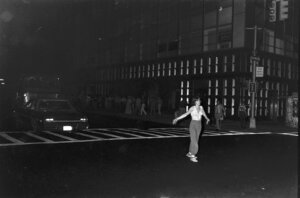
I’m the lifelong resident of a vast and complicated metropolis that smugly prides itself on never stopping. Subways, buses and cabs running day and night, bodegas and diners open 24/7, hundreds of thousands of people at work or out partying somewhere, bike couriers and truck drivers making deliveries — all in a town with a million moving parts, where the show always goes on — until, suddenly, it doesn’t.
I was reminded of that one evening not long ago in a drab Chinese restaurant uptown on Broadway, clutching a pair of wooden chopsticks poised to shovel another mound of chicken and walnuts into my mouth.
Music was playing softly over the house PA system. The melody suddenly sounded strangely familiar, but oddly out of place in those surroundings. I froze mid-bite, trying to place what I was hearing. Then it hit me. I glanced at my dinner companion Ann Aptaker, author of the Cantor Gold noir crime novels.
“Wow,” I said. “Do you hear that?”
She paused, tilted her head slightly, then raised an eyebrow.
“Yes,” she said. “It’s Threepenny Opera!”
Sure enough, the song drifting through the room was Kurt Weill and Bertolt Brecht’s wickedly jaunty tango, “Ballad of Immoral Earnings.” Even stranger, it was a track from my favorite production of the show: the Lincoln Center revival from decades ago, starring the late, great Raul Julia as Mack the Knife and Ellen Greene as his favorite prostitute, Jenny Diver.
“Of all things! What a weird song to play while people are eating,” I mused.
“I don’t think I’ve ever heard it in a restaurant before,” she agreed. “And certainly not a Chinese place.”
“They must have good taste in musicals.”
Shrugging, we resumed picking away at our dinner. A minute later another song from the same show began to play. We gaped at each other.
“They’re playing the whole album!” I sputtered. “What are the odds?”
Ann frowned and paused. then suddenly whirled to reach into the pocket of her denim jacket hanging behind her chair. She pulled out her phone, and the music instantly grew louder. We both laughed. She must have leaned back against her jacket and set off her music app. Whew — mystery solved!
But hearing those distinctive strains of Weill’s score transported me back to one of the hottest summers New York City had ever endured.

It was 1977, the year I attended an outdoor performance of Threepenny Opera at the Delacorte Theater in Central Park. My mother and a roommate from Pratt had joined me that night.
The Delacorte sits beneath the stone towers of Belvedere Castle, lit by floodlamps like a fairytale illustration, open to the sky and the sounds of the city beyond the trees. On a good night it can feel magical. On this particularly sweltering night, the air hung over us in the audience like a damp blanket as Philip Bosco, who had replaced Raul Julia for this summer staging, swaggered across the stage as Mack the Knife, and Ellen Greene reprised her role as Jenny.
And then — just as she was belting out her furious solo number, Pirate Jenny — all the lights shut off. Greene’s mic abruptly went dead, and the band lurched sourly out of tune before grinding to a halt.
We were plunged into pitch darkness. For a moment, there was silence.
Then the crowd began to buzz nervously. Was this part of the show? I’d seen the play several times before, and knew that it most definitely was not.
A few awkward minutes later, some of the cast reappeared wielding flashlights. While the tech crew worked on the electricity, the band filled the darkness with some lively jazz. Rubber-limbed dancer Tony Azito pranced around jovially in the flickering beams, easing the mood for a spell. But that age-old theater adage, the show must go on, was about to bite the dust.
The house manager finally stepped up on stage to make an announcement: “Ladies and gentlemen, we just learned that there’s been a massive power failure at Con Edison. It’s not just us; the whole city is dark!”
We didn’t know it yet, but this was the Big Blackout of July 13, 1977, and there we were, thousands of us stranded smack in the middle of Central Park. There wasn’t even much of a moon out that night, so it was really, really dark.
“Well, this is some pickle,” Mom said.
We wondered how the hell we were going to get out of there.

I vividly recalled the last big blackout in New York City, the one in 1965. I was just a young kid back then and safely at home, so it had actually been fun. While my mother lit a few Sabbath candles, my little sister and I roamed from room to room pretending we were in a haunted house. Meanwhile, our poor Dad had to trudge back to Brooklyn from midtown Manhattan — a five-hour hike in hot leather shoes.
But this time felt very different. I was far from the safety of home, trapped in the middle of what might as well have been a forest at night. Central Park is beautiful when you can see it. In pitch darkness it’s downright hazardous.
“Guess we’ll all just have to sleep in the park tonight,” I cracked. Neither Mom nor my Pratt roomie were laughing.
Thankfully, a phalanx of city cops eventually arrived to help guide us out. Audience members, cast and crew all joined hands as we carefully made our way along the park’s winding paths, stepping over roots and curbs, catching one another when someone stumbled. Our only illumination came from a few scattered police car headlights.
A walk that normally takes ten minutes took forever, but eventually we emerged onto Central Park West.
The scene was eerie. Streetlamps were dark. Traffic lights were out. Cars sat frozen in the intersections. Not a single apartment window was lit. For a city that never sleeps, it felt as if someone had suddenly flipped off the master switch.
Then I spotted something: “Look, the buses are still running!”
A city bus was rumbling slowly toward us, brightly lit inside. With the subways dead, getting back to my dorm in Brooklyn would have been impossible, so Mom’s place on the Upper East Side looked like the safest destination. She had temporarily split with my Dad and was living there with a roommate at the time.
The three of us squeezed aboard along with what felt like half the audience, and somehow made it across town to First Avenue. As we approached my mother’s high-rise, a dreadful thought suddenly hit me.
“Mom, what floor are you on again?”
“Twenty-five,” she replied grimly.
Of course both elevators were dead. We trudged up 25 flights of stairs in complete darkness, arriving exhausted and panting. My mother fumbled with her key, finally opening the door to reveal Sylvia, her gravel-voiced, seen-it-all Long Island roommate, standing there with her ever-present cigarette tip glowing in the dark.
“Come on in, darlings,” she rasped dryly. “Join the party.”
Sylvia had lit a few candles around the apartment, the only light we’d see that night.
Outside, the city was far from peaceful. While we tried to sleep on sofa cushions on the floor, one of the worst nights of unrest in New York history was unfolding in the streets below. Store windows were smashed. Shops were looted. Garbage cans were set on fire.
Lying there in the dim glow of flickering candlelight, hearing distant sirens punctuated by the sudden crash of breaking glass somewhere in the darkness below, I felt a growing sense of dread. An evening that had begun with music and theater had improbably ended with Manhattan plunged into darkness, its fragile machinery suddenly exposed.
By morning the city looked as though it had survived a world war.
This resilient burg has been battered and bruised over the years, enduring terrorist attacks, blackouts, blizzards, hurricanes, floods, garbage strikes, transit strikes, and the occasional collapse of its aging infrastructure. Yet somehow it manages to reset and lurch forward each time, improvising solutions the way Tony Azito danced in the dark that night at the Delacorte.
The post I was there when the lights went out and New York was plunged into darkness appeared first on The Forward.
Uncategorized
Lindsey Graham, pro-Israel Trump confidant in the Senate, dies suddenly at 71
(JTA) — Sen. Lindsey Graham, a Republican from South Carolina who has been one of Israel’s staunchest supporters in Congress, has died at 71.
Graham’s office announced his death in a statement early Sunday morning, saying that he had died late Saturday after “a brief and sudden illness.” Graham had returned from Ukraine, where he met with Prime Minister Volodymyr Zelensky, the day before.
Graham’s death means the Senate and Republican Party have lost one of its most durable pro-Israel voices at a time when anti-Israel sentiment is on the rise in both places. In his more than three decades in Congress, first in the House and then in the Senate since 2003, Graham aggressively backed U.S. aid to Israel, advanced a hawkish line on Iran and met repeatedly with Israeli Prime Minister Benjamin Netanyahu, in both Israel and the United States.
Netanyahu repeatedly said Israel had “no greater friend” than Graham in the United States. Graham’s most recent visit to Israel was in February, ahead of the U.S.-Israel war on Iran, which he later took credit for urging. “They’ll tell me things our own government won’t tell me,” he said of Israeli officials at the time.
Graham was also a vocal backer of Israel’s military responses to attacks by Hamas, including during the 2014 and after Hamas’ Oct. 7, 2023, attack on Israel that triggered the war in Gaza and augured a period of declining support for Israel. On Oct. 8, he issued a statement calling for Israel to defeat Hamas “by any and all means necessary” and in the subsequent weeks drew attention for calling on Israel to “flatten the place.”
Graham continued to promote a two-state solution as it receded as a U.S. priority, but he also adjusted to reflect the mounting isolationist streak in his party. Last year, he made news for embracing Netanyahu’s announcement of a plan to “taper” U.S. aid to Israel, saying it should be done sooner than Netanyahu’s 10-year timeline.
Graham’s outlook on Israel fit into a broad portfolio that included helming the Senate Budget Committee and pushing for a stronger U.S. response to Russia. Graham, who never married and had no children, was up for reelection in November.
This obituary will be updated.
This article originally appeared on JTA.org.
The post Lindsey Graham, pro-Israel Trump confidant in the Senate, dies suddenly at 71 appeared first on The Forward.
