



Uncategorized
Evolving Drone War in Southern Lebanon Increasingly Defines Israel-Hezbollah Fight
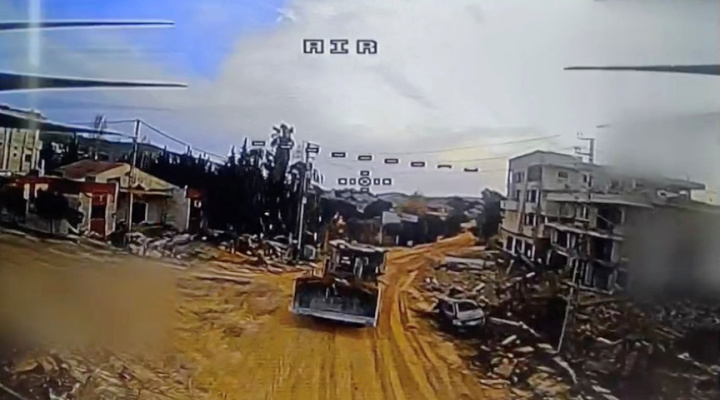
A screengrab taken from a video released by Hezbollah says to show an Israeli D9 armored bulldozer moments before being hit by an FPV drone attack, in Bint Jbeil, Lebanon, with the date of the video given as April 15, 2026. Photo: HEZBOLLAH MILITARY MEDIA/Handout via REUTERS
Iran‘s most powerful ally Hezbollah and Israel are stepping up a drone war in Lebanon – on camera – that is increasingly defining the battlefield and complicating the path to peace between the Israeli and Lebanese governments.
In recent weeks, Hezbollah, an internationally designated terrorist group that seeks Israel’s destruction, has used cheap, easy-to-assemble First Person View kamikaze drones to transform the war it has been fighting since it began firing on Israel on March 2, days after the US-Israeli forces began their attacks on Iran.
Controlled with fiber-optic cables, the FPV drones can evade Israel’s high-tech jamming technologies to target its troops occupying southern Lebanon during a shaky ceasefire announced on April 16, a week after the truce in the wider Iran war began.
The Iran-backed Islamist group, which yields significant political and military influence in Lebanon, has published videos of more than 45 FPV attacks, 28 of them in the nearly four weeks since the ceasefire, which had halted Israeli attacks on the Lebanese capital before Israel said it targeted a Hezbollah commander there on Wednesday.
The truce has also left Israeli ground forces occupying a so-called buffer zone up to 10 km (six miles) in from the border, in confined territory, which Hezbollah knows well, and vulnerable to such attacks.
All of the videos before the ceasefire was announced showed UAVs flying at static positions or vehicles including tanks and excavators, with no fatalities reported by Israel. But since the ceasefire was announced, Hezbollah began targeting groups of soldiers, reporting five attacks. Three Israeli soldiers and one contractor were reported by Israel to have been killed.
Israel is firing back, with at least two deadly FPV drone attacks against Hezbollah in April complete with published drone images purporting to show Hezbollah fighters up close.
The widespread use of FPV attack drones began several years ago and thousands of kilometers away in Ukraine, where front lines are covered with netting to defend against Russia’s drones, and where some drone operators are watching Hezbollah.
“They are amateurs, but they are learning,” said Dmytro Putiata, a drone warfare expert serving in Ukraine’s Unmanned Systems Brigades.
WHY DOES THE DRONE WAR IN LEBANON MATTER?
Iran and mediator Pakistan say any US-Iranian peace agreement must include a halt to Israeli strikes in Lebanon to prevent an escalation there restarting the wider Iran war.
US-mediated direct talks between the Lebanese government and Israel are due to resume on Thursday and Friday, but progress has been slow; Israel insists that Lebanon disarm Hezbollah, which risks reigniting conflict in a country that suffered a 1975-1990 civil war.
Hezbollah’s head of media relations, Youssef el-Zein, said the group assessed that continued Israeli troop casualties from FPV drones could force an Israeli withdrawal more effectively than the negotiations with Israel, which Hezbollah opposes.
Israeli troops who have invaded southern Lebanon in the current conflict presented “an opportunity, and not a threat,” as they could be more easily targeted, he said.
“We know the enemy’s supremacy, but we also know their points of weakness. We are taking advantage of the points of weakness to create that balance,” Zein told reporters.
According to a Hezbollah commander, a specialized drone unit works with the organization’s procurement team to purchase parts from various markets.
They are checked for signs of Israeli interference, according to a Lebanese military source briefed on Hezbollah’s drone usage. The group has been on high alert since thousands of its communication devices were booby-trapped and detonated by Israel in 2024.
Hezbollah’s first FPV video shows an attack dated March 22, three weeks into the war. The first footage showing its drone components, including the warhead, is dated April 11.
“The drones shown in the imagery all show systems assembled from parts commonly made by Chinese enterprises and sold freely on the online marketplaces,” said Konrad Iturbe, a drone expert based in Spain with experience flying and modifying commercial quadcopters.
HOW DO THE DRONES WORK?
A basic drone costs less than $400, according to the Hezbollah commander and an Israeli drone expert. Reuters geolocated the attacks to towns running the entire strip of Lebanon’s border area, showing the breadth of their deployment.
A Russian PG-7L highly explosive anti-tank warhead was fitted on the drone in the April 11 footage, according to a drone operator in Ukraine who declined to be named for security reasons and a foreign security official tracking Hezbollah’s drones.
Hezbollah’s arsenal already included those warheads, the foreign official said, but fitting them onto a drone made them a longer-range, precision weapon.
Asked whether Hezbollah was relying on Russian drone expertise, Zein said the group had in-house experts.
Founded in 1982 with help from Iran’s Islamic Revolutionary Guards Corps, Hezbollah, which has tens of thousands of rockets and precision missiles, began developing drone capabilities in 2004 and used them in 2006 and 2024 wars.
The drone operator in Ukraine said the Hezbollah pilots appeared to have had a few weeks of training. He said the spool in the April 11 footage was consistent with a canister holding about 10 km (six miles) of fiber-optic wiring to link drone and pilot – a link that the Hezbollah commander said was key.
“The objective is that Israeli radar systems cannot detect them, effectively blinding the enemy,” he said.
WHAT IS ISRAEL DOING ABOUT THEM?
Israeli Prime Minister Benjamin Netanyahu has acknowledged the drones are a problem. “A few weeks ago, I ordered the establishment of a special project to thwart the drone threat … It will take time, but we are on it,” he said on May 3.
The Israeli military has reported near-daily explosive drones launched at its forces in southern Lebanon. Israel’s Army Radio says they have hurt as many as 40 troops.
An Israeli defense official said that the drones were harder to detect and neutralize because they are small, and are flown “low and slow” by Hezbollah crews who know the topography well.
ALMA, an Israeli think tank, said Hezbollah’s attacks during the ceasefire predominantly used drones and the dissemination of footage created “significant psychological impact.”
Israeli critics say solutions should have already been found. The defense official, who spoke on condition of anonymity to discuss sensitive matters, said there was no quick fix.
Israel’s defense establishment has been looking at Ukraine and studying the drone threat for over a year, he said. New defense measures could be deployed within weeks to months.
While high-tech solutions are being developed, low-tech solutions, like nets, will be deployed and enhancements to soldiers’ rifles were expected to help take down the drones too, the defense official said.
The Israeli military has also been using its Iron Dome missile interceptor system and has boosted radar detection, a senior Israeli military official said. A newly developed drone interception system was tested by the Air Force in April, the official said, but it failed.
Both the officials said that the best defense is striking the Hezbollah crews operating the drones. Israel published a video on April 13 of a target covering his face as a drone approaches and another on April 29 targeting a fighter on a motorbike. Israel has not published images of its own drones.
Iturbe said some Hezbollah pilots seemed to have moved from easier but less effective fixed-angle flying to pitching down, speeding up and hitting vehicles from above.
“Lesson clearly learned here,” he said.
Still, Hezbollah’s videos show drones mostly targeting armored vehicles, not soldiers, with few consecutive attacks on a target, or shots from a second drone or surveillance position.
“Individual clips of vehicles being struck are great for political videos, but do not necessarily translate into military effect,” forensic imagery analyst William Goodhind said.
Uncategorized
UK Man in Court Charged With Arson at Former London Synagogue

Orthodox Jews stand by a police cordon, after a man was arrested following a stabbing incident in the Golders Green area, which is home to a large Jewish population, in London, Britain, April 29, 2026. Photo: REUTERS/Hannah McKay
A British man charged over an arson attack at a former synagogue in east London last week was in contact with someone using an Iraqi phone number shortly before the fire, prosecutors told a London court on Tuesday.
Moses Edwards, 45, appeared in the dock at Westminster Magistrates’ Court and was remanded in custody until a further hearing next month. He gave no indication of any plea.
The fire at the former East London Central Synagogue was caused by wine bottles filled with an accelerant, which exploded damaging the outside of the building, prosecutors said.
The incident followed a series of arson attacks on Jewish targets in previous weeks, with police saying they were investigating possible Iran links to some of the fires.
Uncategorized
Israeli Para-Athlete Wins Gold at European Taekwondo Championships, Beats Opponent From Azerbaijan

Asaf Yasur, center, posing with his gold medal during the awards ceremony at the 2026 European Taekwondo Championships in Munich, Germany. Photo: Facebook/Israel Taekwondo Federation
Israeli Paralympic athlete Asaf Yasur took home the gold medal in the 2026 European Senior Taekwondo Championships being held this week in Munich, Germany.
The 24-year-old competed in the men’s under-58kg weight category, and on the first day of the championships he beat Azerbaijan’s Sabir Zeynalov 2-1 in the finals after being victorious over Turkish athlete Hamza Tehrani 2-1 in the semifinal. Israel’s national anthem, “Hatikvah,” played in the arena during the medal ceremony, as Yasur stood on the podium with his gold medal.
The Jerusalem native had both of his hands amputated when he was 13 years old following an electrocution accident. Earlier this year, Yasur won gold at the 2026 US Open Paralympic Taekwondo Championship. He previously took home gold medals at the 2024 Paris Paralympics — where he made his Paralympics debut – the 2024 European Championships, and the 2023 World Para Taekwondo Championships. He also won the 2021 and 2023 World Para Taekwondo Championships and silver at the 2023 European Para Championships.
The European Taekwondo Union organizes the European Senior Taekwondo Championships, which is held every two years. This year marks the fourth time the championship is taking place in Germany, after previous being held in Bonn in 2006, Stuttgart in 1984, and Munich in 1978.
Uncategorized
China and US Agree on Opposing Hormuz Tolls, State Department Says
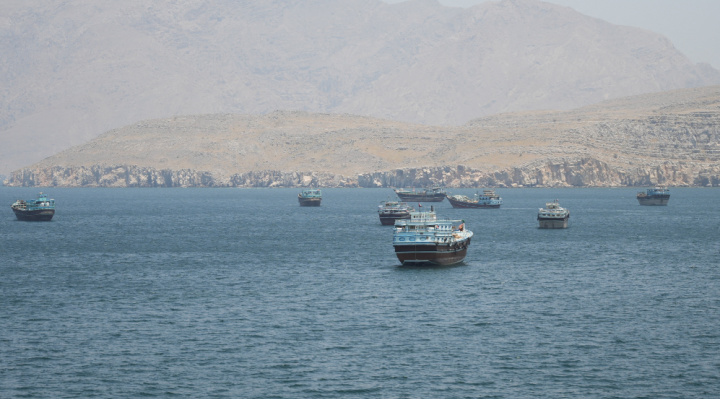
Vessels in the Strait of Hormuz, Musandam, Oman, May 8, 2026. Photo: REUTERS/Stringer
Senior US and Chinese officials agree that no country can be allowed to exact shipping tolls in the Strait of Hormuz, the State Department told Reuters on Tuesday, in a sign that the two countries are trying to find common ground on efforts to pressure Iran to give up control of the vital waterway.
The statement by the State Department comes ahead of a high-stakes summit between President Donald Trump and Chinese President Xi Jinping later this week, where Iran‘s chokehold on the strait will be on the agenda.
Iran‘s near-complete closure of the vital trade artery since the joint Israeli-US airstrikes on the country on Feb. 28 has sent shockwaves through global energy markets.
The State Department said Chinese Foreign Minister Wang Yi and US Secretary of State Marco Rubio discussed the issue in an April phone call.
“They agreed that no country or organization can be allowed to charge tolls to pass through international waterways like the Strait of Hormuz,” department spokesman Tommy Pigott told Reuters in response to questions about the call. The State Department has not previously provided a readout of the call in a break from its usual practice.
China’s embassy did not dispute the US account of the discussion, saying it hoped all sides can work together to resume normal traffic through the strait, which before the war handled one-fifth of the world’s oil and gas supply.
“Keeping the area safe and stable and ensuring unimpeded passage serves the common interest of the international community,” embassy spokesperson Liu Pengyu told Reuters.
Tehran has demanded a right to collect tolls on shipping traffic as a precondition for ending the war. The US has imposed a naval blockade on Iran, and Trump has floated the possibility of imposing its own fees on traffic or working with Iran to collect tolls. After domestic and international pushback, the White House has since said Trump wants to see the Strait of Hormuz open up for traffic without any limitations.
Chinese officials so far have avoided direct mention of tolls, even while condemning the US blockade.
‘NORMAL AND SAFE PASSAGE’
Two sources briefed on the Wang-Rubio exchange said Rubio had raised the prospect of Chinese vessels paying tolls, which they said appeared aimed at encouraging Beijing to apply more pressure on Tehran to bring the conflict to an end.
China maintains ties with Iran and remains a major consumer of its oil exports. Trump has been leaning on China to use its influence to push Tehran to make a deal with Washington.
In a subsequent meeting with Iran‘s foreign minister, Wang said the international community shared a “common concern about restoring normal and safe passage through the strait” while reiterating that China supports Iran in “safeguarding its national sovereignty and security.”
China vetoed a US-backed resolution in the United Nations last month encouraging states to work together to protect commercial shipping in the Strait of Hormuz, arguing it was biased against Iran. That prompted US ambassador to the United Nations, Mike Waltz, to argue that Beijing was tolerating Iran holding the global economy at gunpoint.
Washington together with Bahrain has drawn up another UN resolution demanding Iran halt attacks and mining in the strait, but diplomats say this is also likely to meet with Chinese and Russian vetoes if it comes to a vote.
That resolution also calls for an end to “efforts to exact illegal tolls” in the strait.
China has ordered its companies not to comply with US sanctions against Chinese oil refineries over purchases of Iranian crude, measures intended to isolate and pressure Tehran.