



Uncategorized
Saudi Arabia Launched Covert Attacks on Iran as Regional War Widened, Sources Say
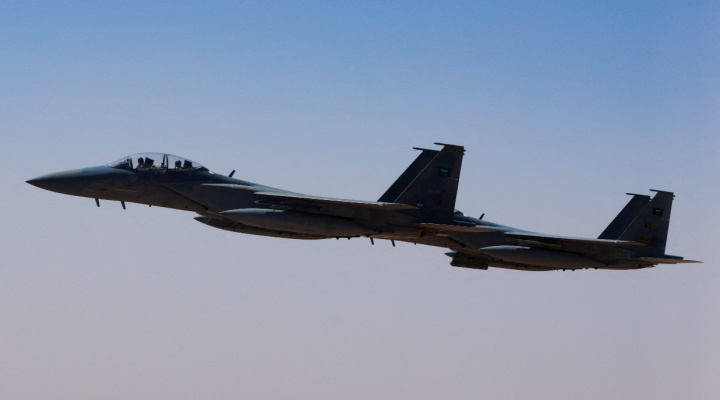
A Saudi fighter jet accompanies Air Force One, carrying US President Donald Trump, on approach to the King Khalid International Airport in Riyadh, Saudi Arabia, May 13, 2025. Photo: REUTERS/Brian Snyder
Saudi Arabia launched numerous, unpublicized strikes on Iran in retaliation for attacks carried out in the kingdom during the Middle East war, two Western officials briefed on the matter and two Iranian officials said.
The Saudi attacks, not previously reported, mark the first time that the kingdom is known to have directly carried out military action on Iranian soil and show it is becoming much bolder in defending itself against its main regional rival.
The attacks, launched by the Saudi Air Force, were assessed to have been carried out in late March, the two Western officials said. One said only that they were “tit-for-tat strikes in retaliation for when Saudi [Arabia] was hit.”
Reuters was unable to confirm what the specific targets were.
In response to a request for comment, a senior Saudi foreign ministry official did not address directly whether strikes had been carried out.
The Iranian foreign ministry did not respond to a request for comment.
Saudi Arabia, which has a deep military relationship with the United States, has traditionally relied on US military for protection, but the 10-week war has left the kingdom vulnerable to attacks that have pierced the US military umbrella.
GULF ARAB STATES BEGAN HITTING BACK
The Saudi strikes underscore the widening of the conflict — and the extent to which a war that began when the US and Israel launched airstrikes on Iran on Feb. 28 has drawn in the broader Middle East in ways that have not been publicly acknowledged.
Since the US and Israeli strikes, Iran has hit all six Gulf Cooperation Council states with missiles and drones, attacking not only US military bases but civilian sites, airports and oil infrastructure, and closed the Strait of Hormuz, disrupting global trade.
The United Arab Emirates also carried out military strikes on Iran, the Wall Street Journal reported on Monday. Together, the Saudi and Emirati actions reveal a conflict whose true shape has remained largely hidden — one in which Gulf monarchies battered by Iranian attacks began hitting back.
But their approach has not been identical. The UAE has taken a more hawkish stance, seeking to extract a cost from Iran and engaging only rarely in public diplomacy with Tehran.
Saudi Arabia has meanwhile sought to prevent the conflict from escalating and has stayed in regular contact with Iran, including via Tehran’s ambassador in Riyadh. He did not respond to a request for comment.
The senior Saudi foreign ministry official did not directly address whether a de-escalation agreement had been struck with Iran but said: “We reaffirm Saudi Arabia’s consistent position advocating de-escalation, self-restraint, and the reduction of tensions in pursuit of the stability, security, and prosperity of the region and its people.”
STRIKES, THEN DE-ESCALATION
The Iranian and Western officials said Saudi Arabia made Iran aware of the strikes and this was followed by intensive diplomatic engagement and Saudi threats to retaliate further, which led to an understanding between the two countries to de-escalate.
Ali Vaez, the Iran Project Director at the International Crisis Group, said retaliatory Saudi strikes on Iran, followed by an understanding to de-escalate, would “show pragmatic recognition on both sides that uncontrolled escalation carries unacceptable costs.”
Such a sequence of events would show “not trust, but a shared interest in imposing limits on confrontation before it spiraled into a wider regional conflict.”
The informal de-escalation took effect in the week before Washington and Tehran agreed to a ceasefire in their broader conflict on April 7. The White House did not respond to a request for comment.
One of the Iranian officials confirmed that Tehran and Riyadh had agreed to de-escalate, saying the move aimed to “cease hostilities, safeguard mutual interests, and prevent the escalation of tensions.”
Long at odds, Iran and Saudi Arabia — the two leading Shi’ite and Sunni Muslim powers in the Middle East — have backed opposing groups in conflicts across the region.
A China-brokered détente in 2023 saw them resume ties, including a ceasefire between the Iran-backed Houthis in Yemen and Saudi Arabia that has since held.
With the Red Sea remaining open to shipping, Saudi Arabia has been able to continue exporting oil throughout the conflict, unlike most Gulf states, and so has managed to remain relatively insulated.
KINGDOM AVOIDED ‘FURNACE OF DESTRUCTION,’ SAYS PRINCE
In an op-ed in Saudi-owned Arab News over the weekend, former Saudi intelligence chief Prince Turki al-Faisal captured the kingdom’s calculus, writing that “when Iran and others tried to drag the kingdom into the furnace of destruction, our leadership chose to endure the pains caused by a neighbor in order to protect the lives and property of its citizens.”
Saudi Arabia’s strikes followed weeks of mounting tension.
At a press conference in Riyadh on March 19, Saudi Foreign Minister Prince Faisal bin Farhan said the kingdom “reserved the right to take military actions if deemed necessary.”
Three days later, Saudi Arabia declared Iran‘s military attaché and four embassy staff members personae non gratae.
IRAN CURTAILED DIRECT HITS ON KINGDOM, SOURCES SAY
By the end of March, diplomatic contacts and the threat by Saudi Arabia to take a more hawkish approach akin to the UAE and retaliate further led to an understanding to de-escalate, the Western sources said.
From more than 105 drone and missile attacks on Saudi Arabia in the week of March 25-31, the number fell to just over 25 between April 1-6, according to a Reuters tally of Saudi defense ministry statements.
Projectiles fired at Saudi Arabia in the days leading up to the wider ceasefire were assessed by Western sources to have originated in Iraq rather than Iran itself, indicating Tehran had curtailed direct strikes while allied groups continued to operate.
Saudi Arabia summoned Iraq’s ambassador on April 12 to protest against attacks from Iraqi soil.
The Saudi-Iranian communication continued even as strains emerged at the start of the broader ceasefire between Iran and the US, when the Saudi defense ministry reported 31 drones and 16 missiles fired at the kingdom on April 7-8.
The spike prompted Riyadh to consider retaliation against Iran and Iraq, while Pakistan deployed fighter jets to reassure the kingdom and urged restraint as diplomacy gathered pace.
Uncategorized
UK Man in Court Charged With Arson at Former London Synagogue

Orthodox Jews stand by a police cordon, after a man was arrested following a stabbing incident in the Golders Green area, which is home to a large Jewish population, in London, Britain, April 29, 2026. Photo: REUTERS/Hannah McKay
A British man charged over an arson attack at a former synagogue in east London last week was in contact with someone using an Iraqi phone number shortly before the fire, prosecutors told a London court on Tuesday.
Moses Edwards, 45, appeared in the dock at Westminster Magistrates’ Court and was remanded in custody until a further hearing next month. He gave no indication of any plea.
The fire at the former East London Central Synagogue was caused by wine bottles filled with an accelerant, which exploded damaging the outside of the building, prosecutors said.
The incident followed a series of arson attacks on Jewish targets in previous weeks, with police saying they were investigating possible Iran links to some of the fires.
Uncategorized
Israeli Para-Athlete Wins Gold at European Taekwondo Championships, Beats Opponent From Azerbaijan

Asaf Yasur, center, posing with his gold medal during the awards ceremony at the 2026 European Taekwondo Championships in Munich, Germany. Photo: Facebook/Israel Taekwondo Federation
Israeli Paralympic athlete Asaf Yasur took home the gold medal in the 2026 European Senior Taekwondo Championships being held this week in Munich, Germany.
The 24-year-old competed in the men’s under-58kg weight category, and on the first day of the championships he beat Azerbaijan’s Sabir Zeynalov 2-1 in the finals after being victorious over Turkish athlete Hamza Tehrani 2-1 in the semifinal. Israel’s national anthem, “Hatikvah,” played in the arena during the medal ceremony, as Yasur stood on the podium with his gold medal.
The Jerusalem native had both of his hands amputated when he was 13 years old following an electrocution accident. Earlier this year, Yasur won gold at the 2026 US Open Paralympic Taekwondo Championship. He previously took home gold medals at the 2024 Paris Paralympics — where he made his Paralympics debut – the 2024 European Championships, and the 2023 World Para Taekwondo Championships. He also won the 2021 and 2023 World Para Taekwondo Championships and silver at the 2023 European Para Championships.
The European Taekwondo Union organizes the European Senior Taekwondo Championships, which is held every two years. This year marks the fourth time the championship is taking place in Germany, after previous being held in Bonn in 2006, Stuttgart in 1984, and Munich in 1978.
Uncategorized
China and US Agree on Opposing Hormuz Tolls, State Department Says
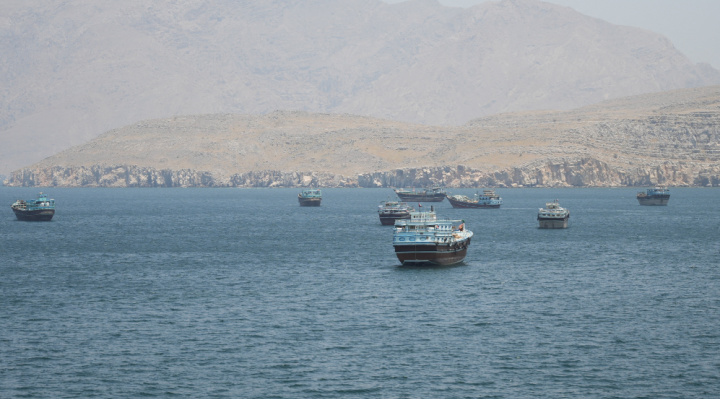
Vessels in the Strait of Hormuz, Musandam, Oman, May 8, 2026. Photo: REUTERS/Stringer
Senior US and Chinese officials agree that no country can be allowed to exact shipping tolls in the Strait of Hormuz, the State Department told Reuters on Tuesday, in a sign that the two countries are trying to find common ground on efforts to pressure Iran to give up control of the vital waterway.
The statement by the State Department comes ahead of a high-stakes summit between President Donald Trump and Chinese President Xi Jinping later this week, where Iran‘s chokehold on the strait will be on the agenda.
Iran‘s near-complete closure of the vital trade artery since the joint Israeli-US airstrikes on the country on Feb. 28 has sent shockwaves through global energy markets.
The State Department said Chinese Foreign Minister Wang Yi and US Secretary of State Marco Rubio discussed the issue in an April phone call.
“They agreed that no country or organization can be allowed to charge tolls to pass through international waterways like the Strait of Hormuz,” department spokesman Tommy Pigott told Reuters in response to questions about the call. The State Department has not previously provided a readout of the call in a break from its usual practice.
China’s embassy did not dispute the US account of the discussion, saying it hoped all sides can work together to resume normal traffic through the strait, which before the war handled one-fifth of the world’s oil and gas supply.
“Keeping the area safe and stable and ensuring unimpeded passage serves the common interest of the international community,” embassy spokesperson Liu Pengyu told Reuters.
Tehran has demanded a right to collect tolls on shipping traffic as a precondition for ending the war. The US has imposed a naval blockade on Iran, and Trump has floated the possibility of imposing its own fees on traffic or working with Iran to collect tolls. After domestic and international pushback, the White House has since said Trump wants to see the Strait of Hormuz open up for traffic without any limitations.
Chinese officials so far have avoided direct mention of tolls, even while condemning the US blockade.
‘NORMAL AND SAFE PASSAGE’
Two sources briefed on the Wang-Rubio exchange said Rubio had raised the prospect of Chinese vessels paying tolls, which they said appeared aimed at encouraging Beijing to apply more pressure on Tehran to bring the conflict to an end.
China maintains ties with Iran and remains a major consumer of its oil exports. Trump has been leaning on China to use its influence to push Tehran to make a deal with Washington.
In a subsequent meeting with Iran‘s foreign minister, Wang said the international community shared a “common concern about restoring normal and safe passage through the strait” while reiterating that China supports Iran in “safeguarding its national sovereignty and security.”
China vetoed a US-backed resolution in the United Nations last month encouraging states to work together to protect commercial shipping in the Strait of Hormuz, arguing it was biased against Iran. That prompted US ambassador to the United Nations, Mike Waltz, to argue that Beijing was tolerating Iran holding the global economy at gunpoint.
Washington together with Bahrain has drawn up another UN resolution demanding Iran halt attacks and mining in the strait, but diplomats say this is also likely to meet with Chinese and Russian vetoes if it comes to a vote.
That resolution also calls for an end to “efforts to exact illegal tolls” in the strait.
China has ordered its companies not to comply with US sanctions against Chinese oil refineries over purchases of Iranian crude, measures intended to isolate and pressure Tehran.