



Uncategorized
Saudi Arabia Launched Covert Attacks on Iran as Regional War Widened, Sources Say
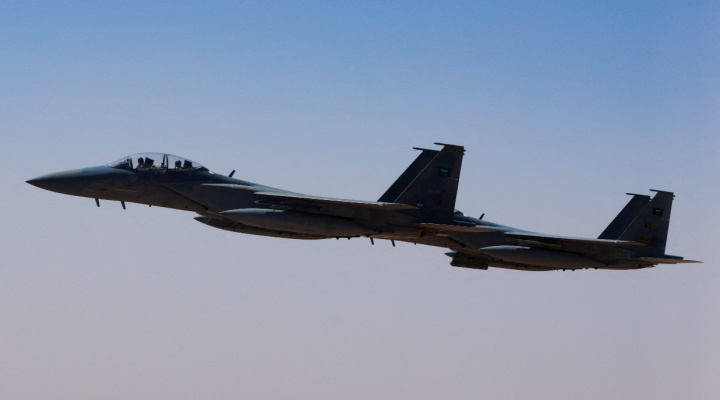
A Saudi fighter jet accompanies Air Force One, carrying US President Donald Trump, on approach to the King Khalid International Airport in Riyadh, Saudi Arabia, May 13, 2025. Photo: REUTERS/Brian Snyder
Saudi Arabia launched numerous, unpublicized strikes on Iran in retaliation for attacks carried out in the kingdom during the Middle East war, two Western officials briefed on the matter and two Iranian officials said.
The Saudi attacks, not previously reported, mark the first time that the kingdom is known to have directly carried out military action on Iranian soil and show it is becoming much bolder in defending itself against its main regional rival.
The attacks, launched by the Saudi Air Force, were assessed to have been carried out in late March, the two Western officials said. One said only that they were “tit-for-tat strikes in retaliation for when Saudi [Arabia] was hit.”
Reuters was unable to confirm what the specific targets were.
In response to a request for comment, a senior Saudi foreign ministry official did not address directly whether strikes had been carried out.
The Iranian foreign ministry did not respond to a request for comment.
Saudi Arabia, which has a deep military relationship with the United States, has traditionally relied on US military for protection, but the 10-week war has left the kingdom vulnerable to attacks that have pierced the US military umbrella.
GULF ARAB STATES BEGAN HITTING BACK
The Saudi strikes underscore the widening of the conflict — and the extent to which a war that began when the US and Israel launched airstrikes on Iran on Feb. 28 has drawn in the broader Middle East in ways that have not been publicly acknowledged.
Since the US and Israeli strikes, Iran has hit all six Gulf Cooperation Council states with missiles and drones, attacking not only US military bases but civilian sites, airports and oil infrastructure, and closed the Strait of Hormuz, disrupting global trade.
The United Arab Emirates also carried out military strikes on Iran, the Wall Street Journal reported on Monday. Together, the Saudi and Emirati actions reveal a conflict whose true shape has remained largely hidden — one in which Gulf monarchies battered by Iranian attacks began hitting back.
But their approach has not been identical. The UAE has taken a more hawkish stance, seeking to extract a cost from Iran and engaging only rarely in public diplomacy with Tehran.
Saudi Arabia has meanwhile sought to prevent the conflict from escalating and has stayed in regular contact with Iran, including via Tehran’s ambassador in Riyadh. He did not respond to a request for comment.
The senior Saudi foreign ministry official did not directly address whether a de-escalation agreement had been struck with Iran but said: “We reaffirm Saudi Arabia’s consistent position advocating de-escalation, self-restraint, and the reduction of tensions in pursuit of the stability, security, and prosperity of the region and its people.”
STRIKES, THEN DE-ESCALATION
The Iranian and Western officials said Saudi Arabia made Iran aware of the strikes and this was followed by intensive diplomatic engagement and Saudi threats to retaliate further, which led to an understanding between the two countries to de-escalate.
Ali Vaez, the Iran Project Director at the International Crisis Group, said retaliatory Saudi strikes on Iran, followed by an understanding to de-escalate, would “show pragmatic recognition on both sides that uncontrolled escalation carries unacceptable costs.”
Such a sequence of events would show “not trust, but a shared interest in imposing limits on confrontation before it spiraled into a wider regional conflict.”
The informal de-escalation took effect in the week before Washington and Tehran agreed to a ceasefire in their broader conflict on April 7. The White House did not respond to a request for comment.
One of the Iranian officials confirmed that Tehran and Riyadh had agreed to de-escalate, saying the move aimed to “cease hostilities, safeguard mutual interests, and prevent the escalation of tensions.”
Long at odds, Iran and Saudi Arabia — the two leading Shi’ite and Sunni Muslim powers in the Middle East — have backed opposing groups in conflicts across the region.
A China-brokered détente in 2023 saw them resume ties, including a ceasefire between the Iran-backed Houthis in Yemen and Saudi Arabia that has since held.
With the Red Sea remaining open to shipping, Saudi Arabia has been able to continue exporting oil throughout the conflict, unlike most Gulf states, and so has managed to remain relatively insulated.
KINGDOM AVOIDED ‘FURNACE OF DESTRUCTION,’ SAYS PRINCE
In an op-ed in Saudi-owned Arab News over the weekend, former Saudi intelligence chief Prince Turki al-Faisal captured the kingdom’s calculus, writing that “when Iran and others tried to drag the kingdom into the furnace of destruction, our leadership chose to endure the pains caused by a neighbor in order to protect the lives and property of its citizens.”
Saudi Arabia’s strikes followed weeks of mounting tension.
At a press conference in Riyadh on March 19, Saudi Foreign Minister Prince Faisal bin Farhan said the kingdom “reserved the right to take military actions if deemed necessary.”
Three days later, Saudi Arabia declared Iran‘s military attaché and four embassy staff members personae non gratae.
IRAN CURTAILED DIRECT HITS ON KINGDOM, SOURCES SAY
By the end of March, diplomatic contacts and the threat by Saudi Arabia to take a more hawkish approach akin to the UAE and retaliate further led to an understanding to de-escalate, the Western sources said.
From more than 105 drone and missile attacks on Saudi Arabia in the week of March 25-31, the number fell to just over 25 between April 1-6, according to a Reuters tally of Saudi defense ministry statements.
Projectiles fired at Saudi Arabia in the days leading up to the wider ceasefire were assessed by Western sources to have originated in Iraq rather than Iran itself, indicating Tehran had curtailed direct strikes while allied groups continued to operate.
Saudi Arabia summoned Iraq’s ambassador on April 12 to protest against attacks from Iraqi soil.
The Saudi-Iranian communication continued even as strains emerged at the start of the broader ceasefire between Iran and the US, when the Saudi defense ministry reported 31 drones and 16 missiles fired at the kingdom on April 7-8.
The spike prompted Riyadh to consider retaliation against Iran and Iraq, while Pakistan deployed fighter jets to reassure the kingdom and urged restraint as diplomacy gathered pace.
Uncategorized
‘Brazen Attacks’: Antisemitism Turns Increasingly Violent in the West

CCTV footage of a Jewish man getting stabbed by an attacker in Golders Green area, which is home to a large Jewish population, in London, Britain, April 29, 2026, in this screengrab taken from a social media video. Photo: Social Media/via REUTERS
Across North America and Europe, antisemitism appears to be entering a new, more dangerous phase, with Jewish communities facing a growing wave of shootings, assaults, arson attacks, and violent intimidation even as overall incident totals in some countries begin to dip after the surge that followed Hamas’s Oct. 7, 2023, atrocities in Israel.
In Canada, early 2026 data already indicate the country is on track to see its most violent year against the Jewish community in recent memory, with more violent antisemitic attacks recorded so far this year than during all of 2025, according to the Jewish advocacy group B’nai Brith Canada.
In total, 11 violent antisemitic attacks have already been recorded across the country since the start of 2026, surpassing the 10 violent incidents documented during all of last year, when more than 6,800 antisemitic cases were reported nationwide.
“These brazen attacks on Jewish Canadians are a sign of a crisis of antisemitism that has spiraled out of control,” Simon Wolle, chief executive officer of B’nai Brith Canada, said in a statement.
“Violence such as this, which has escalated from targeting synagogues to targeting Jewish people directly, does not occur in a vacuum. It is what happens when governments fail to act despite mounting evidence that antisemitism is becoming more normalized and dangerous,” Wolle continued.
Last week, a group of Jewish worshippers standing outside the Congregation Chasidei Bobov synagogue in Montreal was targeted in a drive-by shooting, leaving one person with minor injuries.
A week earlier, three visibly Jewish residents were targeted in a separate antisemitic attack when suspects opened fire with a gel-pellet gun, causing minor injuries.
In the United States, overall antisemitic incidents declined in 2025, but violent attacks against American Jews remained at alarmingly elevated levels, according to the Anti-Defamation League (ADL).
In total, 6,274 antisemitic incidents — including assaults, harassment, and vandalism — were recorded across the country last year, averaging roughly 17 incidents every day.
While antisemitic assaults rose modestly by 4 percent to 203 incidents in 2025, attackers increasingly wielded deadly weapons, with such cases surging nearly 40 percent compared to the previous year.
According to the ADL’s recent report, this broader escalation was marked by the return of fatal antisemitic violence in the US, with Jewish victims killed in such attacks for the first time since 2019.
Last May, two Israeli embassy staffers were shot dead in Washington, DC, followed weeks later by a firebombing in Colorado that killed one person and left 13 others injured.
In Spain, an anonymous group has launched an interactive online map called “BarcelonaZ,” which its creators describe as a mapping of “Zionism” across Barcelona, prompting growing concern within the local Jewish community over an increase in targeted attacks and violence.
The interactive tool functions as a geolocated blacklist of Jewish, Israeli, or allegedly Israel-linked businesses and organizations, which its creators accuse of complicity in what they describe as a “genocide” in Gaza.
On the platform, each entry includes a business name, address, category, links, contact details, and political accusations, which Jewish leaders have denounced as resembling a modern-day “Nazi list.”
The map has intensified an already hostile climate in Spain, where reports of antisemitic harassment and violence have surged in recent months. In one of the latest incidents, an unknown individual attempted to set fire to a Jewish-owned pizzeria in Madrid while customers were still dining inside.
In the United Kingdom, Jewish communities have also faced a mounting wave of antisemitic violence, intimidation, and street-level harassment amid growing fears over public safety.
Recently, an increasingly popular antisemitic TikTok trend in London has led to arrests and convictions after young men filmed themselves using cash to mock and harass members of Orthodox Jewish communities.
Videos circulating on social media show young men walking through heavily Jewish areas of London carrying fishing rods with money attached to the line in an apparent attempt to “fish for Jews.”
In a separate incident over the weekend in Stamford Hill, north London, a man allegedly whipped several Haredi Jewish women with a belt before spitting at volunteer responders who arrived at the scene. Witnesses said he also shouted racist insults, antisemitic slurs, and threats at both the victims and the volunteers.
Hours later, in nearby Amhurst Park in north London, a Jewish child was allegedly assaulted outside a school after a woman screamed antisemitic insults and punched the minor.
These latest incidents come amid a wider surge in antisemitic violence in London, including the stabbing of two Jewish men in Golders Green — an attack that prompted the British government to raise the national terrorism threat level from “substantial” to “severe” for the first time in over four years.
Across the English Channel, three teenage boys assaulted a 14-year-old Jewish girl and threatened to kill her in the Parisian suburb of Sarcelles in March. The attack occurred weeks after a 13-year-old boy on his way to synagogue in Paris was brutally beaten by a knife-wielding assailant. France has seen several high-profile antisemitic attacks over the past year.
Meanwhile, the commissioner to combat antisemitism in the German state of Hesse sounded the alarm in January after an arson attack on a local synagogue in the town of Giessen, warning that it reflected a “growing pogrom-like atmosphere” threatening Jewish life across Germany. The environment has become so hostile that the Jewish community in Potsdam, a city just outside Berlin, fears it may not be safe to open a new Jewish daycare center amid growing security concerns.
In Ireland, the Jewish community has also reported a sharp rise in antisemitic incidents since the Hamas-led invasion of and massacre across southern Israel on Oct. 7, 2023, with community leaders warning that violent threats and intimidation are becoming increasingly commonplace.
One Irish Jew said he and his wife no longer attend community events together out of fear that a mass-casualty antisemitic attack could leave their young son orphaned — a stark reflection of the deepening sense of insecurity gripping parts of Ireland’s Jewish community.
“If there were another community that felt that sense of siege and that they had to take steps to protect themselves in moments where they’re visible, I think there would be a sense of moral outrage about it,” Sunday Times journalist Jon Ihle told “The Claire Byrne Show.”
Uncategorized
Debating Zionism is fair. Protesting Israel’s president at commencement crosses the line
I am grateful for Noam Pianko’s recent essay, “Debating Zionism is good for Jews, actually.” Pianko argued that criticism of a small group of graduating seniors at the Jewish Theological Seminary who objected to JTS’s invitation to Israeli President Isaac Herzog to serve as this year’s commencement speaker was misguided, citing JTS’s long history of internal debates over Zionism.
I was among those critics. In a May 3 blog post for The Times of Israel I argued that even six students publicly opposing Herzog’s presence was six too many — not because Jewish institutions should avoid debate, but because there is a difference between debate premised on a shared commitment to Jewish peoplehood, and debate that rejects of one of Jewish peoplehood’s central expressions.
Pianko rightly reminds readers that JTS has never been ideologically monolithic. Its history includes tensions between tradition and change, particularism and universalism, theology and modernity. Those tensions are part of what has made JTS so influential in American Jewish life for nearly 140 years.
The history of debate over Zionism within the seminary’s intellectual culture does not weaken my concern. It sharpens it.
The crucial issue is conceptual precision. Expressions of skepticism about Zionism in earlier periods of JTS history were often very different from today’s anti-Zionism.
In some cases, they reflected a classical religious view that Jewish return and sovereignty would come through a messianic process rather than through human political action. That position was a theological claim about timing and agency, not a negation of Jewish national aspiration. In others, like Ahad Ha’am’s cultural Zionism, for example, an emphasis was put on Jewish renewal through language, spirit and civilization, while questioning whether political statehood should be the immediate or primary goal. That was an internal argument about how Jewish national life should unfold — not over whether such a life was valid.
Contemporary anti-Zionism, in contrast, frequently challenges the legitimacy of Jewish sovereignty itself. That is not simply another version of an older seminary debate. It is a different claim with different consequences.
To be clear, the students’ letter is not a simple declaration of anti Zionism, and it should not be caricatured as such. Their stated concerns include the devastation of the war in Gaza, the moral responsibilities of Jewish leadership, and the fear that honoring Herzog without sufficient public reckoning sends the wrong message about Palestinian suffering.
Those concerns deserve serious engagement. But seriousness also requires asking what this protest communicates in institutional context. At a moment when the Jewish people and Israel’s legitimacy are under intense assault, opposing the presence of Israel’s president at a flagship Jewish seminary risks turning anguish over Israeli policy into a symbolic rejection of Israel’s legitimacy as a central part of Jewish life. That is the line I believe JTS must be careful not to blur.
So while Pianko is right to highlight ideological range in JTS’s past, we should not flatten the past into the present.
Zionism did not become central to Jewish life by accident. It emerged as the primary vehicle through which the Jewish people reclaimed agency, safety and a collective future after centuries of vulnerability. The establishment of the state of Israel transformed Jewish existence. That fact does not erase earlier debates, but it does change the center of gravity.
Institutions like JTS have a responsibility to teach that complexity honestly — which Herzog’s presence at commencement, and thoughtful, well-informed debates around it, will help to do. Seminaries should expose students to the range of Jewish thought, including theological reservations, cultural critiques and internal disagreements about Zionism.
At issue is not whether the varieties and history of Zionism should be debated at JTS. Of course they should. Instead, this incident is a reminder that a flagship institution of Jewish learning can and should remain clear that Jewish peoplehood, Jewish sovereignty and the state of Israel are not peripheral to contemporary Jewish identity. They are central.
The post Debating Zionism is fair. Protesting Israel’s president at commencement crosses the line appeared first on The Forward.
Uncategorized
UK Man in Court Charged With Arson at Former London Synagogue

Orthodox Jews stand by a police cordon, after a man was arrested following a stabbing incident in the Golders Green area, which is home to a large Jewish population, in London, Britain, April 29, 2026. Photo: REUTERS/Hannah McKay
A British man charged over an arson attack at a former synagogue in east London last week was in contact with someone using an Iraqi phone number shortly before the fire, prosecutors told a London court on Tuesday.
Moses Edwards, 45, appeared in the dock at Westminster Magistrates’ Court and was remanded in custody until a further hearing next month. He gave no indication of any plea.
The fire at the former East London Central Synagogue was caused by wine bottles filled with an accelerant, which exploded damaging the outside of the building, prosecutors said.
The incident followed a series of arson attacks on Jewish targets in previous weeks, with police saying they were investigating possible Iran links to some of the fires.