



Local News
Mini Winnipeg reunion In Toronto a huge hit
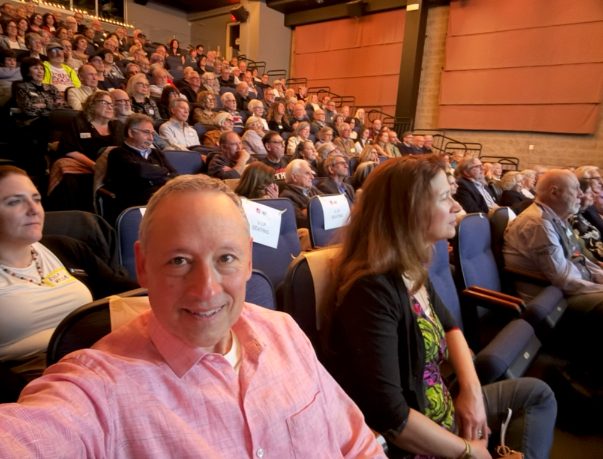
By GERRY POSNER Recently in Toronto, a kind of a Winnipeg reunion took place at the Harold Green theatre in the Miles Nadal Centre at Bloor Street and Spadina Avenue. Think of the old Y at 370 Hargrave Street and you can get a sense of the kind of building we were in.
There were close to 180 people there, maybe more. The sight of all of those ex-Winnipeggers gathered together was akin to the reopening of Portage and Main to pedestrians in its significance. They flooded in and kept coming. Included in the group in attendance were the three sponsors for the evening: Harvey Minuk, David Zitzerman and Joy Kaufman.
The genesis for the reunion was the a result of a movie made by former Winnipegger Allan Novak. As many readers will know, Allan made a documentary film about his mother and her siblings – the Fink family, who were, at the time (a few years ago) the oldest living sibling Holocaust survivors. At the time the movie was made, all four were in the 100 year range. The film was very well received and Allan has, since that time, shown it elsewhere.
As a result, the people running the Miles Nadal Centre were only too happy to screen the film. It was also Allan’s idea to add additional flavour to the evening beyond simply showing the film.
Allan served as M.C. and he began the night with a kind of a Winnipeg Jewish history pop quiz open to all in attendance via their phones. Pictures were shown on the screen relating to a piece of Winnipeg history and audience members were invited to answer as if this were a multiple quiz exam. Thus, for example, the first question was: Which was the first Jewish family to settle in Winnipeg? We had four choices and not many in the crowd chose the Coblentz brothers as the correct answer.
Other questions brought better results. A few of the other questions were: Who was the first Chief Rabbi of Winnipeg? (Answer: Rabbi Kahanovitch); which Winnipeg Jewish scientist worked on the Manhattan Project? (Louis Slotin); and what renowned Winnipeg lawyer whistled with the Toronto Symphony Orchestra? (Harvey Pollock).
When it was all said and done, the winner was the woman sitting right beside me: Elaine Todres. Now, she had been trailing for most of the game, but she made a sudden “run for the roses,” or in this case, the “Jeanie’s cake,” at the end. Now, it is true that she might have been helped by the two men sitting beside her, as in her husband, Rubin Todres – and me. I sensed we both fed her some answers; whether or not she needed our help will remain unknown.
I wanted to enter the quiz but, although I knew many of the answers, I was unable to figure out how to use my phone to give my answers. In short, I have limited skills. I figure the reason Rubin and I knew most of the answers is that although, we weren’t the very oldest people there, we were definitely among the top five.

Part two of the evening consisted of a panel whose members were invited to respond to questions posed by the moderator of the panel, Ralph Benmurgi. Earlier in his career, Benmurgi lived in Winnipeg for a couple years. He was well prepared and although each of us only had time to respond to two questions, Benmurgi tried to get each of us to give our versions of Winnipeg as we once knew it and the reason it “punched above its weight” in the Jewish world.
None of the panelists was reticent to talk. The panelists included: Elaine Todres, Amy Lee, Jonas Chernick, and me. I was easily the oldest on the panel and I suppose that is what qualified me to be invited to participate in the first place. My own opinion was that we all did well in our attempts to get into what made Winnipeg tick. You can ask around (You likely know somebody who was there.) to see if my impression is correct.
The last part of the evening, and for me – the most significant, was the showing of the film “Crossing The River,” about the Fink family. Although I had seen it twice, seeing it a third time was like seeing it afresh and I was delighted that so many people I spoke to at the reception after the programme ended were so taken by the film. You could say that not only was Novak’s film received enthusiastically by the audience, he rendered all of us a great service just by getting us all together.
The reception following the film was packed… I mean packed! It was a good thing the event was not more widely publicized as there wouldn’t have been any more room for more ex-Winnipeggers in the lobby where the reception was held. Now, it is true that some of them might have been drawn to this mini Winnipeg reunion by the suggestion that the organizers had arranged for a Jeanie’s cake to be flown in but, if truth be told, although the appearance was similar, we had a fake cake. Still, we ate it all up.
There were so many people there that I could hardly keep track of them all and I missed seeing many of those who were present, but I do recall at least a conversation of a kind with: Mel and Lesley Springman, Janice Rodin Winocur, Harvin Pitch, Ken Arenson, Michael Mitchell, Susan Rumberg Roadburg, Arthur Standil, Martin Gurvey, Gayla Gurvey and her husband Ken Schwartz, Martin Stoller, Rubin Todres, Michael Levin, the former Brenda Novak, Bernie and Sheila Rubenstein, Paul and Margaret Shuckett, and Nathan and Miriam Jacobson.
The true success of Alan Novak’s creation is the fact that there is a sequel planned for the fall in Toronto.




Local News
Behind the headlines: How the project to build a $17.6 million child care centre and mutipurpose room at the Simkin Centre came about

By BERNIE BELLAN On August 17 of this year a large number of people gathered in the Saul and Claribel Simkin Centre to hear an announcement that the Simkin Centre will soon be adding an entire new wing to its building, to be known as the Gray Family Centre.
The new 20,650-square-foot Gray Family Centre will house the Faye Vickar Lazer Early Learning Centre, a 152-space childcare facility to be operated by the Rady JCC. It will also include a Multipurpose Room for community gatherings and worship, a Wellness and Rehabilitation area, a Grand Gallery, and additional staff facilities.
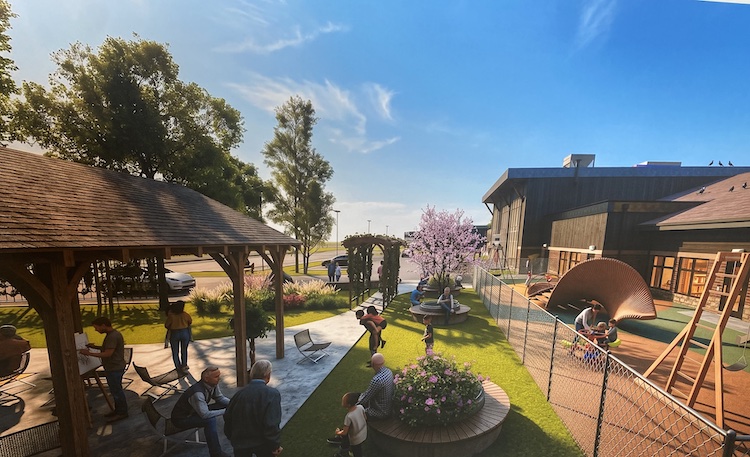
Chief among the components of the project will be the child care centre, to be known as the Faye Vickar Lazer Early Learning Centre. As noted, it will be operated by the Rady JCC, which already operates two other child care centres: The Kaufman Child Care Centre at the Asper Campus and the David and Ruth Asper Early Years Learning Centre on Grosvenor Avenue. In addition, in conjunction with Brock Corydon School, the Rady JCC operates a before and after program at that school.
Financing for this ambitious project will be coming through a combination of public and private funding. At the August 17 announcement we were told that the project is expected to cost $17.6 million in total, of which $4.5 million is to come from a capital grant from the Canada-Manitoba child-care agreement, while the other $13.1 million will be coming from a combination of donations and grants.
Construction of the Gray Family Centre is slated to begin in the spring of 2027, with completion to be sometime in 2028.
Recently, we sat down with Don Aronovitch, who is the longtime chair of the Simkin Centre Foundation and who has also played a lead role in formulating the plan for the entire project. We wanted to discuss where the impetus for this project came from and how the plan was put together.
My first question to Aronovitch was: When did the idea for a new child care centre first come about?
Aronovitch explained it this way: The idea was first broached among himself, David Cohen, and Laurie Cerqueti a few years ago. As he put it, “David Cohen (who is a former CEO of the Jewish Foundation of Manitoba) is one of the world’s master schmoozers and he and I are close friends forever. We sat down and schmoozed with Laurie (Cerqueti, CEO of the Simkin Centre) because that’s what retired people do. We started saying what can we do to enhance the lives of our 200 residents?”
Aronovitch continued: “We have a strong fund at the Jewish Foundation, which supplies healthy cash flow to afford many programs that nursing home don’t normally provide but what more can we do? We came up with a great idea that required government money. Of course, that was a brick wall to the (Conservative) government of the day.
“So we started looking into the idea of adding a child care (facility) to an elder care facility and, with research we found that it’s a spectacular idea. It’s widespread throughout the US (and) is widespread throughout Europe. It’s not widespread in Canada, so we started pursuing it.
(At this point I should note that, after speaking to Don Aronovitch, I happened to run into Gayle Waxman, who is the former long-time executive director of the Rady JCC. I asked Gayle what she thought of the plan to open a new child care centre adjacent to the Simkin Centre. She told me that when she was first searching for a new location where the Rady JCC would open a second day care centre – in addition to the Kaufman Child Care Centre at the Asper Campus, her first choice was actually the Simkin Centre.
Waxman added that she approached the then-CEO of the Simkin Centre with her idea, but that person was cold to the idea, so she says she abandoned the idea of building a day care at the Simkin Centre and began to look for other venues.)
Continuing with how Don Aronovitch described the process whereby an idea tossed around among three different people was eventually transformed into a $17.6 million project, he said: “So we started exploring more deeply and more deeply and more deeply. We went to the government. They were ecstatic with the idea of a child care (centre) because they’re dramatically short of child care spaces.
“And one thing led to the other. David and I went to see the head of the early learning child care division of the provincial government. She was ecstatic with the idea…So, with her encouragement, we got a $25,000 grant from the home (Simkin Centre) board.
“With that money, we sent out for requests for proposals. We went to five firms, I think, that the government recommended. We ended up with MCM Architects for our $25,000.
“They gave us a design plan and the whole plan – which really hasn’t changed, was this 20,000 square foot addition (which) would be added to the east end of the Simkin Centre.”
Aronovitch noted that the new centre would be built adjacent to what is now a wall at the end of the hall where the administrative offices of the Simkin Centre are housed. If you keep walking now, you’d hit a wall.
“Well, that becomes a passageway to the new facility,” he explained. “The first thing (you’ll see will be) a huge multi-purpose room because the purpose of a child care is to bring the joy of children to elders.
“That’s the fundamental rationale here and there’s no grandparent in the world that doesn’t smile at the joy or the cries of a two or five-year-old.”
Aronovitch went on to say that, leading from the “large multi-purpose space, there will be a rehab room and another staff room, and what will become a 152 unit child care facility.”
He noted that “from day one, we did not want to be in the child care business, so we went to the Rady Centre. They’re the lead daycare operator in the city.”
I asked though, when did the plan go from something that was simply being talked about to a hard and fast plan?
Aronovitch responded: “Probably two years ago. It took a long time.”
As of now, he explained, the project has been put out for tender. “I think there have been six firms that attended the site visit (which was organized by MCM Architects). So I’m assuming all six firms are going to submit a tender. I hope so.
“And MCM will do a matrix and say we recommend ABC construction. They’ll make that recommendation to us and we will then take it to the board and presumably the board will approve that. And what we will do is award the contract to ABC contractors.
“So they know they’ve got the contract but (we don’t) expect them to start construction till March because we have a winter happening in Winnipeg – as everybody knows, but that allows them lead time to order things like air conditioners and stuff that because of the supply chain problems worldwide, everything takes longer. So that’s the timeline. We will open ideally in the summer or fall of 2028.”
I harkened back to the time when the Simkin Centre owned 10 acres of land to the east of the centre, which is now home to a large scale residential development, including the Courtyards of Linden Pointe and the soon to be opened Residences of Linden Pointe. I wondered whether thought had been given that long ago to keeping a portion of the land which Simkin then owned for possible future expansion of the Simkin Centre?
It turns out that was exactly the plan. Arnovitch explained: ‘The team of the day said: “We will reserve one acre for future development.” So immediately east of our property is one acre of grass and then the neighboring development to the east.’
Our conversation then turned to the funding of this very large project. As Aronovitch already noted, the government (which, in this case, is the provincial government, using money allocated from the federal government) is only putting up 60% of the cost of building the child care facility: $4.5 million. The remaining $13.1 million for the entire project will be coming from a combination of grants and private donations.
Back in September I had received an email from Gerry Posner, in which he suggested that I ought to write a story about the several individuals who played important roles in fundraising for what was to become the Gray Family Centre. In his email Gerry mentioned five other names, in addition to Don Aronovitch and David Cohen.
In a later email, Aronovitch said that, in addition to his and David Cohen’s roles in leading the fundraising efforts, Sheldon Mindell has also played a lead role in that effort. He also wanted to cite contributions made by members of the he planning committee: Robyn Avery, Ellery Broder, Matan Gamliel, and Jack Hurtig. During our interview, he made particular mention of Jack Hurtig’s role, saying “Jack Hurtig was brilliantly involved because he put the lease together with the Rady Center, and that’s his expertise.”
The conversation turned to the quite enthusiastic responses received from a number of leading members of our community when they were first told about the plan to build a new child care centre, a multipurpose room, and other components in what is to become a 20,000 square foot addition to the Simkin Centre.
Aronovitch described the reaction David Cohen had received very early on from one well-heeled individual within our community when the project was first being bandied about: “David Cohen and I were at a jazz concert and during the intermission, I saw him schmoozing in the corner with a well-known community member who is known to the Simkin Centre.
‘And so they arranged a lunch and this individual said: “So what’s doing at the Simkin Centre?” David told me that when he mentioned a child care, this guy went up like a Christmas tree or Hanukkah bush. The guy said, “Well, if you can do that, I’ve got a million dollars to put on the table for my family name.” ‘
(As of this point, however, Aronovitch says that particular individual – whose name he did not disclose, has not actually committed to a million dollar donation.)
But others who were approached have come through with major commitments, Aronovitch says.
He described the reaction of sisters Debbie and Sarah Gray (also their brother Michael) after David Cohen told them about the project: ‘They got excited about it and said, “We can put forth X dollars if you’ll name the facility after us.” So the whole facility, as in our publicity, is the Grey Family Center. And they put dollars on the table to do that.’
Aronovitch continued: “Then we priced the multi-purpose room – with an Aron Kodesh in there, and the daycare. And so Joel Lazer came forth with the Fay Vickar Lazer Early Learning Center for the child care. And they put money on the table for that naming.
“And then the family of the late Richard Rice has come forward with money for the naming of the multi-purpose room and the Aron Kodesh.”
(In a later email Aronovitch also cited the donation Jackie Simkin has made, which will see the Grand Gallery named for her niece.)
Incidentally, the new multipurpose room will also serve as the new chapel for the Simkin Centre – and not just for Jewish services. It will have room for 250 people, Arnovitch explained, of whom 100-150 will probably be in wheelchairs. (I asked Aronovitch what’s going to happen with the existing chapel and multipurpose room, and he answered that they’re going to be “repurposed.”)
In addition to donations from individuals, Aronovitch noted that the Jewish Foundation has agreed to provide half a million dollars in funding.
In addition, of the $17.6 million overall cost of the entire project, Aronovitch explained that $1.3 million is the cost of the land – which the Simkin Centre is donating. So, if the government is putting up $4.5 million, the Jewish Foundation is contributing $500,000, and the Simkin Centre is donating the land – worth $1.3 million, that still leaves $11.3 million to come from private donors and other possible grants.
Yet, according to Aronovitch, 87% of the project is fully funded – as of the time of writing – which speaks well to how successful the entire fundraising campaign has gone.
I wondered though, about operating costs for the new facility. How will they be borne?
Aronovitch says that the operating costs for the child care centre will be the government’s responsibility, while the new multipurpose room and other new facilities are expected to cost around $80,000 a year to maintain – primarily for heating and air conditioning. In terms of the overall cost to the Simkin Centre, it would be a fairly insignificant cost, given that total expenses for the Simkin Centre, according to its 20245-2026 annual report, were $23,551,709.
The next step in the project will be a groundbreaking ceremony, which Aronovitch says should be held sometime in December (before the ground freezes.)
Local News
Gail Asper adds $10-million donation to ambitious $1.2 billion Hebrew University fundraising campaign
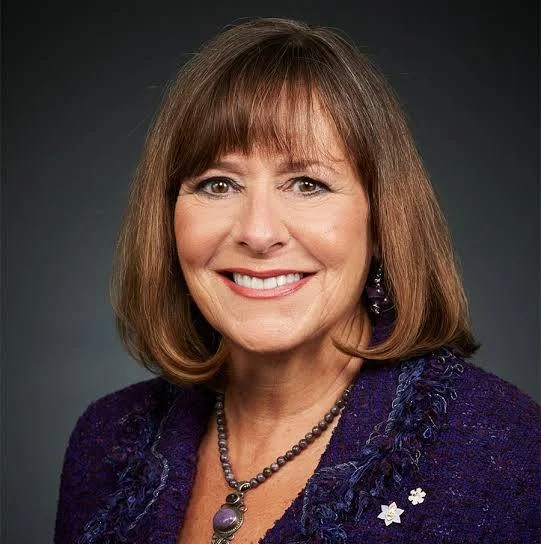
By MYRON LOVE Gail Asper, one of our community’s leading philanthropists, has recently returned from the Hebrew University of Jerusalem’s annual International Board of Governors meeting, during which she pledged $10 million to the university’s $1,2 billion international Powered By Purpose Campaign.
As reported in the Post last April, Asper has taken on the challenge of co-chairing the campaign (with patty Glaser from Los Angeles), which was kicked off at the recent board meeting. “It is important to lead by example,” she notes. “As my father (the late I.H. Asper) used to say, it is important to give what you can.”
Rami Kleinmann, President and CEO of Canadian Friends of the Hebrew University observed that “Gail’s gift is a testament to what is possible when personal conviction, a tradition of giving, and belief in a mission come together. We are deeply grateful for her leadership and for the Asper family’s remarkable partnership with Hebrew University.”
Professor Tamir Sheafer, president of the Hebrew University of Jerusalem, speaking on behalf of the entire Hebrew University community, thanked Gail “for her remarkable generosity and her leadership. Her gift, and her role as co-chair of our international campaign, will help us keep Hebrew University a global leader in research and education for many years to come.”
Asper’s personal connection with the Hebrew University goes back more than 50 years. She recalls going to Israel for the first time with her family in 1974, when she was 14. In her 20s, she and her brothers went to Jerusalem with their parents where Israel Asper would be attending HU annual Board of Governors meetings.
“I met the president of the university,” she recounts. “I got to see what the university was doing and got to know the people on the board. There were board members from all over the world, all accomplished and interesting people.. It was so glamourous.”
In 1989, her father – after more than 20 years on the board – told Gail that he was stepping down to spend more time building the still relatively new Canwest – and suggested that she should replace him as a board member. Not only did she join the board, but she also became one of the founding members of the newly formed Canadian Friends of Hebrew University Business and Professional Division, along with other now prominent community members such as Howard Morry and Murray Palay.
It wasn’t long after she joined the Hebrew U board that she moved on to the board executive,” she notes. “We would have meetings in Israel three or four times a year. Thank goodness now for Zoom. But I really enjoyed meeting with fellow board members, as well as university management and faculty.”
Among the Asper family initiatives at the University are: the Asper HUJI Innovate program – the University’s centre for innovation and entrepreneurship; theAsper prize in Innovation, which supports and celebrates promising Israeli start-ups; the Asper Center for Entrepreneurship and Innovation, the academic and community hub housed within the Hebrew University Business School (HUBS); and ongoing exchanges that bring Canada’s brightest students to Israel for a semester or complete degree.
Gail reports that her new donation is intended the help make up for the rapidly decreasing number of scholarships and grants from foundations outside of Israel that would normally be potentially available for Hebrew University students and researchers, but which have declined in number due to the increasing hostility in academia to anyone connected to Israel.
She is happy to report that the five-year Powered By Purpose Campaign has received a major boost from a $250 million gift from billionaire American hedge fund manager John Paulson. “This is the largest gift ever received by the Hebrew University,” she notes. “This is also the first time that the university has received a donation from Mr. Paulson. We are really excited about it.”
In that earlier interview with the Post, Asper reported that one focus of the new campaign will be Jewish philanthropists and foundations who had been supporting American and Canadian universities but who have been told that, since October 7, 2023, that their donations are no longer welcome. “Others have pulled their donations because of anti-Jewish activity on campuses,” she pointed out. “We will be suggesting that their donations will be better spent supporting Israel’s leading universities rather than antisemitic universities in Canada and the US.”
One area that struck her about this most recent visit to the university was the large number of Israeli Arab students and faculty. “You see the diversity on campus,” she observes. “Close to 20% of the student body and staff are Arab Israelis. Most students seemed to be comfortable on campus and happy to be there.
“It was wonderful to be in Israel,” she says, “and nice to see other Winnipeggers – such as (Federation CEO Jeff Lieberman, (CIJA representative) Gustavo Zentner, and (philanthropist) Larry Vickar also in Israel to attend other institution Board of Governors meetings at a time when direct flights to Israel are scarce and there are very few tourists.”
Local News
Palestinian-born Dor Shachar chose Judaism and life in Israel over Islam and darkness in Gaza
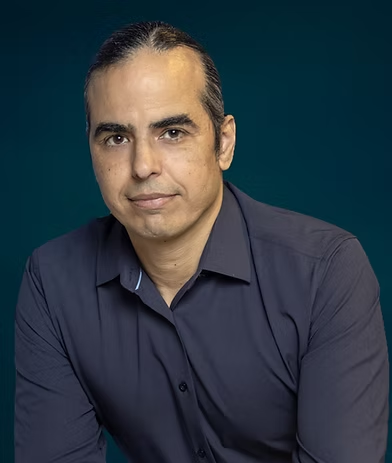
By MYRON LOVE Dor Shachar is a rare individual indeed. It seems almost miraculous – certainly “beshert” – that this individual, who was born into a Muslim family in Gaza and raised as a Muslim, chose to leave behind the hell and darkness that is Gaza and embrace the light of Judaism and Israel.
On Monday, November 2, the proud Jewish Israeli shared the story of his transformation with an audience of about 150. Invitations were specifically sent out to Christian communities in Winnipeg because extreme Islam also targets Christians, as well as moderate Muslims.. Earlier, he also spoke in a couple of schools.
Among the attendees were several members of the Manitoba Conservative Party caucus – including interim leader Konrad Narth. Invitations to attend Shachar’s presentation were also sent to the other provincial parties, but no one from the other parties showed up.
As Shachar doesn’t speak English, his remarks were translated by Jona Rapaport, who is from Montreal and who had family members kidnapped on October 7.
Shachar’s narrative falls into two distinct parts – and I have to admit that the first act was at times very difficult to listen to. What he described of his life growing up in Gaza was horrific. He recalled that the clothes his family wore, the food they ate, and their appliances were all from Israel, and that his father worked on construction projects in Israel for many years. His father and grandfather pretended to be on friendly term with the Israeli soldiers who patrolled Gaza at the that time – in the 1980s –and the family invited soldiers – these same soldiers who would give the kids treats – into their homes. His father and grandfather were hospitable and seemingly friendly. As soon as the guest would leave though, the young Shachar was told that he one day it would be his duty to kill the “sons of apes and pigs” – referring to the Israelis living in Jewish communities that had been established in Gaza.
Shachar reported that his neighbours were future terrorist leaders, including Hamas leader Yahya Sinwar. He witnessed the digging of the first terror tunnels more than 40 years ago. As well, he saw the evil of the various hateful groups who used torture and terror to rule Gaza – from Fatah to Hamas and their affiliated terror groups. He described public scenes of torture and murder that rivaled the worst excesses of the European Dark Ages a thousand years ago. He recalled how in elementary school, students were taught how to throw rocks at Israeli soldiers.
In a particularly horrifying segment, Shachar recalled what happened to him when still in primary school. Apparently, he didn’t show enough zeal about hating Jews and Christians. He was hauled into the principal’s office – where he was whipped. When his father learned about this, he spent hours beating and torturing his son – including hanging a noose from a tree – for “dishonouring” the family. Only an intervention by an aunt most likely saved his life – although his father then proceeded to beat the aunt. He was relegated to looking after the family flocks.
Another time, when he was 11, his father found out that he was skipping school, beat him, tied him to a tree, and doused him in cold water. Shachar was locked in the outhouse for the night and forced to sleep on the floor.
A few months later – when he turned 12 – his father started taking the youngster with him to Israel to work on construction projects. After a couple of months, he managed to run away.
Thus began the second chapter of his life – his new life in Israel.
While working as a security guard watching over a neighborhood of villas where prospective tenants would come to see the apartments, he was approached one day by a resident by the name of Nissim Ozen.
“Nissim took interest in me,” he recounted. “He brought me home with him, got me clothes and shoes and other gifts.”
He began to be invited to Ozem’s home for Shabbat suppers and other meals and was welcomed to have hot showers and watch television.
At Pesach, he was invited for the family’s seder.
“I come for the seder and I see the longest table I have ever seen,” he recounted. “It stretched from the living room through the kitchen out to the garden. On the table, there was bread, only the matzah, some eggs, a shank bone and some greens. I asked my host if he was on a diet.“I didn’t yet know much Hebrew, but I learned about the Exodus.”
That was when Shachar decided that he wanted to become a Jew. Some of his new friends arranged for a local Bet Din. He was subsequently referred to another Bet Din in Tel Aviv, then a third in Kiryat Shemona in the north, and finally, to Jerusalem where he told that, because he was still a minor, he would need his father’s permission.
That was never going to happen.
Nonetheless, Shachar was able to go to school and become proficient in Hebrew – while he eagerly counted down the days until he turned 18 and could become Jewish.
But, there was another hitch in store.
It was now the mid-1990s and the first Palestinian suicide bombers began killing Israelis on buses, in restaurants and wherever they gathered. Shachar spoke of the notorious Yahya Ayyash – the bomb maker, Shachar recalled, who provided his dubious services to all the Palestinian factions. (The IDF caught up with him and killed him with a bomb in early 1996.)
Shachar pointed out that – contrary to what diplomats, politicians and leftists in the West believe – there is no difference between Hamas, the PLO/Palestinian Authority – given the facts and what they say in Arabic from “pay for slay” to other hate they espouse against anyone not aligned with them – even moderates. There is no “partner for peace” among the Palestinian factions, he says, – and no difference between those factions and Al Qaeda, ISIS, and the Taliban.
Unfortunately for Shachar, due to the increased level of attacks by Palestinian terrorists, Israel tightened restrictions on Palestinian workers who were allowed to work in Israel. All Palestinians workers had to have permits. Because he didn’t have one, he was sent back to Gaza, where he was tortured daily by Hamas operatives for six months.
Eventually, he was released to fend for himself in Gaza. Determined to return to Israel and become Jewish, he was – after a few months – able to slip across the border to Egypt and make his way via Turkey back to Israel
Back in Israel, he attended a yeshiva and resumed his efforts to become a Jew. It took him seven years to realize his dream. The climactic moment for him came, he recounted, one Purim when he joined a rabbi in Jerusalem for a “farbrengen.”
“I had never had alcohol before,” he said. “Alcohol is forbidden to Muslims. I quickly became woozy. Nonetheless, the rabbi kept pouring. Even while drunk, I kept insisting that I wanted to be a Jew. That was enough to convince the rabbi to support my efforts.”
Today, Dor Shachar is a proud Jewish Israeli – happily married – who speaks for Israel on the world stage and warns people, especially in the West, about the hateful dogma and true extremist intentions of Islamist ideology. Statistics indicate that 15-25% of Muslims in the West are radicalized. With the influx of people from Gaza and other areas that number may be grossly underestimated.
In Gaza and Judea and Samaria the numbers are higher.
The ultimate goal for Islamic extremists, Shachar warned, is world domination.
