


Uncategorized
Columbia University pledged to revamp Mideast offerings. Students of the subject say fragmented courses fall short.
New president Jennifer Mnookin took the helm of Columbia University July 1, vowing to chart a steady course following a tumultuous Gaza War protest movement and Trump administration threats to pull funding that led the Ivy to make a controversial pledge for reforms.
The government also threatened a takeover of the department called Middle Eastern, South Asian, and African Studies Department (MESAAS), which has long been associated with the Palestinian cause and known as a hub for scholarship critical of Israel.
Columbia’s July 2025 agreement, issued in response to allegations that the protests amounted to discrimination against Jews on campus, pledged to “conduct a thorough review of the portfolio of programs in regional areas across the University, starting with the Middle East” to ensure offerings are “comprehensive and balanced.”
Nearly a year later, the department has been left untouched, according to its chair, Gil Hochberg.
“No requests, suggestions, recommendations, changes were made or enforced by the university on MESAAS as a department. Our academic autonomy has been respectfully preserved,” she said in an interview with the Forward. “The department itself has not been directly or indirectly affected.”
Columbia has made other moves to offer more courses that cover Israel. But undergraduates who study the region say that fragmentation makes pursuing a major challenging.
Orpaz Zamir, a Middle East Studies major at Columbia who hopes to pursue a career in Mideast policy, said courses focused on the conflict are limited. “If you want to study about Israel and Palestine, there are only two classes you can take,” referring to a sociology course taught by Professor Yinon Cohen and the course taught by Massad. He took both.
Massad, the only professor currently teaching about the conflict in MESAAS, has been the department’s chief lightning rod. His article a day after the Oct. 7 attacks, describing the Israeli victims as “colonists” and videos of the attacks as “awesome,” sparked a petition with 70,000 signatures to remove him from Columbia. Massad, who is tenured, has been teaching the course Palestinian and Israeli Politics and Societies for years. Among his students was Darializa Avila Chevalier, a former Columbia Gaza encampment leader who last week defeated a longtime New York congressman on an anti-Israel platform and drew criticism for her refusal to condemn the Oct. 7 attacks. As an undergrad, she called Massad her favorite professor.
In Spring 2024, a visiting professor, Mohamad Abdou, was fired amid the Congressional hearings on campus antisemitism because of a social media post he made shortly after the Oct. 7 attacks that read: “I’m with the muqawamah [the resistance] be it Hamas and Hezbollah and Islamic Jihad.”
Activist faculty made headlines but also spoke to a broader reality, as identified by an internal Columbia University antisemitism task force that found in its December 2025 report that “Columbia lacks full-time tenure line faculty expertise in Middle East history, politics, political economy, and policy that is not explicitly anti-Zionist.”
The same report concluded: “Many Jewish and Israeli students reported that if they want to study the Middle East at Columbia, there currently are not enough options that don’t treat Zionism and Israel as fundamentally illegitimate.”
Exam questions
Students interviewed by the Forward describe experiences consistent with those findings. Zamir said he found Cohen’s course on Israel more balanced than Massad’s, though concluded the assigned readings disproportionately favored the Palestinian perspectives.
“To the Palestinian side, he would give entire chapters and long readings, and then for the pro-Israel side it would be mostly a few pages of an article,” said Zamir. “There’s one book that they did give to us that was a bit more pro-Israeli, but it was pro-Israeli in the bad sense, like it justified ethnic cleansing. It’s not the kind of thing that I would support.”
In Massad’s course, Zamir saw discussions of the conflict reflect a particular ideological viewpoint.
He recalled Massad questioning evidence of Hamas sexual violence during the Oct. 7 attacks and disputing claims that Hamas intentionally targets civilians. Zamir also found the questions on exams to be problematic. On one exam, Zamir said, two out of three questions had to do with how Zionism collaborated with the Nazis. On the final exam, one of three questions asked students whether Israel had the right to exist.
“Because he didn’t give any reason in class for why Israel should exist, it’s very hard to answer that question with anything other than ‘no,’” Zamir said. He said he drew on arguments he had learned outside the course to argue that Israel did have that right — and received full credit for the answer.
Zamir noted that despite their ideological differences, Massad made an effort to make him feel welcomed as the only Israeli in the class, even when fellow students didn’t.
Other students interested in the subject described similar difficulties finding courses they viewed as balanced.
“I was looking up every professor and looking pretty scrutinizingly through the description of every class,” said Zev Huneycutt, a rising senior majoring in Middle East studies, economics and political science.
“In the Middle East studies department, when I would look them up, and they’d have leveled this kind of crazy criticism of Israel, and it’s not stuff like, ‘I have some issues with current Israeli government policies,’ it’s stuff that goes a little farther than that. It’s delegitimizing, and I’m like, ‘Okay, well, I’m not taking that professor then.’”
In February, as part of the agreement with the federal government, Columbia published an internal review committee’s recommendations and commitments from several academic departments to enhance Middle East-focused offerings — almost all of which are set to occur outside the MESAAS department.
Indeed, the first recommendation from the review committee reads: “Expand coursework on the Middle East … by developing offerings that complement — and are clearly differentiated from — courses offered by MESAAS.”
Hochberg concludes that this is because MESAAS is already fulfilling its mandate. She noted that the department was “rigorously reviewed” both internally and externally in 2024 during the standard review process that takes place for every department at Columbia every eight years.
“It would be very strange to have another, and the university would never do that,” she said, adding that the review done in 2024 generated a file of 20 pages of recommendations detailing the strengths and weaknesses of the department. According to Hochberg, none of the recommendations made in internal and external reviews had to do with how Israel is taught at MESAAS.
Hochberg, who was born in Israel and identifies as an anti-Zionist, has previously taught courses on Israeli culture. Serving as chair of MESAAS for the past six years, she said, administrative responsibilities have required her to step back from teaching those courses, contributing to what she acknowledges as a gap in the department’s offerings on Israel.
She contends much of the criticism of an anti-Israel bias within MESAAS has been overblown. “It’s a very vigorous department,” she said. “The picture of it as being like a propaganda machine, it’s just not fair.”
Arab Studies search
Though Columbia has left MESAAS largely untouched, it has made additions to other departments and institutes, including bringing on a visiting professor in the economics department to teach about the Middle East, and arranging a visiting appointment in the History Department to teach the history of modern Israel. Its School of International and Public Affairs has appointed a visiting professor, jointly with Columbia’s Institute for Israel and Jewish Studies, to teach on the Jewish world and Middle East policy with courses beginning this fall.
The university also plans to hire a new Edward Said Professor in Modern Arab Studies and Literature, a tenured position that was vacated last August by Rashid Khalidi, a leading scholar of Palestinian history. Khalidi cited the university’s adoption of the IHRA definition of antisemitism as part of its agreement with the federal government — which equates denying Jews their right to self-determination in Israel with antisemitism — as his reason for resigning.
One potential candidate, Max Weiss, was active in Princeton’s pro-Palestinian movement, serving as a spokesperson when faculty occupied Princeton’s Clio Hall in April 2024 and 13 people were arrested. Another, Rosie Bsheer, was removed from her leadership post at Harvard after she organized a panel that former Harvard President Lawrence H. Summers described as “very likely” antisemitic under the IHRA definition.
The university also plans to launch a new undergraduate major in Global Affairs and Public Policy, which it says will expand Middle East course offerings. But the proposal has drawn criticism. In a June 15 statement, the Student Affairs Committee of the University Senate, a body that sets campus policy, questioned “the role of the Global Affairs and Public Policy major in regard to the federal resolution agreement’s commitment to offer politically prescribed curricula on the Middle East.”
To help expose students to a range of analyses of the Middle East, the internal review committee encouraged cross-listing among the Jewish studies institute, MESAAS and the proposed new program.
But this upcoming school year, the Institute for Israel and Jewish Studies is offering several courses that pertain to the Middle East, including a course on the history of modern Israel and a course on Jews living in North Africa, that are not cross-listed with MESAAS. (The Institute’s director declined to speak with the Forward, saying that she does not discuss Columbia in the media.)
The only Israel-focused course that MESAAS will cross-list for the upcoming year is the sociology course taught by Cohen.
According to Hochberg, “There are absolutely no political barriers to including courses offered by Jewish and Israel studies in the department, and there never have been.”
She said, “I don’t think it’s a hostile relationship between MESAAS and IIJS. There’s just no substantial relationship. But we do cross-list some courses.”
For Zamir, Columbia’s new reforms are unlikely to address what he views as the underlying problem.
“Adding some classes in the Israel Institute won’t change things, because no one will take a class in the Israel Institute unless they are pro-Israeli to begin with,” he said. “If it’s in the Middle East department, it’s like ‘okay, well, it sounds neutral,’ even though it’s definitely not.”
Lishi Baker, who graduated this spring with a major in history and a specialization in the Middle East, said he largely built his Middle East studies education outside the MESAAS department. He sees the university’s efforts to expand Middle East offerings in other departments as a welcome development.
“A lot of people do what I did, which is study the Middle East through other departments,” Baker said.
He pieced together courses from the History Department, political science, policy school and Jewish studies, ultimately earning a minor in Jewish studies because many of the courses he took related to Israel did not count toward his major.
“I think now, the best place to study the Middle East at Columbia is everywhere but the Middle East Studies Department,” said Baker.
The post Columbia University pledged to revamp Mideast offerings. Students of the subject say fragmented courses fall short. appeared first on The Forward.
Uncategorized
Looking for a Yiddish-related event?
The Forverts website now includes a new feature. Each week, you’ll find a listing of upcoming events related to the Yiddish language or culture, both online and in person.
The list will include lectures in English or Yiddish; concerts; plays; day trips; conversation groups and reading circles.
If you know of a Yiddish-related event coming up, let us know by emailing schaechter@forward.com.
Sunday, Nov. 1, 2 p.m. ET. In this Zoom event, L.A. Yiddish culture activist Miri Koral will discuss a unique translation project of 160 works written by diverse masters of Yiddish poetry who perished in the Holocaust. Poet and Holocaust survivor Binem Heller compiled the anthology in 1951 to ensure that the works of these wonderful poets aren’t forgotten, and Koral is determined to get them all translated into English, opening them up to a much wider audience. The program will be in Yiddish. Register.
Sunday, Nov. 1, 2 p.m. ET. Some of the most passionate Yiddish love poetry and prose was written about Crotona Park in the Bronx, an area that fell off the beaten track in the last century. In this on-site tour in Yiddish, scholar Eve Jochnowitz will guide us as we explore the neighborhood and the literature it inspired. The event is free but a donation of $18 is suggested. The group will meet at the corner of Charlotte Street and Crotona Park East. Register.
Sunday, Nov. 1, 2 p.m. ET. Come shmooze in Yiddish with people all over the world at the shmueskrayz hosted by the Parizer yidish-tsenter. The atmosphere is friendly and relaxed. Feel free to sip coffee or a glass of wine. No registration necessary. Zoom link here
Thursday, Nov. 5, 7 p.m. ET. In this Zoom event, we’ll hear an English translation of detailed Yiddish letters written by Shlomo Vorobeichic, a Jewish man in Vilna before the war, to his siblings who had settled in the U.S. Although Shlomo, his wife and two children perished in the Holocaust, two children survived and kept the letters. One of them, Moi Ver, became a well-regarded photographer. In the 1990s, Moi Ver’s daughter Lilian Falk translated her grandfather’s letters into English, giving us a vivid view of Vilna in the early 20th century. Register.
Friday and Saturday, Nov. 6-7. Stockholm khevre: Attend a Yiddish film festival that includes contemporary Yiddish works like the 2026 film Moishe Badkhn (Moishe the Wedding Entertainer); Welcome to Yiddishland (2024), and the Yiddish-Ukrainian film SHTTL (2023). All films are subtitled in English. Tickets.
Sunday, Nov. 8, 3 p.m. ET. Folks in the DC/Maryland/Northern Virginia area: Join the DMV Jewish Labor Bund for a bimonthly Yiddish song circle at Maryland Meadworks. All levels of Yiddish and singing ability are welcome.
Tuesday, Nov. 10, 3 p.m. ET. Toronto folks: Yiddish studies scholar Sonia Gollance will discuss and read excerpts of Tea Arciszewska’s Yiddish play Miryeml, which Gollance translated as part of her project to uncover Yiddish plays by women. The play is often described as a powerful memorial to the 1.5 million children murdered in the Holocaust. The in-person lecture will take place at the University of Toronto and will be in Yiddish. More info.
Wednesday, Nov. 11, 7 p.m. ET. Attend an in-person staged reading of Sh. An-ski’s legendary folk drama, The Dybbuk, directed by Mikhl Yashinsky. The play, originally written in Russian between 1913 and 1916, was translated into Yiddish by An-ski himself and inspired countless film, opera, and ballet adaptations. Register.
Thursday, Nov. 19, 7 p.m. ET. Learn what makes Quebec an essential place on the world map of Yiddish culture historically and today in this Zoom talk between the Yiddish Book Center’s director of special projects, Sebastian Schulman, and Brian Calvert from Jewish Heritage Travel. The discussion will feature a sneak peek at the Center’s upcoming group tour to Montreal and Quebec City. The trip is a unique chance to experience Yiddish-Quebecois culture—its history, art, music, cuisine—as well as Montreal and Quebec City as historic and contemporary centers of Jewish life and creativity. Register.
The post Looking for a Yiddish-related event? appeared first on The Forward.
Uncategorized
These rivals in a close House race agree on Israel. They’re fighting over who Jewish voters can trust.
Israel and antisemitism have emerged as central issues in several closely watched midterm races. But in New York’s 17th Congressional District, where Jewish voters could help decide one of the country’s most competitive House contests, the two candidates have more in common on those issues than their campaigns suggest.
Cait Conley, the Democratic challenger to incumbent Republican U.S. Rep. Mike Lawler, is not a progressive Democrat who Republicans have been warning Jewish voters about in recent campaigns. An Army combat veteran and former national security official, she strongly supports Israel, opposes additional conditions on U.S. military aid and rejects accusations that Israel committed genocide in Gaza. She has also criticized New York City Mayor Zohran Mamdani over his statement marking the third anniversary of the Oct. 7, 2023 Hamas attack and has vowed to confront antisemitism within her own party. But that may not be enough to win Jewish votes from Lawler, who is popular with Jewish voters.
The district includes Rockland and Putnam counties and parts of Westchester and Dutchess. It has one of the largest Jewish populations in the country, with Jews making up an estimated 19% of its population, according to a 2024 study. It is one of the key House races where Jewish voters could make the difference in a closely contested election that will determine which party controls Congress.
Kamala Harris carried the district by a narrow 50-49 margin in 2024, and it voted for Joe Biden by a 59-39 margin before that. The late Jewish congresswoman Nita Lowey, a Democrat, represented the district for three decades until her retirement in 2020. Her successor, former Rep. Mondaire Jones, chose not to run in the redrawn district in 2022 and instead lost a bid for a House seat representing parts of Manhattan and Brooklyn. During his unsuccessful 2024 campaign against Lawler, Jones had to delete a social media post that some deemed insulting to Orthodox Jews after he remarked that the former Republican House Speaker’s meeting with Rabbi David Twersky, the 86-year-old spiritual leader known as the Skverer Rebbe in Rockland County, “was a waste of everyone’s time.”
Conley, 31, faces a difficult challenge in her bid to unseat Lawler, who has deep relationships with Orthodox and Hasidic voters since he first won his seat in the 2022 midterms by a narrow margin of about 2,000 votes, thanks in part to strong support from the large Hasidic communities in Monsey, New Square and New Hempstead in Rockland County.
That makes the race a test of whether a moderate, pro-Israel Democrat can win back Jewish voters who have grown concerned about the growing influence of progressives within the Democratic Party.
In separate interviews with the Forward, Conley and Lawler both stressed their support for Israel and commitment to fighting rising antisemitism. To draw a contrast, Lawler, 40, questioned whether Conley would stick to her positions if elected, while Conley accused him of using his ties to Jewish voters to distract from his support for President Donald Trump’s agenda.
A Democrat who rejects conditions on Israel aid
Conley, a West Point graduate and 16-year Army combat veteran who later served as counterterrorism director on President Joe Biden’s National Security Council and oversaw election security efforts at the Department of Homeland Security, occupies a different position on Israel than many progressive Democrats.
She supports Israel’s right to exist as a Jewish and democratic state, backs continued U.S. military assistance and opposes imposing conditions on that aid, including on offensive weapons.
“I do not believe that what is going on in Gaza is a genocide, and I do not believe in further conditioning assistance to Israel, so it continues to have the means to defend itself against the very real threats that are posed,” Conley said in an interview. “I will be an effective and strong advocate for the Jewish community and assistance to Israel in the Democratic Party.”
Conley said her experience serving in the Middle East shaped her understanding of the threats Israel faces, particularly from Iran and terrorist organizations.
At the same time, she supports a two-state solution and believes American politicians should be able to criticize Israeli Prime Minister Benjamin Netanyahu or other Israeli leaders without questioning Israel’s legitimacy. She expressed concern, though, that criticism of Israeli government policies can sometimes become an excuse for targeting Jews. Conley also supports expanding federal security grants for synagogues and other religious institutions.
Conley said she supported the targeted American strikes on Iranian nuclear facilities in 2025, but opposes Trump’s war with Iran because she believes it has made the United States less secure and increased energy prices.
Lawler isn’t buying Conley’s pro-Israel pitch
Lawler dismissed the suggestion that he and Conley hold essentially the same positions on Israel and antisemitism.
“That’s laughable on its face,” he said in an interview.
His central argument is that Conley may sound like a moderate on the campaign trail but would ultimately follow Democratic leaders in Congress, as support for Israel becomes increasingly divisive within the party.
“She’ll be a rubber stamp on whatever the majority of the Democrats want to do,” Lawler said, citing the July vote to eliminate the $3.3 billion in annual military assistance to Israel. A record 103 of 212 Democrats supported the measure. Another 10 Democrats abstained. Conley “is not going to stand up and be a lone voice on these issues,” he said.
“At the end of the day,” Lawler added, “I have a very clear record of delivering on these issues, and there’s staunch differences in approach.”
A Republican who speaks the community’s language
Lawler’s relationship with Orthodox and Hasidic voters goes beyond his positions on Israel. A practicing Catholic, Lawler has made those relationships part of his political brand, going back to his election to the State Assembly in 2020. He has taken credit for lowering the temperature in Rockland County after local GOP officials in 2019 posted a video widely criticized as antisemitic. He regularly attends community celebrations and has helped arrange meetings between local rabbis and religious leaders, President Donald Trump and Republican leadership.
Earlier this year, William Paul, the son of Sen. Rand Paul of Kentucky, confronted him in a Washington bar, believing the New York congressman was Jewish. Paul later apologized and said he has a drinking problem for which he is seeking treatment.
His presence in the community has become so familiar that his campaign even has Yiddish materials and songs promoting his reelection. The songs are shared in popular WhatsApp groups, played at weddings and blasted from trucks driving through Hasidic neighborhoods to encourage people to vote.
Lawler’s campaign is aiming to surpass the 22,000 votes he received in Hasidic neighborhoods in 2022 and 26,000 votes in 2024, as polls show the race is a dead heat. In an interview with Punchbowl News, he predicted 30,000 Orthodox votes, arguing that the community’s participation is difficult for pollsters to capture.
In his interview with the Forward, Lawler said his popularity comes from a simple strategy: showing up.
“I am really the first elected official that has shown up, you know, consistently and publicly in this community, and not just to see the leadership of the community, but to meet the people,” he said. Lawler has even picked up some Yiddish vocabulary along the way. Asked what word he had learned, Lawler quipped, “I love the word shanda to describe Chuck Schumer,” using a Yiddish term for disgrace about the Senate Democratic leader, who is Jewish.
Lawler believes his efforts have helped build support beyond the Orthodox and Hasidic communities, including among Reform and secular Jews who might otherwise vote Democratic but are concerned about their party’s direction on Israel. “Democrats have effectively abandoned Jewish Americans,” he said.
Conley acknowledged Lawler’s visibility in the community but questioned whether it is matched with policies that benefit Jewish families. “Mike Lawler shows up for the photo op, but when it comes to acting, he turns his back on the community every time,” she said. Conley pointed particularly to his support for Republican-led legislation cutting Medicaid spending and other federal benefits.
A fight over antisemitism in politics
Conley said her own outreach has focused on convincing Jewish voters that she understands their security concerns and shares their commitment to Israel, even as she disagrees with Lawler on domestic policy.
She also spoke of a personal connection to the Jewish community as a member of the LGBTQ community, recalling how Jewish Americans stood up for LGBTQ rights. “That’s why I proudly stand beside them and let them know that there are people who deeply care and will proudly stand shoulder to shoulder with them and fight back against antisemitism,” she said.
As Lawler highlights his ties to Jewish voters and questions whether Conley would stand up to anti-Israel voices in the Democratic Party, Conley accuses him of associating with Republicans who have faced accusations of antisemitic rhetoric and ties to white nationalists.
She said Lawler had a double standard: condemning antisemitism among Democrats while supporting Republicans who have faced accusations of antisemitic rhetoric or associations with white nationalists. “He is the biggest hypocrite,” she said of Lawler. “He is a political operative who will do whatever is politically convenient for his political ambition.”
Conley cited, for example, Peter Oberacker, a Republican state legislator running against Democratic Rep. Josh Riley in the neighboring 19th District, who came under fire after a Facebook post from Veterans Day 2015 resurfaced in which he paid tribute to his grandfather who served in the Nazi-German military during World War II. Lawler attended Oberacker’s campaign launch last year and praised him. Lawler also contributed $5,000 to his campaign.
Conley described Oberacker as an “overt Nazi sympathizer” and said Lawler’s support for him undermined his claim to be a defender of Jewish Americans. Conley also pointed to Lawler’s past connections with members of the New York State Young Republicans, whose group was disbanded following a Politico investigation exposing racist and antisemitic messages. Lawler condemned it and called for those involved to resign from leadership positions.
Asked directly about the criticism, Lawler defended Oberacker. “He’s not an antisemite,” Lawler said, adding that Oberacker represents Jewish constituents in the state Senate. He dismissed Conley’s accusations as an attempt to distract from her own political alliances. “I think Cait is grasping at straws,” he said.
Lawler pointed to Conley’s decision to run on the Working Families Party ballot line, a progressive party that endorsed Mamdani in last year’s mayoral primary and has accused Israel of genocide. He also noted her remarks in a September interview, when she said that she “respects” what Mamdani represents to many New Yorkers. “I don’t respect antisemites,” Lawler said.
Lawler was the lead sponsor of the bipartisan Antisemitism Awareness Act that would require the Department of Education to use the controversial International Holocaust Remembrance Alliance definition of antisemitism — which classifies most anti-Zionism as antisemitic — when investigating allegations of discrimination. It passed in the House in 2024 by an overwhelming majority of 320-91, but was stalled in the Senate due to resistance over constitutionally protected free speech. It was reintroduced in the House last year.
More recently, Lawler partnered with Rep. Josh Gottheimer, a Jewish moderate Democrat from New Jersey, on a bipartisan House resolution condemning antisemitic rhetoric from online personalities including Hasan Piker and Candace Owens.
Conley said she recognizes the rise of “extremism and antisemitism in both parties” and has heard from Jewish voters who feel abandoned by some of the same political allies they once supported. By speaking out on these issues and committing to confront them within her own party, Conley is aiming to convince these voters that they do not have to support a Republican to feel protected.
“The Jewish community knows they have a home in the Democratic Party. Period,” she said.
The post These rivals in a close House race agree on Israel. They’re fighting over who Jewish voters can trust. appeared first on The Forward.
Uncategorized
Rift between Abdul El-Sayed and Haley Stevens puts Michigan Jews on edge
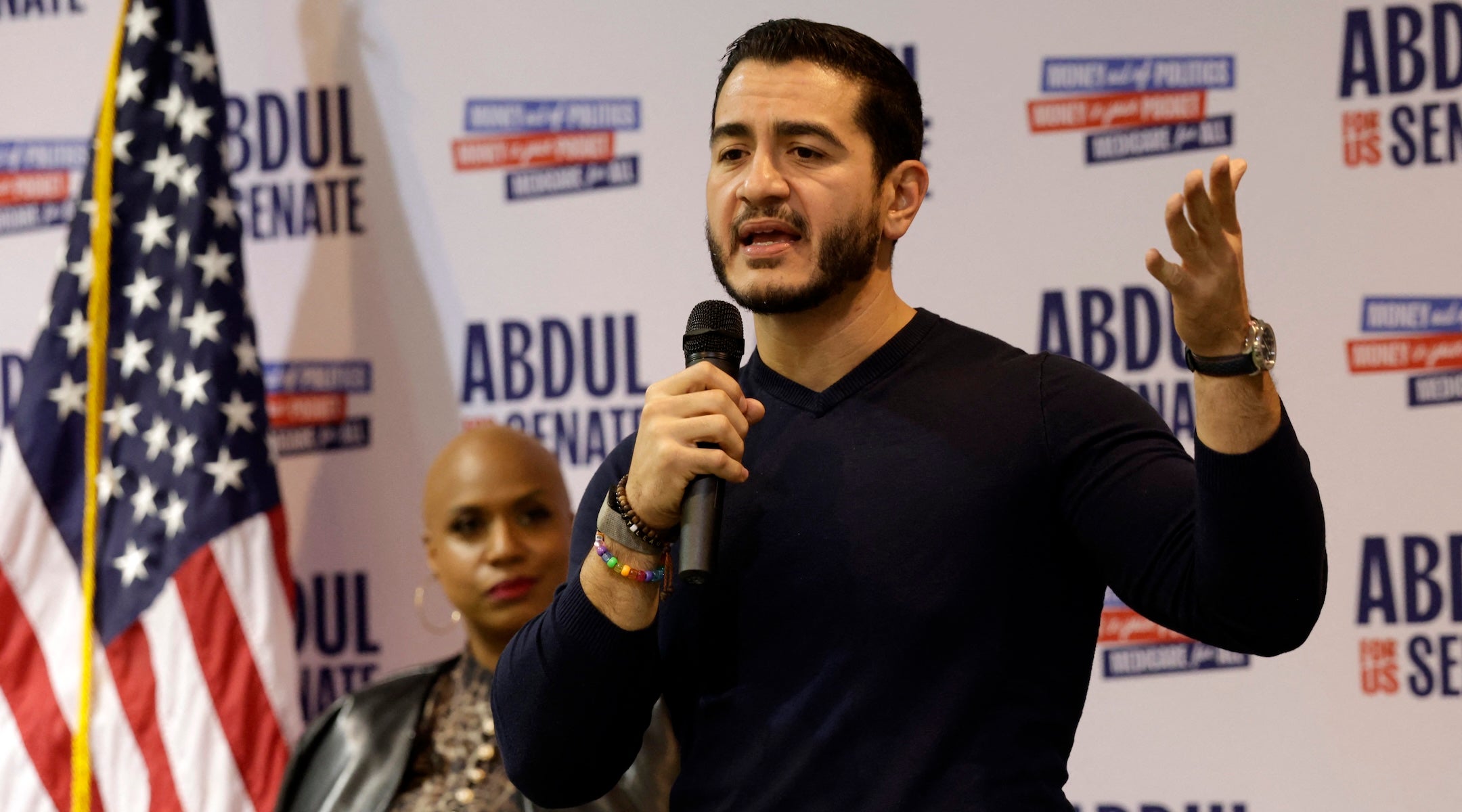
(JTA) — ANN ARBOR, Michigan — An 11th-hour public feud between Michigan Democratic U.S. Senate candidate Abdul El-Sayed and his pro-Israel former primary rival is further exacerbating tensions between Jewish voters and the nominee ahead of Tuesday’s midterm elections.
U.S. Rep. Haley Stevens, who this summer narrowly lost the race for the Democratic nomination to El-Sayed, had previously endorsed her former competitor and was set to join him at a rally Sunday in the crucial final days of campaigning. Michigan is locked in a tight race that could help determine which party controls the Senate.
Instead of a show of unity, Stevens is now forcefully criticizing El-Sayed for his recent criticism of Israel and for not condemning a PAC ad, made by an outside group to boost his campaign, that blamed Israel for rising grocery prices. El-Sayed has shot back, invoking Stevens’ close relationship with the pro-Israel lobby AIPAC.
Stevens, who represents a large Jewish district in suburban Detroit, unloaded on El-Sayed Friday in a series of interviews with the New York Times published early Saturday morning.
On social media Friday, Stevens had said she expected El-Sayed to shortly condemn the ad, paid for by Rebellion PAC, a project of far-left commentator Cenk Uygur. El-Sayed had earlier distanced himself from the ad but had not commented on its content.
“We are not going to say that the cost of groceries is because of Jews and the Jewish state,” Stevens told the Times, adding, “Maybe it is what you want people to believe.” She stopped short of formally rescinding her endorsement of El-Sayed.
The feud comes at a moment when much of the Democratic establishment has coalesced behind El-Sayed in the key Senate race, even as deep concerns remain among many traditionally Democratic Jewish voters. Stevens’ own fiancée, Jewish Democratic megadonor Jason Turkish, said this week he would be voting for Republican nominee Mike Rogers. Stevens told the Times she had met with a rabbi in advance of their wedding and was mulling converting to Judaism.

In a statement sent to the Jewish Telegraphic Agency and other outlets Friday, El-Sayed accused Stevens of “relitigating a primary that ended three months ago.” He also said he had already “defeated” spending “from outside corporations and AIPAC” on behalf of Stevens.
El-Sayed did not mention the Uygur ad, nor another ad — this one produced by his campaign — that featured a brief clip of far-right commentator and anti-Israel voice Tucker Carlson announcing he wouldn’t vote for Rogers. Stevens had publicly urged El-Sayed to take down the Carlson ad, which the campaign had aired on conservative TV channels.
The El-Sayed campaign has dropped Stevens’ name from its description of Sunday’s planned Detroit church event, which is now scheduled to feature Rep. Jim Clyburn of South Carolina and Sen. Angela Alsobrooks of Maryland. USA Today and other outlets have reported that El-Sayed’s campaign has asked Stevens to stay away from all future events.
Stevens and Turkish did not return a JTA request for comment.
In her social media statement Friday prior to El-Sayed’s response, Stevens had outlined Jewish constituent concerns about El-Sayed, noting that he himself has used rhetoric akin to blaming Michigan’s financial ills on Israel.
“The ad did not invent its argument; it dramatized one Dr. El-Sayed has made in his own words throughout this campaign: that Israel is the reason Michigan cannot afford schools, health care, and child care,” Stevens wrote. “Abdul promises to get money out of politics. He can begin by getting Israel out of his explanation for everything Michigan cannot afford.”
Both Turkish, in an earlier JTA interview from a Rogers event, and Stevens, to the Times, said their final breaking point with El-Sayed came after a recent debate in which the nominee had declined to say whether Israel or Iran posed a bigger threat to the United States.
El-Sayed on Friday did condemn a separate comment from anti-Israel streamer and former campaign ally Hasan Piker, who is Uygur’s nephew. In a stream this week, Piker had compared the heavily Jewish Detroit suburb of West Bloomfield to a “KKK neighborhood,” adding, “The supremacist attitude underlying their worldview is identical.”
In a statement to Jewish Insider about Piker’s comments, El-Sayed noted he grew up near West Bloomfield and stated, “Comparing Jewish Michiganders to the Ku Klux Klan is utterly inappropriate and flat out wrong.”
Meanwhile, Republicans are jumping at the Jewish divide. Rogers, a former congressman, has seized on the intraparty feud to appeal to Jewish voters who had supported Stevens in the primary. Earlier this week, President Donald Trump called Jews who back El-Sayed “crazy,” leading to condemnation from some Jewish leaders.
This article originally appeared on JTA.org.
The post Rift between Abdul El-Sayed and Haley Stevens puts Michigan Jews on edge appeared first on The Forward.
