


Uncategorized
This family of Jewish refugees defined American patriotism. Now they’re worried where their country’s headed.
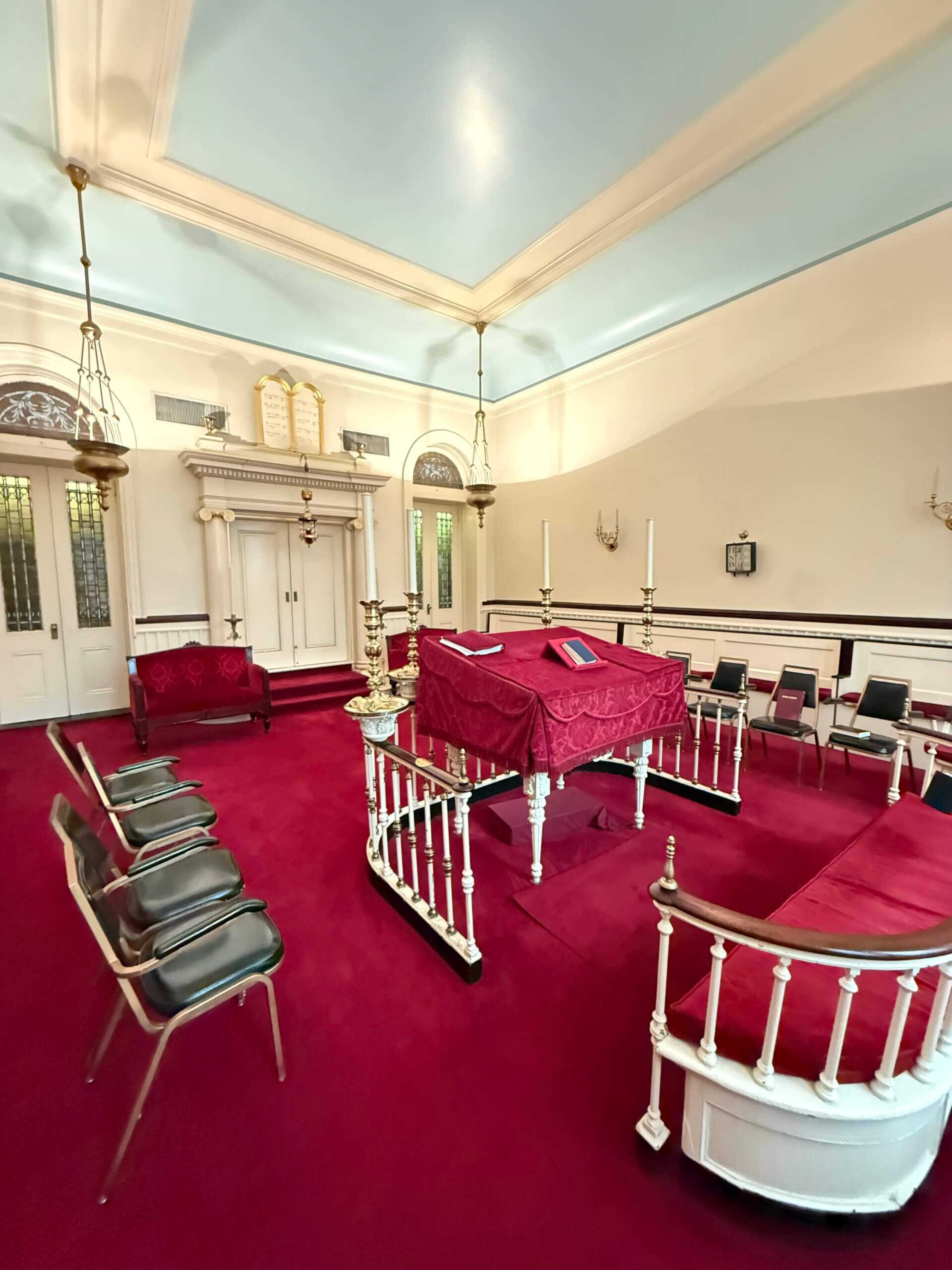
If you want to pray the way the first Jews in North America did, the closest you can come may be weekday services at the Little Synagogue at Shearith Israel on the Upper West Side of Manhattan.
It’s a room of a few hundred square feet, the rough dimensions of the synagogue the first congregation in New York dedicated downtown on Mill Street on April 8, 1730. The community predated the structure; the Dutch, and later the English, prohibited the colony’s Jews from building a house of worship, so for nearly a century, they met in rented homes.
“All the Jews of New York City could fit in a room this size from 1730 until after the American Revolution,” Shearith’s sexton, Zachary Edinger, said on a recent tour of the synagogue. “All the Jews who live across the street today can’t fit in this room today, so that’s how much we’ve grown”
This chapel replica has some of the original furnishings from Mill Street, and other buildings the congregation occupied as their numbers grew. Four candlesticks from a rented home on what was likely Beaver Street crown the platform at the center of the room. The central reading table, or tebah, and the Ten Commandments over the ark, are from Mill Street. There’s a ner tamid, eternal light, from the congregation’s 37 years on 19th Street. The room’s colonial white wood and red-plush upholstery are a stark contrast to the Tiffany glass and Numidian marble of the main sanctuary, completed in 1897 to seat 700 members of what had since become a prosperous, deeply established community with prime real estate on 70th St and Central Park West.
During regular services, the hazzan, Rabbi Ira Rohde, stands at the tebah, cloaked in a black gown, a white lace collar with two tails around his neck, a soft brimless cap atop his head. He cantillates the traditional Sephardic melodies. Among the faithful there are more jeans, polos and ergonomic sneakers than in yesteryear. There’s no Portuguese to be heard — that was nixed just after the American Revolution — but the ritual hasn’t changed much.

If you squint, you can almost imagine yourself in the Summer of 1776, when standing at that very tebah was the first American-born hazzan, Gershom Mendes Seixas, who bet on an untested experiment in freedom. In doing so he, along with his siblings, following a long legacy of displacement and denied citizenship, helped to create the new identity of a Jewish American.
Their descendants would serve on both sides of the Civil War, write the poem at the base of the Statue of Liberty, teach Hebrew to the founder of the Mormon Church, serve on the Supreme Court, establish schools for the deaf and publish The New York Times. More recently, members have owned soccer clubs, run music festivals, pioneered research into alcoholism, played in orchestras, taught children, stewarded the environment, designed museums, made aliyah, immigrated to Canada and Guatemala, converted to Catholicism or moved from secularly celebrating Easter to keeping Shabbat and raising their children Orthodox.
Some are also considering a move that would have been unthinkable for their ancestors: returning to the very continent they fled 300 years before.
Arrival

At the top of the Seixas family tree, monkeys swing from the branches. To their right, Eve tempts Adam with the apple. From this irreverent illustration flows a meticulously-rendered lineage punctuated by drawings of gentlemen in capes and frocks. The chart was made in 1930 by the skyscraper architect Lafayette Anthony Goldstone.
It’s on display in an alcove in the Jewish Museum, a former Warburg mansion overlooking Central Park, a mark of wealth and belonging unimaginable to the refugees listed at the upper parts of the genealogy.
Most early American Jews were Sephardic and had lived for a few generations as Dutch subjects. Their ancestors hailed from Portugal, where the crown forcibly converted Jews to Catholicism in 1496 before commencing an Inquisition in 1536. These “New Christians” left for the Netherlands, where they could worship freely as Jews.
In time, some of the merchant class relocated to Recife, the capital of the Dutch colony in Brazil and a major trade center. In 1654, the Portuguese captured Recife. The Jews, remembering their persecution by that nation, fled back to Amsterdam. One of the 16 ships bound for Holland shipwrecked in the Caribbean. Its 23 passengers, rescued by a French frigate, were dropped off in New Amsterdam. Shearith Israel sprang from that community of exiles. The British seized the city in 1664 and renamed it New York.
When the congregation consecrated the one-story, brick-and-wood synagogue on the seventh day of Passover in 1730, it was roughly half Ashkenazi and half Sephardic, though its customs were Portuguese.
Soon after Mill Street’s dedication, the Lisbon-born Isaac Mendes Seixas arrived in New York and in 1740 married Rachel Levy, who had been born in London. Their first-generation children were a blend of Ashkenazi and Sephardic cultures and another yet to be defined: American. Together they modeled, and received guarantees for, the possibilities of life in a young republic unprecedented in its promise of liberty for Jews.
At the Jewish Museum, the success of their integration is on literal display. Goldstone’s family tree is surrounded by portraits of the Seixas family’s peers and silver ritual objects from Shearith Israel. But perhaps the most telling testament to the Seixas’ place in their country is a piece the museum’s director calls “goyische.”
It’s a 19th century sampler stitched by Rachel I. Seixas, likely named for her great-grandmother Rachel Levy, that reads, “Oh may I seek in early youth what guards from future harms/Religion Modesty and Truth/For these have always charms.” A Puritan might have made it.
“I always am sort of stunned by the age of the person,” historian Laura Arnold Leibman told me when we toured the gallery.

Rachel, who was 9 or 10 when she stitched the sampler, was born in Richmond, Va., a granddaughter of Benjamin Mendes Seixas, one of the co-founders of the New York Stock Exchange and a third lieutenant in the New York Militia during the Revolution. Rachel would later marry into the Cardozo family, live through the Civil War and die in 1902 in Minnesota. Her childhood work is a museum piece; her cousin Naomi Seixas, Benjamin’s sixth great-grandchild, designs museums.
“In my day to day life, I walk from the East Village past the Shearith Israel Cemetery, past Benjamin Seixas’ grave, to work, where I work all day long, engaging with projects that continue this legacy of unfinished work,” said Naomi Seixas, 45.
I spoke with her in her modern, open-plan office in the Financial District. On a wall behind her was a blown-up image of the preamble to the Constitution, part of a mockup for one of her projects, the Theodore Roosevelt Presidential Library in Medora, N.D., which will open on July 4, 2026.
Naomi’s building is a short walk to the Stock Exchange, and if she were to continue down South William Street, she’d hit Seixas Way, the former location of the Mill Street Synagogue. It was in this area that Benjamin was active in the militia movement that sprang up in taverns, co-signing a letter warning New York of imminent war and advising that “every member of the Community capable of bearing arms should acquit himself with military discipline.”
Naomi was born and grew up in Vancouver, Canada, and was raised secular. The family had a menorah and a Christmas tree and she went to Jewish summer camp. Her late father, Peter, who grew up in what his sister called “an extremely nonreligious family,” was a history professor at the University of British Columbia.
What it really meant to be a Seixas clicked for Naomi when she was 12. She was in Philadelphia with her father and they visited Congregation Mikveh Israel, where Gershom Mendes Seixas led the patriot faithful for a time during the Revolution. The rabbi became very animated when her dad introduced himself, and brought them to see Gershom’s portrait.
“All of a sudden I felt a sense of pride, a sense of curiosity and intrigue,” Naomi said. “There was sort of that first real, pronounced moment of understanding that these people were big deals.”
Being a Seixas means having heirlooms divided between your home and historical archives: bibles, oil paintings, steamer trunks of artifacts. But for many, the main inheritance is ideological.
“My family’s participation, and boldness in participation, continues to inspire and hold resonance for me to participate,” said Naomi, who has made history her life’s work. “To show up and do good work and engage with the past, but really work on moments of the present.”

Her ancestors’ boldness can’t be understated. Faced with a choice between loyalty to the crown and an uncertain outcome for the patriot cause, they made a gamble that offered no assurances for their rights as citizens. In August 1776, when the Continental Army lost the Battle of Brooklyn, New York was poised to fall to the British. Gershom Mendes Seixas addressed his congregation, urging them to leave their home for Connecticut.
The words he spoke are lost to history, but their outcome was not. When called to join the cause of freedom, most followed.
Exodus

The story of Shearith Israel’s evacuation is, like so many incidents from the Revolutionary War, often embellished. As historian Adam Jortner writes in A Promised Land, his book on Jews in the Revolution, Gershom Mendes Seixas didn’t shoulder the Torah out of the city; it was almost certainly shipped ahead to Connecticut, where the community reconstituted itself in Stratford. At least two other scrolls stayed behind with a loyalist remnant of the congregation, and were subsequently vandalized by British troops.
Sympathy for the patriots was already ripe by the time most of the congregation left, thanks in no small part to Gershom, the first Jewish religious leader born in the 13 colonies. Gershom conceived of himself as an American and a Jew. His own religious education likely ended with his bar mitzvah, a few years before he was elected to the position of hazzan at the age of 22. At that time, the role didn’t have much cachet. He served at the pleasure of the adjunta, or board, and his service was that of a poorly-paid factotum, leading prayer but also tutoring bar mitzvahs and performing brises. Before Seixas, the hazzans, imported from Europe, rarely ever preached.
Gershom led a fractious community that his predecessors often had difficulty controlling. Records from the time note how one member called his own brother a “bastard” at a baby naming. In 1755, a loud argument during Yom Kippur services — about whether to close a window in the women’s gallery — prompted assault charges. In this litigious environment, Jortner notes, Gershom did something extraordinary when a congregant sued Shearith Israel for defamation: He took the matter to the local government.
This decision reflected a man at home in the milieu he was born into, a world teeming with Enlightenment thought. As rabbi and Jewish history scholar Jacob Rader Marcus notes in his 1969 profile of Gershom, “‘reason’ was one of his favorite words.”
In May 1776, Congress recommended a day of fasting and prayer ahead of impending war. In the text, there was a rare invocation of Jesus. Rather than recuse himself on those grounds, Gershom called on the almighty to “put it in the heart of our sovereign lord George the Third” to turn his “fierce wrath from North America.”
“Seixas and the Jews simply joined the fast — and thus the revolution,” Jortner wrote.
This was not without its risks, but the gamble was calculated.
Gershom was thinking through the implications of independence, Jortner believes. When he heard patriots discussing the country they wished to form, they didn’t mention a church or monarch leading it. Instead, they invoked the rights of men who would decide the nature of the government for themselves.
“He sees in that the opportunity, perhaps, for Jews who have not been considered to be citizens, to take on that role, to suddenly become and have rights as members of the society that they previously had not been,” Jortner told me. “If your society is determined by who’s a person, who’s a citizen and not who believes what, then there’s the possibility that the disenfranchised can also have a say and potentially be protected, not just just tolerated.”
On the parade grounds, there was a preview of this acceptance. Unlike in other armies throughout the world, where Jews were segregated in their own militias, in the Continental Army, they marched with the Christians. But while the arrangement hinted at something like equality, it was only that: a hint.
“People looking back at the Revolutionary War really have this fantasy that American Jews fighting in the war know that it’s going to work out well for them,” said Laura Arnold Leibman, author of The Art of the Jewish Family: A History of Women in Early New York in Five Objects. In fact, “there’s no guarantee that it’s going to actually be better than what things were under the British.”
The certainty of something more than tolerance wasn’t granted after the 1781 Battle of Yorktown, which won the war for the patriots. It wasn’t quite settled when the Constitution was ratified in 1788. Nor was it resolved when Gershom Mendes Seixas is said to have attended — if not, as legend has it, helped officiate — George Washington’s presidential inauguration in 1789.
It wasn’t until 1790, when Gershom’s brother Moses passed a letter to Washington, and Washington responded, that the question of how Jews would belong in the new nation got its clearest answer.
These are the words of Moses

While much of his family decamped for Connecticut in the summer of 1776, Moses Seixas remained in Newport, R.I., and lived through British occupation.
The Jewish community there dates to around 1658. The popular narrative holds that Rhode Island’s founder, Roger Williams, was a champion of religious liberty. This was not quite the case, Rhode Island’s Historian Laureate Keith Stokes told me.
“His general feeling was, ‘I don’t really care who you are, what you are, as long as you are obedient to His Majesty’s laws and you pay your taxes and you’re a good resident,’” Stokes said.
Under an early charter, non-English “resident aliens” were not required to profess a religion, making Rhode Island attractive for Jews and other religious minorities like Quakers.
“The first Jews that would arrive, there’s no discussion about religious freedom,” said Stokes. “They’re simply wanting to be tolerated. Tolerating is a good thing because they’re not being persecuted. No one is breaking down the doors of their temple.”
Toleration was tolerable — up to a point. When the Revolution ended and a government was formed, the Jewish communities in the colonies were increasingly frustrated with the open question of their status. Certain states still required a religious test for residents to qualify as full citizens. In 1787, Jonas Phillips, an Ashkenazi merchant in Philadelphia, wrote a letter to George Washington objecting to a law in Pennsylvania’s Constitution that required an avowal of the “devine inspiration” of the New Testament to hold public office. (Washington’s response was never recorded.)
Moses Seixas, then the lay leader of a diminished Jewish congregation, seized on the opportunity of an August, 1790 visit by the president, on the occasion of Rhode Island’s late entry into the union, to confirm his people’s full share in the new country.
“Permit the children of the stock of Abraham to approach you with the most cordial affection and esteem for your person and merits,” his letter to Washington began. It alluded to the past days “of difficulty, and danger,” in which the God of Israel protected the general.
Then, it made its main ask, not in the form of a question.
“Deprived as we heretofore have been of the invaluable rights of free Citizens, we now with a deep sense of gratitude to the Almighty disposer of all events behold a Government, erected by the Majesty of the People — a government, which to bigotry gives no sanction, to persecution no assistance but generously affording to all Liberty of conscience, and immunities of Citizenship: deeming every one, of whatever Nation, tongue, or language equal parts of the great governmental Machine.”

Reading the words, one is struck by its assertions. The Constitution laid out some conditions for religious freedom, but was vague on who counted as a citizen. These lofty statements, Jortner argues in his book, were only an interpretation, and a hope, of rights to be granted.
Washington understood the subtext for what it was: a request for assurance.
“All possess alike liberty of conscience and immunities of citizenship,” Washington wrote in his response to the Newport Congregation, dated the day after his arrival. “It is now no more that toleration is spoken of, as if it was by the indulgence of one class of people, that another enjoyed the exercise of their inherent natural rights.”
Washington made the issue explicit — this was no longer tolerance, but something more. He then quoted Seixas’ words back to him.
“For happily the Government of the United States, which gives to bigotry no sanction, to persecution no assistance, requires only that they who live under its protection should demean themselves as good citizens, in giving it on all occasions their effectual support.”

Washington conceived of the country, Jortner said, as one in which all classes of citizens participate.
“It more or less happened that way,” Adam Peltz, 43, a lawyer for the Environmental Defense Fund and a descendant of Moses Seixas and Jonas Phillips, said of the promise made in Washington’s letter. “For the most part, people are free to worship or not worship as they please. And that is not true in most places.”
The lesson of the letter, he believes, carries a greater significance: a call to make a difference, but also to “have relationships outside of your little world in order to make it happen.”
But even as the community in Newport made the case for their citizenship, they bumped against one of the founding contradictions of the country.
When author Richard Kreitner reads Washington’s letter, and its requirement that “they who live under its protection should demean themselves as good citizens,” he sees a careful qualifier about how this group must behave to “merit the goodwill of the other inhabitants.”
“I don’t think Washington had it in his mind, but I think that does imply a silence on slavery,” Kreitner said.
Bondage

Certain names are a tradition in the Seixas family — Abigail, Gershom, Benjamin, Grace, Rachel. The first to adopt a Jewish name after the Inquisition was, fittingly, Abraham Mendes Seixas, born Miguel Pacheco da Silva. He had his lech lecha moment in the 1720s, leaving Lisbon with his family for Bordeaux then London. From there, his son, naturally named Isaac, sailed to the New World, where he would found the clan’s American branch.
Migrations continued through the generations, from New York to Rhode Island and down south to Virginia, South Carolina and Louisiana. In the late 19th century, Henriette Rosine Clark (née Seixas), a descendant of Benjamin, resettled in Guatemala, where her English-born husband was extending the railroad from Mexico.
In May 2026, Clark’s great-grandson, Andreas Kuestermann, a hotelier in Antigua, Guatemala, was in Charleston with his husband, Pedro, to visit a graveyard where two Abraham Seixases are buried.
Abraham Mendes Seixas was Isaac’s son and Gershom, Benjamin and Moses’ brother. He was the only Jewish officer in the Continental Army of South Carolina. He was also a slaveholder and the manager of an infamous facility called the Charleston Workhouse, where enslaved people were tortured away from the eyes and ears of the urban population. (I was unable to locate his descendants.)
The other Abraham, Benjamin Mendes Seixas’ son, is Kuestermann’s great-great-great-grandfather. His son James Madison Seixas moved to New Orleans, fought for the Confederacy, and married into a prominent Creole, Catholic slave-holding family that owned the Belle Pointe plantation.
“In a way, it’s just part of history,” Kuestermann, 52, who is also a descendant of the Guatemalan president Carlos Herrera, said of his forebears’ involvement with slavery. “I have no way of judging, because we are not from that era.”
Many Seixas descendants heard stories of relatives on both sides of the Civil War. Nate Hoffman, 56, Gershom Mendes Seixas’ fifth great-grandson, recalls both Confederate gray and Union blue in his grandmother’s steamer trunks of heirlooms. A smaller number of those I spoke with were aware of some members of the family’s role in slavery.
God’s Little Acre, the historic African burial ground in Newport, R.I., has a headstone of a woman named Ann Seixas, who died in 1881. Her parents, Peter and Sara Seixas, took the name of the family that enslaved them. Peter was a mariner. They lived in a home that didn’t exist after they became free. Not much more is known about them.
Historian Keith Stokes, who is descended both from Sephardic Jewish and enslaved Black Rhode Islanders, is careful when discussing Jews and slavery in Newport, a town in which even Quakers, a group noted for their abolitionism, participated in the practice.
“Those Jews who were slave owners and participated in the slave trade, which included the Seixases, it had nothing to do with their religion,” said Stokes. “It had everything to do with the fact that they were 18th century merchant traders, and in fact, most Jews in Newport that time who were not merchant traders did not own slaves and did not invest or participate in slave voyages.”
Jews did not have a leading or disproportionate role in slavery in Newport or anywhere else in North America. (Their involvement was more visible, but by no means dominant, in the Caribbean.) The narrative that says otherwise largely comes from the 1991 Nation of Islam text The Secret Relationship Between Blacks and Jews, roundly condemned by historians. The claims have been sensationalized, but early American Jews were much like every other early American. Some opposed slavery, some were perpetrators and many did nothing either to advance or thwart its progress.
“He’s a man of the 18th century, through and through, good, bad or indifferent, warts and all,” Stokes said of Moses. “We shouldn’t judge him, or anyone, based upon, unfortunately, an 18th century custom that kept all men blinded.”
But what about Abraham, whose distinction in the army is overshadowed by his job managing the Workhouse and a disgusting verse advertisement of his wares printed in the South Carolina State Gazette?
He has for sale
Some negroes, male,
Will suit full well grooms,
He has likewise
Some of their wives
Can make clean, dirty rooms.
For planting, too,He has a few
To sell, all for the cash,
Of various price,
To work the rice
Or bring them to the lash.
“That’s horrible, and quite frankly, he obviously didn’t celebrate Passover,” Nate Hoffman said when I read him these words.
To observe Passover and engage in slavery seems a contradiction to our modern understanding, when some contemporary Haggadot include the spiritual “Go Down Moses.” But as Richard Kreitner argues in his book Fear No Pharoah: American Jews, the Civil War, and the Fight to End Slavery, the Jews of the 18th century didn’t necessarily view the story of Exodus as a call for collective liberation.
“It comes down to two differing interpretations,” Kreitner told me. “One being that the lesson is that Jews should never be oppressed, and we should do anything we need to do, go anywhere we need to go, oppress anybody we need to oppress in order to protect ourselves and make sure that we are never victimized again. The other view being that the lesson of the Exodus is that slavery is wrong, oppression is wrong, and we should fight for emancipation of all kinds.”
If not every Seixas of the 18th or 19th century landed on the latter lesson, many of their descendants did.
Nate Hoffman’s grandmother Abigail, born in 1912, joined the Daughters of the American Revolution to make a point about the Jewish role in the country’s founding. Her grandchildren said she was publicly critical about the organization’s exclusion of Black members and was a champion for civil rights.
Adam Peltz recalls his Seixas-descended grandmother living with a sense of “what might be called noblesse oblige” or “you could call it tikkun olam.”
“It’s a complicated family history,” Peltz said, “you kind of have to deal with the fact that people are going to break all sorts of ways, and you just try to pick the best way that you can.”
The awful truth may be that, in his time, someone like Abraham Mendes Seixas may have considered his job at the Workhouse, a place a survivor named James Matthews likened to hell, as a kind of civic service.
Bernard Powers, Jr., founding director of the Center for the Study of Slavery in Charleston, said the Workhouse was a revenue source for the city and a pivotal part of preserving the operation of the system of slavery.
Seixas arrived in Charleston just before the Revolution, but adapted quickly to his new home’s customs.
“They were blending in with the mores and the worldview of the society that they were a part of,” Powers said of Charleston Jews, for whom historian James William Hagy dubbed South Carolina “the Happy Land.” “And those values were pervasive, they were forceful. And it would have taken an exceptional person to really resist them.”
A family history of persecution didn’t ensure moral clarity when it came to the suffering of others. The evidence was not only in Newport and Charleston, but even in Shearith Israel where, Kreitner recounts, congregant Luis Moses Gomez could be seen walking to services at the Mill Street synagogue with a retinue of enslaved servants carrying his tallitot and siddurim.
Both Kreitner and Leibman marveled at the circumstances of the Sephardic families who left Europe to escape the violence of the Inquisition, resettled in America and visited violence on others.
Kreitner can imagine the logic: “What better way to prove that you are, yourself, not a slave, than to own slaves?”
But, as Naomi Seixas told me, history is not a clean narrative.

A biracial woman named Sara Rodrigues Brandon was born enslaved and Christian in 1798. She and her brother converted to their father’s faith of Judaism and established themselves in London and New York, where they were understood to be white. Sara’s son, a generation removed from slavery, would marry the granddaughter of Gershom Mendes Seixas, the hazzan of Shearith Israel. Another son became president of the congregation.
Her descendants alive today come from that line of the family, said Leibman, the historian who wrote a book on the Brandons.
“Members of this family have been both contributory and complicit and our responsibility is to acknowledge that,” Naomi Seixas said. “Responsibility comes from that complexity.”
There is now, her relations agree, an effort to abdicate responsibility, as the current administration rewrites a complex narrative, not just of the nation’s original sin, but of who counts as an American.
To bigotry no sanction

This spring, Abby Seixas read Moses Seixas’ letter to Washington in her granddaughter’s kindergarten class. In the 1990s, she read it at Touro Synagogue in Newport, and before that, her father did. (The synagogue didn’t quibble over the fact that they were descended not from Moses, but from his brother Benjamin.)
Abby, 76, her brother Noah and her late brother, Peter, Naomi’s father, grew up in Hastings-on-Hudson, in Westchester, N.Y. She remembers only ever going to one Passover Seder in her childhood. The family dyed Easter eggs and was affiliated with the secular humanism of the Society for Ethical Culture. But Frank Seixas, a physician who campaigned for treatments for alcoholism, was committed to his revolutionary pedigree.
“I think dad’s pride in being related to the Seixas ancestors had to do with the contribution that they made to the founding and the importance of that and liberal, open society,” said Noah Seixas, 70, an industrial hygienist and professor emeritus of occupational health at the University of Washington.
Rachel Kimelfeld, Abby’s daughter, remembers her mother reading Moses’ letter at Newport. Now observant, she leads the after-school program at her children’s Jewish day school in Seattle.
“Coming from a completely secular upbringing, kind of moving into this more religious space, it does feel cool to have some religious bonafides — way, way back when,” Kimelfeld said.
But Kimelfeld, her mother and her uncle, with roots that stretch back to the colonial period, are watching their government’s treatment of vulnerable groups, and its flouting of democratic norms, with deep concern.
Abby, a psychotherapist, volunteers at a clinic once a week helping mostly Spanish-speaking immigrants fill out employment authorization forms. One Sephardic man working with her asked if she got involved because of her background. It dawned on her that her heritage has been an “implicit throughline” in her life, one that colors her sense of responsibility for this country.
“To make our union more perfect,” Abby said, “we’ve got a ways to go, but that’s the direction we want to go, not toward the direction we currently are going.”
“Fairness, inclusion and civil liberties and freedom of religion and separation of church and state,” Noah Seixas said. “We should be celebrating it, but instead, we’re grasping to hold on to it.”
When he went to the 2017 Women’s March, he brought a sign quoting the Newport letters: “to bigotry no sanction, to persecution no assistance.”
Noah’s great-niece, Maya, 10, said the letter’s words are still important. Asked in a video call if she still thinks there’s bigotry and persecution in this country, she nodded solemnly.
While the first Trump administration was quick to attack immigration and refugees — and, to the dismay of Seixas descendants, distort their relative Emma Lazarus’ poem at the base of the Statue of Liberty — the second term has placed an emphasis on Christian nationalism alongside nativism.
In May, as part of the Trump administration’s 250th anniversary festivities, House Speaker Mike Johnson and a group of faith leaders congregated on the National Mall for a “Day of Jubilation, Prayer and Thanksgiving,” following the more muted affair of “Shabbat 250.” The only non-Christian clergy on the program was Meir Soloveichik, a member of Trump’s Religious Liberty Commission and the rabbi of Shearith Israel, where Gershom Seixas was once hazzan.
“I don’t think it weaves the tapestry of what our country is fully,” Nate Hoffman said of the roster of religious leaders.
Most Seixas descendants I spoke with bristled at the Day of Jubilation’s argument that America’s founding had a Christian impetus. The event shared apocryphal myths about Washington praying at Valley Forge and applied a largely contemporary evangelical lens to founding fathers with diverse beliefs. Maybe a bigger problem than these revisions are the attendant appeals to “heritage Americans,” which some conservatives deploy to implicitly exclude anyone who isn’t white or Christian from the country’s origins.
Rabbi A. James Rudin, who married the second cousin of a Seixas and was formerly the inter-religious affairs director of the American Jewish Committee, insisted the idea of Christian nationhood, as intended by the founders, doesn’t hold up to scrutiny.
“They had every opportunity to insert a Christian phrase or reference to Jesus in the Constitution and in the Declaration of Independence,” Rudin said.
And they didn’t.
Jortner said that legislation to make the country, or parts of it, explicitly Christian has been litigated.
“When Georgia makes its new state constitution in 1789, they have a choice. They’re urged, ‘Get those Jews out of there,’” he said. “Not only do they not do that, they get rid of their state church entirely. South Carolina creates a state church in 1778 and then gets rid of it in 1790 because it’s not working and everybody hates it. George Washington is asked by the Jews, ‘Hey, are we going to be in this thing that we’re making here?’ And he’s like, ‘Yeah, absolutely.’”
Aryeh Green, a descendant of Gershom Mendes Seixas who ran the foreign press resource group MediaCentral in Jerusalem and was an advisor for Natan Sharansky, takes a more nuanced view. When asked how his forebears would treat the contention that America is a Christian country, Green says Gershom wouldn’t disagree with the claim, but might argue that American freedoms derive from the founders’ Christian understanding of the Hebrew Bible. Built into that understanding, he said, is the imperative “to be a Christian Zionist and love and support and and promote the return of the Jews to their ancestral homeland.”
Kimelfeld, while now religious herself, was disturbed by the news of the event on the National Mall. She’s alarmed as a Jew and a citizen — by rising antisemitism and othering of Jews, and by the breakdown of norms under Trump. To that end, with the encouragement of her husband, an Orthodox Jew from the former Soviet Union, she recently received Portuguese citizenship, and got her mother to do the same.
They’re not the only Seixas descendants to have a backup plan.
Which promised land?

The Chatham Square Cemetery is located behind two locked gates in the Two Bridges neighborhood of Manhattan. On Memorial Day, Shearith Israel decorates the graves of members who served in the Revolutionary War: Benjamin Seixas, Gershom Mendes Seixas and Jonas Phillips, among others. Many of the markers’ inscriptions are faded by weather and time, but on an early June day in 2026, miniature American flags were newly planted.
Naomi Seixas recalled going to the first Memorial Day festivities after Oct. 7, 2023 and hearing a speech imagining how the revolutionary generation would have interpreted Hamas’ attack on Israel, stressing both the early Americans’ patriotism and their longing for Zion.
This ran counter to what her father told her growing up: “America was the promised land.”
Not all of her ancestors thought this way. In his time, Gershom undoubtedly saw the U.S. as the best place to be Jewish. But Jacob Rader Marcus noted the hazzan’s excitement over rumors that Napoleon was looking to restore the Jewish state during a 1799 campaign in the Middle East. In his sermons, Gershom said his people’s tenure in the United States was part of a “long and gloomy captivity,” where despite their guarantees of citizenship, they remained strangers.
Aryeh Green, 63, met with resistance from his grandmother Edith, a descendent of Gershom, when he decided to make aliyah in 1984.
“She felt I was betraying our American heritage, our American Jewish ancestry, this country that’s been so good to us,” he said on a call from Beit Shemesh in Israel.
He sat her down and traced the Seixas family through time. How the generation before Gershom came from Portugal, and before that, the family lore goes, they were in Spain. If one went back far enough, he concluded, the family was in Eretz Israel, expelled by the Romans in the first century.
“It gave her pause. It took her a little time, but she eventually recognized that the Jewish people’s return to our ancestral homeland was no less important to our identity,” said Green, who was interviewed for Michael Hoberman’s book Imagining Early American Jews.
Looking at America today, Green thinks Gershom would be “distressed” by how many Jews are not traditionally observant, “proud” of Jewish contributions to the country and “shocked and incredibly dismayed” by Jews who voted for New York Mayor Zohran Mamdani and at how classic American values have been overshadowed by “the political correctness of the new woke attitudes or the antisemitism that’s unfortunately now part of our public life.”
Alert as Kimelfeld is to rising antisemitism, she very much did not want Israel to be her plan B, hence her new Portuguese citizenship, which opens the door to the rest of the European Union. (She and Abby began the application process during the pandemic, before the government phased out a Sephardic Right of Return law.) Others who explored the opportunity, looking at Jewish history, told me it’s never a bad idea to have more than one passport: Conditions can be good in any country, until they aren’t.
Kelsey Peltz, 25, a descendant of Moses Seixas, is planning to apply for Portuguese citizenship after her uncle Adam finishes applying — it’s easier to be approved, she explained, when a relative has already been accepted. She wants to connect with her family history there. At home in the U.S., she’s not happy with the way things are headed.
She is appalled by politicians pushing hate and violence committed by ICE.
Peltz was shaken by violence between pro-Palestinian and pro-Israel protestors at her alma mater, Tulane. She has at times thought twice about wearing a Star of David necklace in public. Once, on the subway, she caught herself whispering about Passover plans to friends, and questioned why she lowered her voice.
“I feel like I am afraid to tell people that I’m Jewish,” Peltz said, noting negative assumptions she believes are circulating now. “Once that fear comes inside me, I try to fight it.”
Following the example of her ancestors, she hopes to improve the country’s direction by staying here, using her vote and donating to causes she believes in. “I try not to be a doomsayer,” she said.

“America’s the only place I’ve ever known,” Kelsey’s uncle, Adam Peltz, told me. “I’m a 10th generation New Yorker, I certainly feel like I belong here as much as anyone. But, if my ancestor was smart enough to have an escape plan when things were gonna go terrible, don’t I owe it to that lineage?”
Adam and Kelsey’s cousin Avigail Ben-Gad, 29, was born in the U.S. but grew up in Haifa, Israel. Her father, Michael, an economics professor at the University of London, had his class disrupted by pro-Palestinian protesters who he says threatened to behead him, and demanded he be dismissed from his position.
“I used to be very skeptical when I heard people say that we were in a situation like 1930s Germany,” said Ben-Gad, a PhD student in Sephardic history at Hebrew University. “And then, of course, what happened to my dad happened. And I just thought, ‘You know, this is exactly what I’ve read about as happening 80, 90 years ago in German and Polish universities.’”
Avigail thinks the climate for Jews is better in the U.S. than in Europe, but says the incident makes her “happy to be in Israel.”
Thinking back on what her ancestors would make of Jews’ status in the U.S. today, she guessed they would be surprised that her cousins were now planning to become citizens of Portugal, the nation whose mistreatment first led to their journey to America. Then again, those early Jews might have been thrilled by the development, concluding “finally, it’s possible to be Portuguese and Jewish.”
After Moses Seixas and Washington exchanged letters, the United States became unique among nations for this proposition: There was no contradiction between being a Jew and a citizen. That promise has held steady long enough for 10 generations of the Seixas family to thrive here. Will it hold for 10 more?
While preparing for all eventualities, Adam Peltz is committed to the experiment his ancestors started. “We’re here,” he said, “And in fact, we have an obligation to make this the best place we can, and keep the American project going.”
The post This family of Jewish refugees defined American patriotism. Now they’re worried where their country’s headed. appeared first on The Forward.
Uncategorized
He was a privileged Jewish kid from NYC’s Upper East Side. Donald Trump was his greatest invention.
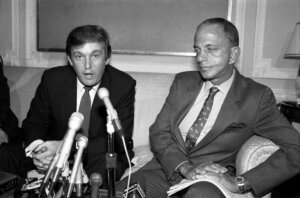
American Scoundrel: Roy Cohn’s Dark Journey from Joe McCarthy to Donald Trump
By Kai Bird with Susan Goldmark
Scribner, $32, 528 pages
By the beginning of the new millennium, Roy Cohn, the red-baiting scourge of the McCarthy hearings, lived largely in the pages of U.S. history books, trotted out on occasion to illustrate how America always manages to overcome its worst nativist impulses. But just in case someone never knew or had forgotten about Cohn’s malign influence on U.S. politics, Tony Kushner brought him back as a villain in his brilliant drama of the early 1990s, Angels in America.
Then, in 2016, Donald Trump was elected president and suddenly, Cohn was breaking news again. The very next year, when Trump was furious at then-Attorney General Jeff Sessions for recusing himself from an investigation into whether Russia meddled with the election, the president cried out to his advisers, “Where’s my Roy Cohn?”
Now, as if in answer to that question, Kai Bird has written a magisterial biography of the notorious lawyer and Trump whisperer that is indispensable reading for anyone who wants to understand the current political moment. Bird, the co-author of American Prometheus, the Pulitzer Prize-winning biography of Robert J. Oppenheimer and inspiration for the Oscar-winning movie, began it in 2022, a couple years before Trump’s re-election. He collaborated with his wife, Susan Goldmark, who did the research for this riveting account of the unseemly, outrageous life of the hustler and con man about whom Trump once said, “If you need somebody to get vicious, hire Roy Cohn.”
Though Cohn has been long gone from public life — he died of AIDS at age 59 in 1986, insisting to the very end that he had succumbed to liver cancer — Bird demonstrates how he practically invented the dark political arts of resentment and division adopted by his former client, protégé and future president of the U.S.
Indeed, over the recent 4th of July weekend — decades after the collapse of the Soviet Union — Trump used Cohn’s divisive, inflammatory rhetoric in back-to-back speeches, including one at Mount Rushmore, branding his political opponents as evil, godless communists.

Bird walks us through Cohn’s life decade by decade. He grew up as an only child in a wealthy Jewish family on the Upper East Side and attended elite private schools, where his boyhood friends included Si Newhouse Jr., heir to the Condé Nast media empire, Gene Pope Jr., who would go on to found the National Enquirer, and, improbably, Al Lowenstein, later a well-known liberal Democratic activist and politician.
After Cohn graduated from Columbia Law School, his father, a judge, pulled strings to get him a job in the U.S. attorney’s office for the Southern District of New York, where he made a name for himself as the boy prosecutor who sent Julius and Ethel Rosenberg to the electric chair in 1953 for passing nuclear secrets to the Soviets. His tactics were highly irregular, including private meetings with the trial judge.
Not long after that, he went to work as chief counsel to Wisconsin Senator Joe McCarthy, using his position to force U.S.-funded libraries abroad to purge 30,000 books on the flimsy pretext that the authors were communists or Soviet sympathizers. He was also a central figure in the so-called Lavender Scare, when hundreds of federal employees thought to be gay lost their jobs because they were deemed a security risk.
By the 1960s, Cohn was back in New York, hanging out at the Stork Club and 21, squiring Barbara Walters around town, and representing mobsters though still living at home with his mother at 1165 Park Avenue. Over the next decade he would be indicted three times by U.S. Attorney Robert Morgenthau Jr. for bribery, perjury, extortion and other white-collar crimes. In each case, he managed to beat the rap though months before his death he was finally disbarred for unethical conduct.
After Cohn’s mother died in 1967, he moved into a stately townhouse on East 68th Street, where he established his law practice and stopped the pretense of dating women though he never publicly came out as gay. Then, in 1973, Cohn met his most consequential client. At the time, Trump was the 27-year-old son of a Queens real estate mogul trying to break into the Manhattan market and living in a rent-controlled studio on East 75th Street with a view of a water tank on an adjacent building.
Cohn advised the family on how to fight a Justice Department lawsuit accusing the real estate company of violating the Fair Housing Act by refusing to rent to Black tenants. Over the course of the litigation, Cohn taught Trump his signature moves: Keep your name in the paper. Never settle. Countersue. Claim victory. Don’t pay the bills.
Cohn also advised Trump on his first major real estate deal in Manhattan — buying the dilapidated Commodore Hotel on East 42nd Street, next to Grand Central Terminal. To get the deal done, Cohn worked his extensive connections to New York’s first Jewish mayor, Abraham Beame, a player in Democratic machine politics and an old friend of Cohn’s father.
For more than a decade, Trump continued to model himself after his mentor, adopting his penchant for personalized license plates and his snarling, scowling demeanor. Bird argues that in the decades since Cohn died, the McCarthyism of the 1950s has morphed into a nativist, America Firster politics that transformed the Republican Party into one of resentments against the old establishment, multiculturalism, globalization and liberal culture — in other words, the MAGA movement of today.
Cohn’s “values, his unethical behavior, and his political mindset have survived and replaced the values of the establishment he so resented,” Bird writes. “Perhaps his life is proof of the ability of one individual to change the arc of history. Certainly, he gave us the narcissistic politics of Donald Trump.”
The post He was a privileged Jewish kid from NYC’s Upper East Side. Donald Trump was his greatest invention. appeared first on The Forward.
Uncategorized
Trump wants to remake Washington — Hitler tried to do the same to Berlin
“It was natural that I also followed my passion for architecture. My faith increased that after many years my dreams would become reality. I was firmly convinced that I would win fame as a builder.”
–Adolf Hitler
“I own buildings. I’m a builder; I know how to build. Nobody can build like I can build.”
–Donald Trump
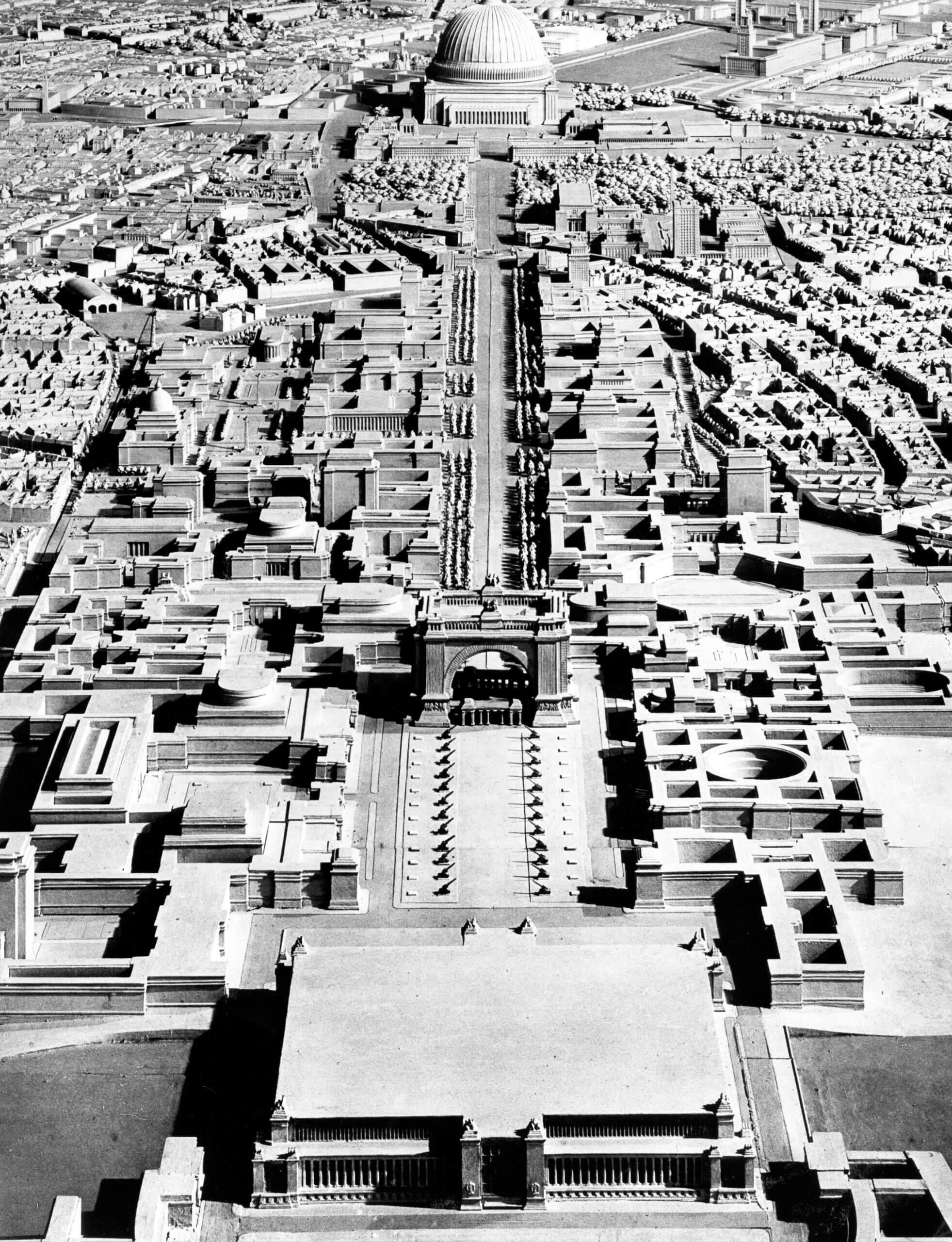
Adolf Hitler personally drew up architectural plans to remake Berlin into a 1,000-year monument to himself with a three-mile-long “Avenue of Splendors,” on one end an Arch of Triumph that would dwarf the Paris original, and on the other, the domed Hall of the People, which would have been the largest enclosed structure in the world.
Hitler’s grandiose remodeling schemes were suspended in 1943, in order to redirect resources to the war he had begun.
Like Hitler, Donald Trump is also busy designing and creating monuments to himself, including an arch even larger than the one Hitler had planned for Berlin. Unlike Hitler, Trump is proceeding at a fevered pace on completing his legacy projects despite the soaring costs of a war he began.
History is replete with monarchs, emperors, pharaohs and tyrants who sought to immortalize themselves with monuments. In modern times, what sets Trump and Hitler apart is their decision to personally draw up a plan to entirely change the look of a capital city to project their powers.
Hitler began sketching his plans to remake Berlin in the 1920s, years before he came to power. In his postwar book Inside the Third Reich, Hitler architect Albert Speer recalled Hitler showing him two sketches the Nazi leader had already made of his own concept, hoping to recruit the architect to the project. In 1937, the Hitler tasked Speer with making it happen.
Speer started by making a model of the redesigned city, to be renamed Germania. In his book, Speer wrote of Hitler’s glee while inspecting the scaled model.
“He bent down, almost kneeling, his eye an inch or so above the level of the model, in order to have the right perspective, and while looking he spoke with unusual vivacity. These were the rare times when he relinquished his usual stiffness. In no other situation did I see him so lively, so spontaneous, so relaxed,” Speer wrote.
Hitler admired the imperial architectural styles of Rome, Vienna and Paris, but came up with designs for Berlin that were meant to surpass those cities not in elegance, but in expressions of Teutonic power.
The Germania model designed by Speer looks like an elaborate Wagnerian stage set: Visitors disembarking from a new train station would immediately see the 380-foot-tall Arch of Triumph, and as they passed beneath they would follow a wide boulevard lined with about a dozen monumental ministry buildings made of hand-hewn stone, a Soldiers’ Hall with a crypt for the tombs of German field marshals, and, at the terminus of the avenue, the monstrous centerpiece of the whole project — the domed Hall of the People, with enough space to hold 150,000 people.
“He wanted the biggest of everything to glorify his works and magnify his pride,” Speer wrote.

The New Reich Chancellery went up, and some other pieces of Germania were completed. But as Hitler’s regime focused on building concentration camps and death camps, and German invasion forces spread across Europe and the Soviet Union, Hitler had to divert resources to pay for his war crimes.
The Reich suspended work on Germania in 1943. Hitler’s original idea was to complete the transformation in 1950, creating Germania as a new Rome, capital of a vanquished continent. But when the Soviet army entered Berlin, the city had been reduced to ruins. Hitler’s Germania fantasy came to a bloody end on April 30, 1945 when he put a bullet in his head inside the Führerbunker.
Like Hitler, Donald Trump seems to favor classical architectural styles for public buildings, although his love of gaudy glitter – on display inside the White House and at Trump’s own properties — contrasts with Hitler’s preference for a Teutonic austereness.
A few days ago Trump gave the White House press pool a tour of work that he has directed to be done on and around the White House. It reminded me of Speer’s description of Hitler’s glee while inspecting Speer’s model of Germania.
“I’m fixing the country. We’re fixing the White House too. One thing I know how to do is build,” said Trump, who spoke of having columns of the White House repaired, its exterior cleaned, of work on his ballroom and the “military complex” that would be built beneath it. He staged the dog-and-pony show to show off a helipad that was under construction.
“It’s ridiculous the way this place was taken care of. Nobody, including presidents, they didn’t see it. But I see it because I was very good at real estate, like maybe the best in a lot of ways,” said the man who went through multiple bankruptcies and has a history of failed business ventures: Trump University, Trump Steaks, and Trump’s airline, to name only a subset of available examples.
Despite Trump’s boasts, his vanity projects have hit some rough patches. There’s the reflecting pool debacle, a court ruling that his name had to come off the John F. Kennedy Center for the Performing Arts. Some Senate Republicans tried to stop him from spending taxpayer money on his garish ballroom.
But because of a Supreme Court ruling, it looks like the ballroom will go up after all. And Trump is not about to abandon other legacy projects – like his Triumphal Arch, and a National Garden of American Heroes.
Trump’s powers are cracking faster than he can build these monuments to himself. His approval ratings are abysmal. Global respect for America is tanking. Allies who have tried to mollify him are beginning to defy him. Iran has outsmarted him. Former MAGA loyalists like Marjorie Taylor Greene and Tucker Carlson have abandoned him. Trump is increasingly looking like an empty shell – a man who has chosen building narcissistic monuments, and corruptly enriching himself and his family, over paying heed to Americans who are suffering because of his self-aggrandizing rule.
Economist Paul Krugman just released a video titled Der Untergang, and subtitled “How badly will Trump punish America?” Der Untergang, German for “downfall,” is the title of a 2004 movie about Hitler’s last days in the Führerbunker. Krugman says that Trump’s obsession with his vanity projects is an indication that Trump knows his powers are rapidly vanishing, and that Trump is becoming perilously desperate.
“In many ways he is behaving like somebody who knows that his days of supreme power are about to end,” Krugman said.
Krugman argues that Trump is showing a deranged proclivity to tear things down rather than preserve them, as evidenced by his demolition of the beloved East Wing. And now Trump is threatening to raze the Kennedy Center for the Performing Arts, simply because he can’t get his name on it.
History has shown how perilous things can become when a despot finds himself backed into a corner. As we approach the mid-term elections, we should all worry about the wreckage Trump is capable of wreaking while watching his powers vanish. Trump’s downfall, whenever and however it may come, must not also be America’s.
The post Trump wants to remake Washington — Hitler tried to do the same to Berlin appeared first on The Forward.
Uncategorized
John Galliano bows out of Met exhibition as backlash over antisemitism mounts
(JTA) — John Galliano withdrew from a planned exhibition of his work at the Metropolitan Museum of Art in response to a rapidly escalating controversy over the museum’s decision to honor the fashion designer despite his history of antisemitic and racist remarks.
Galliano said Monday that, after discussions with the Met and others involved in the exhibition, he had decided that it was best for the show not to take place “at this time.” He said he remained accountable for the pain caused by his past words, particularly to Jews and Asians, and recognized that an exhibition honoring his work could be painful for some. The Met said it agreed with his decision.
The reversal came less than a month after the Met announced that Galliano would be the subject of its spring 2027 Costume Institute exhibition, a rare honor that would have made him only the third living designer to receive a solo show there. The exhibition was to open in conjunction with the Met Gala, one of New York’s biggest annual cultural and celebrity events.
Opposition to the exhibition appeared to mount steadily in recent weeks. Early public pushback came from Dana Thomas, Galliano’s biographer, who wrote in an Aug. 6 New York Times guest essay that the Met had made a serious error in choosing to honor him. The criticism then broadened, with Jewish leaders, museum donors and New York politicians publicly urging the museum to reconsider.
Those criticizing the exhibition were New York City Council Speaker Julie Menin, who called the decision deeply painful for Jewish New Yorkers. Prominent Met donor Alice Tisch described the planned exhibition as a “whitewash,” according to the Times.
The reversal is also a setback for Anna Wintour, Condé Nast’s chief content officer and the driving force behind the Met Gala. She had championed Galliano for decades and was among the Met figures most closely associated with bringing the exhibition to the museum.
The controversy was complicated by the fact that some prominent rabbis had actually met with Galliano before the exhibition was announced and had come away believing that his repentance was sincere, as JTA reported earlier this month.
Rabbi Rick Jacobs, president of the Union for Reform Judaism, said Galliano had shown the contrition necessary to earn his return to the fashion world. Rabbi Joshua Davidson of Congregation Emanu-El, a Reform synagogue in New York, likewise said he was convinced by Galliano’s statements of remorse and his efforts to educate himself about Judaism and the Holocaust. Neither rabbi endorsed the Met’s decision to honor Galliano, however. Rather, both told the museum that if it proceeded, it had a responsibility to make Galliano’s antisemitic conduct and the lessons of his repentance an explicit part of the exhibition.
That distinction was reflected in the Met’s original plans. Andrew Bolton, the Costume Institute’s curator, said in announcing the exhibition that it would address Galliano’s antisemitic and anti-Asian conduct, as well as his firing from Dior, a hate speech conviction in France and his subsequent treatment for addiction and public acknowledgment of his actions.
Galliano, among the most celebrated designers in the world, was fired by Christian Dior in 2011 after a video surfaced showing him praising Hitler and making antisemitic remarks in a tirade in a Paris cafe, and directing an anti-Asian slur at the partner of a Jewish woman. A French court convicted him of making public insults based on race, religion and ethnicity.
After entering treatment for substance abuse, he embarked on a process of rehabilitation and eventually returned to the fashion industry. Abraham Foxman, then national director of the Anti-Defamation League, met privately with Galliano repeatedly; in 2013 the ADL said that Galliano had demonstrated “true contrition.”
After the initial announcement of the exhibition, Jonathan Greenblatt, CEO and national director of the ADL, noted that the organization had “long since accepted his apology,” but added that he understood “why some Jews may question the decision to include Galliano’s work in an exhibit given the massive spike in antisemitism in recent years.”
In a statement Monday, Greenblatt appeared to take a harder line in welcoming Galliano’s withdrawal.
“With antisemitism at crisis levels, the Met honoring John Galliano at this moment was misguided, and even Galliano ultimately recognized what the Met should have done from the start,” Greenblatt wrote on X. “This was the wrong move at the wrong moment. Timing matters.”
Galliano’s withdrawal leaves the Met without a planned spring 2027 Costume Institute exhibition. The museum said information about a replacement exhibition and the 2027 Met Gala will be announced later.
This article originally appeared on JTA.org.
The post John Galliano bows out of Met exhibition as backlash over antisemitism mounts appeared first on The Forward.
