



Uncategorized
They were the Messis and Ronaldos of their time. And their fellow countrymen murdered them.

The World Cup is in full swing. Cristiano Ronaldo, CR7 himself, is improbably, arrogantly playing his sixth tournament at the age of 41. The media loves it: the Lionel Messi vs Ronaldo rivalry continues. Ronaldo plays on with tears and tantrums, breaking records and refusing to simply grow old and go home.
But David Bolchover, author of Digging Deep: Unearthing the Stories of Eleven Murdered Jewish Footballing Greats, finds himself thinking about a different 41-year-old: Jozsef Braun. Arguably the greatest Jewish footballer who ever lived, he was killed by the very Hungarians who had once cheered his name.
“When he was murdered, he was 41,” Bolchover told me when we spoke recently. It was less than 15 years after he had last scored an international goal for Hungary — then one of the top few international teams in the world.
Millions of Jews across Europe were part of the burgeoning soccer culture that was sweeping the continent, with disproportionate representation among elite players, coaches and referees, The way Bolchover tells it, the Jewish soccer culture lost in the European Holocaust was as substantial as the foundational Jewish contributions to culture that helped bring western civilization into the 20th century.
Although he restricts himself to people who played for their countries and who were murdered in the Shoah, Bolchover has selected a team of greats in all 1 positions. He quotes Ursula von der Leyen, president of the European Commission, in 2022, saying “There is no Europe without European Jews,” but where she was thinking that “Europe is Mahler and Kafka, and Freud,” Bolchover is thinking Braun, Zygmunt Steuermann, Béla Guttmann and Arpad Weisz.
These were some of the elite players, coaches and visionaries of the sport — the Messis, Ronaldos, Pep Guardiolas, Zinedine Zidanes, and Carlo Ancelottis of their time. Indeed, Bolchover says that one significant reason that Hungary and Austria’s all-conquering soccer teams became second rate was that they murdered the Jewish populations who were instrumental in achieving and perpetuating that excellence. Dave Rich, who wrote about the UK release of the book, made a point that Bolchover says he wishes he had thought of himself: “Jewish footballers were as prevalent in the football leagues of central and Eastern Europe in the 1920s and 1930s as Black players are in the Premier League today.”
The team that Bolchover unveils in his book would strike fear into the hearts of any pre-War expert on European soccer. Wunderkind Steuermann scored Poland’s first ever international hat trick. Max Scheuer played his whole career for the Jewish, Zionist team Hakoah Wien and led them to the Austrian national title. Weisz went from international star player to record-winning coach, winning the Italian championship for Bologna and Inter Milan. He remains the youngest coach to win Serie A.

Across eight chapters, Bolchover tells the stories of his 11 selected players of his selection and, in so doing, tells a particular history of the Shoah. He can even ignore György Molnár and József Eisenhoffer who between them, in 1924, scored Hungary’s first six goals as they humiliated Italy 7-1 in Budapest. But, along with the glory, it seems like on every page there are footnotes chronicling the tragic fate of the Jews in the towns and villages from which players, their wives, and their families hail.
“I’m not going to just mention a place where Jews lived and not tell you what happened,” Bolchover said. “To me, that’s an abandonment of responsibility. You often get non-Jewish English writers just letting it lie: ‘He was from this area and he died in Auschwitz.’ It’s not good enough.”
Bolchover deliberately avoids saying that these men “died” or that they “perished”; he says they were murdered. “Vocabulary is very important,” he told me. “You have to use ‘murder.’ You can’t use ‘died.’ Even ‘perished,’ I don’t like… I talk about the Holocaust as the Holocaust was. A Jew who’s not angry about the Holocaust is a strange Jew.”
Bolchover is also scathing about the nations for whom his protagonists played. He resists describing many of his players simply as Hungarian, Austrian or German. History, he argues, has already rendered its verdict. “The ones that thought they were Hungarian, the ones that thought they were German, the ones that thought they were Austrian were proven to be wrong,” he said. “They were rejected by the host societies… In the end, they were Jews.”
This is not a polite book. Bolchover does not soften his account for squeamish readers, and he does not traffic in the comforting framing that has come to dominate Holocaust memory in the West: the survivor, the righteous gentile, the redemptive arc. His previous book, The Greatest Comeback, told the story of Béla Guttmann — the brilliant Jewish coach saved by his future brother-in-law — and even that book, Bolchover insists, “did not pull any punches.” This one pulls even fewer. This one is about the rule that Jews were industrially murdered by diverse populations across the continent, not the exception of a few that were saved.
“I felt I needed to write this book,” he said. “I felt more and more drawn to the stories of those who didn’t make it. You feel a responsibility to tell their stories because nobody else can tell them. I felt if I don’t write this book about these 11 players, nobody would. And certainly not in the right way.”
The book was sparked, in part, by fury. In 2019, the release of the biopic about Bert Trautmann — the German goalkeeper who played for Manchester City and who had served in the Wehrmacht — generated a wave of admiring press coverage that Bolchover found intolerable. Trautmann had, it was widely noted, apologized for being a Nazi; the coverage seemed to imply that he was a great guy who had simply made some unfortunate early choices.
“He apologized for being a Nazi, but he was a Nazi,” Bolchoverf said. “He apologized for being an antisemite, but he was an antisemite. And the regime he fought for and supported murdered all these great Jewish footballers that nobody’s ever heard of.”

That nobody has heard of them is not an accident. It is, Bolchover argues, a failure of collective memory — one that begins with the mass extermination of the Jewish crowds who would remember their heroes and proceeds to the shame and repression of the national crowds who gleefully murdered their Jewish compatriots. Jews too have been too quick to embrace the “people of the book” stereotype and look to claim credit for founding football clubs (Bayern Munich, yes; Eintracht Frankfurt, yes; Ajax, yes) while remaining curiously silent or ignorant about the fact that Jews were also, for a golden pre-war generation, many of the very best players on the continent.
“Jews, even Jews, are slightly uncomfortable with the fact of their own ignorance, that actually it wasn’t the founders that were important,” he said. “Why all the focus on that? Why not all the focus on all the top international footballers and coaches? Do we focus really on the founders now, or on the chairman? No, we focus on Messi and Ronaldo.”
The answer, Bolchover suggests, is the Holocaust. Not just because it killed the players, but because it killed the memory of the players. The destruction of European Jewry was so total, so final, that it erased not only lives but legacies. When people laugh and say Jews aren’t really footballers — better suited to medicine, to finance — they are, Bolchover argues, “laughing at our own destruction.”
The 11 players in the book are drawn from across Europe. Bolchover’s structural rule — that they must all be full internationals — was deliberate. He is making a point: These were not obscure club players; they were the stars of their nations, the best their countries could produce. And then their countries killed them.

Bolchover mentions the research he and others have done using Holocaust Yizkor Books — the Jewish memorial books, where decimated communities honored their obligation to remember the dead by listing the names and fates of former neighbors. Bolchover resists that simplistic framing. This is not a memorial volume in the old community sense. It is a piece of serious sports history and Holocaust scholarship, with deep archival research, extensive footnoting, and the kind of narrative drive that makes it readable to someone who has never opened a Jewish history book in their life.
He is withering, too, about the broader European refusal to reckon honestly with the nature of the Holocaust. As Simon Schama has argued — and Bolchover echoes — the Holocaust was not something that happened to the Jews while Europe stood helplessly by. It was something Europe did to the Jews, on a grand scale, with widespread participation. “That’s something Europe doesn’t want to talk about,” Bolchover said. “And even European or British Jews and American Jews don’t want to talk about it.”
None of this is comfortable reading. None of the conversation I had with Bolchover was comfortable. But, in the way that Bolchover insists the Holocaust itself must be discussed, it is honest. As he writes in the book, “to say that the destructive assault on European Jewry was some sort of historical blip or carried out and supported only by an elite cadre of committed German Nazis, constitutes a highly underestimated and sophisticated form of Holocaust denial.”
Which brings us, inevitably, to the 2026 World Cup. To the question of what this history means for the Jews who are alive today, watching the tournament on their screens and phones, where only one Jewish player is on the roster of any of the 48 teams and not a single one is from Europe. This isn’t because Jews are good at business not sport, it’s because Europeans murdered all the Jews who were brilliant sportsmen and coaches and all the Jews who would remember them.
At his UK book launch, Bolchover made the link explicit. Ronaldo at his sixth World Cup. The greatest Jewish footballer who ever lived, murdered at 41. The crowds in their national colors, Norwegians rowing, Senegal drumming, the Scots with their bagpipes, the Dutch in orange. And then the question that nobody wants to ask: What would happen if Israel qualified for the World Cup?
“What would happen if they were there? Nobody would go, ‘Oh, look at those fun-loving Israelis.’ Even in America. And imagine if they were anywhere else in the world.” The same hatred, he said quietly, that accounted for the murder of his eleven players — it is still there. Still in football. FIFA, he noted, has never held a memorial for the great Jewish footballers and coaches who were murdered in the Holocaust.
We know why.
The post They were the Messis and Ronaldos of their time. And their fellow countrymen murdered them. appeared first on The Forward.
Uncategorized
House Democratic leader Hakeem Jeffries calls for ‘dramatic change’ in Israel policy
(JTA) — U.S. House of Representatives Minority Leader Hakeem Jeffries, a New York Democrat poised to become the chamber’s speaker in January, called for a significant shift in the U.S.-Israel relationship but stopped short of opposing defense partnerships.
“The status quo is unacceptable, and we need dramatic change,” Jeffries told reporters at a Thursday press conference.
Jeffries expressed a need for such change with respect to the West Bank, to Gaza and to a memorandum of understanding with Israel over military aid set to expire in 2028. That agreement, signed by the Obama administration in 2016, pledged $38 billion in military aid for Israel from fiscal years 2019 through 2028.
President Donald Trump has said he will wind the aid down before it is set to lapse, citing Israel’s unpopularity, and Israeli Prime Minister Benjamin Netanyahu also backs ending military aid and replacing it by strengthening U.S.-Israel military cooperation.
But when asked about recent demands from Sen. Chris Van Hollen to remove provisions on defense collaborations with Israel from the National Defense Authorization Act – the model of what Netanyahu hopes to sustain – Jeffries responded that he hadn’t spoken with the senator. Van Hollen, a Democrat from Maryland, plans to challenge Senate Minority Leader Chuck Schumer leadership of the Senate Democratic caucus when Democrats take over the chamber in January.
Instead, Jeffries said that “things have to dramatically change over in the Middle East,” without elaborating on the details of such changes. He stressed the importance of ensuring “a safe and secure Israel living side by side as a Jewish and democratic state with an independent Palestinian state that provides dignity and self-determination for the Palestinian people.” Netanyahu and much of the Israeli public oppose the establishment of a Palestinian state.
While Jeffries noted that he wasn’t saying anything he hasn’t “previously said publicly,” his decision to reiterate this need for change following the election as Democrats are set to seize control of Congress demonstrates how the party is adopting a more critical posture on Israel.
This past summer, Jeffries wrote to colleagues urging them to reject an amendment proposed by Rep. Thomas Massie, a Republican from Kentucky, that would have cut military aid to Israel. While a slight majority of Democrats voted in favor of the measure, it was defeated after getting no Republican support aside from its sponsor.
Jeffries had argued at the time that “there are more decisive ways to achieve the urgent change necessary when it comes to the far-right Netanyahu government,” warning that Massie’s amendment would have restricted Israel’s ability to confront Hamas, Hezbollah and other terror groups.
Nonetheless, Jeffries also noted in the letter that the Obama-era memorandum of understanding “expires imminently,” and that “a meaningful change in direction is needed.” Writing that Israel has a robust economy and is capable of paying for its own weapons, he said that future security arrangements “should be structured consistently with defense agreements that exist with our other Western allies.”
Since writing that letter in July in the lead-up to the midterm elections, Jeffries focused primarily on domestic issues and didn’t often address the Israeli-Palestinian conflict. On Thursday, however, the topic was back on the table.
“We’ll work as a caucus to make sure that we can bring about the just and lasting peace that Israelis and Palestinians deserve,” Jeffries said.
This article originally appeared on JTA.org.
The post House Democratic leader Hakeem Jeffries calls for ‘dramatic change’ in Israel policy appeared first on The Forward.
Uncategorized
Ahmed Moor, John Fetterman’s first challenger, envisions ‘Palestine-Israel, from the river to the sea’
(JTA) — When Ahmed Moor started his freshman year at the University of Pennsylvania in 2002, he remembers navigating an atmosphere of Islamophobia around the one-year anniversary of Sept. 11.
He recounted how as he was exiting a derelict math building known for what Moor described as its “dungeon-like” interior, he overheard a kippa-clad student commenting on the grossness of the neighborhood, noting that “it’s not like Ramallah or anything.”
“It was a tough environment,” Moor said, recalling that during a campus protest in 2003 against the Iraq war, he was met with “Go home, terrorist” and other such slogans. “You kind of build a muscle around that early on.”
More than two decades later, the 42-year-old Palestinian American writer is now Pennsylvania’s first candidate to announce a 2028 bid for Democrat John Fetterman’s U.S. Senate seat – running on a platform of dignity, equal rights and affordability.
Though still two years away, this high-stakes race could change how much support Israel gets from the Democratic Party. Fetterman, who hasn’t declared if he will run again, has irked many fellow Democrats by joining Republicans on certain issues, particularly in defending Israel, but has also maintained a powerful voice in a caucus that has held just 47 seats for the past two years. But that influence may soon dissipate, with the Democratic caucus poised to have at least 55 out of 100 seats when Congress convenes in January.
Regardless of whether Fetterman chooses to run, for Moor – a Democratic Socialists of America member from Philadelphia – to secure the seat would require a dramatic shift in voter trends across purplish Pennsylvania.
Moor enters the playing field with radically different stances on Israel and foreign policy from those that Fetterman has espoused. Moor’s priorities include stopping the funding of wars and trimming the military’s budget in general, as well as many domestic issues that Fetterman has historically supported, such as universal healthcare and childcare and affordable housing.
“The DSA presents a really good opportunity for the Democratic Party to re-energize, reinvent itself,” Moor said, describing the DSA as “a blood transfusion.”
An avowed anti-Zionist, Moor wants economic sanctions against Israel and to hold the country’s leaders accountable for what he alleges are war crimes. Ultimately, he said he hopes to see the development of one “Palestine-Israel” state that has equal rights for all — a dream that he said is rooted in American principles of emancipation.
Born in Gaza, Moor moved to Philadelphia as a child and went on to earn degrees from both Penn and Harvard, and started a career in finance. He then switched to journalism, reporting in Beirut and Egypt for The Guardian and other outlets, and co-editing the book “After Zionism: One State for Israel and Palestine.” He also spent many years in Jordan, where he launched a peer-to-peer lending organization, before returning to Philadelphia in 2021.
Looking back at his years as a college student, Moor recalled experiencing some “ambivalence about being an American, the promise of life, liberty, pursuit of happiness, the equality before the law,” particularly while he felt like people viewed him as an outsider.
But he said that things began to look up when he joined the Free Palestine Action Network, a fledgling campus group that existed before Students for Justice in Palestine.
Turning to the situation in the Middle East today, Moor said he still has family members in Gaza, as well as some in the West Bank. Many of his relatives in Gaza, he added, were killed during the war.
He noted that his aunt “was diagnosed with cancer and died a very painful death shortly after that because the hospital itself was destroyed.”
In the future, Moor said he would envision “all of Palestine-Israel, from the river to the sea” as one state with equal rights for “Jews, Palestinians, Druze” and everyone else, including “all of the East Asians who work there, who built lives there.” Lebanese areas currently under Israeli military occupation would go back to Lebanon, while the Golan Heights, captured by Israel in 1967, would go back to Syria, he added.
The leaders of this hypothetical state, according to Moor, would need “to represent everyone who lives under its authority,” with the Knesset legislating laws, the military serving all the people and Palestinians earning a right of return.
Moor compared the current phase of this conflict to mile 15 of a marathon: “Every footfall from here to the finish, 11 more miles, is painful.” Crossing the finish line, he argued, will require “the emancipation of the Palestinians, the right-sizing of our understanding of equal rights, where Jews don’t have superior rights in that country.”
Whether Moor’s Middle East positions will resonate with Pennsylvania voters when they choose their next senator in 2028 remains uncertain.
“If we look at the surveys leading up to the election, that issue didn’t come up a great deal,” Berwood Yost, a public policy expert at Franklin & Marshall College, told JTA. “It was the concerns about personal finances and economics and affordability that were largely driving voters.”
Daniel Hopkins, a political science professor at the University of Pennsylvania, told JTA that although the conflict is “highly evocative and emotive,” his polls have shown that “relatively few voters rank it as an important issue,” except in deep blue Philadelphia.
Yet even if the conflict doesn’t have a direct influence on most voters, Hopkins said that its divisiveness helps candidates distinguish themselves from rivals. For example, he continued, a stance on this subject can often serve as a shortcut to other views.
“The issue partly functions as a within-party issue that helps certain Democrats differentiate themselves from other Democrats,” he added.
For Moor, the idea of maintaining the status quo, which he described as preserving alliances just “to shore Israeli apartheid” would be inconsistent with American ideals.
He rejected the notion of a possible path forward with Gadi Eisenkot, the leader of Israel’s opposition bloc, who recently received a mandate to form a government to replace Prime Minister Benjamin Netanyahu’s ruling coalition.
“Jewish Israelis are confronted with a difficult frame now,” Moor said. “They don’t have any credible leaders who aren’t also implicated in genocide or massive war crimes.”
Asked if he considered Hamas militants to be war criminals, he responded that “everybody who’s committed a war crime is a war criminal.” But he argued that naming Hamas as such would be irrelevant, as the Israeli military had already killed most Hamas combatants, including former leader Yahya Sinwar.
Fetterman was still posting on X this week about “disarming Hamas,” noting that “this vote and voice will always follow our special ally.” Fetterman’s office did not respond to a request for comment.
Moor characterized the senator as “in the rearview mirror for Democrats,” adding that “Fetterman’s story is finished.”
Hopkins, from Penn, disagreed with that conclusion, pointing out that “no one knows whether Fetterman will seek reelection,” and that if he does so, it’s also unclear “whether he will do that as a Democrat.” Hopkins acknowledged, however, that the senator’s vote would be less powerful when it comes to legislating because of the decisive Democratic majority.
As for other possible candidates, Hopkins is looking at potential contenders such as U.S. Rep. Chris Deluzio, who represents southwestern Pennsylvania residents in Beaver and Allegheny counties, including some Pittsburgh suburbs. He also named Conor Lamb, an attorney who served in Congress from 2018 to 2023.
Yost, from Franklin & Marshall, cited these names as well, while noting that “Fetterman has alienated a number of people in his party.”
“There’s been increasing dissatisfaction among his base, including people who voted for him,” added Yost, who directs the college’s Center for Opinion Research and its Floyd Institute for Public Policy.
But Yost also stressed that “running in a state like Pennsylvania for an office like the U.S. Senate is a significant undertaking” that requires large amounts of travel, networking and fundraising.
“Starting now is not a bad idea,” he said. “Two years will be here before you know it.”
Although voters might not be “dialed in” to the 2028 elections for a while, Penn’s Hopkins added that “now is the period of time when candidates are beginning to jockey.”
“One strategy by declaring early might be to try to tell other contenders who would be in your lane, ‘Hey, I’m in this lane,’” Hopkins said.
As for the chances of a Democratic socialist in a swing state like Pennsylvania, Hopkins didn’t rule Moor out but said that “any such individual would have an uphill climb.”
Another Democratic socialist who Moor said he finds inspiring, Chris Rabb, recently won a U.S. House seat in Pennsylvania, but he did so in a heavily Democratic district of Philadelphia, Hopkins noted.
“Pennsylvania has not often nominated candidates who are on the extremes of their party,” he said.
But Yost also acknowledged that “these days, people want to see non-politicians running,” so Moor’s novice status would not necessarily create a barrier to his success.
Despite his relative inexperience, Moor said he is reaching for the Senate seat due to his passion for foreign policy. He said he has concrete ideas for optimizing the military, by deflating a “bloated weapons program,” focusing more on drones and then reinvesting in both jobs programs and climate resilience initiatives.
Recognizing the mammoth expense that running in a state like Pennsylvania involves, Moor said that his fundraising efforts have started out strong, with a lot of “small-dollar” contributions, including from many Jewish donors.
Asked if he had a message for Jewish voters, Moor said that he would convey that “we’re Americans first” and that he believes “in the dignity agenda for all Americans.”
“Poverty is indifferent about whether you’re Jewish or Palestinian, Black, white, whatever,” he said.
This article originally appeared on JTA.org.
The post Ahmed Moor, John Fetterman’s first challenger, envisions ‘Palestine-Israel, from the river to the sea’ appeared first on The Forward.
Uncategorized
What Muhammad Ali taught me from his Jerusalem hotel
The one time I got to talk to Muhammad Ali was a summer evening when I was working at one of my favorite college internships — in the McClurg Court newsroom of WBBM Newsradio 78, the Chicago affiliate of CBS Radio.
The scene came to mind earlier this week when I released a new audio documentary called Broken Hologram about Ali and his brief stint as a Broadway star. But back then, I was one of a quartet of interns who included a cool girl from Hyde Park named Gwen Billings with whom I occasionally took lunch at a nearby hot dog stand and discussed important news figures like, say, Depeche Mode and The Smiths. There was also Linda, a hard-nosed news reporter in the mold of Holly Hunter in Broadcast News. Sometimes she came around to my cubicle and took sips of my Dr. Pepper. Not in a flirtatious way, more in a proto-Daniel Day-Lewis “I drink your milkshake” kind of way. There was a fratty guy named Scott who wore a class ring from (redacted). He went on to a lucrative career, just not in journalism. There was one other dude; he was from Crown Point, Indiana, but that’s just about all I remember.
My job consisted of answering phones, ripping wire copy from the AP and UPI machines, getting sources on the phone and calling every major fire and police station every night to see if there was a story to be reported (“Hi, Sergeant Kupka, it’s Adam from WBBM: Do you have anything working in your area?”).
Even though every sergeant told me the same thing every night, I kept calling because that’s what journalists do: You keep making the calls. In fact, I did pretty much whatever was asked of me, and turned feisty only when one of the few asshole reporters tried to get me to run downstairs to the loading area to fetch him a “Green Streak” edition of the Tribune so he could check on his stocks or intimated that my job description should include making him coffee.
“Sure could do with a cup o’ coffee right now, Adam.”
“Cool, why don’t you make yourself one?”
Note: The individual referred to is decidedly not John Cody, a truly great man who remains a friend to this day. (Fun fact: During Vietnam, John worked for Stars & Stripes alongside Seth Lipsky, founder of the English language edition of the Forward)
Nor am I referring to sports reporter Rich King, a prince of a man who always offered to get people sandwiches from the White Hen Pantry (“Anyone need anything from ‘The Hen?’”).
Sometimes, when the news day got super-slow — for example, when Notre Dame football coach Lou Holtz was in the studio doing a live call-in show — I passed the time by trying to guess the usually ridiculously easy passwords for the WBBM staff’s new computers and snooping in the reporters’ early version of email in a futile effort to find anything interesting. Apologies to the late Dale McCarren (DMC123).

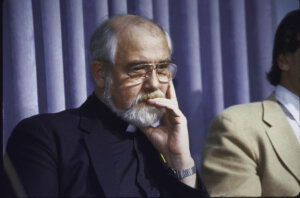
I was working the evening shift when the top news story was about Father Lawrence Martin Jenco, a Catholic priest from Joliet, Illinois, who had been taken hostage in Beirut while he was working for a relief agency. Muhammad Ali was part of a delegation that had flown to the Middle East to try to arrange his release.
Meet Broken Hologram | RSS.com
My supervisor was a terrific guy named Duane Gray, an African-American Conservative who was big on conspiracy theories (“You should read this book. It’s called The Terror Network.”). He was a great manager and colleague who made sure that we kept to the schedule and that traffic, weather, sports and news headlines always came right when they were supposed to. On this particular night, Duane gave me a mission: “Get ‘The Champ’ on the phone.”
“Uh, how do I do that, Duane?”
“Call every hotel,” he said.
He scrawled a list of hotels in Tel Aviv and Jerusalem on a legal pad and I started calling Information to get their numbers. Advantage of working for a CBS affiliate: You got to make all the long-distance calls you wanted.
How many calls did I make? What were the names of all the hotels? I have no idea. But I do remember that one of them was the King David Hotel in Jerusalem because this time, when I asked to be transferred to Ali’s room, no one said, “Sorry, no one here by that name.”
Ali picked up. His voice had that raspy quality it got after he retired from boxing. “Hullo?”
“Hi, I’m calling from Newsradio 78. I was hoping one of our anchors could speak with you.”
“You’re calling from Chicago?” he asked.
“Yeah.”
“Man,” Ali told me, sounding weary but amiable. “It sounds like you’re calling from right next door.”
Duane could be a wise-ass and a cynic, but now he was star-struck. He sprang to his feet. “Is that the Champ?”
I nodded.
Duane grabbed the phone. “How’re you doin, Champ? You’re gonna be on with Dale McCarren. I’m gonna patch you through, Champ.” He gave me a hearty high-five.
Some time later — perhaps after a week, perhaps after two — when Madonna was in town for some concert, movie junket or photo shoot and Duane told me he wanted to get her on the air, I knew exactly what to do.
After I got her on the phone at her hotel and transferred the call to Duane, he shouted: “This kid,” he said, complimenting both me and his own managerial talent, “has the best news instincts of anyone in this newsroom!”
“Hello, Madonna?” Duane said into the phone. “You’re gonna be on with Dale; let me patch you through.”
The post What Muhammad Ali taught me from his Jerusalem hotel appeared first on The Forward.
