


Uncategorized
They were the Messis and Ronaldos of their time. And their fellow countrymen murdered them.
The World Cup is in full swing. Cristiano Ronaldo, CR7 himself, is improbably, arrogantly playing his sixth tournament at the age of 41. The media loves it: the Lionel Messi vs Ronaldo rivalry continues. Ronaldo plays on with tears and tantrums, breaking records and refusing to simply grow old and go home.
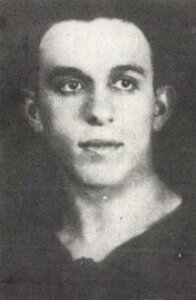
But David Bolchover, author of Digging Deep: Unearthing the Stories of Eleven Murdered Jewish Footballing Greats, finds himself thinking about a different 41-year-old: Jozsef Braun. Arguably the greatest Jewish footballer who ever lived, he was killed by the very Hungarians who had once cheered his name.
“When he was murdered, he was 41,” Bolchover told me when we spoke recently. It was less than 15 years after he had last scored an international goal for Hungary — then one of the top few international teams in the world.
Millions of Jews across Europe were part of the burgeoning soccer culture that was sweeping the continent, with disproportionate representation among elite players, coaches and referees, The way Bolchover tells it, the Jewish soccer culture lost in the European Holocaust was as substantial as the foundational Jewish contributions to culture that helped bring western civilization into the 20th century.
Although he restricts himself to people who played for their countries and who were murdered in the Shoah, Bolchover has selected a team of greats in all 1 positions. He quotes Ursula von der Leyen, president of the European Commission, in 2022, saying “There is no Europe without European Jews,” but where she was thinking that “Europe is Mahler and Kafka, and Freud,” Bolchover is thinking Braun, Zygmunt Steuermann, Béla Guttmann and Arpad Weisz.
These were some of the elite players, coaches and visionaries of the sport — the Messis, Ronaldos, Pep Guardiolas, Zinedine Zidanes, and Carlo Ancelottis of their time. Indeed, Bolchover says that one significant reason that Hungary and Austria’s all-conquering soccer teams became second rate was that they murdered the Jewish populations who were instrumental in achieving and perpetuating that excellence. Dave Rich, who wrote about the UK release of the book, made a point that Bolchover says he wishes he had thought of himself: “Jewish footballers were as prevalent in the football leagues of central and Eastern Europe in the 1920s and 1930s as Black players are in the Premier League today.”
The team that Bolchover unveils in his book would strike fear into the hearts of any pre-War expert on European soccer. Wunderkind Steuermann scored Poland’s first ever international hat trick. Max Scheuer played his whole career for the Jewish, Zionist team Hakoah Wien and led them to the Austrian national title. Weisz went from international star player to record-winning coach, winning the Italian championship for Bologna and Inter Milan. He remains the youngest coach to win Serie A.

Across eight chapters, Bolchover tells the stories of his 11 selected players of his selection and, in so doing, tells a particular history of the Shoah. He can even ignore György Molnár and József Eisenhoffer who between them, in 1924, scored Hungary’s first six goals as they humiliated Italy 7-1 in Budapest. But, along with the glory, it seems like on every page there are footnotes chronicling the tragic fate of the Jews in the towns and villages from which players, their wives, and their families hail.
“I’m not going to just mention a place where Jews lived and not tell you what happened,” Bolchover said. “To me, that’s an abandonment of responsibility. You often get non-Jewish English writers just letting it lie: ‘He was from this area and he died in Auschwitz.’ It’s not good enough.”
Bolchover deliberately avoids saying that these men “died” or that they “perished”; he says they were murdered. “Vocabulary is very important,” he told me. “You have to use ‘murder.’ You can’t use ‘died.’ Even ‘perished,’ I don’t like… I talk about the Holocaust as the Holocaust was. A Jew who’s not angry about the Holocaust is a strange Jew.”
Bolchover is also scathing about the nations for whom his protagonists played. He resists describing many of his players simply as Hungarian, Austrian or German. History, he argues, has already rendered its verdict. “The ones that thought they were Hungarian, the ones that thought they were German, the ones that thought they were Austrian were proven to be wrong,” he said. “They were rejected by the host societies… In the end, they were Jews.”
This is not a polite book. Bolchover does not soften his account for squeamish readers, and he does not traffic in the comforting framing that has come to dominate Holocaust memory in the West: the survivor, the righteous gentile, the redemptive arc. His previous book, The Greatest Comeback, told the story of Béla Guttmann — the brilliant Jewish coach saved by his future brother-in-law — and even that book, Bolchover insists, “did not pull any punches.” This one pulls even fewer. This one is about the rule that Jews were industrially murdered by diverse populations across the continent, not the exception of a few that were saved.
“I felt I needed to write this book,” he said. “I felt more and more drawn to the stories of those who didn’t make it. You feel a responsibility to tell their stories because nobody else can tell them. I felt if I don’t write this book about these 11 players, nobody would. And certainly not in the right way.”
The book was sparked, in part, by fury. In 2019, the release of the biopic about Bert Trautmann — the German goalkeeper who played for Manchester City and who had served in the Wehrmacht — generated a wave of admiring press coverage that Bolchover found intolerable. Trautmann had, it was widely noted, apologized for being a Nazi; the coverage seemed to imply that he was a great guy who had simply made some unfortunate early choices.
“He apologized for being a Nazi, but he was a Nazi,” Bolchoverf said. “He apologized for being an antisemite, but he was an antisemite. And the regime he fought for and supported murdered all these great Jewish footballers that nobody’s ever heard of.”

That nobody has heard of them is not an accident. It is, Bolchover argues, a failure of collective memory — one that begins with the mass extermination of the Jewish crowds who would remember their heroes and proceeds to the shame and repression of the national crowds who gleefully murdered their Jewish compatriots. Jews too have been too quick to embrace the “people of the book” stereotype and look to claim credit for founding football clubs (Bayern Munich, yes; Eintracht Frankfurt, yes; Ajax, yes) while remaining curiously silent or ignorant about the fact that Jews were also, for a golden pre-war generation, many of the very best players on the continent.
“Jews, even Jews, are slightly uncomfortable with the fact of their own ignorance, that actually it wasn’t the founders that were important,” he said. “Why all the focus on that? Why not all the focus on all the top international footballers and coaches? Do we focus really on the founders now, or on the chairman? No, we focus on Messi and Ronaldo.”
The answer, Bolchover suggests, is the Holocaust. Not just because it killed the players, but because it killed the memory of the players. The destruction of European Jewry was so total, so final, that it erased not only lives but legacies. When people laugh and say Jews aren’t really footballers — better suited to medicine, to finance — they are, Bolchover argues, “laughing at our own destruction.”
The 11 players in the book are drawn from across Europe. Bolchover’s structural rule — that they must all be full internationals — was deliberate. He is making a point: These were not obscure club players; they were the stars of their nations, the best their countries could produce. And then their countries killed them.

Bolchover mentions the research he and others have done using Holocaust Yizkor Books — the Jewish memorial books, where decimated communities honored their obligation to remember the dead by listing the names and fates of former neighbors. Bolchover resists that simplistic framing. This is not a memorial volume in the old community sense. It is a piece of serious sports history and Holocaust scholarship, with deep archival research, extensive footnoting, and the kind of narrative drive that makes it readable to someone who has never opened a Jewish history book in their life.
He is withering, too, about the broader European refusal to reckon honestly with the nature of the Holocaust. As Simon Schama has argued — and Bolchover echoes — the Holocaust was not something that happened to the Jews while Europe stood helplessly by. It was something Europe did to the Jews, on a grand scale, with widespread participation. “That’s something Europe doesn’t want to talk about,” Bolchover said. “And even European or British Jews and American Jews don’t want to talk about it.”
None of this is comfortable reading. None of the conversation I had with Bolchover was comfortable. But, in the way that Bolchover insists the Holocaust itself must be discussed, it is honest. As he writes in the book, “to say that the destructive assault on European Jewry was some sort of historical blip or carried out and supported only by an elite cadre of committed German Nazis, constitutes a highly underestimated and sophisticated form of Holocaust denial.”
Which brings us, inevitably, to the 2026 World Cup. To the question of what this history means for the Jews who are alive today, watching the tournament on their screens and phones, where only one Jewish player is on the roster of any of the 48 teams and not a single one is from Europe. This isn’t because Jews are good at business not sport, it’s because Europeans murdered all the Jews who were brilliant sportsmen and coaches and all the Jews who would remember them.
At his UK book launch, Bolchover made the link explicit. Ronaldo at his sixth World Cup. The greatest Jewish footballer who ever lived, murdered at 41. The crowds in their national colors, Norwegians rowing, Senegal drumming, the Scots with their bagpipes, the Dutch in orange. And then the question that nobody wants to ask: What would happen if Israel qualified for the World Cup?
“What would happen if they were there? Nobody would go, ‘Oh, look at those fun-loving Israelis.’ Even in America. And imagine if they were anywhere else in the world.” The same hatred, he said quietly, that accounted for the murder of his eleven players — it is still there. Still in football. FIFA, he noted, has never held a memorial for the great Jewish footballers and coaches who were murdered in the Holocaust.
We know why.
The post They were the Messis and Ronaldos of their time. And their fellow countrymen murdered them. appeared first on The Forward.
Uncategorized
After my dad died, I discovered a lost history of Iranian Jews in the US
I was a freshman in college when my dad died. An Iranian Jew who came to the United States four years before the Islamic Revolution to study at the University of Missouri, he went both by Farzad and by his Hebrew name, David. Eventually, he became a traveling jeweler — or, as he put it, a “merchant,” a word evoking an image of independence, shrewdness and valor on the Silk Road. After each business trip, he’d return home with stories of how nice people were in Raleigh, how cold it was in Minneapolis, and how beautiful the Florida Keys were.
Growing up in an Iranian Jewish community in Great Neck, a suburb on the North Shore of Long Island, I had spent my life mostly surrounded by people just like me, and rarely ever boarded a plane. The contrast between my dad’s cosmopolitanism and my provincialism mirrored another contrast, between his capability and my incapability. These differences made me distrust and worship him.
I knew my dad was getting older. The pace of his hair growth had slowed down, making his insistence on monthly haircuts a regular source of ridicule. But he was only 62; he wasn’t supposed to die. In 2019, he had a fatal heart attack on a flight to Key West — while he was in the air.
It seemed fitting that he — a cosmopolitan who had always seemed separate from the rest of my more provincial family — would die several hundred miles away from where we all lived. In the wake of his death, my desire to better understand his life led me to discover a forgotten chapter of Iranian Jewish history.
My community’s identity, like all identities, reflects a series of choices we’ve made about which parts of our experiences we wish to keep, and which we wish to throw away in the name of self-preservation. But despite our better efforts, the things we try to discard tend to remain with us, sometimes without us even knowing it.
Roots in Mashhad
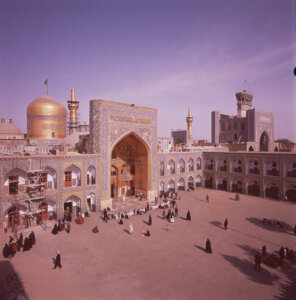
My Iranian Jewish community traces its roots back to Mashhad, a city in northeastern Iran. In 1839, a mob of Muslim Mashadis raided the Jewish ghetto and killed more than 30 people. They seized and married Jewish women, selling others into slavery. Some Jews converted to Islam to escape death; others fled the country.
My ancestors appeared to convert to Islam. But community lore goes that when no one was watching, they wore tiny tefillin, prayed in basements and kept kosher as best they could. On Saturdays, Jewish shopkeepers kept their stores open so as not to be seen keeping Shabbat — but jacked up prices so high no one would buy anything. Jewish parents arranged their children’s engagements at young ages, so that if a non-Jew came requesting their daughter’s hand in marriage, they could honestly say she was taken.

Decades later, under a new government, my ancestors slowly began practicing Judaism openly again. In the mid-20th century, my grandparents and other Mashadi Jews left the city and moved to Iran’s capital, Tehran. But they remained insular. In Tehran’s much larger Jewish community, Mashadis separated themselves, praying in Mashadi synagogues and marrying fellow Mashadis.
They did the same in the U.S., where they first settled in Queens, then later helped form the ethnic enclave where I grew up.
As a child, I learned that being Mashadi made me different from all the other Iranian Jews in Great Neck, whom we called Tehrani even though many of their families came from other cities. So, when I learned that my parents were actually born in Tehran, I was scandalized. If my parents came from Tehran, didn’t that make us Tehrani?
“Why are we Mashadi?” I asked my dad one night, a year before he died: Why was I defined by this city, and not the other Iranian cities where my ancestors lived? Why weren’t we just Iranian?
Unable to explain, my dad laughed off the question. But I know now why Mashadis are Mashadi. It’s because pretending to be Muslim while secretly continuing to practice Judaism was a defining experience, one that taught my ancestors ugly ways to survive.
“To omr-e mani,” my dad would tell me in Farsi, in lieu of a simple “I love you.” Translation: “You are my life.” He always had a flair for hyperbole. And though he didn’t intend it this way, my teenage brain twisted his words to mean: “It will kill me if you aren’t a good Mashadi girl.”
Going to Missouri
When I was little, my mom told me a version of the Mashadi immigration story that matched her own experience: It began in Tehran and ended in Forest Hills, Queens. But when my dad died, I became more invested in piecing together the parts of his life that my mom’s story didn’t capture.

I got his yearbook and attendance records from the University of Missouri; obtained his immigration records from the U.S. Citizenship and Immigration Services; pored over more than 100 old newspapers, magazines and other archival documents; read academic articles and history books; and spoke to about a dozen people who I thought might have relevant intel, including extended family members, scholars and people who attended or worked at my dad’s college.
Arriving in 1974, my dad was one of tens of thousands of Iranians who came to the U.S. in the 1960s and 1970s for college. In Iran, as in other major oil-exporting countries, economic development had led to increasing demand for skilled workers — but there weren’t enough colleges to meet this demand. So the Iranian government gave scholarships to students studying abroad.
Determined to develop allies during the Cold War, the U.S. government doled out scholarships, too. The idea was that students in Iran’s expanding middle class could study engineering in the U.S., then bring that expertise back to their home country, which needed it.
Many of these college students, seeking a lower cost of living, wound up in the Midwest. Plus, in the logic of a tight-knit ethnic community, where one person goes, others follow.
My dad followed a small group of Mashadi men to the University of Missouri in Columbia. His older brother, Behzad, had gone there for graduate school and still lived nearby. In Tehran, both he and my dad had attended an elite boys’ prep school called Alborz, named for the mountain range that stretches along the coast of the Caspian Sea. Historically run by American Christian missionaries, Alborz was considered the best high school in Iran, and American colleges knew it. Plus, if my dad’s kitchen-table bragging is to be believed, he was among Alborz’s top students in math.
Protest and persecution
By the time my dad arrived in Missouri, the tensions that would give way to the Islamic Revolution in 1979 had already emerged. Many Iranians protested the country’s then-leader, Shah Mohammad Reza Pahlavi, over restrictions he placed on democratic institutions, torture against political opponents under his leadership, and his significant expansion of the military.
The Iranian community in the U.S. — then disproportionately composed of college students — leaned into the opportunity this country gave them to express themselves politically. Articles from the Columbia Missourian, once my dad’s local paper, show that at one point in the mid-’70s, anti-Shah protests took place at least once a month at local colleges.

The protesters were embracing an American freedom: The Iranian secret police couldn’t get them, at least not while they were in the U.S. But American authorities had issues of their own.
In October 1975, police maced then arrested protesters at an anti-Shah rally at Lincoln University in Missouri. The protesters were denied food and prevented from calling lawyers because, a spokesperson for the Iranian Students Association said, “they were foreigners and had no rights.” The mayor sent the student-protesters’ names and photos to the Shah, even though students said that could get them executed or imprisoned for life.
At the University of Missouri, letters to the editor in the student newspaper, as well as classified ads, called for Iranian students to go back to where they came from. Graffiti on bathroom walls spread a similar message. Some people simply told their Iranian classmates face-to-face to return to the very place whose government they were protesting.
Many Iranian Jewish students liked the Shah, because he believed in secular government and undertook westernizing reforms. But 2,500 years of living as a minority had taught them to keep quiet. “Normally, Jews would stay out of politics,” mom’s brother Bahram, who studied in the Midwest beginning in 1969, told me. “If you were pro-Shah, you had a lot of students against you. If you were against, you had the embassy that would come after you.”
Two people I interviewed — Bahram and one of my dad’s cousins — both said something I can envision my dad also saying: that being Jewish protected them from anti-Iranian hostility on campus.
My dad’s cousin Sohrab, who went to New York’s Queens College, said that when encountering potentially hostile people, he made sure to emphasize being Jewish. “We feel like somebody’s uncomfortable, we made sure we told them first, ‘I am Jewish. I ran away from Iran,’” Sohrab said.
“We are first Jewish, then Iranian.”
What my dad and I never talked about
When my dad was 22, and a senior at the University of Missouri, his native country erupted into violence.
More than 40 years after the revolution, I sat in my college dorm, reading back issues of the Columbia Missourian, imagining my dad as a young, longish-haired man following the news from afar.
December 1978: “2 million protesters hit Tehran.” February 1979: “10,000 dead in Iran’s crisis.” March: “Firing squads execute 13 in Iran.” As the revolution took place, so did frequent earthquakes, which also claimed thousands of lives.
The college students who’d risked it all in order to advocate against the Shah seemingly got their way when he fled Iran in January 1979. But they were blindsided by the zealotry of the man who took his place: Ayatollah Ruhollah Khomeini, a Shi’ite Muslim cleric who established an Islamic theocracy. He offered a foil to Pahlavi’s friendliness with the West by preaching against the U.S., Israel and imperialism.
After the revolution, the new government tried to assure Iranian Jews that they’d be safe, yet some were executed on trumped-up charges of spying for Israel. My dad’s parents were quick enough to leave by air, landing in Queens. Those who waited too long to emigrate had to pay smugglers to help them over mountainous borders.
When the Mashadi community followed in the footsteps of its sons and immigrated en masse to the U.S., American-educated Mashadi men — now in their 20s and 30s — became informal secretaries, translators, immigration consultants, financial advisors, business consultants, and advocates for higher education, for their own families and for the wider community.
Despite what Sohrab said, de-emphasizing their Iranian origins didn’t always protect the new immigrants from bigotry. Mohsen Mobasher, an anthropologist at the University of Houston-Downtown, told me that because of anti-Iranian hostility that later grew rampant, “some Iranians developed deep feelings of anxiety, suspicion, insecurity and inferiority.”
Once, I asked my dad whether he ever experienced antisemitism or anti-Iranian hostility. He let out a hearty laugh, as though it was ridiculous for me to imagine that he had.
If the question was ridiculous, it was only because I asked it so casually; just as I might ask him to do my laundry or cut me a pineapple. It was as if I’d asked him to synthesize his whole experience of identity into some set of words that might satisfy me. My dad did not see fit to tell me, a girl he was charged with protecting, about times in his life when he may have felt small.
Singled out by the federal government
In November 1979, months after my dad graduated, a group of Iranian militant college students took over the U.S. embassy in Tehran and held 66 Americans hostage. The hostage crisis gave way to unprecedented levels of anti-Iranian sentiment in the U.S., and the animus fell hardest on college students. Members of Congress introduced resolutions calling for all Iranian students to be deported. At Mizzou, one professor announced that he would no longer advise Iranian students.

On Nov. 10, President Jimmy Carter ordered immigration checks on all Iranian college students in the U.S., saying that anyone found to be violating the terms of their student visa would be deported. More than 200 Mizzou students were told to report to an immigration office in Kansas City. To some of these students, the visa checks felt wrong, and they refused to participate.
“I would feel like a criminal,” an Iranian student who did not report told the Missourian.
“This is discrimination — singling out one nationality and investigating them,” said another, who also refused to participate in the check.
By this time, my dad had moved to St. Louis, where he was working for the chemical manufacturer Olin Corporation. But he still had to report for the visa checks. He had a visa for students and recent graduates who were gaining practical training in their field of study. In December, he received a frantic letter from Carl Leistner, the international student program coordinator at Mizzou, telling him to report to Kansas City the following week.
“I regret this delayed notice,” Leistner wrote in the letter. “However, we simply overlooked our practical training students in the rush associated with the registration of our 258 currently enrolled students from Iran.”
My dad traveled more than 200 miles for his interview, but when he arrived, he was sent home. A federal judge had ruled the visa checks were unconstitutional. If that ruling was overturned, my father was told, he might have to come back for an interview later.
Back on the Mizzou campus, some 600 students held a protest where some students advocated “deporting all Iranians from the United States.” “Deport, deport,” the crowd chanted at one point.
By being away from campus, my dad managed to evade these sorts of protests, plus other horrors that befell his collegiate counterparts. Abe Manzour, an Iranian American Jew who was my dad’s classmate at the University of Missouri, was still earning his degree.
“Sometimes, we were scared to go outside,” Abe told me over Zoom in 2021. “I almost got beat up by some guys on the street because they knew I was Iranian.”
Scared to go outside? Almost got beat up? Despite everything I had already read about anti-Iranian hostility, I was still surprised. What Abe was describing seemed a world apart from tales my dad used to tell — stories of beer, women and football games, which would’ve taken place just months beforehand.
“My dad always talked about his time in college,” I said. “He made it sound like the best thing ever.”
“For me it was, too,” Abe said.
A conservative enclave
Growing up in Great Neck, I lived a life very different from my dad’s. Our suburb was full of Iranian Jews, and until I was 18, I rarely ever left it. He was worldly; I was provincial, and in my senior year of high school, as I applied for college, I could no longer contain my jealousy.
“Can I apply to UC Berkeley?” I asked him one Sunday afternoon during my senior year, while he was making “early-bird breakfast.” I knew he’d say no, but wanted to see him squirm.
“I don’t see! I don’t see!”
“Dad!”
“Bache nazaideem ke befresteemesh Ca-lee-forn-yaw!” — “We didn’t have a child so that we could ship her off to California!”

“I know two people who sent their son to college on a different continent!”
“That was over 10 years ago!” At 61, my dad enjoyed describing events of his youth as having taken place “over 10 years ago.”
I never applied to Berkeley; instead, I stayed close to home and went to CUNY Hunter College in Manhattan. For better or worse, my life would be different from my dad’s, in ways that were tied up with the increasingly conservative nature of our community.
In Tehran, Mashadi Jews lived scattered around the city. In Great Neck, Mashadis are neighbors and attend a set of synagogues all within a mile of each other. And many Mashadi Jews in Great Neck have become more religious than their ancestors in Tehran were.
When most people think of assimilation, they envision people becoming more secular and better educated. But most Jewish people in Great Neck — Mashadi and otherwise — have assimilated into a different yet equally compelling idea of America, one that emphasizes religious freedom over other aspects of American culture.

In the Midwest, Mashadi men learned the valuable lesson that Abe Manzour expressed: that it’s possible to experience happiness and personal growth in the midst of a hostile environment. Years later, when they moved to Great Neck, their environment rendered that wisdom useless, like a vestigial organ at risk of evolutionary disappearance.
To the men who’d left Iran to study abroad, we, their children, must have at times seemed narrow-minded and irredeemably young. Especially when I think about my dad’s life, I sometimes resent that I wasn’t allowed to go to California and feel embarrassed to have attended a commuter school.
What made me want to study his life was a binary I imagined between him — worldly — and me — ignorant. But actually, I don’t really believe that a binary between cosmopolitanism and provincialism captures the nuances entailed in our father-daughter relationship. And I don’t believe that being poorly traveled is the same as being ignorant.
Regardless of where one lives or visits, there are many different ways to be ignorant, and many different ways to learn something new.
The post After my dad died, I discovered a lost history of Iranian Jews in the US appeared first on The Forward.
Uncategorized
The stepchildren in the upcoming Israeli elections
דעם 27סטן אָקטאָבער וועלן פֿאָרקומען די וואַלן אין ישׂראל. 38 פּאָליטישע פּאַרטייען האָבן זיך פֿאַרשריבן צו פּרובירן געווינען וואָס מער פֿון די 120 מעגלעכע ערטער אין דער כּנסת. אין די פֿריערדיקע וואַלן, האָבן קאַנדידירט 40 פּאַרטייען. לויט דעם געזעץ, מוז מען געווינען גענוג וואַלן אויף כאָטש פֿיר (4) דעפּוטאַטן — דאָס הייסט 3.25% פֿון דעם סך־הכּל פֿון אַלע מענטשן וואָס האָבן אָנגעגעבן „כּשרע“ שטימעס.
אין די פֿריערדיקע וואַלן האָבן 70.83% פֿון אַלע בירגער אין לאַנד מיט שטימרעכט (4,764,742 פֿון 6,788,804) דערמעגלעכט 10 פֿון 40 פּאַרטייען אַרײַנצוטרעטן אין דער כּנסת. דעמאָלט האָט מען געדאַרפֿט האָבן בערך 153,000 שטימען כּדי אַ פּאַרטיי זאָל קענען אַרײַנפֿירן זייערע ערשטע פֿיר דעפּוטאַטן אין דער כּנסת. הײַנט, מיט 4 יאָר שפּעטער, וועט מען מסתּמא דאַרפֿן באַקומען נעענטער צו 200,000 שטימען.
ווי עס זאָל ניט זײַן, קעמפֿן די גרויסע פּאַרטייען פֿאַר יעדער שטימע, און באַמיען זיך פּטור צו ווערן און דערשטיקן די מעגלעכקייטן פֿון יענע קלענערע פּאַרטייען וואָס וועלן אפֿשר ניט דערגיין צו דעם מינימום פֿון 3.75% — און דערבײַ ׳אַוועקפּטרן׳ שטימען פֿון זייערע טראַדיציאָנעלע, סעקטאָריאַלע שטיצערס (למשל פֿרומע-פֿרײַע, רעכטע-לינקע, ייִדן-ניט-ייִדן).
הײַ-יאָר איז בכלל אַ גרויסער מיש-מאַש פֿון פּאַרטייען. פֿאַראַן נײַע שפּילערס וואָס ענדערן דאָס דעמאָגראַפֿישע און סעקטאָריאַלע פּנים פֿון געוויסע טראַדיציאָנאַלע פּאַרטייען, אָדער פֿון נײַע פּאַרטייען וואָס זײַנען ערשט אויפֿגעקומען. למשל, צו דער אַראַבישער/איסלאַמישער פּאַרטיי „רע׳ם“ האָט זיך צוגעשטעלט אַ ייִד — יואבֿ סגלוביץ (סעגאַלאָוויטש) — וואָס איז אַ געוועזענער הויפּט פֿון דער ישׂראל־פּאָליציי, אַ פֿיגור מיט וויכטיקע דערגרייכונגען.
„עמך ישראל“ – שטיפֿקינד פֿון די רעכטע
אויף דער רעכטער זײַט פֿון דער פּאָליטישער מאַפּע איז אַנטשטאַנען אַ נײַע פּאַרטיי, „עמך ישראל“, פֿון עופֿר ווינטער, אַ געוועזענער גענעראַל־בריגאַדיר. זײַן שותּף, דער צווייטער אין זײַן רשימה, איז יוסוף חדד (כאַדאַד), אַ קריסטלעכער אַראַבער וואָס איז אין דער צײַט פֿון דער צווייטער לבֿנון־מלחמה פֿון 2006, געווען אַן אָפֿיציר אין דער גולני דיוויזיע פֿון צה״ל. קעמפֿנדיק פֿאַר ישׂראל, איז ער שטאַרק פֿאַרוווּנדיקט געוואָרן. ער איז אויך באַקאַנט אויף דער סאָציאַלער מעדיאַ בײַם העלדיש פֿאַרטיידיקן מדינת־ישׂראל קעגן אַנטי-ציוניסטן און אַנטיסעמיטן. ווינטערס ציל איז, אַרײַנברענגען פֿרישע בלוט אין די רייען פֿון די רעכט-געשטימטע פּאַרטייען.
די פּאַרטיי ווערט פּראָיעקטירט צוצונעמען שטימען פֿון דער גרעסערער „ליכּוד“־פּאַרטיי, געפֿירט פֿון בנימין נתּניהו. לויט די מערסטע שטים־אַנטקעטעס ביז הײַנט, וועט „עמך ישראל“ ניט דערגרייכן די געהעריקע 3.75% און אַלע שטימען וועלן דערפֿאַר פֿאַרלוירן גיין. עס ווערט דעריבער איצט געפֿירט אַ גאָר שטאַרקע אַקציע פֿון דער ליכּוד פּאַרטיי אַז „עמך ישראל“ (און אויך נאָך עטלעכע קליינע רעכט-געשטימטע פּאַרטייען) זאָל זיך אָפּזאָגן פֿון אָנטיילנעמען אין די וואַלן. עופר ווינטערס קעגנערס האָבן שוין מצליח געווען אָפּצושרעקן איינעם פֿון די 4 וויכטיקסטע קאַנדידאַטן פֿון „עמך ישראל“, וואָס האָט זיך די טעג אָפּגעזאָגט פֿון קאַנדידירן.
„מילואימניקים„ (רעזערוויסטן) מיט „כּלכּלית„ (עקאָנאָמיע) – „וואָס“, ניט „ווער“
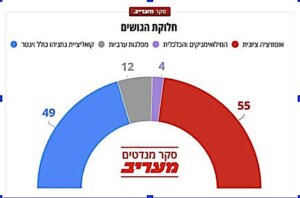
ווען מע קוקט אויף אַ גראַפֿיש בילד פֿון ווי די 120 כּנסת־ערטער ווערן אײַנגעטיילט צווישן די פֿאַרשיידענע פּאַרטייען — לויט די טעגלעכע שטים־אַנטקעטעס — זעט מען דאָס אײַנגעטיילט אויף דרײַ חלקים. פֿון איין זײַט, זעט מען די מעגלעכע צאָל קאַנדידאַטן פֿון דער איצטיקער קאָאַליציע (וואָס נעמט אַרײַן „ליכּוד„ צוזאַמען מיט די חרדישע און אַנדערע רעכט־געשטימטע פּאַרטייען). פֿון דער אַנדערער זײַט, זעט מען די צאָל מעגלעכע קעגנער (סײַ צענטריסטישע, סײַ לינקע, סײַ רעכטע פּאַרטייען) וואָס ווילן פֿאַרבײַטן די איצטיקע רעגירונג פֿון נתּניהון. דער דריטער בלאָק באַשטייט פֿון די אַראַבישע פּאַרטייען. פֿאַראַן אָבער — אין געוויסע פֿון די דיאַגראַמעס — אַ פֿערטע גרופּע, וואָס געהערט צו אַ ספּעציפֿישער פּאַרטיי וואָס פֿירט גאָר אַן אַנדערע פּאָליטיק פֿון די אַנדערע.

צוויי נײַע פּאַרטייען לייגן אָבער פֿאָר עפּעס גאָר אַנדערש פֿון די טראַדיציאָנאַלע רעכטע און לינקע פּאַרטייען: יועז הנדל (יאָאַז הענדל) פֿון דער „המילואימניקים“ (רעזערוויסטן) פּאַרטיי בשותפֿות מיט ירון זליכה (זאַליכאַ) פֿון דער „הכּלכּלית„ (עקאָנאָמיע) פּאַרטיי. זיי וואַרפֿן אָפּ די פּאָלאַריזירטע געדאַנקען און האָבן אֶ פּלאַטפֿאָרמע וועלכע שטעלט דעם טראָפּ אויף „וואָס“ מע דאַרף טאָן. דעם „ווער“ עס דאַרף דאָס אַדורכפֿירן איז ווייניקער וויכטיק – ספּעציעל וואָס אין דער הײַנטיקער פּאָליטיק איז שוין ניט קלאָר ווער עס איז אויף וועלכער זײַט פֿונעם פּאָליטישן ספּעקטרום.
די פּאַרטיי האָט זיך פֿון אָנהייב געוואַקלט בײַ 3.75%, אָבער אין די לעצטע וואַל-אַנקעטעס זעט אויס אַז זיי וועלן ניט נאָר דערגרייכן די געוווּנטשענע פֿיר דעפּוטאַטן, נאָר זיי שטרעבן אויף אַפֿילו נאָך מער. דאָס קען גוט זײַן דערפֿאַר, וואָס צו דער רעזערוויסטן־פּאַרטיי איז צוגעשטאַנען עינת ווילף — אַ באַגאַבטע פֿיגור וואָס איז זייער אָפֿן־האַרציק מיט אירע געדאַנקען. (מע קען זי אָפֿט טרעפֿן אויף דער סאָציאַלער מעדיאַ פאַרטיידיקנדיק מדינת־ישׂראל קעגן אונדזערע שׂונאים).
ווילף האָט אַליין געשאַפֿן אַ פּאָליטישע פּאַרטיי „עוֹז“ וואָס איז זייער ציוניסטיש געשטימט, און וועמענס אידעאָלאָגיע פּאַסט זיך גוט צו צו די פֿון אירע שותּפים הענדל און זליכה. יעדער ישׂראלדיקער בירגער דאַרף דורכמאַכן אַ מדינה־דינסט (ניט דווקא אַ מיליטערישע): מענער און פֿרויען, ייִדן, און ניט-ייִדן. זי דריקט אויך אויס אַנדערע געדאַנקען ווי אַזוי צו פֿאַרבעסערן דעם מצב סײַ וואָס שײַך דער זיכערקייט, סײַ דערציִונג, סײַ דער ישׂראלדיקער עקאָנאָמיע. איר פּאַרטייס נאָמען, „עוֹז“, איז אינספּירירט פֿון די ווערטער „יהוה עוז לעמו יתן יהוה יברך את עמו בשלום“ (ספֿר תּהילים) …
און נאָך אַ זאַך: יועז הענדלס פּאַרטיי, „די פֿאַראייניקטע ליסטע“, איז די איינציקע, אויף וויפֿל מיר ווייסן, וואָס האָט אַ לאָזונג אויף ייִדיש. אין אַ געוויסן זינען קלינגט עס ווי עפּעס, וואָס דער אַמעריקאַנער פּרעזידענט דזשאָן עף. קענעדי וואָלט געזאָגט: „פֿרעגט ניט ׳ווער׳, נאָר ׳וואָס׳ מע מוז טאָן פאַר דער מדינה.“
The post The stepchildren in the upcoming Israeli elections appeared first on The Forward.
Uncategorized
In Oct. 7 blame game, former Shin Bet chief sues Netanyahu ahead of elections
(JTA) — The bitter battle that has raged between Israel’s security and political establishments over who bears responsibility for the failures ahead of the Oct. 7 attacks is kicking into high gear as Israel prepares to hold its first election since the Hamas invasion in 2023.
This week, former Shin Bet chief Ronen Bar upped the stakes by filing a defamation lawsuit against Israeli Prime Minister Benjamin Netanyahu. The premier has blamed the intelligence head for the failures leading up to the attack even as many in the security establishment have pointed the finger at Netanyahu. Bar in his lawsuit lists a litany of occasions Netanyahu allegedly ignored or rejected advice that might have prevented the attacks.
In the run-up to the national vote on Oct. 27, Israeli media have been preoccupied with reports of intelligence that was purportedly shared with top government officials ahead of the attacks. What Netanyahu knew about the Hamas threat before the invasion — and when he knew it — has become a central issue in the campaign and a line of attack for his political rivals.
Gadi Eisenkot, leader of the Yashar party and Netanyahu’s leading challenger, said in response to the lawsuit that “Netanyahu was warned and did not act,” and that he would not allow Netanyahu to “evade the truth.” Opposition leader Yair Lapid said that “Netanyahu can no longer claim that he didn’t know,” while Yair Golan, leader of the left-wing “The Democrats” party, said Netanyahu’s responsibility for “the worst massacre in Israel’s history is direct and clear.”
A range of political and security leaders who were in charge at the time have assumed responsibility and left their posts: Among them are Bar, IDF Chief of Staff Herzi Halevi, Defense Minister Yoav Gallant and military intelligence chief Aharon Haliva.
Not Netanyahu. He has rejected accusations that he is responsible for the failures even as he has prevented the establishment of a state commission of inquiry to investigate those responsible. He has argued that such a commission, whose members would be appointed by the president of the Supreme Court, as is traditionally the case in Israel, would be biased and would not enjoy public trust.
Beyond blaming the security establishment, Netanyahu has also sought to shift responsibility onto political rivals and previous governments. He has pointed to the actions, or failure to act, of political opponents, including Eisenkot, Naftali Bennett and Benny Gantz, when they held senior positions, as well as Israel’s 2005 withdrawal from the Gaza Strip, as factors that contributed to the Oct. 7 massacre.
In the lawsuit itself, Bar accuses Netanyahu of “trying to rewrite history and completely evade his responsibility for the events of Oct. 7.” The filing sets out a series of alleged warnings Bar gave Netanyahu before the attack, as well as Netanyahu’s alleged refusal to adopt Bar’s recommendations for offensive action in the months leading up to the massacre.
The lawsuit details more than a dozen instances in which Bar allegedly warned of Hamas’ growing strength and its intentions to attack Israel, alongside repeated recommendations that Netanyahu take more aggressive action against the group.
Among the warnings cited in the lawsuit, Bar said he presented Netanyahu in January of 2023 with his assessment that Hamas leader Yahya Sinwar wanted a multifront campaign against Israel.
In February, Bar allegedly sent Netanyahu a personal letter warning that terrorist organizations saw an opportunity to act and that the combination of Israel’s internal divisions and instability in the Palestinian arena could bring the country closer to a “perfect storm.”
In July, Bar said he told Netanyahu directly that he was conveying a strategic warning of war.
In September, he allegedly warned that Hamas wanted to escalate the conflict during October.
Netanyahu responded to the lawsuit in a post on X, addressing one specific claim in the filing: that he had never given Bar his personal phone number.
“Ronen, are you serious? You had my red phone number and could have called me immediately, as all heads of the security establishment do,” Netanyahu wrote. “How many lives could we have saved if only you had called in time.” Netanyahu has claimed recently that had security officials awoken him earlier on Oct. 7, he would have somehow stemmed the attack.
Bar’s suit also alleges that he consistently recommended initiating offensive operations against Hamas, including a “preemptive strike” and targeted killings. According to the lawsuit, Netanyahu strongly opposed those recommendations because he wanted to keep Hamas as a secondary concern. Bar also said Netanyahu reprimanded him for dealing with “strategy.”
“The defendant had been in a state of slumber for many long months beforehand and refused to wake up despite the alarm bells the plaintiff sounded in his ears incessantly,” the lawsuit alleges, alluding to Netanyahu’s plaints that he was not awoken early on Oct. 7. “The gap between the professional warnings and recommendations the plaintiff presented to the defendant and the response the defendant gave them is beyond comprehension.”
The defamation claim focuses in particular on a post Netanyahu published on X late last month, in which he claimed that Bar “knew about the real danger” in the early hours of Oct. 7 but chose not to wake him or take other preventive measures. Netanyahu accused Bar of trying to shift responsibility for “all of Ronen Bar’s failures and crimes” onto him.
In a press statement after filing the suit Wednesday, Bar called Netanyahu’s post a “blood libel” and announced that he was suing for 3 million shekels ($968,500) in damages and seeking a correction of Netanyahu’s statements.
Bar repeatedly emphasized in the lawsuit that he was not seeking to absolve himself or the Shin Bet of responsibility for the failures that led to the Oct. 7 massacre. Rather, he said, the suit was a response to Netanyahu’s attempt to “shift the responsibility exclusively onto Bar.”
“I waited quietly for three years for the establishment of a commission of inquiry that would finally expose the Shin Bet’s work, alongside its failures, in the face of an ongoing blood libel,” Bar said.
This article originally appeared on JTA.org.
The post In Oct. 7 blame game, former Shin Bet chief sues Netanyahu ahead of elections appeared first on The Forward.
