


Uncategorized
He was a shy, retiring, Jewish record store manager. How did he come to manage the world’s biggest rock band?
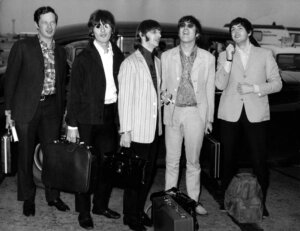
Mr. Moonlight: Brian Epstein and the Making of The Beatles
By Philip Norman
Da Capo, $32.50, 368 pages
Brian Epstein was a most unlikely candidate to discover the Beatles playing in a subterranean music club in Liverpool and manage them toward becoming the biggest pop-rock band in the universe. The somewhat shy and retiring record store manager and classical music aficionado was convinced by an employee to join him during a lunch break to walk over from his family-owned NEMS record shop to the Cavern Club, where he stood out for his age (he was 27; the group’s oldest musician, John Lennon, was 21 and the crowd consisted largely of teenagers), his outfit (a formal suit and tie), and his mature deportment.
But despite being a fish out of water in the grungy club and with no experience working with musicians, within just a few weeks of getting to know the members of the Fab Four, Epstein signed them to a management deal for the purposes of getting them gigs, attracting a record deal, and freeing the foursome from business and logistical concerns. Along the way, Epstein cleaned them up, convincing them to trade their leather outfits for suits and ties, to all cut their hair in the same bowl-cut style that garnered them the nickname “mop-tops,” and to stop eating, smoking and cursing out the audience while performing.
Who was this character, and why did the Beatles put their trust in him?
The 5th or 6th Beatle
Brian Samuel Epstein was born on Sept 19, 1934, which happened to be Yom Kippur, the holiest day of the Jewish year, when Jews traditionally fast and spend the day in synagogue in an annual ritual of atonement. In some small but significant way, atonement would prove to be one of the themes of Epstein’s short, enigmatic life.
Brian’s paternal grandfather, Isaac Epstein, emigrated from Lithuania to Manchester, England, in 1894. He eventually moved to Liverpool, where he opened a furniture shop. The family expanded the business by taking over a nearby shop called North End Music Stores, which became the famous NEMS chain of furniture and record stores. Paul McCartney’s father once bought a piano from NEMS, and teenage Paul — along with his pals John Lennon and George Harrison — often went to NEMS to hear the latest pop and rock ‘n’ roll records from America.
Isaac Epstein’s son Harry married a woman named Malka Hyman (hence her nickname, “Queenie,” as “Malka” is Hebrew for queen), and the two became “prominent and popular members of the largest Jewish community outside London.” Brian and his younger brother Clive were raised in a household that kept a kosher kitchen and had weekly Shabbat dinners.
After briefly attending RADA, the Royal Academy of Dramatic Art, in London, where he had hopes of becoming an actor, Brian Epstein returned to Liverpool and went to work for his father, managing the NEMS record outlet.
As Beatles biographer Philip Norman recounts in Mr. Moonlight: Brian Epstein and the Making of the Beatles, Brian led something of a double life from a young age. He was gay at a time when engaging in homosexual activity was against the law as well as frowned upon socially. Epstein lived his gay life mostly in the shadows, attracted as he was to anonymous trysts with “rough trade,” which could and often did wind up with him getting into trouble with the law as well as being beaten up, robbed, or blackmailed. To make things worse, Epstein was a heavy drug user and drinker who combined alcohol and sleeping pills, and he was hospitalized several times for depression and drug abuse.
Nevertheless, Epstein steered the Beatles to fame and fortune, first in England, then in America, and then all around the world. He was tenacious in trying to score them a record deal in London. Bringing them to the attention of Parlophone staff producer George Martin proved to be auspicious. Although Martin had previously specialized in recording comedy records, he saw something in the Fab Four (who, at least in their early years, were something of a comic group — or at least John Lennon fancied them as such) that was distinctive and showed promise. Martin convinced the upper brass at EMI, which owned Parlophone, to take a flyer on the group. The pairing of Martin and the Beatles would prove as significant as anything Epstein did for them, and when talking about “who was the fifth Beatle?” the only honest answer is both Epstein and Martin (or one was the fifth and the other the sixth — take your pick). Martin’s influence on the Beatles’ musical development and his support of their more experimental tendencies in the recording studio would prove to be an essential ingredient in their magical mixture.
A genteel and not-so-genteel antisemitism
In early 1963, a Jewish Londoner named Helen Shapiro was one of the biggest pop stars in England. Epstein got the Beatles attached to a nationwide tour headlined by Shapiro, which wound up laying the groundwork that would evolve into the full-fledged Beatlemania that would erupt by the end of the year. By early 1964, Epstein convinced American TV variety host Ed Sullivan to have the Beatles appear as guests on his weekly program for three consecutive weeks, lighting the fire of Beatlemania in the U.S., on their way to total domination of the world’s airwaves.

Epstein also worked with Jewish-American concert promoter Sid Bernstein to get the Beatles booked at Carnegie Hall in New York City and later at Shea Stadium, for two massive concerts in 1965 and 1966. In the meantime, Epstein hooked up the Beatles with Dick James (born Isaac Vapnick) for the purposes of creating Northern Songs, a publishing company for their original compositions. Epstein also midwifed the Beatles entrance into moviemaking, making a deal with United Artists to make several films, including A Hard Day’s Night and Help!, both directed by American-born filmmaker Richard Lester (born Richard Lester Liebman). Lester, like George Martin, had previously worked with Spike Milligan and Peter Sellers, two of the Beatles’ favorite comedians.
For Epstein, it was not always smooth sailing. It was a time when a kind of genteel (and not-so-genteel) antisemitism permeated British life and culture, a time when the words “Jewboy” and “Yid” came tripping off the tongue. When Paul McCartney told his father that the Beatles were thinking of partnering with Brian Epstein, pere McCartney replied, “Jews are good with money,” leaving it to our imagination if this betrayed antisemitism or was meant as a compliment.
Even with his commercial and financial success, Epstein found certain doors closed to him. According to Norman, “As a permanent London base, [Epstein] favored the city’s two most exclusive neighborhoods, Knightsbridge and Belgravia, but for him, as he well knew, it wouldn’t be just a question of studying an estate agent’s brochure and requesting a viewing. Antisemitism flourished nowhere more vigorously than among those elegant white squares, many of whose ritzier apartment blocks made clear without stating explicitly they did not welcome Jews.” Brian recounted the anti-Jewish taunting he fell victim to in school in his memoir, writing, “even now [antisemitism] lurks around the corner in some guise or other.”
The godfather
No one was crueler to Epstein about being Jewish and gay than John Lennon, who, although perhaps best known for singing about peace and love, could be violent and cruel to those closest to him. Norman writes that Lennon treated Brian “abominably, at one minute sarcastically over-reverential, at the next blisteringly rude to his face about his clothes, his hair, his accent, his sexuality, even his religion.” When Epstein hired Tony Barrow to be the Beatles’ press agent, Lennon asked him (with Epstein within earshot), “If you’re not Jewish and you’re not queer, what are you doing working for Brian?” And when Epstein asked the band members what he should call his memoir, Lennon replied, “Queer Jew.”
Nevertheless, when Cynthia Lennon gave birth to Julian, the Lennons asked Epstein to be the boy’s godfather. And immediately following Julian’s birth, Lennon and Epstein went on holiday together for two weeks in Spain, where it has long been assumed the two of them had sexual relations of some sort.
When the Beatles decided to retire from touring in 1966, Epstein was left wondering what remained for him to do for them, since so much of his work had revolved around booking concert tours and negotiating deals. With the focus of the Beatles work now dedicated to the recording studio, Epstein spiraled. His drinking and drug use, as well as his expensive gambling habit, grew to epic proportions. He was found dead in his bed on August 27, 1967, at the age of 32. Surrounding him in bed were items of correspondence, the script for the Yellow Submarine animated film, and a novel called The Rabbi by Noah Gordon. Published in 1965, the American author’s debut was an instant hit, spending 26 weeks on The New York Times’ bestseller list.
An inquest ruled that Epstein died from an “incautious” drug overdose. On Oct. 17, a memorial service for Epstein was held at the New London synagogue in Abbey Road, attended by the Beatles, Cilla Black, George Martin, Dick James, and members of the Finchley Jewish Youth Club, for which Brian had served as president. Writes Norman, “The Beatles wore black paper yarmulkes which kept slipping off their shaggy hair.”
The post He was a shy, retiring, Jewish record store manager. How did he come to manage the world’s biggest rock band? appeared first on The Forward.
Uncategorized
JD Vance refuses to disavow Tucker Carlson
(JTA) — Vice President JD Vance acknowledged that he has “political disagreements” with Tucker Carlson, the former Fox News personality who has spread antisemitic conspiracy theories and sparked a rift within the Republican Party.
But that won’t impact their friendship, Vance said during a press conference on Thursday at the White House.
“Everybody knows that Tucker Carlson and I are friends, and I think it’s very obvious that Tucker has said some things that I disagree with,” Vance said.
He pointed to Carlson’s criticisms of Vance’s boss, President Donald Trump, as well as Carlson’s suggestion that he would rather Democratic progressive Abdul El-Sayed win Michigan’s U.S. Senate seat than Republican Mike Rogers, as examples of where they disagree.
“Tucker is a friend despite the fact that we disagree on a number of things. And I’m not going to play the game where I throw friends under the bus because I have political disagreements with them,” Vance said.
Vance’s refusal to disavow Carlson comes days after he appeared in a closed-doors session in Las Vegas before hundreds of Republican Jewish Coalition members, some of whom have indicated that they would prefer Secretary of State Marco Rubio to Vance as Trump’s successor in 2028.
His RJC appearance started and ended with standing ovations for the vice president, and he spoke about the importance of the U.S.-Israel relationship and denounced antisemitism during the 35-minute conversation. He angered a number of attendees and Jewish conservatives, however, when he sidestepped a question about Carlson and other controversial right-wing podcasters.
On Thursday, a reporter asked Vance about “those who are uneasy” with his close relationship to Carlson and believe that he is avoiding addressing questions about it.
“I’m not avoiding anything,” Vance countered.
After declining to distance himself from Carlson, Vance said that his refusal to do so should be a model for how other Americans engage in discourse across lines of disagreement.
“If you have a disagreement with someone politically — even over a deeply held issue — you should still be friends with that person, because the whole republic depends on people of different perspectives being able to talk to one another,” Vance said.
This article originally appeared on JTA.org.
The post JD Vance refuses to disavow Tucker Carlson appeared first on The Forward.
Uncategorized
Jerusalem cafe bows to Haredi protests, will no longer open on Shabbat
(JTA) — Cafe Basimta, the Jerusalem coffee shop that became a flashpoint in the city’s long-running dispute over Shabbat observance, will stop opening on Saturdays beginning this weekend after two months of weekly ultra-Orthodox protests.
The cafe said Thursday that the decision was made “after prolonged deliberation and with a heavy heart,” out of a desire to lower tensions and restore calm.
Eli Birnbaum, CEO of the messianic group Jews for Jesus, which runs the cafe, called the move a “difficult and painful decision” in the statement, saying it stemmed from a responsibility to its customers, its faith and Israeli society.
“Over the past few months, the cafe has become a focal point of friction and danger, a reality that contradicts our identity as Jews who believe in Jesus and our belief in loving others, respect and bringing people closer together, even with those who oppose us,” Birnbaum said.
He thanked Israel Police, the Jerusalem municipality and those who had come to support the cafe during the protests. “We now want to return Cafe Basimta to what it was intended to be: a calm, pleasant and open place for coffee, culture and dialogue.”
The decision marks a reversal for Cafe Basimta and its operator, Yoel Ben David, who said after the first protest on July 4 that the business would continue opening on weekends despite pressure from demonstrators. By late July, Ben David told the Jewish Telegraphic Agency that the protests had actually helped business financially, but added: “Me and the staff, we don’t love it. We’d all love it to just chill out.”
Basimta opened earlier this summer in Jerusalem’s central Nahlaot neighborhood, near the Mahane Yehuda market. It later emerged that the cafe was operated by Jews for Jesus, a missionary organization whose members identify as Jews who believe Jesus is the Messiah.
The demonstrations began July 4 and continued for nine consecutive Saturdays through Aug. 29. At the first protest, dozens of ultra-Orthodox demonstrators, many of them minors, surrounded the cafe, banged on its windows and overturned tables, according to staff and video from the scene.
Later protests saw demonstrators break through police barricades and try to approach the cafe, while a bag containing feces was thrown at its entrance on another weekend. In August, a woman was accused of putting glue in the front-door lock, delaying the cafe’s opening.
Supporters meanwhile began turning up each Saturday to patronize the cafe, at times forming long lines outside, while police deployed officers and barricades to separate the two sides. Politicians including Yisrael Beytenu Chairman and former Defense Minister Avigdor Liberman and Democrats Chairman Yair Golan, a former IDF deputy chief of staff, also visited or backed supporters of the cafe.
Golan denounced Thursday’s decision as the result of “haredi terror,” saying weeks of violence, demonstrations and threats had ultimately forced the cafe to give in. Liberman said the closure showed growing religious coercion, writing on X that in “Israel 2026,” drinking coffee on Shabbat was forbidden while “hating, attacking and rioting on Shabbat was permitted.”
Jerusalem Deputy Mayor Adir Schwartz, who heads the pluralist Hitorerut municipal faction, also criticized the closure. Hitorerut said it was examining ways to operate a cafe on Saturdays in response to Basimta’s closure.
A spokesperson for Jews for Jesus told JTA that any such initiative was unrelated to Basimta or the organization.
Basimta’s ties to Jews for Jesus have also prompted a separate campaign against the cafe by anti-missionary activists. Rabbi Binyamin Vulcan, who heads the counter-missionary activities of Or LeAchim, told JTA in July that the organization was planning a weekday demonstration focused specifically on the cafe’s connection to Jews for Jesus and was seeking to have it closed through municipal channels.
This article originally appeared on JTA.org.
The post Jerusalem cafe bows to Haredi protests, will no longer open on Shabbat appeared first on The Forward.
Uncategorized
Spain’s Jewish federation reports over 200 antisemitic incidents in 2025
(JTA) —
MADRID — Spain’s Jewish umbrella organization and a watchdog group have reported that antisemitic incidents rose 14.5% in 2025, warning that hatred was being “normalized.”
The Federation of Jewish Communities of Spain (FCJE) recorded 221 antisemitic incidents in Spain last year, up from 193 in 2024, in a report released Wednesday together with the Movement Against Intolerance (MCI), a Spanish human rights group. Spain is home to an estimated 40,000 to 70,000 Jews.
The trend matches an increase in hate incidents documented by the Spanish government. Spain’s Interior Ministry said in June that Jews were targeted in 69 hate crimes and incidents in 2025, jumping from 37 in 2024. Data from the Interior Ministry reflects crimes that are formally reported or detected by police, while the FCJE monitors incidents collected from community members, social media and other sources.
The new report came from the Observatory of Antisemitism, a joint initiative by the FCJE and the MCI to track antisemitism since Hamas’s attacks on Israel on Oct. 7, 2023, and Israel’s ensuing assault in Gaza. The initiative has followed incidents such as the vandalism of Holocaust memorials with swastikas, the desecration of Jewish graves and the individual targeting of Jews, including a group of French tourists who were harassed and spat on in July while leaving a synagogue in Barcelona.
“Since October 7, 2023, Spanish Jews have had to go to our gathering places with special security measures,” FCJE president David Obadía said in a statement. “Our children are the only ones who go to school with a police presence, and insults and discrimination are part of our reality practically every day.”
María Royo, a spokesperson for the FCJE, blamed “campaigns against Israel” for the rise in antisemitic incidents. She told the Jewish Telegraphic Agency that some groups, saying Israel has committed genocide in Gaza, also “blame all Jews.”
“The security forces are doing everything within their power, but the government, politicians, media and opinion leaders could be much more rigorous and careful to prevent this situation,” said Royo.
Spanish Prime Minister Pedro Sánchez is among Europe’s most vocal critics of Israel, which he says has committed genocide. The Israeli government has repeatedly said the Spanish government is antisemitic, an accusation that Spain strongly rejects.
Esteban Ibarra, the president of the MCI, said in a statement that antisemitism should be distinguished from debates about Israel.
“Antisemitism is not an opinion or a political disagreement: it is a form of hatred and discrimination against Jews,” said Ibarra. “When it is tolerated, normalized or minimized, coexistence deteriorates and democracy is weakened.”
This article originally appeared on JTA.org.
The post Spain’s Jewish federation reports over 200 antisemitic incidents in 2025 appeared first on The Forward.
