


Uncategorized
Are you there Hashem? It’s me, Clara

“I can complain no more of what brutal tongue-abuse I suffered today. I have exhausted all manners of expression for my grievances.”
I wish I could tell you I don’t recognize those words. I wish I could say they were written by a beleaguered 19th-century governess, or a soldier in the Continental Army afflicted with gangrene. Unfortunately, they were written by me. The day was May 20, 2016. I was 12 years old and full of spite.
I am not sure what, exactly, provoked me that day (since I had exhausted all manners of expression for my grievances), but judging from other angry rants found in this deceptively cute, panda-covered journal, it probably had something to do with: A) My obsession with school, B) My enemies, let’s call them Kyle and Reese, C) My parents’ attempts to discipline me, and D) My conviction that the whole world was conspiring against me. These were heavy burdens for a sixth-grader to bear. Fortunately, the school year was almost over. Reform Jewish summer camp was just around the bend, and I was praying for change. Literally.

“God, if you can hear me, please let me have an amazing camp-experience,” I wrote a few weeks before the session started. “It’s my only escape.” Also, while I had His ear, could He make sure I got a really good part (preferably Belle) in the summer musical, Beauty and the Beast? The previous year, in Aladdin, I’d been relegated to some sadsack ensemble role that clearly did not make use of my incalculable dramatic potential. Please, Hashem!!
But God had His work cut out for Him.
During my first summer, I had established a reputation for myself as a puritanical hardass thanks to my clashes with the popular girls of Bunk 15. Let’s call them Samantha, Madison and Lindsey. Lindsey slept in the bunk bed next to mine, and every night she would amuse the other girls by pretending that she was singing Taylor Swift hits in her sleep. This enraged me. I hung up towels around my bed so I could silent-scream in private. Soon, the trio began to whisper that I was “gossiping” about them. I don’t think the counselors bought that story, though, since successful gossiping requires you to spread lies to many people, and I knew around three. I spent seven weeks in non-stop kvetch mode, writing pathos-ridden letters home, crying a lot, and making petty demands on God in a prior journal that I am scared to open. It got so bad that the camp director had to call up my parents on vacation.
Yet when the long-awaited last day came and my parents loaded up the car with all my musty-smelling camp stuff to take me home, something inexplicable happened: On my first night back in my own bed, I cried that I missed camp. Maybe I had been wrong all along! Send me back!
I don’t know how I got sucked back into another year. Maybe I’d been hoodwinked by ritual — the s’mores, the songs, the tie-dyed shirts, the crying around the lake as we promised to come back — or the fantasy that next year, I would finally be accepted. In any case, nostalgia had caused me to keep secrets from myself. “When does the memory keep secrets?” the Italian writer Alda Merini asks cryptically in her 1989 book Delirio amoroso, or Amorous Delirium, a collection of poems inspired by her experiences with love-induced madness. “When it forgets.”
I had forgotten, and now I was going to pay the price.
On my first day back, I arrived to find that all my complaining to the camp director had backfired: I’d earned an exile worthy of Napoleon, except instead of Elba, I was going to Bunk 20, where I knew nobody. I had no foes, and also no friends.
According to 12-year-old me, I spent the next seven weeks fighting back an unstoppable tide of hostilities. In reality, I probably spent just as much time swimming, kayaking, trying to play volleyball, hanging out with my new friends Lana, Hannah and Sabrina, painting clay pots, and pretending I wasn’t spending Shabbat services writing installments of a bleak tale called “Gertrude’s Life,” about a long-suffering Victorian girl with a mangled left leg. But 12-year-old me was fluent exclusively in “kvetch.” A couple of times a week, a cadre of rabbis with guitars tried to counteract my natural crankiness by teaching us key principles of Reform Jewish wisdom: Shalom (keeping calm), Tikkun Olam (repairing the world), and Hineini (present awareness). Unfortunately for the rabbis, I was too far gone. I had braces on my teeth and eczema on my skin, an intimidating combination of blood and steel.
You probably won’t be shocked to learn that I didn’t get Belle. Instead I got cast as something more fitting, the wicked crone who turns the Prince into the Beast to begin with. It seemed unfair to me that such an important catalyst didn’t have any lines, just menacing gestures. Later in the summer, our bunk went on a camping trip where I broke a glow-stick on myself and my sleeping mat, and I became convinced that I was going to die. I briefly developed “enamorous feelings” for a young fellow before concluding that “he was really into cursing and being a general idiot.” On the bus back from some field trip, a kid named J.T. said he wanted to kiss me, which was repugnant and secretly flattering.
And of course, I somehow still managed to scrap with my tormenters from the year before. On a visit to Bunk 18, the lair of my enemies and also a few friends, Madison told the counselors that she felt “uncomfortable” changing out of her swimsuit in front of me. For my part, I felt uncomfortable that she was framing me as a pervert.

Looking back on this journal, I may have had myself to blame for the isolation I spent so much time complaining about. How would anyone make friends with a 12-year-old nudnik who wrote things like “I had to go to the compost bin thrice during breakfast” and “I started off the morning by crying the equivalent of Taghaza, the city made of salt”? Even Job would not have had the patience.
One way or another, by summer’s end, I was ready to leave camp forever. Or so I claimed. “At the moment, our bunk is creating a plaque to commemorate the summer. Everyone’s laughing, sharing inside jokes I’ll never be a part of,” I wrote. “To be honest, I’m rather sick of this camp thing and going home in two days is perfectly fine with me. Camp days are too frivolous. I need something with which to occupy the mind.”
But if I wanted “something with which to occupy the mind,” I was about to get it. Two days later, I was back home. Camp was no longer tormenting me with its frivolity, and I missed it. Memory had worked its hazy rearview magic on my mind once again. I thought about my friends, about singing the evening prayer and swaying back and forth, about the wooden float we’d burned in the middle of the pond like a Viking ship to commemorate the summer. I thought about ice cream sandwiches. “It’s been so fun, and now it seems like it had all been a dream,” I wrote.
A day or so later, missing camp had become a dream, too. I never went back.
It’s been ten years since I was twelve. That time of life is increasingly dream-like. When I reread the cursed document that is my camp journal, I feel the misery. I feel it churn in my stomach sure as suspicious falafel. Yet in photos taken at camp, I see myself smiling, entwined with other girls, my braces glinting in the sun. I cannot tell which person is real. Both girls — the one in the journal and the one in the pictures — seem unknowable.
I don’t know if I’ll ever figure out what I really thought. Memory is made of such blobby, malleable stuff that you can’t touch it without changing it, reshaping it in some way. And since memories make up our “sense of self,” whatever that is, this must mean that we are constantly morphing, too.
The last thing I wrote about camp at the summer’s end was that it seemed like another life, “as if it had all happened to someone else.”
Maybe it did.
The post Are you there Hashem? It’s me, Clara appeared first on The Forward.
Uncategorized
If Trump makes good on offering Canadian Jews refugee status, will they come?
(JTA) — TORONTO –- Sari Watson was too afraid to attend Yom Kippur services. Concerned by rising levels of antisemitism in Canada, she was safely at home 25 minutes away when a gunman charged at her childhood synagogue.
“My internal alarm has been going off, and you begin to think about escape routes or backup plans,” said Watson, 39, who lives in Quinte West, Ontario, about 15 miles west of Belleville, where the attack during Kol Nidre on Sept. 20 culminated in a shootout that left the gunman dead and one policeman hospitalized. “The only reason I wasn’t at synagogue was because I have been terrified of this exact situation, or worse, happening.”
Florida Sen. Rick Scott, Oklahoma Gov. Kevin Stitt and President Donald Trump himself, all Republicans, have proposed extending refugee status to Canadian Jews who fear the spike in antisemitism in their country.
“’It’s so amazing to know that the Republicans understand the level of antisemitism we’re dealing with here,” she says. “President Trump gets the climate and the danger.”
Still, Watson has mixed emotions about the thought of leaving her home country. “I want to stay here and fight for our safety in Canada,” she said. “The option to come to the U.S. is really important, but we shouldn’t have to need it.”
The Trump administration has imposed stringent restrictions on immigration and is carrying out mass deportations, but is inviting South African whites – and now, potentially, Canadian Jews – refugee status. Critics accuse Trump of playing politics with refugee status, but some Canadian Jews see it as a lifeline.
Talk of Jews feeling compelled to leave Canada gained momentum last week when a well-known Jewish journalist posted publicly on social media about getting a foreign passport. Neil Herland, a newsreader for the national broadcaster, the CBC, wrote on X about his encounter with pro-Palestinian protesters outside Toronto’s Meridian Arts Centre, where Yom Kippur services were being held. Herland said that, concerned about rising antisemitism in Canada, he recently acquired his Austrian passport as a safety precaution. (Independent Press Gallery, a press freedom advocacy group, condemned the CBCfor reportedly suspending Herland after pro-Palestinian advocates lodged a complaint about his post.)
Some Jews are past the precaution stage. Sheldon Shugal, 64, and his wife are currently researching how to move to the United States.
“If I were able to claim refugee status to come to the U.S., I’d do it without hesitation,” said Shugal, who lives in Calgary. “I used to love our country … but it’s just not a place that I want to continue to live in.”
Shugal, a property manager, said he has seen increased antisemitism in Canada in the wake of the deadly Hamas raid in Israel on Oct. 7, 2023, and the war it launched. He said he and his wife have been struggling to overcome the complexity of acquiring an American visa.
“The Jew-hatred is no longer rising in Canada, it’s fully immersed here,” says Shugal. “It’s not the country I grew up in. I don’t feel affinity to Canada anymore.”
Shugal’s concerns are reflected in the findings of B’nai Brith Canada, which recently reported a 9.3% increase in antisemitic incidents from 2024-2025. According to this report, online harassment has surged dramatically, while Ontario saw the greatest total number of antisemitic incidents out of all the Canadian provinces and territories.
Antisemitic attacks have proliferated. In March of this year, Toronto synagogue Temple Emanu-El was shot at following Purim celebrations. The next week, two more Toronto synagogues were hit with gunfire over Shabbat, causing damage to the buildings, though no injuries were reported. In late April, assailants allegedly fired replica guns at “visually-identifiable” members of the city’s Jewish community, with one of the men sustaining minor injuries.
Shugal said reports of antisemitism have rattled him as well as the pro-Palestinian encampment his daughter encountered on her campus. “There hasn’t necessarily been anything I’ve personally experienced. It’s just what I’ve seen throughout the country,” Shugal said.
Lauren Cohen, an immigration lawyer based in Boca Raton, Florida, said that since the Oct. 7 attacks, about half of her Canadian clients cite antisemitism as a primary reason for wanting to leave Canada for the United States.
“In the past three months, I’ve noticed a very significant increase in the number of people between 55-70 who are contacting me,” said Cohen, who is originally from Toronto. “They have grown children or no children, and they have a little bit more money,” she said. “They want freedom.”
Antisemitism is not the only consideration for her clients, Cohen said. “The economy’s struggling. It’s not just antisemitism,” she said. “That might be the straw that broke the camel’s back, but it’s so many other factors as well.”
Cohen founded the Jewish Community Collective, an organization which helps Jewish Canadians and “displaced Jews” find connection in America. Another option for Jewish Canadians looking to make a new home in the States is Lech L’Tulsa, a program cosponsored by the Jewish Federation of Tulsa that helps settle Jewish newcomers, “designed to help Jewish Canadian citizens relocate to Tulsa.”
Some Canadian Jews do not see greener grass south of the 49th parallel, however. They point to Canada’s more expansive social safety net as one of the many reasons life in the Great White North” is better.. “Unquestionably, the answer to whether I’d consider moving to the States is emphatically ‘no,’” said Lawrence Stanleigh, a dentist in Calgary.
“I believe our country is a better place to live,” said Stanleigh, 67. “The U.S. doesn’t have a public healthcare system. Why would I want to leave our safety net for the U.S.?”
Stanleigh said the idea that the United States is a safe haven for Canadian Jews is misleading. “As bad as things are in Canada, I think they’re worse in the United States,” he said. “It’s not a better place for education or for healthcare. The whole idea of moving there for our safety is a fantasy that the Republicans believe in.”
Substituting the United States for Canada is shortsighted, Stanleigh said. “There are failures on behalf of Canadian leaders to stand firm in their support of the Jewish community,” he said. “But as bad as things are, I think they’re worse in the States. Our American cousins are blithely unaware of the problems they have at home.”
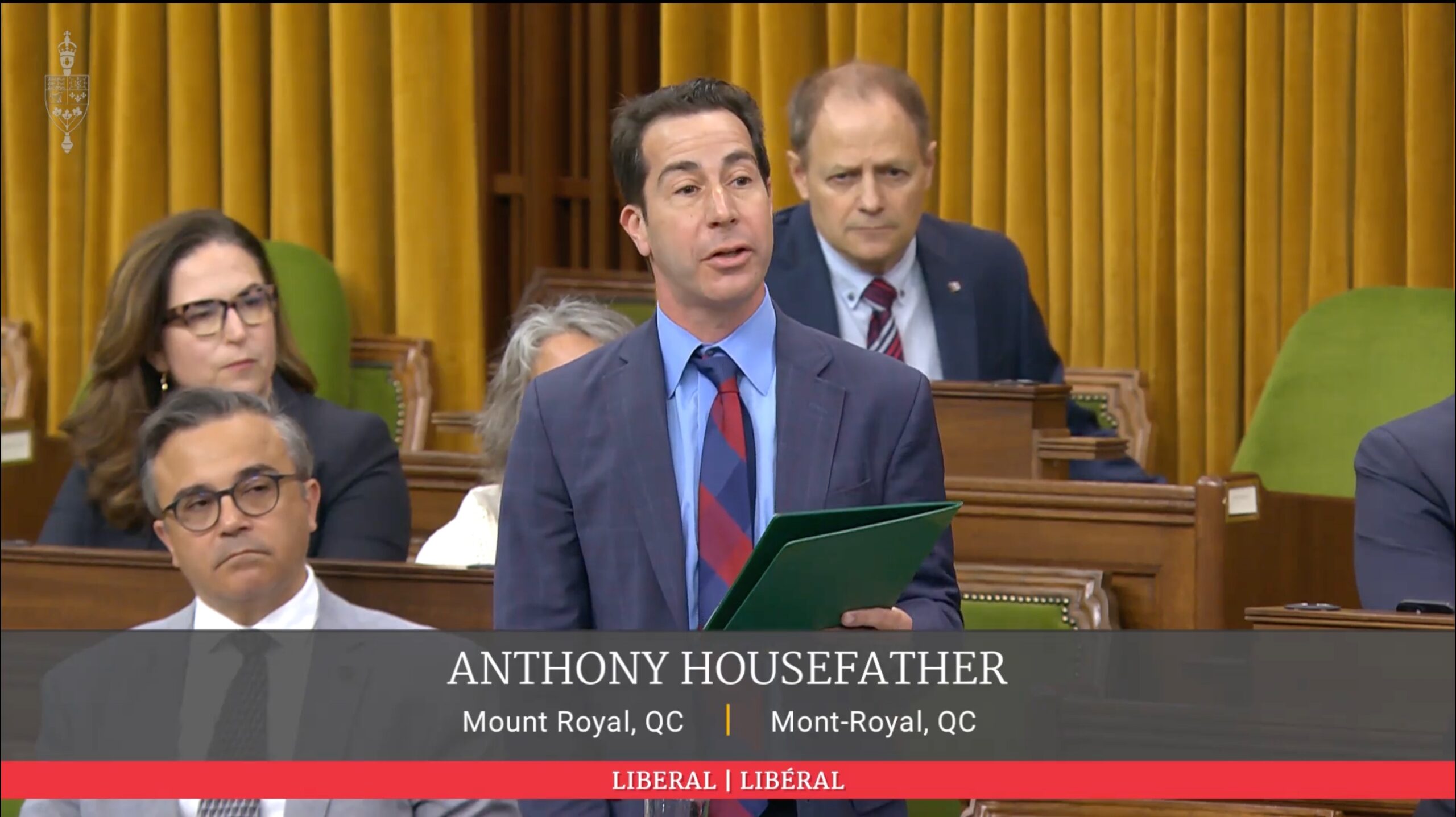
Anthony Housafather, a Jewish Canadian Member of Parliament representing a riding, or electoral district, in Montreal, is skeptical of the notion that the United States would offer Jews better protection.
“I think this idea is inspired by some right-wing Jews who have decided that their mission is to attack the Canadian government, and to make it look like somehow, Donald Trump and the Republicans are the savior of the Jewish people,” Housefather said in an interview.
Trump and Canadian Prime Minister Mark Carney are at a low point in their relationship, with tensions over trade intensifying – and Trump seeks opportunities to take potshots at Carney.
Housefather also does not believe that leaving for the United States is gaining traction among Canadian Jews. “There are some people who have decided that Florida or Israel is a greener pasture,” he said. “But that does not represent a significant or a predominant view, and the idea that everybody’s leaving Canada is actually not true.”
The increase in antisemitism is universal – and should be treated holistically, he said. “What I do agree with is everywhere there’s a very serious problem with antisemitism,” he said. “Everywhere Jewish communities don’t feel safe, and all levels of government need to keep doing more.”
Housefather encourages his Jewish countrymen to remain proud Canadians. “Antisemitism has grown to an unacceptable level in this country,” he said. “It doesn’t mean that you should have less pride in being Canadian because there’s a loud, angry, small group of Canadians trying to make us scared.”
This article originally appeared on JTA.org.
The post If Trump makes good on offering Canadian Jews refugee status, will they come? appeared first on The Forward.
Uncategorized
UK foreign secretary: The threats to Israel don’t justify its treatment of Palestinians
(JTA) — British Foreign Secretary Ed Miliband called Palestinian suffering in Gaza and the West Bank a “stain on the conscience of the world” at the Labour Party’s annual conference in Liverpool, his most blistering attack on Benjamin Netanyahu’s government yet.
His attack comes a number of weeks after he told the British Parliament that his country planned to reset its relationship with Israel and ban trade with its West Bank settlements.
In an initial nod of support to the Jewish state, Miliband, who is Jewish, described how three years ago “Hamas’ murderous attack on Oct. 7th united the vast majority of the world in rightful condemnation.”
The Labour Party, he said, will battle antisemitism and “will always recognise the threats Israel faces and stand emphatically against those who seek its destruction. But this cannot justify the suffering the Netanyahu government has inflicted in Gaza and the West Bank.”
He had a message, Miliband said, for the millions of people who had been moved and outraged by the plight of the Palestinian people: “We hear you. You were right.”
He said the government would call out “ethnic cleansing by the settler terrorists in the West Bank,” the “evidence of war crimes in Gaza” and Israel’s “illegal occupation of Palestine.”
Britain remains committed to a two-state solution to the Israeli-Palestinian conflict, he said, and to helping prevent the destruction of that option.
Miliband repeated his government’s pledge to ban West Bank settlement products and prevent his country’s financial institutions, construction companies and service industry from operating in Israeli-controlled areas beyond the pre-1967 lines.
Laying out the global challenges, he spoke of Iran, Russia, climate change and AI, but he focused on Israel more than on any other issue.
He recalled his Jewish parents’ experiences fleeing and surviving Nazi persecution and finding sanctuary in Britain, “a country that was a beacon of light against the darkness.”
Now, as then, Miliband said, Britain has to confront global challenges by fighting for its values, “the values my parents saw in Britain, values which today are more important than ever.”
His parents did not think it was enough to simply live in a country with values: “They taught me that I have a responsibility to fight for them too,” Miliband said as he spoke of the idea of survivor’s guilt.
“I think my parents had something else. Survivor’s responsibility,” he said, adding that it’s a message passed to the next generation to leave the “world a better place than we found it” by never being “bystanders to oppression and injustice.”
The Palestinian ambassador to Britain, Husam Zomlot, responded to Miliband’s speech on X: “Thank you to the millions of people in Britain and around the world who stood firmly on the side of justice, on the side of Palestine.”
Israel currently has no ambassador posted in the U.K. Tzahi Braverman, Netanyahu’s former chief of staff, was appointed to the post but has been unable to take it up while under criminal investigation for obstruction of justice, fraud and breach of trust and is barred from leaving the country.
Tensions have been rising between London and Jerusalem. Until the Gaza war, Britain had been one of Israel’s staunchest allies. Ties frayed under the former Labour government of Keir Starmer, which last year recognized Palestinian statehood. Relations have been even more strained since Labour Prime Minister Andy Burnham’s new government was sworn into office in July.
In the aftermath of the U.K.’s decision to ban imports of Jewish West Bank settlement products, with France and Canada joining that move, Israel took a number of retaliatory measures. These included closing the British consulate in Jerusalem and removing its representatives from the International Gaza Support Center.
This article originally appeared on JTA.org.
The post UK foreign secretary: The threats to Israel don’t justify its treatment of Palestinians appeared first on The Forward.
Uncategorized
Republican incumbent Rep. Lawler and Democrat Conley spar over antisemitism, Israel in NY debate
(JTA) — Incumbent U.S. House Rep. Mike Lawler, a Republican from New York, faced off against Democrat Cait Conley in a fiery debate on Monday night, sparring over their respective commitments to tackle antisemitism in America.
The friction was immediately palpable when the candidates, who are vying for New York’s hotly contested 17th District seat, one of the most Jewish districts in the country, jousted over everything from military assistance to Israel to the most effective ways to combat religious hatred.
“Israel is our greatest ally in the Middle East,” Lawler said. “They are a beacon of hope and opportunity and freedom and democracy.”
“They have not committed a genocide,” he continued, adding that some of his Democratic colleagues have “wavered in their support” for the country.
Lawler called out New York City Mayor Zohran Mamdani, a Democrat, on his anti-Israel positions, describing him as someone his “opponent says she respects.”
In response, Conley stressed that she is “absolutely disgusted by the rising antisemitism that is happening within both political parties,” describing the phenomenon as “fundamentally un-American.”
She then voiced her support for the bipartisan Jewish American Security Act, legislation that was introduced first as a Senate bill and then as a House companion bill co-led by Lawler.
When Lawler then pressed Conley on whether she denounced not only antisemitism but Mamdani himself, she deflected the question. But he continued to push the matter, noting that he denounced Tucker Carlson and Candace Owens, right-wing personalities who regularly lash out against Israel and who Jewish organizations have said cross the line into antisemitism.
Conley responded by noting her “firm disagreements with members of the DSA,” referring to the Democratic Socialists of America faction that includes Mamdani.
When Lawler reiterated that she had not condemned Mamdani, Conley accused her opponent of failing to denounce President Donald Trump, whom Democrats revile as a bigot, and said he voted “with him 100% of the time” — a claim Lawler decried as “provably false.”
Lawler rattled off multiple bipartisan efforts with Rep. Josh Gottheimer, a Democrat from New Jersey, to advance relevant legislation such as the Antisemitism Awareness Act of 2025.
“Jewish Americans are under attack in this country, and we have a responsibility to stand up and ensure everyone’s safety,” Lawler said. “No one should be in fear of going to synagogue.”
Conley likewise recognized the rising hate against members of the Jewish community, stressing that this hostility has “absolutely no place here in America.”
New York’s 17th Congressional District, the lower Hudson Valley region north of New York City, is home to one of the biggest Jewish populations nationwide, as noted by News 12 debate moderator Tara Rosenblum.
“There are few places in the country where the conflict in the Middle East hits closer to home,” Rosenblum said.
More than one in five voters in the district, which includes all of Rockland and Putnam counties, as well as parts of Westchester and Dutchess, are Jewish, according to Rosenblum. She also noted, however, that there are growing Muslim communities across the Hudson Valley.
Asked whether there were any circumstances under which they would vote to withhold those funds, the candidates both voiced their support of Israel.
Conley, an Army veteran who served multiple combat tours in the Middle East, emphasized both Israel’s “right to exist” and the importance of ensuring “the safety and security of the people of Israel.”
“I also criticize Netanyahu when I believe he’s doing the wrong thing for Israel and for America,” she added.
Conley stressed that like her opponent, she would have voted against a House amendment that sought to cut $3.3 billion in annual aid to Israel. The amendment, authored by Republican Rep. Thomas Massie of Kentucky, would have “stripped assistance packages and other forms of reconstruction,” Conley argued.
Lawler, meanwhile, described U.S. assistance to Israel as “in our interest, especially with respect to our military personnel in the region.” He noted not only the significant number of bases in the Middle East, but also the 700,000 Americans living in Israel.
Both candidates agreed that Israel’s actions in Gaza do not constitute a genocide and that U.S. recognition of a Palestinian state should be conditioned on the disarmament of Hamas. Where they differed was on the expansion of West Bank settlements. Conley opposed such growth, while Lawler said that Israel is operating within its legal authority.
This article originally appeared on JTA.org.
The post Republican incumbent Rep. Lawler and Democrat Conley spar over antisemitism, Israel in NY debate appeared first on The Forward.
