


Uncategorized
Lively Yiddish Forward columnist Miriam Hoffman has died
The Yiddish writer, Forverts columnist, playwright and Yiddish lecturer Miriam Hoffman passed away July 29 in Coral Springs, Florida. She was 90 years old.
Hoffman was a talented storyteller, as seen in the 2017 Forverts video about her, one of ten episodes in its documentary series, Yiddish Writers Monologues. In the 55-minute clip, she describes in dramatic detail her family’s journey from Siberia to a forced labor camp to a displaced persons camp and finally, to New York. The video is in Yiddish with English subtitles.
In a book, also published in 2017, A Breed Apart: A Miraculous Escape from Russia, she tells her life story again, this time in English.
For many years, Hoffman penned a lively column for the Forverts, where she commented, often with biting humor, on certain character types in Jewish society she disapproved of — like American-born Jews snubbing their noses at fellow Jews who had recently arrived from Europe, something she experienced first-hand.
She also wrote about the blatant sexism she encountered in the 1960s and ’70s among the leadership of Yiddish organizations like the Workmen’s Circle and the Congress for Jewish Culture.
But other essays had a serious, softer voice, like the one she told about her decision as a young teen to suddenly cut off her curly locks in order to look more “American” — and how her mother reacted to her daughter’s “rebellion.”
She also hosted a popular Yiddish radio program on the Forward station WEVD.
Hoffman loved the Yiddish theater and began writing plays herself. She and fellow playwright Rena Borow wrote the book for the musical, Songs of Paradise, based on the biblical poetry of Yiddish troubadour Itzik Manger. The show ran at NYC’s Public Theater and the Shakespeare Festival in 1989, drawing a rave review from The New York Times. Her plays were also staged in Montreal and in several European countries.
For 23 years, Hoffman was a popular Yiddish lecturer at Columbia University. In 2011, she published a Yiddish textbook, Key to Yiddish, that included not only lessons in grammar, but also passages on Eastern European Jewish history, customs, songs and holiday content.
I was personally most impressed with her dogged determination to preserve Yiddish as a spoken language with younger generations. In the 1960s, while teaching at the Sholem Aleichem Shul 21, an afternoon Yiddish school in the Bronx, she and three fellow Yiddish cultural activists — educator Gella Schweid Fishman, pianist-composer Malka Gottlieb and artist Tsirl Waletzky — published a series of Yiddish children’s books through a publishing house they created themselves, called Oyfgang (Sunrise).
As Hoffman and Schweid Fishman told me years later, the mood in the Yiddish world then was so pessimistic, and the attitude towards women so dismissive, that none of the Yiddish cultural organizations — including the Workers Circle and the Congress for Jewish Culture — showed any interest in publishing the books.
But Hoffman and her colleagues didn’t give up. An example of this concerned a musical Purim play they wrote and published in 1968, “Purim iz a shpil aza” (“Purim is a time to play”). On the book cover it gives the male name Gavriel Tolyes as the author. But this was a pseudonym; the real author was Hoffman.
“We understood that no one would take our book seriously if they found out that four women published it,” Hoffman told me. “So we took my mother’s name Tolye, and came up with the name Gavriel Tolyes.”
Years later, Hoffman translated the Purim play into English where it was performed and made into a video. This time, the author’s name was her own.
Hoffman was born Miriam Shmulevitsh in Tobolsk, Siberia in 1936. In 1950, her family immigrated to the United States where she studied Yiddish pedagogy at the Jewish Teachers Seminary until 1957. Years later, she finished her bachelor’s at the University of Miami and received a master’s from Columbia University in 1983.
During the 1970s she and her husband Mendl and two young sons, Avrom (Avi) and Binyomin, lived in Israel for several years where she hosted the first Yiddish television program in the Jewish state, together with the popular comedian Shimon Dzigan.
Hoffman often said that one of her main goals in life was to help instill Jewish pride among Jews of all ages in order to stem the tide of assimilation. In 2015 she, along with her son — the renowned Yiddish actor, director and producer, Avi Hoffman — launched the Yiddishkayt Initiative, an organization dedicated to bringing Jews back to their roots through lectures and performances that portray Jewish values and cultural traditions. For Hoffman, this was exactly what she had been waiting for.
Miriam Hoffman is survived by her two sons, Avi and Benjamin, four grandchildren and one great-grandchild.
The post Lively Yiddish Forward columnist Miriam Hoffman has died appeared first on The Forward.
Uncategorized
If Trump makes good on offering Canadian Jews refugee status, will they come?
(JTA) — TORONTO –- Sari Watson was too afraid to attend Yom Kippur services. Concerned by rising levels of antisemitism in Canada, she was safely at home 25 minutes away when a gunman charged at her childhood synagogue.
“My internal alarm has been going off, and you begin to think about escape routes or backup plans,” said Watson, 39, who lives in Quinte West, Ontario, about 15 miles west of Belleville, where the attack during Kol Nidre on Sept. 20 culminated in a shootout that left the gunman dead and one policeman hospitalized. “The only reason I wasn’t at synagogue was because I have been terrified of this exact situation, or worse, happening.”
Florida Sen. Rick Scott, Oklahoma Gov. Kevin Stitt and President Donald Trump himself, all Republicans, have proposed extending refugee status to Canadian Jews who fear the spike in antisemitism in their country.
“’It’s so amazing to know that the Republicans understand the level of antisemitism we’re dealing with here,” she says. “President Trump gets the climate and the danger.”
Still, Watson has mixed emotions about the thought of leaving her home country. “I want to stay here and fight for our safety in Canada,” she said. “The option to come to the U.S. is really important, but we shouldn’t have to need it.”
The Trump administration has imposed stringent restrictions on immigration and is carrying out mass deportations, but is inviting South African whites – and now, potentially, Canadian Jews – refugee status. Critics accuse Trump of playing politics with refugee status, but some Canadian Jews see it as a lifeline.
Talk of Jews feeling compelled to leave Canada gained momentum last week when a well-known Jewish journalist posted publicly on social media about getting a foreign passport. Neil Herland, a newsreader for the national broadcaster, the CBC, wrote on X about his encounter with pro-Palestinian protesters outside Toronto’s Meridian Arts Centre, where Yom Kippur services were being held. Herland said that, concerned about rising antisemitism in Canada, he recently acquired his Austrian passport as a safety precaution. (Independent Press Gallery, a press freedom advocacy group, condemned the CBCfor reportedly suspending Herland after pro-Palestinian advocates lodged a complaint about his post.)
Some Jews are past the precaution stage. Sheldon Shugal, 64, and his wife are currently researching how to move to the United States.
“If I were able to claim refugee status to come to the U.S., I’d do it without hesitation,” said Shugal, who lives in Calgary. “I used to love our country … but it’s just not a place that I want to continue to live in.”
Shugal, a property manager, said he has seen increased antisemitism in Canada in the wake of the deadly Hamas raid in Israel on Oct. 7, 2023, and the war it launched. He said he and his wife have been struggling to overcome the complexity of acquiring an American visa.
“The Jew-hatred is no longer rising in Canada, it’s fully immersed here,” says Shugal. “It’s not the country I grew up in. I don’t feel affinity to Canada anymore.”
Shugal’s concerns are reflected in the findings of B’nai Brith Canada, which recently reported a 9.3% increase in antisemitic incidents from 2024-2025. According to this report, online harassment has surged dramatically, while Ontario saw the greatest total number of antisemitic incidents out of all the Canadian provinces and territories.
Antisemitic attacks have proliferated. In March of this year, Toronto synagogue Temple Emanu-El was shot at following Purim celebrations. The next week, two more Toronto synagogues were hit with gunfire over Shabbat, causing damage to the buildings, though no injuries were reported. In late April, assailants allegedly fired replica guns at “visually-identifiable” members of the city’s Jewish community, with one of the men sustaining minor injuries.
Shugal said reports of antisemitism have rattled him as well as the pro-Palestinian encampment his daughter encountered on her campus. “There hasn’t necessarily been anything I’ve personally experienced. It’s just what I’ve seen throughout the country,” Shugal said.
Lauren Cohen, an immigration lawyer based in Boca Raton, Florida, said that since the Oct. 7 attacks, about half of her Canadian clients cite antisemitism as a primary reason for wanting to leave Canada for the United States.
“In the past three months, I’ve noticed a very significant increase in the number of people between 55-70 who are contacting me,” said Cohen, who is originally from Toronto. “They have grown children or no children, and they have a little bit more money,” she said. “They want freedom.”
Antisemitism is not the only consideration for her clients, Cohen said. “The economy’s struggling. It’s not just antisemitism,” she said. “That might be the straw that broke the camel’s back, but it’s so many other factors as well.”
Cohen founded the Jewish Community Collective, an organization which helps Jewish Canadians and “displaced Jews” find connection in America. Another option for Jewish Canadians looking to make a new home in the States is Lech L’Tulsa, a program cosponsored by the Jewish Federation of Tulsa that helps settle Jewish newcomers, “designed to help Jewish Canadian citizens relocate to Tulsa.”
Some Canadian Jews do not see greener grass south of the 49th parallel, however. They point to Canada’s more expansive social safety net as one of the many reasons life in the Great White North” is better.. “Unquestionably, the answer to whether I’d consider moving to the States is emphatically ‘no,’” said Lawrence Stanleigh, a dentist in Calgary.
“I believe our country is a better place to live,” said Stanleigh, 67. “The U.S. doesn’t have a public healthcare system. Why would I want to leave our safety net for the U.S.?”
Stanleigh said the idea that the United States is a safe haven for Canadian Jews is misleading. “As bad as things are in Canada, I think they’re worse in the United States,” he said. “It’s not a better place for education or for healthcare. The whole idea of moving there for our safety is a fantasy that the Republicans believe in.”
Substituting the United States for Canada is shortsighted, Stanleigh said. “There are failures on behalf of Canadian leaders to stand firm in their support of the Jewish community,” he said. “But as bad as things are, I think they’re worse in the States. Our American cousins are blithely unaware of the problems they have at home.”
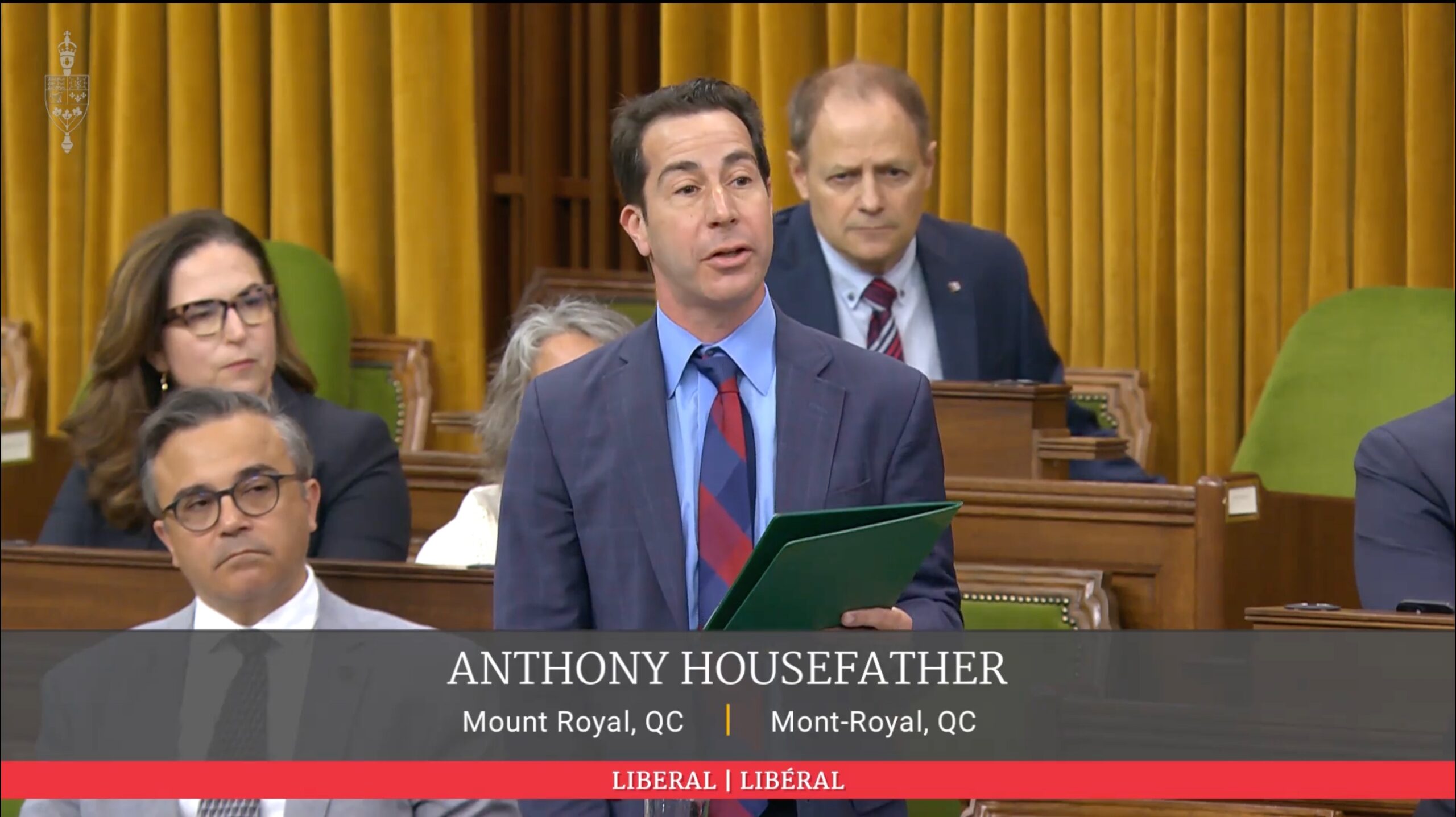
Anthony Housafather, a Jewish Canadian Member of Parliament representing a riding, or electoral district, in Montreal, is skeptical of the notion that the United States would offer Jews better protection.
“I think this idea is inspired by some right-wing Jews who have decided that their mission is to attack the Canadian government, and to make it look like somehow, Donald Trump and the Republicans are the savior of the Jewish people,” Housefather said in an interview.
Trump and Canadian Prime Minister Mark Carney are at a low point in their relationship, with tensions over trade intensifying – and Trump seeks opportunities to take potshots at Carney.
Housefather also does not believe that leaving for the United States is gaining traction among Canadian Jews. “There are some people who have decided that Florida or Israel is a greener pasture,” he said. “But that does not represent a significant or a predominant view, and the idea that everybody’s leaving Canada is actually not true.”
The increase in antisemitism is universal – and should be treated holistically, he said. “What I do agree with is everywhere there’s a very serious problem with antisemitism,” he said. “Everywhere Jewish communities don’t feel safe, and all levels of government need to keep doing more.”
Housefather encourages his Jewish countrymen to remain proud Canadians. “Antisemitism has grown to an unacceptable level in this country,” he said. “It doesn’t mean that you should have less pride in being Canadian because there’s a loud, angry, small group of Canadians trying to make us scared.”
This article originally appeared on JTA.org.
The post If Trump makes good on offering Canadian Jews refugee status, will they come? appeared first on The Forward.
Uncategorized
UK foreign secretary: The threats to Israel don’t justify its treatment of Palestinians
(JTA) — British Foreign Secretary Ed Miliband called Palestinian suffering in Gaza and the West Bank a “stain on the conscience of the world” at the Labour Party’s annual conference in Liverpool, his most blistering attack on Benjamin Netanyahu’s government yet.
His attack comes a number of weeks after he told the British Parliament that his country planned to reset its relationship with Israel and ban trade with its West Bank settlements.
In an initial nod of support to the Jewish state, Miliband, who is Jewish, described how three years ago “Hamas’ murderous attack on Oct. 7th united the vast majority of the world in rightful condemnation.”
The Labour Party, he said, will battle antisemitism and “will always recognise the threats Israel faces and stand emphatically against those who seek its destruction. But this cannot justify the suffering the Netanyahu government has inflicted in Gaza and the West Bank.”
He had a message, Miliband said, for the millions of people who had been moved and outraged by the plight of the Palestinian people: “We hear you. You were right.”
He said the government would call out “ethnic cleansing by the settler terrorists in the West Bank,” the “evidence of war crimes in Gaza” and Israel’s “illegal occupation of Palestine.”
Britain remains committed to a two-state solution to the Israeli-Palestinian conflict, he said, and to helping prevent the destruction of that option.
Miliband repeated his government’s pledge to ban West Bank settlement products and prevent his country’s financial institutions, construction companies and service industry from operating in Israeli-controlled areas beyond the pre-1967 lines.
Laying out the global challenges, he spoke of Iran, Russia, climate change and AI, but he focused on Israel more than on any other issue.
He recalled his Jewish parents’ experiences fleeing and surviving Nazi persecution and finding sanctuary in Britain, “a country that was a beacon of light against the darkness.”
Now, as then, Miliband said, Britain has to confront global challenges by fighting for its values, “the values my parents saw in Britain, values which today are more important than ever.”
His parents did not think it was enough to simply live in a country with values: “They taught me that I have a responsibility to fight for them too,” Miliband said as he spoke of the idea of survivor’s guilt.
“I think my parents had something else. Survivor’s responsibility,” he said, adding that it’s a message passed to the next generation to leave the “world a better place than we found it” by never being “bystanders to oppression and injustice.”
The Palestinian ambassador to Britain, Husam Zomlot, responded to Miliband’s speech on X: “Thank you to the millions of people in Britain and around the world who stood firmly on the side of justice, on the side of Palestine.”
Israel currently has no ambassador posted in the U.K. Tzahi Braverman, Netanyahu’s former chief of staff, was appointed to the post but has been unable to take it up while under criminal investigation for obstruction of justice, fraud and breach of trust and is barred from leaving the country.
Tensions have been rising between London and Jerusalem. Until the Gaza war, Britain had been one of Israel’s staunchest allies. Ties frayed under the former Labour government of Keir Starmer, which last year recognized Palestinian statehood. Relations have been even more strained since Labour Prime Minister Andy Burnham’s new government was sworn into office in July.
In the aftermath of the U.K.’s decision to ban imports of Jewish West Bank settlement products, with France and Canada joining that move, Israel took a number of retaliatory measures. These included closing the British consulate in Jerusalem and removing its representatives from the International Gaza Support Center.
This article originally appeared on JTA.org.
The post UK foreign secretary: The threats to Israel don’t justify its treatment of Palestinians appeared first on The Forward.
Uncategorized
Republican incumbent Rep. Lawler and Democrat Conley spar over antisemitism, Israel in NY debate
(JTA) — Incumbent U.S. House Rep. Mike Lawler, a Republican from New York, faced off against Democrat Cait Conley in a fiery debate on Monday night, sparring over their respective commitments to tackle antisemitism in America.
The friction was immediately palpable when the candidates, who are vying for New York’s hotly contested 17th District seat, one of the most Jewish districts in the country, jousted over everything from military assistance to Israel to the most effective ways to combat religious hatred.
“Israel is our greatest ally in the Middle East,” Lawler said. “They are a beacon of hope and opportunity and freedom and democracy.”
“They have not committed a genocide,” he continued, adding that some of his Democratic colleagues have “wavered in their support” for the country.
Lawler called out New York City Mayor Zohran Mamdani, a Democrat, on his anti-Israel positions, describing him as someone his “opponent says she respects.”
In response, Conley stressed that she is “absolutely disgusted by the rising antisemitism that is happening within both political parties,” describing the phenomenon as “fundamentally un-American.”
She then voiced her support for the bipartisan Jewish American Security Act, legislation that was introduced first as a Senate bill and then as a House companion bill co-led by Lawler.
When Lawler then pressed Conley on whether she denounced not only antisemitism but Mamdani himself, she deflected the question. But he continued to push the matter, noting that he denounced Tucker Carlson and Candace Owens, right-wing personalities who regularly lash out against Israel and who Jewish organizations have said cross the line into antisemitism.
Conley responded by noting her “firm disagreements with members of the DSA,” referring to the Democratic Socialists of America faction that includes Mamdani.
When Lawler reiterated that she had not condemned Mamdani, Conley accused her opponent of failing to denounce President Donald Trump, whom Democrats revile as a bigot, and said he voted “with him 100% of the time” — a claim Lawler decried as “provably false.”
Lawler rattled off multiple bipartisan efforts with Rep. Josh Gottheimer, a Democrat from New Jersey, to advance relevant legislation such as the Antisemitism Awareness Act of 2025.
“Jewish Americans are under attack in this country, and we have a responsibility to stand up and ensure everyone’s safety,” Lawler said. “No one should be in fear of going to synagogue.”
Conley likewise recognized the rising hate against members of the Jewish community, stressing that this hostility has “absolutely no place here in America.”
New York’s 17th Congressional District, the lower Hudson Valley region north of New York City, is home to one of the biggest Jewish populations nationwide, as noted by News 12 debate moderator Tara Rosenblum.
“There are few places in the country where the conflict in the Middle East hits closer to home,” Rosenblum said.
More than one in five voters in the district, which includes all of Rockland and Putnam counties, as well as parts of Westchester and Dutchess, are Jewish, according to Rosenblum. She also noted, however, that there are growing Muslim communities across the Hudson Valley.
Asked whether there were any circumstances under which they would vote to withhold those funds, the candidates both voiced their support of Israel.
Conley, an Army veteran who served multiple combat tours in the Middle East, emphasized both Israel’s “right to exist” and the importance of ensuring “the safety and security of the people of Israel.”
“I also criticize Netanyahu when I believe he’s doing the wrong thing for Israel and for America,” she added.
Conley stressed that like her opponent, she would have voted against a House amendment that sought to cut $3.3 billion in annual aid to Israel. The amendment, authored by Republican Rep. Thomas Massie of Kentucky, would have “stripped assistance packages and other forms of reconstruction,” Conley argued.
Lawler, meanwhile, described U.S. assistance to Israel as “in our interest, especially with respect to our military personnel in the region.” He noted not only the significant number of bases in the Middle East, but also the 700,000 Americans living in Israel.
Both candidates agreed that Israel’s actions in Gaza do not constitute a genocide and that U.S. recognition of a Palestinian state should be conditioned on the disarmament of Hamas. Where they differed was on the expansion of West Bank settlements. Conley opposed such growth, while Lawler said that Israel is operating within its legal authority.
This article originally appeared on JTA.org.
The post Republican incumbent Rep. Lawler and Democrat Conley spar over antisemitism, Israel in NY debate appeared first on The Forward.
