


Uncategorized
Orthodox Jews are scootering to synagogue. Will Shabbat ever be the same?
LOS ANGELES – For thousands of years, the Jews have walked. Dispatched by God to the promised land of Canaan, Abraham walked. When the Israelites became a nation in the desert, they camped, kvetched, warred, and worshiped, but mostly walked. And on Shabbat — when the Torah forbids riding horses, carriages, trains or cars — observant Jews have traditionally walked.
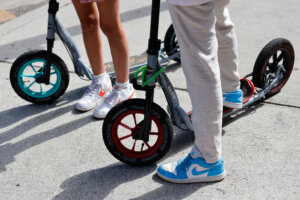
But when Ilana Jurkowitz and her two kids went to prayer services one recent Saturday morning, they did not walk. Nor, as Shabbat-observant Jews, did they drive. Instead, the trio made the mile-and-a-half trek to their Beverly Hills synagogue using a decidedly non-Biblical form of transportation: scooters.
They’re not alone. On Shabbat, the two-wheel, non-electric scooters — the kind you kick off to propel and brake by stepping on the back wheel — have in recent years become ubiquitous in Orthodox communities from LA to Miami Beach to the Five Towns. Kids and parents ride them to and from shul, tzitzit fringes flying in the wind, then to meals or playdates afterward. On long Saturday afternoons, Jewish teens cruise the streets on scooters like their California ancestors once did in classic cars.
Walking, it seems, has gone out of fashion, supplanted by what was once mainly a children’s toy. Sorry, Walter: These Jews do roll on Shabbos.
“We saw other people scooting and thought, OK, we need to start,” Jurkowitz said. “It makes it so much easier.”
For the Jurkowitz family, scooters cut what would be a 35-minute walk almost in half. Journeys the family wouldn’t dare take on foot — like the two-plus mile jaunt to Ilana’s parents — become manageable. “It extends the radius of the community,” she told me. For her kids, the scooters also signified maturity and taste. Seven-year-old Shylee Jurkowitz recounted her graduation from a three-wheel mini-scooter to the two-wheel model; Winston, 10, rocked a Transformers-themed helmet. Ilana, also wearing headgear, carried in a tote bag the straw hat she would wear in shul, and four-inch heels.
In Los Angeles, where electric scooters help residents and tourists alike navigate traffic congestion, the ascendance of kick scooters in Orthodox areas highlights the intersection of religious practice and 21st-century urban geography. As the Shabbat-observant population has surged — Orthodoxy being the fastest-growing Jewish denomination in the U.S. — neighborhoods like Pico-Robertson, where the Jurkowitzes live, have stretched the limits of walking distance. Factor in the heat and Shabbat formal attire, and long walks become a brutal proposition.
There’s just one catch. For all their analog simplicity — they contain no motor, battery, chains or gears — it’s not really clear whether scooters are a kosher Shabbat activity. I grew up in Pico-Robertson in the early aughts, when Razor scooters were a fad; I rode mine so much its orange foam handles turned auburn. But I distinctly remember my Modern Orthodox rabbi advising me that on Shabbat, I should leave my wheels at home — scootering, he said, was against the spirit of the Jewish day of rest. So what happened with everyone else?
Each Shabbat for the last several months, I’ve been putting that question to friends and strangers scootering on the streets of Pico-Robertson. The people I’ve spoken to — at least 30, including respondents to a survey I taped up on street corners — described a trend that speaks to climate and real estate, adolescence and parenting, gender and style, and ultimately the meaning of Shabbat itself.
Eventually I heard enough hype about scooters that I ordered one on Amazon; when the Jurkowitzes went to shul, I was rolling along with them.

Micromobility comes to the shtetl
As the Jurkowitz kids raced ahead, Ilana told me how they wound up living so far from shul.
Before they moved into their current home a little more than a decade ago, she and her husband Nick were living about a half-mile east of their synagogue, Beth Jacob Congregation. But with plans to grow their family, they were lured south by cheaper real estate. The Jurkowitzes’ block today would be considered the outskirts of Pico-Robertson; twenty years ago it might as well have been San Diego.
Initially, they walked, pushing their oldest in a stroller. “And then it just, you know, took a lot longer to get there,” Jurkowitz said. Putting the kids on scooters, she quickly learned, meant they could leave the stroller at home.
Shylee and Winston waited at the end of the block for us to catch up. There’d been some skinned knees and bloody elbows over the years, Ilana said, but nothing dramatic. (Other kids I spoke to weren’t so lucky — one teenager told me he’d broken his arm when his scooter plunged into a crack in the sidewalk and threw him off.)
Greater Los Angeles contains several Orthodox neighborhoods, of which Pico-Robertson is the largest. But since the early 2000s, the majority of them are bound by a single eruv, which is the ritual enclosure that allows observant Jews to bypass the prohibition of carrying objects in public on Shabbat. The ludicrously capacious LA eruv — bound by the 405, 10 and 101 freeways, it covers an area roughly the size of Washington, D.C. — allows people to scooter not merely between home and shul, but from one Jewish neighborhood to another.
One man I spoke to planned to scooter four miles that night from Pico-Robertson to his house in Hancock Park, an Orthodox neighborhood colloquially referred to by Pico’s Jews as “the other side of town.” Another rode to Pico from Chabad of Mount Olympus — a distance of more than five miles. The eruv meant these journeys have long been possible on Shabbat. But the scooters are making them almost routine, and in turn, challenging the paradigm of Orthodox community. Having to walk to synagogue on Shabbat has kept Jews living in close proximity for centuries; with a scooter, Orthodox Angelenos really can live anywhere in a 67-square-mile area.

For now, those crosstown treks — facilitated by dry weather, wide residential streets and the generally flat LA basin — represent the extreme in trip length. But they underscore the appeal of intra-community scoots like the Jurkowitzes’. Property values around the neighborhood’s edges have nearly doubled in the past decade, reflecting the increased demand from Orthodox families priced out of the core. Scooters don’t just help people get to synagogue faster; in some cases — especially families with kids — they are the difference between getting there at all or just staying home.
Of course, people do more than pray on Shabbat, and the turn to scooters had as many social motivations as religious ones. For older kids, having a scooter was the first whiff of independence, a status symbol that made you both taller and faster than your peers. And for younger adults, it was an antidote to Saturday doldrums.
Motti Zuker and Joshua Engelson, Orthodox millennials who I met up with one recent Saturday night, use their scooters less to pray than to meet friends and make afternoon plans. “If I was married and had a family, I wouldn’t,” Engelson told me. But as an older single, he said, “I need to move around places.” In other words, he’s shmooze-maxxing.
Though Shabbat-observant themselves, he and Zuker sometimes attend Jewish Friday night functions where most of the other guests drove. Self-conscious of their garishly unsexy devices — Engelson called it “social suicide” to be caught with one at his age — the two have turned their foldable off-brand scooters into a kind of ironic shtick.
“My go-to thing when I introduce myself is I’ll say, ‘Yeah, it’s the vintage model,’” Zuker said with a grin. He’d used that line on me a few days earlier, when I flagged him down on my walk home from Friday night dinner.

Pumping the brakes
So many yidden breeze by you on scooters in Pico-Robertson that it can be easy to forget how many people object to them. What reminded me was the experience of riding one myself. After services ended at Beth Jacob, I grabbed my ride from a rack in the alley behind the shul and kicked off toward my usual religious haunts. As I hurtled past my coreligionists on the sidewalk, it seemed they were looking at me with a mix of bemusement and contempt. My “Good Shabbos” greetings went ignored.
There is nothing in the Torah that overtly forbids riding a scooter on Shabbat. Instead, scooters fall into the gray area of Shabbat prohibition known as uvda d’chol, or “weekday activity.” Uvda d’chol encompasses activities not explicitly prohibited on Shabbat but which are discouraged — as my rabbi did 25 years ago — because they undercut the notion of the Jewish day of rest. The Talmud specifies modes of transportation as an example: The way one gets around on Shabbat, it instructs, should not be the same as how one travels during the week. (The Shulchan Aruch, a 16th-century legal compendium, forbids running on this basis.)
A scan of Orthodox commentary in the last five years seems to reflect consensus that scootering on Shabbat is improper for this reason. An article on the website of the Orthodox Union, the organization to which most Modern Orthodox synagogues belong, and various lectures about scooters on Orthodox learning library YUTorah, declare scootering uvda d’chol.
But uvda d’chol is an evolving designation, determined not by mere rabbinic mandate but also by community habit. And something unusual occurs in the sources discussing scooters: The rabbis tend to concede it’s happening anyway. Rabbi Aryeh Lebowitz, a rosh yeshiva (senior rabbinic scholar) at Yeshiva University who leads a synagogue in Long Island, said in a lecture last year that he once forbade his son from scootering places on Shabbat, a stringency not abided by the boy’s friends.
“But then the yeshivish community moved in, and they’re all on scooters,” said Lebowitz, referring to a more strictly religious crowd. “The adults are on scooters. So now, people in my shul say, ‘How do I tell my kids not to?’”
According to at least one halachic authority, however, kids are in the clear. Rabbi Yosef Zvi Rimon, an influential Orthodox legal scholar based in Israel, permits children scootering on Shabbat because it is a leisure activity, rather than a form of transportation. And he says that in communities where families live far from their synagogue, adults, too, should not be prohibited from scootering to get there — just as the Shulchan Aruch grants an exception for adults to run to shul, because it facilitates the mitzvah of prayer.
In any event, most riders I spoke to weren’t considering it a gray area at all. To Ilana Jurkowitz, scootering wasn’t a thing she did during the week — so how could it be considered a weekday activity? The upsides, on the other hand, were obvious: They made shul more accessible to the whole family, deepened friendships, and enabled her kids to spend more time with their grandparents.

She had not seen a need to consult her rabbi, she said, because so many other families at her shul were doing it first.
“I’ve just looked at the community and seen it as an adopted mode of transportation, and so kind of went with that,” Jurkowitz said. “I guess I felt like if there was an issue with scooting on Shabbat, knowing that so many do it, that the rabbis would address it.”
At least one Pico-Robertson rabbi had tried to ban scooters from his shul. In an interview, he compared their appeal to that of cars in the Conservative movement, which in 1950 permitted driving on Shabbat only for the purpose of getting to services. “Ultimately, it was exactly this — that, ‘Well, people are living far away, so they have to come on Shabbos,’” said the rabbi, who asked to remain anonymous. “Then people kept going further away, and then the whole community, the sense of community faded.”
Others I spoke to shared his sentiment, but few were willing to say so publicly; two local pulpit rabbis I reached out to for this piece declined to speak at all about the topic.
The rabbi who banned the devices empathized with those colleagues. A rabbi’s imperative, he noted, is to set rules his congregation can follow. Taking a position against an activity that is already accepted community practice may only serve to undercut their authority on everything else.
“The reality of the situation regarding scooters,” he said, “is that it’s not where they want to make their battles.”
Day of leisure or day of rest?
There’s an adage in the Talmud that a man is blessed for every step he takes to reach his synagogue — the longer the walk, the greater the reward. But the heavenly incentives, it turned out, shrank in the glare of Los Angeles sun.
Scooter riders cited fatigue, the heat and time commitment as the main reasons they didn’t want to walk. The first two factors went together; Los Angeles now experiences roughly nine to ten more days per year when temperatures hit 90°F or higher compared to two decades ago. In the parts of Pico-Robertson where the Orthodox community has expanded more recently, shade is in short supply.
But people’s resentment of time wasted on foot may say as much about modern social anxieties as it does about the built environment. Whether shul-hopping singles or families of five, people wanted to squeeze more out of the day of rest.

When I was flitting around town on my blue Razor, my Shabbat itinerary became more ambitious. I timed myself riding from Beth Jacob to another synagogue, then headed to lunch on the eastern edge of Pico-Robertson. From there I swung over to my folks’ for dessert, then kick-pushed another 1.4 miles back southeast to my apartment. By nightfall, and without ever leaving Pico-Robertson, I had scootered just under seven miles. I am confident I have never walked that much on one Shabbat; realizing that, I wondered whether that was a sign I had altered something essential about it.
Wisely, I did not reach out to my childhood rabbi until after I completed my experiment; Rabbi Yosef Kanefsky, who today holds the same position as senior rabbi of B’nai David-Judea, had not changed his stance on scooters since I first sought his counsel some 25 years ago. “I’m glad that I’m consistent,” he said when I shared the memory.
Kanefsky, who recently relayed Rimon’s teachings to congregants, said that enabling more children and parents to get to shul was an important consideration in permitting scooters. But he still wasn’t entirely comfortable with the activity more broadly. He recalled the instruction Moses gives the Israelites not to collect manna on Shabbat. “Shvu ish tachtav,” Moses tells them: Stay put.
“Filling our day with busyness, that’s what the other six days are for,” Kanefsky said in an interview. “We fill our schedule with busyness, and Shabbat is intended to be a day of non-busyness. ‘I got places to go. I got things to do. I can’t stay here too long’ — that’s really what we’re supposed to take a break from.”
Perhaps the best case to be made against scootering, then, is not that it feels like a weekday activity; it’s that walking — even or especially a distance you’d rather drive — feels like a Shabbat activity.
But the debate around scooters isn’t just about scooters. The deeper matter, Kanefsky said, is that as technology has become more advanced, more and more things we would intuitively consider Shabbat-violating actually fall into uvda d’chol rather than clear Biblical prohibitions. Lighting a candle on Shabbat is Biblically prohibited, but turning on an LED light? That’s probably uvda d’chol. Same goes for a smartphone, getting in a short-distance Waymo or talking to Alexa.
This is not to say that permitting scooters on Shabbat means allowing Snapchat, too. But scooters do expose an unavoidable fact about Shabbat in the 21st century and beyond: It will ultimately reflect how communities define uvda d’chol for themselves.

“We need this category, desperately,” Kanefsky said. “If we have the opportunity to be a little more conservative with this category — literally to conserve it — I think that’s in our interest. Because — well, just imagine a Shabbat in which everyone’s phone is on, everyone’s computer is on, and everyone’s taking their EV to shul. That’s the future if uvda d’chol disappears as a category altogether.”
Until then, the scooters roll on. The last person I interviewed for this story was the kid who broke his arm — 14-year-old Natan Wintner, a rising high school freshman. Wintner rounds up what he called “a little Jewish scooter gang” most Shabbat afternoons — five to ten guys bouncing from house to house to pass the time. Girls did this too in their own groups, Wintner said; for him it was “having our bro time.”
Wintner’s dad grew up on the other side of town, back when scootering on Shabbat was a clear no-go. But in a sign of the changing times, Natan got his first scooter when he was 5 and — save for the broken arm a few years ago — has been riding it ever since.
He expects to grow out of the Razor someday. “I do view it as somewhat childish,” he said. But when he sees parents scootering with their kids, he begins to imagine an older version of himself grabbing the handlebars again.
“I think I speak for most kids when I say that walking isn’t really fun,” he said. “Just being able to push yourself off a scooter and give yourself a little less to do, it really makes a big difference for kids. And it’s just more fun, you know? You get to gain speed.”
The post Orthodox Jews are scootering to synagogue. Will Shabbat ever be the same? appeared first on The Forward.
Uncategorized
‘Remember 7.10.23’: In Israel, Hostage Square bears few remnants of a national crisis – but trauma lingers
(JTA) — TEL AVIV – In the days following the Oct. 7, 2023, Hamas attacks, the families of the hostages held in Gaza turned the plaza next to the Tel Aviv Museum of Art into what became known as Hostage Square.
Filled with “Bring Them Home” signs and hostage posters, yellow ribbons and yellow balloons, the square hosted demonstrations and press conferences.
It was here that the families created a replica of a Hamas tunnel and established the Empty Shabbat Table, a haunting art installation to remind visitors – and especially the Israeli government – that their loved ones still languished in Gaza. And it was here, two years later, that the families and thousands of other Israelis gathered to watch the last of the living hostages return to Israel.
Three years after the attack on Simchat Torah, there are few remnants of the hostage families’ encampment: the tunnel replica, a few yellow ribbons and a sign bearing the words “Remember 7.10.23.” During the days leading up to the third anniversary, some paid respects to the few hostage families who set up a sukkah on the square, but the plaza was nearly empty.
By all outward appearances, Israelis have moved on.
Yet beneath the surface, many are still grappling with the trauma of Oct. 7 and the multifront war the attack triggered.
In a Channel 12 TV poll in June, 74% of respondents said they fear that terrorists will carry out another large-scale attack, and 66% said they want the Oct. 7 attack to be investigated by a state commission of inquiry.
Last month, in an Israel Democracy Institute survey, 68% of Jewish Israelis and 32% of Arab Israelis said the Oct. 7 attack is a “central factor” in deciding which party to vote for, behind security and the high cost of living.
In the café at the edge of Hostage Square, Isaac Badra, a 33-year-old realtor, recalled how he and his wife opened their home to their upstairs neighbors because the Badras live on the “safer” ground floor and their Tel Aviv building has no bomb shelter. The trauma persists, he said.
He vividly remembered the air-raid sirens, reserve soldiers rushing to base on Simchat Torah and the frantic phone calls with his wife’s family near the Gaza border as Hamas attacked Sderot, where they live.
“My wife’s mother said she saw terrorists in the street, but I couldn’t grasp what she was saying,” he recalled. When he turned on the TV, he realized the scale of the attack. “I locked all of our doors and our windows and prayed.”
Three years later, Badra said, “When I hear noises outside, I jump. When Arab construction workers shout out to each other, I jump. And now I doubt whether my friends abroad really have our back.”
Roni Shoval, a defense industry worker from northern Israel not far from the Lebanon border, said the trauma of the past three years “is still inside me.” He called the attacks “a modern Holocaust for Israel.”
Even three years later, “I’m not ready to visit Nova,” he said, referring to the memorial at the site of the music festival where Hamas murdered 378 people and abducted dozens more. “Look, I’m getting goosebumps now just talking about it.”
Shoval, 54, is still doing IDF reserve duty, years beyond the maximum age because the IDF needs his expertise. He doesn’t want the same for his children.
“My son will be drafted soon,” he said. “Back in the day, I served in Gaza and Lebanon. I don’t want him sent to Gaza and Lebanon.”
At a nearby table, 24-year-old Yael Meyer sat with classmates from Tel Aviv University. The attack the previous day aboard a flydubai flight bound for Tel Aviv, they said, only reinforced the trauma of Oct. 7 and the war that followed.
“I’m always aware that there could be another terror attack. But I always had the sense that the security services would protect us.” Since Oct. 7, that trust in the government is gone, she said.
Her friend Talia Zecler, also 24, said she felt “helpless” after the attack. “I was angry at my country. Entire families were killed or kidnapped,” she added. “It feels like we’re living in an endless war.”
Her heart races when the sound of a passing motorcycle resembles an air-raid siren. But at the same time, she still marvels at the bravery and solidarity of ordinary Israelis in the months after the attack.
“People became more connected after Oct. 7. They volunteered everywhere, including at Hostage Square,” she said. “There was a sense of unity, that we’re in this together, and we saw it on the flydubai flight.
“This is the Israeli spirit.”
Sitting in the café with her parents, S., a 19-year-old IDF soldier, said the trauma she experienced on Oct. 7 at her home in Jerusalem “is minuscule” compared to the experience of those whose families were directly harmed by the attacks on the Gaza border and, later, attacks by Hezbollah, Iran and the Houthis.
“Sure, when I hear a plane flying in the sky, I think, will there be another war with Iran? I immediately go there,” said S., whose name could not be published due to military protocol.
But as the country prepares to vote for the next government on Oct. 27, she plans to channel her hopes and dreams in the voting booth.
“The most important things for me right now are to have a national investigation of what happened on Oct. 7 and to repair our relations not only with our immediate neighbors but everywhere. We don’t live in a vacuum,” she said.
The post ‘Remember 7.10.23’: In Israel, Hostage Square bears few remnants of a national crisis – but trauma lingers appeared first on The Forward.
Uncategorized
Antisemitic flyers turn up in Ontario neighborhood where a man charged at a synagogue two weeks ago
(JTA) — Police in the Ontario town where a gunman charged the Sons of Jacob synagogue on Yom Kippur are investigating antisemitic flyers distributed around the synagogue’s neighborhood..
In an Oct. 1 press release, Belleville, Ontario, police encouraged those with tips or video evidence to contact police.
“We recognize that incidents such as this can cause concern within our community,” the police said. “Hate has no place in Belleville, and the Belleville Police Service remains in contact with community leaders and are taking proactive steps to support the safety and well-being of residents.”
Police have not identified the distributor of the flyers, and no arrests have been made.
The Canadian Jewish News published photos of the flyers, which included antisemitic conspiracy theories, such as “every single aspect of the Covid agenda is Jewish” and “every single aspect of abortion is Jewish.”
Coming so soon after the attack, the flyers rattled Sons of Jacob congregant Sari Watson, 40. “It’s so incredibly concerning to see this sort of antisemitic rhetoric surface, less than two weeks after the shooting,” said Watson, who skipped attending services the night of the shooting because she was wary of the increase in antisemitic violence in Canada. “This is a sign that this sort of hatred has infiltrated the public consciousness here.”
Belleville police chief Murray Rodd has confirmed the Sept. 20 attack was deliberate.
“This was an exclusive threat to our Jewish community,” he said soon after the attack. “There is no indication there was a threat to any other population or segment of our community, and it was a hate-motivated crime.”
According to police and Ontario’s Special Investigations Unit, the shooter, identified as 29-year-old Sean Ward of nearby Quinte West, Ontario, opened fire on Const. Jeff Smith, who was stationed outside the synagogue as security. Smith, who was seriously wounded, returned fire, and another officer who arrived at the scene also fired at Ward. Ward later died of his injuries. Smith remains hospitalized.
A GoFundMe site dedicated to Smith’s recovery has raised nearly $1 million on behalf of the Canadian Jewish community.
This article originally appeared on JTA.org.
The post Antisemitic flyers turn up in Ontario neighborhood where a man charged at a synagogue two weeks ago appeared first on The Forward.
Uncategorized
From ‘false flag’ to ‘Bibiwood’: flydubai attack spawns conspiracy theories
(JTA) — JERUSALEM – A young girl steps out of the bathroom on a flight and glimpses a bloody scene unfolding in the cockpit: the co-pilot is attacking the pilot with an axe. She screams for help.
A handful of unarmed passengers, still tanned from their vacations in Thailand, rushes by her, successfully grabbing the control wheel as the plane plunges 17,000 feet. They also manage to save the life of the bloodied pilot.
It sounds like the climactic scene from a high-stakes action movie, yet by now most people know that this is what happened last week on a Tel Aviv-bound flydubai jet.
Or did it happen? It is so fantastical that maybe it is just a fabricated story or an event staged by Israel’s Mossad? That is what millions of people on social media seem to be suggesting in online posts.
Even after nonstop media interviews with the hero pilot or with the ordinary passengers who took control of the plane, conspiracy theories about the attempted hijacking are swirling. Some mockingly insist the event never happened. Others say it was a false flag operation. And many of the comments invoke deep-rooted antisemitic tropes.
Some accuse Israeli Prime Minister Benjamin Netanyahu of staging the incident for political survival or to divert attention from the war in Gaza. Others say it was an attempt by Israel to play the victim or garner global sympathy.
“Brought to you by Bibiwood Productions,” wrote one person commenting on a CNN report posted on Facebook.
“Just stop already,” wrote another person beneath CBS’s clip of interviews with the men who fought the rogue co-pilot posted to Instagram. “It’s seriously embarrassing at this point. We didn’t believe it when the news broke; we didn’t believe it the first time you aired this interview. Reposting clips will not convince anyone with half a brain.”
“Bulls–t,” wrote another person.
Monitoring online responses as the attempted hijacking was unfolding last Wednesday, the Combat Antisemitism Movement’s Antisemitism Research Center found that the first conspiracy theories were posted just 67 minutes after the plane sent its first distress signal.
Within five hours, the ARC documented 1,000 hostile posts, and after 12 hours, 2,963 posts. The posts generated at least 30,000 likes and more than 3 million views.
“The fact is that internet companies have promoted a much more open free-speech policy these days, especially on Instagram and X,” said Sacha Roytman, CAM’s Chief Executive Officer, adding that it’s not just the posts that are problematic but also the comments they generate.
“They [the social media platforms] don’t control information anymore; they don’t want to control it,” he said.
Roytman added that another factor is that agitators – likely from Russia or Qatar – have learned how to build an effective bot network to spread misinformation. When the first post appeared after only 67 minutes, he said, “we knew it was not a human posting because no one cares to go online and start posting [that fast].”
“They were activated extremely fast and set up the stage to create an environment that’s toxic enough for other users to be inspired to find the stories they need to build their own claims,” Roytman said.
Amit Cohen, a research fellow at the Institute for National Security Studies and an expert in cyberattacks and digital fraud, said that during such events, “there is often a gap between what the public wants to know and the amount of verified information available at that moment.
“That is exactly the kind of environment in which rumors and conspiracy theories can develop very quickly,” she said. “In this case, claims appeared online within a short period of time suggesting that the event did not happen as reported, that the videos were fake, or that the incident was staged or a false flag.
“Posts like these are not necessarily the original source of the conspiracy theory,” she said, “but they can function as ignition points.”
Cohen said it was important to distinguish between those who “deliberately create disinformation and those who spread it.”
“Someone may share misleading content simply because it fits what they already believe, because it provokes a strong emotional reaction, or even because it seems interesting or ‘worth looking into,’” she said. “They do not need to know where the message originated, and they certainly do not need to be part of any coordinated campaign.”
Gal Yavetz, a senior lecturer of Artificial Intelligence at Bar-Ilan University, said the flydubai story was so incredible, it left many people “looking for answers.”
“Inevitably, some people will accept more natural explanations, and others, who are more extreme, will go and blame the Jews for it,” Yavetz said, pointing out that similar conspiracy theories arose over the summer when thousands of Moroccan nationals flooded Spain’s North African enclave of Ceuta in July.
“Every time there is something that we can’t really understand, that we can’t really explain, we blame the usual suspects — the Jews, the Jews who control the world, the Jews who are the natural scapegoat,” he said, adding that since the Oct. 7, 2023, deadly Hamas raids in Israel, conspiracy theories have become commonplace and all it takes is for a handful of people to start questioning the veracity of the events.
Posts by Egyptian-born, LA-based political satirist Bassem Youssef, known for his controversial comments about Israel and Jews, are a good example. In a series of videos, he mocks the flydubai event and raises suspicions about what really happened.
In one clip posted on X and viewed 130,000 times, Youssef, whose career was supercharged in 2012 when he was boosted by Jewish comedian Jon Stewart, even terms it a “Hollywood production,” drawing on what critics say are familiar antisemitic conspiracy tropes about Jewish control of Hollywood and, by extension, the world.
“I wish it was chatbots, but the truth of the matter is that social media is a breeding ground for this kind of discourse,” said Yavetz, who specializes in social media, political communication and the spread of misinformation and disinformation online.
“They are definitely helping to spread and to reshare most of this misinformation and disinformation, but we know from previous studies that it is really just a negligible number compared to just regular people who are going to the more extreme sides and just taking their own outrageous opinions to social media just because it is now so easy to do so,” he said.
“You don’t really need to do much; you just need to make sure that you can stand behind your claims, and all of a sudden an outrageous post will have 1,000 likes, then 10,000 likes, and these comments are just circulating again and again, going from Facebook to WhatsApp to Messenger and back to Twitter with screenshots and back to Instagram… It’s a flood that you can’t really stop by taking out an umbrella,” Yavetz said.
INSS’s Cohen, who is also a national security expert with the Dvorah Forum, a group that promotes women’s voices in foreign policy, said that “conspiracy theories are not new, but the digital environment has changed their speed, scale, and the ability to obscure where a message originally came from.”
She explained that “in the past, there were more intermediaries between the person producing information and a large audience. Today, a single account can post a claim and reach very large audiences within a very short time.”
And, Cohen added, AI has made the problem worse.
“Mainly because it has dramatically reduced the time, cost, and skill required to create convincing content,” she said.
It has also made it harder for people to believe what appears on their screens.
“The problem is no longer only that AI can create fake content that looks real. It also makes it easier to dismiss real content by claiming that it is fake,” said Cohen. “Once the public knows that convincing images, audio, and video can be artificially generated, the existence of visual evidence no longer necessarily ends the debate.”
This article originally appeared on JTA.org.
The post From ‘false flag’ to ‘Bibiwood’: flydubai attack spawns conspiracy theories appeared first on The Forward.
