


Uncategorized
Orthodox Jews are scootering to synagogue. Will Shabbat ever be the same?
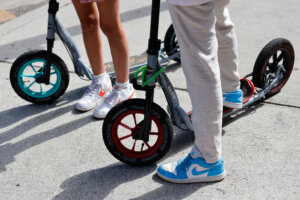
LOS ANGELES – For thousands of years, the Jews have walked. Dispatched by God to the promised land of Canaan, Abraham walked. When the Israelites became a nation in the desert, they camped, kvetched, warred, and worshiped, but mostly walked. And on Shabbat — when the Torah forbids riding horses, carriages, trains or cars — observant Jews have traditionally walked.
But when Ilana Jurkowitz and her two kids went to prayer services one recent Saturday morning, they did not walk. Nor, as Shabbat-observant Jews, did they drive. Instead, the trio made the mile-and-a-half trek to their Beverly Hills synagogue using a decidedly non-Biblical form of transportation: scooters.
They’re not alone. On Shabbat, the two-wheel, non-electric scooters — the kind you kick off to propel and brake by stepping on the back wheel — have in recent years become ubiquitous in Orthodox communities from LA to Miami Beach to the Five Towns. Kids and parents ride them to and from shul, tzitzit fringes flying in the wind, then to meals or playdates afterward. On long Saturday afternoons, Jewish teens cruise the streets on scooters like their California ancestors once did in classic cars.
Walking, it seems, has gone out of fashion, supplanted by what was once mainly a children’s toy. Sorry, Walter: These Jews do roll on Shabbos.
“We saw other people scooting and thought, OK, we need to start,” Jurkowitz said. “It makes it so much easier.”
For the Jurkowitz family, scooters cut what would be a 35-minute walk almost in half. Journeys the family wouldn’t dare take on foot — like the two-plus mile jaunt to Ilana’s parents — become manageable. “It extends the radius of the community,” she told me. For her kids, the scooters also signified maturity and taste. Seven-year-old Shylee Jurkowitz recounted her graduation from a three-wheel mini-scooter to the two-wheel model; Winston, 10, rocked a Transformers-themed helmet. Ilana, also wearing headgear, carried in a tote bag the straw hat she would wear in shul, and four-inch heels.
In Los Angeles, where electric scooters help residents and tourists alike navigate traffic congestion, the ascendance of kick scooters in Orthodox areas highlights the intersection of religious practice and 21st-century urban geography. As the Shabbat-observant population has surged — Orthodoxy being the fastest-growing Jewish denomination in the U.S. — neighborhoods like Pico-Robertson, where the Jurkowitzes live, have stretched the limits of walking distance. Factor in the heat and Shabbat formal attire, and long walks become a brutal proposition.
There’s just one catch. For all their analog simplicity — they contain no motor, battery, chains or gears — it’s not really clear whether scooters are a kosher Shabbat activity. I grew up in Pico-Robertson in the early aughts, when Razor scooters were a fad; I rode mine so much its orange foam handles turned auburn. But I distinctly remember my Modern Orthodox rabbi advising me that on Shabbat, I should leave my wheels at home — scootering, he said, was against the spirit of the Jewish day of rest. So what happened with everyone else?
Each Shabbat for the last several months, I’ve been putting that question to friends and strangers scootering on the streets of Pico-Robertson. The people I’ve spoken to — at least 30, including respondents to a survey I taped up on street corners — described a trend that speaks to climate and real estate, adolescence and parenting, gender and style, and ultimately the meaning of Shabbat itself.
Eventually I heard enough hype about scooters that I ordered one on Amazon; when the Jurkowitzes went to shul, I was rolling along with them.

Micromobility comes to the shtetl
As the Jurkowitz kids raced ahead, Ilana told me how they wound up living so far from shul.
Before they moved into their current home a little more than a decade ago, she and her husband Nick were living about a half-mile east of their synagogue, Beth Jacob Congregation. But with plans to grow their family, they were lured south by cheaper real estate. The Jurkowitzes’ block today would be considered the outskirts of Pico-Robertson; twenty years ago it might as well have been San Diego.
Initially, they walked, pushing their oldest in a stroller. “And then it just, you know, took a lot longer to get there,” Jurkowitz said. Putting the kids on scooters, she quickly learned, meant they could leave the stroller at home.
Shylee and Winston waited at the end of the block for us to catch up. There’d been some skinned knees and bloody elbows over the years, Ilana said, but nothing dramatic. (Other kids I spoke to weren’t so lucky — one teenager told me he’d broken his arm when his scooter plunged into a crack in the sidewalk and threw him off.)
Greater Los Angeles contains several Orthodox neighborhoods, of which Pico-Robertson is the largest. But since the early 2000s, the majority of them are bound by a single eruv, which is the ritual enclosure that allows observant Jews to bypass the prohibition of carrying objects in public on Shabbat. The ludicrously capacious LA eruv — bound by the 405, 10 and 101 freeways, it covers an area roughly the size of Washington, D.C. — allows people to scooter not merely between home and shul, but from one Jewish neighborhood to another.
One man I spoke to planned to scooter four miles that night from Pico-Robertson to his house in Hancock Park, an Orthodox neighborhood colloquially referred to by Pico’s Jews as “the other side of town.” Another rode to Pico from Chabad of Mount Olympus — a distance of more than five miles. The eruv meant these journeys have long been possible on Shabbat. But the scooters are making them almost routine, and in turn, challenging the paradigm of Orthodox community. Having to walk to synagogue on Shabbat has kept Jews living in close proximity for centuries; with a scooter, Orthodox Angelenos really can live anywhere in a 67-square-mile area.

For now, those crosstown treks — facilitated by dry weather, wide residential streets and the generally flat LA basin — represent the extreme in trip length. But they underscore the appeal of intra-community scoots like the Jurkowitzes’. Property values around the neighborhood’s edges have nearly doubled in the past decade, reflecting the increased demand from Orthodox families priced out of the core. Scooters don’t just help people get to synagogue faster; in some cases — especially families with kids — they are the difference between getting there at all or just staying home.
Of course, people do more than pray on Shabbat, and the turn to scooters had as many social motivations as religious ones. For older kids, having a scooter was the first whiff of independence, a status symbol that made you both taller and faster than your peers. And for younger adults, it was an antidote to Saturday doldrums.
Motti Zuker and Joshua Engelson, Orthodox millennials who I met up with one recent Saturday night, use their scooters less to pray than to meet friends and make afternoon plans. “If I was married and had a family, I wouldn’t,” Engelson told me. But as an older single, he said, “I need to move around places.” In other words, he’s shmooze-maxxing.
Though Shabbat-observant themselves, he and Zuker sometimes attend Jewish Friday night functions where most of the other guests drove. Self-conscious of their garishly unsexy devices — Engelson called it “social suicide” to be caught with one at his age — the two have turned their foldable off-brand scooters into a kind of ironic shtick.
“My go-to thing when I introduce myself is I’ll say, ‘Yeah, it’s the vintage model,’” Zuker said with a grin. He’d used that line on me a few days earlier, when I flagged him down on my walk home from Friday night dinner.

Pumping the brakes
So many yidden breeze by you on scooters in Pico-Robertson that it can be easy to forget how many people object to them. What reminded me was the experience of riding one myself. After services ended at Beth Jacob, I grabbed my ride from a rack in the alley behind the shul and kicked off toward my usual religious haunts. As I hurtled past my coreligionists on the sidewalk, it seemed they were looking at me with a mix of bemusement and contempt. My “Good Shabbos” greetings went ignored.
There is nothing in the Torah that overtly forbids riding a scooter on Shabbat. Instead, scooters fall into the gray area of Shabbat prohibition known as uvda d’chol, or “weekday activity.” Uvda d’chol encompasses activities not explicitly prohibited on Shabbat but which are discouraged — as my rabbi did 25 years ago — because they undercut the notion of the Jewish day of rest. The Talmud specifies modes of transportation as an example: The way one gets around on Shabbat, it instructs, should not be the same as how one travels during the week. (The Shulchan Aruch, a 16th-century legal compendium, forbids running on this basis.)
A scan of Orthodox commentary in the last five years seems to reflect consensus that scootering on Shabbat is improper for this reason. An article on the website of the Orthodox Union, the organization to which most Modern Orthodox synagogues belong, and various lectures about scooters on Orthodox learning library YUTorah, declare scootering uvda d’chol.
But uvda d’chol is an evolving designation, determined not by mere rabbinic mandate but also by community habit. And something unusual occurs in the sources discussing scooters: The rabbis tend to concede it’s happening anyway. Rabbi Aryeh Lebowitz, a rosh yeshiva (senior rabbinic scholar) at Yeshiva University who leads a synagogue in Long Island, said in a lecture last year that he once forbade his son from scootering places on Shabbat, a stringency not abided by the boy’s friends.
“But then the yeshivish community moved in, and they’re all on scooters,” said Lebowitz, referring to a more strictly religious crowd. “The adults are on scooters. So now, people in my shul say, ‘How do I tell my kids not to?’”
According to at least one halachic authority, however, kids are in the clear. Rabbi Yosef Zvi Rimon, an influential Orthodox legal scholar based in Israel, permits children scootering on Shabbat because it is a leisure activity, rather than a form of transportation. And he says that in communities where families live far from their synagogue, adults, too, should not be prohibited from scootering to get there — just as the Shulchan Aruch grants an exception for adults to run to shul, because it facilitates the mitzvah of prayer.
In any event, most riders I spoke to weren’t considering it a gray area at all. To Ilana Jurkowitz, scootering wasn’t a thing she did during the week — so how could it be considered a weekday activity? The upsides, on the other hand, were obvious: They made shul more accessible to the whole family, deepened friendships, and enabled her kids to spend more time with their grandparents.

She had not seen a need to consult her rabbi, she said, because so many other families at her shul were doing it first.
“I’ve just looked at the community and seen it as an adopted mode of transportation, and so kind of went with that,” Jurkowitz said. “I guess I felt like if there was an issue with scooting on Shabbat, knowing that so many do it, that the rabbis would address it.”
At least one Pico-Robertson rabbi had tried to ban scooters from his shul. In an interview, he compared their appeal to that of cars in the Conservative movement, which in 1950 permitted driving on Shabbat only for the purpose of getting to services. “Ultimately, it was exactly this — that, ‘Well, people are living far away, so they have to come on Shabbos,’” said the rabbi, who asked to remain anonymous. “Then people kept going further away, and then the whole community, the sense of community faded.”
Others I spoke to shared his sentiment, but few were willing to say so publicly; two local pulpit rabbis I reached out to for this piece declined to speak at all about the topic.
The rabbi who banned the devices empathized with those colleagues. A rabbi’s imperative, he noted, is to set rules his congregation can follow. Taking a position against an activity that is already accepted community practice may only serve to undercut their authority on everything else.
“The reality of the situation regarding scooters,” he said, “is that it’s not where they want to make their battles.”
Day of leisure or day of rest?
There’s an adage in the Talmud that a man is blessed for every step he takes to reach his synagogue — the longer the walk, the greater the reward. But the heavenly incentives, it turned out, shrank in the glare of Los Angeles sun.
Scooter riders cited fatigue, the heat and time commitment as the main reasons they didn’t want to walk. The first two factors went together; Los Angeles now experiences roughly nine to ten more days per year when temperatures hit 90°F or higher compared to two decades ago. In the parts of Pico-Robertson where the Orthodox community has expanded more recently, shade is in short supply.
But people’s resentment of time wasted on foot may say as much about modern social anxieties as it does about the built environment. Whether shul-hopping singles or families of five, people wanted to squeeze more out of the day of rest.

When I was flitting around town on my blue Razor, my Shabbat itinerary became more ambitious. I timed myself riding from Beth Jacob to another synagogue, then headed to lunch on the eastern edge of Pico-Robertson. From there I swung over to my folks’ for dessert, then kick-pushed another 1.4 miles back southeast to my apartment. By nightfall, and without ever leaving Pico-Robertson, I had scootered just under seven miles. I am confident I have never walked that much on one Shabbat; realizing that, I wondered whether that was a sign I had altered something essential about it.
Wisely, I did not reach out to my childhood rabbi until after I completed my experiment; Rabbi Yosef Kanefsky, who today holds the same position as senior rabbi of B’nai David-Judea, had not changed his stance on scooters since I first sought his counsel some 25 years ago. “I’m glad that I’m consistent,” he said when I shared the memory.
Kanefsky, who recently relayed Rimon’s teachings to congregants, said that enabling more children and parents to get to shul was an important consideration in permitting scooters. But he still wasn’t entirely comfortable with the activity more broadly. He recalled the instruction Moses gives the Israelites not to collect manna on Shabbat. “Shvu ish tachtav,” Moses tells them: Stay put.
“Filling our day with busyness, that’s what the other six days are for,” Kanefsky said in an interview. “We fill our schedule with busyness, and Shabbat is intended to be a day of non-busyness. ‘I got places to go. I got things to do. I can’t stay here too long’ — that’s really what we’re supposed to take a break from.”
Perhaps the best case to be made against scootering, then, is not that it feels like a weekday activity; it’s that walking — even or especially a distance you’d rather drive — feels like a Shabbat activity.
But the debate around scooters isn’t just about scooters. The deeper matter, Kanefsky said, is that as technology has become more advanced, more and more things we would intuitively consider Shabbat-violating actually fall into uvda d’chol rather than clear Biblical prohibitions. Lighting a candle on Shabbat is Biblically prohibited, but turning on an LED light? That’s probably uvda d’chol. Same goes for a smartphone, getting in a short-distance Waymo or talking to Alexa.
This is not to say that permitting scooters on Shabbat means allowing Snapchat, too. But scooters do expose an unavoidable fact about Shabbat in the 21st century and beyond: It will ultimately reflect how communities define uvda d’chol for themselves.

“We need this category, desperately,” Kanefsky said. “If we have the opportunity to be a little more conservative with this category — literally to conserve it — I think that’s in our interest. Because — well, just imagine a Shabbat in which everyone’s phone is on, everyone’s computer is on, and everyone’s taking their EV to shul. That’s the future if uvda d’chol disappears as a category altogether.”
Until then, the scooters roll on. The last person I interviewed for this story was the kid who broke his arm — 14-year-old Natan Wintner, a rising high school freshman. Wintner rounds up what he called “a little Jewish scooter gang” most Shabbat afternoons — five to ten guys bouncing from house to house to pass the time. Girls did this too in their own groups, Wintner said; for him it was “having our bro time.”
Wintner’s dad grew up on the other side of town, back when scootering on Shabbat was a clear no-go. But in a sign of the changing times, Natan got his first scooter when he was 5 and — save for the broken arm a few years ago — has been riding it ever since.
He expects to grow out of the Razor someday. “I do view it as somewhat childish,” he said. But when he sees parents scootering with their kids, he begins to imagine an older version of himself grabbing the handlebars again.
“I think I speak for most kids when I say that walking isn’t really fun,” he said. “Just being able to push yourself off a scooter and give yourself a little less to do, it really makes a big difference for kids. And it’s just more fun, you know? You get to gain speed.”
The post Orthodox Jews are scootering to synagogue. Will Shabbat ever be the same? appeared first on The Forward.
Uncategorized
CAIR Connecticut urges Greenwich schools to stop using Eisner Camp over Israel ties
(JTA) — GREAT BARRINGTON, Mass. – Greenwich Public Schools in Connecticut said it would proceed with a planned fall trip for sixth graders at a Jewish camp in Massachusetts as planned this week, despite pressure from a Muslim advocacy organization over the camp’s Israeli symbols and Israel-related programming.
CAIR Connecticut, the state chapter of the Council on American-Islamic Relations, objected to the trip, saying that programming at Eisner Camp in Great Barrington “incorporates connections to Israel,” the chapter’s board chair Farhan Memon wrote in a letter to Greenwich Superintendent of Schools Toni Jones dated Oct. 13.
The four-day Greenwich Schools field trip was organized by the Outdoor Classroom project, which works with seven locations in New England, including Eisner. Four of the camps are affiliated with Christian organizations, and two have no religious affiliation. With its clients, Outdoor Classroom coordinates nature-related learning programs for kids.
Memon wrote that some parents in Greenwich had viewed a video and photos of previous school events at Eisner and “identified Israeli flags and yellow ribbons prominently displayed in spaces used during school visits.”
“At the very least, spaces used by Greenwich students on any school trip should be free of national and political displays,” Memon wrote.
Eisner director Paul Isserles said in a statement shared with the Jewish Telegraphic Agency: “We welcome Outdoor Classroom to use our camp facilities. Throughout the year many outside organizations rent our facilities for various programs. URJ Eisner Camp is proud to have an Israeli flag displayed for our camp programs.”
When it comes to visiting groups, “Frankly, we are not regularly asked to do anything to remove those symbols or to cover them,” said Union for Reform Judaism president Rabbi Rick Jacobs in a telephone interview with JTA. “Because to be honest, we wouldn’t.”
Answering Memon’s letter on Oct. 14, Jones wrote in an email that her school district “acknowledges that individuals and families have vastly different views regarding global events” and that it intends to “provide an inclusive and safe educational environment for all Greenwich Public School students, including when they are on field trips under our care.”
She added that she had “made it clear to a few families that we will not take a political or religious stand.” JTA has seen both the CAIR letter and the email response.
CAIR Connecticut did not respond to JTA’s query.
CAIR’s national website says the organization promotes interfaith dialogue and “condemns all acts of violence against civilians by any individual, group or state.”
The Reform movement founded the 600-acre camp in 1958 as the Joseph Eisner Camp Institute for Living Judaism. It is located in the Berkshire Hills south of the town center of Great Barrington.
It is one of more than a dozen of the movement’s overnight camps in the North America. Many of those camps are rented throughout the year by groups that have nothing to do with Judaism, URJ’s Rabbi Jacobs said. “If a group rents the camp, they come up with their own agenda,” he said.
He added, “There are flags and other symbols of Judaism and of Israel in our camps, and we’re proud of that.”
Some parents had raised concerns about the venue as early as March. CAIR urged the district to stop using the camp in the Oct. 14 letter.
Removing decorations from the camp would not be enough, he said, noting that parents were upset after seeing promotional material about Eisner bringing Jewish campers to visit Israeli army bases under the Gadna, an Israeli military youth program.
A July 2019 post on Eisner Camp’s website says a group of participants in its Israel trip chose Gadna, stayed at an army base, practiced drills and learned to shoot at a target.
“URJ Eisner Camp participants who go to Israel have not participated in Gadna since 2023,” camp director Isserles said in a statement provided to JTA. “Our Israel programming at camp and in Israel is focused on Jewish identity, community, education, and connection to Israel.”
What CAIR is saying is that “A Jewish institution can be an unfit place for public-school children because it is visibly Jewish and identifies openly with Israel,” wrote blogger and Eisner alumnus Rabbi Jeff Salkin in his “Unfiltered” Substack on Oct. 19.
“A Jewish institution should not have to hide its Jewish identity to count as a fit place for other people’s children. You would not ask a church camp to remove a cross, or a Muslim camp to take down a crescent. A standard that demands such hiding makes Jewish identity itself the problem,” Salkin wrote.
This article originally appeared on JTA.org.
The post CAIR Connecticut urges Greenwich schools to stop using Eisner Camp over Israel ties appeared first on The Forward.
Uncategorized
Who are the first time voters who could sway Israel’s election?
(JTA) — JERUSALEM — On Oct. 27, Yael Chernyvsky, 18, from Ramat Hasharon in central Israel, plans to cast her ballot for the first time.
“I’m voting so we can change the future of this country,” the teen told Jewish Telegraphic Agency earlier this month. She was entering a Tel Aviv auditorium where some of Israel’s top politicians were about to address more than 1,000 first-time voters, including many in pre-military programs.
Chernyvsky, who is studying in an army preparation program in the Negev, blames the current right-wing government led by Prime Minister Benjamin Netanyahu for the country’s problems.
So she said she will vote for one of the opposition parties in the “change bloc,” which seeks to oust Netanyahu, who has been in office since 2009 except for a brief period in 2021-2022.
Chernyvsky had not decided which party she will vote for, but she said it will “probably” be either the Democrats led by Yair Golan or Yashar led by Gadi Eisenkot.
“We’ve basically had the same government for 20 years, and I genuinely think it’s corrupt. Why has this war been going on for three years? Why did it take two years to return the hostages? Why does the government give so much money to Haredi Jews who don’t work and don’t serve in the army?”
Chernyvsky is one of the estimated 640,000 Israelis aged 18 to 22 eligible to vote in Tuesday’s election, according to the Israel Democracy Institute (IDI). Comprising nearly 10% of the electorate, their votes could determine as many as 12 seats in the 120-member Knesset.
“Israel is a young country with a high birth rate,” said Tammy Hoffman, head of the education policy program at the IDI, which co-sponsored the young voter event with the Yigal Allon Center. “If their turnout is high, as our research suggests, first-time voters will make a difference.”
In May, Hoffman and her colleagues surveyed potential young first-time Jewish and Arab voters about their attitudes and political engagement. Across Israel’s population groups, 80% to 95% said they would “definitely” or be likely to vote. Secular Jewish youth expressed the highest level of certainty regarding participation, while 87% of Arabs said they intend to vote.
It’s a higher percentage than in the U.S., where the youth turnout in the 2024 presidential election was only 47%, according to the Center for Information and Research on Civic Learning and Engagement.
More than four-fifths of respondents to the IDI survey described the opportunity to vote as either “fairly meaningful” or “very meaningful,” with particularly strong responses among traditional and religious Jewish youth.
A separate poll of 18-year-old to 22-year-old potential first-time voters for the Ynet and Yedioth Ahronoth news outlets also revealed high motivation: 67% of respondents said they were certain they would vote, while another 19% thought they would.
In both polls, national security and the cost of living were top priorities for both Jews and Arabs. Hoffman wasn’t surprised.
“For the past several years, they’ve lived in an unstable environment during their adolescence. They were in junior high during COVID, they witnessed the judicial reform protests, and of course Oct. 7. They are worried about their future.”
While the Hamas attack affected every Israeli, the fact that so many first-time voters are either serving in the Israel Defense Forces or will do so in the near future could influence how they vote.
Jewish Israeli voters of all ages have moved rightward politically over the past couple of decades, Hoffman noted.
“But military service doesn’t necessarily lead you to a nationalist stance,” Hoffman emphasized. “It can do the opposite: It can bring up questions about the war and its goals.”
Arab Israelis, meanwhile, haven’t shifted rightward, but they are more eager to vote in this election than previous elections, reflecting their growing engagement in Israeli society, Hoffman said.
In a Sept. 23 N12 poll, 74% of young people described their political views as right-wing or center-right, while 23% identified as left-wing or center-left. If the election were held at the time the poll was taken, 16% of respondents would vote for Eisenkot’s Yashar party and 14% would vote for Netanyahu’s Likud party.
Despite the assumption that the majority of Jewish youth will vote for right-wing and far-right parties, Hoffman said, mock elections at high schools around the country show a different picture.
She said the majority of students voted for Eisenkot’s Yashar party and Beyachad, led by former prime ministers Naftali Bennett and Yair Lapid from the opposition Change bloc, and “some for Netanyahu’s [right-wing] Likud, but not a lot for [Itamar] Ben-Gvir,” who heads a far-right party.
Omer Gross from Jerusalem, who graduated from high school in June and is now in an army-prep program in the Golan, plans to vote for the Religious Zionist party led by far-right politicians Finance Minister Bezalel Smotrich and Moshe Feiglin.
“I don’t really agree with what Smotrich has been doing in Gaza,” he said, referring to Smotrich’s objective to reestablish the uprooted Jewish settlements in Gaza and incentivize Palestinian emigration from the strip, “but I support what he does in the territories” – the West Bank. “We need a strong, secure Israel.”
Tomer Shiloh from Herziliyah, who attends the same Golan Heights program as his friend Omer, has different plans.
“I’m voting for the ‘Change’ bloc, for Gadi Eisenkot or Naftali Bennett,” the 18-year-old said.
If it were up to Shiloh, the next government would require Haredi, or ultra-Orthodox, young men to serve in the IDF, as he will do next year. He wants the next government to lower Israel’s high cost of living.
“I want the people who run this country to have good values and to do what’s best for the country and not for themselves,” the teen said.
Sgt. M is a 22-year-old office worker doing his first stint of reserve duty following the conclusion of his mandatory army service. He says ensuring that all Israelis serve the country either in the IDF or through National Service is at the top of his election priority list. But he will be voting for the left-of-center Democrats party mostly for economic reasons.
“Did you know that most university students have to work while they study to pay for tuition, books, food and housing?” the reservist, who requested anonymity due to IDF regulations, said as he traveled home by train from his army base. “I wanted to start studying right after finishing the army, but between the cost and reserve duty, that’s impossible,” he said.
Speaking from his home in the northern Israeli city of Shef-Amra, Khalel Alaa Sabeh, 18, said he plans to vote for an Arab party that will prioritize addressing resource gaps in the Arab community.
“I want to see more money allocated to the Arab community,” he said, noting that historically, Arab municipalities have received less government funding than Jewish municipalities. “But most of all, I want our families to be safe. There’s a lot of crime in the Arab sector and the Netanyahu government isn’t doing enough to stop it.”
Sabeh, who plans to start university next year, said he is urging his friends to show up to vote on Oct. 27.
“I want to see change in this country, and if Netanyahu wins we’ll have four more bad years.” Yet whatever the outcome on Election Day, he said, “I won’t leave the country. This is my land, this is my home.”
This article originally appeared on JTA.org.
The post Who are the first time voters who could sway Israel’s election? appeared first on The Forward.
Uncategorized
Israel’s global image is deteriorating. Why isn’t it a bigger issue in the election?
(JTA) — JERUSALEM – Over the past few months, Israeli media has been full of reports of Israeli holidaymakers in Europe, Asia and the Americas being harassed or physically attacked after being identified as Israeli.
In July, a group of Israeli tourists visiting Montenegro were reportedly confronted by a man and a woman, apparently locals, who asked, “Taking a break from genocide?” and told them to stay in Israel. In Greece, an Israeli woman said a restaurant refused to serve her after she told an employee she was from Israel.
In Thailand, a mother and daughter were allegedly beaten after they told a man they were from Israel, according to the mother’s account.. And in the U.S., an Israeli couple checking into a hotel in California were asked if they were “baby killers.”
These reports come as Israel’s image around the world has fallen to historic lows. A Pew poll conducted between February and May this year found that across 36 countries, a median of 67% of adults held an unfavorable view of Israel.
On the diplomatic front, hostility is also growing. Israel’s ongoing military action in Gaza has been termed “disproportionate” by a growing number of world leaders, and unchecked violence by Israeli settlers in the West Bank – as well as Israeli government policy there – has prompted some countries, including some considered allies, to pull back or even impose sanctions.
Despite this hostility the issue of Israel’s diplomacy, its image worldwide and who is to blame for its deterioration is barely factoring into the fast-approaching election on Oct. 27.
Yaakov Katz, a senior fellow at the Jewish People Policy Institute, told the Jewish Telegraphic Agency that there have been complaints about Prime Minister Benjamin Netanyahu and his government not being effective at explaining Israel’s policies or actions to international audiences. Nevertheless, most Israelis see this as a problem beyond their control, he added.
“There is the argument that Netanyahu makes, which is that no matter what we do, the whole world’s against us, and no matter what we say, it’s antisemitism,” said Katz, co-author of “While Israel Slept: How Hamas Surprised the Most Powerful Military in the Middle East.” “People accept that argument, and to a large extent, they don’t push back on it. Why? Because part of it is true, right?”
Katz pointed out that many Israelis believe the sharp rise in antisemitism worldwide would keep happening regardless of what Israel does.
“In other words, Israelis believe that even if the number killed in Gaza was not 70,000 but 10,000, you still would have genocide claims; it makes no difference,” he said, adding that the average Israeli does not fully understand that declining support, particularly in the U.S., could eventually have “existential consequences for the country.”
“Most people here don’t think that far ahead,” Katz said. Instead, they take comfort in news such as President Donald Trump’s endorsement of Netanyahu, he added.
Ofir Dayan, a senior fellow at the Institute for National Security Studies at Tel Aviv University, said, however, that Israelis are painfully aware of what is happening abroad and are concerned about it. But she said there are other, more pressing issues in a country that has been grappling with more than three years of war.
“When people talk about the elections and what the Netanyahu government did right or wrong, they definitely look at this issue, and it is something they care about,” Dayan said.
However, she continued, most are unlikely to vote for a party or a candidate based on their position on this issue because it is just not a priority.
“Israeli voters are very much one-issue voters, and the issue in this election is security,” Dayan said. “We’re not remote enough from Oct. 7 for people to completely shift their vote and vote based on this idea.”
In addition to security and the questions surrounding the Oct. 7, 2023, Hamas-led terror attack, Peter Lerner, the former Israel Defense Forces spokesman for the international press, told JTA that the “issue of Israel’s international standing is secondary to two things: Netanyahu or not Netanyahu, and the left vs. the right.”
“Obviously, each one of those comes with its own package of Oct. 7-related issues and the question of who is most suited to deal with the threats that are around us,” he said, adding, “you just don’t see very many talking about it and when they do talk about it, it is secondary to everything else.”
Of the dozen or so parties expected to win seats in Israel’s parliament, the Knesset, only a few have referred to Israel’s negative global image or suggested ways to improve public diplomacy.
The B’Yachad Party, headed by former prime ministers Naftali Bennett and Yair Lapid, is one of those discussing it as part of a plan to repair ties between Israel and world Jewry. Under this plan, the party hopes to elevate the importance of Diaspora Jewry, allowing a non-voting observer in Israel’s parliament, the Knesset, to focus on such issues.
Amcha Yisrael, a new right-wing party led by former IDF Brig. Gen. Ofer Winter, has two candidates on its list who are prominent public diplomacy activists – Yoseph Haddad and Fleur Hassan-Nahoum. Haddad has said multiple times that he would like to be Israel’s next minister for public diplomacy.
Journalist Eylon Levy, a former spokesman for the Israeli government, told JTA’s “Waiting for 61” podcast that public diplomacy, or hasbara as Israelis refer to it, “is not a goal in itself” for most of the candidates.
He said the discussion was more about “who can manage relations with the world so that we can achieve our national interests.”
Within that framework, Levy pointed out, there is a range of opinions. On the far right, the approach of the Otzma Yehudit Party, led by Minister of National Security Itamar Ben-Gvir, is to make Israel look tough and “screw the woolly-hearted soft liberals if they don’t like it.”
On the left, “the position may be equally detached from reality,” Levy said.
“There is a belief on the left that if Israel starts behaving like a normal country and doesn’t have ministers who say aggressive nonsense, then Israel’s relations will snap back to normal,” he said. “I think there may be a denial there of how much public opinion has shifted against Israel and how much the expectations of policymakers have shifted as well.”
While Levy said he did not believe there would be a massive change in perceptions if a new government were elected on Oct. 27, he did believe it would be given a grace period, at least by Israel’s less-than-friendly allies.
“The question is whether an alternative government would suddenly magically boost Israel’s international standing; I don’t think it will,” he said. “But I do think a more moderate government will buy Israel some goodwill, definitely among those who say, in theory, we support Israel.”
This article originally appeared on JTA.org.
The post Israel’s global image is deteriorating. Why isn’t it a bigger issue in the election? appeared first on The Forward.
