


Uncategorized
One of Dachau’s last living liberators still has somewhere to be
ATLANTA — Hilbert “Hibby” Margol wears two watches.
It is the kind of detail that seems small until you can’t stop noticing it. One watch is ordinary. It has hands, numbers, the plain mechanics of telling time. The other is a Life Alert, the sort of device sold to people who live alone, or to the people who love them and can’t stand the thought of them living alone.
Together the two watches say something about a man before he’s said a word himself: that he has outlived the need for almost everything, except the people determined to make sure he’s still here.
He is 102. He lives by himself in the same two-story house in suburban Atlanta he shared with his wife of 77 years, Betty Ann, who died at 96 last September. The house still carries the warmth of her memory. Family photographs cover every surface that will hold them: the mantel, the end tables, the walls, climbing toward the ceiling like something that grew there on its own.
There will soon be one more: Hibby’s fourth great-granddaughter, Callie Rose, was born two weeks ago.
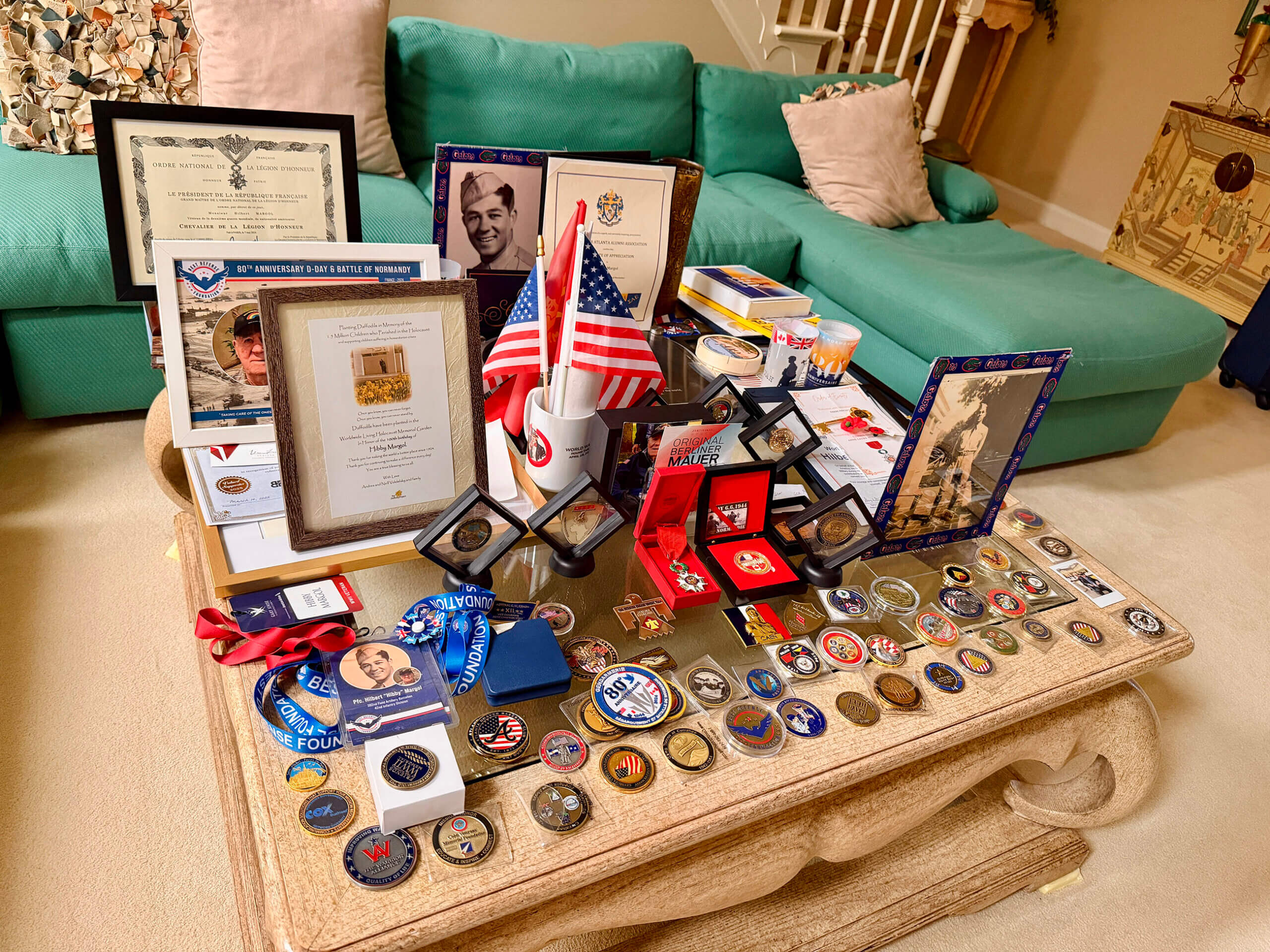
A framed photograph of French President Emmanuel Macron pinning the Legion d’Honneur to Margol’s chest — taken in 2024, when Margol was one of dozens of American veterans Delta Airlines chartered to Normandy for the 80th anniversary of D-Day — leans against the fireplace, not yet hung, as if the house has simply run out of room to keep up with the life still happening inside it.
The coffee table has disappeared beneath medals and ephemera and the accumulated evidence of a hundred years, and it occurs to you, sitting across from him, that you are not in the home of a man winding down. You are in the home of a man still arriving.

His iPhone buzzed. Then again. He glanced at it and rolled his eyes.
“That’s my daughter,” he said. “Checking on me.”
His daughter is, herself, a senior citizen. The phone had no case — hadn’t needed one, he doesn’t drop things — which felt like its own kind of answer to a question I hadn’t yet asked: What does it look like to move through a century without ever quite losing your grip?
On the day I visited this June, he had just returned from yet another trip to Normandy, marking another anniversary of a war he’d fought in as a young man and had spent most of the rest of his life not talking about. A week before that, the Atlanta Braves had honored him on the field on Memorial Day for the second year in a row.

For six decades, Margol said almost nothing about what he had seen at the end of that war — not to his wife, not to his three children, not to anyone. And then, in his 80s, he started to talk about it, and he has not really stopped since.
Margol is sharing his experience as one of a dwindling number of U.S. Army veterans alive today who helped liberate the Dachau concentration camp.
Inside the camp
He and his identical twin brother, Howard — younger by ten minutes — served together in the war. That alone took some doing: the military generally kept siblings apart, a policy hardened after five Sullivan brothers died together when their ship sank in 1942. (It’s loosely the premise behind Saving Private Ryan.) It took a letter from the Margols’ mother to President Franklin D. Roosevelt to get an exception made.
On the morning of April 29, 1945, the brothers were on the outskirts of Munich when they caught a strange, powerful smell drifting out of the woods.

Howard was the one who placed it. It reminded him of an unpleasant odor he would sometimes catch a whiff of in their mother’s kosher kitchen back home in Jacksonville, Florida — the way she would hold a freshly killed chicken over the gas flame of the stove to singe off the last of its pin feathers. Only this stench was much, much stronger.
The brothers went to find the source. What they came to first was a line of boxcars. The first one they reached had its sliding door open. A dead man’s leg was dangling out of it. They opened the cars and found them packed with dead bodies in striped prisoner uniforms “like sardines,” Hibby would say.
They had a small camera, liberated from a dead German officer a few weeks earlier, and they used it to take a photograph of one of the cars — a copy of which hangs in the United States Holocaust Memorial Museum in Washington, D.C.
They pressed further into the woods and came out at another clearing. Above the entrance was a sign: ARBEIT MACHT FREI. Work will set you free.
They had found Dachau.
Beyond the gate was a wide-open yard ringed by low barracks buildings — and, in several places, bodies stacked the way you’d stack cordwood. The arrangement of them is the part that refused to make sense. Somebody had piled them, neatly, as routine.
Neither brother had ever seen anything like it. “We didn’t understand what we were looking at,” Margol said. “It sort of reminded us of a movie set.”
They learned only later that the camp’s ovens had run out of coal months earlier, and without coal, there was no way to cremate the bodies. So the corpses had simply been left where they lay.
It took a moment to register that not everyone in the yard was dead. Off to one side, against a barracks wall, were four or five prisoners — some squatting, some just standing, none of them well. But alive.
The camp’s roughly 32,000 prisoners walked free later that same day, once a Swiss Red Cross negotiator talked the SS commander into a peaceful surrender rather than a last stand.

Years later, at a visit to mark the liberation’s 70th anniversary, an elderly survivor found Margol after a memorial service. She told him she’d been too sick with typhus that morning to understand what was happening around her. Then she leaned over and kissed him on both cheeks. “If you guys were two or three days later,” she told him, “I wouldn’t have made it.”
One family, two branches
I’ve spent much of the past year following a different story: a family of cattle farmers in rural Illinois, building a synagogue in a two-acre cornfield out of the remains of closing synagogues — a Torah rescued from one congregation, an ark from another, stained-glass windows carried out of buildings that no longer exist. The building will also include a museum of tolerance, sharing the stories of the family’s ancestors — some who died in concentration camps, others who survived by being hidden in the homes of Christian families.
The family is named Jakobs. You’ve met the 41-year-old farmer, Nik, in stories I’ve written about the Pennsylvania synagogue he dismantled, piece by piece, to save it; the groundbreaking of the new one rising in a field; and the family’s roots in the Netherlands, where his grandmother, Edith, spent nearly three years hidden in a farmhouse. This spring, I flew with the family to Stadskanaal, the small Dutch town that was her family’s refuge, to watch a local theater troupe stage a play about her survival.
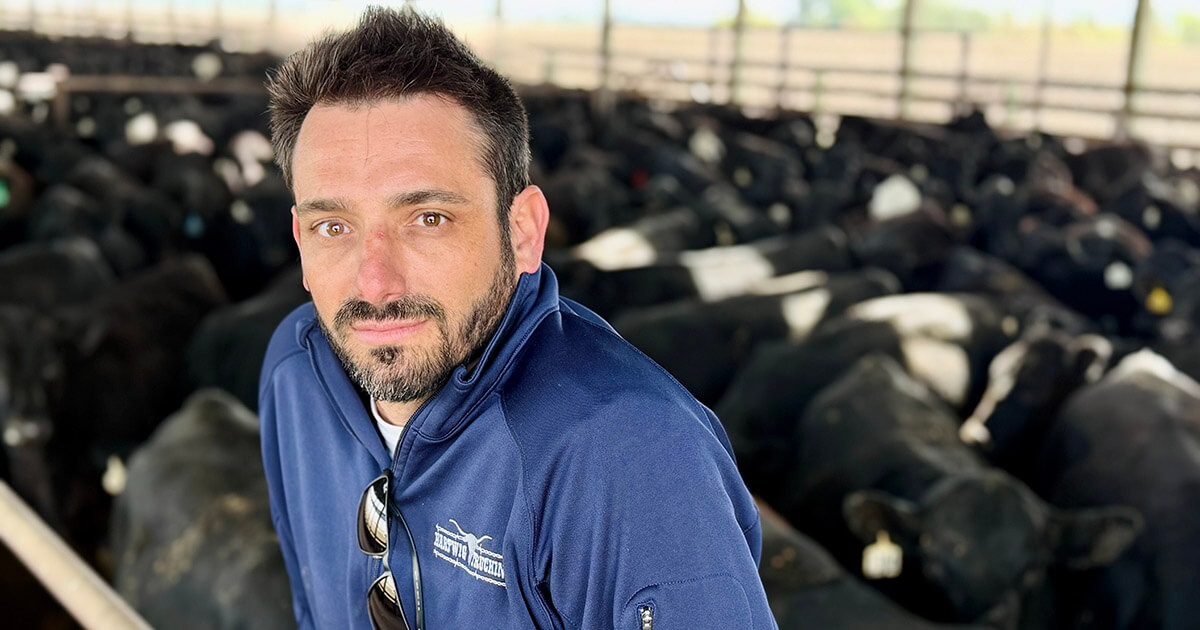
It was in the Netherlands, reporting Jakobs’ story, that he first mentioned a name: Hibby. Jakob’s brother Bryce who left the farm for a career of his own, is married to one of Margol’s granddaughters. Margol’s great-granddaughters carry both halves of this history. On one side: relatives murdered in the Holocaust, and ancestors who survived it in hiding. On the other: a soldier who helped liberate one of the camps.
I asked Margol what he made of it. He didn’t reach for anything grand. “Well,” he said, “it’s quite a story.”
The silence
For decades, Margol said almost nothing about Dachau to his family. “We had written letters,” he said of the war years. “We figured that was sufficient.”
Life moved on. Margol built a business selling furniture and appliances. He raised a family. The war became something that had happened to a younger man.
Then came an invitation.
In 2012, at 88, Margol joined about a dozen other American liberators on the International March of the Living, traveling to Poland with Holocaust survivors and thousands of Jewish teenagers. For the first time since the war, he wasn’t simply remembering what he’d witnessed. He was walking beside people whose lives had continued because soldiers like him had arrived when they did.
“It was such an emotional experience,” he later recalled of walking from Auschwitz to Birkenau, “that when I got home I said, now I have to start talking about it.”
His first talk was at the public library near his home. More than 90 people showed up, on word of mouth alone. Then came another invitation. And another. Synagogues. Churches. High schools. A World War II roundtable. Adult education classes at Emory University. He stopped counting after 200 presentations. Today, he estimates he’s given close to 300.

But talking about Dachau and reliving it are not the same thing. Years ago, touring the United States Holocaust Memorial Museum in Washington, D.C., with a small group, he had to walk through a boxcar on exhibit to continue the tour — cleaner and newer-looking than the one he remembered, but a boxcar all the same. “Emotionally,” he said, “I broke down.”
For most of his life, Margol had carried the story alone. Now he worried what would happen if no one carried it after him.
In September, Margol is returning to Germany with his son Jerry, 74 — this trip courtesy of the Best Defense Foundation, the veterans organization that has taken the two of them to battlefields around Europe, and which is now making a documentary about Margol and another veteran. The itinerary is still coming together, but it includes a stop that father and son have made together twice before: Dachau.
The next generation
Long before Margol began speaking publicly about the Holocaust, he had already spent years building Jewish life closer to home.
Rabbi Mark Zimmerman saw it firsthand. Zimmerman retired this summer after leading Congregation Beth Shalom in Atlanta for 38 years. He met Margol in 1988, when the rabbi arrived and Margol was, as he put it, “a young man of sixty-something.”
“He still comes to synagogue,” Zimmerman said. “He’s still sharp as a tack.”
But what Zimmerman remembers most isn’t Margol’s longevity. It’s what he built.
In the late 1990s, Beth Shalom needed an educational wing. Before the congregation had raised a dollar toward the project, Margol quietly wrote a $100,000 check so the synagogue could hire a professional fundraiser and launch the campaign. He and fellow congregant Stephen Klein later donated roughly $350,000 each to complete the building.
Today the Klein-Margol Educational Wing houses the congregation’s preschool, administrative offices, chapel, library and youth lounge.
“In many ways,” Zimmerman said, “I owe my staying at Beth Shalom to Hibby and his vision. We still have a tremendous preschool because of that original vision.”
Only years later did Zimmerman learn another part of Margol’s legacy, about liberating Dachau. Margol recently gave Zimmerman a copy of the memoir he and his son self-published, becoming one of the congregation’s living links to the Holocaust.
“His firsthand account is such a rare commodity,” Zimmerman said, “in a world where primary witnesses, for the most part, are dying out.”
Nearly 800 miles away, in Sterling, Illinois, the other side of Margol’s family is at work on a version of the same project. Jakobs is building a synagogue, with a museum inside so his grandmother’s story outlives her. Margol has already seen how it turns out — his wing has held preschoolers for a quarter century. Jakobs broke ground this spring.
A hat, a promise
I asked Margol if I could take his picture before I left. “Let me get my baseball hat,” he said, and disappeared into another part of the house.
It’s the one with the patch of the 42nd Infantry Division — the Rainbow Division, one of the liberating forces at Dachau. The nickname dates to 1917, coined by a young Col. Douglas MacArthur because the division’s ranks were drawn from National Guard units in 27 different states.
Room by room, the 102-year-old wandered through his home looking for the hat. He checked the kitchen. He looked at the hook by the door, where another cap was hanging, then shook his head and kept going.
There was something almost unbearably ordinary about it, set against everything he’d just spent hours telling me. The boxcars. The smell. The gate. And now: Where did I put that hat?
He found it, and came back into the room wearing it — the same hat, more or less, that has sat on his head in front of hundreds of audiences by now. He still says yes to the invitations. He still boards planes to Europe. When I asked what all of it was for, he didn’t hesitate.
“I hope and pray,” he said, “that the offspring of all the Holocaust survivors outlive the offspring of the deniers.”

The Holy Ground reporting project is made possible with support from the Henry Luce Foundation.
The post One of Dachau’s last living liberators still has somewhere to be appeared first on The Forward.
Uncategorized
Brooklyn’s new ‘lard bagel’ is not kosher. But it is delicious.

Bagels have long been a staple of the Jewish diet, even if they’re not exactly health food. But the latest addition to New York’s bagel scene achieves the impressive feat of inviting both your doctor and your rabbi’s scorn: the “lard bagel,” made with rendered pork fat.
The decidedly unkosher offering is on the menu at Caputo Bagels, which opened Monday in Brooklyn’s Park Slope neighborhood. The bagel shop is the successor to the once-popular Caputo Bakery in Carroll Gardens, which closed in April after five generations of operation.

At the now-shuttered Caputo Bakery, “lard bread” was a bestseller. Caputo Bagels seeks to recreate the lard bread experience, but in bagel form. Lard, salami, provolone cheese, salt and pepper are all folded into sourdough, hand-rolled, then boiled and baked at 425 degrees. The Italian-Jewish mash-up is the product of a partnership between James Caputo and Rafi Hasid, who also runs the Israeli restaurant Miriam next door.
Eager to try this bagel novelty, I stocked up on Lactaid pills and trekked to Park Slope early Friday morning. There, I met Caputo himself, who said the lard bread was a family recipe and an Italian-American specialty. Lard, he explained, was “a couple levels above adding butter to your bread.”
“A lot of people who went to the bakery are now rushing here to try the lard bagel,” Caputo said, adding that he did “feel bad” that kosher customers wouldn’t be able to eat the signature item.
I reassured Caputo that I did not keep kosher and was eager to taste the lard bagel myself.
But before digging in, I wanted to know what to expect. The first customer I spoke with had ordered an everything bagel, explaining that she hadn’t known the lard bagel “existed.” The second, visiting New York City from Spain, had opted for banana bread.
I asked her if she had considered ordering the lard bagel. “At this hour in the morning?” she asked.
I was starting to get worried. If nobody orders the lard bagel, does it make a sound?
Fortunately, I soon met Kristin Stoller, a local who used to frequent Caputo Bakery. She had ordered both a lard bagel and a plain one, with a side of scallion cream cheese, to bring home for herself and her boyfriend.
“He’s anxious about the lard bagel,” she told me, but she was hoping to convert him.
I asked if she would do a taste test. “Just like the bread!” she said after taking a bite. “This is perfection.”
Her enthusiasm seemed to be contagious. The first customer I’d spoken with came up to me, this time with a lard bagel in hand. I’d piqued her curiosity. “It’s a savory explosion,” she said.
Outside, I found a customer named Kendra Koch sitting on a bench with her dog, Pom Pom. She, too, had ordered the lard bagel, topped with olive cream cheese.
“It tastes like pizza,” she said as Pom Pom angled toward the bagel, seemingly longing for a bite.

I summoned my courage and ordered one sans toppings, figuring it had enough going on flavor-wise to stand on its own. One bite revealed a cheesy, peppery richness. I wasn’t sure I tasted the lard, but I also wasn’t sure if I was supposed to. My official verdict: delicious.
It was just too bad that my kosher friends couldn’t try it. I’m holding out hope that the schmaltz bagel will catch on next.
The post Brooklyn’s new ‘lard bagel’ is not kosher. But it is delicious. appeared first on The Forward.
Uncategorized
Yiddish Modernism and the political tumult in the 1930s
אין די 1920ער און 1930ער יאָרן האָט דער זשורנאַל „אין זיך“ געדינט װי אַ טריבונע פֿאַר מאָדערניסטישע עקספּערימענטן אין דער אַמעריקאַנער ייִדיש־ליטעראַטור. צו די „אינזיכיסטן“ האָבן געהערט יעקבֿ גלאַטשטײן, אַהרן גלאַנץ־לעיעלעס, ה. לײװיק, שלמה שװאַרץ, יהודה לײב טעלער און אַנדערע.
װי מען קען טרעפֿן פֿונעם זשורנאַלס נאָמען, זײַנען די דאָזיקע ליטעראַטן געװען פֿאַרטאָן אין שעפֿערישע חקירות אַרום דעם אײגענעם „זיך“. און טאַקע, אין די 1920 יאָרן האָט „אין זיך“ ניט געהאַט קײן אינטערעס צו די פּאָליטישע דאגות־היום.
אָבער דאָס האָט זיך געביטן נאָך 1934, װען גלאַטשטײן איז געװאָרן דער רעדאַקטאָר פֿונעם זשורנאַל. דער דאָזיקער תּקופֿה איז געװידמעט דאָס נײַע בוך פֿון איתי זוטרא (אוניװערסיטעט פֿון מאַניטאָבאַ, קאַנאַדע) „אינזיכיזם: ייִדיש־דיכטונג און די ייִדישע אידענטיטעט אין אַמעריקע אין די 1930ער יאָרן“.
גלאַטשטײן האָט פֿאַרטײדיקט די שעפֿערישע אױטאָנאָמיע פֿונעם דיכטער קעגן די אַנגאַזשירטע קאָמוניסטישע קריטיקער װי אַלכּסנדר פּאָמעראַנץ, װאָס האָבן געפֿאָדערט, אַז ליטעראַטור זאָל דינען די אינטערעסן פֿון די פּראָלעטאַרישע מאַסן.
אַזױ איז גלאַטשטײנס אײגענע פּאָעטישע שאַפֿונג געװאָרן אַ מין פּאָליטישע פּאָזיציע. די דאָזיקע פּאָליטיק, האַלט זוטרא, האָט משפּיע געװען אויף זײַן ליטעראַרישן סטיל און דעם סטיל פֿון אַנדערע מחברים פֿון „אין זיך“.
גלאַטשטײן האָט געעפֿנט די זײַטן פֿון „אין זיך“ פֿאַר פּאָליטישע װיכּוחים. ער אַלײן איז אַרױס מיט אַ פֿאָרשלאָג צו שאַפֿן אַ פּאַרטײ, װאָס זאָל זײַן אי פּאָליטיש ראַדיקאַל אי ייִדישיסטיש, הגם קײן פּראַקטישע פּראָגראַם האָט ער ניט פֿאָרגעלײגט.
להיפּוך צו אַנדערע ראַדיקאַלע פּאַרטײען, קודם־כּל דער קאָמוניסטישער, איז דער הױפּטציל פֿון גלאַטשטײנס פּאַרטײ געװען צו פֿאַרטײדיקן ייִדישע נאַציאָנאַלע אינטערעסן. דאָס איז געװען ספּעציעל װיכטיק אין דער צײַט װען דער אַנטיסעמיטיזם האָט געהאַלטן אין אײן װאַקסן אין אײראָפּע.
גלאַטשטײן האָט פֿאַרבעטן ייִדישע ליטעראַטן אַרומצורעדן זײַן פּראָיעקט אױף די זײַטן פֿונעם זשורנאַל. לרובֿ זײַנען זײ ניט געװען אײַנשטימיק מיט גלאַטשטײן. דער עיקר זײַנען זײ געװען קעגן דער אידײ, אַז די אינטעלעקטואַלן דאַרפֿן װערן פּאָליטישע אָנפֿירער פֿון די מאַסן.
חוץ דעם, װי עס האָט באַמערקט חיים זשיטלאָװסקי, זײַנען שױן דאָ געװען גענוג פּאָליטישע פּאַרטײען אין װעלכע ייִדן האָבן זיך אַקטיװ באַטײליקט. צו שאַפֿן נאָך אַ פּאַרטײ װאָלט ניט געהאָלפֿן צו פֿאַרבעסערן דעם מצבֿ פֿון ייִדן.
דער אינזיכיזם, האַלט זוטרא, איז בטבֿע געװען עקלעקטיש סײַ פּאָעטיש און סײַ פּאָליטיש. מען האָט ניט געהאַלטן פֿון טראַדיציאָנעלע זשאַנערס און סטילן. אָפֿט מאָל האָט מען עקספּערימענטירט מיט מישן פּראָזע און פֿערזן.
אין די 1930ער יאָרן האָבן די ליטעראַרישע עקספּערימענטן באַקומען אַ פּאָליטישן אַקצענט. סײַ אין דער קונסט און סײַ אין דער פּאָליטיק האָבן די אינזיכיסטן געזוכט אַן ענטפֿער אױף דער עיקר־פֿראַגע: װאָס איז דער עצם פֿונעם ייִדישן „זיך“ אין אַמעריקע אין דער מאָדערנער תּקופֿה?
דער אינזיכיזם איז געװאָרן אַ נײַער מין ייִדישיזם: אַ קולטורעלע און פּאָליטישע אידעאָלאָגיע, װאָסער ציל איז געװען צו פֿאַראײניקן פֿאַרשײדענע פּאָליטישע שטרעמונגען אױפֿן סמך פֿון דער ייִדישער שפּראַך און דער מאָדערנער װעלטלעכער ייִדיש־קולטור.
גלאַטשטײן האָט געגלױבט, אַז װערטער דאַרפֿן טראָגן דעם װירקלעכן אמת, בפֿרט אין די צײַטן, װען כּלערלײ טאָטאַליטאַרישע רעזשימען האָבן פֿאַרשפּרײט ליגנס פֿאַר די צװעקן פֿון זײער מערדערישער פּראָפּאַגאַנדע.
אינעם בוך לידער „ייִדישטײַטשן“, װאָס איז אַרױס אין װאַרשע אין 1937, האָט גלאַטשטײן געפּרוּװט דערגרײכן די טיפֿסטע פֿאָנעטישע און לעקסישע װאָרצלען פֿון דער ייִדישער שפּראַך.
אין די שורות „אַלטער בױם, פֿעלדז און שטאַם / כ׳קום צו דיר מיט ברױט און גראַם“ דריקט גלאַטשטײן אױס זײַן פּאָזיציע לגבי דער ייִדישער קולטור־ירושה. ער קומט מיט זײַן אַמעריקאַנער „ברױט און גראַם“ צו דעם „אַלטן בױם“ פֿון ייִדיש כּדי צו שעפּן שפּראַכלעסע יניקה פֿאַר זײַן פּאָעזיע.
זוטרא אַנטפּלעקט אין „ייִדישטײַטשן“ סאַטירישע אונטערטענער, װאָס מאַכן חוזק סײַ פֿון די פֿאַשיסטן און קאָמוניסטן און סײַ פֿון די אַמעריקאַנער אַסימילאַטאָרן.
די צװײטע צענטראַלע פֿיגור אינעם אינזיכיזם איז געװען דער דיכטער, קריטיקער און זשורנאַליסט אַהרן גלאַנץ־לעיעלעס. אין 1937, אײנצײַטיק מיט גלאַטשײטנס „ייִדישטײַטשן“, איז אַרױס גלאַנץ־לעיעלעס בוך לידער „פֿאַביוס לינד“.
אין הסכּם מיט די עסטעטישע פּרינציפּן פֿונעם אינזיכיזם איז דאָס דאָזיקע בוך אַ מישמאַש פֿון סטילן, זשאַנערס און שטאַנדפּונקטן, װאָס זײַנען פֿאַרקניפּט דורך דער פֿיגור פֿונעם הױפּטהעלד. דאָס איז אַ פּאָעטישער סך־הכּל פֿונעם איניזכיסטישן פּעריאָד אין לעיעלעסעס שאַפֿונג, האַלט זוטרא.
„פֿאַביוס לינד“ האָט באַקומען התלהבֿותדיקע אָפּרופֿן מצד די קריטיקער. גלאַטשטײן האָט געהאַלטן דאָס בוך פֿאַר דער „ערשטער גרױסשװוּנגיקער און גרױסשטאָטישער פּאָעמע אין דער ייִדישער פּאָעזיע“, און ה. לײװיק האָט עס געלױבט פֿאַר זײַן „אָרגאַנישער גאַנצקײט“.
די פֿיגור פֿון פֿאַביוס לינד איז ניט קײן אױטאָביאָגראַפֿישע. זוטרא מאַכט אַ פּרוּװ צו אַנטפּלעקן די פֿאַרפּלאָנטערטע באַציִונגען צװישן דעם מחבר אַהרן גלאַנץ־לעיעלעס, זײַן פּאָעטישער פּערזאָן אַ. לעיעלעס, און זײַן אױסגעטראַכטן „אַלטער עגאָ“ — פֿאַביוס לינד.
לינד פֿיגורירט אינעם בוך װי אַ צעשפּאָלטענע פּערזענלעכקײט: „פֿאַביוס לינד פֿיל לעבנס פֿירט ער“. ער איז סײַ אַ פּראָדוקט און סײַ אַ קרבן פֿון זײַן תּקופֿה.
לינד האָט ספֿקות װעגן כּלערלײ פּראָיעקטן צו לײזן די „ייִדישע פֿראַגע“, אינעם סאָװעטישן ביראָבידזשאַן אָדער אינעם העברעיִש־רעדנדיקן ייִשובֿ אין ארץ־ישׂראל.
חוץ לידער האָט גלאַנץ געשריבן פּאָליטישע קאָמענטאַרן אין דער ליבעראַלער צײַטונג „דער טאָג“. להיפּוך צו גלאַטשטײן האָט ער ניט פֿאַרטראַכט קײן אײגענע פּאָליטישע פּראָיעקטן. זײַן פּאָליטישער שטאַנד איז געװען אין הסכּם מיטן פּראָגרעסיװן הױפּטשטראָם פֿון פֿראַנקלין רוזװעלטס „ניו דיל“.
דער לעצטער נומער פֿון „אין זיך“ איז אַרױס אין 1940, װען אײראָפּע איז שױן געשטאַנען אױפֿן שװעל פֿונעם חורבן. דער קאָנפֿליקט צװישן אַלװעלטלעכקײט און ייִדישקײט, װאָס איז געװען די צענטראַלע טעמע פֿון די אינזיכיסטישע חקירות, איז געלײזט געװאָרן לטובֿת ייִדישקײט.
גלאַטשטײן האָט פּראָקלאַמירט: „אַ גוטע נאַכט, ברײטע װעלט. […] אױף מײַן אײגענעם געבאָט גיי איך צוריק אין געטאָ“. דאָס איז געװען דער סוף פֿונעם ייִדישן מאָדערניזם, פֿאַרסך־הכּלט זוטרא.
די פּאָעטישע קולטור־ירושה פֿון די אינזיכיסטן איז פֿאָרגעשטעלט געװאָרן פֿאַרן ענגליש־שפּראַכיקן עולם אין דער פּרעכטיקער צװײ־שפּראַכיקער אַנטאָלאָגיע „אַמעריקאַנער ייִדישע פּאָעזיע“, װאָס איז אַרױס אין 1986 אונטער דער רעדאַקציע פֿון בנימין און באַרבאַראַ האַרשאַװ.
אין דער הקדמה האָט בנימין האַרשאַװ פּרטימדיק אַנאַליזירט די פֿאָרמעלע און סטיליסטישע חידושים, װאָס די אינזיכיסטן האָבן אַרײַנגעבראַכט אין דער ייִדישער פּאָעזיע אין די 1920ער יאָרן, אָבער ער האָט קױם באַרירט זײער פּאָליטיק.
זוטראס בוך באַטראַכט די אינזיכיסטישע שעפֿערישקײט אונטער אַן אַנדערן קוקװינקל. אין די 1930ער יאָרן זײַנען פּאָליטיק און פּאָעזיע געװאָרן נאָענט צונויפֿגעפֿלאָכטן אין די װערק פֿונעם לעצטן דור אַמעריקאַנער ייִדישעמאָדערניסטן.
The post Yiddish Modernism and the political tumult in the 1930s appeared first on The Forward.
Uncategorized
I never saw myself in Barbie. Would ‘Hanukkah Barbie’ have changed that?

I wasn’t really a Barbie kid. While I occasionally played with my sister’s hand-me-down Barbies, I preferred American Girl dolls. They were Barbie’s chunkier, cherubic counterparts, each representing a girl from a different period in history and accompanied by a series of historical-fiction books about her life. I devoured those books, including the story of Rebecca Rubin, a 9-year-old Russian-Jewish immigrant living on the Lower East Side in the early 1900s.
So when Mattel released its first Hanukkah Barbie last week — officially marketed as the “Barbie Holiday Sweater Doll” — I wondered whether she would have appealed to me when I was growing up. Would her Jewishness have made her feel more relatable than that blonde-haired, blue-eyed, impossibly proportioned bombshell?
As it turns out, I wasn’t the only one thinking about what it means for Barbie to look Jewish. Shortly after her release, Hanukkah Barbie set off a spirited debate over her appearance. Her nose seemed slightly more prominent than the default Barbie button nose, raising questions about whether Hanukkah Barbie’s face reinforced Jewish stereotypes, or if her distinctive nose reflected a good-faith effort to give the doll recognizably Jewish features.
It was at least clear that Mattel did its homework about the Festival of Lights. The hanukkiah on Barbie’s sweater has the correct number of candleholders, and the dreidels bear accurate Hebrew lettering — which is more than can be said about a lot of Hanukkah merchandise. If sales are any indication, Hanukkah Barbie is resonating. The doll, which originally retailed for about $30, is sold out, with third-party sellers now asking for as much as $345.
There have previously been Barbies modeled after Jewish celebrities, including Olympic gymnast Aly Raisman, Israeli Olympic surfer Anat Lelior and fashion designer Diane von Furstenberg. But Hanukkah Barbie is the first Barbie whose identity is simply Jewish — which means she will have the impossible task of representing Jews of all kinds. Sephardic and Ashkenazi Jews, religious and secular Jews all have to somehow find themselves in the same doll.
Complicating matters, the original blonde Barbie has arguably been Jewish all along. Ruth Handler, the daughter of Polish-Jewish immigrants, invented Barbie in 1959, naming “Barbie” after her daughter, Barbara, and “Ken” after her son, Kenneth. “Barbie is a matrilineal Jew? Love it!” one Reddit user joked last month.
But Barbie was always a little too Aryan-coded to feel Jewish to me. Her origins go back to the postwar German ideal of blonde, white femininity. Handler drew inspiration for Barbie’s look from a German toy named Bild Lilli, marketed toward men as a gag gift and sold in bars and tobacco shops. That doll, in turn, was based on the comic-strip character Lilli, characterized by Barbie’s unofficial biographer M.G. Lord as “a golddigger, exhibitionist, and floozy” who worked as a secretary while looking for a wealthy husband. Bild Lilli was manufactured by O.M. Hausser, a toy company that had produced Adolf Hitler figurines during the 1930s.
No wonder stereotypically Ashkenazi-looking Jews like me, not to mention everyone else who also didn’t fit the Barbie mold, felt left out of Barbie-land. (Which is literally everyone, given that scaled up to human size, a traditional Barbie doll’s proportions would make her unable to survive; there’d be no room for her organs in her tiny waist, and she’d have no choice other than to walk on all fours.)
Over the years, Barbie has become far more inclusive. After the debut of the “Colored Francie” doll in 1967, Barbie expanded to include dolls of different races, body types and abilities, including dolls with prosthetic limbs and wheelchairs and, in 2016, the long-awaited introduction of “curvy,” “petite” and “tall” Barbies. Mattel introduced career-themed dolls in the 1960s, evolving from fashion designer, nurse, and flight attendant to a presidential candidate Barbie in 1992.
The American Girl doll, which Mattel acquired in 1998, was part of a similar response to the limitations of the traditional fashion doll. Created by teacher Pleasant Rowland in 1986, American Girl was designed to help girls see themselves in their dolls while making history feel personal and engaging.

Of course, little kids aren’t thinking so much about the sociological implications of their toy choices. For my part, my mom bought me an American Girl look-alike doll with my brunette hair and choppy bangs, hoping that seeing myself reflected in a doll would help build my self-esteem. But I also gravitated toward a blonde-haired, blue-eyed American Girl doll that looked more Barbie-esque, which I begged my mom to buy.
Looking back, I wonder how much of the Barbie beauty standard I had subconsciously absorbed, even with an array of representative dolls at my disposal. Hanukkah Barbie may more closely resemble women like me. But changing the default cultural image of Barbie will take more than a doll with a light-up Hanukkah sweater.
The post I never saw myself in Barbie. Would ‘Hanukkah Barbie’ have changed that? appeared first on The Forward.
