



Local News
Federation mission to Poland mix of heartbreak and celebration
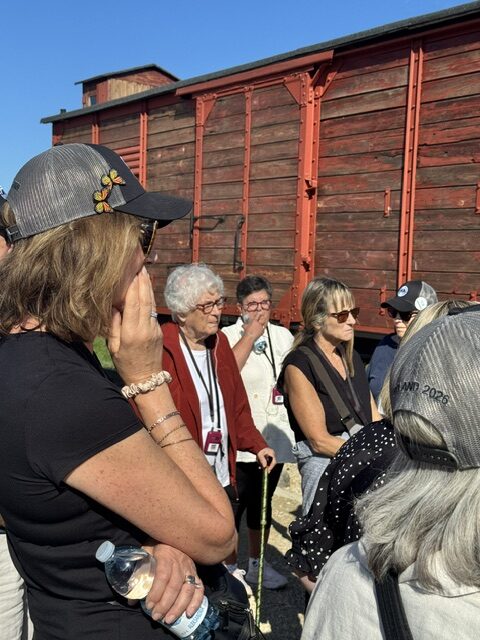
By MYRON LOVE For Sheila Rabb, her first visit to Poland was “both heartbreaking and heartwarming.”
The 90-year-old Rabb was one of 34 participants in the Jewish Federation of Winnipeg’s first ever organized Adult Mission to Poland. The group toured Poland from Wednesday August 26 – Monday August 31, with an entourage of Israel and Polish tour guides, a security guard ,and two bus drivers.
It was Jeff Lieberman, CEO of the Jewish Federation of Winnipeg (and whose late father, Aron Lieberman, was a Holocaust survivor who was originally from Poland) who initiated the trip. “In 2023,” he recounted, “shortly after I was appointed CEO, I learned we had never organized an adult mission to Poland. Given the passage of time since the Holocaust and the tragedy of October 7th, I thought there would be interest in offering this meaningful trip to our community.“
The six-day journey,” Lieberman continued, ”taught us about the 1,000 years of mostly good and impactful Jewish life in Poland before 1939, as well as what happened during the Holocaust. We visited several sites including the Warsaw Jewish Cemetery, the Polin Museum, synagogues, the Krakow Jewish Community Centre, the Lodz Ghetto, Majdanek and Auschwitz-Birkenau concentration camps, and the Chelmo death camp.
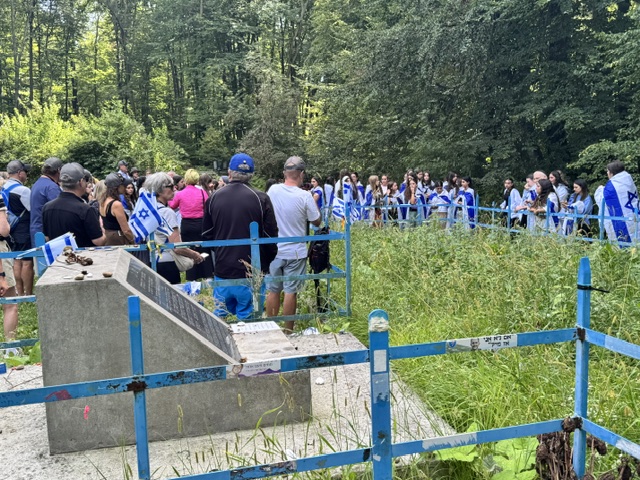
Lieberman noted that the group bonded very quickly. ”We learned so much,” he said. “We cried together and we celebrated together. Many of the people that went on this mission have said how life-changing this trip was for them.”
In particular, the Federation CEO singled out the presence of Sheila Rabb. He describes her as “incredible”. It was a difficult tour with much walking and standing at sites, he noted.
“She was a real trooper,” Lieberman said. “Sheila was able to able to experience this meaningful journey with her children. It was truly special for us to have Sheila and her children, Ian and Irene (Zimmer), join us.”
“There was a wheelchair available for me if I needed it,” said Rabb, who looks much younger than her years. “I must admit that the heavy schedule of 12-hour days and late dinners was a challenge. But everyone was so nice and helpful and protective of me.”
Sheila Rabb’s connection to Poland was through her mother, Molly (Horn) Pitch. Fortunately, she was able to emigrate in the early 1930s. (Sheila’s father, Willy, came here from Russia about the same time.) Molly was able to bring one brother over but sadly, all but one sister were subsequently murdered by the Nazis.
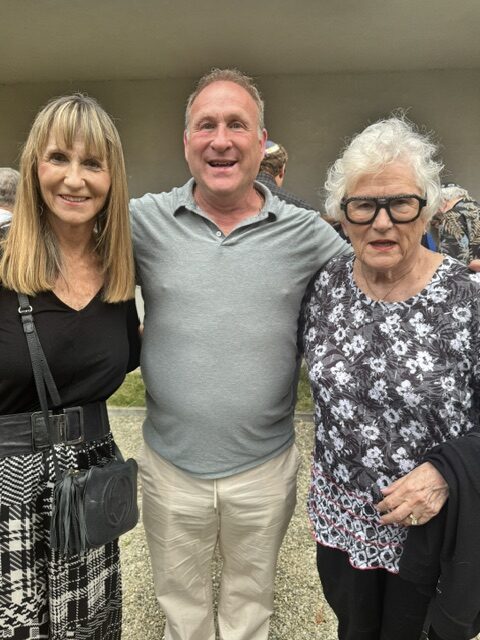
The group began their journey in Warsaw with a visit to the Polin Museum which – Rabb noted – was built by Ron Lauder, president of the Estee Lauder Foundation. The museum recounts over 1,000 years of Jewish life in Poland.
“We learned about Jewish life, how Jews contributed to Polish society and the rich communities that existed throughout the country,” Lieberman reported.. “You can’t talk about Poland without including the impact of what Jews did for Poland.”
Both Rabb and Lieberman have fond memories of a group of Israeli high school students that that they met at the museum, who were from Ulpanat Chorev High School in Jerusalem. “We joined them in singing Hatikvah and other songs and danced a hora with them,” Lieberman said. “We ran into them again at Mila 18 and Auschwitz, and their Head of School invited us to join them for Kabbalat Shabbat in Krakow.
“Our group had the amazing experience of celebrating Shabbat with them,” he continued. “The women were so joyous, and their enthusiasm helped us emotionally after what we had experienced during the first few days of the mission. Their presence and the sorrow they expressed at the sites we shared with them had a profound impact on all of us.”
The group’s time in Warsaw also included a visit to a Jewish cemetery with over 250,000 graves and a walking tour of the famed Warsaw Ghetto.
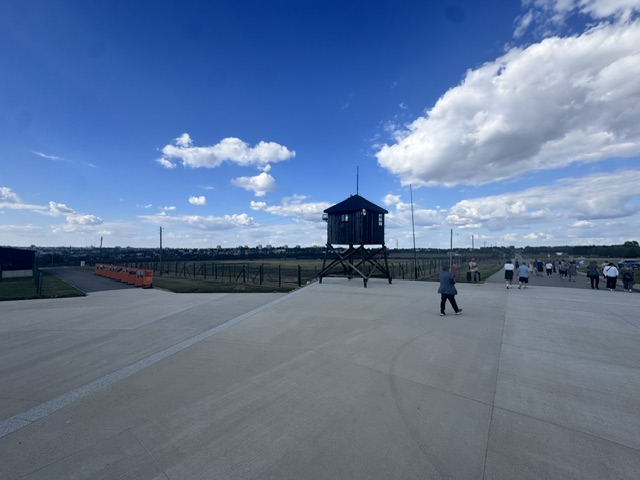
The next stop was Lublin and the Majdanek death camp.
“One can read the books, watch the films and visit the museums, but nothing prepares you for walking the grounds of the death camps and mass grave sites and the profound sadness and shock that accompany them,” observed Jewish Federation staffer Abby Flackman, who was also part of the mission. “Walking in Auschwitz, Majdanek and the forest graves of Chelmno, I felt, validated the lives that were taken. We take the memories of their experiences and assure that they will not be lost with time.
“But,” she added, “we also showed that we are still here. We are still laughing and feeling joy, supporting one another and proud of who we are.”
On the other side of the coin, the group witnessed the ongoing rebirth of Poland’s Jewish community. One site that Sheila Rabb recalled in particular was the reconstituted Lublin yeshiva. The yeshiva, which opened in 1930, was one of the largest in the world. The building was restored by the Jewish community in 2003 and reopened as a synagogue in 2007.
On the Friday of the tour, the group arrived in Krakow, where they toured the old Jewish quarter where, Ian Rabb noted, there are still many Jewish-owned businesses – also the Schindler factory museum. He reported that Krakow has a Jewish population of about 1,200, as well as home to the internationally known annual Krakow Jewish Festival.
Sheila Rabb spoke about a 97-year-old Holocaust survivor the group encountered, who told his story. Although he had lived in California most of his life, he felt the need to return to Poland two years ago.
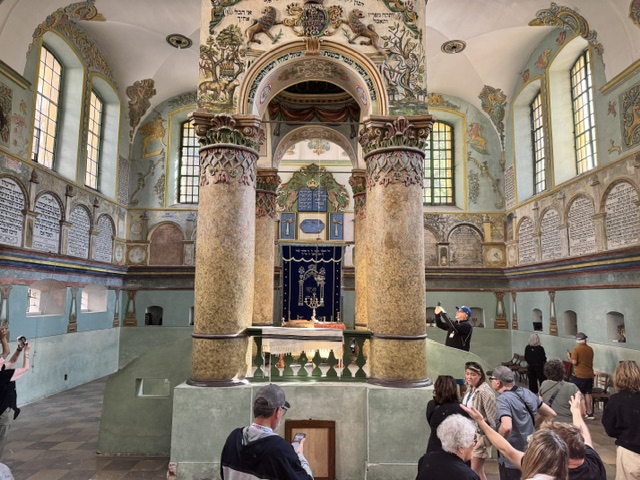
While in Krakow, the group made a day trip to nearby Lancut, formerly a Hasidic stronghold, where the members of the group toured the synagogue that was built in 1761 and has been well preserved.
“The synagogue was unreal,” Ian Rabb commented. “It has an art deco design that exudes spirituality and kabbalah.”
The Winnipeggers finished their tour with a visit to the Lodz ghetto. Lodz was an industrial city and the last Polish city to be made “Judenrein” because the Nazis needed the Jewish factory workers to build tanks and sew German soldiers’ uniforms.
For Sheila Rabb, one of the most difficult moments was standing on the site of the mass grave in the forest near the Chelmno death camp, not far from Lodz, where up to as many as 300,000 victims of the Chelmno gas chambers were buried.
“We recited kaddish over the site,” she said.
Sheila Rabb hac high praise for the Winnipeggers’ Polish and Israeli tour guides, Janush and Mordechai. ”They were outstanding,” she said. “They really brought history alive for us.”
Ian Rabb reports that his cousin (and Sheila’s nephew), Alan Pitch, who was also part of the group, is working on a documentary of the trip.
The last word goes to Abby Flackman. “My biggest takeaway,” she said, “is that we will control how our story ends. The Nazis tried to end our story of the Holocaust. They failed. We went elsewhere, built communities and institutions, grew again in numbers and continue to strive to become stronger, more resilient and thrive.”







Local News
Gail Asper adds $10-million donation to ambitious $1.2 billion Hebrew University fundraising campaign
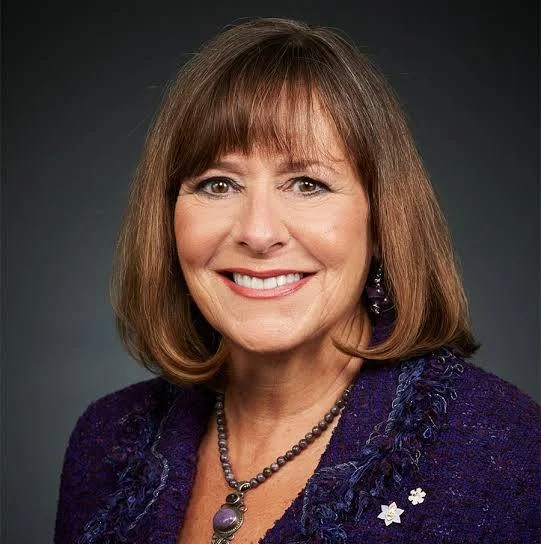
By MYRON LOVE Gail Asper, one of our community’s leading philanthropists, has recently returned from the Hebrew University of Jerusalem’s annual International Board of Governors meeting, during which she pledged $10 million to the university’s $1,2 billion international Powered By Purpose Campaign.
As reported in the Post last April, Asper has taken on the challenge of co-chairing the campaign (with patty Glaser from Los Angeles), which was kicked off at the recent board meeting. “It is important to lead by example,” she notes. “As my father (the late I.H. Asper) used to say, it is important to give what you can.”
Rami Kleinmann, President and CEO of Canadian Friends of the Hebrew University observed that “Gail’s gift is a testament to what is possible when personal conviction, a tradition of giving, and belief in a mission come together. We are deeply grateful for her leadership and for the Asper family’s remarkable partnership with Hebrew University.”
Professor Tamir Sheafer, president of the Hebrew University of Jerusalem, speaking on behalf of the entire Hebrew University community, thanked Gail “for her remarkable generosity and her leadership. Her gift, and her role as co-chair of our international campaign, will help us keep Hebrew University a global leader in research and education for many years to come.”
Asper’s personal connection with the Hebrew University goes back more than 50 years. She recalls going to Israel for the first time with her family in 1974, when she was 14. In her 20s, she and her brothers went to Jerusalem with their parents where Israel Asper would be attending HU annual Board of Governors meetings.
“I met the president of the university,” she recounts. “I got to see what the university was doing and got to know the people on the board. There were board members from all over the world, all accomplished and interesting people.. It was so glamourous.”
In 1989, her father – after more than 20 years on the board – told Gail that he was stepping down to spend more time building the still relatively new Canwest – and suggested that she should replace him as a board member. Not only did she join the board, but she also became one of the founding members of the newly formed Canadian Friends of Hebrew University Business and Professional Division, along with other now prominent community members such as Howard Morry and Murray Palay.
It wasn’t long after she joined the Hebrew U board that she moved on to the board executive,” she notes. “We would have meetings in Israel three or four times a year. Thank goodness now for Zoom. But I really enjoyed meeting with fellow board members, as well as university management and faculty.”
Among the Asper family initiatives at the University are: the Asper HUJI Innovate program – the University’s centre for innovation and entrepreneurship; theAsper prize in Innovation, which supports and celebrates promising Israeli start-ups; the Asper Center for Entrepreneurship and Innovation, the academic and community hub housed within the Hebrew University Business School (HUBS); and ongoing exchanges that bring Canada’s brightest students to Israel for a semester or complete degree.
Gail reports that her new donation is intended the help make up for the rapidly decreasing number of scholarships and grants from foundations outside of Israel that would normally be potentially available for Hebrew University students and researchers, but which have declined in number due to the increasing hostility in academia to anyone connected to Israel.
She is happy to report that the five-year Powered By Purpose Campaign has received a major boost from a $250 million gift from billionaire American hedge fund manager John Paulson. “This is the largest gift ever received by the Hebrew University,” she notes. “This is also the first time that the university has received a donation from Mr. Paulson. We are really excited about it.”
In that earlier interview with the Post, Asper reported that one focus of the new campaign will be Jewish philanthropists and foundations who had been supporting American and Canadian universities but who have been told that, since October 7, 2023, that their donations are no longer welcome. “Others have pulled their donations because of anti-Jewish activity on campuses,” she pointed out. “We will be suggesting that their donations will be better spent supporting Israel’s leading universities rather than antisemitic universities in Canada and the US.”
One area that struck her about this most recent visit to the university was the large number of Israeli Arab students and faculty. “You see the diversity on campus,” she observes. “Close to 20% of the student body and staff are Arab Israelis. Most students seemed to be comfortable on campus and happy to be there.
“It was wonderful to be in Israel,” she says, “and nice to see other Winnipeggers – such as (Federation CEO Jeff Lieberman, (CIJA representative) Gustavo Zentner, and (philanthropist) Larry Vickar also in Israel to attend other institution Board of Governors meetings at a time when direct flights to Israel are scarce and there are very few tourists.”
Local News
Palestinian-born Dor Shachar chose Judaism and life in Israel over Islam and darkness in Gaza
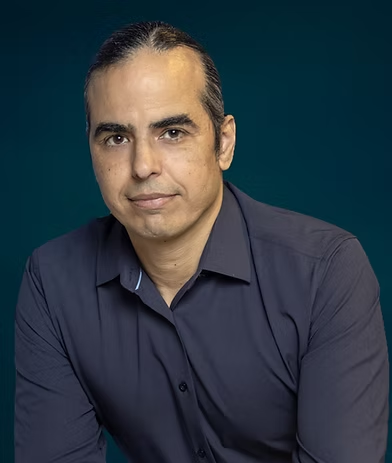
By MYRON LOVE Dor Shachar is a rare individual indeed. It seems almost miraculous – certainly “beshert” – that this individual, who was born into a Muslim family in Gaza and raised as a Muslim, chose to leave behind the hell and darkness that is Gaza and embrace the light of Judaism and Israel.
On Monday, November 2, the proud Jewish Israeli shared the story of his transformation with an audience of about 150. Invitations were specifically sent out to Christian communities in Winnipeg because extreme Islam also targets Christians, as well as moderate Muslims.. Earlier, he also spoke in a couple of schools.
Among the attendees were several members of the Manitoba Conservative Party caucus – including interim leader Konrad Narth. Invitations to attend Shachar’s presentation were also sent to the other provincial parties, but no one from the other parties showed up.
As Shachar doesn’t speak English, his remarks were translated by Jona Rapaport, who is from Montreal and who had family members kidnapped on October 7.
Shachar’s narrative falls into two distinct parts – and I have to admit that the first act was at times very difficult to listen to. What he described of his life growing up in Gaza was horrific. He recalled that the clothes his family wore, the food they ate, and their appliances were all from Israel, and that his father worked on construction projects in Israel for many years. His father and grandfather pretended to be on friendly term with the Israeli soldiers who patrolled Gaza at the that time – in the 1980s –and the family invited soldiers – these same soldiers who would give the kids treats – into their homes. His father and grandfather were hospitable and seemingly friendly. As soon as the guest would leave though, the young Shachar was told that he one day it would be his duty to kill the “sons of apes and pigs” – referring to the Israelis living in Jewish communities that had been established in Gaza.
Shachar reported that his neighbours were future terrorist leaders, including Hamas leader Yahya Sinwar. He witnessed the digging of the first terror tunnels more than 40 years ago. As well, he saw the evil of the various hateful groups who used torture and terror to rule Gaza – from Fatah to Hamas and their affiliated terror groups. He described public scenes of torture and murder that rivaled the worst excesses of the European Dark Ages a thousand years ago. He recalled how in elementary school, students were taught how to throw rocks at Israeli soldiers.
In a particularly horrifying segment, Shachar recalled what happened to him when still in primary school. Apparently, he didn’t show enough zeal about hating Jews and Christians. He was hauled into the principal’s office – where he was whipped. When his father learned about this, he spent hours beating and torturing his son – including hanging a noose from a tree – for “dishonouring” the family. Only an intervention by an aunt most likely saved his life – although his father then proceeded to beat the aunt. He was relegated to looking after the family flocks.
Another time, when he was 11, his father found out that he was skipping school, beat him, tied him to a tree, and doused him in cold water. Shachar was locked in the outhouse for the night and forced to sleep on the floor.
A few months later – when he turned 12 – his father started taking the youngster with him to Israel to work on construction projects. After a couple of months, he managed to run away.
Thus began the second chapter of his life – his new life in Israel.
While working as a security guard watching over a neighborhood of villas where prospective tenants would come to see the apartments, he was approached one day by a resident by the name of Nissim Ozen.
“Nissim took interest in me,” he recounted. “He brought me home with him, got me clothes and shoes and other gifts.”
He began to be invited to Ozem’s home for Shabbat suppers and other meals and was welcomed to have hot showers and watch television.
At Pesach, he was invited for the family’s seder.
“I come for the seder and I see the longest table I have ever seen,” he recounted. “It stretched from the living room through the kitchen out to the garden. On the table, there was bread, only the matzah, some eggs, a shank bone and some greens. I asked my host if he was on a diet.“I didn’t yet know much Hebrew, but I learned about the Exodus.”
That was when Shachar decided that he wanted to become a Jew. Some of his new friends arranged for a local Bet Din. He was subsequently referred to another Bet Din in Tel Aviv, then a third in Kiryat Shemona in the north, and finally, to Jerusalem where he told that, because he was still a minor, he would need his father’s permission.
That was never going to happen.
Nonetheless, Shachar was able to go to school and become proficient in Hebrew – while he eagerly counted down the days until he turned 18 and could become Jewish.
But, there was another hitch in store.
It was now the mid-1990s and the first Palestinian suicide bombers began killing Israelis on buses, in restaurants and wherever they gathered. Shachar spoke of the notorious Yahya Ayyash – the bomb maker, Shachar recalled, who provided his dubious services to all the Palestinian factions. (The IDF caught up with him and killed him with a bomb in early 1996.)
Shachar pointed out that – contrary to what diplomats, politicians and leftists in the West believe – there is no difference between Hamas, the PLO/Palestinian Authority – given the facts and what they say in Arabic from “pay for slay” to other hate they espouse against anyone not aligned with them – even moderates. There is no “partner for peace” among the Palestinian factions, he says, – and no difference between those factions and Al Qaeda, ISIS, and the Taliban.
Unfortunately for Shachar, due to the increased level of attacks by Palestinian terrorists, Israel tightened restrictions on Palestinian workers who were allowed to work in Israel. All Palestinians workers had to have permits. Because he didn’t have one, he was sent back to Gaza, where he was tortured daily by Hamas operatives for six months.
Eventually, he was released to fend for himself in Gaza. Determined to return to Israel and become Jewish, he was – after a few months – able to slip across the border to Egypt and make his way via Turkey back to Israel
Back in Israel, he attended a yeshiva and resumed his efforts to become a Jew. It took him seven years to realize his dream. The climactic moment for him came, he recounted, one Purim when he joined a rabbi in Jerusalem for a “farbrengen.”
“I had never had alcohol before,” he said. “Alcohol is forbidden to Muslims. I quickly became woozy. Nonetheless, the rabbi kept pouring. Even while drunk, I kept insisting that I wanted to be a Jew. That was enough to convince the rabbi to support my efforts.”
Today, Dor Shachar is a proud Jewish Israeli – happily married – who speaks for Israel on the world stage and warns people, especially in the West, about the hateful dogma and true extremist intentions of Islamist ideology. Statistics indicate that 15-25% of Muslims in the West are radicalized. With the influx of people from Gaza and other areas that number may be grossly underestimated.
In Gaza and Judea and Samaria the numbers are higher.
The ultimate goal for Islamic extremists, Shachar warned, is world domination.
Local News
Harvey Richmond: an unusual career path with many twists and turns
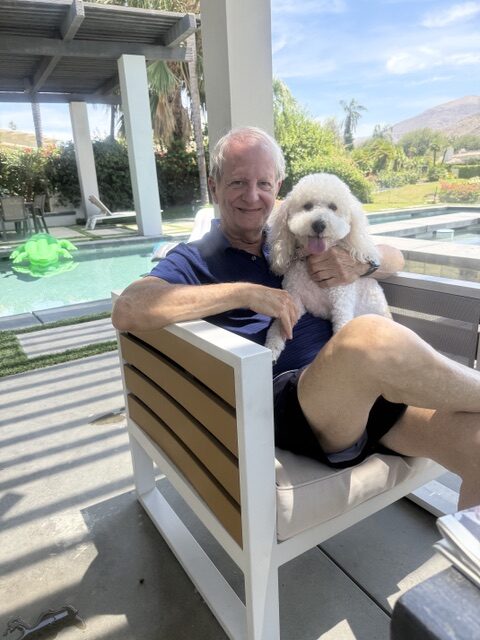
By GERRY POSNER When you talk about someone whose life has had more than a few different moves, Harvey Richmond’s life would be right up there as one of the most circuitous. You could rightfully say that his life has been far from predictable.
Harvey, the middle son of three boys (Barrie – older, and Kenny – younger), whose parents were David and Nettie (Brown) Richmond, is now north of 85 years. He lives in the Los Angeles area and has been there for well over 40 years.
Harvey grew up in the south end of Winnipeg and, for most of those years, his home was a corner house on Waverley and Grosvenor. The family was connected to the Shaarey Zedek synagogue even before it was located on Wellington Crescent.
Harvey went to Queenston School and later graduated from high school at Kelvin. Like many of his contemporaries, he was off to the University of Manitoba, where he obtained a Bachelor of Science degree with a major in Mathematics, then a Bachelor of Science in Pharmacy. He became a licensed pharmacist in 1961.
The plan was for Harvey to join his father, also a pharmacist, in his father’s drugstore. But, at that time, Dave Richmond was getting ready to retire, so Harvey went to work for Bunny Ringer at his drugstore on Pembina Highway, a place likely known to many readers. After two years there, Harvey realized pharmacy was not for him, so suddenly, the first detour in Harvey’s life hit him smack in the face.
Harvey was planning to visit his older brother Barrie, who was doing an internship in Chicago at that time. Flying there was not feasible for Harvey – or anyone else at that particular time, as Northwest Airlines was on strike, so he hopped into his car to drive to Chicago. On his way through Grand Forks, however, Harvey saw a sign advertising the University of North Dakota’s medical school. Why not? he asked himself. He applied, was accepted and thus, in 1966, he was a student in Medicine at the University of North Dakota. At that time, UND had only a two-year programme, with training in the basic sciences. The school had arrangements with other medical schools throughout the USA to accept students who had completed that school’s two year programme. So, after his two years at UND were completed, off Harvey went to the University of Minnesota. By 1971, he was a graduate in Medicine from that university.
During his time in Minneapolis, Harvey also married a woman from that city and, within three years, he was the father of two girls. In 1971, Harvey did his internship at Los Angeles County-USC Medical Centre in Los Angeles. He elected to enter Obstetrics and Gynaecology as his final rotation – which turned out to be a sign of things to come several years down the road. However, in 1971, Harvey was not totally sure that being an OB/Gyn was what he wanted to be.
Harvey signed up for a residency in Minnesota in Neurology, so the family returned to Minneapolis for Harvey to begin a new residency there. After a year, Harvey concluded that Neurology was also not for him, but he chose to remain in the Twin Cities and join a family practice with four other physicians, called Apple Valley Medical Center. While there, he developed a renewed interest in Obstetrics. This time, Harvey decided that Obstetrics and Gynaecology was really what he wanted to pursue, but he also recognized that he needed more comprehensive training to do that.
Thus, at the age of 40, he made yet another major career decision and began a residency in Obstetrics and Gynaecology. He did his residency at the University of Minnesota and St. Paul Ramsay Medical Center. If you can picture it, here was 40-year-old Harvey Richmond, married, with two little kids, now starting over in what was to become his chosen specialty. But – after he finished his residency, his marriage also ended.
Next, Harvey was offered a position in the Los Angeles area. In 1984, off to Long Beach, California he went. About a year later, he had an opportunity to take over a practice in Beverley Hills. He also received privileges to practice OB/Gyn at Cedars- Sinai Medical Centre in Los Angeles. Harvey officially joined the medical staff there in 1986 and has remained on staff ever since.
As Harvey puts it, “Over the course of my career, I have delivered an extraordinary number of babies.” One of his staff tried to calculate the total number and the estimate was in the range of 10,000 to 12,000 babies. Harvey reflects that a large part of his career has been devoted to caring for pregnant women, delivering their babies and practicing OB/Gyn. Additionally, throughout his time at Cedars, he has been on the teaching staff there, instructing OB/ Gyn residents in surgical procedures.
In 1988 Harvey married again. That marriage also ended – in 2003. However, the one constant throughout Harvey’s life the past 40 years has been his career at Cedars-Sinai Medical Center.
Harvey uncategorically states that he was extraordinarily fortunate to find something he loved to do, even though it took him quite a few years and several career changes to get to this point. His journey was difficult at times and he admits it has come at a personal cost in terms of his family.
Yet, his career has given him great satisfaction and filled him with a sense of purpose. As Harvey puts it, “I was privileged to be present during some of the most important moments in people’s lives.”
In the end, Harvey Richmond reflects on his medical practice this way: “ Looking back, I realize that my path was anything but direct. I began as a pharmacist, entered medicine almost by chance, tried Neurology, practiced Family Medicine, and eventually returned to residency so that I could become an Obstetrician and Gynaecologist. Each decision brought me closer to the work I was meant to do.”
To this day, Harvey is grateful to those who supported him along the way. Even at the age of 85, Harvey Richmond is still practicing medicine, although now on a part time basis, working only in the office. He remains active and still gets enjoyment out of his work. The path Harvey took had many twists and turns but, ultimately, many rewards along the way.
