


Features
An Overview of Antisemitism in Western Europe
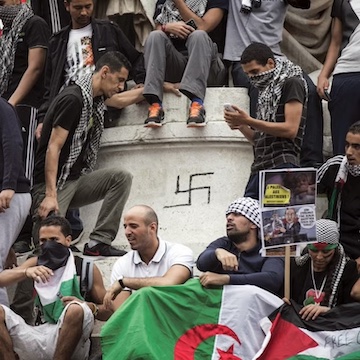
By HENRY SREBRNIK The European Union Agency for Fundamental Rights survey of 2024 found that 96 per cent of Jewish respondents had encountered antisemitism online or offline in the 12 months before the survey, and that 76 per cent avoided wearing or displaying items that would make them recognizable as Jewish in public.
Antisemitism in Austria remained at alarmingly high levels last year, reaching its highest point since records began. The Antisemitism Reporting Center of the Israelitische Kultusgemeinde Wien (IKG), the official body tracking antisemitic incidents against Austria’s Jewish community, released its annual report in April documenting 1,532 cases in 2025.
Last November, protesters rallied in Vienna against an event dedicated to Franz Dinghofer, an Austrian politician who was a self-confessed antisemite and a Nazi party member. They were protesting an event called the Dinghofer Symposium that they say is antisemitic. The far-right Freedom Party of Austria (FPO) members countered that they remember Dinghofer as a statesman in the period between World War I and World War II.
In Belgium, Jewish communities are described as tight-knit but insecure, and constantly aware that their citizenship and prosperity don’t guarantee their acceptance or safety. Too often, writes Brandeis University historian Flora Cassen, who grew up in the country, “governments and the media treat attacks on their Jewish communities as a front in the Israeli-Palestinian conflict, not as an attack on their own citizens.” In March, there was a car burning in the Jewish quarter of Antwerp. As well, a synagogue in Liège was damaged by an explosion in what the country’s interior minister called “an antisemitic act.”
In France, antisemitic violence has intensified while the experience of protection has weakened. Jewish students face harassment framed and justified as political expression. Synagogues operate behind security. Wearing a kippah can require calculation. These are no longer marginal experiences; they have become familiar features of Jewish life in places that once felt self-evidently safe. Since 2000, between 80,000 and 100,000 Jews have fled France — more than 20 per cent of the community.
More troubling still is the ideological shift. Antisemitism is increasingly reframed as political critique, social protest, or resistance to power. Jews are often excluded from the moral category of vulnerable minorities. The very frameworks designed to protect them can struggle to recognise them as victims.
A staggering number of antisemitic incidents has now become normal in France — 1,320 in 2025 is nearly double the already extreme 851 in 2014. But what’s more interesting is the shift in social permission to openly hate Jews.
The far-left La France Insoumise (LFI) Party in France has been accused by academics and ministers of antisemitism after their de facto leader, Jean-Luc Mélenchon, refused to call Hamas a terrorist organization and party members marched with Islamist-linked NGOs during Gaza protests. The LFI’s popularity has been on the rise in polling ahead of next year’s presidential election, according to the French newspaper Le Monde. Ninety-two per cent of French Jews believe that the LFI contributes to antisemitism in France.
Mélenchon took advantage of nationwide student protests in early October. To advance his political prospects, his strategy appears to be to capitalize on the discontent currently roiling the country. Mélenchon has also accused authorities of repression with a racist undertone, since many of the protesters are Muslim. No surprise, then, that Palestinian flags have appeared at the protests.
Although Mélenchon was known in the 1990s as a hardcore secularist, by 2020 he had allied himself with Houria Bouteldja, co-founder of the “decolonial” (anti-West) Parti des Indigènes de la République (PIR). Under Bouteldja’s influence, Mélenchon began to utter questionable remarks on the Jews. The way Mélenchon uses the idea of uniting against one enemy by speaking of Israel “is similar to the way Hitler used to speak about the Jews,” according to Israeli Ambassador to France Joshua Zarka. So it’s no surprise that French president Emmanuel Macron, getting more and more unpopular, recognized a Palestinian state in 2025.
Germany has cracked down on speech and demonstrations that assert support for Palestinians and accuse Israel of atrocities, part of a national policy toward antisemitism, defined over decades in the shadow of the Holocaust and sharpened recently under the helm of Felix Klein, the first federal commissioner for combating antisemitism. Many Jews say they feel safer under such bans. The Central Council of Jews in Germany recommended Klein for his appointment as antisemitism czar. Some human rights groups have objected, however, saying the bans limit free speech and criminalize legitimate expressions of support for the Palestinian cause.
Disputes over Israel recently erupted at the Buchenwald concentration camp memorial, as both Israel’s critics and its defenders claim the Holocaust for their terrain. The anti-Zionist group Kufiyas in Buchenwald announced a demonstration there on April 11, the anniversary of its liberation, in protest against a German court’s decision that the site could refuse entry to visitors who wear a Palestinian keffiyeh. The court said that wearing a keffiyeh to send a political message “would endanger the sense of security of many Jews, especially at this site.” The Buchenwald protest was condemned by the European Jewish Congress, and Klein said it marked a “new low point in the unfortunately all-too-common reversal of perpetrator and victim roles.”
In an election held Sept. 20 in Berlin, the left-wing Die Linke came in first, winning 25.7 per cent, more than doubling its 2023 share. Israel’s ambassador, Ron Prosor, described antisemitism within Die Linke as systemic. Philipp Peyman Engel, editor in chief of the Jüdische Allgemeine, the newspaper of the Central Council of Jews in Germany, wrote that party was “riddled with people who hate Jews and Israel.”
Italy in April announced that it was declining to renew a longstanding defence agreement with Israel, a sharp reversal for Prime Minister Giorgia Meloni’s right-wing government. Opposition parties had put pressure on the government for over a year to suspend the renewal. Marco Grimaldi, an opposition lawmaker, said the decision was “a victory” for those who had protested Israel’s military offensive in Gaza over the last three years.
On Oct. 3, 2025, there was a nationwide general strike, which the labour union leaders officially called “to support the residents of Gaza and a humanitarian aid mission.” While mass anti-Israel rallies gripped other parts of Europe, Italy’s were the most numerous.
Recent Italian demonstrations of “solidarity” with Palestine saw protesters carry Palestinian flags, flags of Italian labour unions, and red flags with hammers and sickles. Some of the banners had the words, in Italian, “yesterday partisans, today anti-Zionists and anti-Fascists,” and declared support for “Palestinian resistance.”
Dutch Jews have long been used to seeing security and armed police in front of their schools, synagogues and gatherings. Since a school and a synagogue were attacked over two days in March, an unsettling feeling has spread among Jews in the Netherlands. Assailants struck Jewish buildings — a religious school in Amsterdam, where most Dutch Jews live, and a synagogue in Rotterdam. Mayor Femke Halsema of Amsterdam called the blast at the school a “targeted attack against the Jewish community.”
Before the Holocaust, the Netherlands had a robust Jewish population. The Nazis deported 75 per cent of Dutch Jews to death camps, the highest such rate in Nazi-occupied western European nations. Today, the Jewish population of the Netherlands is estimated at about 35,000 people, just 0.2 per cent of the country’s 18 million residents.
“I am mostly angry,” declared Menno ten Brink, a rabbi at the Liberal Jewish Community in Amsterdam. The explosions have had a big impact on Dutch Jews and the wider society, added Eddo Verdoner, the Dutch national coordinator for combating antisemitism. Antisemitism has been increasing over the last decade or so, he said, with an “exponential increase” since October 2023.
Relations between Israel and Norway have plummeted to historic lows, with Oslo becoming one of the Palestinians’ staunchest supporters in Europe. Norway became the first European country to announce that it would arrest Israeli Prime Minister Netanyahu and former Defence Minister Yoav Gallant following the International Criminal Court’s issuance of warrants against them, and it then joined South Africa in its International Court of Justice case against Israel.
“I find it shameful that we have one of the most anti-Israel governments in Europe,” MP Himanshu Gulati, chairman of the Israel Allies Caucus in the Norwegian Parliament, has remarked. Not surprisingly, the Norwegian government has recognized. a Palestinian state.
In May, Norway’s higher education minister indicated that she did not intend to punish a university professor who praised Hamas’s Oct. 7 massacres in Israel because he had “the same freedom of expression as everyone else.” Sigrun Aasland was referring to Bassam Hussein, a professor at the Norwegian University of Science and Technology (NTNU), who on April 21, during a lecture before the Socialist Forum in Trondheim, said that the Oct. 7 massacres were “the most beautiful thing that has happened in our century.”
Norway’s Foreign Ministry put out a bill this fall before its parliament that would send Norwegian citizens and companies to prison for buying from, selling to, building for or investing in businesses owned by Jews who live in the West Bank. Negligent violators get six months.
In Portugal anti-Israel sentiment punctuates the actions of the political press. The most significant antisemitic events that occurred in recent years included demonstrations for better housing that targeted local Jews whose personal names were published in newspapers, bomb threats against the country’s largest synagogue and the Holocaust museum, which was called a “brothel that teaches the lie of the 6 million,” and hate messages written on the facades of Jewish homes to identify “Zionist pigs.”
Following October 7, 2023, antisemitic and antizionist incidents surfaced more visibly in public spaces and academic institutions. High-profile incidents include verbal electoral harassment against Jewish community figures like writer Esther Mucznik, acts of vandalism directed at the Lisbon Synagogue, and hostile propaganda targeting Jewish and Israeli students at the University of Coimbra
The far-left Sumar Party in Spain is part of socialist Prime Minister Pedro Sanchez’s ruling coalition. Their support has been strongest in areas with high Muslim populations, with party members attending demonstrations with Muslim Brotherhood-adjacent groups and Gaza protests organized by Islamist-leaning networks. Members also pushed for Spain to recognize a Palestinian state, which it did in 2024, while also referring to Israel as an “apartheid state.”
The political left spread a narrative across social media asserting that the recent migrant invasion by Moroccans of Spain’s Ceuta enclave is part of a vast American-Israeli conspiracy to destroy the country. Spain’s Transportation Minister supported the theory on social media while Gabriel Rufian, a spokesperson from the Spanish Congress, asserted that the U.S. and Israel were flooding Europe with migrants to “blackmail” the country.
In Sweden, debates about antisemitism loomed large throughout the recent election season, despite the country’s small population of Jews, who number about 20,000 in a country of more than 10 million people. Politicians on all sides repeatedly sought to position themselves as the best defenders against antisemitism.
Aron Verständig, who chairs the Official Council of Swedish Jewish Communities, said that while he appreciated gestures of solidarity with the Jewish community, he worried that politicians hurling accusations of antisemitism against each other could reduce Jews to a weapon of political debate. “Of course, it’s good that our situation is discussed and people are interested in what happens to the Jews here in Sweden — but on the other hand, there’s a risk that we are becoming a tool.”
Simona Mohamsson, Sweden’s minister for education and integration, who is of Palestinian and Lebanese descent, wore a Star of David during a televised debate. A member of the center-right Liberals, she wore the symbol “for the children who do not dare to in today’s Sweden.” She criticized members of the Left Party for “flirting with extremists.”
Since 2023, the war in the Middle East has been a defining trigger for antisemitic incidents in Switzerland. For the Jewish community, this has been a constant strain for more than three years.
Pro-Palestine activists are very active at Swiss universities. There have been anti-Israel demonstrations, some of which were associated with calls for violence and antisemitic slogans. The one in Bern in October 2025 stands out in particular because there was a massive outbreak of violence. In the larger cities of Switzerland, offensive graffiti relating to the conflict in the Middle East is omnipresent.
Here and there we see small improvements on the continent, but not enough to turn things around. The ancestral Jewish knowledge that safety can collapse with terrifying speed, even in civilised societies, begins to return.
Henry Srebrnik is a professor emeritus of political science at the University of Prince Edward Island.









Features
Hair straightening at Sets on Corydon

Features
Ontario Online Casinos Let Players Set Daily, Weekly and Monthly Deposit Limits

A deposit limit sets a ceiling on how much money someone can add to an online gambling account. In Ontario’s regulated market, players can choose limits covering 24 hours, seven days and one month, with the website’s system enforcing the amounts they select.
The settings are straightforward, but the timing deserves attention. A daily allowance may sit within weekly and monthly caps, while an increase can involve a waiting period. For adults using Chrome on a Chromebook, understanding these account rules starts with knowing where to find them.
Finding the Settings and Choosing a Period
Deposit controls sit within the gambling website’s account menus. The Tooniebet Ontario responsible gaming page is an operator-specific resource readers can consult alongside their account settings. ToonieBet is operated by Canadix Limited and regulated by the AGCO under an agreement with iGaming Ontario.
Ontario’s standards require an easy and obvious way to set financial and time limits during registration and afterward. Players must be offered deposit and loss limits when signing up, and the controls must remain easy to reach and change once an account is open.
Menu names differ between sites. Published examples place deposit limits under account settings or responsible-gaming tools, where players can select an amount and a period.
Each type of limit measures something different. Deposit limits cap money added to the account. Loss limits restrict net losses after winnings are taken into account, while time limits govern playing time. iGaming Ontario’s player guidance explains all three.
For Chromebook users, these settings are managed through the website’s account interface. Chrome’s own permissions handle separate browser functions, such as access to location information.
How Several Limits Apply to One Deposit
Players can have daily, weekly and monthly limits running together. A deposit must fit within every active cap.
Take a hypothetical account with limits of CAD $40 daily, CAD $100 weekly and CAD $250 monthly. These figures illustrate the process.
If someone has already deposited CAD $90 during the weekly period, the remaining weekly allowance is CAD $10. That becomes the most they can add, even when the daily limit has more room. Reaching the monthly cap would likewise block another deposit until some monthly allowance becomes available.
This is why checking all active limits matters. A new day may bring fresh daily capacity while the weekly or monthly total remains close to its ceiling. The longer periods continue to apply as the shorter one refreshes.
When Money Drops Out of a Rolling Window
The next question is when previous deposits stop counting toward a cap. Some sites use rolling periods, which track elapsed time from individual deposits.
Published Ontario policies include daily windows of 24 hours, weekly windows of 168 hours and monthly windows of 720 hours, equivalent to 30 days. Under that approach, each deposit frees up its corresponding allowance once it falls outside the window.
Suppose someone has a CAD $100 rolling weekly limit and deposits CAD $25 on Friday, followed by CAD $75 on Saturday. Seven days after Friday’s deposit, CAD $25 becomes available again. The other CAD $75 returns seven days after Saturday’s deposit.
Leaving the restored Friday allowance unused means it combines with Saturday’s restored amount. At that point, the full CAD $100 is available. Reviewing deposit dates and times helps explain how much room remains within a rolling period.
Changing a Cap Takes a Separate Step
A limit refreshing follows the schedule already attached to the account. Raising that limit requires a request and a wait.
Ontario’s standards require at least 24 hours before a player’s request to relax or remove an established limit can take effect. The existing limit remains enforceable during the cooling-off period.
Operators publish their own timings. Documented examples include a seven-day wait for deposit-limit increases or removals. Another published schedule allows increases after one day for a daily cap, seven days for a weekly cap and 30 days for a monthly cap.
Lower limits take effect immediately under these published policies. Some policies also restart the waiting period when a player requests another increase while an earlier change is pending. The effective date shows which amount currently applies.
Other Controls and Support
Deposit limits work alongside loss limits, time limits, short breaks and self-exclusion. Together, these give players ways to restrict account funding, gambling activity or access.
Ontario-regulated online casino play is restricted to adults aged 19 and older who are physically in Ontario. Gambling involves financial risk.
For concerns about your gambling or someone else’s, ConnexOntario offers free, confidential information and referral support around the clock. Call 1-866-531-2600 or text CONNEX to 247247. Standard message and data rates may apply.
Features
What “Best Odds” Really Means When Comparing Gambling Review Websites

The phrase best odds appears frequently in gambling discussions, but it is surprisingly easy to use imprecisely. MonsterBetList is primarily a casino review and rankings website, not a dedicated live sportsbook odds comparison terminal. That difference is central to evaluating what its reviews can and cannot establish. A casino rating may explain payout conditions, licence information and bonus restrictions, while a claim about the best available price on a sporting outcome requires a different kind of evidence altogether.
Odds and ratings answer different questions
Sports betting odds represent a price offered on a specified outcome. A review rating is an editorial judgement built from multiple criteria. These two numerical systems cannot be substituted for one another. A bookmaker rated highly for service may offer a less competitive price on a particular match, while a service with a more attractive price may impose different limits or verification rules.
Similarly, a casino review can discuss return-to-player statistics, but RTP is not the same as sportsbook odds. RTP describes a theoretical long-run percentage built into a game model. It does not tell a reader what will happen in one session and it is not an individually negotiable market quotation.
What makes sports odds comparable?
A fair odds comparison starts with identical selections: the same event, outcome, market rules and settlement conditions. Comparing a three-way football result with a draw-no-bet price is invalid because the products pay under different circumstances. The observation time also matters; displayed prices can change quickly as market information or trading decisions evolve.
The numerical format should be standardised. Decimal odds provide one convenient representation, but American and fractional formats express the same underlying idea differently. Converting these formats is straightforward. What matters is the net price, the operator’s rules and whether the quoted offer remains available when reviewed.
Overround explains the hidden cost of many markets
In a simplified two-outcome market, dividing one by each decimal price produces an implied probability. If the implied probabilities add to more than 100%, the excess is commonly described as the bookmaker’s overround. It is one way of understanding the margin embedded in prices, although individual market structure and adjustments can complicate the interpretation.
This concept explains why the word best should not be attached to a price without context. A strong headline may look appealing yet represent an ordinary margin after calculation. More importantly, any single quote is time-dependent. Genuine comparison requires a dated observation and equivalent market rules; broad editorial praise is not enough.
What casino rankings can establish instead
MonsterBetList publishes casino reviews and guides addressing licences, bonuses, payout experiences and responsible gambling. Those topics are relevant to evaluating consumer risk and service quality. A report about the length of a withdrawal process, for example, can be useful if its methodology is transparent. A bonus review can help identify restrictive wagering requirements that marketing headlines omit.
However, a casino ranking should not be presented as evidence that its highest-rated operator consistently offers the best sports prices. Unless a site publishes repeated market-by-market comparisons, that conclusion is not supported. Readers benefit when publishers clearly distinguish what was measured from what readers might assume was measured.
Bonuses can complicate comparisons
A sportsbook may offer free-bet tokens, cashback or other promotions. Their effective value depends on conditions rather than the largest number printed in a banner. Some credits are not withdrawable as cash; others require qualifying selections, minimum odds or a deadline. Casino welcome bonuses often introduce wagering requirements, game-contribution rules and limits on withdrawals. Combining these products under one generic promotional score can hide important differences.
For instance, a large matched deposit might require extensive play before bonus-related funds become eligible for withdrawal. The required betting volume is not a promise of profit. The presence of a promotion may therefore make comparisons more complex instead of simpler. Clear disclosures should precede any judgement about value.
Editorial independence and methods
Review sites sometimes state that rankings are editorially independent. Such a statement is relevant but does not replace evidence of consistent testing. Readers should look for the criteria used, the date of each review, whether real transactions were examined and how negative findings are treated. If one platform receives detailed testing while another is scored on marketing copy, the ranking loses comparability.
Commercial incentives should also be visible. Referral relationships or sponsorships do not automatically make every observation inaccurate, but they create reasons to ask how rankings are insulated from revenue. A publication that explains its methodology and corrections process gives readers a stronger basis for trust than one that simply declares its winners.
Licensing and dispute rights before price claims
A marginally attractive price is of limited value when the operator is not legally available to the reader or does not provide meaningful avenues for redress. Regulations vary by jurisdiction, and a licence in one country may not authorise service in another. It is prudent to verify the legal entity behind a brand and the current status of any licence through official records.
Consumers should also review identity verification, account restrictions and dispute resolution procedures. These operational conditions influence the actual experience of using a gambling service. A sensible evaluation includes them before discussing promotions or theoretical market advantages.
Why guaranteed-profit language is a warning sign
No ordinary review or odds list can guarantee that an individual will win money from gambling. Claims of certain returns often omit the fact that results are uncertain, prices move and transactions are subject to restrictions. Casino games generally incorporate a house advantage, and sports outcomes remain uncertain regardless of a persuasive analysis. The safest response to absolute promises is scepticism.
Readers should also avoid treating gambling as a means of addressing financial problems. Chasing previous losses and increasing stakes to recover money can deepen harm. Consumer-oriented coverage is more valuable when it explains risk and offers realistic options for stepping away.
Conclusion: define the claim before ranking the service
“Best odds” is a specific comparative proposition, not a synonym for a high casino rating. MonsterBetList can be examined for its published casino research, review structure and risk disclosures, but those materials should not be stretched into claims they have not tested. Clear definitions, dated evidence and honest limitations are the foundations of trustworthy comparison journalism.
