



Uncategorized
Jewish and Muslim leaders avoided the hardest interfaith topic for years, and now face a ‘massive fault line’
It’s been a quarter century since a wave of distrust and violence against Muslims swept across America in the wake of the Sept. 11, 2001 terror attacks. But in some pockets of New York City and across the U.S., Jewish neighbors extended a hand of friendship and an interfaith movement was reborn.
Dialogues turned into dinners. Dinners spawned theatrical collaborations. Collaborations turned out volunteers to feed the homeless and sent interfaith teams to Capitol Hill.
Still, as the Palestinian uprising known as the Second Intifada continued to unfold in the Middle East, even the most promising partnerships avoided the Israeli-Palestinian conflict.
“We deliberately parked it on the side,” said Daisy Khan, the former executive director of American Society for Muslim Advancement and founder of the Women’s Islamic Initiative. “We called it the elephant in the room that none of us could handle.”
Now, 25 years after the terrorist attacks that inspired a movement, leaders realize that silence was a critical mistake.
As this year’s Jewish High Holidays, a time of remembrance and repentance, begin at sundown on the 25th anniversary of the Sept. 11 attacks, American Jewish leaders are reflecting on mistakes made and words they wish they could take back, confronting rising antisemitism, and along with their longtime Muslim partners, asking: Where do we go from here?
“Rosh Hashanah is known as Yom Hazikaron, the day of remembrance,” said Rabbi Joshua Davidson of Manhattan’s Temple Emanu-El, adding that remembrance usually refers to the hope that God will remember the covenant with the Jewish people. “When you talk about a day of remembrance, you also talk about the experiences that have shaped us into who we are. 9/11 certainly is an experience that has shaped us into who we are. Anyone who lived in New York is forever changed by that day.”
Interfaith bridge-building
On Sept. 11, 2001, Davidson was a young associate rabbi at another Manhattan institution, Central Synagogue. Feeling otherwise helpless that morning as the towers fell, he headed straight to the nearby mosque on 55th Street to assure his Muslim neighbors that they would not be judged by the actions of the terrorists – his instinct born from years of interfaith dialogue already underway.
The same instinct led President George W. Bush to the Islamic Center of Washington D.C., a week later to proclaim, “Islam is peace.” But that perspective did not prevail in all corners.
Prominent evangelical figures condemned Islam as “evil and wicked.” Mosques were set ablaze, and the Justice Department in the three months after the attacks labeled nine murders as “possible hate crimes.” Despite the community’s fear, the term “Islamophobia” was not widely embraced, as if it was a product of Muslims’ imaginations.
“So many American Muslims were experiencing the anxiety that President Bush recognized right away,” Davidson told the Forward. “So 9/11 crystallized for many the importance of the work of interfaith bridge building … We can learn from one another. When the world becomes complicated and your own community is in jeopardy or is being targeted, you realize how valuable it is to have those friendships.”
Those existing friendships and the ground rules that had sustained them laid the foundation for the aftermath of Sept. 11 and propelled many individuals and groups working behind the scenes to publicly counter what seemed to be an anti-Muslim zeitgeist. While the previous approach to interfaith work had been intimate Shabbat dinners, Ramadan iftars, and discussion groups, the new approach involved rallies, live performances and large-scale programs.
On the morning of Sept. 12, Israeli cellist Udi Bar-David called someone with whom he had collaborated a few times – Majid Alsayegh, an Iraqi-born Muslim engineer and architect in Philadelphia. Determined to offer a constructive response, they formed a team and in Spring 2002 launched a nonprofit for creative intercultural exchanges.
“Because of the tensions of Muslim and Jewish, Arabic and Jewish communities, because of the violence, we felt we needed to speak up and do more,” Alsayegh told the Forward, “to help them understand that dialogue in many forms, including music, is much more powerful than shooting each other.”
Seeking to help audiences listen with less anger, more empathy, artists from B’nai Jeshurun, a synagogue on New York’s Upper West Side, teamed up with Methodists and Muslims to present hard truths gathered from more than 100 New Yorkers. The project titled “Same Difference” later became a documentary.
In the years that followed, connections became more purposeful and direct. In 2008, Rabbi Marc Schneier’s Foundation for Ethnic Understanding launched an annual Weekend of Twinning, which paired scores of synagogues and mosques to explore the parallels and similarities within their traditions. It also enabled them to compare notes about the discrimination each faced as religious minorities and band together to fight the hatred that targeted both.
Khan cherishes the time she spent in synagogues and the friendships she formed there.
“We had such deep ties and such deep relations we weren’t afraid to go to bat for one another,” Khan said. “I think those relationships have even served us to this day.”
‘A massive fault line’
Still, cracks began to show. In 2010, Khan and her husband at the time, Imam Feisal Abdul Rauf, proposed Cordoba House, a mosque and community center in Lower Manhattan. Modeled after JCCs across the country and named for a city in Spain that once had been a center of peaceful coexistence, the proposed facility would offer prayer space, a wedding venue and a swimming pool.
Opponents focused on the location: two blocks from Ground Zero. Many Jewish leaders endorsed the project. Abe Foxman, longtime leader of the Anti-Defamation League, did not.
“We believe that in this place of tragedy and pain and anguish … if you want to heal, the best way to heal is not to do it in your face.”
Foxman, who died in May, never apologized for his remarks, but his successor Jonathan Greenblatt later acknowledged “we were wrong, plain and simple.”
In 2011, when U.S. Congressman Peter King of New York, then-chairman of the Homeland Security Committee, held hearings on Capitol Hill denouncing the radicalization inside American mosques, Jewish friends showed their support by helping to organize a “Today, I am Muslim too” rally in Times Square.
Those shows of solidarity grew throughout the years. Jewish partners joined crowds at airports to protest the Trump administration’s executive order on immigration. Congregations helped each other pick up the pieces when their houses of worship or sacred sites came under assault. But the tougher conversation, probing where people stood on the Middle East conflict and why, remained largely untouched.
As anyone in interfaith relations or diplomacy of any kind will tell you, constructive conversations are best had before there’s a crisis. That crisis arrived on Oct. 7, 2023, when Hamas attacked Israel, murdering more than 1,200 and taking 250 hostages. The war that followed in Gaza sparked virulent protests on college campuses and in public squares and a spike in antisemitic incidents. It also created a chasm of grief too deep and wide for many partnerships to survive.
“When Gaza happened, it created a massive fault line,” Khan said. “For Jews it reinforced existential fears about Jewish safety. For the Palestinians: ‘It’s our existential thing too. We feel we’re getting wiped out.’”
But because many conversation partners had for years avoided the hardest topic of all, they missed the opportunity to feel the emotional weight carried on both sides and hold that tension. When the grief, trauma and fear of Oct. 7 was thrust upon them, leaders could not adequately navigate the emotional landscape to offer moral clarity or comfort, Khan said.
“We could have called for calm,” she said. “We could’ve said that human loss is terrible. We could’ve said a lot of things that calmed people down. None of that happened. It became very tribal.”
Laboratory phase
Dr. Ari Gordon, director of Muslim Jewish Relations for American Jewish Committee, said while some Muslim partners have walked away from their joint advocacy work, some have stayed in touch. Khan and Alsayegh remain committed and hold out hope that their Muslim peers will return and give it another try.
“Everyone in this space has had the hits they’ve taken after Oct. 7,” Gordon said. “Relationships are a long-term investment. They can take dips and turns, peaks and valleys. On a personal level, as a friend, you have the right to say I want to engage with a person. I don’t want to. As a Jewish community we have a responsibility to keep our doors open.”
But it’s also important to keep the trajectory and time frame in perspective. The transformation of Christian-Jewish relations offers a lesson in that regard.
“The idea that a relationship can be beset by conflict and challenges for centuries and undergo transformation,” he said, “is one that I carry in my mind all the time.”
Gordon calls the past 25 years a “laboratory phase of Muslim-Jewish relations.” The Shabbat dinners, iftars, dialogue groups, coalitions, concerts – they all have fortified a connective tissue between American Muslims and Jews that did not exist 25 years ago.
“That trust may not have been sufficient to meet the stress test of October 7 and the continued war but it was definitely there and it didn’t go away,” he said. “After October 7 we entered a new phase and it’s one where we’re not going to go back to the way it used to be, but build something new.”
The post Jewish and Muslim leaders avoided the hardest interfaith topic for years, and now face a ‘massive fault line’ appeared first on The Forward.
Uncategorized
This year’s Hanukkah books serve up golems, holiday magic and dinosaurs

(JTA) — From a mischievous clay golem to a ring-tailed lemur who refuses to taste a latke, this year’s crop of Hanukkah books offers something to delight young readers of all ages.
The new titles range from lighthearted tales of family celebrations to the poignant, timely story of the Jews of Mariupol, Ukraine and the miraculous survival of the city’s menorah. Families across the diverse Jewish spectrum will find something to enjoy.
“Applesauce on Top”
Lina Schwarz; illustrated by Yuko Jones
PJ Library; ages 6 months–2
In this sweet rhyming board book, a little boy and his grandmother cook latkes and applesauce, counting apples and potatoes as they get ready to celebrate Hanukkah with their family. This new title from PJ Library will be distributed to 1-year-olds.
“I Will NOT Eat Latkes!”
Martha Seif Simpson; illustrated by Lisa Hunt
Apples & Honey Press; ages 4–6
In this lighthearted story, two animal pals celebrate Hanukkah together. Nosh, a koala, tries to persuade Potchky, a ring-tailed lemur, to taste a fried latke. Potchky, in a nod to Dr. Seuss’s “Green Eggs and Ham,” refuses, declaring that he only likes potato chips. As the story unfolds, kids hear the story of Hanukkah and the brave Maccabees. Finally, Potchky finds his courage and takes a bite — and loves the latkes.

“Charley and Seymour’s Hanukkah Miracle”
Melody Howard Ritt; illustrated by Nia Gould
Kar-Ben Publishing; ages 4–8
In this fun-filled Hanukkah tale, best friends Charley Chipmunk and Seymour Squirrel love their tradition of celebrating Hanukkah together. Seymour fries the latkes and asks Charley to bring the menorah and candles. But uh-oh: Charley remembers the menorah but forgets the candles. His backpack overflows with all kinds of things that begin with the letter “c,” even cantaloupe. But no candles. Seymour comes to the rescue, using the oil from frying latkes to kindle the menorah — just like in the Hanukkah story. This delightful book is now available in paperback through PJ Library.
“Hanukkah Night at the Construction Site”
Sherri Mandell; illustrated by Viviana Garofoli
Apples & Honey Press; ages 2–3
Toddlers who love trucks will be gleeful when the Hanukkah truck rolls into town in this latest addition to the popular Construction Site series. The entourage includes a large tractor carrying a large clay menorah, a mixer and excavator that serve latkes, chocolate coins, fried jelly doughnuts and gifts, and even a band. The back pages list all the types of trucks.
“Hear Me Roar! I’m a HANUKKAHsaur”
Naomi Gruer; illustrated by Mel Zohar
Kalaniot Books; ages 4–7
Miles is a young dinosaur enthusiast. On the first night of Hanukkah, his family doesn’t have the party Miles had hoped for, but he’s excited to put on his bright green dinosaur costume and roar as loudly as he can. Each night, Miles the dinosaur tries to help celebrate Hanukkah. When things go wrong and he makes a mess in the kitchen or drops things, his family encourages him to try again. On the last night, to his delight, his family throws a big Hanukkah party, with latkes, storytelling and sufganiyot, and all his friends. Zohar’s illustrations portray a diverse, multicultural celebration, including a child in a wheelchair.

“Harriet Hubbard and the Sold Out Hanukkah”
Bonnie Grubman; illustrated by Noa Kelner
Kar-Ben Publishing; ages 2–8
In this zany rhyming adventure, feisty Harriet sets out to her local market to buy all the fixings for a Hanukkah party. But all the shelves are bare — no potatoes for latkes, no chocolate gelt and no sufganiyot. She goes home disappointed but eager to set her table with some dates and raisins. To her surprise, her diverse group of friends arrives bearing everything needed for a festive Hanukkah party, including latkes and sweets. They sing and dance under the glow of the Hanukkah menorah.
“Mrs. Claus’s Noodle Kugel”
Janie Emaus; illustrated by Bryan Langdo
Sky Pony Publishing; ages 3–8
Interfaith families will welcome this addition to their family’s library. Two friends, Anna and Michael, get a letter from Mrs. Claus saying that Santa loved their latkes last Hanukkah and asking them to send the recipe. But the two sets of grandfathers have a different idea, each urging their grandkids to cook the other grandfather’s recipe — one for noodle kugel and one for Italian fettuccine noodles. The magical Mrs. Claus arrives on the scene, creating mayhem in the kitchen, with noodles flying out of the pot and Yiddish expressions sprinkled throughout. A team of elves gets things in order, and the sweet noodle kugel is a success. Kids will laugh out loud.
“Golem, Golem, Golem: Or How Hanukkah Was Saved”
Richard Ho; illustrated by Carmel Ben Ami
Roaring Brook Press; ages 3–6
A young boy turns his clay dreidel into a clay golem, the ancient Jewish mythical figure who acts as the Jews’protector when it isn’t getting into trouble. This boy’s golem causes more good-natured mischief, making a mess and eating all the Hanukkah treats. But trouble strikes when the golem accidentally breaks the family’s beautiful menorah. In a magical turn of events, the golem finds a way to make things right — and disappears. The family celebrates under the glow of their menorah. Lively illustrations depict a multicultural family.

“The Miracle Menorah of Mariupol”
Nancy Churnin; illustrated by Marissa Moss
Creston Books LLC; ages 7–11
In this true, poignant story set in modern-day Ukraine, we learn that for years the Jews of Mariupol gathered outdoors around the synagogue’s glistening golden menorah to retell the story of Hanukkah and the miracle of the oil. In the spring of 2022, to everyone’s horror, the beloved tradition came to an end with the Russian invasion. Andrei, a brave young boy, discovered that while the synagogue was destroyed in the bombing, the menorah had miraculously survived. Andrei cleaned the soot off the menorah and contacted the rabbi, who was in Israel for medical treatment. With the rabbi’s encouragement, Andrei gathered the city’s Jews who had not fled. Together, they lit the menorah, sang the blessings and found a deeper meaning in the Hanukkah miracle. At the book’s end, Rabbi Mendel Cohen recalls the tragic events and expresses gratitude for the young boy’s courage.
“Sharing the Light: A Hanukkah Story”
Jodie Sadowsky; photography by Alejandra Martinez
Lovery, Inc. ages 1 and up
Wren and her younger brother Rory discover ways to celebrate Hanukkah together, despite some light-hearted sibling rivalry. They cook a family recipe for latkes and enjoy a festive holiday.
This article originally appeared on JTA.org.
The post This year’s Hanukkah books serve up golems, holiday magic and dinosaurs appeared first on The Forward.
Uncategorized
Conservative Jewish groups hail Stephen Miller’s appointment to White House chief of staff
(JTA) — Right-leaning pro-Israel groups hailed President Donald Trump’s appointment of Stephen Miller as the next White House chief of staff, welcoming the Jewish aide’s appointment as a safeguard against antisemitism in an era marked by an increase in attacks on Jews and Israel. Liberal Jewish groups expressed alarm, saying his hardline politics endangered the community.
In a letter congratulating Miller, groups including the Combat Antisemitism Movement, the Louis D. Brandeis Center for Human Rights Under Law, the Zionist Organization of America expressed an interest in working with Miller to “hold institutions accountable when they fail to protect Jewish Americans from discrimination and harassment.”
The writers, who also included the American Association of Jewish Lawyers and Jurists, the Coalition for Jewish Values and the Israeli-American Civic Action Network, described Miller’s appointment as “a meaningful reflection of the longstanding contributions of Jewish Americans to public service.”
Just days after the Republican Party incurred massive losses in the midterm elections, Trump announced that he was replacing former chief of staff Susie Wiles with Miller, who had previously served as her deputy. In a Truth Social post, he described Miller as one of his “most trusted advisors.”
The chief of staff holds one of the most powerful White House positions, acting as a gatekeeper to the president and helping to shape his daily agenda.
Liberal Jewish voices warned that Trump’s promotion of Stephen Miller to the role of White House chief of staff could make Jewish communities more vulnerable.
“We expect this appointment to only reinforce some of the most dangerous ways the administration has normalized antisemitism and broader extremism,” Amy Spitalnick, CEO of the Jewish Council for Public Affairs, told the Jewish Telegraphic Agency, noting Miller’s embrace of anti-immigrant rhetoric popular on the far right.
Spitalnick said there is a throughline between the hard-line immigration policies Miller has shaped as a longtime confidant to Trump and the flourishing of antisemitism in recent years.
“At the core of the anti-immigrant agenda Miller has spearheaded are deeply antisemitic conspiracy theories about ‘replacement’ and ‘invasion’ that have already fueled a cycle of deadly violence targeting Jews and others,” she said.
The dueling sentiments from across the Jewish political spectrum were a signal of how divided the community has become during the second Trump term over the best means of combating antisemitism: Through aggressive policing of elite institutions, which Trump favors, or through opposition to what liberal groups say is the president’s systematic corrosion of civil rights protections.
The groups on the right that welcomed Miller’s appointment have generally been pleased by the steps Trump has taken to counter antisemitism on the left. In January 2025, Trump issued an executive order requiring new measures for combatting antisemitism. The Justice Department then launched a multi-agency Task Force to Combat Anti-Semitism. This past May, the department announced the formation of an Advisory Committee on Anti-Semitism, while emphasizing a “commitment to protecting Americans from unlawful discrimination and antisemitic threats.” Much of the focus has been on allegations of antisemitic harassment on university campuses.
While it’s unclear what Miller will do on these specific issues, his supporters see his key role as likely to strengthen such efforts.
Miller has longstanding links to Trump, including on a personal level. Miller’s wedding officiant at the Trump D.C. hotel was Rabbi Aryeh Lightstone, who was involved with the administration’s Abraham Accords to establish peaceful relations between Israel and several Arab neighbors.
But Miller’s critics have pointed out that he, along with Trump and other top Republicans have embraced troubling conspiracy theories that can be linked to Jews. Namely, that Democrats want to flood America with immigrants who are likely to vote against Republicans. At Trump’s October 2024 campaign rally at Madison Square Garden, Miller declared, “America is for Americans and Americans only.”
A more extreme version of the conspiracy theory, which blames Jews for organizing an “invasion” of people of color to replace whites, fueled a number of deadly attacks over the past decade, including the massacre at the Tree of Life synagogue in Pittsburgh in 2018.
The White House press office, which fields media communications for the chief of staff, did not respond to requests for comment.
Spitalnick also slammed the current administration for failing to “protect the civil rights of Jewish – and all – people,” by rolling back programs aimed at countering hate, including at the Office for Civil Rights in the Department of Education and extremism prevention programs at the Department of Homeland Security.
Spitalnick also referred to a 2019 letter sent by Jewish Democratic members of Congress urging Trump to dismiss Miller, who was his senior adviser at the time. The lawmakers argued that his “support for white nationalist and virulently anti-immigrant tropes is wholly unacceptable and disqualifying for a government employee.”
Regarding the current appointment, Spitalnick warned that Miller’s role could “make Jewish and so many other vulnerable communities less safe, instead of advancing the civil rights and pro-democracy policies we know are inherent to our security.”
“As the president and vice president are now seemingly pinning the U.S. election results on Israel, we should be concerned about further scapegoating of the Jewish and Israeli American communities,” she added.
The liberal pro-Israel lobby J Street, meanwhile, posted a Haaretz analysis that likened Miller to Itamar Ben-Gvir, a far-right minister in Prime Minister Benjamin Netanyahu’s coalition known for his extreme nationalistic rhetoric.
“Stephen Miller and Itamar Ben-Gvir both owe their prominence and access to power to their enablers – Trump and Netanyahu – and both traffic in racism and nativism to attempt to build power and incite fear,” the J Street post stated.
Robert Reich, U.S. secretary of labor in the Clinton administration, wrote in a Facebook post that Miller’s appointment was “not a positive development for anyone interested in mending our government or healing our nation.” Reich, who is Jewish and also served in the Ford and Carter administrations, expressed concern that Miller would have outsized influence on the president’s decisions.
“Miller is bigoted, xenophobic, and vicious — the architect and chief advocate of Trump’s loathsome immigration policy,” Reich stated, accusing him of conducting a “brutal Kristallnacht against undocumented immigrants.” Kristallnacht refers to the wave of deadly anti-Jewish violence in parts of Nazi-occupied Europe in 1938.
Katie Miller, who is also Jewish and married to Stephen Miller, defended her husband this weekend, after Michigan Democratic Sen.-elect Abdul El-Sayed called him a “broken man” on ABC’s “This Week with George Stephanopoulos.”
“Stephen has contributed far more to America at 41 than Abdul El-Sayed will in a lifetime,” she wrote on X, alongside a photo of Miller running around with their children.
This article originally appeared on JTA.org.
The post Conservative Jewish groups hail Stephen Miller’s appointment to White House chief of staff appeared first on The Forward.
Uncategorized
This David Schwimmer sweater ad is playing on ‘Friends’ nostalgia. So why are commenters talking about Israel?
David Schwimmer, who played Ross on Friends, is tapping into some late ’90s and early 2000s nostalgia as the star in an ad this week marketing his “dream sweater” for Quince, a clothing and home goods store.
In the ad, Schwimmer, who is Jewish, sketches the perfect red sweater in a notebook while he sits in Central Park and then begins to see it on everyone: a man riding an electric scooter, an angry taxi driver who almost runs into him, a beautiful woman riding in the back of the taxi, even a dog.
The gag is a reference to the Friends episode “The One with the Red Sweater,” where Ross’ on-again-off-again girlfriend Rachel is pregnant and has not told the father, whose identity is a mystery to the group; Joey, Monica and Phoebe know that the father left a red sweater at the apartment, so when Ross stops by and is relieved to find his sweater, they figure out he’s the dad-to-be.
“I’ve been looking for this for like a month,” he says, just after making a reference to the Yiddish-named snack, Mashuga Nuts.
The episode and the ad are apolitical. So why then are some people planning to cancel their Quince orders and boycott the company?
Schwimmer, many of the commenters on the ad are saying, is a Zionist.
“I don’t approve of you featuring a Zio in your ad,” one Instagram user commented. “Please do better.”
Schwimmer on Israel, antisemitism
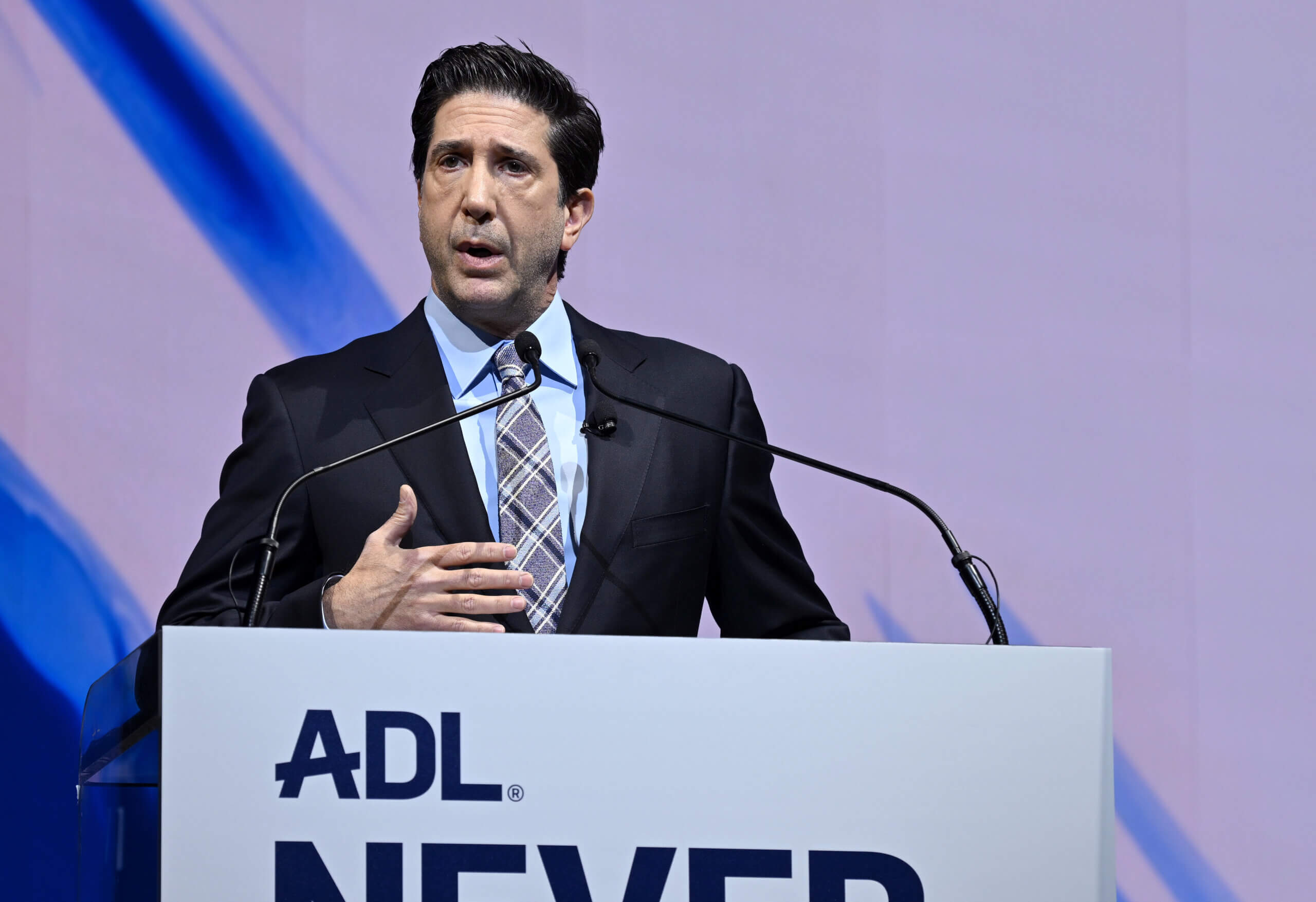
Schwimmer has been outspoken about antisemitism since long before the Oct. 7 Hamas attacks on Israel and the ensuing war in Gaza. Over the course of his career, he’s spoken at multiple Anti-Defamation League events and called for other people to stand against hate, routinely saying, “Silence is complicity.”
The actor appears to have never explicitly identified as a Zionist, and his statements have focused more on galvanizing support for Jews and Israelis — rather than on the Jewish state. But this is of little importance to his critics.

His relationship with the ADL, a staunchly pro-Israel organization, is damning enough for some. Schwimmer also starred in an Israeli commercial for Meitav, an investment management company. The move puts him at odds with the growing Boycott, Divestment and Sanctions campaign, which stands against any financial relationship with Israel or Israeli companies.
After Oct. 7, Schwimmer put out a statement calling the Hamas attack an “atrocity” and a “genocide,” adding that any attempt to justify what happened is “indefensible and antisemitic.” In the same statement, he also touched on Palestinian suffering:
“One can condemn Hamas and still object to the Israeli government’s policies regarding the occupation (as many Israelis do), still believe in the Palestinian people’s right to self-determination, and still mourn the loss of Palestinian civilians and the current destruction of their homes, schools, hospitals and places of worship.”
He’s also been vocal about sexual violence that occurred on Oct. 7, sharing the controversial New York Times piece headlined “Screams Without Words,” that investigated allegations of sexual assault committed by Hamas during the attack. Critics of the piece have questioned the validity of the reporting and argued that one of its reporters is biased toward Israel. The Times has stood by the piece.
Additionally, Schwimmer has criticized universities’ responses to pro-Palestinian protests on campuses that he said have veered into antisemitism.
Schwimmer spoke at a 2025 ADL summit about the backlash he’s gotten for his advocacy, noting that while he’s been “attacked” and “abandoned,” he’s found deep meaning in speaking out and has no plans to stop. He concluded his speech calling on fellow celebrities to do the same.
“You don’t have to say anything political,” Schwimmer said. “No one is asking you to solve the conflict in the Middle East. Just say that you stand with your Jewish friends, colleagues and neighbors against hatred and discrimination.”
The controversy isn’t bothering Quince.
“We’ve seen more than 8 million views across our social channels in the first 48 hours, alongside international press coverage and recognition from the marketing community for the creative,” said Dakota Isaacs, head of brand strategy and narrative, in an email to the Forward. “It’s been especially rewarding to see fans connect with the humor and nostalgia while discovering Quince.”
The post This David Schwimmer sweater ad is playing on ‘Friends’ nostalgia. So why are commenters talking about Israel? appeared first on The Forward.
