



Uncategorized
Anne Carson — a poet of spirituality and ‘small things’ — has won the Nobel Prize
Anne Carson, today awarded the Nobel Prize in Literature, can be a difficult poet. Much of her work is erudite, complex and genre-defying; it is poetry and prose and criticism and translation and, occasionally, a kind of theology. But Carson’s work is also profoundly spiritual and richly rewarding, especially for those of us prone to introspection, intellection, melancholy, and, as Carson once described the task of a writer, “noticing small things.”
There are many facets of Carson’s work, and many lenses through which one might relate to it. Born in 1950, Carson was trained as a classicist, and spent much of her career teaching Ancient Greek; in addition to her translations of Sophocles, Sappho, and others, her own poems are often saturated with classical references. Her essays on a wide variety of subjects are similarly erudite and rich. Many have written on these aspects of her work.
Personally, though, as a contemplatively-inclined Jewish reader, I have found her to be a literary as well as spiritual role model. I use the word ‘spiritual’ with hesitation. I doubt Carson would like it much, and what I mean by it is not the cultivation of certain warm feelings but the choice to pay attention, in a certain way, to both the surfaces and the depths of things; to refuse the pat dichotomy between the head and the heart; to dwell in the interiority of experience that, paradoxically, arises from “noticing small things.”
When Carson does turn explicitly to religious and spiritual subjects (she was raised Catholic), she excels, perhaps more than any other writer I have read, in avoiding the clichés that make writing about ‘spirituality’ so challenging. Her long poem from 1992, “The Truth About God” begins:
My religion makes no sense
and does not help me
therefore I pursue it.When we see
how simple it would have been
we will thrash ourselves
Carson isn’t speaking conventionally here, I don’t think — this isn’t quite the Israelites saying, in Sinai, Na’aseh v’Nishmah, we will do and [then] we will understand. But it is a contemplative version of it; a devotional attitude toward the particular. In another section of the poem, entitled “God’s Justice,” she writes:
In the beginning there were days set aside for various tasks.
On the day He was to create justice
God got involved in making a dragonflyand lost track of time.
It was about two inches long
with turquoise dots all down its back like Lauren Bacall.
So this is why there is no justice in the world, or why we must always pursue it anyway: because God was so busy with beauty. The poet, too, gets distracted; the rest of the poem is about the dragonfly. (Like Mary Oliver, Carson is a sublime poet of nature.) As indeed is true in our world — alongside all the evils and injustices of the last few years, the shimmering of tree branches in the breeze, the light refracting into my study, remain as resonant as ever.
When I heard the news about Carson’s Nobel, I came across a post by Florida State University Professor Martin Kavka, whom I’ve known for many years and who, it turns out, is also a Carson fan. Like me, Kavka was elated to hear the news, and we chatted for a while. “Sometimes we think of poetry as something that expresses the way the world is, that pierces the mystery of the world and gives us True Knowledge,” Kavka told me. “But for me, Carson’s poetry, in its odd recombination of words, expresses how we so often feel askew when relating to the world, as if it will always be mysterious, as if its mystery were just there to taunt us.”
“We all know that when we feel askew,” Kavka continued, “authority figures make us feel that it’s our fault. This is true of religious authority figures — and Jewish texts, given that Deuteronomy suggests that we are at fault when we are not thriving — but also of political and educational authorities. Carson gives us all armor for those moments… And for so many of us who are (over)educated, we value assembly too much and beauty not enough. I feel recalibrated whenever I read her, as if I’ve just visited some sort of emotional chiropractor. “
I love that insight. Carson is definitely, in some ways, a nerdy writer. Her work is intellectual, dense, and sometimes opaque. (I find myself reaching again for the word ‘erudite.’) But that is not at the expense of emotional depth. A recent essay, for example, describes Carson’s heartbreaking loss, due to Parkinson’s Disease, of her ability to write legibly — but along the way discusses the Roman poet Catullus, the painter Cy Twombly, composer David Lang, psychiatrist Norman Doidge, as well as Roland Barthes, John Keats, John Cage, Gertrude Stein, and attending a boxing class for people with Parkinson’s. In it, she writes:
Let’s start with life, your life. There it is before you — possibly a road, a ribbon, a dotted line, a map — let’s say you’re 25, then you make some decisions, do things, have setbacks, have triumphs, become someone, a bus driver, a professor, a pirate, years pass, maybe in a family maybe not, maybe happy maybe not, then one day you wake up and you’re seventy. Looking ahead you see a black doorway. You begin to notice the black doorway is always there, at the edge, whether you look at it or not. Most moments contain it, most moments have a sort of sediment of black doorway at the bottom of the glass. You wonder if other people are seeing it too. You ask them. They say no. You ask why. No one can tell you.
A minute ago you were 25. Then you went ahead getting the life you want. One day you glanced over from 25 to now and there it is, the doorway, black, waiting.
Similarly, Kavka’s favorite Carson poem, “Merry Christmas from Hegel,” begins with the poet “wretchedly lonely with all my family dead”:
It was the year my brother died, I lived up north and had few friends or they all went away. Christmas Day I was sitting in my armchair, reading something about Hegel.
Yet she doesn’t stay in the armchair. She is “overjoyed” at Hegel’s language, at “this notion of a philosophic space where words drift in gentle mutual redefinition of one another,” and she goes outside to stand in the snow:
I went to the middle of a woods. Fir trees, the teachers of this, all around. Minus twenty degrees in the wind but inside the trees is no wind. The world subtracts itself in layers. Outer sounds like traffic and shoveling vanish. Inner sounds become audible, cracks, sighs, caresses, twigs, bird breath, toenails of squirrel. The fir trees move hugely. The white is perfectly curved, stunned with itself. Puffs of ice fog and some gold things float up. Shadows rake their motionlessness across the snow with a vibration of other shadows moving crosswise on them, shadow on shadow, in precise velocities. It is very cold; then that, too, begins to subtract itself, the body chills on its surface but the core is hot and it is possible to disconnect the surface, to withdraw to the core, where a ravishing peace flows in, so ravishing that I am unembarrassed to use the word *ravishing*, and it is not a peace of separation from the senses, but the washing-through peace of looking, listening, feeling, at the very core of snow, at the very core of the care of snow.
This is the consolation of the intellectual life, in the best sense: the abstruse philosophical language of Hegel liberates the poet from her melancholy, sends her out into the woods where she has an encounter with the numinous, rendered in perfect, concrete prose without a single platitude of religious or spiritual writing.
Said Kavka of this work, “I learned how to be a widower — how to relate to the world so that death does not govern my existence — from her.”
I am delighted that Carson has won the Nobel, not only for the recognition (and money!) that she deserves, but because it might win her some new readers, including those of us in the Jewish spirituality world for whom Carson’s “noticing” is at the center of our religious lives. I’ll give her the last words, once again taken from the poem “The Truth About God”:
God’s Work
Moonlight in the kitchen is a sign of God.
The kind of sadness that is a black suction pipe extracting you
from your own navel and which the Buddhists call“no mindcover” is a sign of God.
The blind alleys that run alongside human conversation
like lashes are a sign of God.God’s own calmness is a sign of God.
The surprisingly cold smell of potatoes or money.
Solid pieces of silence.From these diverse signs you can see
how much work remains to do.
Put away your sadness, it is a mantle of work.
The post Anne Carson — a poet of spirituality and ‘small things’ — has won the Nobel Prize appeared first on The Forward.
Uncategorized
In a triumphant, life-affirming documentary, a Jewish virtuoso looks back on his astounding career
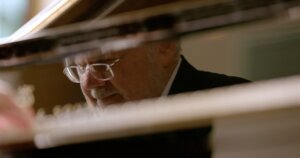
Joseph Levy’s documentary All the Music in the World, is a wonderful, loving tribute to concert pianist Emanuel Ax, an iconic figure in the world of classical performance. Devoid of airs or pretensions, Ax is a remarkably likable musician who still suffers from stage fright. He does not view himself as a “virtuoso” or “maestro.” Everyone, at least in this flick, calls him “Manny.”
Though the film grapples with the passage of time — Ax, inevitably, has been slowing down of late — it is at once triumphant, gentle and life-affirming. I loved it.
Born in 1949 in what is now Ukraine, Ax is the son of Polish Holocaust survivors who never talked about their World War II experiences, short of acknowledging that each had immediate family members who perished in concentration camps. Both his parents, who met after the war, had been married before; his mother had had a child. Ax’s father managed to escape the camps when he jumped off the train carrying him to a camp. He made his way back to his hometown and was ultimately hidden in a church by a local priest.

When Ax was six, the family moved to Warsaw, where his dad took him to the Tchaikovsky opera Eugene Onegin. Young Emanuel was transfixed. To this day he has a special affection for the opera, he says. His formal training started almost as a fluke. The family had inherited an old upright piano from earlier tenants who had abandoned the instrument in the apartment.
Ax continued his musical studies when the family emigrated to Winnipeg and later New York, where they lived across the street from Carnegie Hall. It’s an evocative scene watching him, now in his late 70s, in front of the legendary building and still viewing it with wonder.
“I heard all the greats,” Ax marvels. “I came three or five times a week. I remember in May of 1965 how the line for tickets went around the block because Horowitz was playing. My great regret is that my father was not alive to hear me play at Carnegie Hall or anywhere else except Juilliard. My mother lived to 101 and went to a lot of my concerts.”
Ax studied at Juilliard from the ages of 12 to 26. Along the way, he earned a degree from Columbia University, where he majored in French. He participated in competitions, which he abhorred and dreaded, he says. Although he won several prizes, he never got first place until the Arthur Rubinstein International Piano Master Competition in 1974. Rubinstein served as one of the judges. In addition to earning $5,000 in prize money, Ax landed engagements with the BBC Orchestra and the Israel Philharmonic and got his first recording contract.
“I knew I would never have to do another competition,” he says, sounding slightly stunned and humbled.
For more than half a century the multiple Grammy-winning pianist has played close to a hundred concerts yearly. He has made dozens of albums — some solo performances, others collaborations with such luminaries as Itzhak Perlman, Leonidas Kavakos and, most frequently, Yo-Yo Ma, with whom Ax has enjoyed a 50-year friendship and artistic collaboration.
To celebrate Ax’s 50th anniversary on the world stage, director Levy spent two years filming Ax just living his life — preparing fresh pasta with his grandchildren; conducting master classes; recording a new album; touring and performing Mozart, Chopin, Beethoven and Liszt.
The doc’s two central narrative threads feature Ax rehearsing for a premiere piano concerto that movie composer John Williams wrote for him, and a special concert at Carnegie Hall to commemorate his half-century career.
Interwoven throughout are testimonials offered by his legendary colleagues, including composers Williams and Anders Hillborg and conductors Esa-Pekka Salonen and Andris Nelsons who extol his humility, perfectionism, and artistry.
Despite all this praise, Ax says he never feels he has rehearsed enough and that whatever piece he is about to perform is the most difficult ever. He routinely suffers tremendous anxiety that his performances won’t be up to snuff. Still, he is compelled to play.
“I dream about piano all the time,” he said. “My relationship to music is all- consuming. All the music in the world exists to express what you can’t put into words.”
Besides his passion for great music, what emerges most forcefully is his compassionate nature. In his master classes there is none of the condescension or even cruelty that one sometimes witnesses in these sessions. By contrast, Ax makes modest suggestions on how a student can perhaps improve an already fine performance.
This film could easily have become claustrophobic. Much of it is set in studios and theaters. It’s to Levy’s credit that he seamlessly opens it up to nature. We frequently see Ax practicing on a stage at Skidmore College whose backdrop is a massive floor-to-ceiling window that faces a landscape awash in trees. Later Ax is seen driving through forested dirt roads in the Berkshires on his way to performing the premiere of Williams’ piano concerto at Tanglewood.
Perhaps Levy, who was at one time a cellist himself, is suggesting that great music and pastoral scenes are somehow connected if not synonymous. Either way, the visuals offer a welcome counterpoint to the many enclosed spaces.
The sections featuring Ax and Ma rehearsing or engaging in post-rehearsal analysis are especially delightful. The two met at Juilliard when Ax was about 20 and Ma was 15. Their long-term mutual affection is evident as Ax picks nonexistent pieces out of Ma’s hair and Ma, grinning, teasingly provokes Ax about his performance being too slow.
Ax also met his wife Yoko, a pianist too, when they were students at Juilliard. Their beginning was not auspicious. In fact, on their first date, she brought along a friend. “I didn’t know it was a date,” she says. In the end, Ax’s persistence paid off and they have now been married for more than 50 years and have two adult children. The time spent away from home has been challenging for everyone in many ways, not least Ax’s inability to help with, well, virtually everything, he admits.
The transitional moment that he’s struggling with now, and it will be seismic, is when he should step away from the limelight. His fear that he will disappoint his audience is constant. Performing new pieces has become especially arduous. Still, he can’t imagine not making music. He will always look forward to collaborating with Ma, if not for an audience, then at least for themselves.
In one of the film’s final, and most touching, scenes Ax listens to a recording of his debut concert at Carnegie Hall. His attention is fixed and intent, his expression a marriage of assessment, wonder, and nostalgia. “It’s not bad,” he said. “I’m astounded.”
All The Music in the World is screening online through Nov. 29 as part of DOC NYC festival. It is slated to be theatrically released in 2027.
The post In a triumphant, life-affirming documentary, a Jewish virtuoso looks back on his astounding career appeared first on The Forward.
Uncategorized
After blue wave, Texas Democrats plan to ‘keep the church’ out of the classroom

Few states have pushed as aggressively as Texas to infuse Christianity into public schools. Texas requires public school classrooms to display the Ten Commandments, mandates a statewide reading list that includes Bible passages, and approved a curriculum called Bluebonnet Learning that incorporates Biblical references into math and history lessons.
But the midterm elections, which produced the biggest Democratic victory in Texas in more than three decades, put the future of those policies in doubt.
Democrats now hold the majority in the Texas state house and on the Texas State Board of Education. Democratic Gov.-elect Gina Hinojosa has said she plans to replace Mike Morath, the state’s education commissioner who championed the Bluebonnet curriculum, on Jan. 19, 2027, her first day in office.
“In states like Texas, we can safely say that voters rejected Christian nationalism,” Rachel Laser, president and CEO of Americans United for the Separation of Church and State, told the Forward.
The results dealt a blow to some of the state’s most prominent lawmakers who defended incorporating Christianity into public schools — including Candy Noble, a four-term Republican incumbent in the Texas state house who had sponsored the bill requiring classrooms to display the Ten Commandments. Democrat Angie Carraway defeated Noble in a tight race with 50.8% percent of the vote.
“I’m hoping that the turnout of the last election will right the ship,” Carraway told the Forward. “Some of these things that have been going terribly will turn back the other way.”
Christian curriculum
Lisa Epstein, director of Jewish Community Relations for the Jewish Federation of San Antonio, has testified twice before the Texas State Board of Education to express concern about how the Bluebonnet curriculum teaches students about religion.
Bluebonnet, developed by the Texas Education Agency in 2024, incorporates Biblical references across multiple subjects — and drew criticism from several Texas Jewish groups for prioritizing Christianity at the expense of other religions.
“It made it sound like these things were facts, that Christianity was fact, that Jesus was the Messiah. Instead of teaching kids that these were beliefs,” Epstein told the Forward. “That’s when things started to take off as far as the advocacy that we felt we needed to do for Jewish families — because in San Antonio, most of our Jewish families are in public schools.”
Adopting Bluebonnet was optional, but it came with a financial incentive: School districts that adopted the curriculum were allocated an extra $20 per student. Roughly a quarter of Texas school districts signed up to use Bluebonnet.
But now, Epstein said she hopes that both the curriculum and financial incentive could be rolled back. By a majority vote, the State Board of Education could call for a review of the Bluebonnet curriculum. Alternatively, the board could vote to change required curricular standards, triggering a process to revise the materials.
A separate state initiative has raised similar concerns. In June, the board approved a required statewide reading list, scheduled to take effect in 2030. The list includes passages from the Old and New Testaments, as well as Christian parables for elementary schoolers. First graders, for example, read the picture book Jonah and the Whale.
“Stories that were written by Christian publishing houses, that are really just things you would read in a Sunday school,” Epstein said. “So there were a lot of problems that we saw for Jewish families.”
But with its new Democratic majority, the state board could also vote to revise the reading list, including by removing or replacing individual books.
Several newly elected board members have indicated that revisiting curriculum will be a priority.
“We’ve been running with that as a day one promise,” Democrat Dana Van de Walker, who was just elected to the state Board of Education, told the Houston Chronicle earlier this month. “We’re really committed to keeping the church out of our state.”
The Ten Commandments
It may prove more difficult to roll back the law that requires the Ten Commandments to be displayed in classrooms. Because the mandate was enacted into law, any effort to repeal it must also come from the legislature.
But it’s not clear that Texas Democrats have the votes. While Democrats have a 16-seat majority in the state House, Republicans retain a seven-seat majority in the state Senate.
Still, Carraway told the Forward she is drafting a bill to repeal the Ten Commandments law for when she takes office in the state House in January 2027. In the Texas Senate, meanwhile, state Sen. José Menéndez, a Democrat from San Antonio, has already filed a bill to repeal the classroom-display requirement.

For Carraway, the repeal effort is partly symbolic.
“I just think it sends a good message,” Carraway told the Forward. “Because my opponent is the one who authored the bill for the Ten Commandments, so I feel it’s a good message to start with a clean slate and try to undo that legislation.”
At the same time, the blue wave has the potential to impact ongoing litigation over the law. In July 2025, several Texans — including lead plaintiff Rabbi Mara Nathan of Temple Beth-El in San Antonio — filed a lawsuit challenging the constitutionality of the Ten Commandments law, arguing that it violated the First Amendment.
But incoming Democratic Texas Attorney General Nathan Johnson told CBS News in April that he would not defend the law requiring Ten Commandments in classrooms “because it’s unconstitutional.” If Texas still intends to defend the law, Johnson said, the state will need to hire private, outside attorneys.
That gives Carraway, a middle school social studies teacher in Collin County, Texas, reason for hope. Carraway told the Forward that she “will never forget” the moment the Ten Commandments were posted in her classroom last year.
The display, Carraway said, was among the reasons she decided to run for public office, as she grew increasingly frustrated by what she saw as government overreach by lawmakers who had never worked in a classroom themselves.
“I am a Christian,” Carraway told the Forward. “I just don’t think that Christianity belongs in our schools.”
The next session of the Texas State Board of Education is scheduled to begin Jan. 25.
The post After blue wave, Texas Democrats plan to ‘keep the church’ out of the classroom appeared first on The Forward.
Uncategorized
Mossad helped foil terrorist attack at 2024 Taylor Swift show in Vienna, former chief says
(JTA) — Mossad helped prevent an Islamic State-linked attack at a planned 2024 Taylor Swift concert at Ernst Happel Stadium in Vienna, the former chief of Israel’s foreign intelligence agency said on Monday.
David Barnea, Mossad’s director at the time, said during the ELNET Jerusalem Summit that Austrian intelligence shared a warning with Mossad ahead of the show scheduled for Aug. 9, 2024. ELNET promotes Israeli-European ties.
The Israeli agency analyzed Austria’s information to aid in the arrest of members of a suspected terrorist cell, Barnea said, adding that the arrests prevented the potential mass murder of “up to hundreds of young European men and women.”
The concert organizer Barracuda Music canceled the three back-to-back, sold-out concerts on Aug. 7, a day before Swift’s first show at the venue. Austrian national Beran A., whose last name was not shared in accordance with Austrian privacy rules, was sentenced in May 2026 to 15 years in prison after being convicted of offenses including planning the attack.
The CIA and other U.S. intelligence agencies helped disrupt the plot, then-CIA deputy director David Cohen said at the time.
This article originally appeared on JTA.org.
The post Mossad helped foil terrorist attack at 2024 Taylor Swift show in Vienna, former chief says appeared first on The Forward.
