


Local News
Ilana Shapera one of the leads in dancing dentists upcoming production of “Chicago”
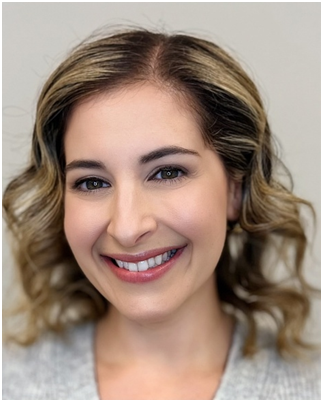
By MYRON LOVE Dr. Ilana Shapera is looking forward to once again treading the boards – this time with a role that she can really sink her teeth into. One of three principals in Affinity Dental – the others being her husband, Igal Margolin, and her brother-in-law, Artiom Margolin – has been cast in the role of Velma Kelly in the upcoming Manitoba Dental Foundation’s production of “Chicago,” which is scheduled to run May 7-11 at the Theatre Cercle Moliere.
“Velma is a real fun character,” Shapera says. “I love her snarkiness.”
“Chicago” the nusical, notes Phil Corrin, the production’s musical director, is based on a 1926 play by the same name that was intended to expose political corruption and its interface with celebrity. Fifty years later, it was restaged as a musical.
“Chicago” is the MDF’s seventh all-dentist musical production. A new show is staged every second year.
Shapera, who previously appeared in the Foundation’s production of “Lucky Stiff” in 2017, says that she is looking forward to getting back to dancing – a passion she has had for most of her life – in her role as Veloma. She reports that she began taking dancing lessons when she was four years old. In her teen years, she studied with Shelley Shearer and participated in Gray Academy musical productions. For several years, she was a member of the Chai Folk Ensemble choir and, for the past six or seven years, she has been singing with the Prairie Voices’ Horizon Choir.
The mother of two young sons, Lev and Shai, expresses her appreciation to her husband, Igal, “for holding down the fort at home, allowing her to live out her Broadway dreams”.
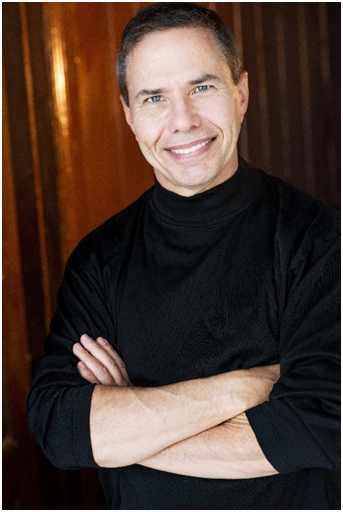
Some readers may remember Phil Corrin for his 25 year career as a band teacher at Garden City Collegiate. He holds a Bachelor of Music (Major in Music Education) from Brandon University and a Graduate Diploma in Fine Arts (Conducting) from the University of Calgary. His first foray into the world of theatre was in the sixth grade when he played Huckleberry Finn in his school’s production of “Tom Sawyer.” Since then, he has been involved in nearly 80 productions as an actor, musician, director, producer, stagehand, audio technician, and music director. He has worked with the Royal Manitoba Theatre Centre, Rainbow Stage, Winnipeg Studio Theatre, Winnipeg Jewish Theatre, Little Opera Company, and the Winnipeg Symphony Orchestra, as well as numerous high schools (including Gray Academy) throughout Winnipeg.
“Phil is happy to once again sink his teeth into the world of All-Dentist Musicals – having previously served as Associate Music Director for “Young Frankenstein” in 2015,” says Frank Hechter, currently the Manitoba Dental Foundation’s executive director (since 2018), who is also a member of the production’s organizing committee.
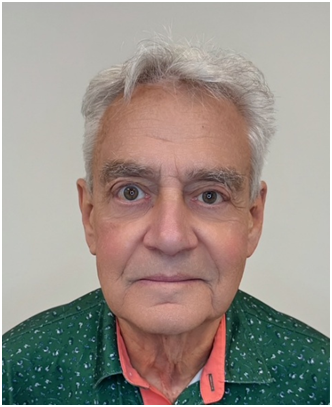
Hechter will be the conductor for the show and will also be a member of the ensemble. For Hechter – who began practising dentistry almost 55 years ago, appearing in “Chicago” will allow him to recreate his St. John’s high school operetta days, renew and create new friendships, challenge himself, and “move beyond his comfort zone,” he says.
A second Jewish member of the organizing committee is Bonnie Antel, the wife of Dr. Joel Antel, a former president of both the Manitoba Dental Foundation and Manitoba Dental Association and who is currently the Canadian Dental Association president. Bonnie says that while she would have loved to be in the “Chicago” cast, she isn’t a dentist. She has, however, been involved in music – both as a singer and choir leader, most of her life.
“I developed a love for music and singing in high school (Grant Park),” she recalls.
Bonnie has a Bachelor of Music, Bachelor of Education and a Master of Education from University of Manitoba and recently retired from teaching music in the Pembina Trails School Division.
As with Ilana Shapera, Bonnie Antel is a Chai alumna. For many years, from the time she was 13, she was a member of the Shaarey Zedek Choir. She adds that in the 1990s, she was the choir director and conductor. Currently, she is the Yom Tov choir leader at the Simkin Centre. “Chicago” is the second Dental Foundation all-dentist musical production that she has been involved with.
“We are all really thrilled that we were able to get the rights to “Chicago” this year,” remarks Antel, who has been involved in the all-dentist musical productions since their inception.. “We do these shows every second year but there has always been another production of “Chicago” somewhere else in the province taking place.”
“Our purposes in producing musical theatre with all dentist performers has always been to create opportunities for dentists with an interest in musical theatre to come together; create opportunities for students and graduates of performing arts programs to gain experience, refine their expertise to enhance their career paths; and to raise funds to support educational and mentorship programs in the performing arts and other charitable organizations,” Hechter points out. “We appreciate the contributions of everyone who has participated in our productions.”
He reports that the net proceeds from the productions have provided funding over the years for the Manitoba Dental Foundation – as well as the Harvey Speigel Bursary in the College of Dentistry (U of M), the Theatre and Film program at the U of W, Prairie Theatre Exchange, Winnipeg Studio Theatre Scholarship, the Rainbow Stage Professional Mentorship Program, the Never Alone Cancer Foundation, and Cancer Care Manitoba. The net proceeds from the production of “Chicago” will be divided evenly between Theatre Cercle Moliere and the Manitoba Dental Foundation.
Readers who may be interested in supporting the MDF and seeing the show can contact Dr. Frank J. Hechter (mdf.ed@manitobadentist.ca) or phone 204-782-8146.





Local News
Marty Green expands his protest against extremist Jewish settlers to two more venues – and is arrested twice more
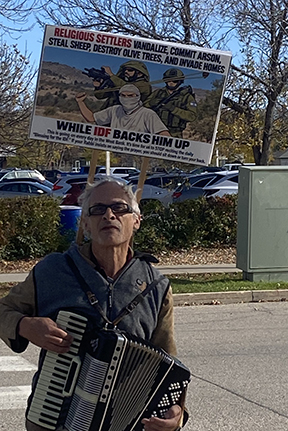
(Tuesday, October 27) We received the following press release about Marty Green being arrested again, both at the University of Manitoba and at Shaarey Zedek Synagogue:
Both sides came to blows on Saturday, October 24, at the Shaarey Zedek Synagogue as security personnel sought to prevent Marty Green from interfering with synagogue traffic as he protested just outside synagogue grounds against the actions of religious settlers in Israel’s occupied West Bank territory. Synagogue Executive Director Rena Secter Elbaze quickly intervened to prevent further escalation. Police arrived shorty thereafter and detained Green for 45 minutes before driving him home and releasing him. It is not clear whether their decision not to lay charges was the result of their own onsite investigation or whether it was at the request of the synagogue executive.
Green has now been arrested four times in the last month and faces multiple charges for disturbing the peace, including two episodes at the Asper Campus and one more this past Friday (Oct. 23) at the University of Manitoba. While Green says initially he was merely handing out leaflets (at the Asper Campus), since his first arrest on September 23, he has returned to the campus with a large placard and an acccordion, accompanying himself while singing songs with lyrics that include such phrases as “The Jews Are Bananas….B-A-N-A-N-A-S”. In addition to listing actions of the religious settlers as including arson, vandalism, and theft, he pointedly alleges that the IDF has been backing up the settlers in their actions.
Green had earlier notified the Shaarey Zedek that he was contemplating bringing his protest to the synagogue. He was told that if he attempted to enter the grounds he would be prevented from doing so. At that time, Secter Elbaze told Green that his intentions were inappropriate, declaring the synagogue to be “a house of worship dedicated to prayer, learning, community, and spiritual engagement.” Green responded that if the synagogue were willing to contact the Crown and inform them that “that there was never any legal basis for their claims that I was conducting myself inappropriately at the Asper Campus” (with regard to his earlier arrests) that he would “voluntarily refrain from carrying his informational campaign to the synagogue(s).”
Green further argues that the recent “psak” (religious ruling) by leading Israeli rabbi Rov Dov Lior, in which Lior declares that it is not merely permissible but praiseworthy for Jews to steal olives from Arab orchards….that this ruling brings his protest within the proper realm of religious discourse. He says further that if the local rabbis were willing to speak out to their congregations against the aforesaid psak, that he might have refrained from taking his campaign to their grounds.
Although Green was released on Saturday without charges, police confiscated his placard. They explained that it was being held as evidence pending an investigation by Major Crimes as to whether it constituted hate literature.
There was no further information given as to what happened at the University of Manitoba.
Local News
Third annual JFest Winnipeg will be offering programs for all ages
By MYRON LOVE JFest Winnipeg is back with a good variety of musical performances, a book launch, popular Jewish-themed films, children’s activities, and a family-oriented Shabbat dinner.
“JFest,” observes Laura Marjovsky, the Rady JCC Director of Programming, “is an opportunity for our community to experience Jewish art and culture. With our range of JFest events, we are trying to reach out beyond what has been our base audience and appeal to all ages. We have a commitment to bring top notch Israeli performers to share the highest caliber of Israeli entertainment with our audiences.”
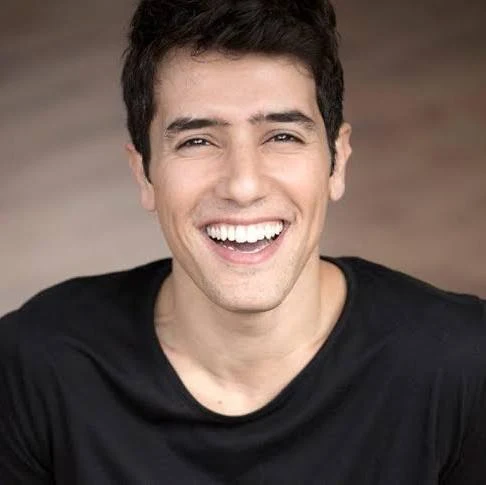
The week-long festival (November 14-21) kicks off with a performance by top-ranked Israeli singer-songwriter Harel Skaat. The popular Israeli star began singing as a child. He shot to fame when he finished second in the second season of “Kochav Nolad” – Israel’s version of “American Idol.” His first album was released in 2006 and achieved Platinum status – with one of the songs being ranked as “song of the year.” He followed that up in 2009 with a second album that reached Gold status. In 2010, he represented Israel at the Eurovision competition.
Skaat’s performance is scheduled for the Seven Oaks Performing Arts Centre (which is attached to Garden City Collegiate) beginning at 8:00 P.M. on Saturday, November 14. Patrons will have the opportunity to purchase an enhanced ticket to attend a meet and greet with Harel.
All other JFest programs and activities will be at the Rady JCC.
Music Producer Karla Berbrayer says Ben Caplan’s performance on Saturday, November 21 will also be another highlight. “Ben Caplan redefines what it means to be a modern folk artist,” Berbrayer says. “His music and stories are matched by his larger-than-life stage presence. This concert focuses on how his Jewish upbringing has influenced his entire performance career.”
“Flatland Famous” is returning by popular demand. This quintet, known for its performances at Winnipeg Jets games, will be presenting its concert, “Jewish Soul of Rock and Roll,” on Wednesday, November 18, at 7:30 pm. This year’s show will feature songs by Amy Winehouse, Neil Diamond, Barbra Streisand, Simon and Garfinkel, and other famous Jewish icons.
On Tuesday, November 17, local author Deborah Schnitzer will be taking centre stage with the launch of her new book, “The Woman Who Swallowed West Hawk Lake.” The University of Winnipeg English Professor Emeritus’s new novel explores intergenerational trauma related to Nazi breeding programs. Joining Schnitzer on stage will be a panel of professionals who have experience working with children who have experienced trauma.
And of course, “Best of the Fest” is back. Films to be presented will include“The Floaters” and “We Met at Grossingers,” two wildly popular movies at last spring’s Winnipeg International Jewish Film Festival.
“The Floaters,” to be screened on Monday , November 16 at 7:00 pm is a funny and bang-on depiction of Jewish summer camp culture.
“We Met at Grossingers” is a loving look back at the Borscht Belt in New York’s Catskills, where generations of young Jewish performers earned their dues and developed their acts. The film will be screened on Thursday, November 19 at 7:00 P.M.
On Friday November 20, JFest will host a Family Shabbat dinner featuring Anat Kriger, an Israeli-born, Toronto-based musician, actor, and children’s performer, who has made several appearances in Winnipeg at major communal events.
Kidfest on Sunday, November 15, will be a day-long potpourri of programming that will include live performances, workshops, bouncy castles, games and crafts, and much more.
Readers seeking more information about JFest can contact Laura Marjovsky at 204 477-7539 or lmarjovsky@radyjcc/com
Local News
Hen Mazzig, leading Israeli advocate, makes first Winnipeg appearance
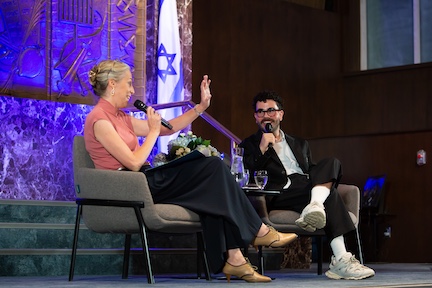
By MYRON LOVE On Tuesday, October 6, a large number of members of our community packed the chapel at the Shaarey Zedek Synagogue, eager to welcome Hen Mazzig in his first appearance in our community.
Over the past few years, the Israeli-born Mazzig – who was appearing at the invitation of our Jewish Federation and Combined Jewish Appeal team – has become one of Israel’s and the Jewish people’s leading advocates on the international stage. His online platforms reach as many 100 million viewers a month with a regular following of almost 1 million. He has been interviewed by numerous leading media outlets and has given addresses at close to 500 universities in recent years.
Mazzig’s presentation in Winnipeg (which was funded by the Asper Family and the Asper Foundation) took the form of a question and answer format with Sarah Mali, the Director General of JFC-UIA (Jewish Federations-United Jewish Appeal) Canada in Israel, asking the questions.
Mali , who was visiting Winnipeg for the third time in the past three years, began by expressing how honoured she felt about having the opportunity to converse with Mazzig – referring to Jewish Federation of Winnipeg President Carrie Shenkarow’s comments regarding Mazzig’s “devotion to Israel and the Jewish people”, his “deep sense of purpose, moral clarity” and “willingness to enter some of the most difficult spaces and conversations.”
The first question that Mali posed to Mazzig was related to his visit to the Canadian Museum of Human Rights and its controversial and one-sided take on the longstanding and ongoing Israeli-Palestinian conflict. She referred to a comment that Mazzig had made on X the day after visiting the museum, in which he wrote that while he “has no problem with people learning about Palestinian history,” he wished that “Palestine Uprooted” didn’t “distort the regional events, including the displacement of 800,000 people just like my grandmother, Hela, who became a refugee when Iraq turned on its Jewish community” post-1948.
“History can only lead to reconciliation when it is told honestly,” he observed. “Otherwise, it is just fuelilng an agenda.”
What most disturbed him about the exhibit, Mazzig told his audience, is that it erased his own family’s history. Expanding upon his family’s roots, he noted that his father’s family came to Israel from Tunisia and his mother’s side from Iraq. He spoke in particular about his maternal grandmother, Hela, who left behind “a beautiful civilization” – Jews had been living and thriving in Iraq since before the Roman destruction of Jerusalem 2000 years ago – to a new land (Israel), where she had to learn a new language (Hebrew) and rebuild her life.
Mazzig added that his grandmother is his anchor in life and the inspiration for all that he has accomplished.
Mali asked Mazzig about his ability to empathize with Palestinians. It was difficult to do, he answered. He got to know Palestinians, he recalled, during the Covid epidemic when he was serving as a medic with the Israel Defense Force and found himself responsible for helping Palestinians through that difficult time and transporting sick Palestinians to Israeli hospitals.
“Even though I fight so hard for Israel,” he observed, it doesn’t mean that I can’t feel empathy for anyone else.”
Mali asked Mazzig how October 7, 2023, changed him.
“I chose not to become a victim,” he said, “but rather to engage more with the world, bear witness, share our stories and talk about genocide. While I was actively advocating for Israel before October 7, I have been much more in demand since. I have become a lot more visible.
”I have found that a lot of people support us,” he continued. “They see what is happening and are on our side.”
On the other hand, he added, a lot of people don’t know anything about Israel. “It is a matter of education,” he said. “I encourage people to go to Israel and talk to Israelis.”
Mali’s last question was what Mazzig means when he writes that “I promise to love being Jewish ten times more than anyone hates me for it.” What does it mean to him to love and find joy and happiness in being Jewish”, she added?
It means cherishing our rich history, Mazzig responded, enjoying Shabbat dinners with family and friends, celebrating all of our holidays and traditions.
“The Jewish People have been through so much over the past 2000 years,” he said. “Many people have tried to destroy us, but we have survived. We are arisen from the ashes numerous time and continued to move forward. Not only are we still here but we have returned as an independent people living again in our ancestral homeland.”
Also addressing the audience at the Shaarey Zedek was Steven Shulman, the president and CEO of the Jewish Federations of Canada. Shulman heaped much praise on our Jewish community in Winnipeg.
“Winnipeg is special,” he noted, “not just in Canada but worldwide. Your CJA campaign continues to be the most successful in North America. You have an outstanding CEO (of the Jewish Federation of Winnipeg) in Jeff Lieberman, who is universally respected.”
He further praised Gray Academy and our community’s highly successful GrowWinnipeg campaign – which has attracted thousands of new families to our community over the past 25 years.
He noted that he was particularly impressed with how our community has come together to protest the biased Nakba exhibit at the Canadian Museum for Human Rights.
He also spoke of the many supporters that we have among non-Jewish Canadians – singling out, as an example, the police officer in Belleville who put his own life on the line protecting the city’s only Jewish congregation from a terrorist attack during yom tov services.
The last word went to Jeff Lieberman, who thanked all the members of our community who have contributed to the CJA campaign this year, as well as our many non-Jewish friends who continue to stand with Israel and the Jewish community.
