


Local News
Simkin Centre shows accumulated deficit of $779,426 for year end March 31, 2025 – but most personal care homes in Winnipeg are struggling to fund daily operations

By BERNIE BELLAN The last (November 20) issue of the Jewish Post had as an insert a regular publication of the Simkin Centre called the “Simkin Star.”
Looking through the 16 pages of the Simkin Star I noticed that three full pages were devoted to financial information about the Simkin Centre, including the financial statement for the most recent fiscal year (which ended March 31, 2025). I was rather shocked to see that Simkin had posted a deficit of $406,974 in 2025, and this was on top of a deficit of $316,964 in 2024.
In the past month, I had also been looking at financial statements for the Simkin Centre going back to 2019. I had seen that Simkin had been running surpluses for four straight years – even through Covid.
But seeing the most recent deficit led me to wonder: Is the Simkin Centre’s situation unusual in its having run quite large deficits the past two years? I know that, in speaking with Laurie Cerqueti, CEO of the Simkin Centre, over the years, that she had often complained that not only Simkin, but many other personal care homes do not receive sufficient funding from the Winnipeg Regional Health Authority.
At the same time, an article I had read by Free Press Faith writer John Longhurst, and which was published in the August 5, 2025 issue of the Free Press had been sticking in my brain because what Longhurst wrote about the lack of funding increases by the WRHA for food costs in personal care homes deeply troubled me.
Titled “Driven by faith, frustrated by funding,” Longhurst looked at how three different faith-based personal care homes in Winnipeg have dealt with the ever increasing cost of food.
One sentence in that article really caught my attention, however, when Longhurst wrote that the “provincial government, through the Winnipeg Regional Health Authority, has not increased the amount of funding it provides for care-home residents in Manitoba since 2009.”
Really? I wondered. Is that true?
As a result, I began a quest to try and ascertain whether what Longhurst claimed was the case was actually the case.
For the purpose of this article, personal care homes will be referred to as PCHs.
During the course of my gathering material for this article I contacted a number of different individuals, including: Laurie Cerqueti, CEO of the Simkin Centre; the CEO of another personal care home who wished to remain anonymous; Gladys Hrabi, who wears many hats, among them CEO of Manitoba Association for Residential and Community Care Homes for Everyone ( MARCHE), the umbrella organization for 24 not-for-profit personal care homes in Manitoba; and a representative of the WRHA.
I also looked at financial statements for six different not-for-profit PCHs in Winnipeg. (Financial statements for some, but not all PCHs, are available to look at on the Province of Manitoba website. Some of those financial statements are for 2025 while others are for 2024. Still, looking at them together provides a good idea how comparable revenue and expenses are for different PCHs.)
How personal care homes are funded
In order to gain a better understanding of how personal care homes are funded it should be understood that the WRHA maintains supervision of 39 different personal care homes in Winnipeg, some of which are privately run but most of which are not-for-profit. The WRHA provides funding for all personal care homes at a rate of approximately 75% of all operational funding needs and there have been regular increases in funding over the years for certain aspects of operations (including wages, benefits, and maintenance of the homes) but, as shall be explained later, increases in funding for food have not been included in those increases.
The balance of funding for PCHs comes from residential fees (which are set by the provincial government and which are tied to income); occasional funding from the provincial government to “improve services, technology, and staffing within personal care homes,”; and funds that some PCHs are able to raise on their own through various means (such as the Simkin Centre Foundation).
But, in Longhurst’s article about personal care homes he noted that there are huge disparities in the levels of service provided among different homes.
He wrote: “Some of Winnipeg’s 37 personal-care homes provide food that is mass-produced in an off-site commercial kitchen, frozen and then reheated and served to residents.” (I should note that different sources use different figures for the number of PCHs in Winnipeg. Longhurst’s article uses the figure “37,” while the WRHA’s website says the number is “39.” My guess is that the difference is a result of three different homes operated together by the same organization under the name “Actionmarguerite.”)
How does the WRHA determine how much to fund each home?
So, if different homes provide quite different levels of service, how does the WRHA determine how much to fund each home?
For an answer, I turned to Gladys Hrabi of MARCHE, who gave me a fairly complicated explanation. According to Gladys, the “WRHA uses what’s called a global/median rate funding model. This means all PCHs—regardless of size, ownership, or actual costs—are funded at roughly the same daily rate per resident. For 2023/24, that rate (including the resident charge) was about $200+ (sorry I need to check with WRHA the actual rate) per resident day.”
But, if different residents pay different resident charges, wouldn’t that mean that if a home had a much larger number of residents who were paying the maximum residential rate (which is currently set at $37,000 per year) then that home would have much greater revenue? I wondered.
Laurie Cerqueti of the Simkin Centre provided me with an answer to that question. She wrote: “Residents at any pch pay a per diem based on income and then the government tops up to the set amount.” Thus, for the year ending March 31, 2025 residential fees brought in $5,150,657 for the Simkin Centre. That works out to approximately $27,000 per resident. I checked the financial statements for the five other PCHs in Winnipeg to which I referred earlier, and the revenue from residential fees was approximately the same per resident as what the Simkin Centre receives.
Despite large increases in funding by the WRHA for personal care homes in recent years, those increases have not gone toward food
I was still troubled by John Longhurst’s having written in his article that the “provincial government, through the Winnipeg Regional Health Authority, has not increased the amount of funding it provides for care-home residents in Manitoba since 2009.”
These days, when you perform a search on the internet, AI provides much more detailed answers to questions than what the old Google searches would.
Thus, when I asked the question: “How much funding does the WRHA provide for personal care homes in Winnipeg?” the answer was quite detailed – and specific:
“The WRHA’S total long-term care expenses for the fiscal year ended March 31, 2024 were approximately $632.05 million.” There are approximately 5,700 residents in personal care homes in Winnipeg. That figure of $632.05 million translates roughly into $111,000 per resident.
“The budget for the 2024-2025 fiscal year included a $224.3 million overall increase to the WRHA for salaries, benefits, and other expenditures, reflecting a general increase in health-care investments.” (But, note that there is no mention of an increase for food expenditures.)
But, it was as a result of an email exchange that I had with Simkin CEO Laurie Cerqueti that I understood where Longhurst’s claim that there has been no increase in funding for care-home residents since 2009 came from.
Laurie wrote: “…most, if not all of the pchs are running a deficit in the area of food due to the increases in food prices and the government/wrha not giving operational funding increases for over 15 years.” Thus, whatever increases the WRHA has been giving have been eaten up almost entirely by salary increases and some additional hiring that PCHs have been allowed to make.
Longhurst’s article focused entirely on food operations at PCHs – and how much inflation has made it so much more difficult for PCHs to continue to provide nutritious meals. He should have noted, however, that when he wrote there has been “no increase in funding for care home residents since 2009,” he was referring specifically to the area of food.
As Laurie Cerqueti noted in the same email where she observed that there has been no increase in operational funding, “approximately $300,000 of our deficit was due to food services. I do not have a specific number as far as how much of the deficit is a result of kosher food…So really this is not a kosher food issue as much is it is an inflation and funding issue.
“Our funding from the WRHA is not specific for food so I do not know how much extra they give us for kosher food. I believe years ago there was some extra funding added but it is mixed in our funding envelope and not separated out.”
So, while the WRHA has certainly increased funding for PCHs in Winnipeg, the rate of funding increases has not kept pace with the huge increases in the cost of food, especially between 2023-2024.
As Laurie Cerqueti noted, in response to an email in which I asked her how the Simkin Centre is coping with an accumulated deficit of $779,426, she wrote, in part: “The problem is that the government does not fund any of us in a way that has kept up with inflation or other cost of living increases. If this was a private industry, no one would do business with the government to lose money. I know some pchs are considering out (sic.) of the business.”
A comparison of six different personal care homes
But, when I took a careful look at the financial statements for each of the personal care homes whose financial statements I was able to download from the Province of Manitoba website, I was somewhat surprised to see the huge disparities in funding that the WRHA has allocated to different PCHs. (How I decided which PCHs to look at was simply based on whether or not I was able to download a particular PCH’s financial statement. In most cases no financial statements were available even to look at. I wonder why that is? They’re all publicly funded and all of them should be following the same requirements – wouldn’t you think?)
In addition to the Simkin Centre’s financial statement (which, as I explained, was in the Simkin Star), I was able to look at financial statements for the following personal care homes: West Park Manor, Golden West Centennial Lodge, Southeast Personal Care Home, Golden Links Lodge, and Bethania Mennonite Personal Care Home.
What I found were quite large disparities in funding levels by the WRHA among the six homes, either in 2025 (for homes that had recent financial statements available to look at) or 2024 (for homes which did not have recent financial statements to look at.)
Here is a table showing the levels of funding for six different personal care homes in Winnipeg. Although information was not available for all homes for the 2025 fiscal year, the figures here certainly show that, while the WRHA has been increasing funding for all homes – and in some cases by quite a bit, the rate of increases from one home to another has varied considerably. Further, the Simkin Centre received the lowest percentage increase from 2024 to 2025.
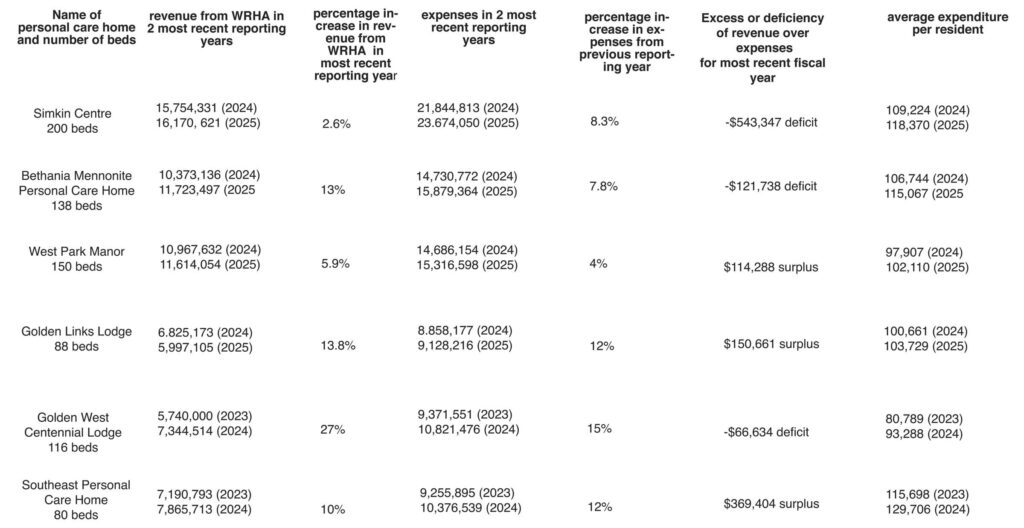
Comparison of funding by the WRHA for 6 different personal care homes
We did not enter into this project with any preconceived notions in mind. We simply wanted to investigate how much funding there has been from the WRHA for personal care homes in Winnipeg in recent years.
As to why some PCHs received quite large increases in funding, while others received much smaller increases – the WRHA response to my asking that question was this: “Due to the nature and complexity of the questions you are asking regarding financial information about PCHs, please collate all of your specific questions into a FIPPA and we can assess the amount of time needed to appropriately respond.”
Gladys Hrabi of MARCHE, however, offered this explanation for the relatively large disparities in funding levels among different PCHs: “Because funding is based on the median, not actual costs, each PCH must manage within the same per diem rate even though their realities differ. Factors like building age, staffing structure, kitchen setup, and resident complexity all influence spending patterns.
“The difference you found (in spending between two particular homes that I cited in an email to Gladys) likely reflects these operational differences. Homes that prepare food on-site, accommodate specialized diets (cultural i.e. kosher), or prioritize enhanced dining experiences (more than 2 choices) naturally incur higher total costs. Others may use centralized food services or have less flexibility because of budget constraints.
“The current model doesn’t adjust for inflation, collective agreements, or true cost increases. This means many homes, especially MARCHE members face operating deficits and have to make tough choices about where to contain costs, often affecting areas like food, recreation, or maintenance. The large differences you see in food spending aren’t about efficiency —–they’re a sign that the current funding model doesn’t reflect the true costs of care.”
But some of the disparities in funding of different personal care homes really jump off the page. I noted, for instance, that of the six PCHs whose financial statements I examined, the levels of funding from WRHA for the 2024 fiscal year fell between a range of $63,341 per resident (at Golden Links Lodge) to $78,771 at the Simkin Centre – but there was one particular outlier: Southeast Personal Care Home, which received funding from the WRHA in 2024 at the rate of $98,321 per resident. Not only did Southeast Personal Care Home receive a great deal more funding per resident than the other five PCHs I looked at, it had a hefty surplus to boot.
I asked a spokesperson from the WRHA to explain how one PCH could have received so much more funding per capita than other PCHs, but have not received a response.
This brings me then to the issue of the Simkin Centre and the quite large deficit situation it’s in. Since readers might have a greater interest in the situation as it exists at the Simkin Centre as opposed to other personal care homes and, as the Simkin Centre has reported quite large deficits for both 2024 and 2025, as I noted previously, I asked Laurie Cerqueti how Simkin will be dealing with its accumulated deficit (which now stands at $779,426) going forward?
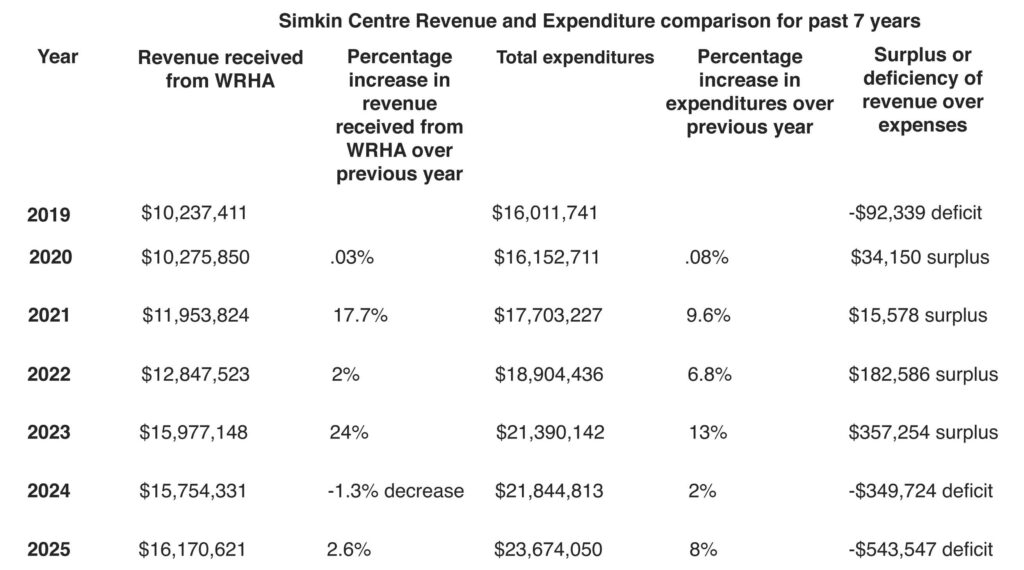
Now, as many readers may also know, I’ve been harping on the extra high costs incurred by Simkin as a result of its having to remain a kosher facility. It’s not my intention to open old wounds, but I was somewhat astonished to see how much larger the Simkin Centre’s deficit is than any other PCH for which I could find financial information.
From time to time I’ve asked Laurie how many of Simkin’s 200 residents are Jewish?
On November 10, she responded that “55% of residents” at Simkin are Jewish. That figure is consistent with past numbers that Laurie has cited over the years.
And, while Laurie claims that she does not know exactly how much more the Simkin Centre pays for kosher food, the increases in costs for kosher beef and chicken have outstripped the increases in costs for nonkosher beef and chicken. Here is what we found when we looked at the differences in prices between kosher and nonkosher beef and chicken: “Based on recent data and long-standing market factors, kosher beef and chicken prices have generally gone up more than non-kosher (conventional beef and chicken). Both types of meat have experienced significant inflation due to broader economic pressures and supply chain issues, but the kosher market has additional, unique cost drivers that amplify these increases.”
In the final analysis, while the WRHA has been providing fairly large increases in funding to personal care homes in Winnipeg, those increases have been eaten up by higher payroll costs and the costs of simply maintaining what is very often aging infrastructure. If the WRHA does not provide any increases for food costs, personal care homes will continue to be squeezed financially. They can either reduce the quality of food they offer residents or find other areas, such as programming, where they might be able to make cuts.
But, the situation at the Simkin Centre, which is running a much larger accumulated deficit than any other personal care home for which we could find financial information, places it in a very difficult position. How the Simkin Centre will deal with that deficit is a huge challenge. The only body that can provide help in a major way, not only for the Simkin Centre, but for all personal care homes within Manitoba, is the provincial government. Perhaps if you’re reading this you might want to contact your local MLA and voice your concerns about the lack of increased funding for food at PCHs.




Local News
The shift in the New Democrats

By NOAH STRAUSS The New Democrats have just wrapped up their 2026 national convention here in Winnipeg. While I was at the convention, I noticed a critical change in the party. Under the current NDP leadership the party and partygoers ignored promoting Canadian merchandise, including flags. It’s interesting to compare the party now to what it was when Jack Layton was the leader (from 2003-2011).
Layton was quite proud to be a Canadian. If you attended or saw any of his rallies you would have seen many Canadian flags, both on stage and in the crowd. Comparing Layton’s era to the current moment, not one Canadian flag was on stage at the recent national convention – only a Palestinian flag.
This should be concerning: Only one flag was present – and it wasn’t ours.
The NDP’s views have shifted and so has the membership. Approximately one in twenty people I saw were wearing keffiyehs. I wonder what was their affiliation to Palestine?
Avi Lewis is not helping the situation; he’s just pouring more gas on the fire. In his acceptance speech at the convention he proclaimed once more that he will not remain silent when Israel commits a genocide in Gaza. He had campaign signs that said ‘Free Palestine’ and ‘Libérer Palestine,’ both on stage and at his numerous campaign events.
In an email sent out to members of Independent Jewish Voices (IJV), an anti-Zionist organization, Lewis noted that he had become a member of that organization, saying “I was also proud to sign IJV’s Together Against Apartheid pledge.”
What does this all mean, though? The NDP have shifted from focusing on Canada and being proud of Canada to supporting a foreign cause and ignoring the facts. Avi Lewis doesn’t care about being Jewish, he cares about getting votes, and if that is what it takes, he’ll tell lies about Israel.
The NDP needs to remember that Canada needs to come first. To the person with the Palestinian flag on the stage: You need to put your Canadian pride first.
If the NDP wants to be seen as a real party, it will put Canada first once again.
Local News
Rachel Fish, leader in combating antisemitism in academia, this year’s Kanee Distinguished Lecture series speaker

By MYRON LOVE The Jewish Heritage Center of Western Canada would seem to have hit another home run with the announcement that Dr. Rachel Fish, a leading voice in tackling anti-Zionism and Jew hatred in North American academia, is this year’s guest speaker at the JHCWC’s upcoming annual Sol and Florence Kanee Distinguished Lecture – which is scheduled for Thursday, April 30, at the Shaarey Zedek Synagogue.
The theme of her timely lecture will be“How the Academy Has Created a Fertile Ground for Antisemitism,” a topic in which she is well versed. Fish has an impressive resumé. She is the co-founder of the nonprofit “Boundless,” a think tank partnering with community leaders across North America to revitalize Israel education and take bold collective action to combat antisemitism. She also serves as Director for The Brandeis University President’s Initiative on Antisemitism; is an associate research professor at the Cohen Center for Modern Jewish Studies; and teaches Israeli history and society at The George Washington University as Visiting Assistant Professor of Educational Leadership in the Graduate School of Education and Human Development.
In the past, she has served as Senior Advisor and Resident Scholar at the Paul E. Singer Foundation in New York City and Executive Director of the Schusterman Center for Israel Studies, where she trained the next generation of academics in the field of Israel Studies. She has also served on the faculty at Brandeis University, George Washington University, and Harvard University. She has has written articles for several publications in the mainstream press and academic journals, and co-edited the book “Essential Israel: Essays for the 21st Century.”
I had the pleasure of speaking with Dr. Fish a couple of weeks ago. My first question to her was how she finds the time to do all that she does. Her response is that there are not enough hours in the day. Her multiple activities remind me of an expression I heard once years ago while I was a member of a short-lived Jewish international development group – “if you want to make sure something gets done, you give it to the busiest person you know.”
Fish observes that she has been explaining Judaism to non-Jews all of her life. “I was raised in Tennessee in a place called Johnson City in the foothills of the Smokey Mountains,” she recounts. “My parents were originally from Ohio. There were very few Jews where we lived. My family spent a lot of time teaching our neighbours, teachers in my school and others we associated with about Jews, our practices and the State of Israel.”
She recalls – as early as 2001 when she was studying at Harvard’s Divinity School, that she was noticing what she describes as a “strong undercurrent of anti-Israel feeling and Jew-hatred”.
“I was determined to pursue a career in higher education,” she notes, “in part because I believe that education matters, because I derive oxygen from teaching, and I particularly enjoy dealing with complex issues. As well, I appreciate the opportunities that teaching at the university level gives me to share what I have learned in public forums such as the Kanee Lecture.”
Ideally, she observes, a professor should not – as much as humanly possible – be sharing her political or personal opinions in class. Higher education should be about creating a space where students can debate freely and challenge each other’s ideas. Instead (as I am sure many readers are aware), too many educators are focused on indoctrinating their students in the teacher’s beliefs – with students with dissident opinion facing hostility and risking ostracism.
Too many universities have become ideological monocultures where critical thinking is discouraged and there is a litmus test for new hires. She cites a FIRE (Foundation for Individual Rights and Expression) report in which an overwhelming majority of the faculty at many leading universities share a leftist – anti-Israel, anti-Christian and anti-Conservative worldview.
That is particularly true with Ivy league and other elite universities in both the United States and Canada – and especially in their liberal Arts and Humanities programs. Much of the anti-Zionist and antisemitic atmosphere – such as the takeover of university quadrants in the wake of October 7 – has been created by outside agitators and foreign funders – notably the oil rich Islamic sheikhdom of Qatar.
“Where you have universities with strong administrative leadership,” she points out, “the level of hostility to Jewish students and threats of violence have not been allowed to take root. It has only been the case where the administration and the board are weak.”
So why, I asked her, do so many Jewish students not seek out alternatives to these compromised campuses?. She responded that some Jewish students have chosen to enrol in universities in the southern United States where there is a more welcoming environment.
But many Jewish students, she observes, continue to enrol in leading universities such as Harvard and Yale, Cornell and UCLA (or York or the University of Toronto in Canada). Many Jewish students still share the belief that being identified with being affiliated with a top flight university will benefit their future careers.
Sadly, she further points out, this poison has filtered down to the K-12 level. Many university education departments have graduated numerous indoctrinated teachers who have taken control of school boards and administrations and seek to impose their vile doctrines on susceptible young minds.
Nevertheless, there are a great many state and lesser known universities that provide a more welcoming attitude to Jewish students.
Rachel Fish suggest that, for too long, North American Jewish communities have been complacent and not recognized the danger in our midst. She does see some hopeful signs though. She has observed that more and more communities, parents and student s have woken to the danger and begun to fight back.
“It’s difficult,” she acknowledges. “It can feel overwhelming. But we have to keep chipping away and not just let the other side win.”
The Sol and Florence Kanee Distinguished Lecture series was inaugurated by the Jewish Heritage Centre of Western Canada in 2006 to celebrate Sol Kanee’s 95th birthday. In welcoming the audience to that first lecture, lecture series co-chair Harold Buchwald paid tribute to Kanee, who died on April 23 at 97, as a man who “cast a giant shadow” on world Jewish history in the second half of the 20th century. The former resident of Melville, Saskatchewan, who spent almost all of his adult life in Winnipeg, Kanee was a leader in the development of Israel and the Free Soviet Jewry movement as well as a macher in our Jewish community and across Canada.
I would encourage readers who may be interested in learning more about the current state of antisemitism in academia – and want to support the JHCWC to go online at jhcwc.org for further information or to order tickets. The price of admission is $50.
Local News
Young tech entrepreneur Adam Fainman gathering accolades locally and internationally

By MYRON LOVE Winnipegger Adam Fainman is taking the world by storm. In fewer than three years his new AI start-up – Moonlite Labs – has attracted thousands of users in 550 cities in 95 countries world wide.
As he explained in an interview in the Winnipeg Sun last June, Moonlite Labs is “a creative content platform designed to make multimedia storytelling radically more accessible. With a few prompts,” he noted, “users can generate professional grade videos, animations, voiceovers, talking avatars, music-reactive visuals, and more.”
On Tuesday, February 24, the young entrepreneur garnered his newest accolade when Winnipeg-based North Forge, Canada’s only start-up incubator, accelerator and fabrication lab, gave Fainman its DARE Emerging Innovator Award at a reception at the Royal Aviation Museum of Western Canada.
“I dedicated the award to my zaida, Jacob T. Schwartz,” Fainman says, noting that his zaida was a prominent computer scientist and professor of Computer Science at the New York University Courant Institute of Mathematical Science, and founder, in 1964, of New York University’s Department of Computer Science – which he chaired for 16 years.
At the awards evening, Fainman adds, he had the opportunity to meet many of the movers and shakers in the industry here.
The son of Shane and Rachel Fainman began his life in Toronto. “My father is from Winnipeg, my mother from New York. They met in the Sinai Desert at a music festival.”
The family moved to Winnipeg in 2006 when Adam was in high school. After graduating from the University of Winnipeg Collegiate he went on to earn a B.Sc. in Computer Science from the University of Winnipeg.
“Performing was always my first love” he says.
Post university, he began a career as a rapper, beatboxer, and producer under the stage name Beatox, touring across Canada and central Europe with his rare ability to combine story-telling and singing.
In 2015, he enrolled in a two-year digital media and design program at Red River Community College. After graduation, on the encouragement of a University of Toronto professor, he continued his studies in Toronto earning a Masters Degree in Music Technology and Digital Marketing.
“During the Covid shutdown,” he recounts, “I began experimenting with AI and producing music videos combining music, story-telling and animation. I posted them on social media sites such as YouTube and TikTok. They went viral, garnering millions of views. People were asking me if I could help them with creating similar videos. I saw there was a gap in accessibility to this technology, so I decided I should create a platform as a solution”
“A friend of mine, Brayden Bernstein was involved in the tech scene in Winnipeg, saw the success I was having on TikTok and gave me some advice on how to go about this” Fainman continues. “As well, a few colleagues from the University of Winnipeg expressed interest in building a solution together.”
Wanting to create a platform that would make it easy for others to replicate what he was doing, Fainman sought out resources in Winnipeg that might be able to help him.
He pitched his idea first to NRC-IRAP (National Research Council of Canada Industrial Research Assistance Program), Canada’s leading innovation assistance program for small and medium-sized businesses,
“They loved the concept and traction I was getting, and agreed to help fund us,” Fainman says.
His next stop was North Forge – in 2024 – where Moonlite joined their Ascent Program and was matched with mentors.
In early 2025, Moonlite Labs made its official debut at the Manitoba AI Innovation Showcase where the new company was greeted with an award. “It was a massive confidence boost,” Fainman told the Sun in that earlier interview. “It was our first time sharing with the public what we’ve been up to for the last year. To win the award… that was very, very rewarding.”
Last June, the company made its presence known on the international stage at VivaTech 2025 in Paris — Europe’s largest startup and tech conference, with over 180,000 visitors.
Moonlite was selected as one of TechCrunch’s Top 30 Startups of the Year, a shortlist that included only two Canadian companies.
“Getting the AI Showcase award, getting into VivaTech, being selected as one of the top 30 startups of the Year by TechCrunch, that was pretty crazy,” Fainman told the Sun.“Backed by ScaleAI, Moonlite joined Canada’s official delegation at VivaTech, which had special visibility this year with Canada named Country of the Year at the conference.
“We had a massive space. The French president came through our whole area. It was the craziest thing,” Fainman recalled. “Everyone had their phones. It was like a mob… then we’re like, oh my God, it’s the French president. People were freaking out.”
As per the Sun story, Fainman was given two days to showcase Moonlite, with a booth for both the platform’s business-to-business (B2B) and business-to-consumer (B2C) offerings. But the most personal moment came on stage, where he delivered a presentation showcasing his journey from beatboxing artist to tech founder.
With Moonlite Labs growing exponentially, Faiman and his team of eight are hoping to become as ubiquitous as Adobe and Canva. “My ultimate goal is to help as many people as possible to create professional-grade videos and ultimately share their stories,” he comments.
He himself, he adds, is hoping to get back to live performances as well. “I recently appeared at Festival du Voyageur and I have just completed my 4th studio album. I can’t wait to use Moonlite for all my videos and world building” he reports.
Readers who might want to try Moonlite for themselves can go to https://moonlitelabs.com
You can get in touch with Adam Fainman at adam@moonlitelabs.com