


Uncategorized
10,000 Antisemitic Incidents Targeted Jews After Oct. 7, ADL Report Says
A punishing wave of over 10,000 antisemitic incidents has hit the American Jewish community since Oct. 7, according to a new report published by the Anti-Defamation League (ADL) Center on Extremism on the first anniversary of Hamas’ massacre across southern Israel.
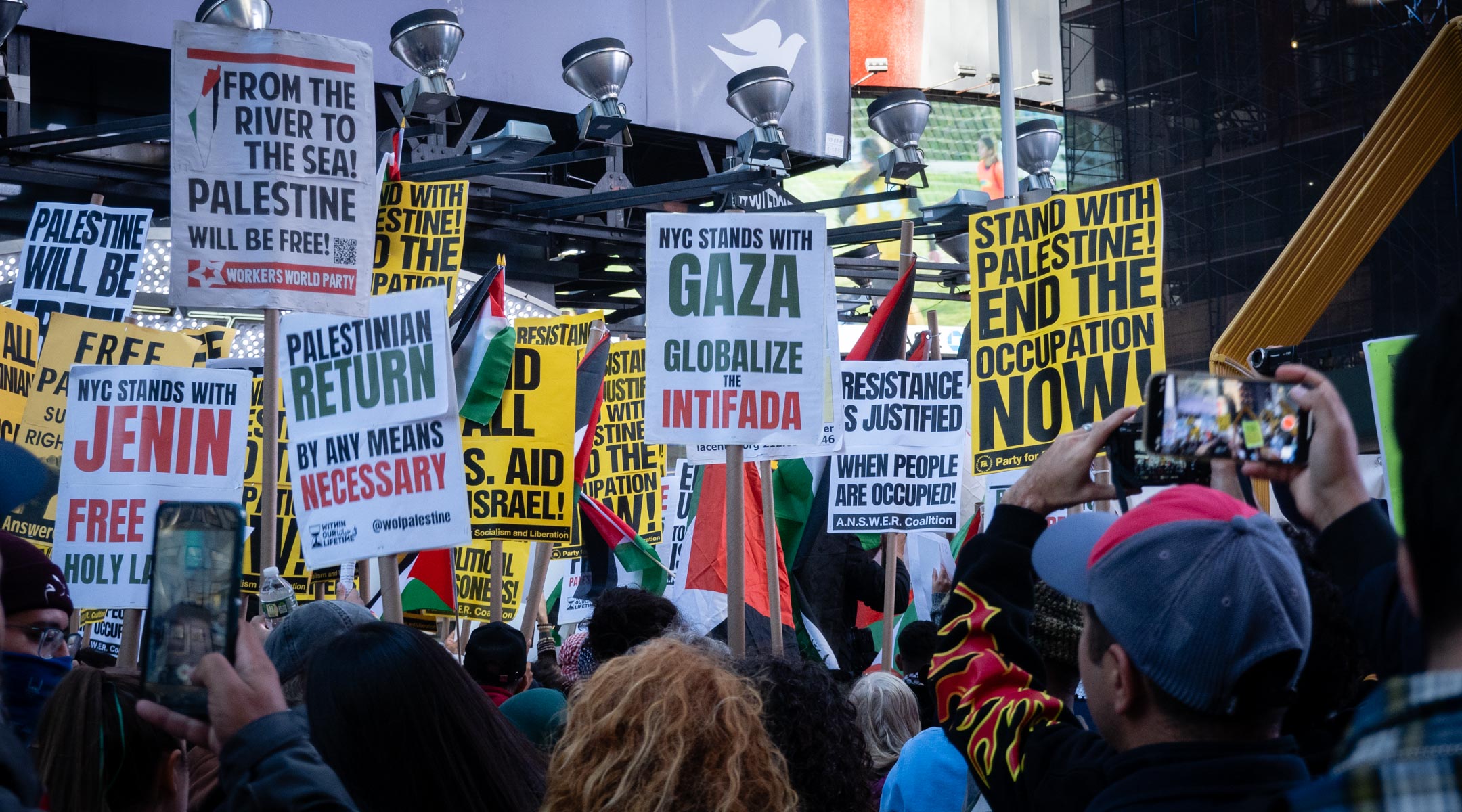
The report, which tracked antisemitic incidents that occurred between Oct. 7 2023-Sept. 24, 2024, showed a 200 percent increase from the previous year, noting that 30 percent of them took place on college campuses and another 12 percent happened during anti-Israel protests. Another 20 percent targeted Jewish institutions, including nonprofit organizations and houses of worship. Of these, 50 percent were bomb threats.
“We mourn the victims of the Oct. 7 attack in Israel, marking one year since the worst massacre of Jews since the Holocaust,” ADL chief executive officer Jonathan Greenblatt said in a statement accompanying the report. “From that day on, Jewish Americans haven’t had a single moment of respite. Instead, we’ve faced a shocking number of antisemitic threats and experienced calls for more violence against Israelis and Jews everywhere.”
As The Algemeiner has previously reported, antisemitism in the US has surged to unprecedented levels.
From Jan. 2023 to Dec. 2023, the ADL recorded 8,873 antisemitic incidents — an average of 24 every day — across the US, amounting to a year unlike any experienced by the American Jewish community since the organization began tracking such data on antisemitic outrages in 1979. Incidents of harassment, vandalism, and assault all spiked by double and triple digits, with California, New York, New Jersey, Florida, and Massachusetts accounting for nearly half, or 48 percent, of all that occurred.
Breaking down the numbers, the ADL found a dramatic rise in the targeting of Jewish institutions such as synagogues, community centers, and schools, with 1,987 such incidents taking place in 2023 — a 237 percent increase which included over a thousand fake bomb threats, also known as “swattings.”
Other figures were equally staggering, with assaults and vandalism rising by 45 percent and 69 percent, respectively, while harassment soared by 184 percent. Antisemitic incidents on college campuses, which The Algemeiner has continued to cover extensively, rose 321 percent, disrupting the studies of Jewish students and leaving them uncertain about the fate of the American Jewish community.
The last quarter of the year proved most injurious, the ADL noted, explaining that after Hamas’ Oct. 7 massacre across southern Israel, 5,204 antisemitic incidents rocked the Jewish community. Across the political spectrum, from white supremacists on the far right to ostensibly left-wing Ivy League universities, antisemites emerged to express solidarity with the Hamas terror group, spread antisemitic tropes and blood libels, and openly call for a genocide of the Jewish people in Israel.
Such incidents occurred throughout the US. In California, an elderly Jewish man was killed when an anti-Zionist professor employed by a local community college allegedly pushed him during an argument. At Cornell University in upstate New York, a student threatened to rape and kill Jewish female students and “shoot up” the campus’ Hillel center. In a suburb outside Cleveland, Ohio, a group of vandals desecrated graves at a Jewish cemetery. At Harvard University, America’s oldest and, arguably, most prestigious university, a faculty group shared an antisemitic cartoon depicting a left-hand tattooed with a Star of David dangling two men of color from a noose.
Most recently, the ADL reported a “staggering” 477 percent increase in anti-Zionist activity on college campuses involving assault, vandalism, and other phenomena. The report — titled “Anti-Israel Activism on US Campuses, 2023-2024” — painted a bleak picture of America’s higher education system poisoned by political extremism and hate.
“As the year progressed, Jewish students and Jewish groups on campus came under unrelenting scrutiny for any association, actual or perceived, with Israel or Zionism,” it says. “This often led to the harassment of Jewish members of campus communities and vandalism of Jewish institutions. In some cases, it led to assault. These developments were underpinned by a steady stream of rhetoric from anti-Israel activists expressing explicit support for US designated terrorists organizations, such as Hamas, the Popular Front for the Liberation of Palestine (PFLP) and others.”
Follow Dion J. Pierre @DionJPierre.
The post 10,000 Antisemitic Incidents Targeted Jews After Oct. 7, ADL Report Says first appeared on Algemeiner.com.
Uncategorized
Newly aired recordings of paramedic Amit Mann’s final hours renew push to let families access Oct. 7 records
(JTA) — Three years after paramedic Amit Mann, 22, was killed by Hamas while treating the wounded in Kibbutz Be’eri on Oct. 7, newly aired recordings of her final calls revealed fresh and harrowing details about her last hours.
The recordings, aired by Channel 12 on Tuesday, prompted her sister, Haviva Mann Izikson, to renew an appeal for a centralized system to ensure other families are not left searching for similar records years later.
The calls capture Amit repeatedly calling emergency services as Hamas terrorists overran Be’eri, seeking assistance while continuing to treat wounded residents.
The previously unknown calls came to light by chance, when, earlier this year, Mann Izikson contacted the Magen David Adom emergency service seeking the precise times of calls Amit had made on Oct. 7 as she updated a presentation she planned to give about her sister. MDA provided information on seven calls. Until then, the family had known of only four.
Mann Izikson said hearing them revealed both that what Amit endured was “even worse than we had thought” and the extent to which Amit continued caring for others even as the situation around her deteriorated.
“It showed me even more both the hell that she went through and, on the other hand, who she was. What she was dealing with, what she went through there, which was even worse than we had thought, and how despite all of that she keeps treating the wounded in every way she can,” Mann Izikson told the Jewish Telegraphic Agency Wednesday as she prepared to return to Be’eri for a memorial event at the dental clinic where Amit was killed.
The recordings trace Amit’s increasingly desperate attempts to summon help as terrorists closed in around the dental clinic. Hours later, she sent her sisters a chilling last message: “They’re here, in the clinic. I don’t think I’ll make it out of here. I love you.”
In one call, Amit is heard struggling to convey the scale of what was happening to a police dispatcher.
“I don’t understand what’s going on,” she told the dispatcher, describing wounded and dead people around her and continued gunfire. She asked whether the army or police had reached the kibbutz. When the dispatcher told her help was coming and urged her to stay inside, Amit began to cry. “Just tell me you’re here.”
Hours later, at 10:41 a.m., after seven calls to Magen David Adom, Israel’s national emergency medical service, Amit made her final recorded call to police. “Listen, terrorists have infiltrated Be’eri! We urgently need an ambulance or police here. Come urgently to the dental clinic.”
Hearing the latest recordings was heartbreaking, Mann Izikson said. She was struck by Amit’s ability to pull herself together after desperate calls for help and return to caring for the wounded, comforting them, asking about their families, bringing them water and improvising with what little there was. Amit placed helmets beneath their heads and covered those who were cold from blood loss.
“She keeps them alive until her final moments, and she stays true to herself until her last breaths,” Mann Izikson said. “It just amazed us.”
Mann Izikson is urging the state to establish a central body that would collect all existing documentation from Oct. 7, including recordings held by emergency services and police as well as security-camera footage and other material, catalogue it by victim, and contact each family. Such a body, she said, should tell relatives: “We have documentation of your loved one. Would you like to receive it?”
“If the family wants it, then all of it should be provided to them proactively,” she added.
She pointed to the family of Gil Buyum, 55, a member of Be’eri’s security squad whom Amit treated after he was shot. In one call, Amit reported him wounded; in a later call, she reported that he had died.
The two recordings allowed Buyum’s widow, Ayelet, to narrow down the time of her husband’s death, Mann Izikson said. Buyum’s 22-year-old son, Inbar “Buri” Buyum, was also killed while trying to defend the kibbutz that morning.
“Only because of Amit’s recordings was she able to identify the 20-minute window in which he died,” Mann Izikson said. “That’s just one example of how someone can get some kind of closure from something like this.”
She said families should be able to decide for themselves whether they want such material. “It belongs to the families. It is the families’ material, and the families should decide what, if anything, to do with it.”
A law passed in July established an Oct. 7 Memory Authority slated to include an archive and centralize documentation of the attack. The law is due to take effect in January, but it is unclear whether the authority will match material to individual victims and notify their families.
JTA was unable to reach the Prime Minister’s Office and the Israel State Archives, the government body responsible for preserving state records, in time for publication.
Merav Israeli-Amarant, CEO and co-founder of the Civil Commission on Oct. 7 Crimes by Hamas, which released a major report in May documenting sexual violence during the attack and its aftermath, said Mann Izikson’s proposal was “profoundly important.”
“Families should not have to discover, years later and by chance, that recordings, footage, or other documentation connected to their loved ones exist,” Israeli-Amarant told JTA. She said there should be a mechanism that “approaches families with sensitivity,” while giving them the choice of whether to “receive it, view it, preserve it, or not engage with it at all.”
But Israeli-Amarant also said there was “unique importance” in preserving such material through civilian institutions, noting that many Oct. 7 families feel abandoned by the state and that some prefer documentation to be handled independently and “outside political considerations.”
Maya Gan-Zvi, manager of the National Library of Israel’s Bearing Witness: October 7 Archive, which has collected hundreds of thousands of files from the attack, cautioned that proactively approaching families, as Mann Izikson proposes, also raised ethical questions because families differ widely in how, and whether, they want to encounter such material.
“Some want to receive everything, and some do not want to know, or not yet,” Gan-Zvi told JTA, adding that even members of the same family may disagree. Contacting a family without first knowing its wishes could “reopen wounds,” she said, particularly in cases involving graphic material or footage filmed by the terrorists themselves.
Gan-Zvi said she favored a system in which bereaved families themselves would take the initiative, registering that they wanted to be contacted, specifying the types of material they wanted and receiving a description of what had been found before deciding whether to obtain it.
According to Israeli-Amarant, any system would face “significant” practical and legal hurdles because Oct. 7 material is scattered among government bodies, emergency services, police, the military, media outlets and private individuals, raising questions of ownership, privacy, consent and the rights of victims’ families.
Some recordings or footage may also be evidence in ongoing investigations or criminal proceedings against Hamas terrorists, she said, making chain of custody, publication restrictions and the integrity of those proceedings additional considerations.
Mann Izikson said providing documentation would help answer fundamental questions that remained unresolved.
“Three years later, we still don’t know the full truth and don’t understand how this happened,” she said. “Every piece of material like this can shed another bit of light and help us understand a little bit more.”
She has listened to the newly aired recordings repeatedly, echoing a pattern she described to JTA on the first anniversary of the attack, when she said she reread Amit’s messages from Oct. 7 every day, in part to piece together what happened during her sister’s final hours and try to come to terms with it.
It took two and a half days for Amit’s body to be identified. Mann Izikson told JTA at the time that when her sister was lowered into the grave, “I felt like they were burying half of my own child. I wanted to go in instead of her.”
Even amid the war, the hostage crisis and the wider grief in Israel on the first anniversary of Oct. 7, Mann Izikson said Amit’s loss eclipsed everything else. “There is all the rest — and the rest is painful and scary,” she said. “And then there is Amit and nothing else at all.”
This article originally appeared on JTA.org.
The post Newly aired recordings of paramedic Amit Mann’s final hours renew push to let families access Oct. 7 records appeared first on The Forward.
Uncategorized
Bereaved mother: ‘Every day is Oct. 7. Still.’
(JTA) — TEL AVIV – Some 50,000 Israelis filled Tel Aviv’s Yarkon Park on Wednesday night to mark three years since the Oct. 7 attacks, at a bereaved families’ memorial ceremony that for the first time took place with no hostages remaining in Gaza.
The ceremony, organized for the third year by the Kumu movement, an initiative set up by families affected by Oct. 7, came more than eight months after the body of Ran Gvili, the last hostage held in Gaza, was recovered and returned to Israel. The last 20 living hostages had returned in October 2025. A year ago, 48 yellow chairs hung above the same stage to represent those still in Gaza.
This year, with the hostage campaign that dominated Israeli public life for more than two years no longer hanging over the anniversary, the emphasis shifted toward remembrance and another unresolved demand of many bereaved families: an investigation into the failures that allowed the attack to happen.
Former hostage Eli Sharabi, who was held in Gaza for 491 days, hosted the ceremony alongside actress Shani Cohen. Sharabi was abducted from Kibbutz Be’eri on Oct. 7; his wife Lianne and daughters Noiya and Yahel were killed in the attack, and his brother Yossi was killed in captivity.
“Remember what happened. Investigate how it happened. Don’t cut corners. Don’t let time blur the truth, don’t rewrite history, and don’t let history repeat itself,” Sharabi said from the stage.
Omri Shifroni, a founder of the Kumu movement whose relatives Liel and Yanai Hetzroni and Avia and Ayala Hetzroni were murdered in Kibbutz Be’eri, also demanded a full investigation.
“That morning, the systems collapsed and the state failed to function,” he said. “But mutual responsibility alone is not enough. To rebuild trust, we also need the truth. We must know what happened. Without investigating the truth, we cannot fix things, and we cannot make sure it never happens again.”
Prime Minister Benjamin Netanyahu’s government has resisted establishing a state commission of inquiry into the failures surrounding Oct. 7 and instead backed legislation for a politically appointed probe.
Wednesday’s ceremony was launched ahead of the first anniversary of the attack as an alternative to the official state event after many bereaved and hostage families said they would shun it.
Netanyahu instead attended the official state commemoration at Mount Herzl on Monday, the Hebrew-calendar date designated by the government for marking the attack.
For Eliot Young, whose brother Nathanel, a British-Israeli soldier, was killed fighting Hamas on Oct. 7, the ceremony has become an annual form of support. He was there with his wife, Rena, and their infant son, who was named after Nathanel.
“These days are very hard, but the fact that these people are here is a huge source of strength for me,” he told The Jewish Telegraphic Agency. “Some of them lost lots of family members, but they’re still here, smiling, having a conversation. It’s an inspiration for anyone who has been through loss.”
Young recalled Nathanel talking about joining the Israeli military from the age of 10, even though he was living in the UK at the time, and said that by 15, Nathanel was going to the gym with the goal of getting into the best unit he could.
“He taught us, and continues to teach us, about persevering with your dreams,” Young said.
Nathanel, a soldier in the Golani Brigade’s 13th Battalion, was killed fighting at the Yiftach military base near Zikim in the Gaza envelope in southern Israel, where he and other soldiers held off Hamas attackers, saving soldiers at the base and preventing an infiltration into the nearby kibbutz.
His sister, Gaby Young Shalev, said that three years on, Nathanel’s memory has become woven into the family’s daily life.
“There’s not one day that goes by where someone in my family isn’t doing something in memory of Nathanel,” she told JTA.
Among the projects is a professional music and DJ studio for at-risk youth at a WIZO school in Jerusalem — Nathanel himself was a DJ — funded with tens of thousands of shekels raised by Young Shalev in his memory. A wine and a cold brew have also been made in Nathanel’s memory.
“We’re trying to live our lives the way that Nathanel would want us to. He definitely wouldn’t want us to sit around moping,” Young Shalev said.
Other memorials were held throughout the day across Israel, including in communities attacked on Oct. 7. At the Nova festival site near Re’im, survivors and bereaved families gathered for a memorial at 6:29 p.m., deliberately matching 6:29 a.m., the time the Oct. 7 attack began and the music stopped.
Eyal Golan, whose sister Shirel survived the Nova massacre and later died by suicide, returned to the Re’im area for the first time in five years. He said he had not been back since developing PTSD during reserve duty in the 2021 Gaza conflict, and had not even driven through the area since.
During the ceremony, Golan chose to remain beside a memorial placard bearing Shirel’s photograph. “I wanted to babysit my little sister,” he said.
He spent much of the day speaking about Shirel and handing out sensory balls designed to help ground people during anxiety and PTSD episodes, part of a project he founded in her memory. It was a marked change from a year earlier, when Golan told JTA he could not bring himself to attend a memorial and had spent the anniversary struggling with a feeling of “emptiness” and his own PTSD.
“For the first time in years, I felt like I had completed a missing piece of the puzzle of my life,” he said after Wednesday’s ceremony. “I felt much more whole.”
Their mother, Yaffa Golan, said being among others “in pain, tearing up, crying” reflected how raw the loss remains.
“You know, for us, every day is October 7. Still now,” she said.
This article originally appeared on JTA.org.
The post Bereaved mother: ‘Every day is Oct. 7. Still.’ appeared first on The Forward.
Uncategorized
The definitive Oct. 7 book was written — and sketched — before the attack
As Salomé Parent-Rachdi and Zac Deloupy worked on the drawings for a book about Israeli-Palestinian romance, they had no way of knowing the world they were depicting was on the brink of collapse.
The day they finished their pencil sketches, we learn in the book’s introduction, was Oct. 6, 2023. The next day, Hamas invaded Israel, killing about 1,200 and taking another 251 hostage. By the time the book was published in April 2024, Israel was locked in a multi-front war that still hasn’t quite settled.
That context — a looming attack, a forever war that has not yet begun — colors every panel of Love and Desire in the Promised Land: The Private Lives of Israelis and Palestinians, a French graphic nonfiction book whose English translation was released this summer. Reading the book feels like opening a time capsule that had been buried in the distant past: Even as it reminds you how bad the Israeli-Palestinian conflict was before Oct. 7, it leaves you wishing desperately you could restore things to how they were.
The book follows Parent-Rachdi, a French journalist, as she travels across Israel and the Palestinian territories to interview 16 subjects about their love lives. She talks to a mix of singles and couples, straight and gay, in Israel, West Bank and Gaza. (That’s one giveaway this book couldn’t have been made today: No journalist has been permitted to enter Gaza unaccompanied since Oct. 7.)
A few tell of dating across Palestinian-Israeli lines. Lana, an Arab Israeli, finds herself in a situationship with a right-wing Israeli — and ends up marrying him. Samira, an Arab Israeli woman, tells us about her Israeli ex, whose enlistment during the 2014 Gaza war — when they are living together — brings the unspoken tension in their relationship out into the open. And we learn the complex family dynamics of a celebrity Muslim-Jewish couple: Fauda star Tsahi Halevi and his Arab-Israeli wife, TV anchor Lucy Aharish.
The less politically fraught experiences are relayed with the same empathy. Avi, an ex-Hasid, reveals that, despite unbearable teenage horniness, he initially didn’t know how to find porn on the internet due to his insular upbringing. (He searches for “woman in pajamas” instead.) Rami, Parent-Rachdi’s fixer and taxi driver in Gaza, says, as a single man in his thirties, he told people he had erectile dysfunction so they wouldn’t grow suspicious.
In between these revelations are glimpses of life as it was in Israel and the Palestinian territories before Oct. 7. We ride shotgun as Parent-Rachdi navigates checkpoints on her way out of the West Bank and deals with Israeli and Palestinian officials on the way into Gaza. Rami — who did finally marry — says he made sure his son was born in Jordan so that he wouldn’t be trapped in Gaza as an adult. Parent-Rachdi has brought his stepson a remote-control car — the kind of toy Rami can’t buy in Gaza due to the Israeli blockade.
The love stories describe conflict, of course, and they do not uniformly lead to happy endings. (Or for that matter, breakups.) What they consistently show instead is people — as far as we can tell, basically good people — reaching out to each other in a pressure cooker of cultural, religious, sexual and political attitudes.
The stories also betray civilians’ genuine skepticism of their own communities with a frankness that seems unimaginable today. The clearest example of this comes in Gaza, where Mohammed, a closeted Palestinian looking for hookups, tells Parent-Rachdi about Hamas honor killings of gay men and his own brush with death. “They’re more likely to kill you if you’re a bottom,” he says matter-of-factly. Catfished by a Hamas intelligence officer, Mohammed escapes arrest by swearing he’s a virgin and flees to the U.S. a few days later.
Would Mohammed make the same disclosures today, when “What about Hamas?” has become a refrain for anyone defending Israel’s response to Oct. 7? The Gaza he left behind no longer exists. The book’s afterword, written in Feb. 2024, reveals that Rami’s wife’s cosmetics store — lovingly illustrated by Deloupy earlier in the book — was leveled in Israeli airstrikes; the family was now living in a refugee camp in Rafah. “We have gone from a life with all the modern comforts to a reality where we move with a cart, where we buy wood to split and burn in order to cook and take a shower,” he says.
As for Mohammed, his house was destroyed, as were many friendships with Jews and Israelis: “I write to them,” he says in the afterword. “They don’t respond, but they read my message.” As for Hamas, he says, “today, seeing the suffering, somehow I feel like I better understand their resistance.” When the authors checked in with the subjects, several did not respond. By then, some 30,000 Palestinians were dead.
As it reminds us what we’ve lost, Love and Desire in the Promised Land also points the only way toward a shared future: people on all sides defying the forces pulling them apart. It shows us it can be done. Even in the afterword, one of the interviewees, a Modern Orthodox Jew named Jean-Marc, is optimistic: “I am still convinced, even more so now, that we have to work with the Palestinians,” he says. “Our safety depends on it.”
The post The definitive Oct. 7 book was written — and sketched — before the attack appeared first on The Forward.
