


Uncategorized
A Jewish-Muslim art show builds ‘little bridges’ of coexistence
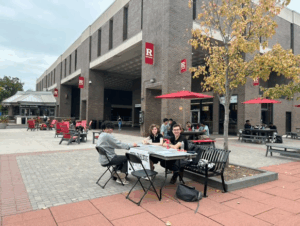
Hannah Finkelshteyn and Aakef Khan spent a lot of time in the same building even before they met. Khan’s filmmaking classes at Rutgers’ Mason Gross School of the Arts often met on the same floor where Finkelshteyn, a drawing major, had her studio.
But their paths wouldn’t cross in earnest until after Oct. 7 — when they would become unlikely friends and later co-curators of an exhibition bringing together Jewish and Muslim artists. The result is “Open Archways: by the light of the same moon,” opening Thursday at the Bowery Art Collective in Metuchen, New Jersey.
Finkelshteyn, 23, was born in Brooklyn and raised in East Brunswick, New Jersey, in the Modern Orthodox community, attending Jewish schools up until college.
“Oct. 7 and the reaction to Oct. 7 completely shifted my entire experience of college and my ability to learn and my ability to be a part of the Rutgers community,” she told me at a coffee shop in Manhattan. She and Khan took the train into the city together when we met before Thanksgiving.
The first several days after the attacks went by in a haze, Finkelshteyn recalled. She scrolled through articles, and texted and called her many family members and friends in Israel, where she spent a gap year, to ask, “Are you okay?” and “Are you alive?”
“Grief was palpable” among the Jewish community on campus, she said. But as the days went by, she became increasingly aware of responses and social media posts from other classmates that left her feeling confused and isolated. She even dropped a small group course in part because of what she saw her peers saying online.
“I can’t be sitting here being terrified for my family while this person who’s sitting across from me thinks Oct. 7 was a good thing,” Finkelshteyn said.
The only one in that room who she felt she could have an actual conversation with was a Palestinian classmate. “I asked her if her family was okay, and she asked if my family was okay,” she said. “And we both talked about just not being able to focus on anything.”
Finkelshteyn, who graduated last spring, wanted to talk and to listen, to understand and be understood. But there didn’t seem to be a space for that on campus — until a friend of her then-boyfriend (now husband) suggested they start an “Open Dialogue Table” like one he’d seen elsewhere.
The three of them, along with other like-minded students, began setting up a table on campus in shifts with a sign inviting passersby to come talk about Israel and more. “Once a week, every week, we sat at this table, and we had conversations. And honestly, it made things feel a lot less foggy,” she said.
One day, Khan came over and sat down.
Becoming friends and co-curators
Raised in a religious Muslim family of Pakistani descent, Khan, 22, went to public school during the week and to Saturday school at the mosque in South Brunswick, New Jersey, where he grew up. He first heard news not about the Hamas attacks on the Gaza envelope, he said, but about Israel cutting off water and electricity to Gaza. He and Finkelshteyn were on the same campus, but ensconced in their own communities and vastly different news ecosystems. Khan’s conversations and group chats afterward were full of talk about boycotts and encampments.
“It felt like a big gray cloud was over Rutgers for months,” Khan, who is currently a senior, told me. But as someone who had always felt the urge to ask, “Why?” and challenge his own beliefs, he said he found it unsettling to be surrounded by only one slice of opinions. So he began actively searching for others. “I was looking for a place to feel like I can belong and speak without feeling like I had to censor myself,” he said.
“I need to stand somewhere where I can see both perspectives,” he said he realized, which led him through the doors of Hillel and steered him toward the Open Dialogue Table.
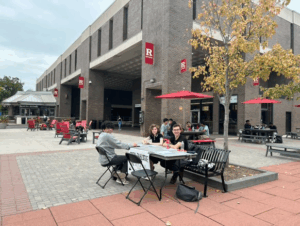
When Khan first sat down, he started chatting with Finkelshteyn’s boyfriend, who quickly made the connection that both Khan and Finkelshteyn were art students. And then the two artists were off, chatting about filmmakers and LiDAR camera technology.
“It started with me trying to be like, ‘All right, like, what is up with Israel?’” Khan said. “But it ended up being, ‘Wow, I just made two new friends.’ And I think once I started to look at it that way, things became a lot less scary.”
He began carving time out to go to Shabbat dinners. It was uncomfortable at first to walk into such an explicitly Jewish space, Khan recalled, but it helped to hear Finkelshteyn or her boyfriend shout his name from across the room and enthusiastically motion him over to sit with them and meet their friends.
Khan and Finkelshteyn kept talking — about art, religion, language, community and current events. “Once we can talk about other things that we’re passionate about, now we can sort of hear each other out on Israel-Palestine and all those things, and be willing to see each other’s perspectives as valid, even if ultimately we don’t align,” Khan said.
They became artistic collaborators and genuine friends. “I never expected that I would invite someone I met at the Open Dialogue Table to my wedding,” said Finkelshteyn, who got married this past summer. But she did, and Khan came out to celebrate the special day — his first Jewish wedding — with his new friends.
In the months since, Khan and Finkelshteyn have been hard at work pulling together a larger group of Jewish and Muslim artists around them from Rutgers and beyond to meet, talk, create and show their work together.
“Open Archways” is their small way of trying to lift the heavy fog of tension and misunderstanding that marked their college experiences post-Oct. 7. “I believe that starts with grassroots work like this of creating spaces where Muslim and Jewish people can intermingle and create friendships,” Khan said. “They may not agree on everything, but at least they can see the other side as human.”
Living ‘by the light of the same moon’
Khalid Khashoggi has always had Jewish friends, he said. He was born in Beirut in 1965, but hasn’t returned to Lebanon since he was 10, when the civil war broke out and his family left for Europe.
At the English and Swiss boarding schools he attended, he found it easier to bond with Jewish students than the other boys. Reflecting back decades later, he said he thinks it’s because “there is more in common between Jewish and Muslim/Arab cultures than with any Anglo-Saxon culture.” He’s remained close ever since with two of those friends, who he said treated him like a brother.
“I just want other members of my culture to experience that warmth,” Khashoggi, who moved to the U.S. for college and settled here afterward, told me on a video call. He’s been running an SAT prep school for 25 years and, more recently, working with young artists and curators as founder and director of the Bowery Art Collective. The latter began right before the pandemic, when Khashoggi noticed all the art portfolios the test prep students were carrying around and suggested they use the school’s space to have an exhibition.
When the war threatened to make connections like his boarding school friendships all the more improbable, and as he witnessed “scary” incidents of antisemitism that were more “mean and violent” than he’d ever seen before, he came up with the idea of a joint exhibition.
“I could tell that both sides were getting pushed apart,” he said, recoiling at the idea of being placed in a stance of immutable opposition against people he considered friends. As he put it: “Don’t tell us who we need to hate.”
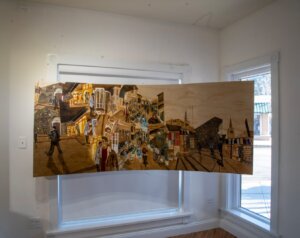
“Let’s use the magic of art to reconnect these communities, even if it’s just 10 people,” he said. “There’s no way we can solve the world’s problems,” he added. “But at least if we can make some friends while we’re doing this — across two communities that have been told not to be friends — then that would be great.”
“There’s nothing like friendship to dispel stereotypes,” Khashoggi said.
He and Arianna Astuni, his co-CEO at the test-prep company and BAC’s executive director, quickly found Finkelshteyn, at the recommendation of another student who’d worked with BAC. She was in, without hesitation. But their first call for a Muslim co-curator was met with a lot of opinions and no applications.
“We got some backlash at first,” Astuni told me on a joint video call with Khashoggi. “People get so caught up in the largeness of political issues, and then they’re yelling large things that they really don’t know and they really couldn’t possibly feel.”
For Astuni, who said she was used to watching connections being cultivated in their small gallery and community, the response was surprising. And for her longtime test prep and art collective colleague, it was dispiriting.
“I remember having conversations with friends and saying, I don’t know. I think I’m insane,” Khashoggi said. “Everyone’s telling me that what I’m trying to do is not doable. Or they would be like, yeah, it’s a beautiful idea, but it’s just not the time to do that. It’s not the time to normalize relationships.”
Instead of giving up or waiting for some elusive right time in the distant future, they reworked the ad for a Muslim curator and tried again. This time, applications came in for them to consider. Among them was one from Khan, whom Finkelshteyn had encouraged to submit.
Ultimately, Khashoggi felt, “Aakef was the best applicant. It also helped that he had worked with Hannah before, and knew her, and they had a good dynamic,” he said. “That was really important.”
Together, Finkelshteyn and Khan came up with the exhibition’s subtitle: “by the light of the same moon.” In an environment that tends to emphasize only the differences and tensions between the Muslim and Jewish communities, they wanted to speak honestly about the difficulties while also illuminating points of intersection and understanding.
One of those intersections is the lunar calendar, which both religions follow. “The moon governs when we fast,” Khan said, and determines when Jews and Muslims celebrate holidays and perform certain rituals. More than that, Finkelshteyn added, “it’s something that Muslims and Jews have in common that general American culture does not.”
“The waxing and waning of the moon has welcomed Ramadans and Yom Kippurs, Mawlids and Passover Seders. Its cycle has determined which day we gather in the synagogue for Rosh Hashanah, and which nights we fill the mosque for Taraweeh,” reads the exhibition description they developed. The artists, it says, are exploring “the intersections between Muslim and Jewish culture that begin with the use of the moon as our clock.”
Showing up
“Open Archways” isn’t like most exhibitions, in part because it brings together supposed arch-enemies. That presented a challenge, even among artists interested in interfaith collaborations. “People get worried like, ‘Oh, is there a specific political agenda? If I sign up for this, am I signing my name next to a certain thing that I don’t want to sign my name next to?’” Finkelshteyn said.
But the project veers from a more typical format in other ways, too. Group shows often come together behind the scenes, with curators putting out a call, artists submitting pre-existing work and the selected pieces being presented side-by-side without their creators ever speaking, save for maybe a quick hello at the opening reception. Here, the goal was to facilitate artist meetups as a fundamental part of the process and for these interactions to build little bridges across communities and help inspire the work on display. In practical terms, this meant artists had to be willing to engage and able to make the time commitment.
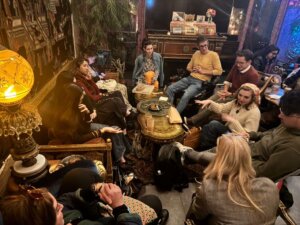
The curators ultimately assembled a group of 15 Muslim and Jewish artists with diverse religious and geographic backgrounds. The Muslim artists have roots in Pakistan, Lebanon, Turkey, Syria, Burma and Bangladesh, and their Jewish counterparts in Poland, Austria, Romania, Russia, Azerbaijan, Yemen, Israel and more.
They met as a group twice this fall, first in October at the BAC space in Metuchen with a structured agenda — Khan and Finkelshteyn had everyone sit in a circle, introduce themselves, and share something about their culture that they love, before letting everyone mingle and explore the gallery. The second meetup, at a non-alcoholic “anti-bar” and cafe in the East Village in November, was a little more casual, and allowed the conversations about identity, religion, diaspora, gender and art to expand.
“A lot of it was really oriented around, like, what has your experience been? What is your identity to you? What does it mean?” Miki Belenkov, a participating artist, told me on a video call. One of the themes that emerged in the discussion, they recalled, was around “how do we balance our deep emotional and historical connections to these identities, while also navigating being modern people.”
Belenkov, 28, a queer Jewish artist and art therapist in New York City whose parents were refugees from the Soviet Union — their father is from Muslim-majority Azerbaijan — was raised on ideas of “coexistence and mutual respect and appreciation and sharing of traditions,” they said. “It was exciting to see that here there are people trying to build conversation and space for Muslim and Jewish artists.”
After Oct. 7, which happened while Belenkov was in grad school, “I had to make entirely new friends,” they said. “Pretty much just everyone that I had built a community with did not see me as a community member anymore, because of my identity.” They’ve since focused on attending events that “create joy” and forming “community connections with equally peace-loving people.”
Their large-scale textile work in the exhibition, a tablecloth, references both the struggles of the last couple years — including mezuzahs stolen off doorposts and formerly close friends who’ve blocked them on Instagram — but also focuses on “being able to come together in the midst of all of this and still find joy and light.”
Another Jewish artist, Micah Steinerman, 22, is a senior at Rutgers studying drawing and animation whose family’s roots are in Eastern Europe and Yemen. He created a small triptych depicting the holy sites of Jerusalem, foregrounded by a blossoming fruit tree in the center. This is flanked by smaller canvases on either side: One says shalom, as in peace, and the other adapts a quote from his namesake book in the Bible: “Every person will sit under their own fruit tree, and no one will make them afraid.”
But perhaps the highlight of his experience was a collaboration with Khashoggi that melded Arabic and Hebrew calligraphy. “I had become more closed off about my Jewish identity,” he told me on Zoom. Over the course of several sessions with Khashoggi, who taught him some Arabic and oil painting basics, he realized they both related to “having to feel hidden.”
“The painting experience with Micah reconnected me to my own religion, my own culture, my own language. It was something I’d shoved in a box” after leaving Lebanon as a kid, Khashoggi said. “Micah said, ‘Hey, no, let me look in that box, it’s cool.’” That genuine display of interest by someone from another culture, he said, was “healing.”
Building little bridges
On a recent tour to pick up everyone’s finished artwork for installation, Khashoggi was heartened to see a small sign of the project’s success. One of the Muslim artists came along to assist with pickup, and Khashoggi watched as she greeted one of her Jewish colleagues. You can see “the strength of the connection from the way they hug each other,” Khashoggi said.
“I don’t imagine all of a sudden that all Arabs and Muslims and Jews around the world will start hugging each other the way our artists are,” he said. Still, he said, “we have 15 little bridges that we built.”
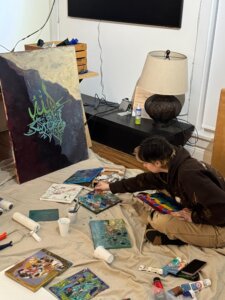
Khashoggi’s hope, he said, is that “one or two of the people coming to visit will have the wherewithal, the influence, to allow us to open up another show;” he dreams of another “Open Archways” in New York or Paris or Tel Aviv that would expand the circle of Muslim and Jewish artists who are meeting, talking and collaborating.
The BAC gallery where the exhibition is currently installed is dotted with couches and chairs. On opening night, there will be tea and other refreshments and, the curators hope, an opportunity for people to start conversations — maybe a little bit like the one Finkelshteyn and Khan had at the Open Dialogue Table. The art might help.
“You’re looking at the same thing, and you can talk about that thing,” Finkelshteyn said. “I hope there are a few people who come to this exhibit, who come to this reception, or even who just hear about this reception, and think, ‘Oh, people can talk to each other.’”
That doesn’t mean they’ll always be on the same page. She and Khan aren’t, and they said that was scary at first, as they navigated their fledgling friendship. The first time they didn’t agree, Khan recalled, “it felt like the whole place was burning down.” But they soon realized they can still talk and be friends, while also disagreeing.
They, along with Khashoggi, Astuni, and the participating artists, appear clear-eyed about the scale of change this one show is likely to make. But that micro-movement in the right direction seems to be exhilarating to them all the same.
Ali Saracoglu, 30, a New York City–based Muslim artist who moved to the U.S. from Turkey, put it most poetically. “When we check the news, it doesn’t look good,” said Saracoglu, who works in Ebru art, a traditional Turkish form of paper marbling. “In those moments, I remind myself, for a room to be dark, darkness needs to surround everywhere. But if light finds a tiny crack to come in, that’s usually good enough to illuminate the whole room.”
“This exhibit,” he said, “is a step toward finding that crack, or opening that crack ourselves, for the light to come in.”
The post A Jewish-Muslim art show builds ‘little bridges’ of coexistence appeared first on The Forward.
Uncategorized
A Chabad Jew was stabbed in NYC. He returned the next day to continue wrapping tefillin.
(JTA) — Less than 24 hours after he was stabbed in midtown Manhattan, Yosef, a Chabad-Lubavitch man from Crown Heights, was back on the same street where he’d been assaulted, popping into Diamond District businesses as usual to help employees wrap tefillin.
Yosef, 26, who did not share his last name to maintain his privacy, told the Jewish Telegraphic Agency that he was back on 47th Street on Thursday afternoon, the day after the stabbing, without missing a beat in his Monday-through-Thursday rounds even as police investigate the incident as a possible hate crime.
A number of the people he visited pieced together that the widely circulated footage of a man being stabbed the previous night was of him.
“They were in shock. They were obviously scared for me,” said Yosef, who has been wrapping tefillin and distributing Shabbat candles to Jewish Diamond District employees for about three years. He started that routine when his father, a Chabad Jew who works in the jewelry business, realized he needed his son’s help to handle the demand for those acts. Yosef told Chabad.org that he was “still shaken” by the attack a day later.
Still, he told JTA, “We can’t allow some hate to stop us.”
Yosef said he felt it was important to communicate that message because “we need more mitzvahs in the world, we need more light in the world.”
Yosef was taken to Bellevue Hospital on Wednesday evening around 6 p.m., where medical staff assessed that he had no internal bleeding and would not need stitches. No arrests have been made, but the assailant has been described as a woman in her 40s.
The attack has renewed concerns about security that have faced Chabad adherents and institutions, which often host public events and maintain a visible street presence. But the threat didn’t diminish their presence in midtown Manhattan on Friday.
Multiple Chabad men stood under a bright yellow tent on the sidewalk wrapping tefillin for a steady stream of workers in the heavily Jewish Diamond District.
“The Rebbe says that the way to defeat darkness is only through the addition of light,” said Shmuel Cohen, who was handing out small photographs of the movement’s late leader, the Lubavitcher Rebbe Menachem Mendel Schneerson.
Cohen told JTA that he had not heard about the attack that took place just down the block two days earlier, though his partner under the sidewalk tent had. Cohen said that the best way to respond is through “the observance of Torah and mitzvot without being ashamed of our Judaism but presenting it to everyone.”
Also on Friday, Chabad officials met with New York Police Department representatives for their annual meeting about security ahead of Chabad’s international conference in Crown Heights, the Brooklyn neighborhood where the movement is headquartered. The conference begins on Nov. 5.
Chabad has been targeted in multiple high-profile attacks in the past year, including the deadly Bondi Beach shooting in Australia in December. The following month, a man rammed a car into the doors of the Chabad-Lubavitch headquarters in Brooklyn, raising further questions over how the movement should balance its commitment to making its events accessible with security.
Meanwhile, Jews have been targeted in more than half of hate crimes committed in New York City in 2026, despite making up about 12% of the city’s population.
“Security is our top priority. Our goal is to provide an environment where every participant feels safe and can fully experience the purpose and spirit of the gathering,” said Rabbi Mendy Kotlarsky, a top organizer of the upcoming conference.
In the wake of the attack, Yosef said he is not concerned about going out in public as a visibly Jewish person and doesn’t plan to change how he approaches the world.
“I was wearing the same clothes on Tuesday and Wednesday and Thursday,” he said. “I didn’t change my routine.”
This article originally appeared on JTA.org.
The post A Chabad Jew was stabbed in NYC. He returned the next day to continue wrapping tefillin. appeared first on The Forward.
Uncategorized
They met on a Birthright trip then married. Now this American Israeli couple’s internet fame has turned to infamy.
Ethan and Hila Klein first met at Yad Vashem — Israel’s Holocaust museum — in 2007, a meet-cute they recounted, giggling, years later for their millions of YouTube followers.
“I think I went up to her and said something like, ‘They had it coming, don’t you think?’” said Ethan, known for his edgy humor and infamous internet trends, including Vape Nation and Papa Bless. “No I didn’t say that. I wonder if you would have laughed though.”
They were on a Birthright trip, Ethan an American and Hila an Israeli soldier on leave to join the group. Soon after the trip ended, Ethan moved to Israel to be with Hila, and the two began making videos under the name H3H3 Productions (the H for Hila and the 3 standing in as an E for Ethan). They married, moved to America, and started a popular podcast.
A Jewish love story, until Thursday, when Hila, now mother to their three children, accused Ethan publicly of having a months-long affair.
“The betrayal I feel is immeasurable,” Hila said in an Instagram post. “My only family on this side of the world. How do I even begin to make sense of this?”
Ethan reposted her statement.
Their podcast is run by a handful of crew members who often chime in and participate in various skits and bits. The crew also shared a statement saying they stand with Hila and refuse to work with Ethan, though they added they don’t know what this will mean for the future of the show.
A couple roiled by Oct. 7
The left-leaning, secular couple’s videos and podcasts focused primarily on pop culture, internet drama and general politics, not Jewish or Israeli issues.
Both Ethan and Hila would make statements sometimes when tensions in Israel flared, and they would occasionally speak out against IDF actions that upset them.
In 2021, Ethan started a podcast with political commenter Hasan Piker, a controversial left-wing influencer, called Leftovers, a nod to their leftist politics.
Then came Oct. 7.
Ethan, an American Israeli dual citizen like Hila, was horrified by the attacks but quick to call the IDF genocidal in the aftermath. In their first episode together after Oct. 7, Ethan and Piker said the show would continue through their disagreements. The episode was tense, and it was their last.
As Piker’s rhetoric on Israel intensified and became at times antisemitic, the two began a nasty internet feud, culminating in a nearly five-hour livestreamed debate.
Piker posted about the news of the affair on X, sharing a video of Ethan and expressing disgust for men who cheat.
“Now this is a high caliber man [with] good morals,” Piker said sarcastically. He also posted “Judge me by my enemies” after sharing Hila’s statement.
Hila, who owns a makeup and clothing company, increasingly came under scrutiny by Piker and others after Oct. 7 for her service in the IDF. Artists refused to work with her. One model she hired publicly disavowed her after finding out she was Israeli.
The couple was harassed, sometimes online, sometimes in-person, as they attempted to take what they viewed as a nuanced stance in the aftermath of Hamas’ attack on Israel and the ensuing war in Gaza. The united front seemed to fortify their relationship, as Ethan, ever outspoken, routinely came to his wife’s defense.
Their show lost thousands of subscribers, but loyal fans stuck with them — fans who now say they are gutted and confused by the news of the affair. Many in disbelief noted that Ethan had Hila’s face tattooed on his arm less than two years ago as a surprise for her.
“The greatest thing a man can do for his children is to love their mother,” says the quote surrounding the tattoo.
The Forward attempted to contact the Kleins through their work emails and did not immediately hear back.
The post They met on a Birthright trip then married. Now this American Israeli couple’s internet fame has turned to infamy. appeared first on The Forward.
Uncategorized
These Jewish college students have some ‘nonnegotiables’ for El-Sayed
At the University of Michigan, first-year student Robert Kashan, 18, and sophomore Jacob Reich, 19, sat behind a large blue sign. “Some things are nonnegotiable,” it declared in all caps.
The sign laid out their requirements for any candidate seeking their support: a commitment to Jewish safety, “including for Zionist Jews,” and supporting Jewish statehood in Israel, among other positions.
“Zionism is a legitimate part of the Democratic coalition, and a lot of us are feeling less represented by the Democratic Party,” Kashan told the Forward.
The students are part of a broader “Nonnegotiable” movement in Michigan, a coalition of Jewish Democrats who are spelling out their dealbreakers for candidates ahead of the Senate election between Democratic nominee Abdul El-Sayed and Republican nominee Mike Rogers.
The movement has attracted national attention, with hundreds of rabbis across 34 states signing on to the “Nonnegotiable” demands. Meanwhile, about 20 students at the University of Michigan have publicly signed, while hundreds more offered support anonymously, according to Reich.
The “Nonnegotiable” supporters aren’t saying whom they’ll vote for if their concerns aren’t addressed — or whether they’ll vote at all. But they are pushing back against the assumption that Jewish voters will, as the saying goes, “vote blue no matter who,” urging El-Sayed to engage with their demands if he hopes to earn their support.
That’s in contrast with two other Jewish political camps, including a group called Michigan Jews for Democracy that endorsed El-Sayed. Their petition, which has garnered almost 1,000 signatures, notes that some signatories hold reservations about El-Sayed but are voting for him nonetheless as a check on President Trump.
“We understand that a vote is not a valentine; it’s a strategic chess move,” the petition reads.
A competing petition, dubbed “Michigan Jews Against Extremism,” has drawn hundreds of signatures from Michigan Jews who plan to vote for Rogers. That petition similarly emphasizes that Rogers voters may still have reservations about the candidate: “Our vote for Mike Rogers does not require that we agree with him on every issue or that we support President Trump,” it reads.
“Nonnegotiable,” meanwhile, rejects the idea that Jewish voters would have to choose between Zionist and Democratic values. Some have criticized the nonnegotiable movement for ignoring the reality of the electoral choice at hand. Others have called it “a veiled attempt to excuse the actions of Jewish Democrats who want to feel validated about voting for Mike Rogers.”
But Kashan and Reich, who met at Hillel and plan to major in political science, said the “Nonnegotiable” movement was the only way they could see themselves engaging in the election, as they felt increasingly pulled between their identities as Democrats and as Jews.
Some Michigan Jews have expressed alarm at El-Sayed’s questioning of whether Israel should exist as a Jewish state and his decision to campaign alongside controversial Twitch streamer Hasan Piker, who has been accused of antisemitic rhetoric. Rogers, who Trump has endorsed, earlier this week called El-Sayed “anti-Jew.”
In a letter to Michigan Jews, El-Sayed has vowed to “stand up against antisemitism and take the threat of violence against our Jewish community incredibly seriously.” He has also hired a Jewish liaison in the final weeks leading up to the election.
This will be the first election when Kashan, who just turned 18, is eligible to vote, and Reich’s first national election after voting in a local primary in his hometown of Palo Alto, California. For both, voting Democratic in their first major election had once seemed like a given.
“I’m a Jewish Democrat, and I want Democrats to take the Senate,” Reich said. “I want to vote for a Democrat in my own state.”
They’re still holding out hope that will happen — and that, with less than two weeks until the Nov. 3 election, El-Sayed will sign on to their petition.
And if he doesn’t? Neither student is ready to say.
The post These Jewish college students have some ‘nonnegotiables’ for El-Sayed appeared first on The Forward.
