Connect with us

Uncategorized

A little‑remembered Gilded Age millionaire helped make milk safe for American kids through his ‘retail giving’

The 1844 edition of the widely used schoolbook written by William H. McGuffey, “Newly Revised Eclectic Fourth Reader,” includes a dialogue about the difference between “true and false philanthropy”:

Mr. Fantom: I despise a narrow field. O for the reign of universal benevolence! I want to make all mankind good and happy.

Mr. Goodman: Dear me! Sure, that must be a wholesale sort of a job: had you not better try your hand at a town or neighborhood first?

As the discussion continues, the lesson becomes clear. Mr. Fantom’s approach is too ambitious to accomplish much, while Mr. Goodman’s, if narrower in scope, was likely to be more useful in practice.

Donor with mundane objectives

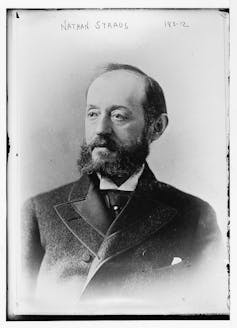
Andrew Fisher’s biography of a Gilded Age New York department store magnate, “Nathan Straus: From Macy’s Magnate to International Humanitarian,” suggests that Mr. Goodman would likely have applauded Straus’ approach to philanthropy.

This black and white photo is a portrait of a man in an old-fashioned suit.
Nathan Straus made his mark in philanthropy after a successful career running the Macy’s department store. Library of Congress Image by

Many of Straus’ contemporary philanthropists were setting lofty goals for their giving. In oil magnate John D. Rockefeller’s case, it was promoting “the welfare of humanity throughout the world.” For steel tycoon Andrew Carnegie, it was “to promote the advancement and diffusion of knowledge and understanding.”

Straus pursued more mundane objectives that included championing milk pasteurization. Although his efforts are not as well known today as those of his more ambitious – and wealthier – counterparts, they accomplished a lot and showed that what might be called “retail giving” can have far-reaching effects.

Successful immigration story

The Straus family came to the United States from Germany in the 1850s during the first big wave of Jewish immigration. Lazarus Straus, Nathan’s father, followed a familiar path for Jewish immigrants at the time, beginning as a peddler and eventually establishing his own store in the small town of Talbotton, Georgia, where the members of his family were the only Jews.

He prospered, became a respected citizen and saw that his children received good educations, including in their religion.

Then the Civil War upended the family’s life, first by reviving antisemitic prejudices and then, eventually, by destroying the family’s business.

Starting anew in New York City, Lazarus and his older sons, Isidor and Nathan, began to sell imported china, glassware and other crockery to retailers in the Northeast and South. One was Rowland H. Macy, who had founded an eponymous store that was on the cutting edge of what Fisher calls a “retailing revolution.”

Macy’s innovations included stocking large inventories of many kinds of merchandise, competitive pricing, extensive advertising and providing a variety of services like public restrooms and a cafeteria to make shoppers’ experiences more pleasurable.

Aided by the rapid urban and economic growth of the late 19th century, the model flourished. Department stores displaced smaller, specialty shops. Other retail powerhouses, such as Bloomingdale’s and Lord & Taylor, soon competed with Macy’s.

The Straus family sold their wares at Macy’s. After Rowland H. Macy died, the Straus family became partners with its new owners. By 1896, the Strauses owned the store outright. And Macy’s was expanding: It bought another department store in Brooklyn and created a flagship building on Manhattan’s Herald Square, which Macy’s still occupies.

The big Macy's store in Manhattan is seen in a black-and-white photo.
The landmark Macy’s department store in New York’s Herald Square opened in 1902 while Nathan and Isidor Straus ran the retailer. Library of Congress Image by

His philanthropy journey begins

While Isidor Straus oversaw the store’s internal operations, Nathan focused on the company’s external activities, such as purchasing, marketing and dealing with government and business leaders.

A third brother, Oscar, pursued a career as a politician and diplomat, eventually becoming secretary of commerce and labor under President Theodore Roosevelt and the first Jewish member of a presidential cabinet. Perhaps inevitably, this led to a series of public appointments for Nathan Straus.

However, as they became wealthier, Nathan and his wife, Lina, increasingly devoted their attention to a series of philanthropic projects.

In 1893, the U.S. entered a four-year economic depression, its worst until the 1930s. As unemployment in New York City rose, Nathan Straus used his merchandising skills to address the needs of the jobless and poor.

He created a number of “depots” near tenements and boarding houses that sold coal, food and fuel at discount prices. Fisher, Straus’ biographer, rightly calls these early examples of what is now known as “social entrepreneurship”: the application of business principles to solving social problems.

Making milk less deadly

As these efforts were getting away, Straus also launched what would become his major preoccupation: promoting pasteurized milk.

In New York City in the early 1890s, Fisher writes, “the annual mortality rate among children under five was about 15 percent,” or 18,000 infants and toddlers per year. A main cause was consuming raw milk, which, unless certified by inspectors, was likely not only to contain a variety of pathogens, such as tuberculosis bacteria, but spoil easily going from farm to table.

Although scientists had long known that heating could make milk safer, doctors and public health officials worried that sterilizing milk might also destroy its valuable nutrients.

Straus, who had lost one of his own children to what he believed was a milk-borne infection, built on his projects for the unemployed by working with New York social service agencies to develop pasteurization plants and infant-milk stations near low-income neighborhoods.

They sold sterilized and refrigerated milk at below-wholesale prices, or donated it to those who could not afford to pay. Businesslike efficiency kept costs low, as did donations. Multilingual ads publicized the product’s availability, doctors and nurses advised parents on child-rearing, and careful recordkeeping aimed at assessing the program’s health benefits.

Straus and his wife devoted much of their time and money to this work. In addition to establishing 297 milk stations in 36 cities, they also spoke and wrote widely about the merits of pasteurization.

By 1908, their efforts paid off when the U.S. Public Health Service endorsed pasteurization and state and local governments began requiring that milk sold in their jurisdictions be pasteurized. Raw milk remained available in many states, and debates over its safety continue to this day.

As a result of this and other Progressive Era measures, New York City’s health commissioner estimated that infant deaths dropped by two-thirds
during the first two decades of the 20th century, with similar declines elsewhere in the country.

A beachfront city has some tall buildings.
The coastal Israeli city of Netanya was named after philanthropist Nathan Straus. Jack Guez/AFP via Getty Images Image by

Other causes

While most of Nathan Straus’ efforts occurred in the U.S., he used his trips to Europe for Macy’s to promote pasteurization on the continent.

During a 1904 visit, he toured the Mediterranean and stopped in Palestine, then part of the Ottoman Empire. Impressed by the early Jewish settlements and holy sites he saw, Straus became an ardent advocate for creating a Jewish homeland in the Middle East, an unusual position for a Jewish businessman of that era, according to Fisher.

On a subsequent trip, a broken leg kept Straus from returning to New York on the maiden voyage of the Titanic; his brother Isidor and sister-in-law Ida were not so fortunate.

In the U.S., Nathan Straus led Zionist organizations, while in Palestine, his chief contributions involved supporting a variety of health care and economic development activities, including Hadassah, the women’s health and community development organization founded by Henrietta Szold.

The Israeli city of Netanya is named in his honor.

No foundation to be remembered by

Nathan Straus’ achievements as a philanthropist are not widely known today because he did not create a grantmaking foundation that outlasted him, as Rockefeller and Carnegie did.

Instead, by the time of his death in 1931, Straus had donated much of his fortune. Fisher writes that Straus used to invoke an old Hebrew proverb: “Money given in health is gold. Money given in sickness is silver. Money given after death is lead.”

He also didn’t donate heavily to the burgeoning network of communal organizations set up to assist the growing population of Jewish immigrants, as did the financiers Jacob Schiff and Felix Warburg, who were also affluent Jewish immigrants from Germany.

As Fisher notes, this pattern of philanthropy resembles that of Straus’ friend – and pallbearer – Julius Rosenwald, the longtime head of Sears, Roebuck and Co. Both supported Jewish causes as well as major initiatives aimed at helping others: In Rosenwald’s case, it was schools for African American children in the South, while for Straus, it was milk pasteurization in New York City and beyond.

During and after World War I, they worked together to assist Jewish refugees in Europe. Fisher might have added that neither Straus nor Rosenwald sought much recognition for their work.

His thorough account should help give Straus the credit he deserves for his philanthropy. It should also show that donors do not have to aspire to “make all mankind good and happy” to make an important difference.

In many ways, Nathan Straus was an old-fashioned do-gooder, responding to the needs he saw with innovative solutions. As a result, he wound up accomplishing a lot of good.

This article is republished from The Conversation under a Creative Commons license. Read the original article.

The Conversation

The post A little‑remembered Gilded Age millionaire helped make milk safe for American kids through his ‘retail giving’ appeared first on The Forward.

Continue Reading

Uncategorized

Sacred fasting meets Ozempic

Millions of people worldwide – as many as 1 in 8 adults in the U.S. – are on GLP-1 medication, such as Ozempic, Mounjaro, Wegovy and Zepbound, for treating diabetes or for weight loss.

These drugs are adding a medical twist to religious observances that involve fasting, such as the Jewish holiday of Yom Kippur, which will be observed from sundown on Sunday until nightfall on Monday. Traditionally, fasting on Yom Kippur means forgoing food and water for about 25 hours, which can strongly affect a person’s metabolism.

Other religious traditions include different types of fasts. For example, Muslims who fast during Ramadan neither eat nor drink from dawn to sunset, but they break their fast each night. Christian and Hindu traditions also include dry fasts as well as partial fasts, such as Lent and Navratri, in which people avoid certain foods.

As a specialist in obesity medicine, I work with many patients who take GLP-1 drugs. Most people can safely fast for Yom Kippur or other religious or cultural observances. But depending on their circumstances, they may need to plan ahead, take certain precautions and be clear on when it’s medically advised that they break their fast.

Common GLP-1 side effects and fasting

GLP-1 drugs such as Ozempic, Mounjaro, Wegovy and Zepbound mimic a natural gut hormone– glucagon-like peptide 1 – that lowers your blood sugar by triggering insulin release when your blood sugar is high. These drugs also slow how quickly food passes through the stomach, which reduces appetite to aid in weight loss.

GLP-1s have some common side effects that can occur in anyone taking them, including nausea, vomiting, dizziness, constipation and dehydration. Fasting may exacerbate them, especially in people who are prone to an upset stomach. GLP-1 side effects are also more common when a patient is increasing their dose, which usually happens monthly as tolerated until they reach their full dosage.

That’s why, if you’re planning to fast for Yom Kippur, it’s best to avoid starting a new GLP-1 medication or increasing the dose of your medication sooner than two weeks or so before the holiday.

GLP-1 drugs work by simulating a gut hormone produced in the body, spurring the release of insulin and slowing down digestion.

Timing your dose

If you take GLP-1 drugs as weekly injections, which is the most common way of dosing these medications, you should stick to your schedule even if you plan to fast. These drugs stay in your system during the entire week, so moving or skipping that weekly dose right before fasting can interfere with their effects on blood sugar or weight loss.

If your weekly injection falls on Yom Kippur, you can generally go ahead and administer it as scheduled. Some patients do report increased nausea on their injection day – if that happens to you, you may wish to delay the injection until after the fast, if you’ve cleared it with your doctor.

Patients who inject GLP-1 drugs daily may need to adjust the timing. For patients taking these medications for diabetes treatment, it may make sense to do the injection right before the meal that breaks the fast or to hold off until after the fast. This helps reduce the risk of stomach side effects, which can occur when these medications are taken on an empty stomach.

More recently, many patients have switched to oral GLP-1 medications. These pills must generally be taken on an empty stomach with a small amount of water, at a set time before taking any other drugs or any food or beverages.

Because fasting for Yom Kippur includes abstaining from drinking, taking the pill as directed may involve breaking the fast. That means you’ll need to decide in advance whether to take the medicine before the fast begins, after the fast ends or on an alternative schedule. It’s best to avoid simply skipping the daily dose scheduled for Yom Kippur and taking a double dose after the fast.

Skipping the dose won’t be harmful if you’re taking the medication for weight loss. But if you have diabetes, skipping it could dangerously elevate your blood sugar. And doubling the dose later could lead to serious side effects, such as pancreatitis, an inflammation of the pancreas that can lead to hospitalization.

Diabetes versus weight loss

If you’re using GLP-1 medications solely for weight management, fasting for 25 hours should not pose serious issues beyond stomach upset. In rare cases, though, combining these drugs with fasting can stress the pancreas enough to cause pancreatitis.

Fasting on GLP-1s carries the biggest risks for diabetic patients. That’s because GLP-1 medications are often used alongside other drugs that work primarily by lowering blood sugar, which raises patients’ overall risk of a blood sugar crash.

The greatest concern is in patients taking a GLP-1 medication together with insulin or drugs that stimulate insulin production, such as sulfonylureas. The GLP-1 medication itself may not cause a drop in blood sugar. But because it suppresses appetite and lowers glucose levels, these other medications can magnify the risk of low blood sugar during a prolonged fast.

If that’s your situation, talk to your doctor about whether you can adjust the timing, dose and type of insulin you take and reduce your dose of sulfonylurea in order to fast safely.

In general, people who have Type 1 diabetes or poorly controlled diabetes are strongly advised not to fast – as are people who:

  • Experience frequent or severe drops in blood sugar.
  • Have hypoglycemia unawareness – an absence of warning signs for high blood sugar.
  • Are managing diabetes during pregnancy.
  • Have severe kidney disease with a high risk of dehydration.
  • Experience severe gastrointestinal side effects from GLP-1 medications.
Not overeating along with drinking plenty of water beforehand is helpful for anyone fasting – but crucial for people on GLP-1 medications.

From prefast prep to the post-holiday meal

Regardless of what GLP-1 medication you take and for what indication, if you plan to fast you’ll need to do some pregaming, monitor how your fast is going and be mindful of how you break it.

  • First, if you are unsure about anything, talk to the clinician who is monitoring your GLP-1 drug treatment so you can decide together whether fasting is safe for you and whether your situation requires any special precautions.
  • Before fasting, it’s important to eat a normal meal that includes protein and to avoid both overeating and undereating. Overeating is never recommended when on GLP-1 medications, and undereating can set you up for more side effects during the fast. Although GLP-1 therapy can substantially reduce appetite, patients should avoid skipping the prefast meal entirely.
  • GLP-1 medications don’t just decrease appetite – they can also suppress the body’s natural thirst signals. So before your fast begins, aim to stay hydrated to prevent getting dehydrated while fasting.
  • If you are diabetic, make sure you fast under close guidance from your doctor – and make sure you are checking your blood sugar during fasting. Using a glucose monitor is a good idea, particularly if you are taking insulin or other glucose-lowering medications. The goal is for your blood sugar to remain within your usual daily nonfasting range.
  • Be ready to break your fast right away if you start feeling dizzy, confused, faint, nauseated or acutely ill, or if your blood sugar dips too low or spikes too high. These symptoms are dangerous and need to be addressed immediately. Stash a rapid source of carbohydrates – even just some glucose tablets or a few hard candies – within reach so you can access them quickly if needed.
  • Finally, plan a gentle, balanced meal to break the fast rather than an unusually large meal, which may provoke nausea, abdominal pain, reflux or vomiting. It’s generally best to avoid higher-fat foods, too, since they can slow down digestion.The Conversation

This article is republished from The Conversation under a Creative Commons license. Read the original article.

The post Sacred fasting meets Ozempic appeared first on The Forward.

Continue Reading

Uncategorized

A comedian went viral for saying he supports Israel onstage — he wasn’t even there

Menachem Silverstein’s High Holidays were interrupted by what he calls a beautifully ironic “monkey paw situation.”

“Like any good Jewish comedian, I’m in Rosh Hashanah services praying to God for a little bit of a boost in my career, for something to go viral, for something to hit,” Silverstein, a 30-year-old comic in Los Angeles, told me. “I turn my phone after hag. I have about 40-plus messages from people being like, ‘What the hell’s happening? Is this you?’”

Friends were sending him links to a video of a crowd leaving a theater in the middle of a standup set. The caption overlaid on the clip said, in English and Arabic, “audience walks out after comedian backs Israel.” On an X post with more than 2 million views, an account named “Truthseeker” identified the comic as Silverstein.

Silverstein knew immediately the video was of the Laugh Factory in Chicago, a venue he last played this summer. He had no memory of the crowd walking out — a traumatic experience for any standup. In fact, as he took a closer look at the video, he realized it wasn’t even him onstage.

“My most viral thing was not showing up to a comedy club, which is hilarious in itself,” said Silverstein, who estimates across platforms the clip has been seen more than 10 million times. “If I would have known, I would have missed more shows.”

By the time Silverstein was clued into his virality, it was too late to contain the disinformation.

Alex Jones picked the clip up, commenting, “It’s got one guy in a yarmulke. He literally says, ‘If you don’t support what Israel is doing in this war, leave.’”

No such statement is made in the clip. There’s no guy in a yarmulke, only a man in a dark t-shirt who appears to be blindfolded. This didn’t stop news outlets like Palestine Chronicle and the 1.1 million follower Global Reports Instagram account from running with the story.

Someone captioned the original clip — now deleted — indicating the comedian stated their support for Israel, leading to a mass exodus. From there, Truthseeker identified Silverstein as the comic, based, Silverstein believes, on a joke he retired about three years ago.

“Basically, the joke was, ‘Hi, my name is Menachem. I stand with Israel. It’s not political; they’re just the only people that can pronounce my name.’”

Grok and other AI models reinforced the claim that Silverstein was the person in the clip. But the real reason for everyone leaving their seats was something much less loaded: a prank.

David Fuhrer, president of the Laugh Factory said, based on an account confirmed by the Chicago Laugh Factory’s head of operations, that the video was from a Sept. 10 performance of a regular show called “What Could Go Wrong?,” in which practical jokes are played on comics.

“In this particular case, we had a comedian named Kieron Harrell and we blindfolded him and put headphones on him,” Fuhrer said. “They walked the entire audience out into the lobby as a joke so he had an empty room he was performing to.”

Fuhrer said it had “nothing to do with antisemitism or people walking out on Menachem.” He doesn’t know who repurposed the video, only that it had gone viral.

“It’s a shame because he’s a wonderful person and a great performer and a part of our family here.”

If you go to the “What Could Go Wrong?” Instagram, you’ll see a better image of the real comic, Harrell, who looks nothing like Silverstein.

A better look at the comic from the clip. Screenshot Instagram

Daniel Cassilagio, who produces “What Could Go Wrong,” captioned the images of the performer, saying the show was “so good that it was used as a geo political [sic] disinformation campaign.”

Cassilagio wrote on Instagram that the clip was recorded, uploaded without the producers’ knowledge and “then virally shared by what are most likely bots from China.”

People who don’t check their sources have “been harassing both the comic that was on stage, and a comic from LA who I’ve never even heard about or met,” Cassilagio wrote on a post that, judging by its 166 likes, has far less visibility than the fake account. “He wasn’t even in Chicago at the time.”

Silverstein told me that, while he added around 200 followers, he’s been inundated with hateful comments and his reach has dropped as people have been reporting his account. If you search his name now, the top hits are for his nonexistent scandal. When he’s looking to play clubs, he’s concerned that bookers will see he “walked a crowd” and deny him a slot.

Beyond the made-up controversy, there’s not much about geopolitics in Silverstein’s act. His material includes jokes on fatherhood, being 5’9” (“a Jewish 6’2”) and some well-deserved ribbing of Kanye West. In videos, he can be seen circumcising a baby carrot.

In an age when performers like Macklemore and Jerry Seinfeld have been canceled for their views on Israel and Palestinians, Silverstein sees a new frontier in his experience.

“It used to be you watch a podcast or watch a stand-up clip, clip someone out of context, post it, and get them canceled,” he said. “Now they’re getting away with just posting a random thing, putting your name on it, and then people believe it.”

The post A comedian went viral for saying he supports Israel onstage — he wasn’t even there appeared first on The Forward.

Continue Reading

Uncategorized

‘Run, hide, fight’: Synagogues make threat preparedness part of High Holiday services

Rabbi Yosef Kanefsky plans to open his Yom Kippur sermon this year in an unusual way: with an emergency evacuation plan.

It’s how he opened his Rosh Hashanah sermon, too.

“I mentioned [that] people should understand where the exits are,” Kanefsky said. “I mentioned what our plan is, God forbid, if we need to evacuate the children in the youth program — that we have volunteers for that.”

Kanefsky, senior rabbi at B’nai David-Judea Congregation in Los Angeles, acknowledged that the reminder to prepare for the worst could be “potentially a little bit jarring” on the holiest days of the year. But with synagogues on heightened alert, he said, it felt unfortunately necessary.

“It’s just part of our lives right now,” he said. “That extra measure of vigilance.”

Extra security measures at synagogues are nothing new. Since the 2018 shooting that killed 11 worshippers at Pittsburgh’s Tree of Life synagogue, Jewish institutions have invested heavily in infrastructure, personnel and training to counter the threat of violence. But this High Holiday season, several synagogues are taking the unusual step of integrating emergency preparedness into the services themselves, whether through verbal instructions like Kanefsky’s or written plans handed out alongside prayer books.

A flyer distributed at Beth Tzedec Congregation in Toronto outlines a three-point plan in the event of an attack: Run, hide or — as a last resort — “Be prepared to defend yourself.”

“Remember: Your actions before police arrive may save your life,” it reads in all-caps.

In August, the Jewish nonprofit Secure Community Network released a safety card that synagogues can customize with their own evacuation maps then place in their pews. While a range of scenarios could prompt a building evacuation, like a fire or earthquake, the card focuses on reacting to an attack.

It includes instructions for how to make a tourniquet to stop bleeding and tips for fleeing or fighting “the shooter.”

And at Congregation Emanu-El in San Francisco, a flyer advising congregants to run, hide, or fight in the event of an attack was placed on every other seatback during Rosh Hashanah.

“It brought home the potential dangers in a way I hadn’t seen before,” Frances Dinkelspiel, a member of Congregation Emanu-El, told the Forward. “You’re going in for services. You’re opening your heart. There’s a sense of community. You’re embracing one another. And then there’s this piece of paper that’s reminding you: Don’t relax too much.”

Kanefsky said he felt a responsibility to his congregation to provide safety instructions, noting that the High Holidays may attract out-of-town visitors unfamiliar with the building.

But he also acknowledged that such warnings “can take away from the spiritual mood that we’re working so hard on building,” he said.

Kanefsky said he tried to make the announcement as unobtrusive as possible — giving the instructions in what he called “a spiritual and emotional envelope” by thanking the synagogue’s security team and framing preparedness as “part of the devotion to one another and our devotion to God.”

Michael Masters, Secure Community Network’s CEO, said the High Holidays present an elevated security risk at synagogues compared with other times of year. Even basic preparedness measures, like knowing where the exits are, can make a meaningful difference in a threat situation, he said.

He cited the ramming attack on Temple Israel in West Bloomfield, Michigan, in March as a prominent recent example. Seconds after the assailant drove a truck filled with explosives through a building entrance, a security guard opened fire on the vehicle; after the vehicle caught fire, the campus was safely evacuated.

“The guard was there, and he was well trained, and he did an amazing job, as did law enforcement,” Masters said. “But the faculty and the staff and the students were all trained as well.”

Dinkelspiel emphasized that she feels safe at her synagogue, which has a modern security system and bollards around the sidewalk to prevent cars from driving onto the property. But that sense of safety, she said, was part of what made the flyer so unnerving.

“After all these security measures the congregation has,” Dinkelspiel said, “there was still this reminder on this flimsy piece of paper that Jews can be attacked at any time.”

The post ‘Run, hide, fight’: Synagogues make threat preparedness part of High Holiday services appeared first on The Forward.

Continue Reading

Copyright © 2017 - 2023 Jewish Post & News