


Uncategorized
A Look Inside Gaza: More Questions Than Answers as Israel Remains Vigilant, Hamas Refuses to Give Up Weapons

Israeli soldier on guard in Gaza, February 2026. Photo: Jonathan Sacerdoti / The Algemeiner
GAZA — Going into Gaza remains a rare opportunity for journalists. Access has been tightly controlled throughout the Israel-Hamas war, and even now, months into a ceasefire that has paused the fighting without resolving it, entry is neither routine nor casual. Last week I had the opportunity to interview Nadav Shoshani of the Israel Defense Forces (IDF) inside the Gaza Strip itself, as he walked me through the so-called “Yellow Line” roughly dividing the enclave between east and west, the strained reality on the ground, and the directions in which this conflict may now move.
Shoshani is the IDF’s international spokesperson, one of the most visible Israeli figures to emerge since Hamas’s Oct. 7, 2023, invasion of the Jewish state. For months he has been a fixture in global media, correcting casualty claims and explaining operations in real time. In modern conflict, the spokesman is not an afterthought to the battlefield but an extension of it. What is said publicly shapes diplomatic reaction, public opinion, and operational latitude. English-language briefings in particular are conducted with as much care as any military deployment.
Spokesmen can be dry to interview: They do not reveal classified plans or freelance personal views. Instead, they articulate the institutional position. They present what Israel wants seen, understood, and, ideally, repeated. But even this is useful data for us journalists, and for our readers, too. It is a form of evidence, explaining the narrative the army — and the state — wants to be repeated. From this embed, and from this conversation, the message was consistent: tense but disciplined control in a moment of relative calm (but not peace), determination without appetite for escalation, action in response to violations rather than initiative for renewed war. It was almost as if they wanted to portray a sense of disciplined, determined boredom.

IDF international spokesperson Nadav Shoshani in Gaza. Photo: Jonathan Sacerdoti / The Algemeiner
We met at an IDF post a few hundred meters from what is now called the Yellow Line, the boundary dividing Israeli-controlled territory from areas still under Hamas control. Just beyond it lay Deir al-Balah and the central camps, dense urban belts whose origins stretch back to the aftermath of 1948 and whose political culture has long been shaped by displacement, factional rivalry, and Islamist terrorist organizations.
Shoshani’s own trajectory mirrors the way this war has pulled figures back into public roles. During his initial decade-plus in the IDF he served in key communications positions, including spokesperson for Military Intelligence and head of the IDF’s social media desk. In 2022 he moved into politics, advising Gadi Eisenkot in Israel’s parliament, known as the Knesset. He briefly entered private consulting. After Oct. 7, he was called back into uniform at Eisenkot’s request. Since then, he has become one of the IDF’s most recognizable English-language voices.
As we moved between locations in a military jeep, he spoke about operating in a conflict that is scrutinized but rarely visited, as a result of Israel’s own decision to bar free movement of journalists in the area. The informational theater runs parallel to the physical one. Every strike, every claim, every casualty figure is contested. The spokesman stands at the junction between battlefield and broadcast.
From the vantage point near the Yellow Line, the broader strategic dilemma came into focus.

Israeli military jeep driving in Gaza. Photo: Jonathan Sacerdoti / The Algemeiner
Hamas continues to control significant internal areas of Gaza. Israeli assessments indicate that weapons accumulated earlier in the war remain dispersed across the enclave. Tunnels are still being uncovered even in the southern city of Rafah, where the IDF has operated for an extended period. “The IDF are world class experts in dealing with terror tunnels,” Shoshani said. “And still, after a year plus in Rafah, there are still tunnels.” He described the network as vast and deeply embedded.
In the sector we were visiting, Shoshani said, there are dozens of tunnel shafts. “Single digits” are dismantled each week. It is a steady, grinding process rather than a decisive sweep. As the Israelis are still discovering new shafts and tunnels, the assumption is that the network is even more vast than they know. And for Israel, destroying the tunnels is part of Hamas’s commitment to disarmament in accordance with the US-backed ceasefire.
“The first line of the agreement says Gaza will be a terror free zone,” Shoshani told me. “The agreement speaks about Hamas disarming.” Israel, he said, is committed to that outcome.
Yet Hamas leaders abroad have recently made clear that disarmament is not under consideration. Khaled Meshaal has described surrendering weapons as removing the “soul” of the resistance. Instead, he has floated the prospect of a long “hudna” — a five, seven, or ten-year truce in which weapons remain intact. A pause, not a conclusion. The way things are at the moment it seems like America remains undecided, torn between the momentum of building on the relative calm of the ceasefire and the inclination toward helping Israel defeat its jihadist enemies.
That divergence defines the uncertainty of this moment. A ceasefire predicated on demilitarization rests on a premise one side openly rejects.

Landscape in Gaza, February 2026. Photo: Jonathan Sacerdoti / The Algemeiner
Israel currently controls somewhere between 51-58 percent of the Gaza Strip. Within Israel’s political and security leadership, the argument is not over whether Hamas must be weakened, but over how far that effort must go. One school supports sustained operational control and calibrated pressure, judging that persistent attrition imposes manageable diplomatic costs while limiting Israeli exposure. Another warns that leaving Hamas organizationally intact, even in a diminished form, merely postpones the next confrontation and preserves its capacity to reconstitute. The dispute turns on a single question: Can Hamas be contained, or must it be eradicated to prevent recurrence?
“We are literally standing between Hamas and our civilians,” Shoshani said, pointing toward Israeli communities only a kilometer or two away. The distance is short enough to be visible. Oct. 7 lingers as the unspoken baseline of risk. I walked through the burnt-out homes of Be’eri shortly after the massacre. I cried quietly among the makeshift memorials at Re’im for the Nova party victims slain by the barbarous Palestinian terrorists full of bloodlust. I met survivors from Nahal Oz, evacuated for months from their beloved home and living as a family of four in a single kibbutz bedroom in the north. The scars will remain in the psyche of Israel and Jews for decades to come.
The atmosphere at the post was quiet but taut. Occasional distant fire cracked and faded. Wind carried sand across the position. A short drive away, at the Kissufim crossing, pallets of humanitarian aid sat stacked inside Gaza, inspected and approved. “Every week, 4,200 trucks are going into Gaza,” Shoshani said. He emphasized that the Israeli depot on the other side was empty because everything cleared had been transferred into the Strip, awaiting collection by international agencies.

Supplies stacked in Gaza. Photo: Jonathan Sacerdoti / The Algemeiner
Humanitarian logistics and sniper fire exist side by side. Reconstruction frameworks are discussed internationally while tunnel shafts are dismantled meter by meter.
US President Donald Trump is expected to announce billions in funding for Gaza and provide an update on an international stabilization force at the next meeting of his Board of Peace. Israeli Prime Minister Benjamin Netanyahu has now formally joined the initiative, signing a back-dated letter during his US trip last week. Public language emphasizes transformation and demilitarization.
Questions surrounding the proposed international stabilization force are also occupying serious attention among policymakers. Under the framework advanced during the Trump administration’s post-war planning, the concept envisages a multinational force deployed in Gaza after the cessation of major combat operations. Its stated purpose would be to oversee demilitarization, support reconstruction, assist in training local security forces, and provide a transitional security umbrella while Israeli forces reduce their footprint.
Within the proposed international architecture, Indonesia has emerged as a potential contributor. Jakarta signaled its readiness, in principle, to supply a substantial contingent to such a force, positioning itself as a Muslim-majority state willing to participate in post-conflict stabilization. The rationale is clear. Indonesian involvement would lend broader regional legitimacy to any arrangement and dilute the perception that Gaza’s future security is being shaped solely by Western actors or by Israel. But everyone knows that nobody can truly disarm Hamas other than the IDF.
Legitimacy is only one dimension of the problem. For Israeli decision-makers, the critical issues are structural and operational. Under what mandate would such an international force operate? Would it be authorized to conduct active counter-terror operations, or confined to monitoring and training? How would intelligence be shared? What happens if armed factions attempt to regroup or test the limits of the force’s authority? These are the foundations upon which success or failure rests.

Israeli soldier on guard in Gaza, February 2026. Photo: Jonathan Sacerdoti / The Algemeiner
The Indonesian proposal illustrates the wider tension embedded in the international force concept. A deployment designed primarily for peacekeeping and humanitarian support may stabilize the optics of the post-war environment, but stabilization in a territory where armed networks have deep roots requires more than presence. It requires enforceable authority, coherent command structures, and the political will to confront spoilers — all things I witnessed in the IDF outpost in Gaza but cannot imagine will be present among foreign forces.
I ask LTC Shoshani about the Indonesian rumors and statements. On the ground, foreign troops are absent. “I think that’s more in the in the level of declaration and statements made by politicians,” he said. “It’s not something on the ground happening right now. As you can see, there’s only IDF soldiers in Gaza, but we’re working within the [US-led Civil Military Coordination Center] CMCC for the different solutions that have been agreed upon.” For the IDF, political declarations have yet to alter operational reality.
The central questions remain stark. Can Hamas realistically be disarmed without permanent occupation? If not, can Israel accept a reduced but armed Hamas presence? And if neither path proves viable, how long before the present equilibrium fractures? My embed in the Gaza Strip seems designed not to answer these questions, but to prompt them to the rest of the world to ponder. Criticism is easy, but Israel has to deal in solutions.
Meanwhile, the yellow line is clearly marked, by fluorescent yellow blocks of concrete dotted along the length of the strip. “It is not the type of area where you cross by accident,” Shoshani said. The IDF post we were standing in was deliberately positioned 200 to 300 meters back, allowing time for warnings, leaflets, shots into the air if necessary. Escalation is designed to be gradual.

Israeli soldier on guard in Gaza, February 2026. Photo: Jonathan Sacerdoti / The Algemeiner
Yet he seems keen to point out that ceasefires erode incrementally. A sniper attack. A targeted strike in response. Another violation. The cumulative weight builds.
From inside Gaza, the picture is neither triumphant nor chaotic. It is controlled, watchful, provisional. Israel is holding territory, responding to attacks, dismantling infrastructure, insisting on disarmament as the stated end state. As Trump and his two key negotiators — Steve Witkoff and Jared Kushner — talk publicly about reconstruction and rebuilding, and as Britain, France, and Canada deal in fantasies of Palestinian statehood, the Israeli soldiers I meet are tasked with the boring, grinding, slow process of degrading Hamas, pushing back when it ventures forward, and keeping alert as it declares it will not disarm.
That thick mud wall Shoshani and I stand behind wasn’t here a few weeks ago. It has been built because the line did not hold well enough. Though the line itself remains in place, what lies beyond it, and what may yet cross it again, remains unresolved.
Jonathan Sacerdoti, a writer and broadcaster, is now a contributor to The Algemeiner.
Uncategorized
Jewish communities can help save trans lives — here’s how
In the 16 months since the 2024 election, the lives of hundreds of thousands of transgender, nonbinary and intersex people in the United States have been upended. A new survey shows that, during that time period, 9% of the country’s transgender population moved from one U.S. state to another over concerns for their personal safety. Andjust today, as we celebrate Transgender Day of Visibility, the Supreme Court released a decision that harms transgender people, as well as the entire LGBTQ+ community, by striking down a state law that protected LGBTQ+ youth and their families from so-called conversion therapy, a dangerous, disproven practice.
Jews have a religious obligation to protect transgender lives; a key tenet of our faith is the belief that to save a life is to save the whole world. Research shows that religious groups can play a particularly significant role in the lives of transgender youth. With the support of such groups, trans kids experience dramatically lower rates of depression and suicide. Conversely, when social support is stripped away, the risks rise.
That’s why more than 1,000 rabbis, cantors, and other spiritual leaders representing all major Jewish denominations — Orthodox, Conservative, Reform, Reconstructionist and Renewal — from 48 U.S. states and the District of Columbia recently signed an open letter publicly declaring that Jewish tradition compels us to support the full equality of transgender, nonbinary and intersex people.
The letter was spearheaded by Keshet, the leading national Jewish organization dedicated to LGBTQ+ equality, and the Religious Action Center for Reform Judaism — the organizations for which we respectively work. For us, the need for Jews to make a strong statement of support for the trans community was urgent.
In recent years, almost every state in the U.S. has proposed or passed legislation to take away the rights of transgender, nonbinary and intersex people. In the first quarter of 2026 alone, politicians in 42 state legislatures have introduced a staggering 740 laws targeting transgender people. At this horrifying rate, they’re on track to surpass last year’s 1,022 anti-trans bills, proposed in 49 states.
Only some of these bills will become law. But all of them aim to take away rights and erase transgender people from public spaces — by ending gender-affirming healthcare, restricting restroom use, forcibly outing students at school, banning books, and more. Kansas passed a particularly terrifying example of this sort of legislation in February, with a law that revoked the IDs of transgender people — passed in the dead of night, and put into effect the very next day.
Jewish communities are painfully aware of the dangers of policies and laws that try to legislate minority groups out of the public square. That clarity gives us a particular mandate to combat such efforts.
So many American Jews have ancestors whose lives were shaped by exclusionary laws, scapegoating, censorship and attempts to erase us from public life. So many of us who immigrated to this country have firsthand experience of that same torment. This strategy of disenfranchisement and persecution has appeared repeatedly throughout Jewish history, often preceding profound tragedy.
As Jewish leaders, we see echoes of those dangerous patterns today in rhetoric that portrays LGBTQ+ people as a threat to society. We know, from our own history, that these are not the actions of a functioning democracy.
Our congregants and community members have been asking us what they can do to support our trans youth in their circles. And LGBTQ+ Jews want to know how Jewish organizations are working to stand up for their existence, dignity and safety. We must answer both questions more vigorously and decisively.
Even as we work to protect and advance LGBTQ+ rights in the public square, we have the power — and the responsibility — to make our Jewish communities safe havens. We have a unique role to play.
There are things all of us can do to create Jewish communities of belonging and affirmation for our transgender, nonbinary and intersex community members:
- Commit to using the names and pronouns that LGBTQ+ members use for themselves.
- Push your Jewish community leaders to take proactive steps to turn your community into a safe and affirming space for all transgender and LGBTQ+ people.
- Establish gender-neutral restrooms. Then, create and post a policy that encourages people to use the restroom, locker room or other gendered facilities that align with their gender.
- Implement anti-harassment, anti-bullying and non-discrimination policies that affirm the dignity and safety of all community members.
The rights and lives of our neighbors are in our hands. As many of our political leaders fail to protect members of our community, we must lead by example to build a world of affirmation and belonging for all.
The post Jewish communities can help save trans lives — here’s how appeared first on The Forward.
Uncategorized
Why the ‘No Kings’ marches reminded me of Germany in 1933
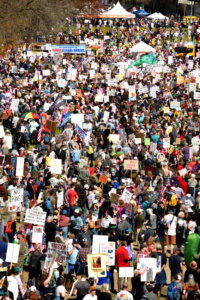
Germany’s parliamentary election on March 5, 1933 was the most fateful in the nation’s history, securing Hitler’s hold on power and launching 12 years of despotic rule and, eventually, a world war.
Like Germany nearly a century ago, as the United States enters the campaign season for our midterm elections, we too stand at destiny’s threshold. The outcome will determine whether Donald Trump can continue his assaults on democratic institutions, or whether he is checked by a Congress he has rendered virtually powerless since beginning his second term.
The moods of Germans in the spring of 1933 and Americans in the spring of 2026 are strikingly similar — a shroud of foreboding hangs over defenders of democracy. Yet beneath the gloom runs a pulse of defiance. In the United States, that defiance took visible form this past Saturday, when millions joined anti-Trump No Kings marches and rallies across the country.
As impressive as the Saturday protest was, America’s protectors of the republic would do well to heed what happened in Germany in the run-up to the two parliamentary elections of 1932 and the Weimar Republic’s final parliamentary election in March 1933 — moments when democratic hopes briefly rose, only to be extinguished.
In America under Trump, Indivisible has emerged as the most visible national organization in the anti-Trump resistance. During the Weimar Republic, its counterpart was a broad pro-democracy coalition called the Reichsbanner, led by the Social Democrats. Over the past century, memory of the Reichsbanner has nearly vanished, which is a shame given its dauntless devotion to democracy in the face of constant danger.
During the Weimar Republic’s final election campaigns, multitudes of Germans — rank upon rank, singing and chanting — marched through Berlin and other cities and towns across the country, gathering at rallies where orators denounced the fascists and vowed to defend the republic.
“1932 will be our year, the year of final victory of the republic over its enemies,” declared Karl Höltermann, the Reichsbanner’s national leader.
As the Weimar Republic was attacked by extremists on the right and left in its early years, and after Hitler’s abortive Beer Hall Putsch in 1923, the Social Democrats, the German Democratic Party, and the Center Party joined forces in 1924 to create a pro-republic defense organization, which they called the Reichsbanner.
In 1931, the Nazis, the German National Peoples’ Party, the veterans’ association Stahlhelm, and other anti-democratic forces joined to form the Harzburg Front. The Reichsbanner and its allies countered by marshaling Germany’s democratic constituencies — workers, veterans, liberals, Catholics — into a coordinated force known as the Iron Front.
As the Great Depression threw millions out of work, street violence intensified, cracks widened, and fragile coalition governments collapsed. The ranks of the Nazi and Communist parties swelled. Votes for Nazi candidates in the July 1932 election more than doubled — from 6.4 million to 13.1 million — making Hitler’s party the largest in the Reichstag with 230 seats, about 100 more than the Social Democrats, although short of a majority.
Enthusiasm for Hitler waned as Germany’s economic crisis eased, reflected in the November 1932 election. The Nazi bloc fell from 230 to 196 seats. It was a blow, but they remained the largest party.
The Reichsbanner’s years of defending democracy hurtled toward an ignominious end as Hitler used the burning of the Reichstag as a pretext to suspend civil liberties, the Nazis won a slim majority of parliamentary seats in coalition with the Nationalists in the March 5, 1933 election, and the last nail was driven into the republic’s coffin 14 days later when the parliament voted to give Hitler complete power.
During these tumultuous months defenders of democracy were intimidated, beaten, murdered and tortured, and many wound up in concentration camps, including Reichsbanner members. Höltermann fled to Britain, where he lived out the rest of his life in exile, dying in 1955.
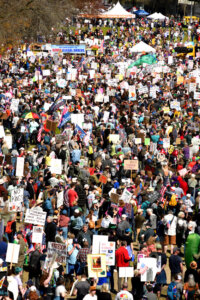
This past Saturday’s No Kings protests looked nothing like the anti-Hitler demonstrations led by the Reichsbanner nearly a century ago. But the posters carried by anti-Trump activists, their anti-fascist slogans, the frogs, unicorns and other creatures cavorting among the marchers, and above all, the dauntless defiance, all came from the same impulse that drove the defenders of the Weimar Republic.
As in communities across the nation, Saturday’s rally and march here in Portland, Ore. was truly impressive. There were so many people in the march that they simultaneously filled two bridges spanning the broad Willamette River dividing downtown from the east side.
A drum corps of anti-Trump activists was so precise in close-order drill that they might have surprised out-of-town visitors who think of Portland as a hipsters’ paradise. But the Portlandia stereotype was rescued by a guy on a unicycle riding in front of the drum corps — wearing a frog costume and juggling tennis balls.
Equally striking were three 13-foot puppets created by an Indivisible Oregon arts team and towed along the parade route — Donald Trump stuck in an oil barrel and holding a Boeing 747 in one of his tiny hands, Stephen Miller dressed as Dracula, and RFK Jr. as a mad scientist with a giant worm coming out of his head.
Although the Saturday nationwide protests appeared peaceful, confrontations broke out that night outside Portland’s ICE facility and at the Los Angeles Metropolitan Detention Center. Federal officers in Portland used tear gas to move protesters away from the gates, and in Los Angeles, authorities arrested dozens during a brief clash outside the detention center.
What’s next?
Indivisible co-founder Ezra Levin — sort of a Karl Höltermann of the 21st century — said plans are in the works for a general strike on May 1 to protest government policies that favor billionaires over workers. It is an idea inspired by a January 2026 general strike in Minneapolis, shuttering more than 700 businesses, to demand a halt to an escalation of federal immigration enforcement that led to the shooting deaths of two activists. Labor unions, religious organizations, community advocacy groups, teachers and students were among those involved.
“The next major national action of this movement is not just gonna be another protest. It is a tactical escalation,” Levin said at the No Kings rally in Saint Paul. “It is an economic show of force, inspired by Minnesota’s own day of truth and action,” .
I wish Levin well. But I worry.
General strikes are extremely rare in the United States. And there are reasons for that. Before Minneapolis, the last one occurred in Oakland, Calif., in 1946, when 100,000 workers staged a two-day walkout. Over the decades, as labor muscle has weakened, general strikes have become more difficult to organize. While workers have the right to strike, the Taft-Hartley Amendments of 1947 prohibit strikes organized for political purposes or directed at secondary targets..
A nationwide general strike in Germany in 1920 indicates some potential pitfalls.
In March 1920, when right-wing officers attempted to overthrow the republic in the far-right Kapp Putsch, the nation’s democratic forces responded with a general strike so vast that it quickly brought the coup to its knees. But the victory came at a steep price. Instead of unifying Germans around the defense of their republic, the strike widened the fissures already running through the nation.
As I was riding the bus to Portland’s protest on Saturday, I thought back to Karl Höltermann and the Reichsbanner. And I reflected on this fact: Germany’s anti-Hitler movements failed because not enough Germans thought democracy was worth preserving. Back then, democracy was not a historic tradition in Germany, unlike our 250 years of experience.
If we rescue our democracy, it will be because enough of us chose to.
The post Why the ‘No Kings’ marches reminded me of Germany in 1933 appeared first on The Forward.
Uncategorized
Outrage First, Facts Later: Jerusalem’s Palm Sunday Story

Pope Leo XIV delivers a homily during the Palm Sunday Mass in Saint Peter’s Square at the Vatican, March 29, 2026. REUTERS/Francesco Fotia
News that Israeli police had blocked Latin Patriarch Cardinal Pierbattista Pizzaballa from entering the Church of the Holy Sepulchre in Jerusalem on Palm Sunday spread rapidly across social media this week.
The reaction was swift and severe, with Israel accused of restricting Christian worship and violating religious freedom at one of Christianity’s holiest sites.
But much of the outrage was missing key facts.
Israeli police, along with the Prime Minister and President, said the measures were driven by security concerns at Jerusalem’s holy sites during wartime.
With Iranian missile fire ongoing and fragments already landing near religious locations, authorities cited the risk of mass casualties in an area with limited shelter and difficult emergency access.
The decision, they said, was about protecting both the cardinal and worshippers.
What was also largely overlooked is that the situation was quickly resolved.
Following coordination between Israeli authorities and the Catholic Patriarchate, an agreement was reached allowing prayer under agreed limitations, and access was restored.
There is room to criticize what was, at best, a clumsily handled situation that should have been resolved before escalating publicly. But there was no evidence of malice — only an attempt to enforce safety regulations under wartime conditions.
That context, however, was almost entirely absent from the viral narrative.
Pro-Palestinian accounts on X portrayed the incident as a deliberate act against Christians. Some framed it as persecution; others as proof of systematic religious discrimination.
One widely shared post by Quds News Network claimed Israel had prevented the cardinal from entering the church with no reason given, omitting any reference to security measures or crowd control, and reinforcing the perception of deliberate obstruction.
Israeli police just prevented Roman Catholic cardinal Pierbattista Pizzaballa from entering the Church of the Holy Sepulchre in occupied Jerusalem to hold the Palm Sunday service, which marks the beginning of the Catholic Easter observances. pic.twitter.com/WNvcGsLfh5
— Quds News Network (@QudsNen) March 29, 2026
In another post, Palestinian writer Mosab Abu Toha — previously criticized for disparaging Israeli hostages in Gaza — cast the incident as part of a broader pattern of restrictions on worship, again without mentioning the security rationale cited by Israeli authorities.
Israel is preventing Christians from celebrating one of the holiest days in Christianity for the first time in centuries.
Israel must realize that Jerusalem is not its city to decide who enters or leaves.
Al-Aqsa Mosque has been closed to Muslims for over a month, particularly… pic.twitter.com/m4CzE9V2YN
— Mosab Abu Toha (@MosabAbuToha) March 29, 2026
Susan Abulhawa went further, using the incident to promote inflammatory rhetoric about “parasitic Jewish supremacists,” falsely claiming that Jews were granted unrestricted access while Christians and Muslims were barred.
Israel closed the holiest sites to Muslims and Christians, but they’re allowing parasitic Jewish supremacists into the compounds to defile these sites.
Israel must be destroyed for humanity’s sake. https://t.co/PQn46UZ4Qd— susan abulhawa | سوزان ابو الهوى (@susanabulhawa) March 29, 2026
Other commentators, including Ethan Levins, Carrie Prejean, and longtime Israel critic Mehdi Hasan, echoed similar claims — all reinforcing the same stripped-down narrative: denial of access, devoid of context.
For the first time in centuries, Christians were blocked by the Israeli government from celebrating Palm Sunday at the Church of the Holy Sepulchre.
The Latin Patriarch of Jerusalem Cardinal Pierbattista Pizzaballa was prevented from entering Church by Israel Police.
The… pic.twitter.com/UJAyUg0Nqw
— Carrie Prejean Boller (@CarriePrejean1) March 29, 2026
Israel is the enemy of Christianity. https://t.co/2F1ubfqWaW
— Ethan Levins
(@EthanLevins2) March 29, 2026
Missing from much of the online reaction was the perspective of Cardinal Pizzaballa himself. He stated that he was treated with politeness and emphasized the importance of respectful dialogue moving forward.
Cardinal Pizzaballa: “It is true that the police had said that the orders from the internal command prevented any kind of gathering in places where there is no shelter, but we had not asked for anything public, just a brief and small private ceremony to preserve the idea of the… https://t.co/uGNwus8RAw
— Rich Raho (@RichRaho) March 29, 2026
In reality, Israel faced a difficult choice: allow unrestricted access during Holy Week amid an active war and credible security threats, or impose temporary limitations and face international backlash.
Either option carried consequences. Had a mass casualty event occurred, the criticism would likely have been far more severe.
This is the nature of a lose-lose scenario.
Events in Jerusalem, particularly around religious sites, do not unfold in a vacuum. They are shaped by security realities, historical sensitivities, and the challenge of balancing competing religious claims.
Reducing such incidents to a single viral image strips away that complexity.
The Palm Sunday episode is a case study in how quickly a misleading narrative can take hold when context is omitted, and how rarely subsequent clarifications receive the same attention as the initial outrage.
In the end, the situation was resolved not through outrage, but through dialogue.
That, too, is part of the story.
The author is a contributor to HonestReporting, a Jerusalem-based media watchdog with a focus on antisemitism and anti-Israel bias — where a version of this article first appeared.