


Uncategorized
A sign in my neighborhood says ‘The Holocaust is fake’ — I wish I felt surprised
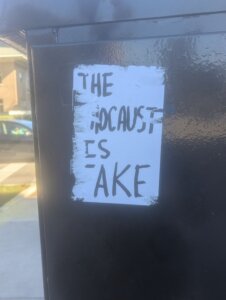
When I saw a sign on my streetcorner in Chicago that said “The Holocaust is fake,” I immediately stopped. I had just left the pool and was on my way to shop for Shabbat. Disgusted, I brought an older neighbor to take a look. I knew he had taken down his mezuzah in fear after some of the protests after Oct. 7 and had only recently put another Jewish symbol back up.
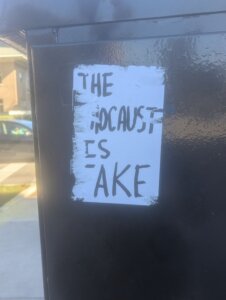
I wanted company as I snapped a picture of the sign, but I also wanted him to be aware of what was happening in the neighborhood. Because these days, the truth and lies are blurred.
Later, I learned that similar stickers and graffiti, some of it misspelled, had appeared on other corners and benches on the Far North side of Chicago, traditionally a stronghold of the Jewish community here, which is the third largest in the U.S.
“Holocaust” and “fake” are two words whose meanings used to be clear to all. Yet the doubt cast on both “Holocaust” and “fake” represent two disturbing trends; their convergence is dangerous, and entirely predictable.
Those who traffic in Holocaust minimization and denial have been recent guests on The Joe Rogan Experience, the country’s #1 podcast, which has far more listeners than network television. Rogan, who has hosted the “Holocaust revisionist” Darryl Cooper, has 19.4 million subscribers on YouTube, 19.7 million on Instagram and 15 million on X. Meanwhile, NBC and CBS News average 5.6 and 3.6 million viewers, respectively.
Redefining fake
Meanwhile, the mainstream news media, where fact-checking is prized, has been maligned for years as “fake news,” a term the current U.S. president uses so often that no one blinks when something real is dismissed. When fact-checked information is “fake,” it’s not surprising to see history described that way too.
The Holocaust was the ultimate truth of the 20th century. The ghettos, the crematoria, the gas chambers — so many elements of the industrialized and intentional slaughter of an entire people were without precedent and were the final stop on centuries of anti-Jewish hatred.
In the weeks after Oct. 7, I was haunted by the thought that the “genocide” charge against Israel was not just about criticizing Israel, but at root, about minimizing the Holocaust.
The term “genocide” was coined by Raphael Lemkin, a Polish-Jewish lawyer who had lost 49 members of his family in the Holocaust.
Yet the world’s oldest Holocaust archive changed its name in September 2019 from the Wiener Library for the Study of the Holocaust and Genocide to the Wiener Holocaust Library. The Library, located in London, stated that it wanted to clarify “the centrality of the Holocaust” to our work without changing its “commitment to furthering the study of genocide.”
A few years earlier, in 2011, Jeremy Corbyn, who would become Labour Party leader in 2015, sought to change “Holocaust Memorial Day” to “Genocide Memorial Day — Never Again for Anyone” in 2011. That prompted swift backlash.
“Holocaust Memorial Day already rightly includes all victims of the Nazis and subsequent genocides,” Karen Pollock, chief executive of the UK’s Holocaust Educational Trust, wrote at the time on Twitter. “But the Holocaust was a specific crime, with antisemitism at its core. Any attempt to remove that specificity is a form of denial and distortion.”
Changing the meaning of the word ‘Holocaust’
Increasingly, the word ‘Holocaust’ is being used to describe what was not the Holocaust.
Simon and Schuster is currently promoting a forthcoming book edited by Susan Abulhawa that it describes as documenting “the holocaust of our time.” The editor’s note accompanying the copy that reviewers have received is signed “From the river to the sea.”
According to the United States Holocaust Museum, “approximately 9.5 million Jews lived in Europe in 1933, the year Hitler came to power. This number represented 1.7% of Europe’s total population and more than 60 percent of the world’s Jewish population. By 1945, most European Jews — 2 out of every 3 — had been killed.”
The world Jewish population still hasn’t recovered its 1933 levels.
Even in this moment where words and numbers increasingly do not matter, there is no account — not even from the Hamas-run Health Ministry itself—-that suggests that 2/3 of Gazans have been killed in this conflict.
This is not to minimize the tremendous suffering of both Israelis and Palestinians in a war that began with a Hamas-led attack on Israel, in which some Gazan civilians participated. It was a horrible and harrowing two years.
Returned Israeli hostages have described being held in the homes of ordinary Gazans. CNN reported that three hostages were held in the home of a physician whose son was a freelance journalist for the US-based Palestine Chronicle. The son filed dispatches about the war in Gaza while his family held hostages.
Fact-check: A military attack and hostage-taking were not features of the Jewish community’s experience during the Holocaust.
What is real? What is fake?
Who’s a journalist? Who’s a hostage-holder?
What’s “news”? What’s “experience”?
What’s the difference between the Holocaust and the holocaust?
,
In this world where facts can be fake and nothing is taboo, anything seems possible. You can make the Holocaust into a lower-case “holocaust.” You can make Raphael Lemkin, the columnist for Zionist World, into an anti-Zionist, which was what Lemkin’s family asserted that the Lemkin Institute was doing, as it used their relative’s name while attacking Israel. And you can put up a sticker in a Jewish neighborhood claiming that the “Holocaust is fake.”
Holding on to disgust
I wrote to various family members with a photo of the sign in my neighborhood. None reacted too strongly; “I hate to say it, but I’m numb to this already,” one wrote.
I’m glad I’m still disgusted. I’m writing this to encourage you to be disgusted, too. Resist the guests on podcast “experience” forums who claim that antisemitism is being exaggerated, and that the Holocaust wasn’t that bad.
Because once holocaust is just a word, marketing copy from a publisher, devoid of Jewish content, and cleansed of historical accuracy, all words can be redefined to serve this kingdom of lies we increasingly seem to be living in.
The post A sign in my neighborhood says ‘The Holocaust is fake’ — I wish I felt surprised appeared first on The Forward.
Uncategorized
Outrage First, Facts Later: Jerusalem’s Palm Sunday Story

Pope Leo XIV delivers a homily during the Palm Sunday Mass in Saint Peter’s Square at the Vatican, March 29, 2026. REUTERS/Francesco Fotia
News that Israeli police had blocked Latin Patriarch Cardinal Pierbattista Pizzaballa from entering the Church of the Holy Sepulchre in Jerusalem on Palm Sunday spread rapidly across social media this week.
The reaction was swift and severe, with Israel accused of restricting Christian worship and violating religious freedom at one of Christianity’s holiest sites.
But much of the outrage was missing key facts.
Israeli police, along with the Prime Minister and President, said the measures were driven by security concerns at Jerusalem’s holy sites during wartime.
With Iranian missile fire ongoing and fragments already landing near religious locations, authorities cited the risk of mass casualties in an area with limited shelter and difficult emergency access.
The decision, they said, was about protecting both the cardinal and worshippers.
What was also largely overlooked is that the situation was quickly resolved.
Following coordination between Israeli authorities and the Catholic Patriarchate, an agreement was reached allowing prayer under agreed limitations, and access was restored.
There is room to criticize what was, at best, a clumsily handled situation that should have been resolved before escalating publicly. But there was no evidence of malice — only an attempt to enforce safety regulations under wartime conditions.
That context, however, was almost entirely absent from the viral narrative.
Pro-Palestinian accounts on X portrayed the incident as a deliberate act against Christians. Some framed it as persecution; others as proof of systematic religious discrimination.
One widely shared post by Quds News Network claimed Israel had prevented the cardinal from entering the church with no reason given, omitting any reference to security measures or crowd control, and reinforcing the perception of deliberate obstruction.
Israeli police just prevented Roman Catholic cardinal Pierbattista Pizzaballa from entering the Church of the Holy Sepulchre in occupied Jerusalem to hold the Palm Sunday service, which marks the beginning of the Catholic Easter observances. pic.twitter.com/WNvcGsLfh5
— Quds News Network (@QudsNen) March 29, 2026
In another post, Palestinian writer Mosab Abu Toha — previously criticized for disparaging Israeli hostages in Gaza — cast the incident as part of a broader pattern of restrictions on worship, again without mentioning the security rationale cited by Israeli authorities.
Israel is preventing Christians from celebrating one of the holiest days in Christianity for the first time in centuries.
Israel must realize that Jerusalem is not its city to decide who enters or leaves.
Al-Aqsa Mosque has been closed to Muslims for over a month, particularly… pic.twitter.com/m4CzE9V2YN
— Mosab Abu Toha (@MosabAbuToha) March 29, 2026
Susan Abulhawa went further, using the incident to promote inflammatory rhetoric about “parasitic Jewish supremacists,” falsely claiming that Jews were granted unrestricted access while Christians and Muslims were barred.
Israel closed the holiest sites to Muslims and Christians, but they’re allowing parasitic Jewish supremacists into the compounds to defile these sites.
Israel must be destroyed for humanity’s sake. https://t.co/PQn46UZ4Qd— susan abulhawa | سوزان ابو الهوى (@susanabulhawa) March 29, 2026
Other commentators, including Ethan Levins, Carrie Prejean, and longtime Israel critic Mehdi Hasan, echoed similar claims — all reinforcing the same stripped-down narrative: denial of access, devoid of context.
For the first time in centuries, Christians were blocked by the Israeli government from celebrating Palm Sunday at the Church of the Holy Sepulchre.
The Latin Patriarch of Jerusalem Cardinal Pierbattista Pizzaballa was prevented from entering Church by Israel Police.
The… pic.twitter.com/UJAyUg0Nqw
— Carrie Prejean Boller (@CarriePrejean1) March 29, 2026
Israel is the enemy of Christianity. https://t.co/2F1ubfqWaW
— Ethan Levins
(@EthanLevins2) March 29, 2026
Missing from much of the online reaction was the perspective of Cardinal Pizzaballa himself. He stated that he was treated with politeness and emphasized the importance of respectful dialogue moving forward.
Cardinal Pizzaballa: “It is true that the police had said that the orders from the internal command prevented any kind of gathering in places where there is no shelter, but we had not asked for anything public, just a brief and small private ceremony to preserve the idea of the… https://t.co/uGNwus8RAw
— Rich Raho (@RichRaho) March 29, 2026
In reality, Israel faced a difficult choice: allow unrestricted access during Holy Week amid an active war and credible security threats, or impose temporary limitations and face international backlash.
Either option carried consequences. Had a mass casualty event occurred, the criticism would likely have been far more severe.
This is the nature of a lose-lose scenario.
Events in Jerusalem, particularly around religious sites, do not unfold in a vacuum. They are shaped by security realities, historical sensitivities, and the challenge of balancing competing religious claims.
Reducing such incidents to a single viral image strips away that complexity.
The Palm Sunday episode is a case study in how quickly a misleading narrative can take hold when context is omitted, and how rarely subsequent clarifications receive the same attention as the initial outrage.
In the end, the situation was resolved not through outrage, but through dialogue.
That, too, is part of the story.
The author is a contributor to HonestReporting, a Jerusalem-based media watchdog with a focus on antisemitism and anti-Israel bias — where a version of this article first appeared.
Uncategorized
The Media Ignores Iran’s Crimes, Because It Wants to See the Regime Prevail

Members of the Islamic Revolutionary Guard Corps (IRGC) attend an IRGC ground forces military drill in the Aras area, East Azerbaijan province, Iran, Oct. 17, 2022. Photo: IRGC/WANA (West Asia News Agency)/Handout via REUTERS
Start with three facts from this past week.
Not rumors. Not slogans. Not social media noise.
Facts — reported in mainstream outlets, documented by international human rights bodies, and, in part, reflected in the regime’s own conduct and admissions.
First, a 19-year-old wrestler — Navid Afkari — was executed by the Iranian regime after a trial widely condemned by international observers. Hung. Killed. His crime: protesting.
Second, officials tied to the Islamic Revolutionary Guard Corps (IRGC) advancing frameworks where children as young as 12 can be integrated into war-support roles — patrols, logistics, internal enforcement. Not speculation. Not anonymous leaks. Positions reflected in both external reporting and Iranian media.
Third, multiple independent investigations — and mainstream media reports — documenting the systematic use of rape and sexual violence by the IRGC and Basij against detainees, particularly protesters, as a tool of repression.
Stop there.
You don’t need embellishment. You don’t need a fourth example. You don’t need a roundtable parsing “context.” What you need is to understand what kind of regime produces all three of these facts consistently, predictably, and without apology.
Because in the Islamic Republic of Iran, these are not aberrations. They are not excesses at the margins of an otherwise functioning system. They are the system.
Authoritarian systems do not need to announce what they are. They demonstrate it. Not in their slogans — which are often framed, for many Western audiences, in the language of justice and resistance — but in what they do to people, particularly their own citizens.
For 47+ years under this Iranian regime, the pattern is direct and repeatable. That is not hyperbole or metaphor. It is a description of how the Iranian regime operates.
And yet — and this is where the second scandal should begin — this regime still receives the benefit of the doubt, if not outright support, in significant parts of Western discourse.
Watch almost any show on MSNBC or CNN and you can hear it happen in real time.
The language shifts. It hedges. Or it flips into outright advocacy.
Iran becomes “complicated.”
The regime becomes “reactive.”
Its brutality is sometimes acknowledged, but immediately diluted with qualifiers — history, geopolitics, grievance. Explanations that are rarely extended to democratic states defending themselves.
And then there is the next tier — those who go further and actively sanitize what is happening as they also effectively cheerlead for this regime in its current war against America, Israel, and every moderate Sunni Arab state in the region.
They do not talk about the crimes happening in Iran, because those facts are disqualifying.
Once stated plainly, without euphemism or ideological filtering, these facts collapse the narrative that these groups rely on to excuse or deflect from the regime’s conduct.
You cannot claim moral seriousness or concern for human rights and dignity while excusing executions of protesters, the integration of children into state security structures, and the systematic use of sexual violence as a tool of repression.
You can argue politics. You can criticize Israel. You can debate foreign policy or military strategy.
But if you ignore or minimize these facts about the Iranian regime, you are not making an argument tied to human rights. You are abandoning it.
There is a sad, long and well-documented history of this kind of intellectual evasion and duplicity.
In the 1930s, Western journalists like Walter Duranty downplayed or denied Stalin’s famine in Ukraine while millions died. Soviet show trials and purges were explained away as internal necessities. In Mao’s China, the Great Leap Forward and Cultural Revolution were rationalized or ignored by sympathetic observers even as tens of millions perished. Later, Pol Pot’s Cambodia was dismissed by some Western voices as exaggerated propaganda until the killing fields could no longer be concealed.
Evidence is available. Documentation exists. But it is discounted, reframed, or ignored because it conflicts with a preferred political narrative.
If you excuse or downplay executions after sham trials, as well as these other crimes, you are providing political cover for a regime routinely and regularly engaged in brutality and systematic repression.
Large parts of the anti-Israel, self-described “pro-Palestinian” movement are not engaged in a human rights campaign. They are engaged in a selective political project that ignores abuse when it is inconvenient and amplifies (and lies about) it when it is useful. If human rights were the standard, the Iranian regime would be at the center of their outrage. It isn’t.
And that tells you everything you need to know.
Micha Danzig is an attorney, former IDF soldier, and former NYPD officer. He writes widely on Israel, Zionism, antisemitism, and Jewish history. He serves on the board of Herut North America.
Uncategorized
An American Student’s View From Israel: The First Day of My First War

A drone view shows a damage in a residential neighborhood, following a night of Iranian missile strikes which injured dozens of Israelis, amid the US-Israel conflict with Iran, in Dimona, southern Israel, March 22, 2026. Photo: REUTERS/Roei Kastro
On February 28, 2026, at 8:15 AM, I was woken up by a very unique alarm clock. Israel’s Home Front Command app had suddenly replaced Google and Gemini as the most invaluable tool I had.
Surprise is not the right word for what I felt at that moment, because we had all been anticipating a war for the past month.
I bolted awake in my bed and looked at my roommates in disbelief. “Yup, that’s a siren,” said one of them. I frantically threw on my shoes and ran to the bomb shelter, feeling the adrenaline kicking in.
The bomb shelter was crammed with people, as we were on a trip to Safed at the time, a town in Israel’s North, famous for its Jewish mystics and beautiful views. Our counselors attempted to count us off as Israelis around us were shouting at and through each other, both on the phone and in person.
My journey to Israel began in March of last year, when I decided to apply to the Alexander Muss High School, a semester abroad program for North American students in Israel. This program integrates the students’ schoolwork from home with a travel schedule around Israel and a rich educational curriculum to connect kids with Jewish history and modern Israel.
It is an amazing program that allows students to learn extensively about Israel and its culture, something that I, as a kid from the Bay Area, do not get.
All of our original plans to explore Safed that day were scrapped. We were given 15 minutes to pack up our things and get on the bus to go back to campus in Hod HaSharon, in central Israel. What was supposed to be an hour and a half ride turned into three; it was also the most surreal bus ride of my life.
Ten minutes into the drive, a siren rang. We drove into a tunnel and were told to crouch down in the aisle of the bus and cover our heads and necks. Something I had seen Israelis do for years on the news was now a reality for me.
After some time, we were back on the road, but not for long.
After several more sirens, stops, and crouching down in the bus, we finally made it back to campus. We did not get a break for long. Soon we were greeted by another round of sirens, and back into the bomb shelter we went.
There were a total of twenty-seven sirens that day. The entire day was spent in the bomb shelter. During the brief couple of minutes between rounds that we had, we set objectives for what was to be accomplished, whether it be grabbing food, water, or plugging in a portable charger that was dead at the most opportune time. Many attempted, unsuccessfully, to take showers, but were interrupted by sirens. It did not feel frightening, but it did feel very strange.
This truly gave me the full Israeli experience.
Normal, everyday tasks were done under the constant stress of whether they would be interrupted by a siren. During a particularly intense day of rocket fire, I prepared baggy clothes to throw on in case of a siren while showering. Meals were frequently interrupted. What we in the Bay Area take for granted is not the case for Israelis now. Multiple times a day, we are forced to drop whatever we are doing and run to the shelter.
And that’s assuming Israel’s defenses work, and bomb shelters will protect us. But sometimes they won’t.
This war has provided me with an unparalleled experience, where, for the first time, I truly understand what being part of the Israeli community means, both in peace and in war.
These moments that now make up everyday life, whether positive or not, have brought my classmates and me together.
In the past month, I have learned a lot, and I have experienced a real war, something one never looks forward to.
I fully understood who I was when, under that tunnel where the bus stopped to hide from the missiles, we formed a big circle and began singing Hatikva, Israel’s anthem. That was a moment of unity and resiliency that I, as an American and a Jew, will never forget.
Sheina Stesin is a high schooler from the Bay Area, and is currently on a study abroad program in Israel.