


Uncategorized
Vance Says Israel ‘Not Controlling’ Trump, Fails to Defend Judaism in Response to Antisemitic Comments at Event

A screenshot of a question-and-answer session at the University of Mississippi in Oxford on Oct. 29, 2025, in which US Vice President JD Vance is questioned about his views on Israel and Judaism. Photo: Screenshot
US Vice President JD Vance on Wednesday responded to a question from a right-wing student activist who made antisemitic statements against Israel and Judaism, arguing the Jewish state does not control American foreign policy while not countering the questioner’s remarks targeting the Jewish religion.
Vance appeared at the University of Mississippi for an event held by Turning Point USA, the influential conservative advocacy organization led for years by the late Charlie Kirk.
More than 90 minutes into the session, during the questions portion, a man wearing a red “Make America Great Again” baseball cap and a white “Ole Miss” hoodie was given the microphone.
“Thank you for the opportunity to speak,” the individual said. “I’m a Christian man and I’m just confused why that there’s this notion that we might owe Israel something or that they’re our greatest ally or that we have to support this multi-hundred-billion-dollar foreign aid package to Israel to cover this — to quote Charlie Kirk, ethnic cleansing in Gaza. I’m just confused why this idea has come around considering the fact that not only does their religion not agree with ours but also openly supports the prosecution of ours.”
The question — in which the student incorrectly quoted Kirk, an outspoke pro-Israel advocate —prompted applause from the audience.
“First of all, when the president of the United States says ‘America first’ that means that he pursues the interests of Americans first. That is our entire foreign policy,” Vance responded. “That doesn’t mean that you’re not going to have alliances, that you’re not going to work with other countries from time to time. And that is what the president believes is that Israel, sometimes they have similar interests to the United States and we’re going to work with them in that case. Sometimes they don’t have similar interests to the United States.”
Vance used the example of the US-brokered ceasefire to halt fighting between Israel and Hamas in Gaza to illustrate his point.
“In this example, the most recent Gaza peace plan that all of us have been working on very hard for the past few weeks, the president of the United States could only get that peace deal done by actually being willing to apply leverage to the state of Israel,” Vance said. “So, when people say that Israel is somehow manipulating or controlling the president of the United States, they’re not controlling this president of the United States, which is one of the reasons why would we be able to have some of the success that we’ve had in the Middle East.”
The vice president, who was baptized into the Catholic faith in August 2019, then shifted to theological discourse, apparently wanting to respond to the student’s statement that Judaism “openly supports the persecution of Christians.
“Now you ask about, you know, sort of Jews disagreeing with Christians on certain religious ideas. Yeah, absolutely. It’s one of the realities is that Jews do not believe that Jesus Christ is the Messiah. Obviously, Christians do believe that,” Vance said. “There are some significant theological disagreements between Christians and Jews. My attitude is let’s have those conversations. Let’s have those disagreements when we have them. But if there are shared areas of interest, we ought to be willing to do that, too.”
Vance continued, “One thing I really, really care about is the preservation of the Church of the Holy Sepulchre in Jerusalem. Christians believe that that is the site where Jesus Christ was crucified and also that his tomb is right there as well. My attitude is if we can work with our friends in Israel to make sure that Christians have safe access to that site, that’s an obvious area of common interest, I am fine with that.”
The vice president then emphasized to the student that he would not put Israel ahead of the United States, saying, “What I’m not OK with is any country coming before the interests of American citizens. And it is important for all of us, assuming we’re American citizens, to put the interest of our own country first. That’s what we’re going to do. That’s what we try to do every single day. I promise you. Thank you.”
Antisemitic sentiment on the American political right has surged in the weeks following the murder of Kirk, with prominent social media podcaster figures such as Tucker Carlson and Candace Owens suggesting Israeli involvement in the shooting without any evidence. This conspiracy theorizing inspired death threats against pro-Israel conservative figures and the arrest of a man now facing 140 years’ imprisonment.
On Monday, Carlson published a more than two-hour interview with neo-Nazi podcaster Nick Fuentes on X. Photos of Carlson with his arm around Fuentes’ shoulder and smiles on both their faces began circulating around social media.
Carlson apologized to Fuentes in the discussion, saying “I’m sorry I called you gay, by the way.” He also referenced the prominent political commentator Ben Shapiro, who is widely known to be an Orthodox Jew, adding, “I don’t think Fuentes is going away. Ben Shapiro tried to strangle him in the crib in college, and now he’s bigger than ever.”
In the interview, Fuentes contrasted himself with Shapiro, stating, “I didn’t come from some strange background. I come from a normal home. My parents are Catholic.”
Fuentes’s comments appear to differ with the views of Pope Leo XIV, the head of the Catholic Church.
Leo on Wednesday condemned antisemitism and affirmed the Catholic Church’s commitment to combating hatred and persecution against the Jewish people, arguing his faith demands such a stance.
Speaking in St. Peter’s Square at the Vatican for his weekly “general audience,” the pontiff acknowledged the 60th anniversary of Nostra Aetate, a declaration from the Second Vatican Council and promulgated on Oct. 28, 1965, by Pope Paul VI that called for dialogue and respect between Christianity and other religions.
Since the publication of Nostra Aetate, “all my predecessors have condemned antisemitism with clear words,” Leo said. “I too confirm that the Church does not tolerate antisemitism and fights against it, on the basis of the Gospel itself.”
Uncategorized
Why this Zionist Israeli is running with an Islamist party
(JTA) — KIBBUTZ EIN HAHORESH, Israel – He’s been called a “terror supporter” and a “traitor,” and even accused of devious steps to enable Islamists to “infiltrate” Israel’s next government. But Yoav Segalovitz, the Jewish parliamentarian who recently broke strict taboos by teaming up with an Arab Islamist party, is unperturbed.
“There are always crazy people, and it doesn’t matter what they say on television; I think when you’ve chosen your path, you just have to ignore it all,” he said in a recent interview with the Jewish Telegraphic Agency.
It has been just over a month since Segalovitz, 67, a veteran member of Israel’s parliament, the Knesset, made his unprecedented decision to leave the centrist Yesh Atid party for Ra’am, an Arab-Israeli party with roots in the Muslim Brotherhood, in the hopes of bridging the gap between Jews and Arabs in Israel.
“Are all the old patterns going to change in the coming month? Absolutely not,” Segalovitz, a former deputy minister for public security and a former police investigator, said. “But I’m thinking long term, not just about these particular elections. From my perspective, this is a long-term story. It’s not about the here and now.”
At a recent campaign event in the well-worn communal dining room of Kibbutz Ein Hahoresh, an agricultural community in the Emek Hefer region of central Israel, Segalovitz explained to a group of around 80 Jewish voters why he made the radical decision as a self-declared Zionist to team up with an Islamist party.
“I wanted to have an impact,” he said, describing how he knew it would somehow be related to the Arab community in Israel that makes up around 21% of the total population.
“I knew I wanted to break down the paradigms that exist; I wanted to cross the bridge; the only question was how I could do this,” Segalovitz said, speaking to the small crowd of kibbutz members and residents of the surrounding communities.
Microphone in hand, the neatly dressed former police officer described how, when tensions were high and societal divisions deeper than ever during the final days of the previous Knesset, he asked himself how he could make a meaningful difference in Israeli society.
Segalovitz said that at first he considered creating a brand new joint Israeli-Arab party. But he quickly realized that he could make greater change by joining forces with Ra’am, an Arab party whose leader, Mansour Abbas, is already known for his own paradigm-breaking political moves.
Abbas, a deeply religious conservative Muslim who, in his own words, identifies as a Palestinian citizen of Israel, was the first Arab party leader to join an Israeli government, breaking deep-rooted taboos in his own community. In 2021, his bold move to join former prime ministers Naftali Bennett and Yair Lapid in a ruling coalition helped to briefly oust Prime Minister Benjamin Netanyahu from power.
While the move signaled an unprecedented shift in Israeli politics, it was also fraught with tension and ultimately proved to be deeply unpopular with much of the Israeli public and some in the Arab community. Ultimately, Ra’am’s inclusion in the Bennett-Lapid government was one of the factors that led to its rapid downfall.
If including an Arab party in the government was controversial before Hamas’ attacks on Oct. 7, 2023, today it is close to unthinkable. In the run-up to the Oct. 27 election, most predominantly Jewish parties have avoided saying publicly that they would consider including Ra’am, or any other Arab party, in a future coalition. And, beyond Ra’am, the other Arab party – the Joint List – remains emphatically against any such alliance.
But recent polls suggest that bringing Arab parties into a governing alliance could be the only way to secure the parliamentary majority needed to form a new government. With Segalovitz now running on Ra’am’s list, such a prospect may be slightly more realistic.
However, the challenges of reaching such an arrangement were evident at the recent Kibbutz Ein Hahoresh meeting.
An aging audience of casually dressed kibbutzniks sauntered into the sparse hall curious to hear Segalovitz’s story. They gave him a warm and polite reception, and grilled him with questions after listening to him speak. But most said they were not swayed to vote for him.
“He’s very brave for doing what he did,” said Elie Aloni, 80, a resident of nearby Beit Herut. But she continued to say that she would not vote for Ra’am because she’s already committed to the left-wing Democrats Party.
Aloni said her party’s leader, Yair Golan, had already stated that he wanted to see Ra’am join the government, and she hoped that would happen. She was also hopeful that having an Israeli Jew on Ra’am’s list would make it easier for the party to be included in the next coalition.
But she acknowledged that, after Oct. 7, including Arab parties in a government could prove difficult.
“I’m a peace activist, but even I have become disillusioned,” she said. “After Oct. 7, it has become more difficult to trust the Arabs. But they are not going to disappear, and neither are we.”
Segalovitz knows that his support is unlikely to come from Jewish voters. Instead, he has been focusing on reaching the Arab community and encouraging them to exercise their democratic rights.
Since joining Ra’am in early September, he has traveled around the country to address Arabic-speaking audiences – Muslims, Christians and Druze – about why he joined the party and what he hopes to achieve. The meetings are conducted in Hebrew because, as he admits, he does not speak a word of Arabic.
Segalovitz told JTA that despite the cold reception, including some outright attacks, from Israeli Jews, the Arab community has overwhelmingly embraced him – even though there is some skepticism.
Michael Milshtein, head of the Palestinian Studies Forum at the Moshe Dayan Center at Tel Aviv University, who has researched political trends in Israel’s Arab community for years, called Segalovitz’s decision to join Ra’am “pioneering.”
However, he noted that the Jewish MK has also faced attacks from within the Arab community from those who struggle to accept an openly Zionist Israeli joining their political ranks.
Although there are some Jewish Israeli members of Arab parties, namely the communist-leaning Hadash, they often identify as anti-Zionist. Segalovitz’s arrangement with Abbas is slightly different. He has not formally joined the Islamist party but rather forged an agreement whereby he will retain the freedom to vote independently on issues including religion and state, national security and LGBTQ rights.
“His move is revolutionary; he is not a post-Zionist or an anti-Zionist like some Jewish members of Hadash,” Milshtein said. “He [Segalovitz] is creating connections with a traditional religious party and it’s just bizarre.”
Segalovitz’s presence in Ra’am, which emerged from the southern branch of the Islamic Movement in Israel, historically linked to the Muslim Brotherhood, has also prompted questions across the Arab world about how Abbas can continue to be associated with the movement that also includes more extreme groups such as Hamas, Milshtein said.
But Milshtein said the two men were “pioneering” in much the same way.
“It’s kind of a mirror: Mansour breaks all kinds of taboos, and so does Segalovitz,” he said, adding that many Jews respected Segalovitz, and even supported his decision, “even if they won’t end up voting for him.”
Ra’am’s changes started in the 1990s when Israel’s Islamic Movement split into two, enabling the southern branch, the political home of Ra’am, to seek political engagement with state institutions as a way to make changes within the community. Abbas’s ascent to the leadership brought Ra’am’s current goals into even sharper focus.
Abbas, 52, a dentist by training, succeeded in breaking the party’s organizational ties with the religious leadership, allowing it to work even more harmoniously with institutions in Israel and focus on improving life for the country’s Arab citizens.
At this point in Ra’am’s history, Segalovitz’s arrival could be a significant political asset. The party’s focus is on improving life for Israel’s Arab community, and Segalovitz brings experience tackling violent and organized crime, one of the sector’s most pressing concerns.
As head of the Israel Police’s Investigations Unit from 2009 to 2013, and as deputy public security minister from 2021 to 2022, Segalovitz focused on violent crime. As deputy minister, he headed a government program aimed at addressing violent crime, successfully reducing homicides in the Arab sector by some 16%, the lowest level since 2014.
After Netanyahu’s return to office in 2022, Segalovitz’s program was scrapped. Since then, the murder rate has soared, with organized crime reaching beyond the Arab community. According to statistics compiled by the Abraham Initiatives, the number of murders in the Arab sector more than doubled between 2022 and 2025, rising from 116 to 252.
“Today, Israel has similar crime rates to those in South American countries,” said Segalovitz, referring to the organized crime that has been surging in the Arab community. He pointed the finger at Netanyahu and his government for failing to address deeper social and economic problems in Arab society.
Segalovitz is also a firm believer in some type of national community service for the Arab sector, akin to the mandatory military service most Jewish Israelis must undertake.
“Arabs make up 21% of Israel’s population,” Segalovitz said. “They are involved in every area of daily life in Israel, in medicine, economics, education and more. We live together with one another, and we need to decide how to manage a future partnership.”
“Our future does not allow us not to work in partnership with each other,” he said. “We have partnerships in all areas of life, except in politics.”
While running with Ra’am is his way of trying to change that, Segalovitz is under no illusion that his efforts will translate into votes. Instead, he sees his candidacy as a small first step toward a longer-term shift in Israeli politics.
This article originally appeared on JTA.org.
The post Why this Zionist Israeli is running with an Islamist party appeared first on The Forward.
Uncategorized
From Holocaust survivor to Nazi hunter to Entebbe hero
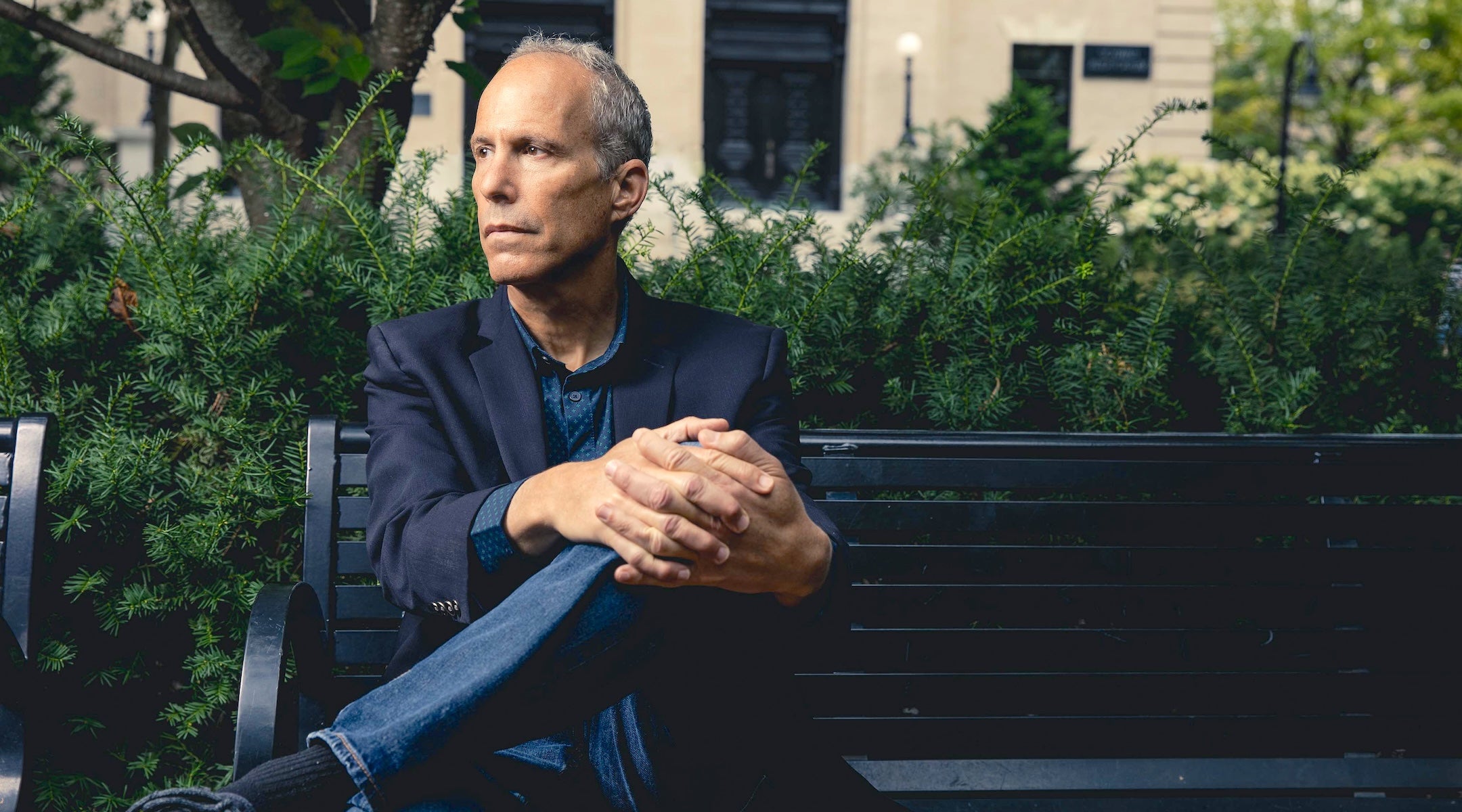
(JTA) — When Boaz Dvir flew from the United States to Israel in late September to screen his new film, “To Kill a Nazi,” he didn’t expect its story to become newly relevant. But just as Dvir arrived, the thwarting of an apparent hijacking of a flydubai flight bound for Israel offered an uncanny echo of the history his film recounts.
The film tells the largely overlooked story of Michel Cojot, a French Jewish Holocaust survivor and Nazi hunter who helped fellow hostages during the Entebbe hostage crisis and later provided intelligence that aided the Israeli rescue mission. For Dvir, the timing was striking.
“As I’m driving around, what do I hear?” he told the Jewish Telegraphic Agency. “Somebody tried to hijack a plane from Dubai to Israel and do a 9/11 type of terrorist attack? And the passengers saved the day? Ordinary guys?
“And of course, people brought it up everywhere I went, because the parallels are uncanny.”
Michel Goldberg was born in Paris in 1938. After the Nazis invaded, his father Joseph Goldberg was captured and sent to Auschwitz, where he was killed. According to his 1982 memoir “Namesake,” Michel was raised in France’s so-called “free zone,” which the Nazis would also occupy starting in 1942, and took his last name from his stepfather after his mother remarried.
Growing up to become a successful banker, Michel teamed with the famed Nazi-hunting couple Beate and Serge Klarsfeld and in 1975, while working in South America, embarked on a plot to find and kill Klaus Barbie, the Gestapo commander who had signed the arrest papers for Cojot’s father, and who was at that point hiding out in Bolivia.

Posing as a journalist, an armed Cojot met the “Butcher of Lyon,” but given the opportunity, Cojot failed to pull the trigger. In his memoir he writes that Barbie instead deserved to live in constant fear of reprisal, and that murder was a “Nazi” solution.
The year after his mission to Bolivia, Cojot and his son were on the fateful Air France flight that, bound from Tel Aviv to France, was hijacked by Palestinian terrorists and West German far-left radicals, with 102 Israelis on board. It led to the standoff at Entebbe International Airport in Uganda and the heroic rescue by Israeli commandos.
During the seven-day crisis, Cojot acted as a translator and go-between among the hijackers and passengers. When the Ugandan dictator Idi Amin spoke to the hostages, Cojot translated his English into French. He was even credited with persuading the lead hijacker, Wilfried Böse, to release the non-Israeli hostages. After his release, Cojot provided information to Mossad, including the layout of where the hostages were being held, which greatly assisted the Operation Thunderbolt rescue mission.
Cojot went on to write a book about Barbie’s crimes, and then testified in Barbie’s war crimes trial in the late 1980s. Barbie was sentenced to life in prison; he died of cancer in 1991. Cojot himself passed away in 1999. While the story of Entebbe is very well-known, Cojot’s role in it has often been left out of such tellings. None of the feature films about the rescue, most recently 2018’s “7 Days in Entebbe,” include him as a major character.
Divir hopes to give the forgotten hero the recognition he deserves. The grandson of Holocaust survivors who was born in Petah Tikva a few weeks after the Six-Day War in 1967, the filmmaker remembers the weeklong Entebbe crisis. He was nine years old then.
“I was like most Israeli kids at the time, outside most of the day and playing,” Dvir said. “But my brother and I, who was a year younger, decided that in solidarity with the hostages, we’re gonna ground ourselves, and so we did for that whole week.”
At the end of the week, he remembers his father waking him up and telling him, “The IDF did it.”
“We knew immediately what he meant, and of course we were thrilled for everybody, the released hostages, the military, but we’re also happy to be able to go outside again,” said Dvir.
While histories of the Entebbe affair omitted the actions of Michel Cojot, another Frenchman, pilot Michel Bacos, has often been recognized as a hero of the affair for having refused to be freed in the first release of the hostages. Most obituaries of Bacos, who died in 2019 at age 95, included this.
In fact, Dvir originally planned to make a documentary about Bacos. However, his research, including an interview with Bacos himself, led Dvir, a journalist and journalism professor at Penn State, to doubt Bacos’ version of the events.
But those former hostages kept mentioning another Michel, a genuine hero. “The story that I knew so well, Operation Thunderbolt, that I grew up with, now suddenly took on a whole new meaning,” Dvir said.

The film includes interviews with all four of Cojot’s children, including his son Olivier, who was with him in Entebbe, along with hostages and experts; Cojot himself appears in archival footage.
Dvir also composed the film’s music, which Penn State musicians perform on the soundtrack.
Dvir worked on the project for nearly a decade, even presenting it publicly as a work in progress as early as 2018.
“This project took a lot longer than most of my projects,” the director said.
A familiar voice narrates the film: Jason Alexander, the Jewish actor best known for “Seinfeld.” Dvir’s manager and business partner is a friend of Alexander’s, who agreed to narrate after viewing a rough cut.
“To Kill a Nazi” premiered at the Dances With Films festival in June. It has also screened at the Nashville Jewish Film Festival and the Croatian International Film Festival, and premiered in New York City on Oct. 16 at Regal Battery Park as part of the Chelsea Film Festival.
It’s also set to play the Austin Film Festival at the Boulder Jewish Film Festival, and the Silicon Valley Jewish Film Festival on Oct. 29; at the Galaxy Theatre in Austin, Texas on Oct. 31; and at the Harrisburg Jewish Film Festival on Nov. 12. Dvir hopes it will be picked up by a streaming service.
Some Jewish and Israeli filmmakers, especially since Oct. 7, have complained that they’ve had difficulty getting their films into festivals.
Dvir said that while “To Kill a Nazi” is “doing very, very well” and has been accepted to film festivals both Jewish and non-Jewish, “it’s been a little more of an effort than I’m used to putting in.”
“I don’t have any proof for it, but my sense is that there are some film festivals to which we submitted that may not have even really watched it or given it a fair shot,” said Dvir, who denounced the apparent boycotts of other films and artists. “At the end of the day, it really doesn’t matter. Because we can only do so many film festivals anyway. I’m very happy with what we got.”
This article originally appeared on JTA.org.
The post From Holocaust survivor to Nazi hunter to Entebbe hero appeared first on The Forward.
Uncategorized
Michigan’s El-Sayed doubles down: Israel ‘not an ally’
(JTA) — Abdul El-Sayed, the Democratic Senate nominee in Michigan, is doubling down on his view that Israel is not a U.S. ally as the Nov. 3 midterm elections draw closer.
El-Sayed, a vocal critic of Israel who faces former Republican Rep. Mike Rogers in one of the country’s most competitive Senate races, told ABC News on Monday that Israel is “not actually our friend.”
“An ally that takes your money to push you into wars you shouldn’t be fighting is not an ally,” said El-Sayed, referencing Israel’s reported lobbying of the United States to enter into a war with Iran.
He compared Israel with a friend who “keeps bumming off [your kid’s] money” and “talks about them behind their back and then gets them into fights with other friends.”
“What would you tell your kid to do with that friend? You’d probably tell them, maybe it’s not actually your friend,” he said.
El-Sayed made similar remarks in an interview with MS NOW on Thursday, saying that “the government of Israel has done nothing but use us” and “has done terrible things with our money.”
He added that he would continue to question whether Israel was an ally regardless of the outcome of Israel’s election on Oct. 27, as Prime Minister Benjamin Netanyahu, who has served as Israel’s leader for most of the past 18 years, seeks another term.
“Netanyahu is one part of it, but the Israeli military has done heinous things, like heinous things, full war crimes, genocide,” said El-Sayed. “So I think we got to just get serious about whether or not we as a country should be subsidizing that government.”
El-Sayed previously affirmed that he does not consider Israel an ally to the United States in his first bitter debate with Rogers on Oct. 8. The candidates will meet for a final debate on Wednesday.
He told MS NOW that he was “committed to the safety and security” of Jewish voters, some of whom have pressured him to moderate his views on Israel. “Now, we may have differences when it comes to Israel, but the things that unite us are a lot bigger,” he said.
This article originally appeared on JTA.org.
The post Michigan’s El-Sayed doubles down: Israel ‘not an ally’ appeared first on The Forward.
