


Uncategorized
After three years in Israel, Reform convert told she can’t make aliyah
When Isabella Vinci stepped out of the mikvah on Nov. 11, 2021, she thought she had done everything that would be required to become Jewish. A beit din, or rabbinic court, had approved her conversion after nearly a year of study with Rabbi Andrue Kahn at Temple Emanu-El, a Reform congregation in New York, including a congregational course and one-on-one meetings.
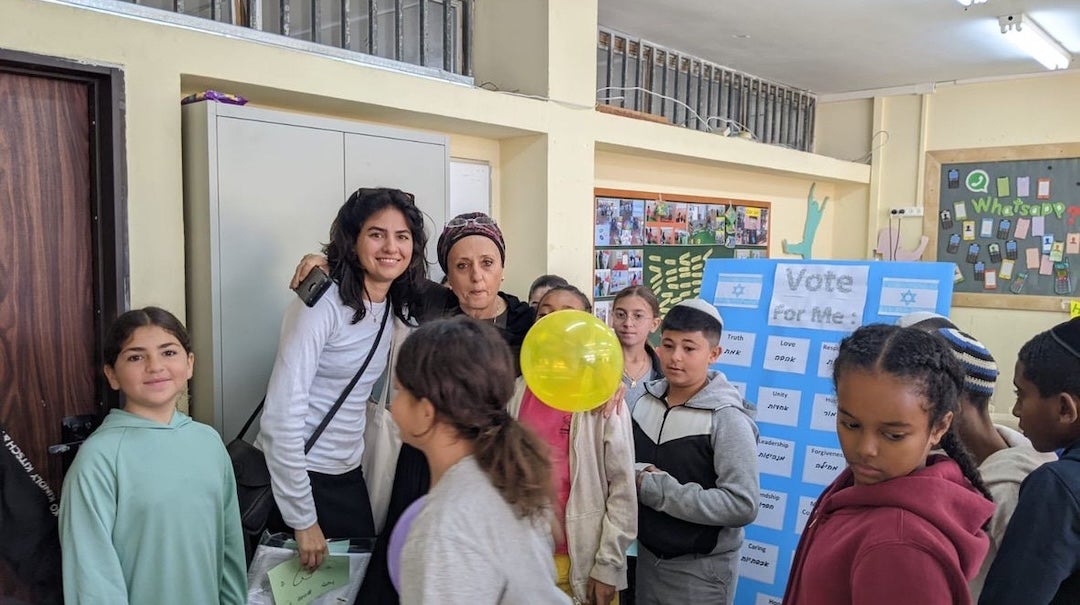
Within a year, she visited Israel on Birthright and returned on an immersion program to teach English in an Orthodox public school in Netanya. Friends, rabbis and colleagues, she said, embraced her as Jewish.
Israel’s Population and Immigration Authority did not.
In a pair of decisions issued in January and again in last month, immigration officials rejected Vinci’s application for aliyah under the Law of Return and then denied her administrative appeal.
The letters point to two main problems: She studied for conversion online during the COVID period, and she did not prove sufficient post-conversion participation in a synagogue community — particularly while living in Israel.
Vinci, 31, had to leave behind the life she had built in Tel Aviv and move back to the United States. She is now preparing a court petition with the Israel Religious Action Center, the legal‐advocacy arm of Reform Judaism in Israel.
For decades, IRAC and other non-Orthodox advocacy groups have complained about attempts by religious parties in Israel to block the recognition of conversions outside of Orthodoxy. But Vinci’s advocates say she was blocked from citizenship despite a Supreme Court ruling from 2005 allowing overseas conversions, regardless of denomination.
Her rejection also reflects a gap between the Diaspora and Israel, they say, in everything from religious practice to the adaptations made necessary by the pandemic.
“The whole world — from rabbis to strangers who hear my story — tells me I am Jewish. They see that I am putting everything on the line to be a part of our people. The only ones telling me that I’m not Jewish are within this government agency,” Vince said in an interview, describing months of silence and what she felt was the government’s unwillingness to consider new supporting documents. “Why aren’t they putting in the work and the effort to actually understand where I’m coming from?”
Vinci grew up Catholic in a sprawling, multicultural family, spending early years in Florida and most of her childhood in Omaha, Neb. She never felt rooted in the church and developed her own spirituality as a teen. Jewish relatives and friends were part of her orbit, and she felt increasingly drawn to the religion.
When she moved to New York as an adult, she decided to become a Jew, going through Temple Emanu-El in Manhattan, one of the most prominent congregations of Reform Judaism.

Temple Emanu-El on the Upper East Side of Manhattan is one of the largest Reform congregations in the world and the oldest in New York. (Courtesy Temple Emanu-El)
Neither the immigration authority nor the Interior Ministry, which oversees it, responded to a request for comment.
But official responses Vinci received show that decisions in her case zero in on whether her path fits internal regulations drawn up in 2014 to vet conversions performed abroad. The Israeli Supreme Court ruled in 2005 that such conversions, regardless of denomination, must be recognized, leaving it to the ministry to set criteria.
Those rules anticipate in-person study anchored in a congregation; if the course is “outside” the congregation, they require a longer, 18-month track. In Vinci’s case, officials treated her 2020-2021 Zoom coursework as external and concluded she hadn’t met the time or community-involvement thresholds.
IRAC’s legal director for new immigrants, attorney Nicole Maor, appealed the initial rejection, sending in a detailed memo. Maor wrote that congregational classes conducted on Zoom during a pandemic should be considered congregational, rather than external. She argued that the criteria’s purpose is to prevent fictitious conversions — not to penalize sincere candidates who followed their synagogue’s rules during COVID.
“The entire purpose of the criteria is to protect against the abuse of the conversion process. A person who converted in 2021, came to Israel on a Masa program to contribute to Israel in 2022-2023, and stayed in Israel to work and support the country in its most difficult hour after Oct. 7 deserves better and more sympathetic treatment,” she wrote.
She also wrote that the ministry had ignored evidence of Vinci’s Jewish communal life in Israel, from school prayer with students to weekly Orthodox Shabbat meals with a host family.
As part of Vinci’s appeal packet, Kahn submitted a letter describing the cadence of Vinci’s studies: roughly five months in Temple Emanu-El’s Intro to Judaism course alongside his own one-on-one meetings beginning Dec. 21, 2020, and continuing “1-3 times a month for 2-3 hours” until her November 2021 conversion — about 11 months in total. He listed key books and practices he assigned and attested to her active participation in synagogue young-adult programming.
A host family in Netanya provided a letter saying Vinci spent “Shabbat with our family every weekend as well as most holidays,” describing a year of Orthodox observance in their home and an ongoing relationship since she moved to Tel Aviv after Masa. The school where she taught also wrote in support.
The ministry was unmoved.
In an interview, Maor, who handles a large caseload of prospective immigrants, said Vinci’s case is emblematic of a larger phenomenon.
“It’s not just bureaucracy,” Maor said. “There’s a recurring theme — a suspicious attitude at the ministry that has become worse in recent years and makes life much more difficult for converts.”
Vinci’s case sits at the fault line between Diaspora practice after COVID and Israeli bureaucracy. Around the world, Reform and Conservative congregations shifted classes, and in some communities, services, to Zoom. Many have retained hybrid models because they work for busy or far-flung learners.
“This reality has led to a widening gap between how Diaspora congregations operate and the demands of the Interior Ministry,” Maor said.
There is also a philosophical mismatch: For the ministry, involvement in the Jewish community post-conversion appears to mean synagogue membership and attendance logs. For non-Orthodox streams, Maor said, Jewish life can be expressed in multiple ways — home ritual, learning circles, social-justice work — especially in Israel, where Jewish rhythms permeate public life.
In Vinci’s Netanya year, that life included like daily school prayer, holidays with an observant host family, and teaching in a religious environment. Maor argues that should count.
Kahn, who says two of his other converts have made aliyah without incident, said he was saddened by Vinci’s rejection given her devotion and the hoops she jumped through to satisfy paperwork and timelines.
“It wasn’t like she was mucking around in Israel, she was really doing the work and legitimately devoted to being Jewish,” he said.
After losing her legal status and appeal, Vinci returned to the United States. She took a legal-assistant job in Kansas City and is scraping together fees to file a court petition.
Maor won’t predict the outcome, but she said often cases settle before a precedent is set. The state agrees to a compromise such as additional months of study, rather than risk a ruling that forces a policy shift.
Vinci hopes the case determines not only where she celebrates the next set of holidays, but also improves how Israel treats a growing cohort of would-be immigrants whose Jewish journeys began on a laptop during a once-in-a-century shutdown and amid rising antisemitism.
“I hope my story sheds light on inter-community love and acceptance,” she said. “In our current political and social climate, the best thing we can do is be united as one.”
—
The post After three years in Israel, Reform convert told she can’t make aliyah appeared first on Jewish Telegraphic Agency.
Uncategorized
They met on a Birthright trip then married. Now this American Israeli couple’s internet fame has turned to infamy.
Ethan and Hila Klein first met at Yad Vashem — Israel’s Holocaust museum — in 2007, a meet-cute they recounted, giggling, years later for their millions of YouTube followers.
“I think I went up to her and said something like, ‘They had it coming, don’t you think?’” said Ethan, known for his edgy humor and infamous internet trends, including Vape Nation and Papa Bless. “No I didn’t say that. I wonder if you would have laughed though.”
They were on a Birthright trip, Ethan an American and Hila an Israeli soldier on leave to join the group. Soon after the trip ended, Ethan moved to Israel to be with Hila, and the two began making videos under the name H3H3 Productions (the H for Hila and the 3 standing in as an E for Ethan). They married, moved to America, and started a popular podcast.
A Jewish love story, until Thursday, when Hila, now mother to their three children, accused Ethan publicly of having a months-long affair.
“The betrayal I feel is immeasurable,” Hila said in an Instagram post. “My only family on this side of the world. How do I even begin to make sense of this?”
Ethan reposted her statement.
Their podcast is run by a handful of crew members who often chime in and participate in various skits and bits. The crew also shared a statement saying they stand with Hila and refuse to work with Ethan, though they added they don’t know what this will mean for the future of the show.
A couple roiled by Oct. 7
The left-leaning, secular couple’s videos and podcasts focused primarily on pop culture, internet drama and general politics, not Jewish or Israeli issues.
Both Ethan and Hila would make statements sometimes when tensions in Israel flared, and they would occasionally speak out against IDF actions that upset them.
In 2021, Ethan started a podcast with political commenter Hasan Piker, a controversial left-wing influencer, called Leftovers, a nod to their leftist politics.
Then came Oct. 7.
Ethan, an American Israeli dual citizen like Hila, was horrified by the attacks but quick to call the IDF genocidal in the aftermath. In their first episode together after Oct. 7, Ethan and Piker said the show would continue through their disagreements. The episode was tense, and it was their last.
As Piker’s rhetoric on Israel intensified and became at times antisemitic, the two began a nasty internet feud, culminating in a nearly five-hour livestreamed debate.
Piker posted about the news of the affair on X, sharing a video of Ethan and expressing disgust for men who cheat.
“Now this is a high caliber man [with] good morals,” Piker said sarcastically. He also posted “Judge me by my enemies” after sharing Hila’s statement.
Hila, who owns a makeup and clothing company, increasingly came under scrutiny by Piker and others after Oct. 7 for her service in the IDF. Artists refused to work with her. One model she hired publicly disavowed her after finding out she was Israeli.
The couple was harassed, sometimes online, sometimes in-person, as they attempted to take what they viewed as a nuanced stance in the aftermath of Hamas’ attack on Israel and the ensuing war in Gaza. The united front seemed to fortify their relationship, as Ethan, ever outspoken, routinely came to his wife’s defense.
Their show lost thousands of subscribers, but loyal fans stuck with them — fans who now say they are gutted and confused by the news of the affair. Many in disbelief noted that Ethan had Hila’s face tattooed on his arm less than two years ago as a surprise for her.
“The greatest thing a man can do for his children is to love their mother,” says the quote surrounding the tattoo.
The Forward attempted to contact the Kleins through their work emails and did not immediately hear back.
The post They met on a Birthright trip then married. Now this American Israeli couple’s internet fame has turned to infamy. appeared first on The Forward.
Uncategorized
These Jewish college students have some ‘nonnegotiables’ for El-Sayed
At the University of Michigan, first-year student Robert Kashan, 18, and sophomore Jacob Reich, 19, sat behind a large blue sign. “Some things are nonnegotiable,” it declared in all caps.
The sign laid out their requirements for any candidate seeking their support: a commitment to Jewish safety, “including for Zionist Jews,” and supporting Jewish statehood in Israel, among other positions.
“Zionism is a legitimate part of the Democratic coalition, and a lot of us are feeling less represented by the Democratic Party,” Kashan told the Forward.
The students are part of a broader “Nonnegotiable” movement in Michigan, a coalition of Jewish Democrats who are spelling out their dealbreakers for candidates ahead of the Senate election between Democratic nominee Abdul El-Sayed and Republican nominee Mike Rogers.
The movement has attracted national attention, with hundreds of rabbis across 34 states signing on to the “Nonnegotiable” demands. Meanwhile, about 20 students at the University of Michigan have publicly signed, while hundreds more offered support anonymously, according to Reich.
The “Nonnegotiable” supporters aren’t saying whom they’ll vote for if their concerns aren’t addressed — or whether they’ll vote at all. But they are pushing back against the assumption that Jewish voters will, as the saying goes, “vote blue no matter who,” urging El-Sayed to engage with their demands if he hopes to earn their support.
That’s in contrast with two other Jewish political camps, including a group called Michigan Jews for Democracy that endorsed El-Sayed. Their petition, which has garnered almost 1,000 signatures, notes that some signatories hold reservations about El-Sayed but are voting for him nonetheless as a check on President Trump.
“We understand that a vote is not a valentine; it’s a strategic chess move,” the petition reads.
A competing petition, dubbed “Michigan Jews Against Extremism,” has drawn hundreds of signatures from Michigan Jews who plan to vote for Rogers. That petition similarly emphasizes that Rogers voters may still have reservations about the candidate: “Our vote for Mike Rogers does not require that we agree with him on every issue or that we support President Trump,” it reads.
“Nonnegotiable,” meanwhile, rejects the idea that Jewish voters would have to choose between Zionist and Democratic values. Some have criticized the nonnegotiable movement for ignoring the reality of the electoral choice at hand. Others have called it “a veiled attempt to excuse the actions of Jewish Democrats who want to feel validated about voting for Mike Rogers.”
But Kashan and Reich, who met at Hillel and plan to major in political science, said the “Nonnegotiable” movement was the only way they could see themselves engaging in the election, as they felt increasingly pulled between their identities as Democrats and as Jews.
Some Michigan Jews have expressed alarm at El-Sayed’s questioning of whether Israel should exist as a Jewish state and his decision to campaign alongside controversial Twitch streamer Hasan Piker, who has been accused of antisemitic rhetoric. Rogers, who Trump has endorsed, earlier this week called El-Sayed “anti-Jew.”
In a letter to Michigan Jews, El-Sayed has vowed to “stand up against antisemitism and take the threat of violence against our Jewish community incredibly seriously.” He has also hired a Jewish liaison in the final weeks leading up to the election.
This will be the first election when Kashan, who just turned 18, is eligible to vote, and Reich’s first national election after voting in a local primary in his hometown of Palo Alto, California. For both, voting Democratic in their first major election had once seemed like a given.
“I’m a Jewish Democrat, and I want Democrats to take the Senate,” Reich said. “I want to vote for a Democrat in my own state.”
They’re still holding out hope that will happen — and that, with less than two weeks until the Nov. 3 election, El-Sayed will sign on to their petition.
And if he doesn’t? Neither student is ready to say.
The post These Jewish college students have some ‘nonnegotiables’ for El-Sayed appeared first on The Forward.
Uncategorized
Does anyone in Jerusalem care what happens to us?
An Israeli think tank has put on paper what most American Jews know in their kishkas: Israel’s actions over there affect our safety here.
So here’s my question: Does anybody over there care?
The report, published by The Institute for National Security Studies (INSS), drew on the input of 20 Jewish leaders from five countries. It concluded that Israel’s actions since the Hamas attack on Oct. 7, 2023 have normalized hostility toward Israel, divided Jewish communities, sapped the political influence of pro-Israel organizations and fueled antisemitism.
Those actions include damaging statements by government officials, limits on humanitarian aid to Gaza at the height of the war, widespread damage to civilian infrastructure in Gaza and unchecked settler violence in the West Bank. The authors also cited as inflammatory “the proliferation of images of civilian death and suffering in Gaza” — though the actual civilian death and suffering has also alienated and enraged many outside Israel, including Jews.
“The conflict is not only over there in the Middle East, it is local all over the Jewish world now, and Diaspora Jewry has skin in the game,” said Theodore Sasson, one of the report’s authors, in an interview with JTA’s Andrew Silow-Carroll, who first wrote about the study.
To be clear, the report doesn’t excuse, exonerate or rationalize people who commit antisemitic acts. “Jews and Israelis are not to blame for antisemitism,” the report states.
“What we’re saying is that Israel is not the cause” of antisemitism, Sasson said, “but enlightened Israeli policy can seek to maintain robust Diaspora support for the state of Israel and can deny the antisemites the material that fuels their mostly spurious claims.”
This is not a novel connection. Three previous academic studies, in Belgium, Australia and the U.S. found statistically significant links between Israeli military operations that result in high Palestinian casualties and spikes in reported antisemitic incidents abroad. Not surprisingly, a Mellman group poll found that 56% of U.S. Jewish voters believe Israel’s policies have fueled antisemitism.
None of this means Israel shouldn’t act in its own interest and put the security needs of its own population first. Antisemites would continue to exist even if Israelis did nothing but play backgammon and sip arak. The report is not about eradicating antisemitism, but about Israeli actions that provoke and endanger Jews abroad — and what Israel can do about those.
I get the principled resistance to a report that seems to shift some of the burden of antisemitism onto the Jews. David Bernstein of the North American Values Institute told Silow-Carroll that American Jews aren’t agents of Israel, and that nobody would say an African country’s actions endanger African Americans. That’s not entirely true — the 9/11 attacks increased hate crimes against American Muslims and bigots targeted random Asian Americans during the COVID-19 pandemic. Pretending actions have no consequence even if the reaction is illegitimate is principled, but naive. If Israel can lower the temperature, it should.
But here’s the sad fact about the current Israeli government: it doesn’t even lower the temperature for its own citizens.
Exhibit A is Oct. 7. This is the government on whose watch that horror happened, and Prime Minister Benjamin Netanyahu has never engaged in a full, independent accounting of what went wrong. How do you prevent future Oct. 7s when you don’t know the weaknesses that enabled it in the first place?
Exhibit B is the flydubai near-disaster, which we in the Diaspora have already mythologized as yet another example of Israeli courage and pluck. It was that, but also a result of a complete breakdown of government responsibility. Israel’s rules should have kept the Omani pilot out of that cockpit, but, as Channel 12 reported, Minister of Transportation Minister Miri Regev took no action despite multiple warnings. Regev, a close ally of Netanyahu, remains in her job.
Finally, Exhibit C: Police under National Security Minister Itamar Ben Gvir have failed to curb violent crime in Israel’s Arab communities which recorded 252 murders in 2025 — and 2026 is on track to surpass that record.
Israel’s supporters often comfort themselves with the mantra that Israelis love life while their enemies love death. But this government has been pretty cavalier about life.
If that’s how Israel’s leaders treat their own citizens, is it so surprising they fail to be overly concerned about Jews abroad? Last year saw the highest death toll from antisemitic attacks in 30 years, while the agency Israel created specifically to deal with such calamities has been AWOL. The Ministry for Diaspora Affairs and Combating Antisemitism, a Tel Aviv University report found, has “not contributed in any meaningful way to the cause, and in some cases has been an embarrassment.”
All this is happening as the screws are tightening on Jewish communities in Australia, France, Italy, Canada and elsewhere. But Israel, established in part to keep Jews safe, has, under this government, too often increased or ignored the dangers. Zionism is supposed to be the Diaspora’s Iron Dome, but this government, by inexorably, deliberately foreclosing on the possibility of a democratic Jewish state, is functionally anti-Zionist.
The report listed several measures Israel could take to reduce the threat to Diaspora communities, among them controlling the incendiary rhetoric of government ministers and opening a diplomatic path with the Palestinians that stops the slide toward a single, non-democratic state.
One of the report’s recommendations is that Israel set up procedures to assess how its policies affect Jews abroad. In other words, the think tank is asking the government to start caring, formally.
It’s hard to imagine any of that happening unless, on Oct. 27, Israelis vote the current government out.
“Netanyahu cannot be part of the healing process. It is Netanyahu from whom we must be healed,” David Horovitz, the far-from-radical founding editor of The Times of Israel, wrote this week in an editorial titled, “For Israel’s Sake, Netanyahu Has to Go.”
As it turns out, it’s for all our sakes.
The post Does anyone in Jerusalem care what happens to us? appeared first on The Forward.
