


Uncategorized
American synagogues are closing at a record rate. This retired judge is rescuing their stained glass windows.
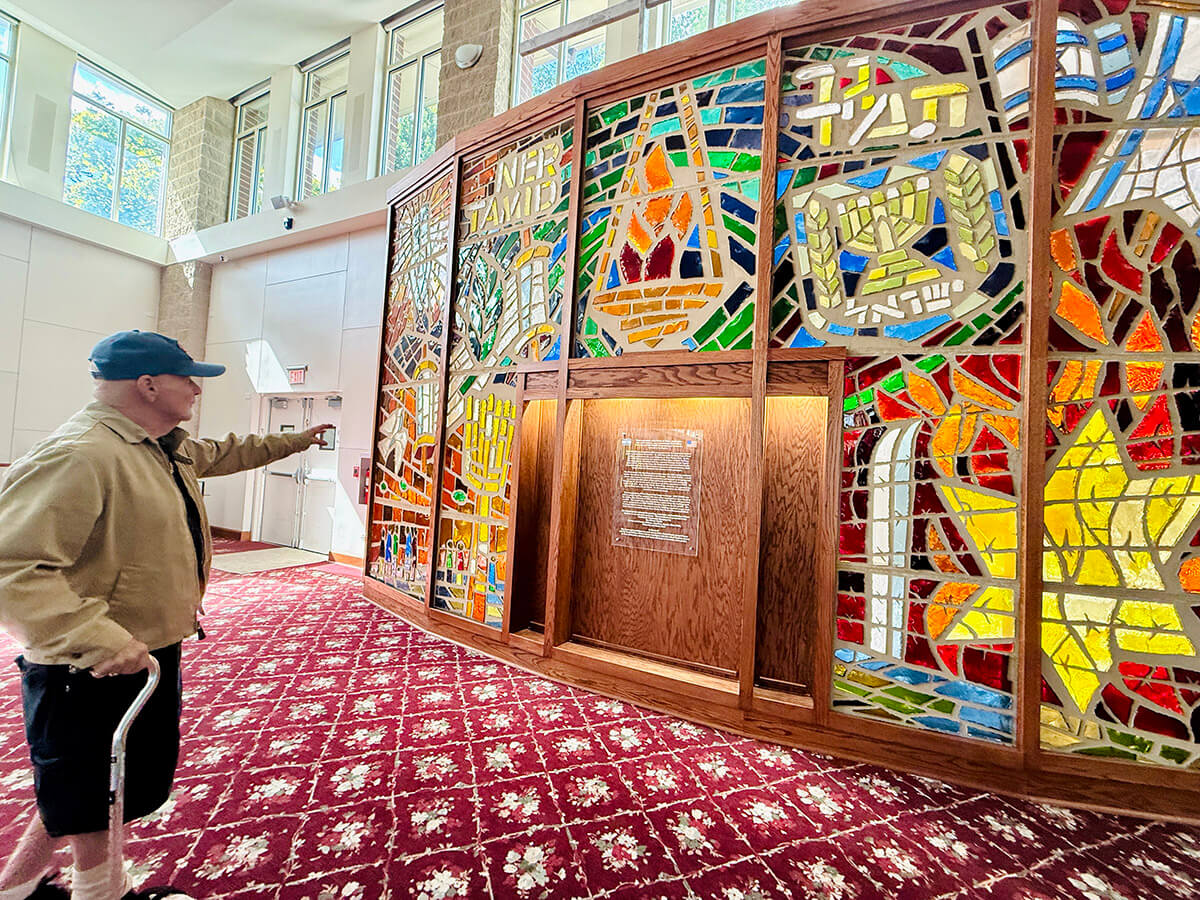
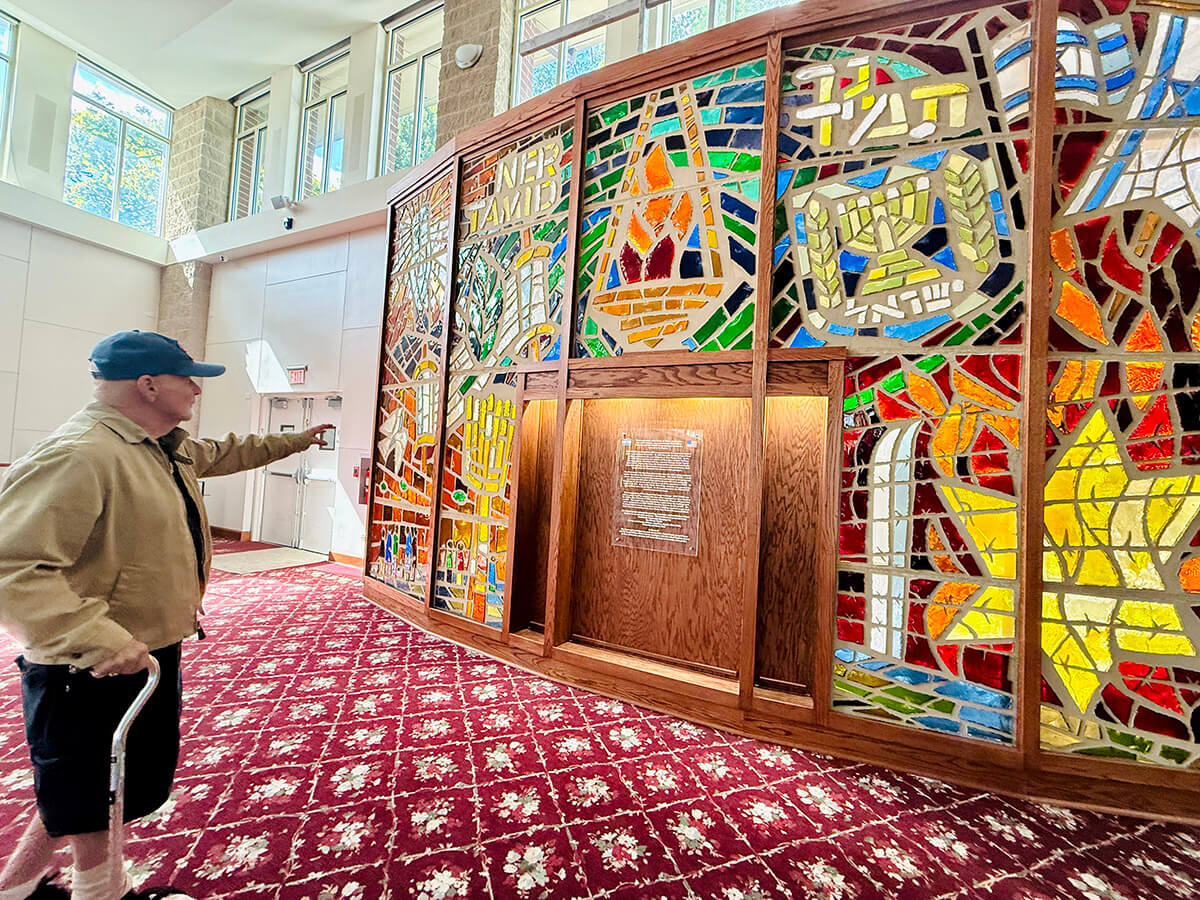
CHICAGO — Jerry Orbach moves through the sanctuary of Northbrook Community Synagogue with the practiced eye of a man who’s spent years rescuing pieces of a fading world. The suburban Chicago congregation glows with stained glass saved from shuttered synagogues, their colors reframed along these walls. What began as one man’s mission has turned the space into a living museum — a collage of light and loss.
A large gold Star of David hangs from a chain around Orbach’s neck, catching the light from the windows he’s saved from seven shuls. At 79, the retired judge has made a second career of rescuing what others have left behind: stained glass from synagogues that have closed, merged, or fallen into disrepair.
He isn’t just saving glass; he’s salvaging light — the one thing that never stops traveling.
Each panel is marked by a small plaque: the name of the congregation, the town it once illuminated, the year it died. When the sun hits them just right, color ripples across the walls like ghosts, a chorus of light still singing long after the voices are gone. “A continuation instead of a destruction,” he says, as if arguing a case.
For more than a century, the number of synagogues in America steadily climbed, a reflection of immigration, assimilation, and Jewish ambition. But by the 1990s, that momentum stalled. In the decades that followed, it reversed. There are roughly 20% fewer synagogues today than there were in 1990, according to data gathered by Alanna E. Cooper, a Jewish Studies professor at Case Western Reserve University. For the first time in American history, more synagogues are closing each year than opening.
The walls of Northbrook Community Synagogue now hold what those closures leave behind: fragments of glass salvaged from sanctuaries across the post-industrial Midwest, where factories shuttered and congregations dwindled. Orbach has become a one-man preservation society.
A history in glass
Stained glass has long been a marker of Jewish arrival in America. When immigrant congregations began erecting monumental synagogues in the early 1900s, they built them with arches, domes, and large window apertures. Glass became the medium of belonging.

In cathedrals, stained glass told the stories of saints. In synagogues, it told the story of survival. Early designs depicted the 12 tribes, the days of creation, the Exodus from Egypt. Later came darker panels, fractured blues and reds evoking the Holocaust, followed by bursts of gold and white celebrating the creation of the State of Israel. Across a century of Jewish life, the art evolved into a visual Torah of endurance.
The factories closed. The congregations scattered. But the windows remain: fragile, luminous, still looking for a home.
Orbach leads me into a small elevator, one hand steadying his cane as the doors close. “You’re gonna like this,” he says, as the bell dings and the elevator jolts to a stop.
The basement sprawls beneath the entire building, a hidden warren of storage rooms and concrete corridors. One room is a large gym. Another section is soon to become indoor pickleball courts. But in a far corner, the scene could be straight out of an Indiana Jones movie. This is where Orbach has built something else: a warehouse of memory.
Wooden crates line the walls, some open, others nailed shut. Inside are stained-glass windows that have yet to find a new home — towering panels from Beth Achim synagogue in Southfield, Michigan, each thirteen feet tall and three feet wide. For now, they rest here, waiting for wherever their journey next takes them, like the vessels of a traveling tabernacle.
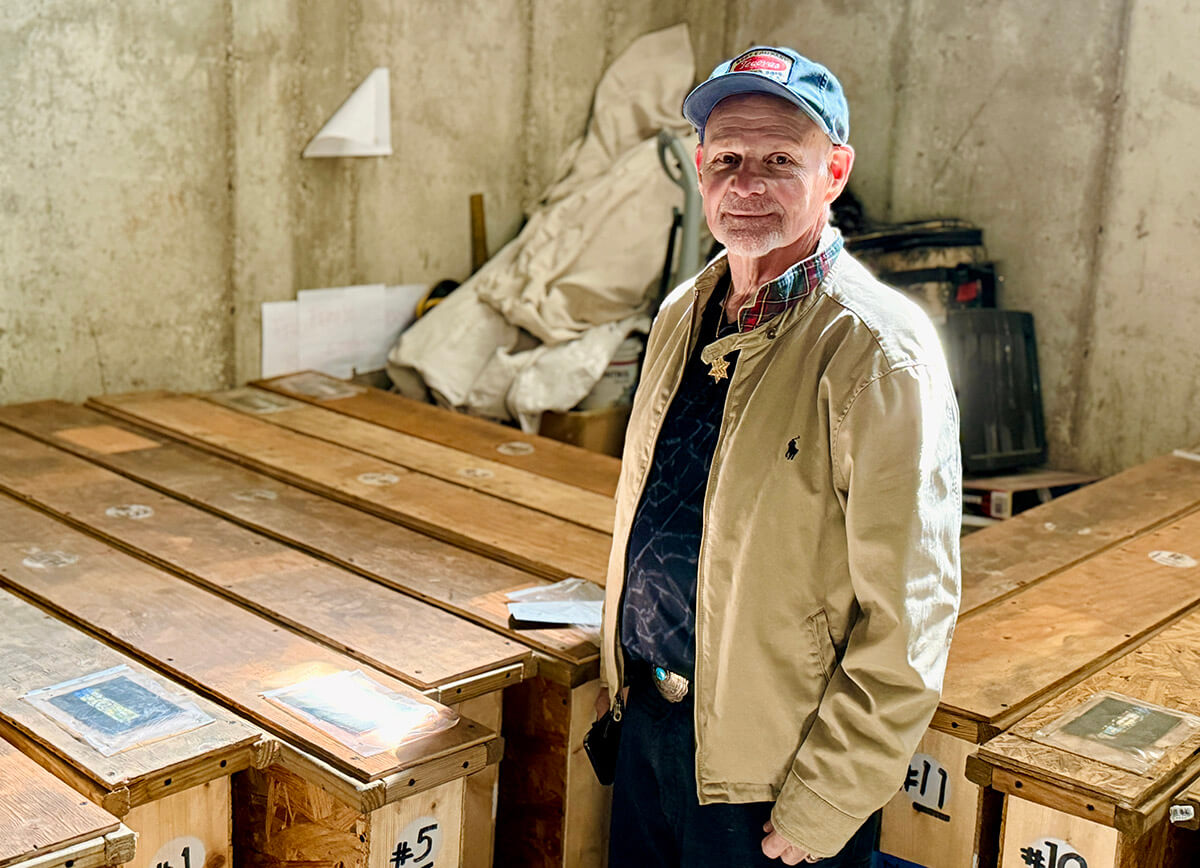
Orbach lifts his phone, flicking on the flashlight. Dust drifts through the beam. The air smells faintly metallic, like old pews and time. He runs the light along the edge of a crate, tracing the outline of a hidden window.
“I just got these in two weeks ago,” he says, like a shopkeeper showing off new stock. “Seven for the holidays, seven for the days of creation. They’re gorgeous.”
He steps closer to a crate, resting his hand on the wood as if on a headstone. This, he said, is how memory becomes a kind of faith.
The case for light
A son of Chicago, Orbach was born in Humboldt Park to parents who fled pogroms in Eastern Europe — his mother from Ukraine, his father from Poland. When he was eight, the family moved north to Albany Park, then a humming center of Jewish life. He’s stayed close to the city ever since: studying law at Loyola, serving as a prosecutor and alderman, and later, in 1988, taking the bench in Cook County. In time he rose to head the court’s law division in District Two, a job that taught him to listen before ruling. He retired two decades ago, though he now mediates and arbitrates cases — a judge, it seems, never entirely off duty.
A few of Orbach’s earliest rescues were the panels from his childhood synagogue in Albany Park. They once illuminated the sanctuary where he became bar mitzvah, where he was married, where his parents once prayed. Reinstalled now in Northbrook, they’ve since framed his grandchildren’s baby namings. “They sold the building to a church,” he said. “I couldn’t stand the idea of those windows ending up in a dumpster.”

Something shifted. He started calling contractors, preservationists — anyone with a ladder and a conscience. Soon he was showing up at demolition sites, paying crews out of pocket to let him climb the scaffolding and pry the glass from the walls. Once, at Mikro Kadosh Anshei Ticktin, an old Chicago congregation, he and his crew worked through the night, prying the stained glass from the front while a bulldozer tore into the back of the building. “By the end, there was one wall left,” he said. “It was shaking while we got the last window out.”
He talks about the windows the way some people talk about those who once prayed beneath them, as if they still have a pulse. “If you keep the memory of the shuls alive,” he said, “the people in them are alive too.”
From ruin to renewal
Among Orbach’s most prized rescues are a set of stained-glass windows from Saginaw, Michigan — luminous panels manufactured in France and salvaged just before their synagogue was torn down. He brought them to Northbrook several years ago, giving their light a second life.
A few months after Orbach installed the Saginaw windows, Cooper — the scholar who tracks synagogue closures and the fate of their sacred objects — flew in from Cleveland to see them. She’d been studying what happens to the sacred items left behind when synagogues close: Torah scrolls, yahrzeit plaques, arks, pews, memorial lights. But the stained glass, she said, posed the hardest questions.
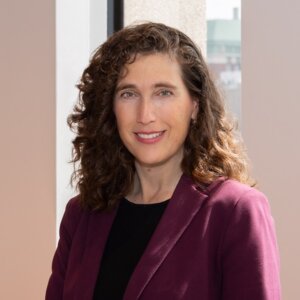
Stained-glass windows don’t have a sacred status like a Torah scroll or even the building itself. They carry a different kind of holiness. “I’ve heard many congregations describe their windows as the soul of their congregation,” Cooper said.
She found in Orbach what her fieldwork had only theorized. “He’s creating an afterlife for these windows,” she said at a dedication ceremony at Northbrook, where they both spoke.
Standing before the crowd that day, Cooper described the scene she’d witnessed when windows were removed from Ahavath Israel in Kingston, New York, which Orbach also rescued and relocated to Northbrook. Cooper recalled workmen carrying the panels to their crates as the last members of the congregation looked on. “As they lowered the windows into the boxes,” she said, “it felt like a burial.”
Now she gestured toward the sanctuary, the glass alive with color once more. “And this,” she said, “is the afterlife.”
In his own sanctuary
Orbach has one more thing to show me, in his two-story home on a quiet suburban street. Rusty, his six-year-old rescue mutt, bounds to the door. His wife, Noreen, waves from the hallway.
The foyer is lined with photos of his two daughters and their families. Hanging above the entryway are two stained-glass windows he salvaged years ago from a shuttered synagogue in Lakeview, Illinois, where he used to go for minyan. The site is now condos.
“In my own way, this is how I keep those shuls alive,” he says, glancing up at the glass.
The post American synagogues are closing at a record rate. This retired judge is rescuing their stained glass windows. appeared first on The Forward.
Uncategorized
Somerville councilors to discuss Israel divestment proposal
(JTA) — SOMERVILLE, Mass. — The issue of divestment from Israel returns to the Somerville City Council in Massachusetts on Tuesday night as lawmakers plan to discuss how to implement a nonbinding ballot question on the matter that passed last year.
The divestment push has divided the city of more than 84,000 residents, which has a long-standing Jewish population. It is located between Cambridge, home to Harvard University, and Medford, a city with which it shares the Tufts University campus.
After Question 3 passed with 55.7% of the residents’ vote in November 2025, the City Council that same month passed a resolution committing to work toward an ordinance within a year to enact the ballot’s goals.
The measure to that effect, introduced in June, would bar the city from investing in or procuring labor, services or goods from companies that support entities identified by the ordinance as violating international law, including Israel.
Unlike the divestment proposal awaiting a November ballot vote in Providence or the binding human rights divestment ordinance passed by Medford’s city council in 2025, the Somerville ordinance specifically mentions Israel and Palestine.
In response to the push for a binding ordinance, 74 registered voters in Somerville submitted a petition for a hearing, which was held in September, before final action is taken, citing concerns about its impact on the city. The issue has now moved to the city’s Legislative Matters Committee, which is meeting Tuesday night.
Among the groups opposing divestment is Shalom Somerville, which submitted the September petition stating that “the sense of belonging and safety experienced by Jewish, Israeli and other residents of diverse backgrounds” is at risk as a result of the ordinance.
Sam Gechter, co-founder and president of Shalom Somerville, said that the ordinance singles out Jews who support Israel, which makes it antisemitic. Deputy City Solicitor David Shapiro also advised in November 2024 that such an ordinance would be “likely invalid,” according to a letter from the Anti-Defamation League and the Louis D. Brandeis Center for Human Rights Under Law.
“I think it’s incredibly irresponsible,” Gechter said, suggesting that the ordinance would slow down governmental action. “But the biggest thing for me is that it makes Jews feel unwelcome in Somerville.”
A local organization, Somerville for Palestine (S4P), has been a driving force behind both the ballot question and the ordinance, which the group developed in collaboration with sponsoring city councilors Ben Ewen-Campen, Ben Wheeler, Wilfred N. Mbah and Jon Link. “It’s what people voted for,” said Mo Katz-Christy, a member of S4P’s leadership and Jewish Caucus. “We want to follow the will of the people.”
The ADL issued a statement condemning the ordinance in June. It also joined the Brandeis Center in issuing a letter calling the proposal an unconstitutional intrusion into foreign affairs.
Other Jewish organizations disagree. Jewish Voice for Peace Boston has worked closely with S4P to back the measures. “I don’t think that those objections have validity,” said Eli Gerzon, a longtime member of JVP. “As a Jewish organization, we are especially concerned that ‘never again’ really means what it says: never again, that we never let a Holocaust, a genocide happen.”
This article originally appeared on JTA.org.
The post Somerville councilors to discuss Israel divestment proposal appeared first on The Forward.
Uncategorized
A major Jewish museum hopes to join the Smithsonian – at a difficult moment for the storied institution
(JTA) — Philadelphia’s Weitzman National Museum of American Jewish History is moving closer to becoming part of the Smithsonian Institution at a moment of significant upheaval for the storied museum network.
A new congressional commission will study whether to make the museum part of the Smithsonian. Its members were sworn in Tuesday, when they also held their first meeting.
In an exclusive interview with the Jewish Telegraphic Agency, the commission’s new chair Philip Darivoff, a former longtime chair of the Weitzman, and vice chair Dara Horn, a New York Times bestselling author, said that the Weitzman joining the Smithsonian would send a powerful message that Jews are a crucial component of the history of the country.
“It’s a different statement that our country makes when it says that the study of Jewish American history and culture is important to this nation,” Darivoff said. Both he and Horn also hope that a boost in the Weitzman’s profile could combat what they called an “epidemic of ignorance” among Americans when it comes to knowledge of Jewish history and culture.
“This really would be an elevation of the Jewish community,” Horn, author of “People Love Dead Jews” and “The Final Solution to the Jewish Question,” told JTA. “The place that Jews show up in a school curriculum is typically more about the Holocaust” — an area that the author has written critically about in the past as too limiting a view of Jewish life.
Horn believes in the Weitzman project, she said, because she hopes to emphasize the ways that Jews have contributed to American founding ideals such as religious pluralism.
“I’m really interested in the connections between the Jewish story and a lot of our foundational ideas in this country,” she said. Jewish ideas such as the Exodus from Egypt in the Passover story “were inspiring to Americans,” she added.
The wheels for the Weitzman joining the Smithsonian began turning in 2024, when Congress passed legislation in 2024, then signed by President Biden, to establish the commission. The group spent the next two years putting the commission together, and has two years from its first meeting to research and publish a report on the feasibility of such a move — though Darivoff said he hopes to finish the work well before the deadline.
Adding a new member to the Smithsonian has been known to take years, if not decades. The two most recent additions, the National Museum of the American Latino and the American Women’s History Museum, were both long in the works.
Founded in 1976, the Weitzman is already an existing, fully functioning institution — and also already a Smithsonian affiliate, meaning it can share resources with other museums in the system. Unlike a museum being built from scratch, the Weitzman already has a building and collection, which proponents hope could speed the process.”
Dan Tadmor, the Weitzman’s CEO, told JTA that joining the Smithsonian would improve their educational mission.
“We have a national footprint for our educational programming, but of course we’d like to widen it,” he said. “Who would say no to a curriculum that’s been developed by a Smithsonian museum?”
The Weitzman’s bid for increased prominence within the Smithsonian comes as the Trump administration has sought to exert greater control over the latter — home to such storied institutions as the National Museum of American History, the National Portrait Gallery and the National Zoo.
This summer the White House issued a report alleging “radical ideology” in the museums’ content, and Interior Secretary Doug Burgum recently announced plans for signs accusing Smithsonian leaders of ideological bias. Observers say such signs are indicative of larger administration priorities opposing the teaching of historical subjects such as slavery. Smithsonian Secretary Lonnie Bunch III is stepping down at the end of the year.
A representative from the Smithsonian declined to comment to JTA on the Weitzman’s bid, or on its current political conditions.
The commission’s chair and vice chair of the new Weitzman said that the current political upheaval shouldn’t affect their work. The Smithsonian, Horn said, “has lasted through many political winds.”
“I think we see this as a long-term project that’s about the place of Jewish Americans in this country’s history,” Darivoff said. “The Smithsonian is a really important institution for this country, and it is the great museum complex of our nation. God willing, it will be flourishing for centuries to come. It’d be an honor to be included in the Smithsonian.”
This article originally appeared on JTA.org.
The post A major Jewish museum hopes to join the Smithsonian – at a difficult moment for the storied institution appeared first on The Forward.
Uncategorized
Two deaths in Manchester synagogue attack last year will be probed through public inquiry, Britain says
(JTA) — The deaths of two Jewish men in an attack on a synagogue in Manchester last year will be examined through a public inquiry, the British home secretary announced on Monday, a necessary step to include sensitive information in the investigation.
Melvin Cravitz and Adrian Daulby were killed during the attack on Yom Kippur on Oct. 2, 2025, when Jihad Al-Shamie rammed a car into a group of worshippers outside the Heaton Park Hebrew Congregation in Manchester and stabbed two people. Cravitz died from stab wounds and another man, Andrew Franks, was seriously injured but survived. Daulby was shot by police while blocking the synagogue doors to stop Al-Shamie from entering. Two other people were seriously injured.
Al-Shamie, a Syrian-born British citizen, said he was acting for the Islamic State, also known as ISIS, before police shot him dead.
Home Secretary Shabana Mahmood announced the public inquiry in a statement about national security at the House of Commons, saying that “what happened that day must be fully understood.”
“This will ensure that all evidence can be heard, including any sensitive national security material that could not otherwise be fully heard in the coroner’s court,” said Mahmood.
Judge Alexia Durran, the chief coroner of England and Wales, was overseeing inquests into the deaths of Cravitz and Daulby. Durran last month recommended that Mahmood convert the inquests into a public inquiry, following statements from Home Office lawyers that some information from MI5 would be withheld from open court due to national security concerns. A full investigation that involves hearing sensitive material in private requires a public inquiry.
Earlier this year, Greater Manchester Police’s chief constable Stephen Watson said he was “deeply sorry” for a “missed opportunity” to uncover the plot against the Heaton Park synagogue. Watson made the apology after prosecutors revealed that Al-Shamie had two prior arrests for allegedly breaching a non-molestation order and alleged rape, and his mobile devices were not examined until after the synagogue attack.
Mahmood listed “a series of attacks on our Jewish community” in the year since the synagogue attack, including the stabbing of two Jewish men in the London neighborhood of Golders Green, a spate of arson attacks and a “foiled but potentially lethal plot” against Jews in Manchester on the eve of Yom Kippur last month. In the last case, two Iranian men have been charged with terrorism offenses.
“Faced with the threat posed to our Jewish community, we have increased funding to the police by an additional £250 million to boost police presence in key Jewish areas and to tackle antisemitism on our streets,” said Mahmood.
She added, “I know we cannot simply build higher walls around our Jewish community and expect them to live in fear. So we must root out the evil of antisemitism wherever it lurks in society, and this government is committed to that effort.”
Mahmood’s announcement comes days after the Home Office released data showing that hate crimes against Jewish people in England and Wales rose 10% in the year ending in March.
Mahmood said the United Kingdom was aware that “the Iranian state is targeting our Jewish community,” adding that the threat posed to Jews demonstrated “how the lines are increasingly blurring between extremism and state threats.”
The post Two deaths in Manchester synagogue attack last year will be probed through public inquiry, Britain says appeared first on The Forward.
