


Uncategorized
Andrea Weiss, trailblazing Reform rabbi who merged scholarship and activism, dies at 60
(JTA) — Rabbi Andrea Weiss, a former provost of Hebrew Union College-Jewish Institute of Religion who made history as the first woman to ordain rabbis in the Reform movement, has died.
Weiss died on Tuesday surrounded by family at her home in Lower Merion, Pennsylvania, following a year-long battle with cancer. She was 60.
“Andrea brought lev shalem — a whole heart to everything she did,” Cantor Jill Abramson, HUC’s interim head of seminary and director of its Debbie Friedman School of Sacred Music, said in a statement. “Whether in a classroom or a hallway discussion, she has always been a model of what it means to live a life guided by scholarship and sacred purpose. We will miss her presence in these halls and hold her family in our prayers.”
Weiss’ death strikes another blow for the leadership of the Reform movement, which has also buried two leaders of HUC who died prematurely while Weiss worked there — Rabbi Aaron Panken, then the seminary’s president, in 2018, and Rabbi David Ellenson, its past president, in 2023. The school of sacred music, meanwhile, is named for another luminary of the movement who died prematurely at 59 in 2011.
Born on Sept. 9, 1965, Weiss was raised in San Diego where her family belonged to Temple Emanu-El. In 1987, Weiss received her bachelor’s degree from the University of California, Berkeley, and was ordained as a rabbi at HUC in 1993.
Weiss joined the HUC faculty in 2000 alongside Rabbi Lisa Grant, who served as the director of the school’s rabbinical program.
“There was actually four of us, four women, who started at the same time, and we really changed the whole gender balance of the faculty, which was very exciting and thinking about, long term potential of what that would mean for the culture of the school,” Grant told the Jewish Telegraphic Agency.
During her tenure at the school, Weiss led multiple initiatives including a curricular redesign, the launch of the Virtual Pathway for Rabbinical students and the creation of the Seminary Hebrew Program.
Weiss taught several courses at the school, including “The Poetry and Power of the Psalms,” “Literary Artistry of the Bible” and “Teaching Bible to Adult Learners,” a course she co-taught with Grant beginning in 2003.
“Rabbi Weiss has been a transformative presence at Hebrew Union College for more than two decades,” said the school’s current president, Andrew Rehfeld, in a statement. “Her scholarship, vision, and fierce commitment to the formation of Jewish clergy have shaped this institution in ways that will endure for generations. We are grateful beyond measure for her service and hold her and her loved ones in our hearts.”
Weiss received her PhD from the University of Pennsylvania in 2004, where her research centered on metaphor and biblical poetry, scholarship that informed her later work including her 2006 book, “Figurative Language in Biblical Prose Narrative: Metaphor in the Book of Samuel.”
In 2008, Weiss won the National Jewish Book Awards Book of the Year as the associate editor of “The Torah: A Women’s Commentary,” the first comprehensive collection of Torah commentary written entirely by female scholars. Sen. Elissa Slotkin chose the text to be sworn in on last year.
In 2016 and 2020, Weiss led a nonpartisan, interfaith initiative titled “American Values, Religious Voices” that brought together 100 faith leaders to write letters to former President Joe Biden and President Donald Trump as well as Congress during the first 100 days of their administrations. The letters were later published as two books.
Weiss described the initiative at the time as “a national, nonpartisan campaign created from the conviction that scholars who study and teach our diverse religious traditions have something important to say about our shared American values.”
Grant said Weiss offered a model of Jewish engagement that was validated by the ancient rabbis.
“There’s a great Talmudic debate about which is more important, which is greater, study or action, and the rabbis have this back and forth about it, and in the end, they conclude study because it leads to action,” Grant said. “She certainly lived that, that her study and her teaching led her to be an activist as well.”
In 2018, Weiss was appointed as HUC’s provost, becoming the first female rabbi to ordain rabbis in the Reform movement.
Grant said the honor was “extraordinarily meaningful and very heavy” for Weiss.
“She would make the time every year to meet individually for an hour with every single student, to hear about their story, their journey, their learning,” said Grant. “And she would craft that into a short blessing upon ordination.”
As news of Weiss’ death spread on Tuesday, many of her former students and rabbis whom she ordained eulogized her on social media.
“Rabbi Andrea Weiss helped me to grasp and appreciate biblical poetry in a way that nobody else could,” wrote Evan Schultz, the senior rabbi of Congregation B’nai Israel in Bridgeport, Connecticut, in a post on Facebook. “Her wisdom helped shape me as a rabbi and a writer. She was brilliant, kind, and genuine.”
Rabbi Binyamin Minich, the leader of Kehilat Daniel in Tel Aviv, recalled in a post on Facebook being a part of Weiss’ first ordination cohort.
“I remember this feeling of awe, understanding that our 2019 cohort of Israeli Rabbinical Program alumni would be the first ordained by a woman,” wrote Minich. “That meant the idea of women being rabbis settled fully in the Jewish contemporary life and ascended to a next level. It was the real proof of [lalmud velelemed leshmor vela’ashot] – ‘to study and to teach, to preserve and to act.’”
Rabbi Shira Koch Epstein, the executive director of Atra: Center for Rabbinic Innovation, recalled connecting with Weiss in 2019 in Jerusalem and hearing about a bar mitzvah project Weiss had helped organize for her son. The project brought his baseball team to Cuba, where they donated equipment and met with locals.
“It was a big project that they did that was really inspirational; it inspired my son, Ami, to do a baseball-related mitzvah project for his bar mitzvah,” said Epstein. “Definitely not as ambitious as theirs, but Rabbi Weiss really taught me both Torah and the living Torah, of how to turn what you care about and your interests into tzedakah and action in the world.”
Weiss is survived by her husband Alan; her two children, Rebecca and Ilan; her father, Marty; her siblings, Mitch, Laura and Roger; her sister-in-law Catherine; and her nieces, nephews and cousins.
The post Andrea Weiss, trailblazing Reform rabbi who merged scholarship and activism, dies at 60 appeared first on The Forward.
Uncategorized
Germany couldn’t stop Hitler’s election tactics; can America stop Trump’s?
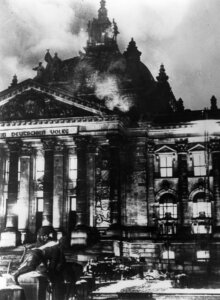
Herding political opponents into prisons and concentration camps, suspending civil liberties, and sending SA thugs to destroy newsrooms and beat up journalists were among the means used by Adolf Hitler to game Germany’s parliamentary election of March 5, 1933, won by the Nazis.
As much as Donald Trump might fantasize about deploying such brutal tactics to subvert our midterm elections, he hasn’t done so — yet. But his objective is the same: Detonate constitutional barriers standing in the way of his lust for power. “Cheat like hell,” Trump told the GOP’s midterm convention last month.
Historian Timothy Ryback has just published a book about the last gasps of the Weimar Republic, titled 53 Days: How Hitler Dismantled A Democracy. The 53 days begin when Hitler becomes chancellor on Jan. 30, 1933, and end with the Reichstag’s March 23 passage of the Enabling Act, which gave him absolute power.
For our own perilous time, there is another number to take note of: 652 — the number of days between Trump’s second inauguration and our Nov. 3 midterm elections.
Hitler’s long march to despotic power occurred over 3,422 days — from his failed Beer Hall Putsch on Nov. 8-9, 1923, up until passage of the Enabling Act.

After spending less than a year of a five-year sentence for the failed 1923 coup, Hitler returned to a Nazi party that was in utter disarray. But the Great Depression turned the Nazis’ fortunes around, as jobless and disaffected Germans flocked to Hitler with his promises to make Germany great again. In parliamentary elections in 1930, the number of Reichstag seats held by the Nazis rose dramatically from 12 to 107, and more than doubled that in elections in 1932, making them the largest party. After some backroom political wheeling and dealing, President Paul von Hindenburg offered the chancellorship to Hitler, which he accepted on Jan. 30, 1933.
Even though Hitler was chancellor, his coalition wasn’t dominated by Nazis. When the Reichstag went up in flames on Feb. 27, 1933, der Führer had the pretext he needed to begin dismantling the last remnants of democracy. The Nazis’ first targets were Communists. More than 4,000 were arrested in the initial hours after the fire. It didn’t take long for Social Democrats, trade unionists and Jews to also face raids, arrests, beatings and terror, as Hindenburg — at Hitler’s urging — issued a decree that suspended Germans’ civil liberties.
There was still a barrier standing in Hitler’s way: the Reichstag. But Hitler had a scheme for getting rid of it: calling for a new election and ultimately engineering a vote by the Reichstag to abolish itself.
In the days and nights before the national election, set for March 5, Nazis carried out a campaign of repression and menace across the country. Brandishing firearms, storm troopers ruled the streets. Homes of Hitler critics were raided. His campaign speeches were blasted from loudspeakers. Voters were offered rides to the polls in transports organized by the Nazis, an unsubtle hint at which party they should vote for.
In the election, the Nazis and their Nationalist allies won a majority of seats in the Reichstag but fell short of the two-thirds needed to amend the constitution. But Hitler had a workaround: Convene the Reichstag to vote on a measure that would allow him to declare laws without the approval of the federal legislative body. With Communist delegates of the Reichstag either in hiding or in custody, Hitler already had a structural advantage; they wouldn’t be there to vote. With the Reichstag building destroyed, the delegates convened on March 23 inside the Kroll Opera House, which swarmed with armed storm troopers and members of the SS who harassed and threatened delegates who were either on the fence about giving Hitler absolute power or were known to oppose it.
In the end, weeks and months of trying to tilt elections through terror and intimidation gave Hitler his ultimate prize: of 538 delegates in the Kroll Opera House, only 94 — all Social Democrats — voted against the Enabling Act. In effect, German democracy was steered by Hitler into committing suicide.
In an essay for Literary Hub, Timothy Ryback noted parallels between Hitler’s election victory on March 5, 1933 and our midterm elections and cataloged them.
They include Trump’s “brazen attempt to quash negative press coverage” and Hitler’s and Trump’s virtually identical pre-election low approval ratings. Both the Nazi leader and the American president had gone to court to try to have earlier election results overturned, and the German election, like our fast-approaching midterms, was seen as a referendum on the nation’s leader.
“Amidst all the turmoil, everyone understood that the March 5 election was a make-or-break moment not only for the Hitler chancellorship but for democracy itself,” Ryback wrote.
With the midterms just around the corner, this can be said about America as well.
Since Trump’s second inauguration on Jan. 20, 2025, he has thrown more effort into trying to rig the midterms for the Republicans than into virtually any other endeavor — other than perhaps misusing his powers to enrich himself and his family, and dreaming up monuments to himself.
Trump’s pardon of 1,500 insurrectionists who stormed the capitol on Jan. 6 was an early signal that the defeated president had no intention of playing fair during the 2026 midterms. What followed was a barrage of assaults on the election system. Here’s just a partial list: lawsuits demanding sensitive voter data, the gutting of oversight bodies, intimidation of election officials and orders for key GOP-led states to redraw their congressional districts — all designed to both undermine Americans’ trust in the election system and manufacture pretexts for contesting any midterm outcomes that displease him.
Amid these relentless attempts to subvert the midterms, the Democrats have had success at blocking some of Trump’s poisoned salvos, such as holding the line against the so-called SAVE America Act and fending off Trump’s attempts to seize voter information. But none of this deters Trump, who just comes back with more schemes. The latest revelations come from documents obtained by Democracy Forward, a legal advocacy organization.
Those documents show that “U.S. Immigration and Customs Enforcement (ICE) collected tens of millions of voter records, explored undercover investigations against voter registration groups and considered feeding state election data into a system used to locate people for deportation as part of a sweeping federal effort to find alleged voter fraud ahead of the 2026 midterms,” according to Democracy Docket, which reviewed the documents.
“This is an absolute smoking gun,” said Democracy Docket founder Marc Elias.
Trump has openly suggested a federal takeover of election administration, and during the past several months it seems like he’s been laying the groundwork for that to happen if he doesn’t get the results he wants on Nov. 3. It’s all too easy to imagine horror scenarios: Trump claims massive voter fraud, his supporters storm county election offices in protest, the FBI seizes ballots and voting machines, unrest erupts across the country, Trump declares martial law.
If Trump’s schemes trigger the kind of disorder he appears to be preparing for, the question will be whether our courts, our press, our civil servants and our voters stand firm. Germany’s institutions bent until they broke. Ours have bent, but they have not yet snapped. What happens next will reveal whether they still possess the steel that Germany’s lacked.
The post Germany couldn’t stop Hitler’s election tactics; can America stop Trump’s? appeared first on The Forward.
Uncategorized
Sally Rooney’s publisher stops selling her books in Britain, citing ban on pro-Palestinian group she backs
(JTA) — Sally Rooney’s publisher says it will stop supplying her books in the United Kingdom because current legislation prevents it from passing her earnings on to her.
The best-selling Irish writer, whose work includes the novel “Normal People,” which was adapted into a hit BBC drama, has long been a vocal supporter of the Palestinian cause.
Faber said it would no longer supply her books in the United Kingdom because of her backing for Palestine Action, a group that the British government last year proscribed as a terrorist organization, saying it had “orchestrated a nationwide campaign of direct criminal action against businesses and institutions.”
“Current legislation in the UK has led to circumstances where Faber cannot pass on UK earnings to Sally Rooney for her work,” the publisher said.
“To sell a writer’s work and not be able to pass on earnings is an unconscionable situation for a publisher,” it said. “As such, and in full agreement with Sally, we have taken the decision that we can no longer supply her works in the UK in any format. We remain the proud publisher of her remarkable body of work, which we will continue to sell in other territories.”
Faber had no further comment, the statement said.
Yvette Cooper, then the Home Secretary, banned Palestine Action last year following an attack by the group on the Royal Air Force base at Brize Norton which caused millions of pounds of damage. It had previously targeted businesses and premises which it said were linked to Israeli defence companies.
Soon after the announcement, Rooney wrote an opinion piece in the Irish Times in which she doubled down on her support for Palestine Action, adding that she would give the proceeds of her books to back the group. “If this makes me a ‘supporter of terror’ under British law, so be it,” she wrote.
In a statement following the action announced by Faber, Rooney cited her Irish Times opinion piece as she explained that the publication of her books “could now constitute a serious criminal offence.”
The ban of Palestine Action has proven to be highly contentious in Britain. Back in February, the group’s co-founder Huda Ammori challenged the move in the High Court, with Rooney providing a supportive witness statement. She said at the time that she was “almost certain” her work would be dropped in Britain if the ban persisted.
The court ruled in Ammori’s favor, but that decision was overturned by the Court of Appeal in June. The Supreme Court is due to hear an appeal next month.
Rooney said on Wednesday: “After a process of consultation and deliberation, and with my full agreement, my publisher Faber has therefore determined that it can no longer supply my work within the UK.
“I have made every effort to be honest with the public about my beliefs and intentions, and I am wholly prepared to accept the consequences.”
Rooney’s support for the Palestinian cause predates the attack by Hamas on Oct. 7, 2023, and the subsequent war in Gaza. In 2021 she declined to sell Hebrew translation rights for her novel “Beautiful World, Where Are You?” to the Israeli publisher that had previously released her books in Hebrew.
At the time, she said she supported the BDS movement and would not work with an Israeli publisher unless it is willing to “publicly distance itself from apartheid and support the U.N.-stipulated rights of the Palestinian people.”
That move prompted backlash in Israel and beyond, including calls to boycott Rooney’s work. Israeli bookstore chains reportedly removed some of her books from shelves.
However, earlier this year she agreed to have her latest novel, “Intermezzo,” published by an Israeli publisher approved by boycott activists.
This article originally appeared on JTA.org.
The post Sally Rooney’s publisher stops selling her books in Britain, citing ban on pro-Palestinian group she backs appeared first on The Forward.
Uncategorized
Trump cheered in video address to Michigan synagogue
(JTA) — SOUTHFIELD, Mich. – President Donald Trump addressed a Michigan synagogue by video Wednesday evening as part of an event orchestrated by Leo Terrell, chair of the administration’s task force for combating antisemitism, and the Zionist Organization of America.
Trump’s greeting, which was prerecorded, was met with applause from the estimated 500 Jews who had come to Congregation Shaarey Zedek in the Detroit suburbs amid a pivotal Senate election in the state that has prompted deep anxieties among its Jewish population.
The president told the crowd that Terrell “speaks for our country” and “speaks for a lot of people, a lot of people that love Israel but really, more than anything else, they don’t want to see false and inaccurate statements made about this horrible subject of antisemitism.”
The event was billed as the first stop on Terrell’s “American Tour Against Hate” and was staged by the U.S. Justice Department, while also serving as a fundraiser and booster for ZOA. Attendees were handed donation forms for ZOA’s Michigan chapter. The organization’s national director, Mort Klein, is close with Terrell and said he intends to participate in all future stops on the tour.
Several other Trump officials, including Terrell and U.S. Attorney General Todd Blanche, would address the crowd over the course of the night to emphasize the administration’s efforts to combat antisemitism.
(L-r) Leo Terrell, chair of the Trump administration’s Task Force to Combat Antisemitism, with U.S. Department of Labor official Kenneth Wolfe at an event to combat antisemitism at Congregation Shaarey Zedek in Southfield, Michigan, on Oct. 14, 2026. (Andrew Lapin/JTA)
Kobi Erez, director of ZOA’s Michigan chapter, told the Jewish Telegraphic Agency after the event that the evening was designed to be “nonpartisan.”
“It’s a tour against hate, and we can’t choose one side,” Erez said. “We have to fight antisemitism and hate for all.”
He argued that the event was not a ZOA fundraiser in his view, saying that it was free to attend and that the organization was asking for donations mainly to cover security costs.
He also said that the organization had been in touch with the head rabbi of Shaarey Zedek, Aaron Star, to address any concerns about the nature of the event so close to Election Day. “We had to promise Rabbi Starr that we were going to make a disclaimer that Shaarey Zedek doesn’t necessarily represent all the views of the speakers.”
Terrell did make that disclaimer, midway through the two-hour event.
Starr told JTA that there had been a back-and-forth with ZOA over the Trump video due to “a string of miscommunications and some last minute changes over the course of the day.”
Polls have shown that a majority of Jews nationwide have opposed Trump and his policies since his entry on the political scene. Yet recent fears about growing antisemitism and anti-Israel sentiment on the left have also alienated many Jews from the Democratic Party.
Some Michigan Jews are preparing to vote for a Republican for the first time over their objections to the Democratic Senate candidate, Abdul El-Sayed, a harsh critic of Israel whose prior remarks on Jewish safety have also upset many in the community.
El-Sayed’s name was not uttered from the stage Wednesday, but the Trump officials on hand took many opportunities to praise their boss’s work on Jewish issues.
“This administration, unlike any other administration, is committed 24/7 to fighting antisemitism,” Terrell told the crowd.
An estimated 500 Michigan Jews applaud Trump administration officials during an event held to address antisemitism at Congregation Shaarey Zedek in Southfield, Michigan, Oct. 14, 2026. (Andrew Lapin/JTA)
The Conservative synagogue was billed online as a “co-sponsor” of the event along with Frankel Jewish Academy, a local Jewish day school. But Starr told JTA, “It wasn’t our event.”
Midway through the program, Terrell stated that Shaarey Zedek “is not sponsoring this event,” adding, “The words of the speakers, mine and others, are theirs alone and are not a representation of this great religious institution.”
Terrell stated that DOJ and ZOA were the sponsors — itself an unusual arrangement between a federal agency and an activist group. Klein told JTA following the event that Terrell had contacted his organization to help organize the tour, and that ZOA “really did all the work.”
U.S. Attorney General Todd Blanche, who has been criticized for appearing at campaign events and who recently penned a memo loosening restrictions on political activism for senior federal officials, also addressed the crowd in a prerecorded video.
“In recent years, we have seen a disturbing rise in antisemitic rhetoric and acts of hatred against fellow citizens,” Blanche said. “Hate has no place in America, and this Department of Justice remains committed to confronting it wherever it appears.”
Initially billed as a conversation between Terrell and Klein, the event functioned more as an informational session for Jews to learn how their government is responding to antisemitism.
Flyers from the FBI instructed attendees on how to respond to various categories of threat. A roundtable of local and federal law enforcement officials, led by the FBI Detroit office field director who had responded to the terror attack on Temple Israel in the state in March, sought to assure the Jews in attendance that they had their backs.
Terrell also unveiled a just-launched “American Tour Against Hate” app that, he said, would enable its users to take a pledge to fight antisemitism and “report” antisemitic incidents. It wasn’t immediately clear where the reports would be filed to. The Combat Antisemitism Movement, another activist group, was credited for the app on its download page.
Trump administration official Leo Terrell addresses Congregation Shaarey Zedek in Southfield, Michigan, on the first stop of his “American Tour Against Hate,” Oct. 14, 2026. (Andrew Lapin/JTA)
Still, politics seeped in, and much of the crowd seemed happy about it. Klein attacked another anti-Zionist politician, New York City mayor Zohran Mamdani, by name in his remarks. He also drew enthusiastic cheers for calling to “fight the open-border policies that we had in the past, which allows unvetted people from countries whose governments and populations overwhelmingly hate Jews.”
Other Jewish speakers alluded to El-Sayed — particularly his initial reaction to the Temple Israel attack, which many Jews believed was equating the attack with Israel’s war in Lebanon. The candidate has since apologized for his initial remarks.
“No conflict overseas can ever justify trying to murder innocent people here at home, and no political candidate should ever excuse terror and hate,” Erez told the crowd.
Later, during an interfaith roundtable, Rabbi Shneur Silberberg of the Bais Chabad Torah Center in West Bloomfield leveled a more direct accusation.
“If you respond differently to a terror attack against a group of Jewish schoolchildren, and your response is any different than it would be to any other group of children, then that’s antisemitism,” Silberberg told the crowd.
During the program, Terrell inveighed against antisemitism with a showman’s flair, often to the delight of the audience, some of whom shouted his name. “News flash: I’m not Jewish. Who cares?” Terrell asked the crowd early on, to laughter and applause. He donned a red hat in the style of Trump’s “Make America Great Again” merchandise, with the lettering instead spelling, “American Tour Against Hate.”
He went after college campuses and K-12 teachers he said were “indoctrinated,” and repeatedly denounced what he called “the Jewish tax,” which he defined as the high security costs the community bears in order to safeguard its houses of worship and other institutions.
Flyers from the Federal Bureau of Investigation laid out on a table during the “American Tour Against Hate,” an event staged by the Trump administration at Congregation Shaarey Zedek in Southfield, Michigan, Oct. 14, 2026. (Andrew Lapin/JTA)
“For you to enjoy your right to walk down the street, to enjoy your synagogue, to go to a Jewish community center, to have your kids walk through their school, you have to pay extra security, millions of dollars,” Terrell said. “That’s going to stop.”
Terrell and Klein plan to meet with the head of Detroit’s Jewish federation as well as with rabbis at Temple Israel during their stay in town, Klein told JTA.
Erez said that Terrell’s visit to Michigan also included meetings with the mother of a Temple Israel preschooler who had been in the building during the March attack, as well as with Jewish college students who had experienced antisemitism. Terrell also met with leaders of Frankel Jewish Academy, one of the event’s co-sponsors, as well as the local Jewish Community Center, he said.
A longtime supporter of Trump, Klein said he believed the event demonstrated that more Jews were warming to the president as concerns about antisemitism have grown.
“I think more Jews certainly are more supportive of Trump than they were before, because they see what he’s done,” he said.
Sharon Matlen, a resident of nearby Farmington Hills who grew up in Skokie, Illinois, during the infamous neo-Nazi march of the 1970s, told JTA she had come to the event because “I’m very interested in antisemitism.”
“I really got a lot out of it,” Matlen said, of the talk. She spoke highly of Terrell: “I think he has our back. I’m glad that he’s there for us.”
Of El-Sayed, she said, “I pray he does not get in.”
The post Trump cheered in video address to Michigan synagogue appeared first on The Forward.
