


Uncategorized
As Netanyahu loses support before election, Ben-Gvir rises in polls
(JTA) — RAMLA – Prime Minister Benjamin Netanyahu and the parties in his coalition seem to be losing support heading into Israel’s first election since Oct. 7 – with one exception. Otzma Yehudit, headed by Minister of National Security Itamar Ben-Gvir, is seeing a rise in the polls.
Ben-Gvir’s growing popularity ahead of the Oct. 27 election was on full display on a recent weekday when the far-right politician, surrounded by a massive entourage of security guards, police and flag-waving fans, made his way through the central Israeli city of Ramla’s marketplace.
Yet, amidst the cheering and celebration, the extreme nationalism that has contributed to his meteoric rise through the ranks of Israel’s political system – and made Ben-Gvir a household name even beyond Israel’s borders – also drew ire and deep-seated fear in this city known for its mixed Jewish-Arab population.
“Here comes the next defense minister,” a gaggle of teenage boys in matching Ben-Gvir T-shirts chanted as the minister walked through the market, greeting shoppers and stallholders begging for selfies. Ben-Gvir has his sights set on being Israel’s next minister of defense, a huge promotion from his current role managing internal security.
At several of the stalls, the controversial minister stopped to embrace vendors. At a pickle stand, he sampled olives. At a candy store, the owner joyously threw handfuls of small candies over the passing group. And at a juice stand, Ben-Gvir and his entourage were treated to complimentary cups of lemonade.
The minister, elated by the welcome, smiled and waved at passersby, grabbing phones to take selfies, and even chatting with excited fans on video calls.
Beyond the celebration in Ramla, however, Ben-Gvir has been condemned in Israel and beyond for calling for the expulsion of Gazans and using dehumanizing language about Palestinians. A disciple of Jewish extremist Meir Kahane, he for years kept a photo of Baruch Goldstein, who mowed down Palestinian worshippers at a Hebron mosque, in his living room.
It is not only his rhetoric and symbolic gestures that have drawn polarizing admiration and anger. During his four years as national security minister, Ben-Gvir has actively downgraded conditions in Israeli jails, pushed through a law establishing a death penalty for Palestinian terrorists and has led the police during the proliferation of settler violence against West Bank villagers.
These measures have earned opprobrium abroad, but they appear to be winning votes. His supporters are ever more impressed with how he puts his words, and paperwork, into action – and shares it proudly on TikTok.
Polls published this week show that even as Netanyahu and his coalition partners are losing votes to the opposition bloc led by former IDF chief Gadi Eisenkot, Ben-Gvir is getting more. Otzma Yehudit, translated as “Jewish Power,” is predicted to increase from its current six seats to as many as nine.
On the ground, in the marketplace in Ramla, Ben-Gvir’s visit drew extreme reactions ranging from sheer joy to pure anger.
“I love Ben-Gvir,” gushed Hodaya Nabara, 52, who seconds before snapped a selfie with the politician. “He does what he says he will do.”
A resident of southern Israel, Nabara said she was most impressed by how he had ordered the demolition of illegally built homes, in some cases whole villages, built by the burgeoning Israeli Bedouin population, in the Negev region where there is little oversight of construction, and where Bedouin say the government neglects their needs.
“They need to know there is a red line and they can’t do whatever they want,” she said.
But as the entourage passed by Michal Sharabi, the 53-year-old began hurling insults at him and shaking.
“I can’t stand him at all, because of him there is no peace in this country,” she told JTA after calming down. “He is a lowlife, and the people going with him don’t believe in themselves. Is he not embarrassed to come to this city, where Jews and Arabs live together … It’s a chutzpah. I’m furious.”
In a nearby grocery store, a mixed group of Arabs and Jews frowned at the unfolding spectacle.
“We don’t like being defined as Arabs or Jews; we are ‘Ramlaim’ (residents of Ramla),” insisted Uri, who said he was Jewish but declined to give his full name. “We are all neighbors here, and he is making people fight.”
His friend, Hamudi Abu Ghanam, said Arab residents of the city like him were impacted by the events of Oct. 7, 2023, when Hamas launched deadly raids inside Israel, just like the Jews, and many came to help out but that Ben-Gvir still incited against them.
“He is racist,” he said. “Since Oct. 7, we are all against Hamas, and instead of saying thank you, he comes and destroys people’s homes.”
Ben-Gvir’s stop in Ramla struck a particular nerve because the city, which is about 78% Jewish and 22% Arab, was a central point of tension in 1948 when Israel was created. For Arabs, the evidence of the Nakba, which Palestinians call the “catastrophe” of Israel’s creation that displaced the local Palestinian Arab population during its war of independence, is all around in ruins.
At one point on his jaunt through the market, two Arab girls donning traditional hijab headcoverings hovered nearby, but they quickly made a U-turn when they realized who was at the center of the commotion.
Some Jewish onlookers pointed to his theatrics as reasons they were unimpressed by him. Benny Muhtar, 68, a Jewish resident of Ramla, told JTA he thought Ben-Gvir was full of “hot air” – a populist with no substantial policies.
“Look at the young men surrounding him; they are making a lot of noise like this is a serious campaign … that is what is making the people look up and take notice, but none of it is real, and he is doing a lot of damage,” he said.
Others enjoyed the spectacle but, with less than two weeks to go until casting their vote, were still unsure whom they would choose.
“He’s done a lot of really good things,” said Edna Mahbesh, 65, who was handing out the free lemonade. “I really hope he is successful in the election.”
But she was not sure if she would actually vote for him.
“I’ll decide that next week,” she said.
Arbel Flehandler, 19, a first-time voter, stood on the side, watching in awe as the politician passed by.
“He is really good and does a lot of good things,” he said. “I am definitely going to vote for a right-wing party, but not sure if I will vote for him or not. This is my first time, and I am still thinking about it.”
Zehava Perets, 80, said the reactions to Ben-Gvir showed just how polarized Israel is right now.
“It is such a shame there are so many divisions,” she said. “I really don’t know who I will vote for … There are a few good people in each bloc, but it is impossible to get them to work together.”
Liron Lavie, an assistant professor in the Department of Political Studies at Bar-Ilan University, said the extreme reactions for and against Ben-Gvir “speaks to how politics works these days” – as politicians “connect with the electorate through emotional reaction and a sense of pride or fear.”
She said Ben-Gvir should be viewed as part of the “larger global trend where far-right parties are getting stronger.”
Lavie assessed that Otzma Yehudit benefited from the growing appeal of providing simple solutions and simple messaging – and that Ben-Gvir was especially effective on social media platforms such as TikTok.
“At the end of the day, people prefer simple messages,” said Lavie.
She also said that Ben-Gvir, despite being in the government on Oct. 7, had successfully distanced himself from that fact and positioned himself as a strong alternative to Netanyahu on the right.
“Likud and Netanyahu are losing ground,” she said. “They are being criticized about how they managed the situation, either from the center and left or from the right, allowing voters to go to Ben-Gvir, who was able to position himself as an [alternative] to Netanyahu from the right.”
This article originally appeared on JTA.org.
The post As Netanyahu loses support before election, Ben-Gvir rises in polls appeared first on The Forward.
Uncategorized
Huckabee calls settler attack on Washington Post photographer a ‘despicable act of terror’
(JTA) — U.S. Ambassador to Israel Mike Huckabee on Saturday condemned an attack in the West Bank by masked settlers on a Washington Post photographer. The attack, which also targeted Palestinians harvesting their olives, occurred Friday and comes amid a sharp rise in settler violence.
Heidi Levine, the Washington Post photographer who holds U.S. citizenship, described the attack to reporters from her hospital bed.
“I got jumped and I saw in the very beginning at least 25, maybe 50 of them, and I was on the ground and they were kicking me for like 10 minutes,” she said.
“We have called for a full investigation, arrest, and prosecution to the fullest extent of the law to whoever participated in this,” Huckabee wrote on X. “Attacking a female photographer is a despicable act of terror carried out by masked cowards. Dishonorable act of senseless violence.”
Israeli President Isaac Herzog also condemned the “shocking violence” and said he had called Levine to apologize. “I expressed my deepest sorrow to Heidi and apologized for what she went through. The despicable behavior of the perpetrators of this attack does not represent the citizens or the values of the State of Israel.”
Video footage from the scene shows masked settlers surrounding and attacking Levine. Some settlers at the scene were masked and carrying weapons. Palestinians can also be seen throwing stones toward the settlers.
A Palestinian was reportedly shot in additional clashes in the area. The Israel Defense Forces alleged in an official statement that soldiers “fired toward a suspect who ran toward them, carrying a sharp object and posed a threat.” Several vehicles were set on fire by the settlers.
Prime Minister Benjamin Netanyahu was equivocal in addressing the attack, stopping short of directly condemning the assailants.
He said that the circumstances in which Levine was allegedly assaulted “remain unclear,” while adding that “Israel unequivocally condemns violence against anyone.”
According to Netanyahu’s statement, “200 Arabs and far-left activists confronted approximately 40 Israeli youths.”
“We will not allow disputed incidents to be exploited to demonize the hundreds of thousands of law-abiding Jewish residents of Judea and Samaria,” the statement said, using the biblical names for the West Bank.
Netanyahu faces elections in less than two weeks and can ill afford to alienate his far-right coalition partners who are aligned with extreme settler factions.
Israeli opposition leader Yair Lapid, by contrast, issued a forceful condemnation of the attack and linked it to the policies of Netanyahu’s government.
“Jewish terror attacks, this time targeting a Washington Post photographer as well, are not a failure of the government — they are the government’s policy,” Lapid said.
“We will put an end to this. It is a disgrace to the State of Israel, a disgrace to the Jewish people, and a disaster on the international stage,” he added. Settler violence against Palestinians in the West Bank has surged since the Oct. 7, 2023, Hamas-led attack on Israel. Netanyahu’s government has sought to downplay the phenomenon, often portraying the perpetrators as a small group of violent youths. But numerous figures in Israel’s political and security establishments have warned that the violence is a broader and dangerous phenomenon.
Levine told reporters the settlers forcibly took her equipment. “All I remember afterwards is that Palestinians managed to come and rescue me and try to carry me, and then an ambulance came,” she said.
The IDF acknowledged the incident in an official statement, saying that “a female journalist was injured” during a “confrontation.” The military said troops dispersed those involved and that “details of the incident will be examined.”
“Violence against innocent civilians is a grave and intolerable phenomenon that requires a coordinated, multi-agency response. The IDF will work together with the relevant authorities to eradicate this phenomenon,” the military said.
The IDF did not announce any arrests in connection with the attack. Settler violence against Palestinians in the West Bank has frequently gone unpunished, with many such incidents resulting in no arrests.
The Foreign Press Association, which represents international media in Israel and the Palestinian territories, condemned the attack, saying Levine was “badly beaten by Israeli settlers” and had sustained moderate injuries.
“This is the latest in a long line of violent attacks by Israeli settlers against journalists and other civilians in the occupied West Bank. Yet our repeated calls for action to confront this lawlessness have been ignored by Israeli authorities,” the association said.
Matt Murray, executive editor of the Post, issued a statement calling for an investigation. “While we are relieved that Heidi has received medical care and is safe, we are outraged by this unwarranted attack on a journalist doing her job and urge a thorough investigation and follow-through from authorities,” Murray said.
The post Huckabee calls settler attack on Washington Post photographer a ‘despicable act of terror’ appeared first on The Forward.
Uncategorized
Jewish Democrats launch ads blasting Young Republicans for praising Hitler
(JTA) — The Jewish Democratic Council of America is launching an attack ad on social media in battleground districts, slamming Young Republicans for praising Hitler and using antisemitic tropes in group chats.
The new ad, which is running on Meta platforms, warns of “thousands of messages shared in a group chat,” in which “members muse about using gas chambers against political opponents.” Readouts play over images of text messages such as “I love Hitler,” uncovered in a Politico investigation last year of exchanges between leaders of Young Republican groups across the country on the Telegram app.
The ad also includes footage of Vice President JD Vance responding to the revelations by saying that “we’re not canceling kids because they do something stupid in a group chat.”
A PBS News anchor then warns that “this is the speech of Republicans today who are going to be the leaders of the party tomorrow.”
“They’re voting. Are you?” the ad concludes.
The JDCA ad blitz comes as each party is trying to paint the other as extreme – with Democrats accusing Republicans of associations with far-right racists and Republicans linking Democrats to anti-Israel candidates and officials, including Michigan Senate nominee Abdul El-Sayed and New York Mayor Zohran Mamdani.
Haile Soifer, CEO of the JDCA, said in a statement that the ad aims to remind “younger Jewish voters across the country of the GOP’s dangerous extremism ahead of the midterms.”
“If young Republican leaders feel emboldened to praise Hitler in group chats, we shouldn’t be surprised Republicans under Trump echo, espouse, and amplify extreme rhetoric and antisemitic tropes,” Soifer added.
The ads, which the JDCA says cost close to $300,000, are targeting Jewish voters in six key states – Ohio, Michigan, Texas, Georgia, North Carolina and Iowa – and in every House district that the Cook Political Report deems a “toss-up,” a JDCA spokesperson said.
The JDCA has not endorsed El-Sayed.
The ads are aimed at “reaching younger Jewish voters,” a JDCA spokesperson said.
The text messages in the ads have been circulating since last October, when Politico unearthed a slew of chats from a Telegram channel.
The Kansas Young Republican club and New York’s statewide Young Republicans organization were disbanded shortly after the exposé’s publication, but a New York City counterpart, the New York Young Republicans Club, remained operational. The club hosted a gala in December that welcomed white nationalists and antisemitic conspiracy theorists.
Other cohorts that have since come under fire for similar such chats, including the University of Florida’s College Republicans chapter and the Florida International University College Republicans club.
Meanwhile, a Young Republican whose “I love Hitler” text was featured in the exposé is now defending his actions. Denying that he is antisemitic, he wrote that he’s “a guy with a dark sense of humor who sometimes finds himself funnier than he actually is.”
He accused fellow Republicans of becoming “the party of pearl-clutching,” using a term describing theatrical reactions to a situation that isn’t truly scandalous.
The vice president also denounced the phenomenon of pearl clutching, as noted in the soundbites of the JDCA ad. Vance, instead, described the text messages as “edgy, offensive jokes.”
The Young Republicans did not immediately respond to a request for comment.
This article originally appeared on JTA.org.
The post Jewish Democrats launch ads blasting Young Republicans for praising Hitler appeared first on The Forward.
Uncategorized
Jewish students were not interviewed for University of Pittsburgh campus antisemitism report
(JTA) — Can a college campus accurately assess its antisemitism problem without talking to Jews?
That’s the question facing the University of Pittsburgh, where an internal working group on campus antisemitism recently published a report that did not include, nor appear to have solicited, the perspectives of the school’s estimated 1,400 Jewish students — nor any other members of the campus Jewish community beyond the group itself.
The July report by Pitt’s working group on campus antisemitism, which is made up of Jews, has divided the campus, drawing criticism from the left for what they perceive as recommendations that would limit speech, and from within the campus Jewish community for not adequately consulting with Jewish students and faculty. Even before its publication, one author of the report said her home was targeted after she was named to join the working group.
The report has also resurfaced questions about the most effective methods for universities to address antisemitism for Jewish students three years on from the Oct. 7, 2023, Hamas attacks that prompted so much uproar across campuses.
The report’s omission of any research on its Jewish community was by design, the working group’s chair recently told the Jewish Telegraphic Agency.
“Our charge from the chancellor and provost was not to provide data as part of our report,” Katherine Blee, a sociologist and the faculty chair of the Pitt working group, said in an interview.
Instead, she said, the recommendations came out of discussions between the group members, whom she characterized as “a very diverse group with a very diverse set of opinions, which is representative of the university.”
The school immediately agreed to take action on the group’s recommendations, which include strengthening its Title VI civil rights law compliance; giving “clear guidance” on free speech and protest policies; reviewing its bias training; and committing to new “Dialogue and Discourse” programming to facilitate constructive conversations around Jews and Israel.
The issue of antisemitism at Pitt became particularly urgent after two Jewish students wearing kippahs were wounded in a violent off-campus attack in 2024 in an incident that preceded the announcement of the working group. The perpetrator, who wore a keffiyeh and had no apparent university affiliation, attacked the students with a bottle as they were on their way to a Hillel Shabbat dinner.
“We recognize that members of our Jewish community have experienced harm, and we take that seriously,” the university said in its press release following the report. The school’s statement went on to quote the Mishnah-era rabbinic sage Rabbi Tarfon: “It is not your duty to finish the work, but neither are you at liberty to neglect it.”
This was a heartening development for some of the committee members. But the finished report, as well as a strict confidentiality agreement agreed upon by its authors, have sparked local controversy.
The university’s Jewish Studies program director, initially a member of the working group, didn’t sign the final document.
And some non-Jewish campus faculty writ large have criticized the report’s recommendations for, they claim, potentially threatening shared governance principles at the university. The university’s chapter of the American Association of University Professors, the national faculty union that in 2024 ended its longstanding opposition to academic boycotts to allow members to boycott Israel, called for the report to be withdrawn.
Blowback among a more progressive contingent of Jewish personnel at Pitt has led to the proposal of an alternative set of recommendations for tackling antisemitism, including creating a joint Kosher/Halal dining area and emphasizing teshuvah, or the Jewish tradition of repentance, “when a member of the university community does harm.”
This cohort has stronger, more ideological concerns with the report than whether it surveyed Jewish students. “We refuse to let anyone use the pain of antisemitism to dismantle academic freedom, free speech, and open engagement within our university community,” an open letter proposing the new plan reads.
Proponents of the second plan stressed the importance of soliciting perspectives from the broader Jewish community.
“If you’re going to really talk about this, you need to be really thinking more broadly about what does the rest of the community think,” Harry Hochheiser, a Jewish biomedical professor at Pitt and critic of the report who has helped push the alternative set of recommendations to the university, told JTA.
Pitt’s report, and the response to it, comes as the question of how to respond to campus antisemitism feels less settled than ever. Some campuses are continuing to see fresh threats to Jewish safety: Recent flyers at the University of Oregon targeted that school’s Hillel director, by name, as an “enemy of the people.”
At the same time, the Trump administration’s aggressive response to the issue is starting to see pushback. A recent bipartisan report from the federally mandated U.S. Commission on Civil Rights criticizes the administration’s handling of campus antisemitism cases, as well as its withholding of documents related to the investigations.
In response to a series of emailed questions from JTA, a Pitt spokesperson said the working group “drew on perspectives from across the University community rather than establishing a faculty-only process,” and that the school is “taking next steps on a number of the Working Group’s recommendations.”
The working group’s members include administrators, a student Hillel president — the lone student whose name appears on the final report — and a former director of Pittsburgh’s Jewish Community Relations Council.
The Pitt spokesperson, Jared Stonesifer, also said the school “is in frequent and ongoing discussions with Jewish students about their experiences and their views on the campus environment, and student input was included on the Working Group that produced the report.”
Both Blee and Stonesifer framed the report as the first of many future steps to help Pitt confront campus antisemitism, and expressed hope that future steps would involve talking to Jewish students. One of the report’s recommendations is to “survey antisemitism in the campus environment regularly.”
Pitt’s undergraduate student body is home to around 1,400 Jews, just under 7% of the 21,000 total students, according to Hillel International estimates. The school is served by Hillel Jewish University Center, a local Hillel that also tends to Jewish students at other Pittsburgh colleges, as well as a dedicated Chabad house and a Jewish Studies program that grants an undergraduate certificate.
Julia Jassey, co-founder and CEO of the national Jewish student advocacy group Jewish on Campus, offered a mixed assessment of the Pitt report and of the school’s promise to include students in future decisionmaking.
“Students should be a part of the process in the implementation, not looking at it as a postmortem,” Jassey told JTA, noting that student input is valuable because “no two campuses are exactly the same.”
Yet, Jassey added, “That doesn’t mean that the report itself is inherently not helpful.”

A sensitive climate
That Pitt would commission a campus antisemitism report was, on its own, not unusual.
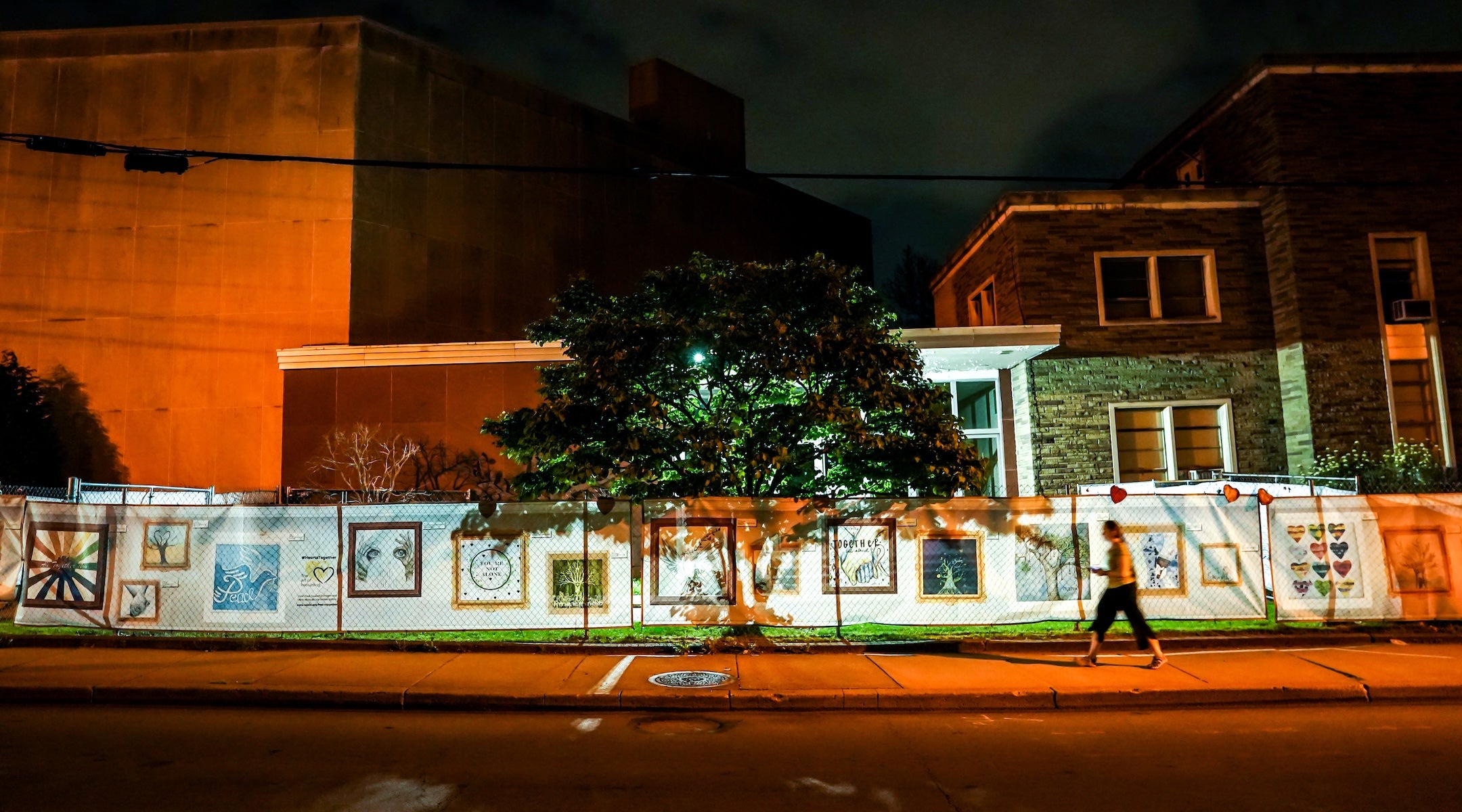
In addition to the attack on the two Jewish students in 2024, Pitt’s Jewish community also continues to live in the shadow of the 2018 shooting at the Tree of Life worship center, two miles from campus. Many of the university’s Jewish students and faculty have personal connections to it; Pitt has also hosted exhibits about the attack. A local memorial and museum commemorating the attack, now under construction, is scheduled to open to the public in 2028.
Both the 2024 attack and the Tree of Life massacre were part of “the context in which we were writing,” Blee said.
Blee is a longtime member and past president of Congregation Dor Hadash, the Reconstructionist synagogue located inside the Tree of Life building. One Dor Hadash congregant was among the 11 killed in the attack.
In addition, her research specialty is white nationalism and far-right antisemitism: When the perpetrators of the deadly 2017 “Unite the Right” rally in Charlottesville, Virginia, were charged with violations of federal law, Blee was called to the stand as an expert witness.
So when her synagogue became the site of the deadliest antisemitic attack in U.S. history, Blee recalled, “my work and my Jewish life intersected in a really terrible way.”
Blee’s 2025 appointment to chair the antisemitism working group, the Pittsburgh Jewish Chronicle reported, marked the moment the working group “begins to take shape.”
The final report recommends the university form an “advisory group” on Jewish issues, and suggests that the local Hillel and Chabad-Lubavitch house, as well as the Pittsburgh Jewish federation, should be represented — a recommendation that spurred criticism from pro-Palestinian groups on campus who objected to the federation’s presence.
Additional members of the working group contacted by JTA for this story, including the former JCRC staffer, directed requests for comment to Blee or declined to comment. The director of the Hillel serving Pitt’s campus, after requesting questions from JTA by email, did not respond by press time.
In a statement accompanying the report’s publication, the working group’s vice chair, Jennifer Murshatashvili, wrote, “My goal was to contribute to outcomes that would improve life for everyone at Pitt, not only Jewish and Israeli members of our community.”
Murshatashvili, a professor of Eurasian studies at Pitt, also told the university community that after she was named to the working group, “my home was targeted, and I was subjected to extensive online hatred and harassment.”
Even though the working group was not charged with gathering data, Blee told JTA, one of its instructions was to investigate “how effective” the university’s existing policies on antisemitism were after the Oct. 7, 2023, Hamas attacks in Israel strained relationships on the campus. There was disagreement among the group about how seriously to take the encampments mounted by pro-Palestinian groups at Pitt, she said.
“Some people were more concerned about the encampments than others,” she told JTA. Drawing on her own research into the far right, she explained, “Everybody would agree that a Nazi rally is antisemitic. Not everyone on the committee, and not everyone at the university, and not everyone in the United States Jewish community, would agree that the totality of the protests after October 7 were antisemitic.”
Blee declined to elaborate on how the working group determined policy effectiveness without gathering data. The confidentiality agreement brokered by the group members also prevented her from sharing more detail on their internal deliberations, she said.
“I can tell you that the committee gathered information that was needed,” she said. “But under that confidentiality agreement, I don’t want to go into exactly how that was done.”
Rachel Kranson, the director of Pitt’s Jewish Studies program, was announced as a member of the working group in 2025 but does not appear on its final report. Kranson declined to comment to JTA.
A flood of reports
Internal reports chaired by Jewish university faculty, officials and students have become part and parcel of the standard university response to campus antisemitism since Oct. 7.
At public and elite private schools alike, the formation and release of an internal antisemitism report has been greeted with considerable fanfare — and no small amount of controversy, directed at everything from the political makeup of committee members to the data-gathering process and final recommendations.
Yet one consistency among such reports has been the presence of at least some polling of the experiences of that school’s Jewish students — which many Jewish groups and Jewish leaders have agreed is a crucial component of any successful campus antisemitism response.
Committees at Harvard and Columbia, two schools figuring prominently into the national conversation on campus antisemitism, each conducted reports with more than 500 Jews on campus to inform their findings. Harvard’s final report runs 311 pages, while Columbia released multiple reports on the subject.
Stanford’s antisemitism committee report, released in 2024, runs nearly 150 pages and was informed by listening sessions with more than 300 people, as well as additional one-on-one interviews with students, administrators, and representatives of national Jewish groups.
The University of Washington and the University of California, Los Angeles, both public universities like Pitt, also surveyed and interviewed Jewish students to inform their own reports. The data itself can sometimes lead to controversy: A contingent of progressive Jews at UW criticized that school’s report for conducting focus groups with only a few dozen Jewish students, among other objections.
Pitt’s report — published two years after the administration committed to forming the working group — runs eight pages and includes no references to interviews or focus groups. It largely praised the university for, its authors said, already taking meaningful steps to combat antisemitism.
“I was surprised at the brevity of the report as the culmination of 1.5 years of work,” Andrea Goldschmidt, a psychiatry professor at Pitt and member of the Pitt Jewish Community affinity group, wrote in an open letter. “This stands in sharp contrast to the very lengthy and thorough reports I have seen come out of other universities.”
Goldschmidt also criticized the lack of “listening sessions or focus groups with the Jewish community during the course of the task force’s work.” She suggested that the lack of such conversations “reflects either that there was so much internal disagreement on the task force that the short report reflects the only areas of confluence among its members, or that the task force was somehow hobbled in its work before it even began.”
The Pitt Jewish Community affinity group’s president, Vicky Davide, echoed those concerns in comments to the student newspaper, telling the Pitt News that she and her colleagues had trouble accessing information about the group’s inner deliberations. They were “really disappointed” by the finished report, Davide, who leads engagement programs at Pitt, said.
Some suggested that, despite the lack of input from Jewish students, the recommendations themselves could still be useful. Jassey claimed that Pitt’s recommendations generally enjoy a “consensus” among Jewish students more broadly, and expressed hope that students would be included in the implementation step.
“I guess the question now is, what’s next,” she said.
This article originally appeared on JTA.org.
The post Jewish students were not interviewed for University of Pittsburgh campus antisemitism report appeared first on The Forward.
