


Uncategorized
Bernie Sanders downplays Graham Platner’s Nazi tattoo: ‘There might be one or two more important issues’
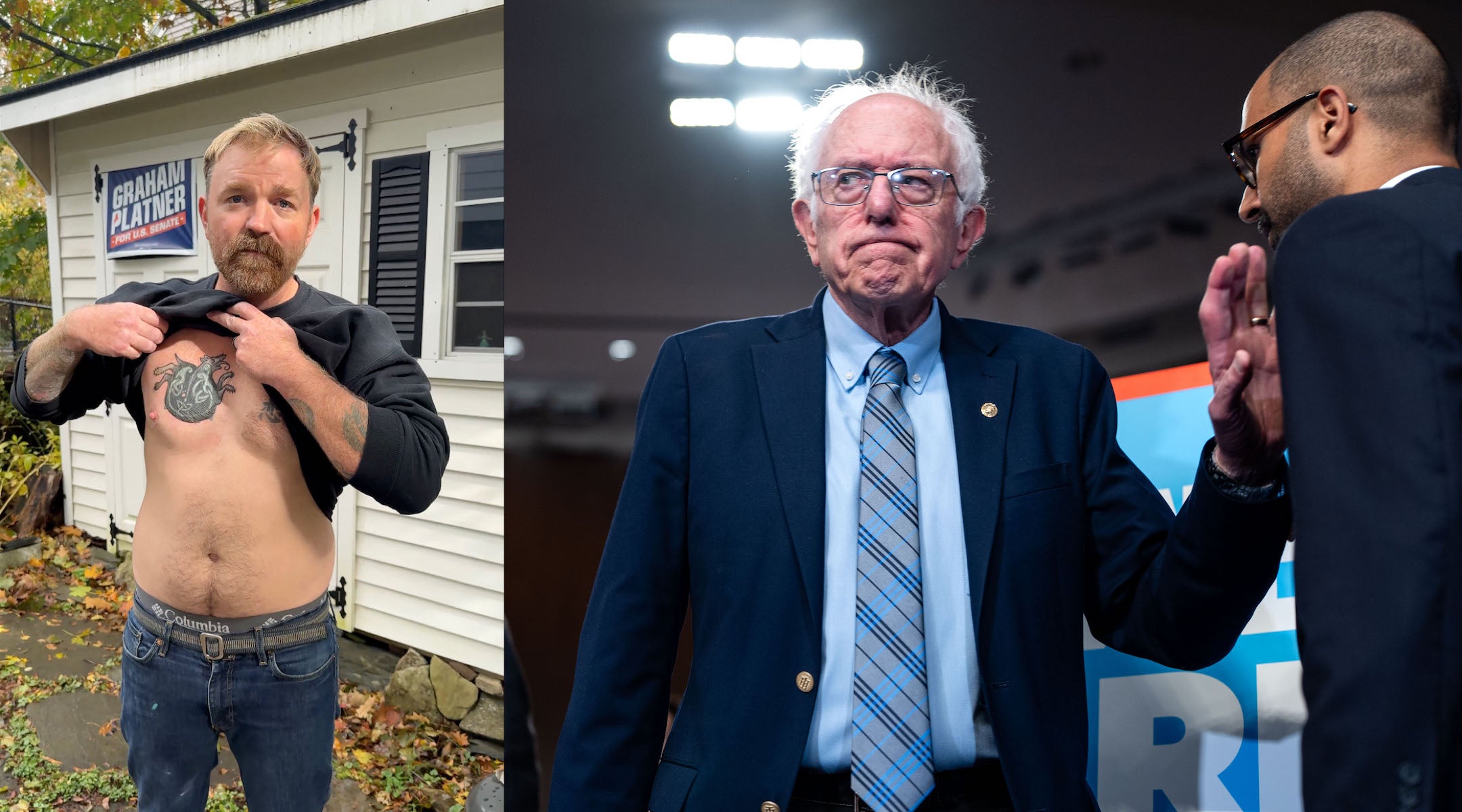
(JTA) — After Graham Platner, the progressive Senate hopeful running in Maine’s Democratic primary, revealed this week that he had had a Nazi-inspired tattoo on his chest for nearly two decades, several of his allies on the left cut him loose.
One who hasn’t: Vermont’s Jewish senator, Bernie Sanders.
“I’m not overly impressed by a squad of media running around saying, ‘What do you think about the tattoo on Graham Platner’s chest?’” the elder statesman of the progressive movement told Axios this week. “Between you and me, there might be one or two more important issues.”
Sanders also said he “absolutely” stood by his endorsement of Platner. Axios plans to air its full interview with Sanders on Friday but released snippets of the conversation on social media.
Sanders has backed Platner, a Marine veteran and oyster farmer, since soon after the latter announced his Senate bid this August. Platner’s anti-establishment platform, which includes embracing many progressive policies Sanders helped popularize, had made him a rising star despite his lack of any political experience. Platner has also taken a hard line against Israel.
That popularity was shaken following the recent revelation of Platner’s old Reddit posts, in which he made comments disparaging various groups. In an effort to get ahead of the opposition, Platner then himself revealed that he sported a skull-and-crossbones chest tattoo resembling an S.S. Totenkopf. He said he paid for it in 2007 while “inebriated” with fellow Marines in Croatia, and claimed he hadn’t known it was affiliated with Nazis (though subsequent reporting has suggested he knew it was a Totenkopf).
“I’m not a secret Nazi,” Platner said on Monday. He initially did not apologize for or suggest he would remove the tattoo.
After the revelations, Sanders told Axios he was still “impressed by the guy.”
“He went through some very difficult experiences in the military as a machine gunner, seeing his friends killed, came out of the military, he will acknowledge, I’m not telling you what he doesn’t say, he had PTSD,” the senator said. “He went into a dark period in his life. I suspect that Graham Platner is not the only American to have gone through a dark period.”
Sanders then sought to draw a line between condemnation of Platner and the election of President Donald Trump. “I think as a nation, especially given the fact that we have a president who was convicted on 14 felonies, maybe we have to do a little bit of forgiveness,” he said.
He wasn’t the only prominent progressive Jew who has remained in Platner’s corner since the tattoo revelation. Jon Lovett, the co-founder of influential left-wing podcast “Pod Save America” and media company Crooked Media and a former Obama official, has accused Platner’s progressive critics of demanding “only perfect candidates off the Harvard Law conveyor belt.” (Platner revealed his Nazi tattoo on a “Pod Save America” episode.)
“Of course he SHOULD answer for that tattoo,” Lovett wrote in a follow-up post on X Wednesday. “He’s explained the story, how it wasn’t flagged as a hate symbol when he entered the army or when he received a security clearance. He’s apologized and covered it up. Maybe it’s not enough. Maybe you don’t believe him.”
Following pushback, Platner did cover up the tattoo with a different design he referred to as a “Celtic knot with some imagery around dogs.”
In a post and video he posted to social media Wednesday, the candidate lifted his shirt to reveal his new tattoo and expressed regret that the old one might have invited comparisons to Nazis.
“It’s come to my attention that it has a stark resemblance to a symbol that is used by neo-Nazis, and I want to say, that was not my intent at all. And the idea that I was going around with something like that utterly horrifies me,” Platner said. “I know that symbols like this can be incredibly damaging to people, and the idea that I had it all these years and it could have been read like that is incredibly troubling.”
He added, “I have lived a life dedicated to antifascism, antiracism and anti-Nazism. I think that racism and antisemitism are a long scourge on our society and a long scourge on our politics, and I think it has no place in our world.”
Platner quickly pivoted, accusing “the establishment” of trying to destroy his movement with distractions.
“Every second we spend talking about a tattoo I got in the Marine Corps is a second that we don’t talk about Medicare for All, it’s a second we don’t talk about raising taxes on the wealthy,” he said.
Another prominent Jewish senator, Majority Leader Chuck Schumer, responded to the revelations about Platner’s tattoo by making an endorsement in the race, which he had until this week avoided. He is backing Janet Mills, Maine’s former governor, saying she “is the best candidate to retire Susan Collins.”
A recent poll, conducted just before the tattoo revelations, found that Platner holds a wide lead over Mills among Democratic voters.
Platner’s opponents have started to riff on the controversy, as well: Jordan Wood, a former congressional aide also running in the primary, posted on social media to “fess up” that he, too, has a tattoo — of the symbol of Barack Obama’s presidential campaign. “I got this tattoo a few years ago as a reminder of what hope and a positive vision can do in our politics,” he said on Instagram. Adding a dig at Platner, he concluded, “And yes, I knew what it was when I got it.”
A defiant Platner has pledged to remain in the race. At a rally Wednesday evening in Ogunquit, he again said he hadn’t known the meaning behind his tattoo.
He added, “If they thought this was going to scare me off, if they thought that ripping my life to pieces, trying to destroy me, was going to make me think that I shouldn’t have undertaken this project, they clearly have not spent a lot of time around Marines.”
The post Bernie Sanders downplays Graham Platner’s Nazi tattoo: ‘There might be one or two more important issues’ appeared first on The Forward.
Uncategorized
Contributor to Drop Site News Says Israelis Should ‘Be Removed From Our Planet’

Abubaker Abed reporting from Gaza. Photo: Screenshot
Abubaker Abed, a self-described Palestinian journalist and contributor to the far-left news outlet Drop Site News, has come under intense scrutiny following the circulation of social media posts in which he called for the “wiping out” of Israel and said that Israelis “mustn’t feel safe.”
The remarks, which quickly spread across multiple online platforms, have prompted widespread condemnation and renewed skepticism over the credibility and coverage of Drop Site News, a controversial publication fiercely critical of Israel and US foreign policy in the Middle East.
“Wiping out Israel off the planet is not enough revenge. Israelis mustn’t feel safe anymore. Haunt them and go after them where they go. These terrorist parasites must be removed from our planet,” Abed posted on an Instagram story.
Drop Site co-founder Ryan Grim responded to the incident by clarifying that Abed’s comments do not reflect the editorial position or institutional stance of his publication. Grim, a far-left investigative reporter who has repeatedly accused Israel of committing “genocide” in Gaza, did not condemn the statements by Abed.
“We also are never going to police the language of anyone who survived a genocide,” Grim posted on X.
Abed, a social media influencer from Gaza who evacuated to Ireland during the Israel-Hamas war, has previously suggested that attacks on Jewish institutions might be justified if they signal support for Israel.
Following the recent attack on the Temple Beth Israel Synagogue in Michigan, Abed resurfaced a photo from the synagogue featuring an Israel soldier. Abed wrote that the attempted mass casualty event was justified because the assailant defended himself.
“A person is not criminally responsible if they act reasonably to defend themselves against an imminent and unlawful use of force,” Abed wrote in a since-deleted post on X. “Israel murdered his relatives and is illegally bombing and invading his country.”
The FBI said last week that the attack on the largest Jewish temple in Michigan was an “act of terrorism” inspired by Hezbollah, the Iran-backed Lebanese terrorist group committed to Israel’s destruction.
Drop Site, a new media organization which debuted in July 2024, has found itself under immense criticism over its coverage of the Israeli-Palestinian conflict and the broader Middle East. The outlet has consistently characterized Israel as a “genocidal” aggressor stoking chaos and violence throughout the region.
Meanwhile, Drop Site depicts internationally recognized terrorist groups such as Hamas, Hezbollah, and the Houthis in a far more favorable light. Drop Site lead reporter Jeremy Scahill routinely refers to Hamas as “the resistance” and has given softball interviews to Hamas leaders.
Drop Site has also defended the Iranian regime from accusations of terrorism, asserting that Tehran’s goals “center on national sovereignty.” The site contends that Iran has “sought to project influence regionally through allied governments and forces (Hezbollah, Hamas, Houthi, Iraqi Militants, etc.) what’s often called the ‘Axis of Resistance.’”
Some observers have raised alarm bells over the outlet’s growing popularity among establishment mainstream liberals. Ben Rhodes, a former Obama administration official and co-host of the popular “Pod Save America” podcast, has praised the outlet on his social media profile and confirmed he is a subscriber.
Drop Site’s expanding influence does not seem to be confined to left-wing or liberal ideological circles. Right-wing media personality Mike Cernovich contended on X that young conservatives are increasingly reading Drop Site “for Israel news.” Joe Kent, the former director of the US National Counterterrorism Center, over the weekend reposted a Drop Site article pushing Iranian regime propaganda falsely claiming the US was actually trying to kill a downed American airman — just hours before he was dramatically rescued.
Uncategorized
Frankfurt cinema declines to participate in Jewish film festival, spurring backlash
(JTA) — A Frankfurt cinema’s decision not to participate in the local Jewish film festival is spurring allegations of antisemitism, even as its manager says the move was financial.
The Jewish Community of Frankfurt announced last week that the Astor Film Lounge did not wish to host movies during Jewish Film Days this year. The cinema, it said, had cited its workers’ reluctance to staff movies that are part of the biennial festival, as well as concerns about the security required to host Jewish events.
“The decision unequivocally signifies that Jewish life, Jewish people, and a Jewish media presence are no longer welcome at the Astor Film Lounge,” the community said in a statement.
“This line of reasoning is not only disappointing, but sends a devastating societal signal: If Jewish life and Jewish presence are suppressed out of fear of potential reactions, then this effectively amounts to a capitulation to antisemitic pressure,” the statement continued. “The fact that Jewish life can only take place under police protection is already shameful. That this necessity for police protection is now being used as a pretext to completely prevent Jewish events is a scandal.”
But the cinema’s managing director, Tom Flebbe, contested the Jewish Community of Frankfurt’s interpretation of events. In a statement cited in a leading local newspaper, he said the theater had withdrawn this year for economic reasons, as only 40 to 50 guests had come to screenings last year.
Flebbe said a lower-level manager had made unauthorized and inaccurate remarks about security concerns.
“Economic viability is a legitimate and necessary basis for business decisions — regardless of the thematic context of an event,” Flebbe said, adding that other joint projects with the Jewish community will continue as planned.
“The ASTOR Film Lounge MyZeil views Jewish life as a natural and welcome part of this society,” the statement concluded. “The decision against participating in the 2026 Jewish Film Days is not against Jewish people, Jewish culture, or Jewish presence. It is the result of a careful consideration of economic factors. We regret that our reasoning has been interpreted in this way and stand by our decision.”
During the 2024 festival, a half-dozen venues hosted screenings as part of Jewish Film Days. The Astor Film Lounge hosted one screening, of the film “March ’68,” a love story set during the Polish government’s antisemitic campaign following Israel’s Six-Day War.
Film festivals have emerged as a frontier for tensions over Israel and antisemitism. Germany’s largest film festival, the Berlinale, was roiled by tensions this year as its jury head fended off calls to criticize Israel. A major Toronto film festival, meanwhile, ruffled feathers last year by first canceling and then screening a documentary about the Oct. 7 attack on Israel. And a Jewish film festival was canceled in Malmo, Sweden, last year because too few cinemas would agree to show movies for it.
Flebbe’s explanation for why Astor Film Lounge would not participate in this year’s Jewish Film Days did not satisfy everyone who heard it. The Berlin-based German-Jewish Values Initiative, a non-partisan think tank, in an open letter called the economic justification a “mere pretext.”
“To the best of our knowledge, the Jewish Community of Frankfurt was prepared to guarantee a minimum revenue” for the film festival, the letter said. By apparently giving in to “threats and antisemitic pressure,” it added, the cinema has capitulated “to the very forces seeking to drive Jews out of the public sphere.”
The post Frankfurt cinema declines to participate in Jewish film festival, spurring backlash appeared first on The Forward.
Uncategorized
Israeli, Serbian leaders denounce antisemitic statements at Belgrade protest
(JTA) — Israeli and Serbian officials are denouncing antisemitic comments made by demonstrators during a clash between Serbian students and police at a protest last week.
“Death to Vučić and all the Jews around him,” one protester said in a televised interview, referring to Serbian President Aleksandar Vučić. “Long live Serbia.”
The protest last Tuesday marked the latest flashpoint in a series of anti-government protests that have erupted across the country over the past year after 16 people died in an accident at a railway station in November 2024. Hundreds of students participated in the protest, which came as Serbian police searched the offices of the University of Belgrade as part of an investigation into the death of a female student. The school’s leadership claimed that the investigation was an “attack on the university” for its support for the student-led protest movement.
Serbia and Israel first established diplomatic relations in 1948, and Vučić told the Jerusalem Post last year that the country “will always appreciate, respect, and like the Jewish people and Israel.”
Nemanja Starović, the Serbian minister of European integration and the chair of Serbia’s delegation to the International Holocaust Remembrance Alliance, called on the protest leaders to “unambiguously condemn these antisemitic incidents and to immediately remove all antisemitic messages and slogans from university premises.”
“On multiple occasions over the past months, we have warned about the widespread antisemitic ideology within the so-called blockade movement at universities in Serbia,” Starović wrote in a post on X. “Ignoring this dangerous threat has allowed it to escalate into open calls for murder, which now appear as a logical and inevitable outcome.”
The Israeli Foreign Ministry condemned the demonstrator’s comments in a post on X.
“Israel strongly condemns the reprehensible antisemitic calls made yesterday in Belgrade,” the post read. “Israel appreciates the Serbian government’s immediate condemnation of these calls and its firm and consistent stance in the fight against antisemitism.”
Efraim Zuroff, the director of the Israel Office and Eastern European Affairs for the Simon Wiesenthal Center in Jerusalem, also condemned the antisemitic rhetoric in a Times of Israel op-ed.
“One gets the impression that this is a politically motivated to harm President Aleksandar Vučić, who has close ties with the State of Israel, key Jewish organizations such as AIPAC and the Serbian Jewish community,” Zuroff wrote. “That is completely unacceptable! If these things are not stopped, they will end up in dangerous violence, and therefore cannot be ignored.”
The controversy over the protest comes as antisemitism has surged in Europe in recent years. Last September, Serbia arrested 11 individuals accused of perpetrating hate-motivated acts in France and Germany, including throwing green paint on the Holocaust Museum, several synagogues and a Jewish restaurant in Paris.
The post Israeli, Serbian leaders denounce antisemitic statements at Belgrade protest appeared first on The Forward.