


Uncategorized
Can an Israeli and a Palestinian restaurant coexist peacefully in the shadow of Columbia University?
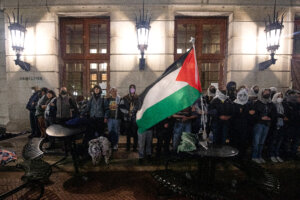
In the fall of 2023, in response to protests following Hamas’ Oct. 7 attack and Israel’s invasion of Gaza, Columbia University closed its wrought-iron gates. Since then, the Ivy League school in Manhattan’s Morningside Heights neighborhood has rarely left the news cycle. With the encampments, student occupation of Hamilton Hall, police in riot gear, congressional hearings on campus antisemitism, and ICE arrests of student activists, Columbia has become a flashpoint in debates about free speech, antisemitism and the limits of dissent.
The encampments are gone, as are the hostage posters. There are no more protests and counter-protests outside the campus gates, but soon the remnants of that political fight may play out in the opening of two restaurants, one Palestinian, one Israeli.
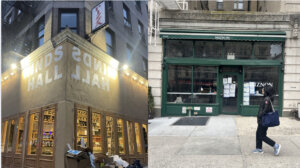
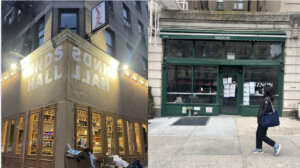
Ayat, the fast-growing Palestinian chain owned by Brooklyn-born couple Abdul Elenani and his wife Ayat Masoud — the restaurant’s namesake — is opening on 106th and Amsterdam Avenue. They’ve named it Hinds Hall Ayat, which was what student activists called the occupied Hamilton Hall in 2024. Hind was a five-year-old girl killed during Israel’s assault on Gaza that year.
Seven blocks north, Miznon, the international Israeli pita chain owned by Eyal Shani, the 67-year-old Tel Aviv celebrity chef known as the godfather of Israeli cuisine, is expected to open on 113th and Broadway, though no date has been set.
Miznon pitches itself as a destination for elevated Israeli street food, while Ayat specializes in Palestinian soul food, meaning larger homestyle platters. The concepts might be different as well as the vibe, but both offer superb, freshly baked, pillowy pita stuffed with spiced meats and topped with brightly flavored pickles and tahini.
The two restaurants arrive at different moments in their trajectories. Shani has been an internationally recognized chef for decades, with 60 restaurants from Singapore to Los Angeles and a Michelin star in Manhattan. Ayat opened its first location in a former Bay Ridge tanning salon five years ago. It now has 10 outposts, and Al Badawi, another Palestinian restaurant owned by Elenani and Masoud with two locations, was named one of the city’s 43 best restaurants in 2025 by New York magazine.
Owners of both restaurants say their decisions to open in the neighborhood are coincidental, and motivated by business, not politics. But in a conflict with competing national identities and claims to the land at its core, food has become a powerful proxy. To eat a babka from an Israeli bakery, or kunafa from a Palestinian, has become political. At the same time, restaurants have become targets of activists. Israeli chefs are accused of appropriating traditional Arab foods and bearing responsibility for Israel’s policies, while restaurants with displays of Palestinian nationalism are accused of promoting violence.
A mile north of Columbia, Tsion, an Ethiopian Jewish restaurant in Harlem, closed earlier this year after repeated harassment over its owner’s pro-Israel stance. Both Miznon and Ayat have had locations vandalized and staff threatened simply because they are Jewish and Israeli or Muslim and Palestinian.
All of this is avoidable. Just a couple blocks away from Ayat’s new location, Claire’s Kitchen Cafe on Manhattan Avenue is owned by Israelis and offers an “Israeli Bowl” of marinated chicken on its menu, alongside Greek and Mexican options. Claire’s, like nearby Halal shawarma spots Zaad and Zurna, pitches itself as Mediterranean, a commonly used catchall label that avoids controversy, but renders the experience generic: hummus scooped into a bowl stripped of the culture that produced it. Ayat and Miznon offer something different — the experience of a Palestinian family meal in East Jerusalem or a taste of a hip Tel Aviv food stall — powerful statements in themselves, with meanings shifting over time.
The Ayat story
In 2014, Elenani, then a student at City College, opened a food stall at Gansevoort Market in Manhattan’s Meatpacking District. The food was “Palestinian orientated,” but he says he didn’t have “the balls” to say so. Instead, he gave it the more generic name, MTerranean. When the market closed in 2016, so did the restaurant,
Elenani, now 33, grew up in Bensonhurst, Brooklyn, the son of Egyptian immigrants during a time of increased Islamophobia after 9/11. In a January interview with the British-based online publication Middle East Eye, he recounted how at the age of five, he witnessed his mother, who wore a hijab, called a terrorist.
His parents modeled how to navigate a diverse city, even one that was at times hostile to Muslims. His father owned Chock Full O’ Nuts coffee shops and several Dunkin Donuts, including one with a Kosher certification in Brooklyn. “In the first grade,” he told me in a phone conversation, “my mom used to give me certain Christian gifts or certain Jewish gifts to give to my teachers when it was their holiday.”
After MTerranean closed, he turned his focus to growing his chainlet of Cocoa Grinder cafes and a Bay Ridge bagel shop. When the pandemic wiped them out, he faced a choice about what to do next. “Going through COVID and seeing how fast things can change, and losing everything overnight, it built a thick skin,” he told Middle East Eye.
He rented out a former Bay Ridge tanning salon with his wife, Palestinian-American Ayat Masoud, 31, whose family owns the Halal market Balady nearby. “I remember thinking I’ll just be very bold about Palestine and not care about what will happen after,” he said.
Masoud, a former prosecutor in the Brooklyn DA’s office who has a private practice, developed the menu with her East Jerusalem-born mother. They included not just the mainstream Levantine staples of hummus and shawarma, but harder to find traditional dishes like Mansaf, heaps of lamb cooked in a thick yogurt sauce served with rice, and Palestine’s national dish, Musakhan, a half chicken roasted with sumac and caramelized onions served over freshly fired taboon bread.
Their goal was to transport customers to Palestine. “If I can eat mansaf over here in New York and think, ‘wow, this tastes just like when I was in Jerusalem,’ that connects those two dots,” Elenani told me. This time, Elenani chose the less generic name, Ayat.
At first, he recalled, many customers called it “Pakistinian cuisine,” confusing Palestine with Pakistan. “I think that was the first moment where I thought I’m going to drive myself to the max to make sure I open up as many locations as possible to communicate that culture and tradition,” he told Middle East Eye.
While MTerannean came and went with little notice, Ayat is leaving its mark. There are now seven Ayats in New York City, one in Texas, one in Princeton and locations set to open in DC and Philadelphia. Elenani plans to franchise and expand to 20 locations nationwide within the next year.
Ayat’s biggest growth has been in the two-and-a-half years since the Oct. 7 attack and Israel’s invasion of Gaza. Palestinian-American families gather over heaps of rice and meat, keffiyeh-wearing activists show solidarity over mint tea, and then there are many just curious about the cuisine and culture of a people who are almost solely portrayed in the American media in terms of violence, either as victims or perpetrators.

But the representation of Palestine comes with a price. Ayat was bombarded with thousands of fake one-star reviews after Pete Wells gave it a rave write-up in The New York Times in 2020. Since Oct. 7, according to Elenani, locations have been vandalized, and staff members have been called terrorists and threatened.
In the face of hostility, Elenani says, he always responds with kindness in accordance with his faith. In 2016, when a Cocoa Grinder cafe was robbed of thousands, he didn’t call the police. Instead, he posted a letter of forgiveness outside the store. “If the money you stole was to better you and your family’s living, then I forgive you,” it read. And this past Thanksgiving, when an Islamophobic caller threatened him and his staff, he invited him to the restaurant.
“I didn’t respond with hate,” he told me, “He ended up coming in and he apologized. He gave me a hug. I feel like people just need to hear a little bit from other backgrounds, just to understand each other.”
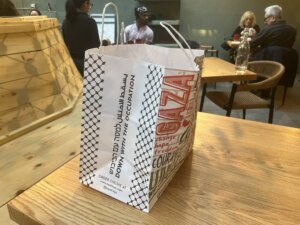
Still, Elenani and Masoud have not softened their political stance. Diners at Ayat’s other locations are greeted by murals of the Al-Aqsa Mosque looming over Palestinian children held at gunpoint by IDF soldiers. The menu calls to “End the Occupation” in Arabic, English and Hebrew. In 2024, the restaurant caused controversy with its seafood section title “From the River to the Sea,” a slogan, Elenani claims, is a call for equality, but which the Anti-Defamation League says is an incitement to genocide. The phrase remains on the menu in the original Brooklyn location, but at other locations, the menu reads “From the Rind to the Seed,” a tongue-in-cheek play on the watermelon as a pro-Palestinian symbol
When I asked Elenani how he weighs the risk of alienating customers against the mission of representing Palestinian culture, he pushed back on the premise. “One thing about Palestinian cuisine — you cannot keep politics out of it,” he said. “But I don’t even call it politics. I call it oppression. I call it genocide. Politics is Democrats and Republicans. We’re talking about who’s living and who’s dying.”
The Miznon story
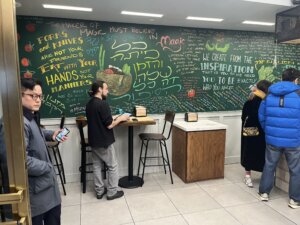
If Ayat with its jugs of oil as decoration, faux olive trees and large platters made to share family-style represents deep rooted tradition, Miznon is the opposite. At each location, the menus along with wall art of pita sandwiches and poetic quotes about the food in Hebrew and English are drawn in chalk. Miznon means canteen, so there are few seats, and the food is offered in individual-sized portions and designed to be eaten quickly or taken to-go.
“The Israeli lifestyle is to live in the now as if it’s all going to disappear,” Shani told Surface Magazine in 2022 in describing Israeli cuisine. “We’re always looking for the new and mostly prefer to forget the past.”
At Miznon, that means vegetable-forward plates, like its star dish, a roasted baby cauliflower. Some traditional Middle Eastern dishes are prepared with a twist. Instead of shawarma, pitas are filled with “ribeye minute steak” or “a folded cheeseburger.” The vibe is cosmopolitan and modern. While Elenani and Masoud sometimes have oud players at their restaurants, Shani books DJs.
At the age of 30 in 1989, Shani opened the Jerusalem restaurant Oceanus. A former film student who taught himself to cook from a Julia Child cookbook, he had almost no culinary tradition to draw from. What he built became the foundation of modern Israeli fine dining, one rooted in the land with local tomatoes, eggplants, wild herbs and tahini, as well as a melting pot of the country’s multicultural influences.
“I just had a feeling that I have to invent the Israeli cuisine,” Shani said last year on the podcast, Being Jewish with Jonah Platt. He was inspired, he said, by the Palestinian women he watched in the Old City markets, carefully tending to a few tomatoes and cucumbers.
“They were my first vision,” he said. His other inspiration was the land itself — the mountains around Jerusalem where he gathered wild sage, thyme and hyssop. When asked about his relationship with those Palestinian women and what he took from them, he answered simply: “There’s no borders when we are talking about food.”
Shani closed Oceanus in 2000, the same year the Second Intifada began. In 2008, he and his partner Shahar Segal, a filmmaker and advertising executive, opened HaSalon, a high-end Tel Aviv restaurant. Two years later, his fame grew when he served as a judge on the Israeli version of MasterChef, where he became popular for his poet-philosopher approach to food. Others called for his removal after he penalized a contestant for living in a West Bank settlement.
In 2011, he and Segal opened the first Miznon in Tel Aviv, pitching it as a democratization of his fine dining sensibility. “Young people did not come to my other restaurants because they couldn’t afford it,” he told The New York Times. Paris followed in 2013, then Vienna, Singapore, Melbourne and, in 2018, New York. He now operates around 60 restaurants worldwide. In each one, he says, he spends weeks with the head chef, instilling them with his “spirit and beliefs” until, as he put it on the podcast, “I print my mind on his mind.”
While Elenani was afraid to call his restaurant Palestinian, and publishers hesitated to put Palestine on cookbook covers out of fear that it would be seen as a provocation, Shani was part of a global Israeli food wave. Israeli chefs like Yotam Ottolenghi in London and Michael Solomonov in Philadelphia won Michelin stars and James Beard Awards. The Israeli brand Sabra, part-owned by Pepsi, defined hummus for many Americans. Israeli food was having a moment. Palestinian food was shunned.
But things have changed. In July 2025, masked protesters stormed the Melbourne Miznon throwing food and chairs, damaging the restaurant. In a statement, the protesters claimed they targeted Miznon because the co-owner Segal was a spokesperson for the U.S. and Israeli-backed Gaza Humanitarian Foundation (GHF) whose food distribution system was accused of endangering the lives of Gazan civilians.
Two weeks later, amid calls to boycott Miznon, Segal stepped down from his position at GHF, but the controversy didn’t go away. Miznon London is the site of a weekly Friday protest by a Jewish anti-Zionist group against Shani’s initiative to provide meals for Israeli soldiers.
“Israel is seen as violent,” Shani told the Forward last June noting a decrease in non-Jewish customers. “It’s not cool anymore, and we can feel it.”
‘Do what you gotta do’
Miznon’s intention to open near Columbia was first announced in 2023 and generated almost no reaction. Last August, when news broke that Ayat was opening nearby, the response online was immediate and sharp. One article called it the “‘From the River to the Sea’ Eatery.”
Elenani has leaned into the controversy. Since 2014 when he wasn’t bold enough to label his restaurant as “Palestinian,” there has been a shift. “It feels like now those Muslim 9/11 kids are having the moment where we can show that this city is our home,” Amani Al-Khatahtbeh, a Muslim-American author, told The New York Times, after Zohran Mamdani won the New York mayoral election. Elenani marked the occasion by closing every Ayat kitchen and feeding more than 4,000 Mamdani volunteers in Bushwick. Three weeks later, he announced the restaurant would be named “Hinds Hall Ayat”
Many in the community, still raw from two years of protests and divisions, would prefer places that facilitate dialogue, not deepen divisions. “I’d like to try Palestinian food,” Allison Lander, a 46-year-old piano teacher and Morningside Heights resident, told me, but said that she felt torn about going, given Ayat’s choice of name “Hinds Hall” and the political slogans on the menu.
“It’s hard for me to take a strong stance against Palestinians right now who are trying to draw attention to the conflict,” she said, but added that “you have to be more sensitive to Jewish community members.”
Shani, characteristically, has said nothing political at all. When I asked what a Columbia student should take away from eating at Miznon, he responded by email: “I want them to care about the experience inside the pita. The feeling, flavors and texture. I want people to fall in love with the pita.” Still, students who have promoted boycotts of pro-Israel businesses, might have opinions beyond the pita.
On Ayat opening nearby, Shani wrote: “We come from the same region and share many food behaviors, ingredients and ways of cooking, and those naturally inspire one another. Food is about bringing people together by reminding us of what we share.”
Elenani had more to say. “I have no idea if they’re even opening up there, but it’s all good,” he said. Still, he took issue with Shani calling his cuisine Israeli, when he says it is Palestinian. “I just wish they could appreciate the culture and cuisine, but not appropriate it and rebrand it into something that it’s not.” Then he offered them a name: “Do what you got to do,” he said. “Call it modern Mediterranean.”
The post Can an Israeli and a Palestinian restaurant coexist peacefully in the shadow of Columbia University? appeared first on The Forward.
Uncategorized
Somerville councilors to discuss Israel divestment proposal
(JTA) — SOMERVILLE, Mass. — The issue of divestment from Israel returns to the Somerville City Council in Massachusetts on Tuesday night as lawmakers plan to discuss how to implement a nonbinding ballot question on the matter that passed last year.
The divestment push has divided the city of more than 84,000 residents, which has a long-standing Jewish population. It is located between Cambridge, home to Harvard University, and Medford, a city with which it shares the Tufts University campus.
After Question 3 passed with 55.7% of the residents’ vote in November 2025, the City Council that same month passed a resolution committing to work toward an ordinance within a year to enact the ballot’s goals.
The measure to that effect, introduced in June, would bar the city from investing in or procuring labor, services or goods from companies that support entities identified by the ordinance as violating international law, including Israel.
Unlike the divestment proposal awaiting a November ballot vote in Providence or the binding human rights divestment ordinance passed by Medford’s city council in 2025, the Somerville ordinance specifically mentions Israel and Palestine.
In response to the push for a binding ordinance, 74 registered voters in Somerville submitted a petition for a hearing, which was held in September, before final action is taken, citing concerns about its impact on the city. The issue has now moved to the city’s Legislative Matters Committee, which is meeting Tuesday night.
Among the groups opposing divestment is Shalom Somerville, which submitted the September petition stating that “the sense of belonging and safety experienced by Jewish, Israeli and other residents of diverse backgrounds” is at risk as a result of the ordinance.
Sam Gechter, co-founder and president of Shalom Somerville, said that the ordinance singles out Jews who support Israel, which makes it antisemitic. Deputy City Solicitor David Shapiro also advised in November 2024 that such an ordinance would be “likely invalid,” according to a letter from the Anti-Defamation League and the Louis D. Brandeis Center for Human Rights Under Law.
“I think it’s incredibly irresponsible,” Gechter said, suggesting that the ordinance would slow down governmental action. “But the biggest thing for me is that it makes Jews feel unwelcome in Somerville.”
A local organization, Somerville for Palestine (S4P), has been a driving force behind both the ballot question and the ordinance, which the group developed in collaboration with sponsoring city councilors Ben Ewen-Campen, Ben Wheeler, Wilfred N. Mbah and Jon Link. “It’s what people voted for,” said Mo Katz-Christy, a member of S4P’s leadership and Jewish Caucus. “We want to follow the will of the people.”
The ADL issued a statement condemning the ordinance in June. It also joined the Brandeis Center in issuing a letter calling the proposal an unconstitutional intrusion into foreign affairs.
Other Jewish organizations disagree. Jewish Voice for Peace Boston has worked closely with S4P to back the measures. “I don’t think that those objections have validity,” said Eli Gerzon, a longtime member of JVP. “As a Jewish organization, we are especially concerned that ‘never again’ really means what it says: never again, that we never let a Holocaust, a genocide happen.”
This article originally appeared on JTA.org.
The post Somerville councilors to discuss Israel divestment proposal appeared first on The Forward.
Uncategorized
A major Jewish museum hopes to join the Smithsonian – at a difficult moment for the storied institution
(JTA) — Philadelphia’s Weitzman National Museum of American Jewish History is moving closer to becoming part of the Smithsonian Institution at a moment of significant upheaval for the storied museum network.
A new congressional commission will study whether to make the museum part of the Smithsonian. Its members were sworn in Tuesday, when they also held their first meeting.
In an exclusive interview with the Jewish Telegraphic Agency, the commission’s new chair Philip Darivoff, a former longtime chair of the Weitzman, and vice chair Dara Horn, a New York Times bestselling author, said that the Weitzman joining the Smithsonian would send a powerful message that Jews are a crucial component of the history of the country.
“It’s a different statement that our country makes when it says that the study of Jewish American history and culture is important to this nation,” Darivoff said. Both he and Horn also hope that a boost in the Weitzman’s profile could combat what they called an “epidemic of ignorance” among Americans when it comes to knowledge of Jewish history and culture.
“This really would be an elevation of the Jewish community,” Horn, author of “People Love Dead Jews” and “The Final Solution to the Jewish Question,” told JTA. “The place that Jews show up in a school curriculum is typically more about the Holocaust” — an area that the author has written critically about in the past as too limiting a view of Jewish life.
Horn believes in the Weitzman project, she said, because she hopes to emphasize the ways that Jews have contributed to American founding ideals such as religious pluralism.
“I’m really interested in the connections between the Jewish story and a lot of our foundational ideas in this country,” she said. Jewish ideas such as the Exodus from Egypt in the Passover story “were inspiring to Americans,” she added.
The wheels for the Weitzman joining the Smithsonian began turning in 2024, when Congress passed legislation in 2024, then signed by President Biden, to establish the commission. The group spent the next two years putting the commission together, and has two years from its first meeting to research and publish a report on the feasibility of such a move — though Darivoff said he hopes to finish the work well before the deadline.
Adding a new member to the Smithsonian has been known to take years, if not decades. The two most recent additions, the National Museum of the American Latino and the American Women’s History Museum, were both long in the works.
Founded in 1976, the Weitzman is already an existing, fully functioning institution — and also already a Smithsonian affiliate, meaning it can share resources with other museums in the system. Unlike a museum being built from scratch, the Weitzman already has a building and collection, which proponents hope could speed the process.”
Dan Tadmor, the Weitzman’s CEO, told JTA that joining the Smithsonian would improve their educational mission.
“We have a national footprint for our educational programming, but of course we’d like to widen it,” he said. “Who would say no to a curriculum that’s been developed by a Smithsonian museum?”
The Weitzman’s bid for increased prominence within the Smithsonian comes as the Trump administration has sought to exert greater control over the latter — home to such storied institutions as the National Museum of American History, the National Portrait Gallery and the National Zoo.
This summer the White House issued a report alleging “radical ideology” in the museums’ content, and Interior Secretary Doug Burgum recently announced plans for signs accusing Smithsonian leaders of ideological bias. Observers say such signs are indicative of larger administration priorities opposing the teaching of historical subjects such as slavery. Smithsonian Secretary Lonnie Bunch III is stepping down at the end of the year.
A representative from the Smithsonian declined to comment to JTA on the Weitzman’s bid, or on its current political conditions.
The commission’s chair and vice chair of the new Weitzman said that the current political upheaval shouldn’t affect their work. The Smithsonian, Horn said, “has lasted through many political winds.”
“I think we see this as a long-term project that’s about the place of Jewish Americans in this country’s history,” Darivoff said. “The Smithsonian is a really important institution for this country, and it is the great museum complex of our nation. God willing, it will be flourishing for centuries to come. It’d be an honor to be included in the Smithsonian.”
This article originally appeared on JTA.org.
The post A major Jewish museum hopes to join the Smithsonian – at a difficult moment for the storied institution appeared first on The Forward.
Uncategorized
Two deaths in Manchester synagogue attack last year will be probed through public inquiry, Britain says
(JTA) — The deaths of two Jewish men in an attack on a synagogue in Manchester last year will be examined through a public inquiry, the British home secretary announced on Monday, a necessary step to include sensitive information in the investigation.
Melvin Cravitz and Adrian Daulby were killed during the attack on Yom Kippur on Oct. 2, 2025, when Jihad Al-Shamie rammed a car into a group of worshippers outside the Heaton Park Hebrew Congregation in Manchester and stabbed two people. Cravitz died from stab wounds and another man, Andrew Franks, was seriously injured but survived. Daulby was shot by police while blocking the synagogue doors to stop Al-Shamie from entering. Two other people were seriously injured.
Al-Shamie, a Syrian-born British citizen, said he was acting for the Islamic State, also known as ISIS, before police shot him dead.
Home Secretary Shabana Mahmood announced the public inquiry in a statement about national security at the House of Commons, saying that “what happened that day must be fully understood.”
“This will ensure that all evidence can be heard, including any sensitive national security material that could not otherwise be fully heard in the coroner’s court,” said Mahmood.
Judge Alexia Durran, the chief coroner of England and Wales, was overseeing inquests into the deaths of Cravitz and Daulby. Durran last month recommended that Mahmood convert the inquests into a public inquiry, following statements from Home Office lawyers that some information from MI5 would be withheld from open court due to national security concerns. A full investigation that involves hearing sensitive material in private requires a public inquiry.
Earlier this year, Greater Manchester Police’s chief constable Stephen Watson said he was “deeply sorry” for a “missed opportunity” to uncover the plot against the Heaton Park synagogue. Watson made the apology after prosecutors revealed that Al-Shamie had two prior arrests for allegedly breaching a non-molestation order and alleged rape, and his mobile devices were not examined until after the synagogue attack.
Mahmood listed “a series of attacks on our Jewish community” in the year since the synagogue attack, including the stabbing of two Jewish men in the London neighborhood of Golders Green, a spate of arson attacks and a “foiled but potentially lethal plot” against Jews in Manchester on the eve of Yom Kippur last month. In the last case, two Iranian men have been charged with terrorism offenses.
“Faced with the threat posed to our Jewish community, we have increased funding to the police by an additional £250 million to boost police presence in key Jewish areas and to tackle antisemitism on our streets,” said Mahmood.
She added, “I know we cannot simply build higher walls around our Jewish community and expect them to live in fear. So we must root out the evil of antisemitism wherever it lurks in society, and this government is committed to that effort.”
Mahmood’s announcement comes days after the Home Office released data showing that hate crimes against Jewish people in England and Wales rose 10% in the year ending in March.
Mahmood said the United Kingdom was aware that “the Iranian state is targeting our Jewish community,” adding that the threat posed to Jews demonstrated “how the lines are increasingly blurring between extremism and state threats.”
The post Two deaths in Manchester synagogue attack last year will be probed through public inquiry, Britain says appeared first on The Forward.
