



Uncategorized
China Unleashes ‘Antisemitic Wave’ Amid Gaza Conflict, New Report Shows

Iranian President Masoud Pezeshkian and Chinese President Xi Jinping shake hands as they meet, in Beijing, China, Sept. 2, 2025. Photo: Iran’s Presidential website/WANA (West Asia News Agency)/Handout via REUTERS
The Chinese Communist Party has embraced overt antisemitic messaging in its domestic propaganda in recent years, according to a new report which ties the move to both geopolitical rivalry with the United States and efforts to curry favor with Arab and Muslim countries hostile to Israel.
The Jewish People Policy Institute (JPPI), a prominent think tank based in Israel, documents in the report how China’s authoritarian government has deliberately cultivated antisemitism among the population and internationally as a strategy.
One key trend detailed by the study’s author, JPPI senior fellow Shalom Salomon Wald, is the way in Chinese media that Israel, Jews, and Judaism have grown conflated.
“In popular discourse, Israel and Jews are more or less synonymous. This is not much different from the West, where the anti-Israeli presentation of the Gaza war by official and social media is regularly causing verbal and physical violence against local Jews,” Wald writes. “Chinese officials, intellectuals, and news providers are generally aware of the difference between Israel and world Jewry. Officials acknowledge the distinction when it suits them, for example, when they insist that their criticism of Israel has no antisemitic connotation. They often fail to draw the distinction when it does not suit them.”
The report identifies 2021 as when “the Chinese government chose to harden its attitude toward Israel and its Jewish supporters. Chinese contacts informed some Israeli experts of this policy change. Whether [Chinese President] Xi Jinping himself made the relevant decisions is not known. No single reason, but a convergence of events caused this change.”
Writing in The Jerusalem Post, Wald identifies at least three factors driving China’s shift toward anti-Zionism.
The first is economic, with Israel walking back its relationship with China under US pressure.
“Israel, admonished by the United States, made Chinese investments, particularly in hi-tech and infrastructure projects, more difficult,” he writes. “The Chinese expressed their resentment quite openly.”
The second is geopolitical. “China was in the midst of expanding its presence in the Arab Middle East, offering major economic cooperation and long-lasting political ties,” Wald explains. “A harder attitude against Israel was a cheap sweetener for such offers.”
The third is the perception that, due to internal issues, Israel has grown weaker: “Israel’s domestic crisis eroded its ‘strongman’ image in Chinese eyes. A country wracked by mass demonstrations and numerous ineffective elections could no longer be taken as seriously as it had been.”
However, recent Israel-Hamas conflicts in Gaza were also key catalysts for upticks in antisemitism.
“Antisemitic waves washed over China’s social and official media following the Gaza conflicts of 2021 and 2023-25. They were authorized, if not initiated, by the Chinese government in pursuit of China’s political goals and based on anti-Jewish tropes,” states the report, which notes the hostility especially surged following Hamas’s Oct. 7, 2023, massacre across southern Israel.
“Chinese media began spreading antisemitic tropes under the cover of criticism of Israel’s military actions,” it continues. “While similar denunciations conflating Israel, Zionists, and Jews occurred in other countries too, in China all political speech is tightly monitored and censored if it is not in line with official positions. If antisemitism was spreading on China’s media, it meant that it was officially sanctioned. It appeared in government sources and public media, in social media, and in universities.”
Wald notes in the JPPI report that Beijing’s turn toward antisemitism will have a long-term impact on education.
“Universities are among the most influential promoters of Chinese antisemitism,” he states. “As they train China’s next generation, they risk transmitting current prejudices to some of China’s future leaders. Today, almost all Chinese government leaders and most Communist Party high officials are university graduates.”
The report describes how the rise in academic antisemitism in China has destroyed years of positive scholarship, quoting Prof. Ping Zhang of Tel Aviv University who said that “the foundation of the good relationship built between the two sides over the past three decades has been shattered.”
JPPI’s research notes that during the 20th century, China’s leaders originally supported Zionism. Sun Yat-sen, the first provisional president of the Republic of China and known today as the “father of modern China,” wrote in 1920 to the head of the Shanghai Zionist Association that he favored the “movement to restore your wonderful and historic nation which has contributed so much to the civilization of the world.” Similarly, in 1948 the Communist Party’s People’s Daily praised the founding of Israel.
Since then, however, China’s sympathies have shifted dramatically, recognizing a Palestinian state in 1988 and, more recently, moving closer to Hamas and Iran, whose leaders openly promote antisemitism and seek Israel’s destruction.
This month, for example, a Chinese military attaché in Tehran presented Brigadier General Bahman Behmard, commander of the Iranian Air Force, with a scale model of China’s J-20 fifth-generation stealth fighter. Even though no official contract was announced, experts interpreted the Chinese gesture as a sharp warning to the US and its ally Israel amid mounting fears of renewed conflict in the Middle East.
Days earlier, a new study revealed the extent to which the Iranian regime used Chinese technology to silence dissent during recent nationwide anti-government protests, imposing near-total internet shutdowns and disrupting satellite communications while carrying out a brutal crackdown. According to the international human rights organization Article 19, China has provided material and technical support to Iran since at least 2010, bolstering its surveillance and censorship capabilities as Chinese firms continue operating in the country despite international sanctions.
China, a key diplomatic and economic backer of Tehran, has moved to deepen ties with the regime in recent years, signing a 25-year cooperation agreement, holding joint naval drills, and continuing to purchase Iranian oil despite US sanctions.
China is the largest importer of Iranian oil, with nearly 90 percent of Iran’s crude and condensate exports going to Beijing.
According to some media reports, China may be even helping Iran rebuild its decimated air defenses and ballistic missile program following the 12-day war with Israel in June.
Closer to home, Beijing has also lambasted the Jewish state for its increasingly close ties with Taiwan. China considers Taiwan, a nearby island run by a democratic government, as a renegade Chinese province that must be reunited with the mainland — by force, if necessary.
In September, Israeli Prime Minister Benjamin Netanyahu spoke to a delegation of 250 US state legislators at the Foreign Ministry in Jerusalem, warning of China’s role in demonizing Israel.
There is “an effort to besiege — not isolate as much as besiege Israel — that is orchestrated by the same forces that supported Iran,” Netanyahu said. One is China. And the other is Qatar. They are organizing an attack on Israel … [through] the social media of the Western world and the United States.”
That same month, the Institute for National Security Studies (INSS), an Israeli think tank, released a report examining how China has increasingly used state media and covert campaigns to spread anti-Israel and antisemitic narratives in the US. The effort includes the promotion of conspiracy theories about “Jewish control” of politics, the economy, and the media.
While China’s primary aim is to target and undermine the United States, according to the study, Israel ends up suffering “collateral damage” as a result.
Uncategorized
At Trump’s Christian revival on the National Mall, one rabbi made a Jewish case for America
On the National Mall Sunday, Christian worship music boomed from giant speakers as “Adonai” and other names of God flashed across jumbo screens behind a praise band. Pastors invoked America’s biblical destiny. Sadie Robertson, the Christian social media personality and granddaughter of Duck Dynasty patriarch Phil Robertson, preached from both the Old and New Testaments.
And then Rabbi Meir Soloveichik — the lone Jewish speaker at the planned nine-hour “Rededicate 250” rally called by President Donald Trump, billed as a national “jubilee of prayer, praise and thanksgiving” — stepped to the podium and began talking about Irving Berlin.
Soloveichik, 48, a scion of one of modern Orthodoxy’s most revered rabbinic families and a member of Trump’s Religious Liberty Commission, used his remarks to offer a Jewish case for American exceptionalism, a contrast to the explicitly Christian vision of the nation’s founding that defined the day.
Recalling how Berlin wrote “God Bless America” as fascism spread across Europe and antisemitism consumed the continent, Soloveichik described the song as both a patriotic anthem and a prayer of gratitude from a Jewish immigrant who found refuge in the United States. The hymn, he said, represented “a plaintive prayer to God that America continue to be blessed.”
The four-minute speech fit squarely within Soloveichik’s broader worldview. A senior scholar at the conservative Tikvah Fund and rabbi of Congregation Shearith Israel in Manhattan, the oldest Jewish congregation in the United States, he has long argued that America’s civic ideals are aligned with traditional Judaism and biblical morality. His 2024 book, Providence and Power: Ten Portraits in Jewish Statesmanship, examines Jewish political leadership through the lens of faith and moral responsibility.
For Soloveichik, the connection between Judaism and American identity culminated in the Second World War. He noted that “God Bless America” was first broadcast publicly the day after Kristallnacht, when Nazis destroyed Jewish homes and synagogues across Germany. “At the very moment when darkness deepened,” Soloveichik said, “America raised its voice united in the song that Irving Berlin wrote.”
He added that “in the years that followed 1938, the prayer that is ‘God Bless America’ was carried by American soldiers who defeated evil, liberating Europe and the world.”
Then came the line that drew some of the loudest applause of his remarks: “It is a reminder, as hatred of Jews makes itself manifest again, that antisemitism is utterly un-American.”
Separation of church and state
The moment captured the complicated role Jews increasingly occupy within the Trump-era religious right: embraced as part of America’s Judeo-Christian heritage, even as critics warn that the broader movement surrounding events like Rededicate 250 blurs the line between religious pluralism and Christian nationalism.
Rachel Laser, the Jewish CEO of Americans United for the Separation of Church and State, denounced the rally before the event. “If President Trump and his allies truly cared about America’s legacy of religious freedom, they would be celebrating church-state separation as the unique American invention that has allowed religious diversity to flourish in our country,” she said in a statement. “Instead, they continue to threaten this foundational principle by advancing a Christian Nationalist crusade to impose one narrow version of Christianity on all Americans.”
Sunday’s event — part revival meeting, part patriotic pageant — was the centerpiece of the Trump administration’s religious programming tied to this year’s 250th anniversary of the founding of the United States. Secretary of Defense Pete Hegseth and House Speaker Mike Johnson were slated to appear alongside evangelical pastors, worship leaders and conservative Christian influencers. President Trump and Vice President JD Vance were scheduled to address the crowd by video, while Trump himself spent the weekend golfing after returning from an overseas trip to China.
“This is a recognition of the deeply embedded history and religious and moral tradition of the country,” Johnson said Sunday on Fox News, dismissing criticism that the rally blurred the separation of church and state. Those objecting to the event, he added, “want to erase the history of America.”
No Muslim speakers appeared on the lineup. Organizers promoted Trump’s declaration of a national “Shabbat 250” observance the day prior as evidence of interfaith inclusion.
One of the Sunday event’s chief promoters, Trump spiritual adviser Pastor Paula White-Cain, had reassured supporters beforehand that the gathering would celebrate America’s Christian foundations without “praying to all these different Gods.”
Soloveichik did not address those tensions. Instead, he closed by returning to the image of America as a nation uniquely capable, in his telling, of transforming a Jewish refugee into the composer of one of the country’s most enduring patriotic hymns.
“To sing this song,” he said, “is to be reminded that America’s story is unique.”
“GOD BLESS AMERICA IS NOT JUST A SONG. IT’S A PRAYER.” 🇺🇸🙏
Rabbi Meir Soloveichik delivers a powerful reminder that America’s love of liberty has always been tied to faith — tracing its story and why anti-Semitism is fundamentally un-American. pic.twitter.com/aKMg42nS2I
— Real America’s Voice (RAV) (@RealAmVoice) May 17, 2026
The post At Trump’s Christian revival on the National Mall, one rabbi made a Jewish case for America appeared first on The Forward.
Uncategorized
Israel to Establish Defense Offices in Former UNRWA Compound

A man handles fallen cables at the Jerusalem headquarters of the United Nations Relief and Works Agency for Palestine Refugees (UNRWA) as the headquarters is dismantled by Israeli forces, in East Jerusalem, January 20, 2026. Photo: REUTERS/Ammar Awad/File Photo
Israel’s cabinet on Sunday approved a plan to build a defense compound on the site of the recently demolished premises of the United Nations Relief and Works Agency in East Jerusalem.
Israel in January demolished structures inside the UN Palestinian refugee agency’s East Jerusalem compound after seizing the site last year, in an act condemned by the agency as a violation of international law.
In a joint statement, the Defense Ministry and Jerusalem Municipality said the new compound would include the establishment of a military museum, a recruitment office and a defense minister’s office.
Defense Minister Israel Katz called the decision one of “sovereignty, Zionism, and security.”
UNRWA, which Israeli authorities accuse of bias, had not used the building since the start of last year after Israel ordered it to vacate all its premises and cease its operations.
A UNRWA spokesperson declined to comment on the Israeli plan.
The agency operates in East Jerusalem, which the U.N. and most countries consider territory occupied by Israel as it was captured from Jordan in the 1967 Middle East war. Israel considers all Jerusalem to be its indivisible capital.
UNRWA also operates in Gaza, the West Bank and elsewhere in the Middle East, providing schooling, healthcare, social services and shelter to millions of Palestinians.
“There is nothing more symbolic or justified than establishing the new IDF recruitment office and defense establishment institutions precisely on the ruins of the former UNRWA compound — an organization whose employees took part in the massacres, murders, and atrocities committed by Hamas terrorists on October 7,” Katz said.
Israel has alleged that some UNRWA staff were members of the Palestinian terrorist group Hamas and took part in the attack on Israel on October 7, 2023, that killed about 1,200 Israelis and led to Israel’s war against Hamas.
Uncategorized
Palestinian Leader’s Son Wins Role in Abbas’ Party, Official Says
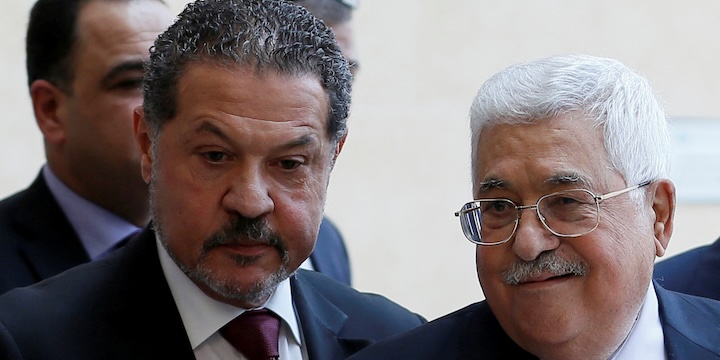
Palestinian President Mahmoud Abbas, accompanied by his son Yasser, leaves a hospital in Ramallah in the Israeli-occupied West Bank, May 28, 2018. REUTERS/Mohamad Torokman
The millionaire businessman son of Palestinian President Mahmoud Abbas has won a steering role in his father’s political party Fatah, a party official said on Sunday, as a succession fight looms for control of the embattled Palestinian Authority (PA).
Yasser Abbas won a seat in elections for the Fatah Central Committee, the party’s highest decision-making body, at its first general conference in almost a decade. Mahmoud Abbas, 90, will remain chairman, it decided.
The PA was set up as an interim administration under the 1990s Oslo accords between Israel and the Palestine Liberation Organization, an umbrella group still internationally recognized as the representative of the Palestinian people. The powerful Fatah party dominates both the PA and the PLO.
Abbas’ son’s foray into politics has fueled speculation that the president may be seeking to position Yasser, 64, to succeed him as head of Fatah.
That has drawn criticism from some Fatah officials, who say Yasser would be unable to unify Palestinians or help them chart a new political future after years without national elections or tangible steps toward statehood.
In the more than two decades since Mahmoud Abbas was elected to succeed Fatah founder Yasser Arafat, Palestinians have come to view the PA as ineffective and corrupt, something denied by Abbas, who has ruled by decree since his mandate expired in 2009.
In 2007, Abbas’ Fatah forces in the Gaza Strip were overpowered by Hamas militants who seized control of the enclave, a year after Hamas swept the Palestinian parliamentary elections.
Peace talks with Israel meant to lead to the creation of a Palestinian state in the West Bank, Gaza and East Jerusalem collapsed in 2014, with expanding Israeli settlements since carving up areas slated for Palestinian statehood. The PA is also grappling with a financial crisis.
Yasser Abbas, who has never held an official role within Fatah or the PA, runs tobacco and contracting firms in the parts of the West Bank where the PA exercises limited self rule. Critics have long alleged that he and his brother Tarek have used public funds to help their businesses, allegations both men reject.
Among others to have won seats on the Central Committee are Majed Faraj, head of the General Intelligence Agency, and former militant group leader Zakaria Zubeidi, released in a Hamas-Israel prisoner-hostage exchange as part of a 2025 Gaza ceasefire.