


Uncategorized
Israeli bobsled captain on Olympics exit: ‘Holy endeavor’ slammed into rigid rule

The man who piloted the Israeli bobsled team to its first-ever Olympic Games defended the athlete-swapping scheme that led to the team’s removal from competition, saying in an interview with the Forward that the Israeli sporting authority blew the incident out of proportion.
The Olympic Committee of Israel said it pulled the team after learning that a member had faked an illness in order to allow the substitution of a teammate in his place.
AJ Edelman, the team’s captain, did not contest that account. He said that the substitution was unanimously agreed to by the group, calling it “essentially a normal maneuver” at the Olympics given what he called a “somewhat arbitrary” rule that allows alternates to compete only when an athlete is medically unable to continue.
The reason it didn’t work, he said, was that the teammate chosen to fake sick tipped off the Israeli committee, which needed to approve the substitution.
“We’re not the only team to have made that sort of substitution in the competition,” Edelman, 34, said in a phone interview with the Forward from Prague, shortly after midnight local time Tuesday. “We are the only team for which the person then was just upset that he was the one doing it and made a scene about it.”
The swap would have made Ward Fawarsy, who was traveling with the squad as an alternate, the first Druze Israeli to appear in Olympic competition. Instead, the committee pulled the team before its third race, cutting short Israel’s run with two heats remaining.
The Israeli committee said in a statement that it had reported the matter to the International Olympic Committee and would conduct an investigation after the Games.
The exit — which Edelman characterized as a voluntary withdrawal — blighted a budding underdog success story. The team, nicknamed “Shul Runnings” (a play on the title of a popular movie about the 1988 Jamaican team), had scrapped its way into the Olympics without financial support from Israel — largely thanks to the perseverance of Edelman, its indefatigable spearhead, who told the Forward he saw the team as a “holy endeavor.”
Without a national sports program behind him, Edelman, a former MIT hockey goaltender, had recruited Israeli athletes from other sports to the project — Zisman was a former pole vaulter, Fawarsy played rugby — and crowdfunded relentlessly to pay for their training. He said this year was the first he broke even, with the team’s costs totaling to around $300,000.
After narrowly missing qualification in 2022 and 2026, Israel broke through in January, receiving an invitation after the United Kingdom decided to send only one team instead of two.
But at the end of a whirlwind month in which the team was burglarized at its pre-Olympic lodgings, booed at the opening ceremony and drawn into controversy involving multiple foreign broadcasters, Israel’s withdrawal left it below teams that crashed in the final results for 4-man bobsled, marked “Did Not Start” on the scoresheet.
Israel also finished last out of 26 teams in 2-man sled.
Taking the plunge

The fake illness plan was set in motion after the second of four heats in the 4-man competition, with Israel in 24th place out of 27 and medaling out of reach.
Olympic rules generally do not allow alternates to compete unless a team member has to withdraw due to injury or illness. The idea to fake an injury, according to Edelman, had been Zisman’s earlier in the year, when it appeared that he, not Fawarsy, would be the alternate. Edelman said he nixed the proposal at the time.
But in Italy, with Fawarsy the alternate due to a pre-Olympics injury, Edelman went for the switch.
“Ward’s inclusion was important because of his years of service to the team, because of who he was and because of who he represented,” Edelman said. “I was quite proud that a group of young Israelis took a look at their brother, their teammate, and said, ‘This is important for you. This is important for us.’”
After the group agreed to the plan, the question became which team member would drop out.
According to Edelman, Zisman thought it should be Menachem Chen, because he had raced with Edelman in the 2-man. But Zisman, Edelman said, “was the weakest performer. And given that Ward’s position was his position in the sled, they were somewhat interchangeable.”
Zisman appeared to begrudgingly go along with the arrangement at first, undergoing a medical exam and signing an affidavit to support the substitution request, according to Israeli officials. But Edelman said that during that process, Zisman volunteered that “another athlete should do it instead, and at that point Israel made it what it became.”
The Olympic Committee of Israel said in a statement that Zisman had admitted to the head of the delegation that he had acted improperly, forcing the committee to withdraw the request and disqualify the move.
“The Olympic Committee of Israel views any deviation from the Olympic values as unacceptable and cannot accept inappropriate behavior,” the OCI statement added. “It should be emphasized that, up to this point, the participation of the bobsleigh delegation has taken place in the spirit of sport and without any violations by the athletes.”
The Israel committee did not respond to questions sent by the Forward, and Zisman did not respond to a request for comment.
Edelman flatly disagreed with the committee’s decision.
“We felt that it was completely fine, given that it was essentially a normal maneuver,” Edelman said. “It was really blown into something that we hadn’t expected. Israel insisted on sort of making an example of the situation.”
Iced out of Italy
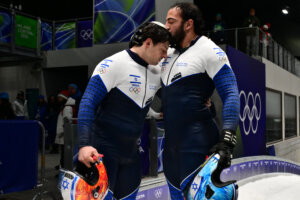
The incident capped a Winter Olympics in which Israel appeared in more headlines due to controversy than competition. The country did not medal at Milan Cortina — it has never medaled at a Winter Games — and most of its athletes ended competition in the bottom half of contestants.
The first Israeli delegation to compete at the Winter Olympics since the attacks of Oct. 7, 2023, was also a frequent target at the Games. Much of the ire from foreign press and other athletes targeted Edelman, who has been a vocal defender of Israel’s war in Gaza on social media.
As Israel was racing in the 2-man event, a commentator for a Swiss TV broadcast listed Edelman’s comments and actions related to the war, which it said were “in support of the genocide in Gaza.” The network later apologized.
An Italian commentator also landed in hot water after he told someone off camera but on live air to avoid the Israeli team.
Edelman said the hostility extended to his fellow bobsled athletes, and claimed that one had called the team “baby killers.” He declined to name the athlete or say what country he represented.
“I take a look at a guy like that, who has made the Olympics a couple of times, and I go, ‘What a loser,’” Edelman said. “He spends his time worrying about Israelis or Jews? What a total loser. So I just don’t put too much stock in it.”
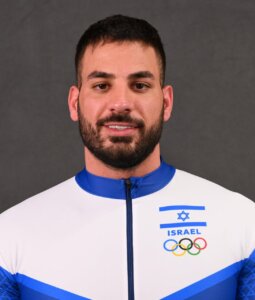
Edelman did not want to highlight the role Fawarsy’s ethnic background played in the team’s decision to break the rules, saying doing so “minimizes him as an athlete and it minimizes him as a person, into something demographic.” At the same time, he appeared to allude to Fawarsy serving in the IDF as a reason for his inclusion.
On Oct. 12, 2023, Edelman posted a picture of Fawarsy to Instagram, writing in the caption that his teammate was “serving on the front lines right now.” (He edited the caption earlier this month to, “Love Ward. Send him a message with your support!”)
“He served Israel with distinction and a level of heroism that all of us aspire to have in our lives,” Edelman told the Forward, adding, “Ward earned it and deserved it as much, if not more, than any of the other guys.”
Fawarsy did not respond to an inquiry.
Frozen fallout
Few in the public sphere have found inspiration in the team’s intentional rule-breaking, even done in service of a Druze athlete’s achievement. Israel’s i24 news broadcast called it a “dramatic and disappointing development.” The Times of Israel said the team’s “legacy was tainted.”
And David Greaves, the president of the Israeli Bobsleigh and Skeleton Federation, told Times of Israel that he was “deeply disappointed in the actions of the team.”
Edelman maintained that the public reaction reflected a lack of context about how the sport tends to operate.
He compared the move to a football player seeking medical treatment to stop the clock or buy time for fatigued teammates. But that ploy, he noted, conferred a competitive advantage his team’s swap had not.
The rule that alternates could not compete was arbitrary in Edelman’s view because it was mostly designed to limit the census of the Olympic Village. He said that other teams had similarly broken the rule with none the wiser.

“When you take a look at the sport from the outside and don’t understand how the sport works, what the usual behavior is in the sport and why things are the way they are,” he said, “the decision seems like a very heavy risk to have taken on. The move is not unusual. It is not uncommon whatsoever.”
It did not appear that any other men’s bobsled teams made substitutions at the 2026 Games. It was unclear how many alternates ultimately competed at Milan Cortina.
At least one alternate was substituted in in another sport: Rich Ruohonen, an athlete on the U.S. curling team, entered competition late in a match with his team facing a near-insurmountable deficit. His throws made Ruohonen the oldest-ever U.S. Winter Olympian. It was unclear how he was able to substitute, and U.S. broadcasters embraced the moment. (Ruohonen could not be reached for comment.)
In a statement to X following news of the team’s withdrawal, Edelman took accountability for the decision and said he believed he had been “putting the country first.” And while he believed Israel was held to a higher standard than other countries, he was not sure that should have influenced his team’s choices.
“A lot of people have asked, ‘Would you do it again?’” Edelman told the Forward. “I think it would have been very hard in the future for all of us to take a look back on it and go, ‘You know, every other team does this sort of thing — we were just not going to get Ward in there because we’re looked at extra harshly if something goes wrong.’
“Again, it’s tough to explain to outsiders who don’t know the sport,” he continued. “So I feel very comfortable and confident in the decision that the team unanimously took.”
The post Israeli bobsled captain on Olympics exit: ‘Holy endeavor’ slammed into rigid rule appeared first on The Forward.
Uncategorized
The definitive Oct. 7 book was written — and sketched — before the attack
As Salomé Parent-Rachdi and Zac Deloupy worked on the drawings for a book about Israeli-Palestinian romance, they had no way of knowing the world they were depicting was on the brink of collapse.
The day they finished their pencil sketches, we learn in the book’s introduction, was Oct. 6, 2023. The next day, Hamas invaded Israel, killing about 1,200 and taking another 251 hostage. By the time the book was published in April 2024, Israel was locked in a multi-front war that still hasn’t quite settled.
That context — a looming attack, a forever war that has not yet begun — colors every panel of Love and Desire in the Promised Land: The Private Lives of Israelis and Palestinians, a French graphic nonfiction book whose English translation was released this summer. Reading the book feels like opening a time capsule that had been buried in the distant past: Even as it reminds you how bad the Israeli-Palestinian conflict was before Oct. 7, it leaves you wishing desperately you could restore things to how they were.
The book follows Parent-Rachdi, a French journalist, as she travels across Israel and the Palestinian territories to interview 16 subjects about their love lives. She talks to a mix of singles and couples, straight and gay, in Israel, West Bank and Gaza. (That’s one giveaway this book couldn’t have been made today: No journalist has been permitted to enter Gaza unaccompanied since Oct. 7.)
A few tell of dating across Palestinian-Israeli lines. Lana, an Arab Israeli, finds herself in a situationship with a right-wing Israeli — and ends up marrying him. Samira, an Arab Israeli woman, tells us about her Israeli ex, whose enlistment during the 2014 Gaza war — when they are living together — brings the unspoken tension in their relationship out into the open. And we learn the complex family dynamics of a celebrity Muslim-Jewish couple: Fauda star Tsahi Halevi and his Arab-Israeli wife, TV anchor Lucy Aharish.
The less politically fraught experiences are relayed with the same empathy. Avi, an ex-Hasid, reveals that, despite unbearable teenage horniness, he initially didn’t know how to find porn on the internet due to his insular upbringing. (He searches for “woman in pajamas” instead.) Rami, Parent-Rachdi’s fixer and taxi driver in Gaza, says, as a single man in his thirties, he told people he had erectile dysfunction so they wouldn’t grow suspicious.
In between these revelations are glimpses of life as it was in Israel and the Palestinian territories before Oct. 7. We ride shotgun as Parent-Rachdi navigates checkpoints on her way out of the West Bank and deals with Israeli and Palestinian officials on the way into Gaza. Rami — who did finally marry — says he made sure his son was born in Jordan so that he wouldn’t be trapped in Gaza as an adult. Parent-Rachdi has brought his stepson a remote-control car — the kind of toy Rami can’t buy in Gaza due to the Israeli blockade.
The love stories describe conflict, of course, and they do not uniformly lead to happy endings. (Or for that matter, breakups.) What they consistently show instead is people — as far as we can tell, basically good people — reaching out to each other in a pressure cooker of cultural, religious, sexual and political attitudes.
The stories also betray civilians’ genuine skepticism of their own communities with a frankness that seems unimaginable today. The clearest example of this comes in Gaza, where Mohammed, a closeted Palestinian looking for hookups, tells Parent-Rachdi about Hamas honor killings of gay men and his own brush with death. “They’re more likely to kill you if you’re a bottom,” he says matter-of-factly. Catfished by a Hamas intelligence officer, Mohammed escapes arrest by swearing he’s a virgin and flees to the U.S. a few days later.
Would Mohammed make the same disclosures today, when “What about Hamas?” has become a refrain for anyone defending Israel’s response to Oct. 7? The Gaza he left behind no longer exists. The book’s afterword, written in Feb. 2024, reveals that Rami’s wife’s cosmetics store — lovingly illustrated by Deloupy earlier in the book — was leveled in Israeli airstrikes; the family was now living in a refugee camp in Rafah. “We have gone from a life with all the modern comforts to a reality where we move with a cart, where we buy wood to split and burn in order to cook and take a shower,” he says.
As for Mohammed, his house was destroyed, as were many friendships with Jews and Israelis: “I write to them,” he says in the afterword. “They don’t respond, but they read my message.” As for Hamas, he says, “today, seeing the suffering, somehow I feel like I better understand their resistance.” When the authors checked in with the subjects, several did not respond. By then, some 30,000 Palestinians were dead.
As it reminds us what we’ve lost, Love and Desire in the Promised Land also points the only way toward a shared future: people on all sides defying the forces pulling them apart. It shows us it can be done. Even in the afterword, one of the interviewees, a Modern Orthodox Jew named Jean-Marc, is optimistic: “I am still convinced, even more so now, that we have to work with the Palestinians,” he says. “Our safety depends on it.”
The post The definitive Oct. 7 book was written — and sketched — before the attack appeared first on The Forward.
Uncategorized
Christian leaders are racing toward the Rapture. Is Israel really to blame?

End Times Fascism: And the Fight for the Living World
By Naomi Klein and Astra Taylor
Farrar, Straus & Giroux, 384 pages, $32
Judaism is not usually a religion associated with apocalyptic thought. There’s no Jewish version of the Book of Revelation. There is a concept of a Messianic Age, but most observant groups forbid interfering with — encouraging or discouraging — its arrival.
Yet Judaism, or at least Israel, is central to Christian apocalyptic thought. The lines that drive its connection to Israel are well-traced. The Book of Revelation requires Jews to return to the promised land, and a Third Temple to be built for Jesus to return, and so, for years, Christian Zionists like John Hagee, the founder of Christians United for Israel and Mike Huckabee, the current U.S. ambassador to Israel, have encouraged wars in the region, seeing them as part of prophecy.
Hagee and Huckabee have talked in glowing terms of the many lands they believe comprise “greater Israel” all becoming part of the modern nationstate, in fulfillment of biblical requirements for the Rapture. Byron Stinson, another wealthy evangelical leader, has worked to breed and import blemish-free red heifers to Israel, because their ashes are necessary to build the Third Temple that will herald the return of Jesus.
More recently, the Jewish extremists who are also hungry to build a Third Temple have moved from the fringe into the Israeli government. Several times now, Israeli security minister Itamar Ben-Gvir has stalked around the Temple Mount, where Jews are officially forbidden from prayer, and led a large group in prayer, flanked by the police force he heads. Bezalel Smotrich, Israel’s minister of finance, has promised to fund the construction of a Third Temple.
But as powerful as these Jewish leaders are, the Christians are far bigger. CUFI, the group led by Hagee, is the biggest Zionist group in the U.S., far larger than AIPAC.

And yet End Times Fascism, a new book from activists and writers Naomi Klein and Astra Taylor — Klein is known for books like No Logo and Shock Doctrine, where she coined the relevant term “disaster capitalism” — focuses largely on Israel, and the extremists in its government.
The book’s central argument is that accelerationist fanatics believe an apocalyptic future will benefit them — whether in heaven or on earth. And they’re racing toward that future with increasingly fascistic terms.
These apocalyptic futures vary. For Christians, it might be the Rapture, and ultimately heaven. For AI techies, it’s a world ruled by the silicone grip of an all-knowing machine — or at least a world ruled by the superrich and filled with AI-driven propaganda masquerading as the voice of God while it surveils its users. For ethno-nationalists, it’s a homogenous country in which they can live out their nostalgia for an imagined perfect past. End Times Fascism is divided into sections, each taking on one of these groups and its ravenous vision for the end of the world, and how it is leading the world into fascism — through moral policing, surveillance, xenophobia.
But in the section on religious extremism, Israeli extremists get at least as much airtime as the Christians, despite the fact that these end time fanatics have far less global influence and don’t represent the vast majority of Jews.
It is, of course, important to understand the interplay between Christian apocalyptic thought and Judaism, and this is where things can get tangled. Christian Zionists’ desire for the Rapture leads them to support Israel and, sometimes, to display a kind of philosemitism. Ultimately, they are neither true friends to the Jews nor supporters of Israel; Hagee once gave a sermon claiming God sent Hitler as a kind of shepherd to force Jews back to Israel, in alignment with the biblical plan — when, of course, Jews will convert or burn in hell. But these beliefs have not made most Jewish groups cut ties with CUFI; Israel’s prime minister, Benjamin Netanyahu, has, for decades, referred to U.S. Christian Zionists, and Hagee in particular, as beloved supporters of Israel, and has said that Christian Zionists made Jewish Zionism possible. Many Jews are similarly grateful for evangelical support of Israel, regardless of what less supportive beliefs might undergird it, and are willing to ally with these religious extremists if it means support for Israel’s wars and annexations.

Certainly, all of these thoughts build on one another, and are difficult to untangle; plenty of hawkish Jews and Israelis want Israel to expand for non-biblical reasons. But the vast majority of Jews are not actively working to build a Third Temple and bring about the end of the world as we know it. Yet Klein and Taylor represent Jews largely through extremists like Ben-Gvir, and even focus their discussion of Christian apocalyptic thought on its overlap with Judaism and Israel. These religions share the Hebrew Bible, but little else.
There is far more to Christian apocalyptic thought than Israel. Plenty of Rapture-hopefuls in the U.S. believe their own country is the promised land; indeed, theological power is shifting away from Israel, as a new cohort of Christian extremists like Candace Owens, Nick Fuentes and Tucker Carlson catch hold of the political discourse and steer it toward open antisemitism and harsh scrutiny of U.S. support of Israel.
The old guard is being replaced by a new Christian right that is suspicious of Israel’s every action, and doesn’t egg on its wars. When Tucker Carlson interviewed Ted Cruz, a staunch supporter of Israel, the senator explained the Christian theological grounding of his support for Israel; Carlson, also a loudly devout Christian, jeered.
That’s not to say, of course, that there aren’t still many Christian Zionists in power in the U.S., shaping its foreign policy regarding Israel. But End Times Fascism feels as though it is stuck in a previous era of American Christianity, and of U.S. politics.
This problem is not limited to the section on religious apocalypse. The second part of the book, focused on the AI hunger of transhumanist tech titans, spends time on neoreactionary thinker Curtis Yarvin’s plan for a New Gaza, as it was presented at a Peter Thiel conference. Thiel is, himself, a Christian who is famously obsessed with the antichrist and the end of the world — once again, there is crossover, and these topics all share threads. But Israel is not the major driver of the race toward AI killing us all, or any other tech-related doom.
The fundamental idea of Klein and Taylor’s work is that rapturous obsessions drive not only worldly destruction — that much seems obvious — but also fascism. It’s a smart idea, and they have plenty of examples, whether surveillance by our internet overlords or ICE raids pushed for by white nationalists. But the book spends so much time on its trendiest target — Israel — when it should direct its energy examining figures like U.S. Secretary of Defense Pete Hegseth and the muscular Christianity driving his new testosterone regime for the U.S. military, or influential online figures like Owens or Fuentes agitating for a white, Christian U.S. (Some of these influencers are mentioned, but not as primary drivers.)
Certainly, Israel is involved in U.S. politics, in Christian nationalism, in the building of an ethnostate. (Israel in fact appears least in the third section on ethnonationalism, which is surprising given its identity as a Jewish state.) But despite Israel’s importance, the U.S., and its leaders, are still far more powerful.
The issue might be the book’s structure. The idea that apocalyptic thought drives fascism is a fairly simple one, and many of Klein and Taylor’s examples are familiar. The idea that is more subtle, and harder to grasp, is the way the threads of eschatological thought, ethnonationalism and tech wealth all share ideas and shape each other.
Peter Thiel alone, given his tech companies, his antichrist obsession, his love of Nazi theorists and his influence over Vice President JD Vance, could generate at least a chapter in any of the book’s three sections, or serve as a throughline for the entire book. Yet the topics are divided, as though each form of apocalyptic thought is its own entity, instead of woven together to show the ways they all reinforce each other.
End Times Fascism closes with a section on how to fight the rising fascism. Perhaps this should be the main focus of the book; many people who read the news already feels as though our leaders are racing toward the apocalypse, or at least WW III and a second Great Depression. The real question is what to do.
End Times Fascism offers some inspirations, including New York City’s mayor, Zohran Mamdani, as well as the Jewish Labor Bund. At least if the focus is once again on Jews, this time it’s positive.
The post Christian leaders are racing toward the Rapture. Is Israel really to blame? appeared first on The Forward.
Uncategorized
Why Dolly Parton sang a song about a Jewish journalist

A Broadway show, a star-studded television tribute, a new hotel and museum in Nashville. As odes to Dolly Parton keep coming, a recording of the late country music singer honoring an American Jewish journalist has recently surfaced.
Never before released in America, the song, “A Bridge Across,” sung by Parton and accompanied by the Nashville Symphony, honors slain journalist Daniel Pearl.
The song features spare lyrics set to violin music composed in honor of Pearl, a Wall Street Journal reporter who was brutally murdered by terrorists in Pakistan in 2002.
Originally recorded in 2008 by Parton, renowned fiddler Mark O’Connor, and the Nashville Symphony, the song was intended to be part of a compilation album called This is My America, produced and funded, oddly enough, in Canada but never released in the U.S.
It was O’Connor and his wife Maggie who resurrected the recording this fall, shortly after the deaths of Parton and another musician that connected the four artists: Oregon violinmaker Jonathan Cooper, who died in September.
Deeply troubled by the journalist’s murder in 2002, Cooper learned Pearl was an amateur fiddler and set out to create a quartet of string instruments – two violins, a viola and a cello – in the journalist’s honor. He entrusted the instruments to O’Connor to use during his annual summer music camp in North Carolina. Every year since, four students from the camp have received one of the Daniel Pearl memorial instruments to play for a year.
“These young people carry the message that love fights hatred through music-making and understanding that Daniel Pearl’s family want him remembered for,” O’Connor told The New York Times. Likewise, Cooper’s loving gesture inspired Parton, O’Connor said.
Canadian violinist Samantha Robichaud received one of the violins in 2005 and has gone on to become a successful recording artist with more than a half dozen albums. She has toured North America as an ambassador for the Daniel Pearl Foundation, sharing Pearl’s story, including his passion for

music and its power to change lives. Enter songwriters Tom McBryde and Lynn Wilbanks, whose introduction to Robichaud inspired verse.
On the album, the Nashville Symphony played one of Robichaud’s compositions while Parton introduced Pearl to listeners.
“He believed that music was something that could cross all social barriers, political borders and imaginary boundaries,” Parton says, before singing McBride’s and Wilbanks’ lyrics.
“A bridge across a question one journey begins, one step at a time to a place within.
A bridge across a border, a hand reaching out one heart at a time to erase the doubt.
A bridge across a difference can close a divide, one song to be sung on the other side.”
“It was perfect. She knows what he stood for,” Pearl’s father, Dr. Judea Pearl, told the Forward. “She was such a giving person.”
Judea Pearl met Parton in 2018 at the Los Angeles Press Club where she received that year’s Public Service Award for Contributions to Civic Life for her Imagination Library, which sends free books to children. (It inspired the creation of the PJ Library for Jewish books.) The Press Club recently dedicated its upcoming National Arts & Entertainment Journalism Awards to Parton’s memory.
In 2018, Judea Pearl was there to present the Daniel Pearl Award for Courage and Integrity in Journalism to Saudi Arabian writer and blogger Raif Badawi whose wife accepted the award while he served a 10-year prison sentence for his online activism.
The foundation devoted to Daniel Pearl’s legacy has been less visible since the 2021 death of Pearl’s mother Ruth who, as a young girl, witnessed and survived the anti-Jewish pogroms in Baghdad known as the Farhud.
As the 25th anniversary of his son’s murder approaches in February, Judea Pearl said the foundation will start a new chapter under his daughters’ leadership. Parton’s song lends the effort a touching soundtrack.
The post Why Dolly Parton sang a song about a Jewish journalist appeared first on The Forward.
