


Uncategorized
Could this be the most Jewish musical that never admits its own Jewishness?
There’s a moment in the musical Oliver! when Fagin launches into one of Lionel Bart’s deliciously minor-key melodies, and suddenly the show feels about as Victorian as a hot pastrami on rye. Oliver! may be the most Jewish musical ever written that refuses to admit as much, and watching Simon Lipkin’s sly, buoyant portrayal of Fagin on London’s West End recently, I felt a jolt of something I hadn’t expected:
Home.
Not literal home, but the emotional topography of my family’s Friday night dinner tables where Holocaust survivors, former Yiddish theater actors and comedians filled the empty chairs left behind by Auschwitz itself. Improbably, Oliver! belonged to them too.
The musical’s West End revival underscores this. At a moment when antisemitism is still frighteningly on the rise, and theaters everywhere are re-examining the stories they tell and who gets to tell them, Oliver! has slipped into surprisingly contemporary territory. Matthew Bourne’s production doesn’t necessarily announce that it is a “Jewish” interpretation, but it acknowledges the show’s long, complicated history with a lighter touch and a sharper awareness. Watching Lipkin lean into the character’s humor and inherent Jewishness (“Oy, a broch!” he cries out emphatically at one point, beating his heart with his fist) but without the burden of caricature, I realized how the work has evolved — quietly, confidently — and how audiences have evolved along with it.
It’s impossible to miss the Jewish musical DNA in Bart’s score. The minor keys, the phrasing (“Such a sky you never did see!”), the cantorial wails that hold joy and heartbreak in the same breath: These were familiar to me long before I knew what to call them. Bart may have been writing about Victorian street urchins, but he couldn’t escape the musical instincts of his upbringing in London’s East End where he was born Lionel Begleiter. The melody of “Pick a Pocket or Two” could pass for a klezmer romp at a Hasidic wedding; “Reviewing the Situation,” sung by Fagin when he finds himself at a moral crossroads, is practically a cantor’s aria, ornamented with flourishes I’ve heard at countless High Holiday services.
There’s nothing explicitly Jewish in the script — no references or labels — yet many of the melodies feel instinctively Jewish in their rhythms and slyness. And that instinct carried me back to a question I’ve often considered since childhood:
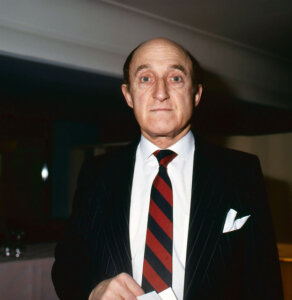
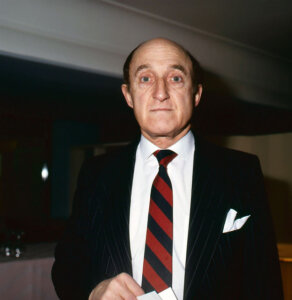
How did Ron Moody, who originated this comic version of Fagin in 1960 and reimagined him for the 1968 film, manage to get away with it?
When I first saw Moody’s Fagin on screen, I was captivated by his portrayal. But I also didn’t understand how someone could play such a Jewish rogue at a time when Dickens’ caricature of “the Jew” still hovered uneasily in our cultural memory. Whenever I try to think of famous Jews on stage, the first two that pop into my head are villains: Shylock and Fagin. Shakespeare’s Merchant of Venice has been around forever, first published in 1600. But Oliver! debuted only 14 years after the Holocaust — the role should have been a minefield. Yet critics adored him, Jewish audiences embraced him, and Moody’s Fagin became beloved, not reviled.
Years later, when my friendship with Moody began — after he’d expressed interest in playing a villain opposite Carrie Fisher in a horror-comedy film I’d written — I was surprised by how different he was from the man onscreen. Soft-spoken and unmistakably British; nothing like the quicksilver trickster he was so skilled at portraying. He could summon that twinkle instantly, of course, but it wasn’t his resting state. He was in his early 60s then, newly delighted by late-in-life fatherhood, devoted to his younger wife Therese and their first child (whom he called “Boo-boo” with disarming tenderness). As more children arrived — he ultimately had six — I would tease him about assembling his own soccer team, which amused him to no end.
His Fagin, I came to realize, wasn’t a caricature but a cultural inheritance he carried lightly — a set of rhythms and comic cadences he understood from growing up as Ronald Moodnick in a warm Jewish household. And that was why the performance didn’t offend, and why it felt so familiar.
Though my mother lit the Sabbath candles and whispered the Hebrew blessing each Friday night, our dinners were less about religious ritual than about the rebuilding of a life she had salvaged from Auschwitz with nothing but willpower and the hope of joy still intact. In New York, she fashioned a new family out of survivors, actors from the Yiddish theater, and intellectuals whose humor carried both bruises and brilliance. These friends became surrogate aunts and uncles to my sister and me.
My mother was endlessly curious and had a gift for gathering people. She co-hosted a weekly language club with radio personality Barry Farber, a Southerner who startled me by speaking fluent, musical Yiddish. Occasionally he’d turn up at our Friday night table alongside an unlikely combination of guests, including my Bostonian Jewish piano teacher, a wryly funny family friend who once published an anarchist newspaper in Cuba until Castro forced him to flee, other European Holocaust survivors, and whichever schoolmates of mine my mother decided ought to be fed. The orbit was colorful and improbable, but it made sense. These were people who made her feel alive.
Some of our guests were well-known in the Yiddish arts — like Fyvush Finkel and his wife, Trudi; Broadway stage actors Muni Seroff and Irving Jacobson; Malvina Rappel, who had appeared in the classic Yiddish film Motel the Operator (Motl der Operator) and later hosted a radio program on WEVD back when it still broadcast in Yiddish.
Friday nights tended to unfold the same way: dinner first, then an impromptu cabaret. Someone sat down at the piano; someone else — usually my parents — burst into song or shtick. In an instant, our modest living room became a sort of vaudeville house. It was unself-conscious and exuberant, a weekly affirmation that even those who had lost everything could conjure laughter with astonishing force.
I didn’t know it then, but this was an education. Not in religion, but in rhythm. In timing. In the strange alchemy that binds sorrow to humor. Long before I ever wrote a script, I had already absorbed the comedic cadences that would shape my work.
As I grew older, that early immersion quietly charted the course of my career. Writing my book They’ll Never Put That on the Air brought me into long, generous conversations with some of the greatest architects of American television comedy — Carl Reiner, Larry Gelbart, Norman Lear, David Steinberg — artists whose work dismantled censorship and altered the medium. They offered insights I hear in my head to this day when I write.
In one of those unlikely, full-circle pinch-me moments, a few years ago I found myself directing Mel Brooks in the recording booth for Flower of the Dawn, an animated musical film I co-wrote and produced. Mel quickly corrected a joke of mine on the spot: “You’re cluttering the line with all this extra stuff at the end. End it here, with the punch!”
What stayed with me wasn’t just the correction; it was the realization that the comic instincts I’d carried since childhood had an architecture. Mel didn’t echo my family’s living room cabaret; he clarified what all that laughter had taught me.
So when I sat in the Gielgud Theatre watching Simon Lipkin give Fagin new life, it felt less like a reinterpretation than a recognition. Lipkin wasn’t parroting Moody — he was putting his own youthful spin on the role, while tapping into the same emotional and musical DNA: a blend of humor, vulnerability and those unmistakable minor-key inflections that carry an entire history inside them.
Not everyone in that audience heard what I heard. But I did. And for a moment, the distance between my family’s living room and a West End stage felt very small.
The post Could this be the most Jewish musical that never admits its own Jewishness? appeared first on The Forward.
Uncategorized
Syria Will Stay Out of Iran conflict Unless It Faces Aggression, President Says

Syrian President Ahmed al-Sharaa attends the Ministry of Awqaf conference titled “Unity of Islamic Discourse” at the Conference Palace in Damascus, Syria, Feb. 16, 2026. Photo: REUTERS/Khalil Ashawi
Syrian President Ahmed al-Sharaa said on Tuesday that his country will stay out of the US-Israeli war against Iran unless Syria is subject to aggression and has no diplomatic solutions.
“Unless Syria is targeted by any party, Syria will remain outside any conflict,” the Syrian president said at an event hosted by think tank Chatham House in London.
“We do not want Syria to be an arena of war. But unfortunately, today, things are not governed by wise minds. The situation is volatile and random,” the president said.
The month-long conflict has spread across the region, killing thousands, disrupting energy supplies, and threatening to send the global economy into a tailspin.
“We want Syria to have ideal relationships with the entire region, with Lebanon, Iraq, Turkey, Saudi Arabia, and world powers like the UK, France, Germany, and the US. I think that Syria is qualified to start a strategic relationship network,” he said, responding to a question on whether Syria would stay neutral while the conflict goes on.
Syria has been keen to stay on the sidelines of the regional conflict that has pulled in neighboring countries, including Lebanon, where armed group Hezbollah is locked in fighting with Israeli ground troops, and Iraq, where Iran-aligned factions have launched drone and rocket attacks.
Syria sent thousands of troops to its western border with Lebanon and its eastern border with Iraq earlier this month. Syria‘s defense ministry said the deployment was part of efforts to “protect and control the borders amid the escalating regional conflict.”
“We had enough war. We paid a large bill. We are not ready for another war experience,” Syria‘s president said.
Uncategorized
Europe Shows Unwillingness to Help With Iran War, Pushes Back on Some US-Israeli Military Operations

US President Donald Trump and French President Emmanuel Macron react on the day of a press conference, at the White House in Washington, DC, US, Feb. 24, 2025. Photo: REUTERS/Evelyn Hockstein
France and Italy have pushed back against some US-Israeli military operations, sources said on Tuesday, as US President Donald Trump criticized NATO allies in Europe as unhelpful in the month-long war in Iran, highlighting divisions.
The decisions came against a backdrop of tensions between Washington and key partners over the war. Earlier this month, Trump called longtime NATO allies “cowards” over their lack of support. On Tuesday, he slammed countries that did not help in the US-Israeli strikes.
FRANCE SAYS NO
Trump accused France of blocking aircraft carrying military supplies to Israel from flying over its territory, writing on Truth Social that France had been “VERY UNHELPFUL.”
The French presidency said it was surprised by the post and said its decision was consistent with France’s policy since the conflict began.
A Western diplomat and two sources familiar with the matter told Reuters earlier that the refusal, which happened at the weekend, was the first time France had done this since the start of the conflict on Feb. 28.
The sources said Israel had wanted to use France’s airspace to transport US weapons to be used in the war against Iran.
Israel’s defense ministry accused France of actively obstructing the transfer of munitions to Israel, according to a statement.
It said the French ban was imposed despite prior coordination and assurances that the munitions were intended solely for use against Iran, adding that the effort was critical to European security.
The ministry said Israel would cut all defense procurement from France and would have no new engagement with the French military. French arms sales to Israel are relatively small, and it was unclear whether the move would affect French troops serving with UN peacekeepers in Lebanon.
ITALY DENIES PERMISSION
Italy last week denied permission for US military aircraft to land at the Sigonella air base in Sicily before heading to the Middle East, sources said.
According to the Corriere della Sera daily, which first reported the news, “some US bombers” had been due to land at the base in eastern Sicily before flying on to the Middle East.
Italy’s Defense Minister Guido Crosetto later denied any rift with Washington or any change in policy. He posted a message on X to say that US airbases remained active, but that Washington needed special permission for uses outside existing agreements.
SPAIN IS MOST VOCAL AGAINST WAR
Meanwhile, Spain defended its decision to fully close its airspace to US planes involved in attacks on Iran.
Prime Minister Pedro Sanchez has been among the most vocal critics of the US and Israeli strikes and Defense Minister Margarita Robles said Spain will only allow for the use of its bases for the collective defense of NATO allies.
Trump also singled out Britain as being unhelpful, just as Buckingham Palace confirmed King Charles and Queen Camilla will pay a state visit to the US in late April.
He wrote on Truth Social: “All of those countries that can’t get jet fuel because of the Strait of Hormuz, like the United Kingdom, which refused to get involved in the decapitation of Iran, I have a suggestion for you: Number 1, buy from the US, we have plenty, and Number 2, build up some delayed courage, go to the Strait, and just TAKE IT.”
The United States, France, Italy, Spain, and Britain are all NATO members, as is Germany, which hosts Ramstein, the largest US base in Europe.
Germany said early in the war there were no restrictions on the US using the base, though the issue has been debated after President Frank-Walter Steinmeier said he believed the war was illegal.
US Defense Secretary Pete Hegseth declined on Tuesday to reaffirm Washington’s commitment to NATO’s collective defense, saying that would be up to President Donald Trump after key European allies refused to stand with the United States in the war against Iran.
Asked by Reuters at a news briefing if the US is still committed to NATO’s collective defense, Hegseth said: “As far as NATO is concerned, that’s a decision that will be left to the president. But I’ll just say a lot has been laid bare.”
In apparent reference to tensions with NATO allies France, Italy, Spain and Britain, Hegseth said “when we ask for additional assistance or simple access, basing and overflight, we get questions or roadblocks or hesitations.”
“You don’t have much of an alliance if you have countries that are not willing to stand with you when you need them. [Trump is] simply pointing that out, and ultimately, it’ll be his decision of what that looks like,” Hegseth said.
Uncategorized
Toronto Police Allow Anti-Israel Protests Outside Synagogue, Other Jewish Sites

Illustrative: Hundreds of anti-Israel protesters, primarily university students, rally at Toronto’s Nathan Phillips Square on Oct. 28, 2023. Photo by Sayed Najafizada/NurPhoto
Protesters in Toronto this past weekend demonized the Jewish state through provocations such as chanting accusations of terrorism outside of a synagogue and destroying an effigy of Israeli Prime Minister Benjamin Netanyahu with a noose around his neck.
Israel’s consul general in Toronto, Idit Shamir, blasted Toronto police, charging they had failed to follow a recent pledge to prevent demonstrations outside of Jewish institutions.
“One week ago, Toronto Police banned pro-Palestinian protests at Bathurst and Sheppard, the heart of Toronto’s suburban Jewish community, after two years of documented harassment and antisemitic displays targeting the people who live, pray, and send their children to school there,” Shamir wrote on X. “Today, one week later, police escorted a pro-Palestinian protest through that same intersection.”
Shamir described how the anti-Israel advocates marched “past Darchei Noam Synagogue. Past the Toronto Heschel School. Past the L’Chaim Seniors Residence. Masked demonstrators chanted that Zionists are racists and terrorists.” He added that “small groups broke off onto side streets to reach Jewish residents more directly. No arrests. The ban held exactly as long as the gap between demonstrations.”
In making his statement, Shamir shared a video posting from lawyer Caryma Sa’d, a journalist and self-described satirist running a “Protest Mania” website whose footage vividly documented the events. The video features a man saying to Toronto police, “You gotta start enforcing the law. I don’t know who gives you your mandate, but start enforcing the law.”
Concluding his statement, Shamir wrote: “In Hebrew, there is a word for this: hefker. הפקר Ownerless. Abandoned. Beyond protection. Every generation of Jews has known a city where that word became real. I did not expect Toronto to be mine.”
In analyzing the event, the Combat Antisemitism Movement said that “Toronto Police have not explained why the march proceeded along this route. The gap between policy and enforcement remains clear — and so do the questions about whether Jewish residents are being protected in practice.”
In further videos shared by Sa’d, demonstrators and pro-Israel counter-protestors exchanged profane insults on Sunday with accusations of “Rape supporters!” and vulgarities like “Dirty c—t! F—k you, f—king losers!” A video of activists on Saturday shows one man who calls a yellow-jacketed police officer a “dumb f—k.”
The Canadian Antisemitism Education Foundation (CAEF) stated that “Toronto Police would not tolerate a white supremacist parade up and down Jane St. between Finch and Steeles. So why are Toronto’s Jews required to tolerate a hate parade in the part of the city where we make our homes and community?”
Toronto’s law enforcement defended the decision to sanction the protestors’ route. “Officers ensured the group did not enter residential streets, and no arrests were made,” a police spokesperson said.
The spokesperson explained that the ban “does not apply to lawful demonstrations at the main intersection and along major roadways. Demonstrations have taken place at this intersection for several years. They can be tiring, disruptive, and distressing – but that does not make them illegal. Demonstrations are protected under Canadian law, and enforcement action is taken when there are reasonable grounds to believe a criminal offence has occurred.”
Another report of a Toronto protest over the weekend said that demonstrators burned Israeli and American flags. One individual took an effigy of a noosed Netanyahu and spit on its head before stomping the symbol of Israel’s leader.
According to Israel National News, demonstrators proclaimed, “We will sacrifice our souls and our blood for Al-Aqsa and Palestine.” Other chants asserted that “resistance is justified when a people lives under occupation” and declared that “the only solution is intifada.”
According to A Dictionary of Modern Written Arabic, the word “intifada” translates as “to be shaken off, be dusted off; to shake; to shudder, shiver, tremble; to shake off from oneself; to wake up, come to consciousness.”
Since the 1980s, the term came to refer to two distinct efforts by Palestinian terrorists to murder Israelis and destroy the Jewish state, with the first period starting in 1987 and the second in 2000. Anti-Israel activists today now regularly demand that supporters of the Palestinians seek to “globalize the intifada,” meaning engage in violence and terrorist acts everywhere. In an interview with cable host Al Sharpton on Sept. 7, then-New York City mayoral candidate Zohran Mamdani said he would “discourage” use of the phrase. He had previously refused.
Mirroring trends around the planet, Canada has seen a surge in recent years of antisemitic hate crimes, pro-terror advocacy, and vulgar street demonstrations with Toronto as the epicenter.
On March 10, Toronto Police Deputy Chief Frank Barredo said that according to witnesses, two men drove up to the US consulate in a white SUV and fired a handgun at the building before fleeing in the vehicle.
Royal Canadian Mounted Police Chief Superintendent Chris Leather announced an increased security presence at the US and Israeli consulates in response, saying at a press conference that “these consulates deserve a heightened amount of vigilance and security at this time in the hopes that we can bring the temperature down in the coming days and weeks.” Vandals in Toronto have previously shot bullets at a Jewish-owned restaurant and at a local synagogue.
B’nai Brith has documented the rise of antisemitism in Canada, with the organization’s 2024 audit finding a 7.4 percent increase from 2023, reaching 6,219 for the highest total ever recorded since tracking began in 1982.
On Sept. 21, 2025, Canada joined with its Anglosphere allies the United Kingdom and Australia in choosing to recognize a Palestinian state.
Canadian Prime Minister Mark Carney asserted at the time that “this in no way legitimizes terrorism, nor is it any reward for it.”