


Uncategorized
Debunked Hamas Casualty Figures and Their Impact on Reporting

Palestinian gunmen stand guard on the day that hostages held in Gaza since the deadly Oct. 7, 2023, attack, are handed over to the International Committee of the Red Cross (ICRC), as part of a ceasefire and hostages-prisoners swap deal between Hamas and Israel, in Khan Younis, southern Gaza Strip, Oct. 13, 2025. Photo: REUTERS/Ramadan Abed
Since October 7, 2023, Hamas has shaped global public opinion through its propaganda warfare. The terrorist organization excitedly recorded and uploaded the atrocities committed against Israelis that day to social media platforms, and those who saw any trace of it were rightfully horrified.
But shortly after, when the images weren’t as fresh and no longer front-page news, Hamas turned to a new strategy — playing victim to the Israeli army. And since then, the media has run with it.
For instance, on October 17, 2023, reports claimed an explosion occurred inside the Al-Ahli Hospital. The media rushed to re-print Hamas’ claim that more than 500 people had been killed.
Evidence then came out that displayed it was a parking lot adjacent to the hospital that had been hit by a misfired Palestinian Islamic Jihad rocket, and the casualties were fewer than reported.
The media has continued this pattern since. Any death toll that the Hamas-run Ministry of Health (MoH) publishes is immediately reported on by Western media, oftentimes without any attribution to Hamas.
This has resulted in blood libels being printed on the front pages of newspapers, blaming Israel for targeting non-combatants, including women and children.
But the vast majority of the casualty numbers that have been used throughout the war have been purposefully misrepresented by Hamas.
As of December 2025, the Hamas-run MoH has claimed that over 70,000 people have died in Gaza since the start of the war.
But further analysis done by Salo Aizenberg, a board member of HonestReporting, displays that this includes the casualties of Hamas fighters, natural deaths, and internal fighting amongst Gazans.
While the analysis is based on informed estimates, and the precise toll may take years to verify, it nonetheless highlights the extent to which Gaza casualty figures have been misrepresented in media coverage over the past two years.
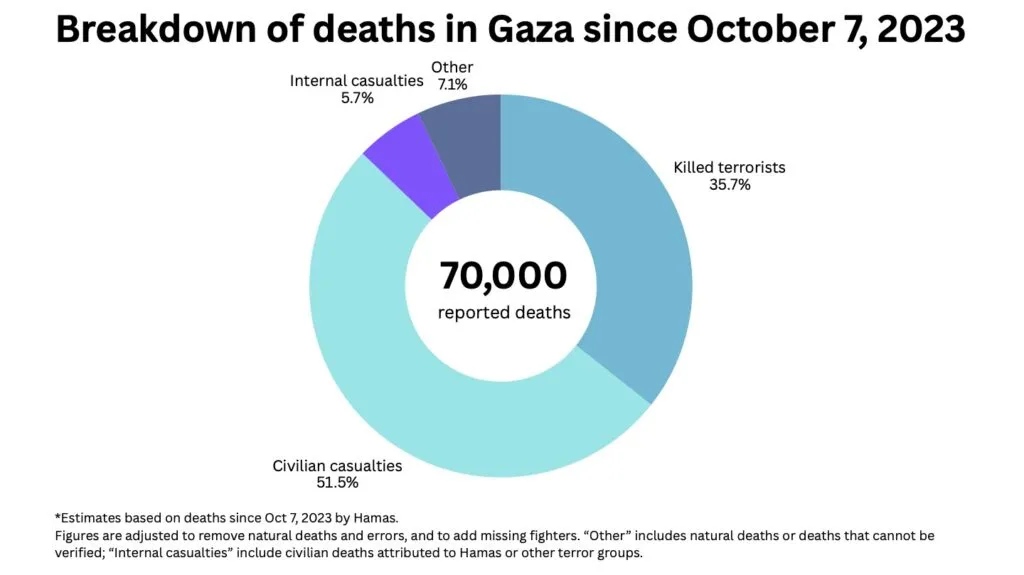
Although it is difficult to determine the exact number of terrorists killed by the IDF since the beginning of the war, estimates suggest the number to be more than 22,000 as of October 2025, not including those who were killed during the terrorist attacks on October 7. President Donald Trump has confirmed the number to be greater than 25,000, the number used in Aizenberg’s analysis.
Beyond combatants, throughout the war, there were likely to be around 11,000 natural deaths, based on pre-war patterns. Another 4,000 deaths were caused by internal fighting within Gaza from different factions, including firing on civilians at aid sites or executions of individuals Hamas deemed to be collaborating with Israel. An additional 1,000 estimated deaths can be attributed to errors in reporting.
After removing these casualty numbers from the total of 70,000, there are a remaining 54,000 deaths. Of the 54,000, one can reasonably assume that around 25,000 were terrorists, leaving 36,000 civilian casualties. While every innocent civilian casualty is a tragedy, this is nonetheless a remarkably low civilian-to-combatant ratio of 1.45:1, especially given the circumstances of urban warfare.
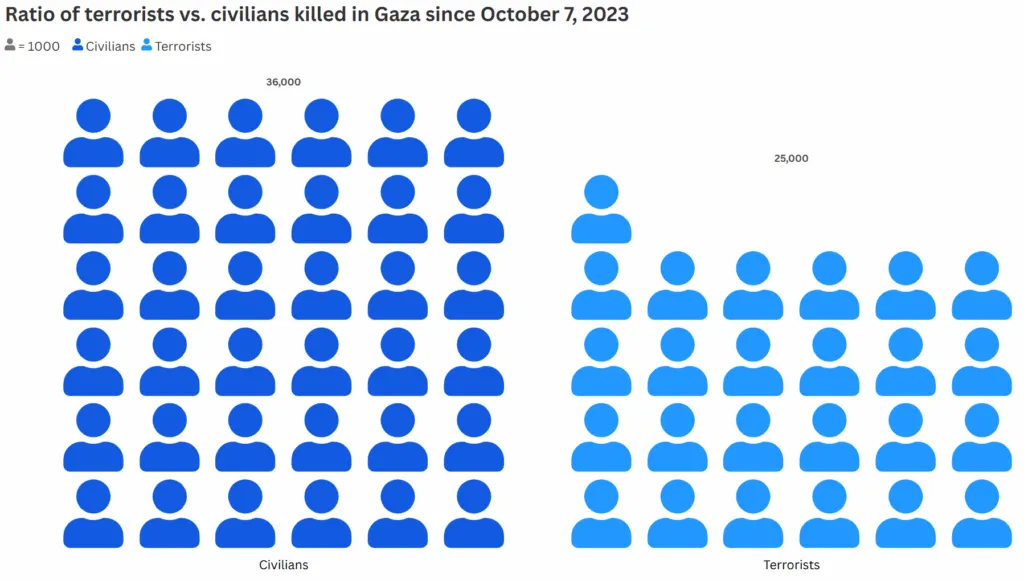
Visualization based on data by Salo Aizenberg.
These numbers entirely dispute the claims that the majority of deaths are civilians — a claim the media has previously made. One “investigative” piece done by The Guardian and +972 Magazine, published in the summer of 2025, claimed that 83% of casualties were civilians.
What the outlets willfully omitted, however, was that this figure counted only terrorists whom the IDF had identified before the war and could conclusively confirm as eliminated, excluding thousands of combatants who could not be identified during the fighting. By presenting this partial dataset as comprehensive, the article created a misleading impression that was then cited as authoritative.
This information is not necessarily new either.
A December 2024 report by the Henry Jackson Society found that 84% of the publications analyzed failed to make the critical distinction in total numbers between combatant deaths and civilian deaths, further illustrating the extent to which misleading casualty narratives have been allowed to take hold. The report also found that men of combat age were disproportionally represented, and natural deaths were included in casualty statistics.
Perhaps even more telling is the ratio between male and female casualties. Males of combat age (18-59) died at 3x the rate of women the same age, resulting in a 3:1 ratio. The 32,690 deaths of men of combat age account for 46.7% of total casualties.
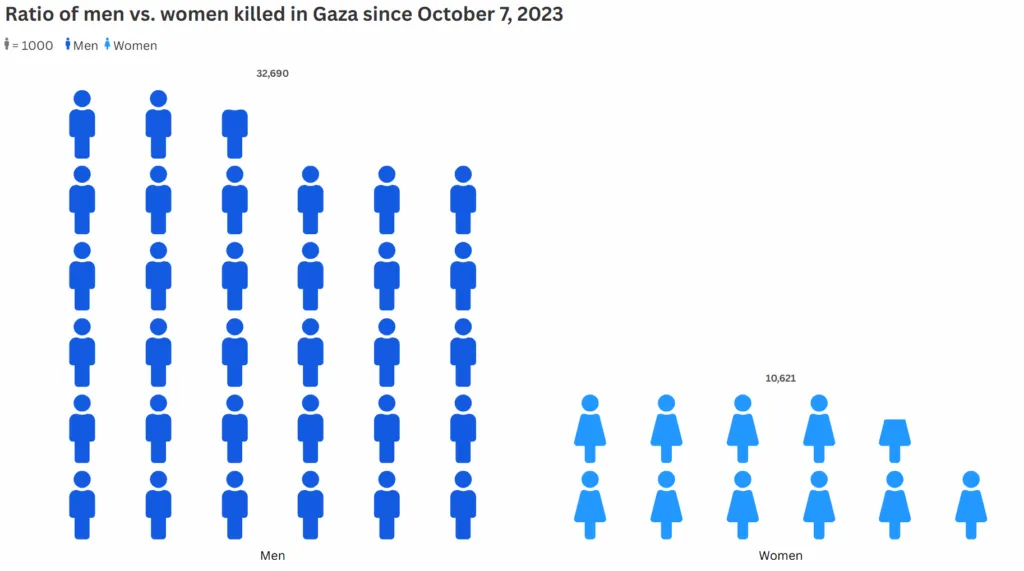
Visualization based on data by Salo Aizenberg.
Outlets, including the Associated Press, BBC, and Washington Post, have all previously parroted the claim that 70% of the casualties in the war were women and children. Naturally, it was based on falsified data, and the new casualty analysis once again disproves this claim.
Even after the UN walked back this percentage due to incomplete information, news outlets have continued to print that more than half of the casualties are women and children.
Throughout the two years of war, the media have repeatedly reprinted Hamas’ libels and casualty figures with little skepticism, allowing a terrorist organization to shape the narrative without rigorous analysis or verification.
Inflated civilian casualty claims will continue to distort public understanding of the war by obscuring the true civilian-to-combatant and male-to-female casualty ratios.
It is therefore only responsible journalism for every outlet that published Hamas’ casualty figures without questioning them to issue corrections and acknowledge that not every casualty during the war has been the result of IDF action.
The author is a contributor to HonestReporting, a Jerusalem-based media watchdog with a focus on antisemitism and anti-Israel bias — where a version of this article first appeared.
Uncategorized
Talarico blames Netanyahu, not the Israeli people, for devastation in Gaza
(JTA) — James Talarico, Texas’ Democratic nominee for the U.S. Senate, said he holds Prime Minister Benjamin Netanyahu, rather than the Israeli people, responsible for civilian devastation in Gaza.
Talarico, a Texas state representative, is running neck and neck against Republican Attorney General Ken Paxton, in a race whose results could affect which party controls the Senate this November. Israel has been one of many sources of disagreement among the candidates, who have sparred on issues ranging from affordability to immigration to reproductive rights.
“I believe that Israel, like any nation, has a right to defend its people,” the candidate said while fielding questions on Wednesday at a CNN town hall. “But I don’t believe that Benjamin Netanyahu has a right to wage war against civilians or use collective punishment or restrict aid to civilians.”
A Texas Politics Project poll, issued by the University of Texas this week, showed Paxton trailing Talarico by 3 percentage points, with 47% to the Democrat’s 50% and a margin of error of 3.34 percentage points.
Talarico said in August that he supported stopping arms sales to the Netanyahu government and conditioning military aid “on ending the death and the destruction in Gaza and the West Bank.” He declined to call the crisis “genocide,” noting that the term is being litigated in the International Court of Justice. But he said he’d “use every bit of our nation’s diplomatic and financial leverage to protect the lives of Palestinians.”
When he was pressed further by Rabbi Holly Levin Cohn of Congregation Beth El Binah in Dallas during the town hall, Talarico stressed the importance of directing his criticisms “toward Prime Minister Benjamin Netanyahu and not the Israeli people.”
Addressing Israelis’ trauma, Talarico acknowledged that the Oct. 7, 2023, Hamas attack on Israel “was the deadliest day for the Jewish people since the Holocaust.”
Cohn pushed back on his comments regarding aid restrictions, noting Israeli support of humanitarian efforts and arguing that there’s much more going on in the country than the media may be projecting.
Talarico told the rabbi he recognized that his “words carry weight” and gave her his word that he’s “going to continue to listen to all sides of this conflict.” He also expressed hope that “we can all come together to fight for a two-state solution where we have security for Israel and we have freedom and self-determination for Palestinians.”
Talarico also gave a “shoutout” to a local rabbi, Neil Blumofe at Congregation Agudas Achim in Austin. “I spent my first year of my seminary studies learning the Hebrew scriptures from a local rabbi,” he said. “Shout out Rabbi Neil Blumofe!” Cohn grinned.
The post Talarico blames Netanyahu, not the Israeli people, for devastation in Gaza appeared first on The Forward.
Uncategorized
Irish Jewish leader ‘shocked’ after hotel cancels over 70 rooms for antisemitism conference
(JTA) — DUBLIN — An Irish Jewish leader said a Dublin hotel canceled rooms reserved for European delegates after learning that they were visiting for an antisemitism conference.
Maurice Cohen, the president of the Jewish Representative Council of Ireland, said he booked over 70 rooms at the Herbert Park Hotel for people attending a meeting of the Special Envoys and Coordinators Combating Antisemitism (SECCA).
The envoys, who included Jewish community leaders, diplomats and government ministers from across Europe, were invited to the conference this week organized by the World Jewish Congress and the European Commission. The event was tied to Ireland’s Presidency of the Council of the European Union, which rotates between EU member states, and included delegates meeting with Irish Prime Minister Micheál Martin. Most of the government-appointed special envoys are not themselves Jewish.
Cohen said he met with Herbert Park Hotel’s general manager in May to inspect its conference rooms and explained the purpose of the event. According to Cohen, the manager responded by asking, “Will the IDF be involved?”
That question “shocked” Cohen, he told the Jewish Telegraphic Agency.
“I said, this is about antisemitism. It’s not about Israelis, it’s not about Israel, it’s not about the IDF,” he said.
Cohen said the manager told him she had to consult with the hotel owners to determine if his booking could be accepted. The next day, he learned that the rooms were canceled without explanation. The Herbert Park Hotel did not respond to JTA requests for comment.
Cohen booked rooms for the delegates and the conference at different hotels. He described the cancellation in a speech at the SECCA meeting on Tuesday, calling it an example of “contemporary antisemitism.”
“How quickly does the word ‘Jewish’ change a conversation?” he said to the attendees. “How easily does a gathering about antisemitism become associated with the Israeli army? And how quickly can people who were welcome when they were simply 70 hotel guests become something rather different once they are known to be attending a Jewish conference?”
Yoni Wieder, Ireland’s chief rabbi, suggested that the hotel could have based its decision on fears of controversy.
“It’s possible that whoever took the decision had no objection to the conference itself,” Wieder told JTA. “They may simply have wanted to avoid the possibility of protests outside the hotel or some other backlash.”
Ireland’s government has been sharply critical of Israel. The country has recognized Palestinian statehood, barred Israeli far-right ministers from entering its borders and in July passed a law that banned imports from Israeli settlements in the Palestinian territories. Martin has said that Israel committed genocide in Gaza, a charge Israel vigorously rejects. He has also condemned rising antisemitism in Ireland, which is home to about 2,200 Jews.
Herbert Park Hotel is “actually quite familiar with Jewish guests,” according to Wieder, who said that he has overseen kosher catering at the hotel.
Cohen, who has lived in Dublin all his life, said he had fond memories of the hotel. For years it was his favored site for meetings, New Year’s Eve celebrations and his mother’s birthdays through her 93rd.
“Over time the hotel became associated in my mind with friendship, celebration and my mother,” he said in his speech. “So it was strange that, many years later, the same hotel would acquire a very different place in my memory.”
The post Irish Jewish leader ‘shocked’ after hotel cancels over 70 rooms for antisemitism conference appeared first on The Forward.
Uncategorized
Whatever you think of Ilhan Omar, these threats are unconscionable

The Trump administration is reportedly planning to build a case to strip Congresswoman Ilhan Omar (D-MN) of her citizenship and eventually deport her.
It is my hope that American Jews — even those who do not like Omar and can recite every questionable comment she has made over the past 15 years to illustrate why — will understand this as offensive and outrageous not only because they are Americans, but because they are Jews.
The Trump administration may claim that it is building a case against Omar due to paperwork (reports suggest that they are interested in whether her father listed her age as 17 on her citizenship application when she was really 18). It is similarly filing dozens of lawsuits attempting to denaturalize citizens by trying to prove they lied in the process of gaining citizenship. However, that this is happening now, ahead of the midterm elections against a sitting member of Congress, a high-profile progressive whom the president has said should “go back” to her country of origin, suggests that it is, to put it mildly, politically motivated.

Evidently, the Trump administration sees citizenship not as a right or a responsibility but as a reward, one that can be taken away if that is seen as useful to the president and his adherents. That use could be silencing political opposition or something as simple (and callous) as an opportunity to brag about the sheer number of attempted denaturalizations.
Jews, too, have found themselves on the wrong end of political denaturalization. I do not mean to compare the Trump administration to the Nazis, but the stubborn fact is that Jews were indeed stripped of their citizenship as part of a political project in Germany and elsewhere in Europe in the 1930s and 40s. And in the early 20th century in the United States, it was Jews who politicians claimed were incapable of assimilating, of ever really being a part of the United States. These arguments culminated in legislation that kept out Jews who could have found refuge here. The threat of denaturalization and the experience of perpetual otherness is a grievous part of modern Jewish history; we should be offended by its presence in our political present.
Jewish tradition as well as history encourages us to stand up to authority when that authority is wrong. Mordecai refuses to bow to Haman; Nathan yells at King David for sleeping with Bathsheba and having her husband killed; Moses famously urges Pharoah to change his oppressive ways. Even God is on the receiving end of pushback when Abraham pleads and negotiates to spare Sodom.
I do not think one needs to be Jewish to be outraged by the attempt to denaturalize Ilhan Omar. I think it is also bone-chilling as an American who believes we, including our elected officials, have the right to openly oppose our president, and I am worried as a person who thinks it would be good to continue to live in a democratic republic. And I am sure that there are Jews who will say that Omar deserves to lose her citizenship because she has said things about Israel they do not like.
But the Jewish lens through which I see this is that it is right to challenge power when it is abused, and it is wrong for the powerful to make a show of trying to cast their opponents out of the country.
The point is not whether Trump can make good on the threat to strip Omar of her citizenship and deport her, but that it is obscene to use denaturalization as punishment for being a high-profile political opponent in the first place. If he is trying to make it more dangerous to speak out while being from the “wrong” country, then the rest of us need to say that this is a fundamental misunderstanding of what it means to be an American citizen.
We should do this because we are Americans and we should do this because we are Jews. We should do this because of the ways in which our American and Jewish identities bleed into one another. And, we should do this because we may not know exactly whether it is as Americans or as Jews that we know we have to protect the right to speak truth to power, but we know we need to do it all the same.
The post Whatever you think of Ilhan Omar, these threats are unconscionable appeared first on The Forward.
