


Uncategorized
‘Faust’ author Goethe’s fascination with Yiddish
Johann Wolfgang von Goethe is usually remembered as a towering figure of European culture: poet, playwright, scientist, and all-around genius of the Enlightenment.
His drama Faust opens with a scene that echoes the Book of Job, where God makes a wager with the devil over whether a good man can be led astray. What far fewer people know is that Goethe’s connection to the Bible was not just literary. He actually learned Hebrew so he could read it in the original — and his path to Hebrew ran straight through Yiddish.
Goethe was born in 1749 in Frankfurt am Main into a well-to-do Christian family. Frankfurt was also home to a densely packed Jewish quarter, the Judengasse (German for “the Jewish street”). As a boy, he ventured there, feeling both nervous and curious. In his autobiography, Poetry and Truth, published in 1833, he recalled what it was like for a German boy to step into a crowded world of people who dressed differently and spoke a strange-sounding German he called Judendeutsch (Jewish German).
But instead of fear or disdain, what stayed with him was fascination. He remembered friendly people and beautiful girls, and he was struck by the sense that the Jews carried ancient history with them into everyday life. They were, he wrote, “the chosen people of God … walking around in memory of the earliest times.” Even their stubborn attachment to tradition, he felt, deserved respect.
Goethe wanted to see more. He described how he insisted on visiting Jewish schools, attending a circumcision and a wedding, and getting a glimpse of Sukkot. Everywhere, he recalled, he was welcomed, entertained, and invited back. For an 18th-century German boy, this kind of contact with Jewish life was unusual — and it clearly made a lasting impression.
At home, Goethe was buried in languages. His father hired tutors to teach him Latin, Greek, English, French and Italian. Goethe learned quickly but soon grew bored with endless grammar drills. So he did what any restless young writer might do; he turned language learning into a game.
He invented a novel made up of letters exchanged by seven siblings scattered across Europe. Each sibling wrote in a different language: A music historian in Rome wrote in Italian, a Hamburg businessman in English, while a theology student wrote Latin and Greek. The youngest sibling stayed home and wrote in Yiddish. The effect, Goethe later suggested, was both amusing and confusing for the other characters.
That detail is telling. Goethe treated Yiddish as something playful and odd, a kind of Jewish-flavored German. But he knew it well enough to use it creatively.
In his autobiography, he describes the seven-language novel but doesn’t give it a title. We can guess, though, that his Yiddish was the Western Yiddish spoken by Frankfurt Jews at that time. A sentence like ikh vil kaafen flaash (“I want to buy meat”) would have sounded close to the local German dialect, but not quite the same.
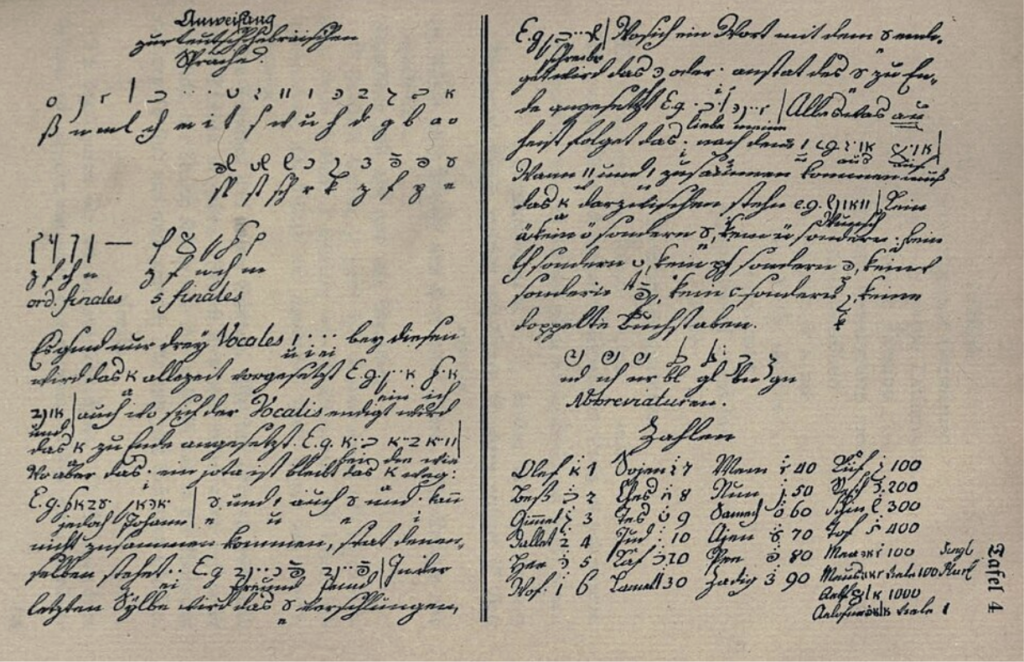
Goethe soon realized that if he wanted to understand Yiddish properly, he would have to learn Hebrew. His father arranged a tutor, and young Goethe plunged into a whole new alphabet. Although the location of his childhood notebooks are unknown, two of its pages are located online. On them, he carefully writes out the Hebrew letters, their names, sounds and even their numerical values. His notebook contains reminders to himself that Hebrew words are built from three-letter roots and urges himself to practice again and again so the forms would stick in his memory.
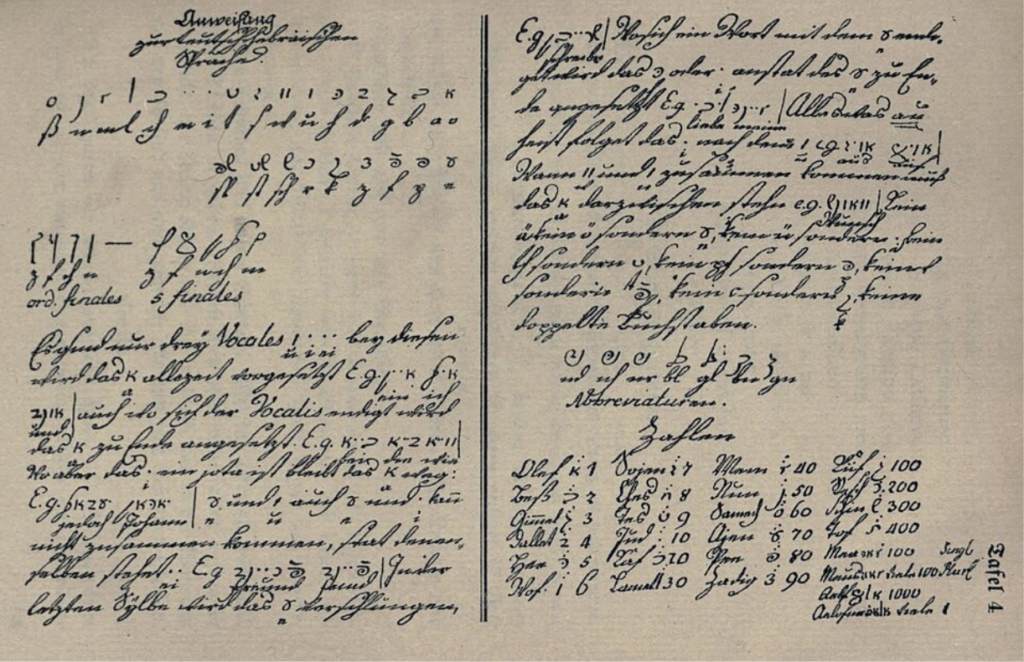
It wasn’t easy. Goethe later wrote that he got used to reading from right to left and identifying the letters, but was confused by all the dots and dashes — the vowel points, that seemed to complicate things even further. Still, he pushed on. He learned to read the Hebrew Bible and even tried his hand at writing a German epic based on stories from Genesis.
His interest in Yiddish didn’t disappear with childhood. When he was 17, Goethe apparently wrote a Purim play in Judendeutsch, written in Hebrew letters, complete with a translation into High German. Years later, he translated King Solomon’s Song of Songs into German. The Bible became a lifelong companion — not just as literature, but as a moral guide. “I loved and valued the Bible,” he wrote, “and owed my moral education almost entirely to it.”
As Goethe grew older, his ideas expanded in many directions. Influenced by the Jewish philosopher Baruch Spinoza, as well as Persian, Sufi and Buddhist writings, he developed a broad, inclusive worldview. He dreamed of something he called Weltliteratur — world literature — a shared cultural space where the works of all peoples could speak to one another.
Near the end of his life, Goethe said that the age of world literature had arrived, and that everyone should help bring it about. Seen this way, his childhood journey — from the Judengasse, through Yiddish, to Hebrew — was more than a youthful curiosity. It was an early step toward a vision in which cultures, languages and traditions are not sealed off from one another, but connected.
For Forward readers, there is something especially satisfying in this story. Yiddish appears here not as a joke or a dead-end dialect, but as a bridge — linking everyday Jewish life to the Bible, and even carrying one of Europe’s greatest writers toward a deeper engagement with Jewish tradition and, ultimately, with the idea of world culture itself.
The post ‘Faust’ author Goethe’s fascination with Yiddish appeared first on The Forward.
Uncategorized
Democrats to weigh resolution condemning AIPAC, fueling concerns about ‘undercurrent of antisemitism’
(JTA) — The Democratic National Committee is set to consider a resolution at a meeting next week that “condemns the growing influence” of AIPAC.
The resolution also condemns large-scale outside spending in elections generally but calls out only the pro-Israel lobby specifically, even as other lobbies are pouring similar sums into trying to influence election outcomes.
The meeting is being held during an election cycle in which rejecting AIPAC support has become a defining issue in Democratic races. It also comes amid concerns from some Jewish Democrats — including ones critical of AIPAC — that the group’s emergence as a bogeyman in American politics is inappropriate or even antisemitic.
“I do think there is an undercurrent of antisemitism in the degree to which AIPAC seems to be vilified,” Rep. Dan Goldman told the Jewish Telegraphic Agency last month. Goldman has accepted an endorsement from AIPAC as he seeks a third term, but says he won’t take money from corporate PACs in this election.
The resolution, which is subject to amendments before it is voted on, specifically names AIPAC and its super PAC, United Democracy Project, as having been “one of the largest outside spenders in Democratic contests” in 2024. It also refers broadly to other “corporate money PACs” and sources of “dark money,” though it does not name any specific groups.
Committee member Allison Minnerly, who introduced the resolution, told the Intercept, a left-wing outlet, that formally distancing the Democratic party from AIPAC “could be one step toward” winning back voters who “might really not have felt represented or seen when it came to Gaza or seeing their party support Palestinian rights or stand against military conflict.” Minnerly also introduced a resolution last August calling for an arms embargo on Israel, which was defeated.
A recent NBC poll found that 57% of Democratic voters have a negative view of Israel, compared to 13% who have a positive view of the country.
Meanwhile, a growing number of the party’s congressional candidates — and politicians thought to be seeking its 2028 presidential nomination — are swearing off AIPAC, and crossing its red line of supporting conditions on military aid to Israel.
The group has also spawned opposition online. Track AIPAC, the social media watchdog that posts politicians’ pro-Israel lobbying campaign donation numbers, has amassed 442,000 followers on X since 2024.
At town halls and candidate forums, politicians on the campaign trail are often being asked whether they would accept an endorsement or donations from the group.
Alana Zeitchik, an Israeli-American advocate and writer, said she understands that candidates might be asked about AIPAC in those types of settings, and said that she personally “would love to hear candidates” reject all special interest and corporate dollars. But when they hone in on AIPAC “on their own accord,” she said, she views it as “a political strategy to feed the beast, this hyper-obsession with AIPAC.”
The proposed DNC resolution voices concern over “massive outside spending” on candidates based on their foreign policy positions, pointing specifically to AIPAC’s $14 million spend in a single Illinois primary. The threat of those expenditures “raises concerns about undue influence over democratic debate and policymaking,” the resolution reads, and in “shaping Democratic party positions.”
The resolution condemns “the growing influence of dark money and corporate-backed independent expenditures in Democratic elections.”
AIPAC has remained a major spender in this year’s midterm elections. The group, which is operating with the aim of electing a majority pro-Israel Congress, recently shelled out around $22 million in support of four Illinois candidates, three of whom it backed through shell PACs under different names. Two of its four preferred candidates won.
While it narrows in on AIPAC, the DNC resolution does not address other types of high-spending special interest groups, such as real estate lobbying groups or the burgeoning landscape of pro-AI PACs.
New Jersey Sen. Cory Booker, who has previously received AIPAC donations but is rejecting all PAC money this year, told Politico last week that the particular attention paid to AIPAC has been “problematic.”
“There are Iranian Americans that bundle money. There are Turkish Americans that bundle money. There are a lot of ethnic groups that bundle money, and often for things that I don’t agree with. But somehow AIPAC seems to be drawing a lot of attention, and that’s problematic to me,” Booker said. “[AIPAC] is not the problem in America. The problem in America is money in politics.”
Adam Carlson, head of the progressive polling form Zenith Research, poked fun at Booker’s comments with a facetious tweet that dismissed Booker’s concerns, and pointed out the lack of an AIPAC-sized group for Iranian and Turkish Americans.
“Cory’s right. I am sick and tired of the mainstream media refusing to report on PERSIAPAC and TURKPAC spending hundreds of millions of dollars meddling in primaries to boost their preferred candidates,” wrote Carlson, who is Jewish. “It’s an antisemitic double standard, and he’s a hero for pointing it out.”
Goldman, like Booker, says he isn’t taking corporate PAC money in this election, but he did accept AIPAC’s endorsement. Goldman is currently facing a primary challenge from Brad Lander, a Jewish progressive whose attacks against Goldman have centered the congressman’s AIPAC endorsement.
While the DNC’s proposed resolution suggests that AIPAC is shaping Democratic party positions, Goldman asserted that his views are independent from his endorsements.
“I have personally pushed AIPAC very much to recognize that it is an organization that supports first and foremost the State of Israel and the U.S.-Israel relationship, but that does not mean that they should be unwavering in their support for the Israeli government,” he said.
He added, “I am going to continue to operate independently, based on my own understanding and nuanced view of the situation, and work towards a peace in the region and two-state solution and security for Israel.”
Other Democrats have said they turned down AIPAC because of foreign policy disagreements. In Illinois, Rep. La Shawn Ford said he met with UDP but did not receive its endorsement because he was unwilling to meet its requirement of supporting unconditional military aid to Israel.
Zeitchik said she is not a fan of AIPAC’s “really dirty” tactics, which have included spending on attack ads against pro-Israel politicians because they are open to conditioning military aid — but she, too, has concerns about the particular attention paid to it.
“I think that the hyper-obsession with AIPAC amongst progressives, and making AIPAC the bogeyman, the problem, has an undercurrent of what I’d call an antisemitic worldview, or an antisemitic reaction,” Zeitchik said.
Joel Petlin, the school district superintendent in the heavily Jewish village of Kiryas Joel, outside New York City, wrote that the DNC’s proposed resolution “singles out AIPAC for doing precisely what many other lobby groups are doing every day.”
He added, “If this resolution passes, the DNC can finally stop calling themselves ‘the big tent party,’ because it clearly isn’t large enough for American Jews.”
Similar accounts to Track AIPAC have popped up online, though none have taken off in the same way. Oil PACs Tracker was founded in 2021 and has 43,000 followers. An account called Melt ICE, which tracks candidates’ stance on ICE, has garnered 3,000 followers since being created in January.
Zeitchik said she appreciates how congressional candidates such as Jack Schlossberg, who is running in New York’s 12th Congressional District, have approached the issue by rejecting all special interest money without harping specifically on AIPAC.
“When I see Israel become a wedge issue, and politicians continue to push and make it a wedge issue — that, to me, is alarming,” she said.
This article originally appeared on JTA.org.
The post Democrats to weigh resolution condemning AIPAC, fueling concerns about ‘undercurrent of antisemitism’ appeared first on The Forward.
Uncategorized
Stitched in faith, woven in memory, these precious artifacts bind Jews to their history

The red stitching has long since faded, and the hand-woven linen has softened from white to ivory. Embroidered with a menorah, a double-headed eagle, a lion, and a Magen David, the 18th-century Torah binder is simple in design yet rich in history.
The binder is among 25 artifacts from London’s Memorial Scrolls Trust making their American debut in Fordham University’s “Binders of the Covenant” exhibition. Aside from showing how these functional objects, beautified, in keeping with hiddur mitzvah (beautifying a ritual object) the exhibition reveals the binders’ dual purpose: securing parchment Torah scrolls while symbolically binding families to their community.
“The binders allow us to see the artistic expression of the devotion; of how they reflect traditional values of Jewish identity, like going toward the Torah, toward the chuppah, and doing good deeds. But there is also an acknowledgement of local identity like in the Hapsburg double eagle or a German flag,” Magda Teter, a chaired professor of History and Judaic Studies at Fordham, told me.

Though women were historically excluded from reading or carrying the Torah, they were the primary creators of these binders. Through intricate needlework, they forged a physical connection to the sacred text. The collection includes a binder created by a grieving husband for his late wife, Esther, and another inscribed by a mother celebrating her daughter’s birth.
“It shows that women managed to get close to the Torah, they are bound to the Torah even if their physical bodies were not allowed to do that,” Teter said.
The history of these binders is rooted in survival.
Between the 14th and 20th centuries, Ashkenazi parents in Central Europe swaddled newborn boys in linen strips called wimples. Women embroidered them with religious and secular symbols. When a boy began formal Torah studies around age three, the family donated the wimple to the synagogue to be reused during milestones, such as a recovery from illness or the Shabbat before a wedding.
“It’s a collective story of community. Seeing these artifacts brings history to life,” guest curator Warren Klein said.
Over time, the creation of these binders evolved as women moved beyond traditional linen and cotton to incorporate silk, leather and velvet, reflective of Bohemian artistic traditions.
An intricately decorated 18th century binder featuring intricate leatherwork flowers, embroidery and beads on plum-colored velvet is a prime example.
“It shows an exchange of artistic ideas,” Klein said.
Over time, production shifted from hand-embroidery to sewing machines and paint. The inscriptions shifted as well, as German, Czech, and Yiddish frequently replaced traditional Hebrew.
Visitors to the exhibit will note the lingering shadow of the Shoah. A 1922 binder depicts a Magen David alongside a German flag; a display of pride in both Jewish and national Jewish identity created just two decades before the Holocaust.
Embroidered in canary-yellow silk thread on linen, a 1918 Bar Mitzvah binder for Ludwig Rosenzweig serves as a reminder of this era. On Oct. 26, 1942, Rosenzweig, his wife, and child were murdered at Auschwitz. Today, these binders remain the only physical witnesses to such interrupted lives.
“You can’t escape the loss but in order to appreciate the loss you need to understand the life. Those binders bring the people to life; they capture the moments of joy and celebration, and of course death. The binders create communal memory,” Teter said.
The tradition of hand-sewn binders has faded over the last half-century. Families are more apt to commemorate a child’s birth with the donation of engraved silver Judaica or prayer books with commemorative bookplates.
Yet, rather than lament this change, the exhibit brings the practice of creating binders to the present with the display of contemporary works by fabric artist Rachel Kanter.
“These community binders show vibrancy,” Teter said. “They show that Jewish life is ongoing,”
The post Stitched in faith, woven in memory, these precious artifacts bind Jews to their history appeared first on The Forward.
Uncategorized
California College Employee Calling Jewish Professor ‘Colonizer’ Was Antisemitic, Investigation Finds

Sign reading “Welcome to City College of San Francisco” above glass entry doors with building number 88, San Francisco, California, Aug. 29, 2025. Photo: Smith Collection/Gado/Sipa USA via Reuters Connect
A City College of San Francisco (CCSF) staff member who called a Jewish professor a “colonizer” among other verbal attacks engaged in unlawful harassment and discrimination based on the academic’s Jewish identity, according to an independent investigation into the incident.
The Louis D. Brandeis Center for Human Rights Under Law and the StandWithUs Saidoff Legal Center, two Jewish advocacy groups, on Tuesday celebrated the upholding of a disciplinary investigation’s finding as a “significant victory” for Jewish faculty and students.
“The outcome establishes a critical precedent for how universities must evaluate conduct often mischaracterized as political speech but that, in context, targets Jewish identity,” the groups said in a statement.
The investigation stemmed from a series of incidents which escalated to an explosive May 2025 confrontation in which CCSF employee Maria Salazar-Colon, president of the local Service Employees International Union (SEIU) union, allegedly launched a volley of anti-Jewish invective at computer science professor Abigail Bornstein. Calling Bornstein a “colonizer” and telling her to “shut the f—k up,” Salazar-Colon converted the professor’s name into a sobriquet by denouncing her as “Dumb-stein” during the public comment portion in a meeting of the community college’s board of trustees, according to the Brandeis Center and StandWithUs.
That utterance, combined with other comments related to Israel, indicated Salazar-Colon’s awareness of Bornstein’s Jewishness and her willingness to degrade her over it, the Brandeis Center and StandWithUs said — noting that a trivial discussion on college “governance,” not politics or the Middle East conflict, set the staff member off.
Salazar-Colon allegedly continued targeting Bornstein through email, denouncing her again as a “colonizer” and making other crude statements. The conduct drove the professor off campus. She reported the alleged harassment to the CCSF administration and filed a criminal complaint with the local police.
However, Salazar-Colon hit back, filing her own grievance in response to allege that she was the victim. Meanwhile, the college hired a law firm as a third-party investigator to look into the matter. Its findings were conclusive, determining not only that Salazar-Colon was fully culpable but that her conduct, rising to “workplace violence,” was intentionally discriminatory against a Jewish colleague.
CCSF ultimately dismissed Salazar-Colon’s “retaliatory” complaint, but the finality of its decision hung on the opinion of the college trustees. Salazar-Colon filed an appeal with the body. It took no action, crystallizing, the Brandeis Center and StandWithUs said, a consensus on the “seriousness of the underlying conduct and the strength of support for the [third-party investigator’s] findings.”
On Monday, Brandeis Center staff litigation attorney Deena Margolies told The Algemeiner that, in this case, justice prevailed but that many other Jewish members of academia suffer similar indignities.
“The college did the right thing here. They brought in an independent investigator. They made clear that this was about discrimination based on Bornstein’s protected identity, that being Jewish — not union advocacy — and that’s important and a necessary distinction that we don’t often see being recognized,” Margolies said. “I’m seeing many more of these disciplinary matters in the employee context, and I notice that what often happens is that when a Jewish professor or staff member is targeted or files a complaint, there is often a cross complaint, a baseless complaint which is retaliatory. And yet, they always end up coming through.”
CCSF will be taking disciplinary action. against Salazar-Colon.
As previously reported by The Algemeiner, antisemitism promoted by university employees often disguises itself as politics, complicating higher education institutions’ response to it.
In September, a survey conducted by the Anti-Defamation League (ADL) and the Academic Engagement Network (AEN) found that staff and faculty accelerated the “antisemitism” crisis on US college campuses by politicizing the classroom, promoting anti-Israel bias, and even discriminating against Jewish colleagues. It found that 73 percent of Jewish faculty witnessed their colleagues engaging in antisemitic activity, and a significant percentage named the Faculty and Staff for Justice in Palestine (FSJP) group as the force driving it.
Of those aware of an FSJP chapter on their campus, the vast majority of respondents reported that the chapter engaged in anti-Israel programming (77.2 percent), organized anti-Israel protests and demonstrations (79.4 percent), and endorsed anti-Israel divestment campaigns (84.8 percent). Additionally, 50 percent of respondents said that anti-Zionist faculty have established de facto, or “shadow,” boycotts of Israel on campus even in the absence of formal declaration or recognition of one by the administration. Among those who reported the presence of such a boycott, 55 percent noted that departments avoid co-sponsoring events with Jewish or pro-Israel groups and 29.5 percent said this policy is also subtly enacted by sabotaging negotiations for partnerships with Israeli institutions. All the while, such faculty fostered an environment in which Jewish professors were “maligned, professionally isolated, and in severe cases, doxxed or harassed” as they assumed the right to determine for their Jewish colleagues what constitutes antisemitism.
Administrative officials responded inconsistently to antisemitic hatred, affording additional rationale to the downstream of hatred. More than half (53.1 percent) of respondents described their university’s response to incidents involving antisemitism or anti-Israel bias as “very” or “somewhat” unhelpful, and a striking 77.3 percent thought the same of their professional academic associations. In totality, alleged faculty misconduct and administrative dereliction combined to degrade the professional experiences of Jewish professors, as many reported “worsening mental and physical health, increased self-censorship, fear for personal safety,” and a sense that the destruction of their careers and reputations was imminent.
“Antisemitism cannot and should not be downplayed as political, academic, or workplace disagreement. Antisemitism is, clearly and concretely, insidious discrimination,” Brandeis Center chairman Kenneth Marcus, a former US assistant secretary of education for civil rights, said in a statement released with the news of the outcome of the CCSF incident. “Institutions have both the authority and the obligation to intervene, and we are hopeful that these outcomes encourage those who wish to report incidents of antisemitism to come forward without fear of retaliation.”
Follow Dion J. Pierre @DionJPierre.