


Uncategorized
Hidden in Central Park, a modest installation of Holocaust art — but what was it doing there?
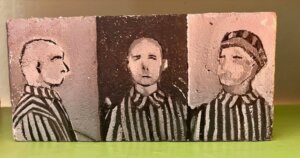
I’m a big walker. It’s how I stay sane, if one could call what I am, sane. I listen to books, podcasts and music. The lake I live on upstate has a road straight around it, so it is a perfect and beautiful four-mile walk. I walk around it once or twice every day.
Not long ago, I went walking in Central Park, which is down the block from my apartment in Manhattan. About a quarter of a mile of the way in, I saw out of the corner of my eye something interesting on the curb. Oddly, it looked like art.
When I went over to see what it was, it turned out to be a beautifully, albeit austerely, painted brick, with what I thought were three viewpoints of a prisoner in black and white. On the side was a piece of masking tape with a series of numbers, which made it seem like it was an installation, and this was the edition number. Maybe it was some new Banksy installation, I thought, and greedily picked it up. Had I found some secret treasure? It was heavy enough to be an encumbrance, but already, in my assessment, too valuable to leave.
By the time I got halfway around the park, I collected three more and was trying to do my seven-mile walk carrying four heavy bricks in a plastic bag I picked out of the trash. I knew I’d never make it all the way around. I decided to hide them under a bush at 74th and Fifth and come back later to collect them.
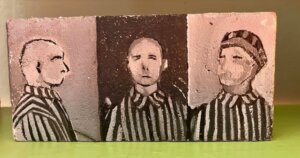
I had lunch with my friend Christine who afterwards walked with me to the secret hiding place and helped me carry them through the park. She was equally astonished by them. When I got home, I showed my spouse, Kevin, a talented writer and editor, who knew at once what they were. They were Jewish prisoners from the concentration camps and the numbers hastily taped to the sides were some kind of identification numbers. I wondered if they were the ones tattooed on their arms.
Kevin looked on the web and found something called the Arolsen Archives where you could look up the numbers like the ones on the bricks and find out who the prisoners were, so they were more like the filing numbers, the tally of the murdered. It seemed logical, though I couldn’t find any of the four on the bricks.
Why hadn’t I immediately known what the images were? I am a Jew. I have always been obsessed with the Holocaust. I saw Claude Lanzmann’s monumental nine-hour documentary, Shoah, twice. I spent eight harrowing hours at Theresienstadt two years ago. I created an opera out of Giorgio Bassani’s Holocaust novel, The Garden of the Finzi-Continis. My grandmother flooded us when we were children with photos of everyone who was murdered in the little Polish village she mercifully escaped the day it was wiped off the map. But it took Kevin, a Catholic, to identify them.
I suddenly felt very strange. Had I disturbed some kind of Holocaust memorial someone was in the process of installing all over the park? But they seemed so delicate and randomly placed — one good rain might destroy them. The masking tape was already falling off. Maybe someone has an explanation, or knows what I should do with them, I thought. They should be protected. They are disturbing and moving, and chillingly beautiful. They should be seen.
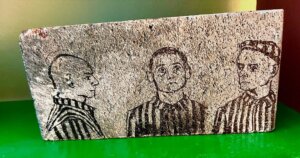
Taken by their aesthetic beauty, but curiously oblivious to their power, I arranged them on the shelves in our bedroom. But as soon as Kevin entered the room, he said, “Those cannot stay in here.” It never occurred to me that sleeping in a bed where these faces were staring down at you might be upsetting.
I posted my story and images of the bricks on Facebook seeking to find answers, and received all kinds of responses, including, especially from my writer and artist friends, an almost haughty and judgmental, “Put them back!” I felt guilty, ashamed, and thought about it, but it didn’t feel right.
This is what I wanted to happen: People would see what I had posted, understand how extraordinary my discovery was, and answer the questions that I had: Why would someone do this? The pieces were oddly located — one on the curb, one on a wall, on a bench, but all out in the open for anyone to find — was anyone checking on them? Why was I the only one that saw them? Was I, in fact, the only one? Were they a memorial? An installation? Were they Banksy? Was I holding a treasure and finally about to get rich? Of course I couldn’t sell them, but I thought about it.
No one had any answers, though, and none of my 5,000 Facebook friends raised their hand to say, “I made them, and this is why.”
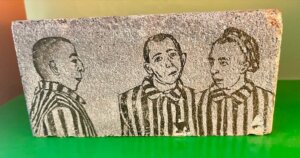
I am a composer, and sensitive to the gesture — an artist’s quiet activist act, the element of chance, the small revolution, the poetry of it. Perhaps I should have left them undisturbed, let the artist have his/her/their way. But I didn’t, I couldn’t, and here we are.
Now what?
The world feels so precarious right now — violent and unpredictable. This looked like it might be some profound political statement, some cry from the artist’s studio, some shriek in the dark in these bricks. But I don’t know what it was, and I’m dying to find out.
I still question my obliviousness to what the images were when I first saw them. It rattles me. Could I be inured to such horrors?
Last night, when I went to sleep, I dreamt I was in a building with three other men. We were wiring a building to blow it up. When the blast was imminent, and the building started collapsing, they got out and I didn’t. I woke up startled, shaking, sweating and wondering: What do these bricks signify?
And why was it me that found them?
Can anyone tell me?
Anyone?
The post Hidden in Central Park, a modest installation of Holocaust art — but what was it doing there? appeared first on The Forward.
Uncategorized
Can Netanyahu win again? The secret to his political survival – and why it may finally fail him

Israeli Prime Minister Benjamin Netanyahu was once dubbed “King Bibi” for his remarkable ability to win elections, starting with his surprise victory in 1996 at age 46. The number of political rivals who have risen and fallen during his decades in power is almost impossible to count.
But with the Oct. 27 election just days away – three years after Israel’s worst security failure under his watch and amid deep divisions at home and declining international support — could this finally be the 77-year-old Israeli leader’s last stand?
Recent polls show Netanyahu’s Likud party trailing former military chief Gadi Eisenkot’s Yashar party. Several right-wing and religious parties are also polling below the 3.5% threshold needed to enter the Knesset, threatening to waste thousands of votes that Netanyahu may need to secure a majority. Meanwhile, the opposition appears more organized and motivated than in previous elections, posing a serious threat to his nearly two-decade dominance of Israeli politics.
Netanyahu has spent much of his political career proving predictions of his demise wrong. In 2015, he defied polls and led the Likud Party to a surprise victory after warning on Election Day that Arab voters were heading to the polls in droves. In 2021, after 12 consecutive years as prime minister, he was forced into the opposition by an unlikely coalition led by Naftali Bennett and Yair Lapid. He returned to power less than two years later, almost immediately igniting mass protests over his judicial overhaul agenda, which his rivals said would concentrate power and eviscerate Israeli democracy.
Then came Oct. 7, the deadliest attack on Jews since the Holocaust. Israelis were furious over the security failures that allowed Hamas to breach the border and kill about 1,200 people. Families of hostages demanded the immediate return of their loved ones, and even longtime supporters questioned whether he could remain prime minister after the end of the military campaign in Gaza.
Netanyahu’s political future appeared bleak. Mazal Mualem, a political commentator and author of Cracking the Netanyahu Code, said in an interview that everyone close to Netanyahu whom she spoke with in the weeks after the attack believed it was over. “Bibi was the only one who thought he would survive,” she said, using Netanyahu’s nickname.
But Netanyahu refused to resign. He kept his right-wing coalition together through the war in Gaza, survived nationwide protests and hearings in his ongoing corruption trial. In a remarkable political achievement, he became the first Israeli prime minister in more than 50 years to lead a government through its full four-year parliamentary term — something he himself had never accomplished before in his long career.
How did Netanyahu survive?

In interviews with the Forward, Mualem and another Netanyahu biographer, Anshel Pfeffer, reflected on how Netanyahu has survived when his political career appeared doomed. They offered different explanations, but agreed on one thing: Netanyahu can never be counted out.
Pfeffer, a correspondent for The Economist and author of Bibi: The Turbulent Life and Times of Benjamin Netanyahu, said that while there’s “no equivalent” to his political instincts and campaign skills, Netanyahu also lacks certain human instincts, including “shame” and “introspection,” that might otherwise have forced him to step aside. “He has no shame,” Pfeffer said.
Netanyahu’s ability to hold on to power, Pfeffer added, also relied on a political system he spent decades building, in which the political careers and financial interests of his allies are tied to his success. That helped him keep far-right partners such as Itamar Ben-Gvir and Bezalel Smotrich, along with the Haredi parties, in his coalition despite disagreements over the war and military draft exemptions.
Mualem sees another reason Netanyahu survived: He transformed. “It’s almost as though he killed the old Bibi and a different person was born,” she said.
Netanyahu, once known for his risk-averse doctrine and being at times moderate on the Israeli-Palestinian conflict, became more willing to take bold military action. Under his leadership, Israel killed the leaders of Hamas and Hezbollah, launched strikes against Iran and expanded its military presence in Gaza, Syria and Lebanon. Mualem argued that this transformation helped Netanyahu win back voters who had turned against him after Oct. 7 and strengthen his standing among his political base. “He went to war for himself and for the country,” she said. “He didn’t give up.”
Can he do it again?

Netanyahu is now counting on those same political skills to carry him through another difficult election.
Recent polls show the parties in the anti-Netanyahu bloc holding an average of 55 seats, short of the 61 needed for a majority in the 120-seat Knesset. The two Arab lists — the United List, a coalition of three Arab Israeli parties, and Ra’am, led by Mansour Abbas — are generally counted outside either bloc. But their projected 13 to 15 seats could determine whether Netanyahu’s opponents can form a minority government or at least unite to elect a Knesset speaker from their ranks, giving them significant influence over the legislative agenda. Opposition leaders remain divided over whether they should cooperate with Arab lawmakers.
With little chance of winning over voters firmly opposed to him, Netanyahu is focusing on right-wing voters who supported him in previous elections but are now considering staying home. His goal is to convince them that the alternative to his leadership is too risky.
Netanyahu’s campaign slogan, “It’s the right or Palestine,” is tapping into post-Oct. 7 fears about the establishment of a Palestinian state, warning that an Eisenkot-led government dependent on Arab support will lead to Palestinian statehood. He made a similar claim in 1996 when he suggested Shimon Peres would divide Jerusalem.
Mualem said Netanyahu is approaching this race as if it were his first campaign. “Netanyahu’s secret isn’t magic,” she said. “It’s hard work and a refusal to give up. He never raises his hands in surrender.”
Shalom Lipner, a nonresident senior fellow at the Atlantic Council’s Middle East program, said Netanyahu has another important advantage: As prime minister, he can largely shape the national conversation. When attention turns to issues that expose his political weaknesses, including Haredi military exemptions or his government’s responsibility for Oct. 7, Netanyahu can redirect the focus to Hamas, Iran or other security threats.
Lipner, who served under seven consecutive Israeli prime ministers between 1990 and 2016, compared it to President Donald Trump’s political style. Both leaders, he said, are skilled at drawing attention to issues that favor them.
Earlier this week, Trump endorsed Netanyahu for reelection, giving his longtime ally another opportunity to highlight their partnership in confronting Iran. “If Israel has the wrong leader, which would be anyone other than Bibi, America will have to do this work ourselves, and I am not inclined to do so,” Trump wrote on Truth Social.
Netanyahu seized on the endorsement to rally his base and try to persuade undecided voters that his close relationship with Trump is essential to Israel’s security. “We have a job to finish,” he told Trump during a phone call that was turned into a campaign clip.
Lipner believes Netanyahu’s tactics face greater limits than in previous elections because Israeli voters have become increasingly skeptical and entrenched in their views.
Still, Netanyahu has little reason to stop trying.
Israeli political commentator Amit Segal suggested that the statement about working with Trump for the coming two years was aimed at swing voters tired of Netanyahu, but who “will find it easier to support him for final arrangements for one last job,” with the implicit expectation that this would be his final term.
The day after the election

For both Netanyahu and his opponents, winning more votes on Election Day is only half the battle. The bigger challenge is finding a way to form a government afterward.
Under Israel’s electoral system, the 37 parties running in this election cycle must win at least 3.25% of the national vote to enter the Knesset. Votes cast for parties that fail to cross that threshold do not translate into seats, potentially costing their political allies crucial seats available for redistribution.
That makes the fate of smaller right-wing parties, including one led by retired general Ofer Winter and a reservist-backed, economy-focused party led by former minister Yoaz Hendel, particularly important in determining the balance of power.
Voter turnout and first-time voters will therefore be critical to the makeup of the political map.
Even if Netanyahu does not win 61 seats, he could still benefit if the opposition cannot agree on a government. Polls show that a majority of voters want a different prime minister, but those voters are spread across parties with sharply different ideologies and priorities.
Eisenkot has suggested establishing a minority government with Arab lawmakers abstaining to allow it to be sworn in without formally joining the coalition. Other opposition figures, particularly Avigdor Lieberman, are opposed to alliances with Arab members.
These divisions are Netanyahu’s greatest hope. If the opposition can’t come to an agreement, that could set the stage for another election, leaving Netanyahu as prime minister until a replacement government is sworn in.
Is this his last stand?

All three experts said it is too early to predict whether this election will mark the end of Netanyahu’s career.
“At one point it’s going to be your last stand,” Lipner said. “I just don’t know if this is it.”
“Netanyahu has found so many ways to come back against all the odds against him,” Pfeffer said. “So you certainly can’t count him out, and I’m not going to try to.”
Mualem suggested that even if Netanyahu loses power, he may simply return to the opposition and wait for his rivals to fail. “Netanyahu doesn’t have another life,” she said. “Politics is the only life he has.”
The post Can Netanyahu win again? The secret to his political survival – and why it may finally fail him appeared first on The Forward.
Uncategorized
While AIPAC’s critics rejoice as lobby shifts strategy, its defenders push back
(JTA) — AIPAC’s critics gloated on Thursday after the pro-Israel lobby announced that it was ending direct contributions and candidate endorsements. But defenders of the storied Washington institution pushed back at that characterization, saying instead that the organization had made a smart course correction amid strong political headwinds stoked at least in part by antisemitism.
The American Israel Public Affairs Committee announced the decision in a letter to its members on Wednesday, explaining that the lobby would now shift its focus to mobilizing individual donors. The abandonment of direct PAC contributions and candidate endorsements marks a significant reversal in a strategy that AIPAC launched in 2021, ahead of the 2022 election cycle. The letter informed donors that AIPAC’s super PAC, the United Democracy Project, also launched in 2021, would continue to operate.
The move came in an increasingly tense political cycle for AIPAC, which it called “one of the most challenging environments in recent memory.” The lobby has become a target for progressive candidates, particularly Democratic Socialists of America members, who have sharply criticized candidates who receive donations from AIPAC. In turn, the organization has become a symbol of undue political influence among some voters.
The DSA responded to the lobby’s policy shift by saying that “AIPAC has realized what we all already knew: working people do not want their tax dollars to fund apartheid and genocide.”
Kenneth Roth, former executive director of Human Rights Watch and a staunch Israel critic, wrote that AIPAC’s decision shows that “candidates don’t want its backing,” while the anti-Zionist group Jewish Voice for Peace posted that AIPAC was now deeming itself “too toxic.”
Jeremy Ben-Ami, president of the liberal pro-Israel lobbying group J Street, which has frequently tangled with AIPAC on social media, argued in a statement that “AIPAC can’t save its brand by folding its PAC.” Describing AIPAC as “a once-revered organization,” he said the lobby became toxic not due to its support of candidates but “because of the policies it asks those candidates to defend.”
But those with ties to AIPAC defended the move as one that will actually help the lobby fortify its impact. “It’s a marker of institutional health when they can look around at the reality, see it for what it is and change themselves accordingly,” Jonathan Greenberg, director for combatting antisemitism at Defending Education and a former AIPAC staffer, told the Jewish Telegraphic Agency.
“They recognized that their political ground had shifted and that they needed to change with that shift,” added Greenberg, who served as AIPAC’s Midwest political director until 2011 and ran for state office in Illinois as a Republican a year later.
Calling out what he described as a “horrifying demonization campaign” against AIPAC in Washington, he said he believes that the lobbying group made this strategic decision in an effort to continue operating amid widespread antisemitism.
“The pro-Israel community is still going to be deeply involved in campaigns,” added Greenberg, who identifies as a political conservative but no longer a Republican. “AIPAC is just wisely understanding that the way the organization operates can change, so that it can still be the voice that it’s always been on Capitol Hill.”
Recognizing that the U.S. political landscape is undergoing profound changes amid deep dissatisfaction across party lines, a former AIPAC spokesperson who requested anonymity to speak freely pointed out that institutions must evolve to stay effective. Other major interest groups, such as the pharmaceutical, hospital and real estate industries, are advancing their priorities with a variety of tactics, including lobbying, direct contributions, super PACs and networks of donors, the person noted.
In fact, one point of agreement on Thursday between AIPAC’s supporters and detractors was that the 72-year-old institution wasn’t going anywhere. “Mobilizing greater resources for AIPAC, pro-Israel candidates, and our super PAC is critical,” the AIPAC letter stressed, as it pledged to reinvest in its long-standing network of members nationwide.
“AIPAC staff and local leaders will continue working with you on political fundraising efforts, recommending contributions to candidates who are worthy of your support, and ensuring your resources are deployed in the most effective ways possible,” the letter added.
Indeed, opponents of the lobby indicated that the change in approach did little to satisfy them – and potentially opened up new lines of attack. DSA charged that AIPAC would “try to bankroll the same candidates under a different name.”
“You can’t hide AIPAC,” the DSA added. “The world has woken up.”
J Street’s Ben-Ami maintained that AIPAC’s decision to keep its super PAC even as it dropped its PAC “only doubles down on the dark money politics that helped create its problem in the first place.” Traditional PACs can contribute a maximum of $5,000 to individual candidates in each race, while super PACs can spend unlimited funds to independent political communications that serve to support or oppose candidates. Both have to disclose their donors, but super PAC donors aren’t always transparent about the origins of their money.
Tali deGroot, J Street’s vice president of political and digital strategy, likewise assessed that AIPAC’s influence wouldn’t disappear in the next election cycle.
“Instead, AIPAC’s donors and its super PAC will keep spending heavily in our elections, only now voters will have a harder time seeing where that money comes from,” deGroot said.
Defending Education’s Greenberg acknowledged that AIPAC’s choice to increase its reliance on its super PAC could fuel even more opposition to the lobby.
“But I don’t think fashioning ourselves to placate antisemites gets us anywhere,” he continued. “What we know about antisemites, from thousands of years of dealing with them, is that if we don’t give them this reason, they’ll find another reason.”
The former AIPAC spokesperson said the jury was out on whether the AIPAC pivot would improve its public image. “The question is whether AIPAC’s shift reflects a broader evolution in how organizations and interest groups engage politically, and whether changing its approach will change how the public perceives its influence,” the former spokesperson noted.
This article originally appeared on JTA.org.
The post While AIPAC’s critics rejoice as lobby shifts strategy, its defenders push back appeared first on The Forward.
Uncategorized
UK adopts sweeping measures against antisemitism in schools
(JTA) — The U.K. has adopted sweeping measures to combat antisemitism in English schools, prompting pushback from the country’s largest teachers’ union.
The move came after a new government-commissioned review found that three in five Jewish students reported experiencing antisemitism in English schools. The most common incidents were jokes, stereotypes and comments about Jewish people. About half of respondents who witnessed or experienced antisemitism said the incidents were not reported, most often because they did not think they would be taken seriously.
The government on Wednesday accepted 27 recommendations from the report, including dedicated antisemitism training for leaders and staff, improved recording of antisemitic incidents and moves to build a better understanding of Jewish life, identity and contemporary antisemitism.
The government commissioned the report following a spate of high-profile attacks on Jews in Britain, including an attack on a synagogue in Manchester last year that left two men dead.
The report’s author, Sir David Bell, the vice chancellor of the University of Sunderland and former chief inspector of schools in England, recommended addressing antisemitism distinctly from other forms of racism. He argued that antisemitism was a “uniquely complex” problem because of intertwined racial and religious dimensions, since Jewish identity can encompass both an ethnicity and a religion, along with expressions of prejudice that hold all Jews responsible for the actions of Israel.
The government will also encourage English schools to adopt the International Holocaust Remembrance Alliance (IHRA) working definition of antisemitism. The definition is supported by many mainstream Jewish organizations and has been adopted by 47 countries, including the U.K., but critics say that it conflates some forms of antisemitism with criticism of Israel.
British Education Secretary Lucy Powell called Bell’s review a “generational moment” and said that “implementation is now my priority.”
However, the National Education Union, the largest union representing teachers, lecturers, teaching assistants and support staff in the United Kingdom and Europe, raised concerns on Wednesday about recommending the IHRA definition for schools. NEU general secretary Daniel Kebede said in a statement that the definition “risks deepening the problem rather than tackling it, and actively undermining efforts to confront antisemitism.”
“The IHRA’s contested framing risks blurring the line between antisemitism and legitimate criticism of the Israeli government and the genocide in Gaza, leaving teachers with uncertainty when they need clarity,” said Kebede. He cited a risk that “children who cannot critically explore issues through classroom discussion will instead seek their answers in online and unsafe groups.”
Kebede also encouraged Britain’s Department for Education to strengthen guidance on all forms of racism, not only antisemitism, saying that 65% of teachers report they have not received any antiracism training in the past year.
The Board of Deputies of British Jews, an umbrella organization for British Jewish communities, celebrated the antisemitism report and the government’s adoption of its proposed measures. The group specifically praised the report’s “clear recommendations that schools and local authorities follow government guidelines by adopting the IHRA Working Definition of Antisemitism as a tool to deepen understanding of contemporary antisemitism.”
“We remain concerned about undue external influence on schools driven by narrow political agendas, and tendentious materials seeping into schools and increasing disharmony, and we will continue to press for vigilance against this,” said the Board of Deputies.
The post UK adopts sweeping measures against antisemitism in schools appeared first on The Forward.
