


Uncategorized
Hitler’s favorite composer Richard Wagner found early inspiration in a Jewish artist’s music
BAYREUTH, GERMANY — Midway through the second act of the Bayreuth Festival’s new production of Rienzi, a miniature Richard Wagner takes command of the Festspielhaus. A child painted gold and wearing the composer’s familiar velvet cap and facial hair bursts onstage and presides over a manic pageant of the ten operas that have made up Bayreuth’s repertoire for the past 150 years. Minnesingers and Meistersingers collide; mythical and medieval heroes jostle for position; the medieval Wartburg castle of Tannhäuser turns into the boxy East German automobile that shared its name. The whole sequence, chaotic yet tightly choreographed, has a high-camp exuberance.
Over the past decades, Bayreuth has become surprisingly good at critiquing and even poking fun at itself. The Norwegian director Stefan Herheim’s landmark 2008 Parsifal turned Wagner’s mystical final opera into a galloping history of Germany and the festival that had grown up around it. Nine years later, Barrie Kosky, the first Jewish director to work on the Green Hill, set Die Meistersinger von Nürnberg partly inside Wagner’s own home and partly in the courtroom of the Nuremberg trials.
Founded by Wagner in 1876 as the ideal theater for his own works, Bayreuth is marking its 150th anniversary this summer with its very first staging of Rienzi. The festival had originally hoped to also perform its full repertoire of canonical Wagner works. Financial limitations forced it to abandon that plan.

Rienzi was Wagner’s third completed opera and his first great success when it premiered in Dresden in 1842, yet it belongs to the period of his career that Bayreuth has traditionally treated as the composer’s prehistory. The opera, a rarity nowadays, also feeds directly into several histories that the festival has spent decades learning how to discuss: Wagner’s enormous artistic debt to the German-Jewish composer Giacomo Meyerbeer; Wagner’s rabid antisemitism; Adolf Hitler’s fascination with Wagner; and the Wagner family’s own embrace of German nationalism and Nazism.
Rienzi, der letzte der Tribunen (Rienzi, the Last of the Tribunes) takes its story from an 1835 historical novel by the English writer Edward Bulwer-Lytton. Its hero, Cola di Rienzo, was a 14th-century Roman notary and man of letters who tried to break the power of the city’s feuding aristocratic families and establish a republican government. During Wagner’s lifetime, Rienzi remained his most popular opera.
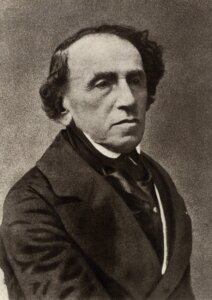
This summer on the Green Hill, the sparkling and rousingly triumphant music of Rienzi itself kept pointing away from Bayreuth and toward Paris. Giacomo Meyerbeer, born Jakob Liebmann Meyer Beer into a wealthy Jewish family in Berlin in 1791, became the dominant composer of French grand opéra and one of the most internationally successful musicians of the 19th century. His Robert le diable and Les Huguenots showed what opera could achieve when intimate drama, huge public scenes, chorus, orchestra and stage technology were coordinated on an unprecedented scale. There is an old joke that Rienzi is Meyerbeer’s best opera. The young Wagner would not necessarily have taken that as an insult.
In 1837, the 24-year-old Wagner wrote to Meyerbeer that the older composer’s works had given his ideas about dramatic music a “new direction.” He praised Meyerbeer for mastering the strengths of the Italian and French schools and combining them into an art with international reach. “Goethe is dead — but he was no musician; there is nobody left but you,” Wagner wrote Meyerbeer in 1840. When the young composer arrived in Paris poor, obscure and desperately ambitious, Meyerbeer supported him, wrote recommendations on his behalf and praised music from Rienzi. In one letter, Wagner told Meyerbeer that he wept when he thought of “the man who is everything to me” and that working and striving “for you, and you alone” gave meaning to his efforts.

The musical indebtedness ran deeper than the patronage. Wagner later acknowledged that grand opéra, with its huge scenic and musical resources, had been his model for Rienzi. His ambition, he wrote, was “not simply to imitate it” but to surpass it through an extraordinary expenditure of means: five acts, five large finales, hymns, processions and what he called the “musical clash of arms.” Those techniques did not disappear when Wagner later repudiated grand opéra. He absorbed and transformed them in “mature” works like Tannhäuser, Lohengrin and Götterdämmerung, the final installment of the Ring cycle, which might be said to be the grand opéra par excellence.
That artistic debt increasingly tormented him. When Robert Schumann remarked in 1843 that Der fliegende Holländer “smacked of Meyerbeer,” Wagner responded with extraordinary defensiveness, insisting that the faintest Meyerbeerian odor would threaten his creative identity while conceding in the same letter that he remained personally indebted to the elder composer. After an attempt to staged Rienzi in Berlin in 1847 ran aground, Wagner’s resentment acquired a paranoid cast: he persuaded himself that the Jewish composer exercised secret control over the press and court circles that had disappointed him, despite the considerable evidence of Meyerbeer’s efforts to assist him.
The anxiety Wagner seemed to feel about Meyerbeer’s influence never fully disappeared. In 1872, eight years after Meyerbeer’s death, Wagner’s wife Cosima recorded a dream in which her husband was “walking arm in arm with Meyerbeer” and Meyerbeer had “smoothed for him the paths to fame.” She immediately connected it with another dream that repeatedly troubled Wagner: Money due to him had failed to arrive and he was unable to pay his rent.
Wagner’s antisemitism cannot be reduced to wounded professional vanity. It drew on larger currents of German nationalism and anti-Jewish thought and became, over the ensuing decades, one of the ugliest and most persistent elements in his worldview. Meyerbeer nevertheless became central to how Wagner articulated it. The cosmopolitan art Wagner had once admired could now be recoded as rootless; theatrical brilliance became superficiality; international success became commercial calculation. In the infamous 1850 essay “Das Judenthum in der Musik” (“Judaism in Music”), Wagner denied Jews the capacity for authentic artistic creation. In “Oper und Drama” (“Opera and Drama”), Meyerbeer became his supreme example of a composer who manufactured “effects without causes.”
The accusation is comically revealing when heard alongside Rienzi, one of the most unabashedly effect-hungry scores ever composed, especially in Bayreuth’s gargantuan performing version. This points to why Rienzi sits so uneasily inside the later Wagner myth: The prophet of a regenerated German art first made his name with a gigantic cosmopolitan entertainment modeled on a genre perfected in Paris by a Jewish composer.

Rienzi’s most consequential 20th-century admirer was Adolf Hitler. August Kubizek, a boyhood friend of Hitler’s, claimed in his memoir that Hitler emerged from a performance of Rienzi in 1905 in a state of near ecstasy and later told him, “In that hour it began,” retrospectively lending the performance in Linz a prophetic quality. What had begun that evening was a political vocation modeled on the populist tribune who rose from obscurity by promising national renewal.
Early on, Hitler adopted Rienzi’s rousing overture for his political meetings in Munich; it later became a ritual element of the Nazi Party rallies at Nuremberg. For his 50th birthday in 1939, Hitler received Wagner’s autographed manuscript of Rienzi. Now lost, it was presumably in the Führerbunker when Hitler committed suicide to escape capture from the advancing Soviet troops.
I don’t think one need describe any of this as an “abuse” of Wagner. Music does not arrive with instructions for use. The Nazi embrace of Rienzi belongs to the opera’s reception history just as Meyerbeer belongs to its compositional history. Hitler recognized something in Rienzi’s transformation of political aspiration into mass spectacle that answered to his own imagination. That does not make Wagner responsible for Hitler; nor does it require us to pretend that the attraction was based on a misunderstanding.
The connection between the Führer and the Wagner Festival, however, is a different story altogether. After Wagner’s death in 1883, his widow Cosima helped turn the festival into a center of völkisch nationalism and antisemitism. Winifred Wagner, the composer’s English-born daughter-in-law, directed the festival from 1930 to 1944 and became one of Hitler’s closest friends. The relationship between Nazism and Bayreuth was not a hostile takeover of an innocent artistic institution. As I wrote in these pages in 2013, Bayreuth supported Hitler before Hitler supported Bayreuth.
After World War II, the festival answered this inheritance principally through aesthetics. When Wieland and Wolfgang Wagner — the composer’s grandsons — reopened Bayreuth in 1951, Wieland’s stripped-down, abstract productions decisively broke with the representational style associated with the Nazi period. But the brothers also asked visitors to refrain from political discussion on the Festival Hill: “Here, art is what counts.”
The morning of this year’s Rienzi premiere, the German-Jewish public intellectual Michel Friedman stood inside the Festspielhaus and quoted that appeal in a speech devoted to Wagner’s antisemitism and Bayreuth’s history.
Before Friedman spoke, the Russian-Jewish maestro Semyon Bychkov conducted Wagner’s “Siegfried Idyll” alongside chamber music by Gustav Mahler and Pavel Haas, the Czech Jewish composer murdered at Auschwitz. The festival has also made the open-air Silenced Voices memorial to Jewish artists excluded and persecuted at Bayreuth a permanent feature of the Green Hill. (First unveiled in 2012, it could definitely use a facelift.)
Bayreuth has approached this outlier with the characteristic fussiness of an institution that considers itself the standard bearer of Wagner. There is no definitive Rienzi and so the festival has assembled its own new performing version from the earliest available materials and later revisions. The result contains roughly four hours of music inside an evening that runs six hours with its two long intervals. Rienzi resembles its successors in sheer length, if in nothing else.
The last time I saw a live Rienzi was 16 years ago at the Deutsche Oper Berlin. Back then, the director Philipp Stölzl compressed the opera to about three hours and presented Rienzi’s rise and fall as an explicit Hitler-Mussolini parable. As a commentary on the work’s reception history, it was anything but subtle.
Bayreuth’s production, directed by Alexandra Szemerédy and Magdolna Parditka, is less literal but also less involving. Their Rome is a gray contemporary or near-future political landscape dominated by election campaigns, polling, smartphones and screens. The production had a strong visual grammar and some remarkably assured tableaux (including the riotous act two ballet), but it didn’t seem particularly interested in telling a story.
Virtually nobody at Bayreuth or anywhere else can be expected to know the intricacies of this plot in advance, which made the festival’s refusal to provide surtitles unusually exasperating. With Tristan und Isolde or Parsifal, performed before an audience that often knows the texts intimately, dispensing with projected translations can enhance concentration. But Rienzi is an obscure opera being performed in an unfamiliar version, and the staging itself rarely clarified the action. Eventually I stopped worrying about it. Another chorus arrived, another political faction reversed itself, another steely declaration climbed toward a climax. Rienzi is prodigiously good at generating excitement and considerably less good at persuading you that one excitement necessarily leads to the next.
In interviews, Nathalie Stutzmann, the French conductor helming the production, has stressed Rienzi’s affinities with Bellini and the Italian bel canto tradition. The Festival Orchestra sounded phenomenal: brilliant without becoming merely blaring and surprisingly lyrical beneath all the military and ceremonial pomp.
The Festival Chorus, which bears much of the opera’s weight, produced one immense wave of sound after another. The Austrian heldentenor Andreas Schager sounded as though he were born to sing Rienzi, which is an insane thing to say about anyone. His seemingly inexhaustible voice and effortless buoyancy suited the character’s mixture of exhortation, certitude and growing desperation.
Their audience responded with the decorum of a mausoleum. This audience can sit through a climax that would bring almost any Italian or French opera house to its feet with the stillness of a congregation awaiting further instructions. (Whenever I tentatively tried to applaud an aria in the silence that followed a full cadence, I was immediately shushed.)
No one needs Rienzi to become a permanent Bayreuth fixture. 150 years since the first Bayreuth Festival, it’s enough that it has punched a hole in the repertory. The Salzburg Easter Festival, which is currently building a new Ring with Kirill Petrenko and the Berlin Philharmonic, plans to interrupt Wagner in 2028 with Arnold Schoenberg’s Moses und Aron. Bayreuth might profit from similar encounters: With Meyerbeer and the other composers who fed Wagner’s imagination, or perhaps with composers whose music later found itself excluded from the German tradition in the name of ideas that flourished on the Green Hill. The sepulchral Festspielhaus could stand a little “luft von anderem Planeten” (“air from other planets”), to quote a Stefan George poem that Schoenberg set to music.
Listening to Rienzi at Bayreuth makes audible something the Wagner cult spent generations trying not to hear. Beneath the composer who would announce a new German art stands the cosmopolitan operatic world he learned from; behind the antisemite who made Meyerbeer a symbol of artistic falseness stands the desperate young composer who begged for Meyerbeer’s help and absorbed his example. 150 years after Bayreuth opened, their new Rienzi reminds us that Meyerbeer was inside Wagner’s music all along.
The post Hitler’s favorite composer Richard Wagner found early inspiration in a Jewish artist’s music appeared first on The Forward.
Uncategorized
Recorded anti-Jewish hate crimes rise 10% in England and Wales
(JTA) — Hate crimes targeting Jewish people in England and Wales rose by 10% in the year ended in March, according to the latest data released by the British government.
Police-reported hate crime — including crime influenced by other factors such as race and sexual orientation — overall increased by 7% compared with the previous year, according to the Home Office data released last week.
British Foreign Secretary Ed Miliband posted on X on Monday, “Antisemitism has no place in our society. This morning, I hosted a crucial discussion with the J7 Global Task Force to discuss how we can work together across countries to stamp out the scourge of antisemitism.”
Following the meeting, the Board of Deputies of British Jews issued a statement explaining that Miliband and the task force had discussed, among other things, “the sharp rise in global antisemitism” and the “continued demonisation of Israel.” Representatives from the U.K., the U.S., Canada, Germany, France, Argentina and Australia make up the task force.
“In the meeting, the J7 proposed a new international intergovernmental ministerial task force on antisemitism, comprising the countries represented in the J7 and taking on the key themes discussed. We were pleased that the Foreign Secretary agreed to host an inaugural meeting of J7 countries’ ministers to start this process,” the statement sent to JTA said.
The Community Security Trust, a charity that protects the Jewish community and monitors antisemitism, said on X that the new data show “that antisemitic hate crime remains at an unacceptably high level.”
“As seen previously, Jewish people continue to experience by far the highest police-recorded rate per head of religious hate crime of any faith group,” CST said. “This shows the disproportionate scale of anti-Jewish hatred and its impact on Jewish life in Britain.”
Religious hate crime rose by 13% overall in the 12 months to March 2026, the report said. The overall figure rose from 10,067 to 11,419 offenses.
The two groups most affected were Jews and Muslims, the Home Office said. Religiously motivated hate crimes against Muslims increased 15%, the report found, with spikes reported around public protests in September 2025 and the start of the U.S. war with Iran in February.
The number of recorded offenses affecting Jews rose from 2,874 to 3,162 offenses, spiking after the attack on Heaton Park synagogue in Manchester last year on Yom Kippur.
Two men, Melvin Cravitz and Adrian Daulby, were killed on Oct. 2, 2025, after Jihad Al-Shamie, who was wearing a fake suicide bomb belt, drove into the gates of Heaton Park synagogue and began attacking congregants with a knife. Cravitz died from stab wounds; Daulby was fatally struck by a police bullet during the response.
A spate of violent antisemitic incidents followed this year, including the torching of four ambulances belonging to Jewish volunteer service Hatzola on March 23 and the stabbing of two Jewish men in separate attacks in Golders Green on April 29.
The Home Office figures, which do not include data from London’s Metropolitan Police Service because of a change in how it records crime, showed the second-highest level of religious hate crime directed at the Jewish community since the Home Office began keeping records in 2018. It was surpassed only by the year ending March 2024.
“In the last year, there were 117 police recorded religious hate crimes targeted at Jewish people per 10,000 population, the highest rate for any religious group. The next highest rate was for religious hate crimes targeted at Muslims, with 13 per 10,000 population,” said the Home Office.
The report was published on Oct. 8, at a time of heightened sensitivity. Eleven people were arrested at pro-Palestinian marches in London a day earlier, despite calls by the Metropolitan Police to avoid demonstrating on the anniversary of Hamas’ deadly 2023 raids inside Israel.
Police reported 20 arrests at Saturday’s pro-Palestinian protest in London, where many demonstrators were wearing kaffiyehs, waving Palestinian flags and brandishing banners.
The level of hate directed at the Jewish community has remained at an “elevated level” since the beginning of the Israel-Hamas conflict, the report stated.
The CST said, “There is an urgent need to reduce the amount of incitement connected to conflict overseas,” adding that “much more needs to be done across society to tackle this problem.”
Over the summer the government announced a major funding boost to support the Jewish community, promising £250 million ($335 million) over the next three years for increased policing and protection of Jewish communities.
More remains to be done, according to community organizations.
A spokesperson for the Board of Deputies of British Jews said the report’s publication “confirms the need for rigorous prosecution to ensure deterrence, and a whole of society approach to tackling hatred and extremism, and to stopping conflict in the Middle East being used to incite hatred against the Jewish community.”
The Campaign Against Antisemitism said the report was evidence that the British justice system was failing the Jewish community.
“Antisemites, emboldened by the Hamas terrorist atrocity three years ago, are not only not letting up in their hatred but are doubling down,” it said in a statement. “That’s because there is no real deterrent. So really these figures are most damning for the criminal justice system, which has utterly failed to defend British Jews.
“Even as conflict in the Middle East is easing off, antisemitism in the U.K. is rising, yet there have been essentially no changes in policing policy over the past three years and nobody has been held to account for this monumental failure,” the campaign said.
This article originally appeared on JTA.org.
The post Recorded anti-Jewish hate crimes rise 10% in England and Wales appeared first on The Forward.
Uncategorized
Hasan Piker criticizes ‘opportunists’ who accused Mamdani of genocide
(JTA) — Hasan Piker called the protesters who jeered New York Mayor Zohran Mamdani at an Oct. 7 vigil last week “opportunists,” who “tarnished” the anti-Zionist movement’s message.
Piker, the popular streamer who has campaigned for a number of democratic socialist candidates, made his remarks Sunday at Jewish Currents Live, an all-day event hosted by the left-wing magazine at the Brooklyn Academy of Music.
Speaking on a panel titled “Can the Left Wield Power?”, he said that the protesters had “valid concerns,” including demands like firing police commissioner Jessica Tisch and disbanding the NYPD’s Strategic Response Group, a heavily armed unit that often responds to protests.
But he criticized the Democratic Socialists of America — the left-wing political organization that Mamdani has called his “political home” — for not playing a bigger role in last week’s protest, which started at City Hall and later overran an Israeli peace vigil. DSA did not sponsor the protest, though some campus chapters of its student section, the Young DSA, participated.
“The DSA not being at the forefront of the anti-Zionist mobilization in New York City is what allowed that mobilization to be tarnished by opportunists, sectarians and those who actually were calling him a genocidaire — which I obviously find to be ridiculous,” Piker said, referring to protesters’ chants of “Mayor Mamdani you can’t hide, we charge you with genocide.”
Piker, who has drawn heat for his anti-Israel views, did not comment on the Hamas iconography displayed by numerous protesters, nor the decision to crash an Oct. 7 vigil that memorialized the 1,200 people killed in the Hamas-led attacks on that date in 2023, and the 74,000 Palestinians who have been killed since then, according to Gaza health ministry figures, which do not distinguish civilians from combatants.
Separately, Mahmoud Khalil, the Columbia University pro-Palestinian protest leader who was detained by ICE last year, reportedly criticized those protesters’ “purity politics” during an event in Washington, D.C.
“You don’t have to agree with someone 100 percent — 85 percent is good,” he said, provided that the end goal is “liberating Palestine and ending the unconditional support of the United States.”
Where should Democrats draw the line?
Two Democratic congressional nominees from New York, Brad Lander and Darializa Avila Chevalier, appeared on a separate panel focused on Israel and the Democratic Party.
Lander is Jewish and Darializa Avila Chevalier helped lead Columbia University’s pro-Palestinian encampment in 2024. Peter Beinart, editor-at-large at Jewish Currents, moderated the panel, which also featured Georgia state Rep. Ruwa Romman, the first Palestinian American elected to public office in her state.
Their discussion exposed some of the gaps between Lander and Avila Chevalier, both progressives who were endorsed by Mamdani this year and who appeared in a campaign ad together alongside fellow Mamdani endorsee Claire Valdez.
Beinart asked where Democrats should draw the line on what is considered legitimate Palestinian resistance. He pointed to the pro-Palestinian protest held in New York City on Oct. 8, 2023, which Avila Chevalier attended and Lander called “abominable” at the time.
“I think international law has already drawn that line,” Avila Chevalier said, arguing that U.S. protests should target Israel, which receives U.S. support, rather than Hamas.
“We could be the biggest anti-Hamas protesters, but a protest against Hamas in the U.S. isn’t going to do anything,” Avila Chevalier said. “Because we don’t fund it. We don’t have any structural power over it, there is nothing tying us to that institution other than condemning it endlessly.”
After the event, Lander did not confirm to the Jewish Telegraphic Agency whether he had spoken about that Oct. 8 protest with Avila Chevalier.
“We have talked about these issues broadly in private, and I don’t want to characterize those conversations,” Lander told JTA. “And obviously I’ve made my feelings known in public, and I stand by them. I mean, on that day, I was in mourning.”
An attendee named Mark, 29, who declined to share his last name to avoid potential workplace complications, said he felt that Avila Chevalier “didn’t really acknowledge the criticism about perhaps disregarding loss of life; despite the power imbalance, it is lost life.”
For Lander, meanwhile, Mark said it was “politically expedient” for him to not directly address Avila Chevalier’s presence at the 2023 protest. “This is a super lefty crowd that probably would eat him alive if he went against her right now,” he said.
During the panel, Avila Chevalier repeated her call for an arms embargo against Israel while Lander stopped short of doing so, consistent with his statements in the past that Israel should be able to buy defensive ware. Both said Congress must pass the Block the Bombs Act and vote to suspend the sale of offensive U.S. military weapons to Israel. Lander was the only speaker on stage who advocated for a two-state solution in the region.
Beinart asked Romman about Jon Ossoff, the Jewish Democratic senator running for reelection in her state, and how she views his stance on Palestine. She said she was pleased that both Georgia senators have been consistently voting in favor of Bernie Sanders’ resolution to block arms sales to Israel, but added that “in terms of leading, in terms of rhetoric, there’s still a lot of work to be done.”
“We’ll get everyone to where we need them to be eventually,” she said.
‘The bund is back in town’
The Jewish Labor Bund — the early 20th-century socialist movement that fought against Bolshevism, Nazism and Zionism — came up at numerous points on Sunday. One attendee doled out fliers with a website URL and the message, “Tell your bubbe the bund is back in town.” It was also a subject of a conversation that featured Molly Crabapple, whose 2026 book “Here Where We Live is Our Country” focuses on the Bund.
Arlene Geiger, an Upper West Sider and longtime activist, told JTA that she related to those conversations.
“My connection to Judaism is not to Israel, it never has been. It’s more to Eastern Europe and the Bund, so that spoke to me,” Geiger said.
Mark, who is from New Jersey, said he doesn’t come from a “staunchly pro-Zionist” family, but that he has a new interest in leftist Jewish spaces since realizing that he could no longer comfortably distance himself from the issue of Israel, which he believes is committing a genocide.
“It’s just an education for me to be immersed in this kind of space,” he said.
This article originally appeared on JTA.org.
The post Hasan Piker criticizes ‘opportunists’ who accused Mamdani of genocide appeared first on The Forward.
Uncategorized
In Israel, boy killed, hikers injured, after suspected Hezbollah cluster bomb detonates
(JTA) — An explosion during a school hiking trip killed a boy about 14 years old on Monday and injured 24 others in northern Israel, Magen David Adom, Israel’s emergency medical service, said.
Rescue teams were dispatched to the scene, and the injured were evacuated to hospitals in northern Israel.
“An initial investigation by IDF forces at the site indicates that it was likely a cluster bomb belonging to the Hezbollah terror organization that had been left in the area and exploded,” the military said in a statement.
“The injured were scattered along the route, some trying to help their wounded friends,” explained David Radko, an MDA medic who said he was the first to arrive on the scene. “Despite the horrific scenes and distress, the injured cooperated with me exceptionally well. Everyone tried to help their friends as much as they could. Some even applied tourniquets to their friends to stop the bleeding.”
Police Commissioner Danny Levy visited the scene and said authorities may ban similar school trips in the near future. “We need to examine whether we are putting students at risk by allowing them to go on these trips,” he said.
Tamir Douadi, a resident of Kibbutz Manara, described the scene in a voice cracking with emotion to Channel 12: “Look, they’re young people, children. You see them sitting there like that, holding their friends.”
The object exploded “in the hands” of one of the schoolchildren, Comm. Meir Eliyahu, commander of the Israel Police’s Northern District told reporters at the scene.
Orly Ben Simon, an MDA paramedic, said personnel identified several people with injuries of varying severity, including a 14-year-old boy who was unconscious and in critical condition. “We immediately began prolonged and intensive resuscitation efforts. Unfortunately, his injuries were critical, and we had to pronounce him dead at the scene,” she said in a statement provided by the MDA.
She added that medical teams treated two teenagers who were seriously injured, as well as other injured people who were able to walk.
In an initial statement, the Ma’alot-Tarshiha municipality said the explosion occurred during an annual hiking trip by students from the ORT Ma’alot religious high school, located in the mixed Jewish-Arab town, about five miles from the Lebanese border. The entire area has come under heavy fire from Hezbollah since Oct. 7, 2023, and some of the munitions have failed to detonate.
MDA said the injured included 22 teenagers and two adults in their 50s. Two of the injured were in serious condition and 10 were in moderate condition. They were evacuated by ambulance and helicopter to hospitals in Haifa, Safed and Nahariya.
Israel’s Education Ministry described the incident as “extremely serious.” According to the ministry, the trip was properly approved in accordance with established procedures. Ma’alot-Tarshiha Mayor Moti Ben David told Israeli media that the route was a popular hiking trail.
This article originally appeared on JTA.org.
The post In Israel, boy killed, hikers injured, after suspected Hezbollah cluster bomb detonates appeared first on The Forward.
