


Uncategorized
How a monument to a Jewish Confederate ended up in a storage unit, next to a vacuum cleaner
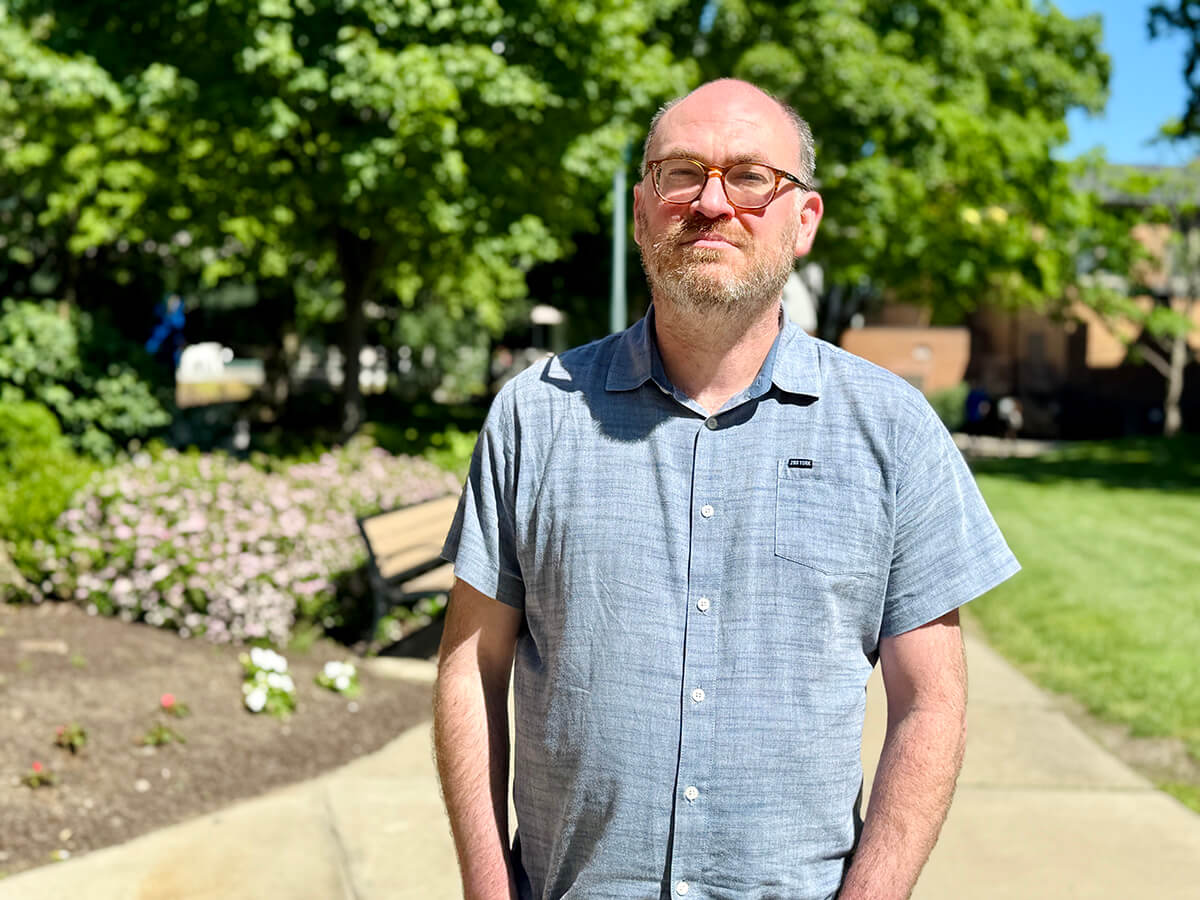
Behind an orange roll-up door at a self-storage facility in New Orleans, sits a vacuum cleaner, some lighting gear and a cardboard box.
Inside the box is a Confederate monument, one of the strangest Jewish heirlooms in America.
It is granite, four and a half feet tall, 1,600 pounds and shaped like a thick tombstone. It lies on its side on a crushed wooden pallet because it can no longer stand up. A third of it once sat underground, and when Charlotte, North Carolina, chipped it out of a sidewalk in the summer of 2020, the buried end came out ragged. It carries a few gouges where a protester swung a hammer. Until the city scrubbed it, it also carried three letters in black spray paint: BLM.
“There it sits to this day,” said Kenneth Hoffman, executive director of the Museum of the Southern Jewish Experience, half a mile away in New Orleans, “and possibly will sit forever.”
The stone is one of the last left standing — or, more precisely, lying down — from a century-long campaign in which American Jews built monuments across the South to Judah P. Benjamin, the Confederacy’s Jewish secretary of state, because, for a time, he represented their own acceptance in the South. The monument’s fall tells the story of what changed — not just about Benjamin, but about the Jews who once celebrated him.
Its journey from a Charlotte sidewalk to a New Orleans storage unit involves a Yiddish-speaking ex-convict, the United Daughters of the Confederacy, an antisemitic banker, two Polish-born rabbis, a dollar bill pulled from a stranger’s wallet, and a retired lawyer whose wife descends from the man who once hid Benjamin from the Union Army.
What nobody has figured out is what to do with it.
The brains of the Confederacy
Benjamin was a New Orleans lawyer, a sugar planter who owned 140 enslaved people, and a U.S. senator from Louisiana. When the South seceded, Confederate President Jefferson Davis made Benjamin attorney general, then secretary of war, then secretary of state. The two men worked side by side as much as 10 hours a day. Benjamin’s face was engraved on the Confederate $2 bill, likely the only paper money issued in America to feature a Jewish person.
He was known as “the brains of the Confederacy” — a phrase that started as an insult, the old canard of the Jewish puppet master, a way of pinning the Civil War’s loss on the one Jew in the cabinet. He married a Catholic woman, never joined a synagogue and was not a practicing Jew, but none of that mattered. A senator from Ohio sneered that Benjamin was an “Israelite with Egyptian principles.”
When the Confederacy collapsed, Benjamin ran. He disguised himself as a Frenchman who spoke no English, hid in a Florida swamp and slipped out to sea. He made it to London, reinvented himself as a barrister, and died wealthy and free in Paris in 1884, never having answered for any of his past.
That flight is why there are so few monuments to him. Davis went to prison. The generals surrendered and lived out their lives in the South. Benjamin escaped and never came back.
“Some considered Judah Benjamin a kind of traitor,” said Jonathan Sarna, the noted Brandeis University historian of American Jewry.
So the Lost Cause never fully claimed him. Southern Jews claimed him instead.
‘Judah P. Benjamin Nite’
The commemoration campaign that followed has been reconstructed largely by David Weinfeld, an assistant professor at Rowan University who is working on a book called Southern Jews and the Lost Cause. It was indifferent to geography.
Jewish war veterans presented a Benjamin portrait to Atlanta Mayor William Hartsfield in 1954 for the city’s collection of “Confederate Heroes and Statesmen.” Weinfeld found that Alabama’s B’nai B’rith opened its 1962 state convention with a dinner-dance called “Judah P. Benjamin Nite,” and offered to fund a monument at the state capitol honoring him as “a son of the Jewish people.”
Alabama didn’t have a strong connection to Benjamin, which was precisely the appeal there. He “provided a means for southern Jews to prove their southernness regardless of what former Confederate state they resided in,” writes Weinfeld.

Sarna puts the calculation more starkly. Jewish safety in the South depended on being counted as white, and Southern Jews understood the alternative.
“Why did they want to be white?” he asked. “Because the alternative was to be Black.”
The stakes weren’t abstract. In the years around those celebrations, synagogues across the South were bombed and set on fire, and rabbis who backed integration were punished for it. “There were people whose response was, ‘If we want to continue to be here in the South, this is the price we have to pay,’” Sarna said.
It was a bargain, mostly unspoken: stay loyal to the white South and you will be well treated. Many Southern Jews upheld their end of it. Plenty, Sarna said, “had prejudices not different from those of their non-Jewish counterparts.”
The United Daughters of the Confederacy embraced Benjamin right back. “They understood that celebrating a Jew made the Confederacy look tolerant,” Weinfeld told a room of scholars at the American Jewish Historical Society’s conference this June in Cleveland.
The Daughters chartered a Judah P. Benjamin chapter in Bradenton, Florida, in 1914, and after World War I began sponsoring Benjamin markers across the South.
In 1924, the Daughters bought Belle Chasse, Benjamin’s old Louisiana plantation, and a New Orleans rabbi spoke at the dedication, consecrating the house to “the impulse of patriotism.” The next year they bought the Gamble Plantation in Ellenton, Florida, where Benjamin is said to have hidden from Union troops, and gave it to the state. It remains a state park officially named the Judah P. Benjamin Confederate Memorial. With B’nai B’rith’s support, the UDC raised a monument in Sarasota in 1942 — pink Georgia marble, crowned with a bronze sundial — and another in Fayetteville in 1944.
The Sarasota dedication came six weeks after Pearl Harbor, and the Birmingham News found in it a wartime moral. Honoring Benjamin was fitting “especially so right now, when the United States is at war with totalitarian forces whose ringleader, Nazi Germany, proclaims and practices racial and religious intolerance,” the paper wrote. The monument was “in a way a part of the answer of the South, the land of the Confederacy, to Adolf Hitler’s assault upon those freedoms which Southerners and all Americans hold dear.”
It was a memorial to a slaveholding Confederate, offered as the South’s rebuttal to Hitler.
The Charlotte fiasco
In Charlotte, the arrangement broke down in public.
According to Weinfeld’s extensive research, the local UDC chapter was preparing to host the 1948 state convention and wanted a marker for the spot where Benjamin sheltered for a week in April 1865, in the home of a Jewish merchant named Abraham Weill. The chapter’s historian, Josephine Yarbrough, needed money. She wrote to Harry Golden.
Weinfeld has traced what happened next through Golden’s own account and contemporaneous records.
Golden was about the least Confederate man in North Carolina. Born in what is now Ukraine, raised on the Lower East Side, he had served federal prison time for mail fraud before reinventing himself in Charlotte as publisher of the one-man newspaper the Carolina Israelite.

Golden would go on to become a best-selling humorist and an ally of Martin Luther King Jr. during the civil rights movement. But in 1948, he called Benjamin “one of the greatest Jews America has ever produced.” He signed up the city’s two synagogues, Temple Israel and Temple Beth El, which agreed to buy the granite and present it to the Daughters as a gift.
Then came the letter.
A non-Jewish New York banker with Charlotte in-laws warned UDC members across the state that the Daughters were being used for Jewish propaganda. Charlotte’s so-called good Jews, he wrote, were “good only because they are as yet unrevealed.”
That was all it took. The local Daughters voted to yank their name off the stone, then went to the city council to stop the marker from being erected. They argued it would block passengers boarding city buses. The state and national organizations overruled them, and both synagogues voted to press on.
On Oct. 1, 1948, police blocked off South Tryon Street for the unveiling. The mayor came. A Presbyterian minister delivered the keynote. And the Jewish blessings came from two rabbis — Aaron Tofield of Temple Israel and Philip Frankel of Temple Beth El — both born in Poland. Three years after the Holocaust ended, two immigrant rabbis from the old country stood on a Southern sidewalk and consecrated a monument to the Confederacy.
Hidden in plain sight
The stone did what stones do. It stood there.
Charlotte changed around it — the streetcars, then the skyscrapers, then the FedEx store it eventually fronted. The inscription was right there for anyone who bothered to crouch down and read it. You could ship a package, grab a coffee and walk right past a monument to the Confederate secretary of state.
Charlotte’s Jewish community never forgot, exactly. During her years in Beth El’s pulpit, which ran from 1998 to 2016, Rabbi Judith Schindler used the marker to teach the congregation’s teenagers about Jews in the Confederacy.
In August 2017, white supremacists marched in Charlottesville, Virginia, to protest the planned removal of a statue of Confederate General Robert E. Lee, and a counterprotester was killed. Soon after, Beth El’s board voted unanimously to push Charlotte to move the marker somewhere else — or find some other use for it. The answer was the same every time: North Carolina law barred removing Confederate monuments unless they were relocated somewhere equally prominent.
Then, in June 2020, artists painted a “Black Lives Matter” street mural along South Tryon, directly in front of the stone. The monument looked out over the M in “Matter.”
Days later, somebody spray-painted “BLM” across most of the granite and went at it with a hammer. The granite mostly won. “They probably whacked at it several times,” Hoffman said, “and it really only took out a few chips.”
On June 17 of that year, Temple Israel and Temple Beth El — the same two congregations that had paid for the stone in 1948 — wrote to Charlotte’s mayor, city council and city manager. This time, they demanded the monument be removed.
“We should neither celebrate the Confederacy nor honor the legacy of white supremacy,” they wrote. “The monument does not belong in a place of prominence within our city, just like German cities do not memorialize or erect statues to Nazis.”
A week later, Schindler and Mike Wirth, an artist in her congregation, placed a vinyl wraparound banner over the monument. On it was a quote from Emma Lazarus: “Until we are all free, we are none of us free.”

City workers then pried the monument out of the sidewalk, “sort of to the relief of everyone,” Hoffman said. The city scrubbed off the spray paint, declared the marker damaged and put it in municipal storage.
Then, hundreds of miles away and north of the Mason-Dixon line, a retired lawyer read a book.
The dollar
Barrett Freedlander was reading a biography of Judah Benjamin when he hit a half-page passage about a monument in Charlotte. He was shocked. He was also, he realized, related to the story.
Freedlander, 84, is a retired Baltimore attorney. His wife, Laura, is the great-great-granddaughter of Abraham Weill — the merchant who sheltered Benjamin, and whose name is misspelled “Abram Weil” on the stone.
“The only reason I cared about it,” he said, “is because of the family connection.”
That connection runs deeper than Benjamin. Richmond was days from falling. Confederate President Davis, worried about the “disorganized bands of troops roving about the country,” put his wife and their four children on a southbound train — and handed her a pistol and “showed me how to load, aim and fire it,” Varina Davis wrote.
When they arrived in Charlotte, the rented house was packed up and nobody in town would help a family everyone assumed would be arrested.
Except one man.
“The agent, Mr. A. Weill, an Israelite, came to meet us there and gave us every assistance in his power,” Varina wrote in her memoir, “and when he found there were no conveniences for cooking, he sent our meals from his own house for several days, refusing, with many cordial words, any offer to reimburse him.”
Freedlander thinks he knows why the Confederate first lady reached for the word “Israelite,” and why a Jewish merchant was the only person in Charlotte willing to take in a family the rest of the city was shunning. “Only the persecuted would appreciate her issues,” he said.
The Weills prospered. Weill helped found the synagogue in Wilmington, North Carolina, where relatives still belong. His granddaughter Laura married Julius Cone, a Greensboro textile tycoon. The family fortune allowed sisters Claribel and Etta Cone to buy the Matisses and Picassos that are the crown of the Baltimore Museum of Art.
So when Freedlander learned the marker had disappeared into municipal storage, he started making calls. A staffer in the mayor’s office said the city had no use for it and was willing to let it go. But the manager of the warehouse where it sat called Freedlander back with a complication: the city couldn’t simply hand over public property. He was obligated to charge for it.
“How much?” Freedlander asked. One dollar. Freedlander offered to send a check. The man said not to bother and paid it himself, out of his own wallet.
Freedlander’s original idea was to put the monument in his own backyard. “My wife didn’t want it,” he said.
A friend mentioned the new Museum of the Southern Jewish Experience in New Orleans. Another friend of Freedlander’s, a Baltimore executive whose company hauls computer equipment around the country, priced out the job, got into four figures, then called back and said he’d do it for free. It was history, he said.
Monument vs. museum
The stone arrived in New Orleans via truck in November 2022. It was lowered onto the pavement outside the Museum of the Southern Jewish Experience’s offsite storage with a jack lift, and has not moved since.

Hoffman’s first instinct had been to display it. The stone, he realized, tells three tales at once: the Civil War, when Benjamin rose to the Confederate cabinet; 1948, when the two Charlotte synagogues paid for a monument to him; and 2020, when it was defaced during the summer of Black Lives Matter protests.
Last October, when the Southern Jewish Historical Society held its conference in New Orleans, Hoffman and Weinfeld convened a roundtable of historians to figure out what to do with the monument. One idea floated that seemed to gain consensus was to display the marker alongside a light projection restoring the graffiti.
For now, the monument remains in storage. Hoffman said that if and when it goes up, it will be “with its full context. Not like it’s a historical marker.”
Samantha Baskind, an art historian at Cleveland State University, thinks the museum should not wait to display it.
“Yes, originally the statue commemorates Benjamin as a distinguished Jewish American and Confederate statesman,” she said. “But the fact that it was defaced during Black Lives Matter protests makes it acquire a second history. The graffiti isn’t merely vandalism in a conventional sense. It documents a moment when Americans were publicly reevaluating Confederate symbols.”
Which means the object now holds a double meaning: why Benjamin was honored in the 20th century, and why so many people rejected that honor in the 21st.
Baskind knows firsthand the cost of institutional flinching. In 2022, she curated an exhibition of 19th-century Jewish American artists for a gallery at Princeton, including work by Moses Jacob Ezekiel, a Jewish sculptor who spent part of his career producing Confederate monuments. Baskind, who wrote a book about Ezekiel, had written labels confronting Ezekiel’s Lost Cause loyalties head-on. Late in the process, the venue that was planning on showing the exhibition canceled it.
“It was almost devaluing what your students are capable of thinking about,” Baskind said. “And isn’t that what we do in an educational environment?”

Her verdict on the Charlotte stone is unambiguous. The city should never have cleaned it. “I wouldn’t see it as damage. It’s part of the object’s history.” The graffiti “deserves interpretation and not concealment.”
And the question a museum ought to ask, she said, isn’t whether Benjamin was good or bad. “The more interesting question is: Why did different generations understand him so differently?”
Early in the 20th century, American Jews saw a success story. Today most see a man who helped run a slaveholding rebellion that waged war on other states. “Neither perspective should replace the other,” Baskind said. “A museum explains how and when those shifts occurred.”
Then she offered the distinction she believes the argument comes down to. “A monument exists to honor,” she said. “A museum or gallery exists to explain.”
Visitors to the Museum of the Southern Jewish Experience can still find Judah Benjamin there. He’s in a display case in an exhibit about Jews, slavery and the Civil War: two Confederate $2 bills bearing his portrait, one from 1862, one from 1864. Both are blank on the back.

“Which tells you something about the financial solvency of the Confederacy,” Hoffman said. “Save money. Just print it on one side.”
Half a mile away, one of the last monuments American Jews built to the highest-ranking Jew in the Confederacy, and to the standing he seemed to promise them, lies in a cardboard box in the dark, its graffiti scrubbed, its chips intact, waiting for somebody to decide what it means.
Freedlander hopes to take a trip to Wilmington later this month with some of his grandchildren to visit family graves — including that of Abraham Weill, the man who helped a fleeing family when nobody else in town would, and got a monument he never asked for.
“I’m a bystander to all this,” Freedlander said. “I’m just the messenger. But I did want to preserve it.”
The post How a monument to a Jewish Confederate ended up in a storage unit, next to a vacuum cleaner appeared first on The Forward.
Uncategorized
Archaeologists uncover a 300-meter section of ancient aqueduct in Jerusalem
(JTA) — JERUSALEM — Israeli archaeologists have uncovered a 300-meter (984-foot) section of Jerusalem’s ancient Lower Aqueduct, providing another window into how engineers about 2,000 years ago ensured that the city would have an adequate supply of water for residents and pilgrims.
The Israel Antiquities Authority (IAA) began the dig three months ago in advance of the planned construction of a new neighborhood in East Jerusalem, at the city’s edge. Such “salvage excavations” are often carried out prior to major construction projects in Israel to ensure that any ruins discovered at the site can be mapped and protected even if they aren’t excavated at the time.
Believed to have been built in the Hasmonean period in the second and first centuries B.C.E., this engineering system carried spring water from the Gush Etzion region of the West Bank, through Solomon’s Pools south of Bethlehem, to Jerusalem and the Temple Mount. It remained in intermittent use until the early 20th century.
Although parts of the aqueduct have been uncovered in previous excavations, this is the first time such a large section will be made permanently accessible to the public, Benyamin Storchan, an IAA archaeologist and the excavation’s co-director, told the Jewish Telegraphic Authority.
Based on earlier discoveries and a wide range of research, archaeologists had strongly suspected where the newly uncovered section was located.
“We were able to work with municipal urban planners to ensure that the shape of the new neighborhood will be determined not only by its natural topography, but based on the antiquities found there,” Storchan said.
The aqueduct, the discovery of which was made public on Sunday, will be preserved as a promenade/archaeological park at the entrance to the future neighborhood by the IAA and Israel Land Authority.
Bringing Water to Jerusalem
Before the aqueduct was built, the landlocked city of Jerusalem relied on the Gihon Spring and rainfall runoff for its entire water supply, Storchan said. Under Hasmonean rule, Jerusalem’s population grew and the need for water increased. That was especially true during Jewish festival times, when pilgrims doubled or even tripled the population.
The solution involved transporting water from springs in the Gush Etzion region, a hilly area more than 800 meters above sea level. Spring water had to be channeled to collection areas, and then toward Solomon’s Pools, an extensive water-storage complex built south of Bethlehem. From there, two major aqueducts, the Lower Aqueduct and the Upper Aqueduct, carried water toward Jerusalem – a distance of more than 20 kilometers (12 miles).
The Lower Aqueduct, which appears to predate the Upper Aqueduct, “is an engineering marvel,” Amit Re’em, the IAA’s Jerusalem district archaeologist, said in a press statement. “Even today, with all our modern technology, building such a system would require extensive planning and effort. The thought that, about 2,000 years ago, they managed to bring water to Jerusalem this way is astonishing.”
Its route had to follow the contours of the rugged topography while maintaining a gentle gradient for the water to flow by gravity alone, without mechanical pumps. Along most of its route, the water dropped just one meter in elevation per kilometer.
“The newly exposed section reveals the various stages in the history of the water system,” the IAA said. “Initially, the water flowed in a built, plastered channel. Then, about 500 years ago, during the Ottoman period, ceramic pipes were installed within the original channel, the outer face of the aqueduct wall was plastered and small stones were pressed into the plaster while still wet.”
Used for about 2,000 Years
One of the aqueduct’s most remarkable characteristics was its longevity. Believed to be constructed during the Hasmonean period, it was repaired and reused through successive eras, including the Roman, Byzantine, Umayyad, Crusader, Mamluk and Ottoman periods.
The fact that various kingdoms and rulers decided to repair and not replace the water system “is one of the most fascinating parts,” Storchan said of the waterway. Rather than repurposing an older structure for a different use, successive rulers retained the aqueduct’s original purpose.”, “here we see a single installation being reused again and again for its original function.”
The aqueduct was used until about a century ago, when modern water infrastructure, including electric pumping stations, proved more efficient. Its long history of repairs, however, complicates archaeological dating, Storchan said. Those who repaired it over the millennia added plaster, repaired collapsed sections and modified the channel, sometimes obscuring evidence of the original construction.
Utilizing modern technology
Still, the latest excavation gives researchers an opportunity to reexamine longstanding questions with advances in scientific dating methods.
“Today, technology is more advanced than it was then. We’re working with all kinds of specialists to pinpoint the dating of the original construction,” Storchan said.
One such method is optically stimulated luminescence (OSL), which can estimate when mineral grains in sediment were last exposed to sunlight. Combined with the analysis of mortar, plaster and archaeological layers, the technique may help narrow the dates associated with different stages of the system’s development.
For Storchan and his colleagues, every new insight is a cause for celebration.
“Our job as archaeologists,” he said, “is to fill in another piece of the puzzle.”
This article originally appeared on JTA.org.
The post Archaeologists uncover a 300-meter section of ancient aqueduct in Jerusalem appeared first on The Forward.
Uncategorized
Regan Katz manages not just one, but two different – and successful baseball teams in two different cities

By BERNIE BELLAN About three months ago I wrote a story about an up and coming local football star by the name of Gavin Katz – who, although only 14 years old, had already received widespread recognition for his defensive abilities on the football field. (You can read that story at “Gavin Katz: ‘The next great Jewish football player’.”)
Gavin had been both a linebacker and defensive lineman for his pee-wee Fort Garry Lions Bantam football team – and he was voted most outstanding defensive player on his team by his coach, John Makie.
One thing that stood Gavin in especially good stead as a football player was that, in his 14th year, he grew 4 inches to 5’8″ and added 35 pounds to weigh 170 pounds at the time I spoke to him in July.
With him graduating from Ecole River Heights last June and moving on to Kelvin High School this September, Gavin had hopes to make the Kelvin football team, but he was realistic about his chances, saying that he thought he would probably “end up on the practice roster” for the Clippers varsity team “where he will be fighting for a playing role,” because if he did make the team he’d be among the youngest players on the team (which is usually made up predominantly of players from Grades 11 & 12).
Well, as I noted in my introduction to my story about Gavin Katz, the idea for doing that story came from sportswriter Scott Taylor. Recently, Scott sent me another email about a story, but this time the idea he suggested was to do a story about Gavin’s father, Regan.
I had mentioned Gavin’s parents’ names in my story about Gavin – also that Regan is former Mayor Sam Katz’s nephew (His father is Sam’s older brother, David), but other than adding Gavin’s mother’s name (Mandy), I didn’t go into any detail about Regan Katz and his own very successful career.
Then I received another email from Scott Taylor, this time about Regan (with a photo attached):
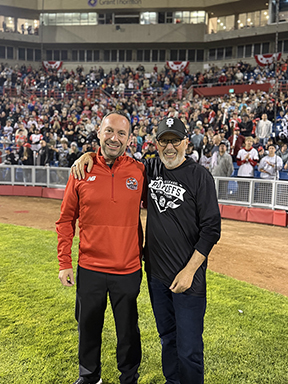
“Here’s a photo of the best baseball executive in Canada — Regan Katz.
“He runs both the Goldeyes and the Ottawa Titans. He helped get the Goldeyes to the playoffs, just won a championship with the Ottawa Titans and also set the affiliated minor league attendance record in Ottawa with more than 10,000 fans for the Frontier League opener and again for the Championship series.
“This guy has his shit together.”
And so, since my story about Gavin Katz was one of the most widely read stories on this website this past summer (It was also very widely read in the print Jewish Post newspaper.), I decided that, if Scott Taylor sends me a story idea, it’s an idea worth following up.
Which led me to contacting Regan Katz again. (The last time I contacted him it was to see whether he could wake Gavin up to talk to me. After all, like most teenagers, Gavin likes to sleep in when he can, but it was already 11 am on a Saturday morning when I was calling, so I figured: “Dad, go wake up your son. There’s a not-so-important journalist who wants to talk to him.”
Which is how I ended up having a very enjoyable interview with a very personable and unassuming young man – who did seem a little bit drowsy as I talked to him.
This time though, when I spoke with Gavin’s father, Regan was very much alert. Considering the hectic schedule he maintains though during baseball season, I could have forgiven him for sounding just a wee bit tired himself. But, at the time we did our phone interview, Regan’s baseball season had wound up. He sounded quite relaxed – still very much enjoying the accolades he had received for his work running not just one, but two different minor league baseball teams.
Before I began to ask Regan about his life in baseball, however, I wanted to touch base with him about Gavin’s football career. By now, the high school football season was in full tilt, and I was curious to know whether Gavin had made the Kelvin football team?
Regan told me that Gavin was one of only three “freshmen” to make the team and “Gavin’s the only one who started every game, and, yesterday got defensive player of the game” (which would have been played Thursday, Oct. 1, as our interview was conducted Friday, Oct. 2.)
I asked Regan whether Gavin was still playing linebacker (which, Gavin had told me, was his preferred position on defense)?
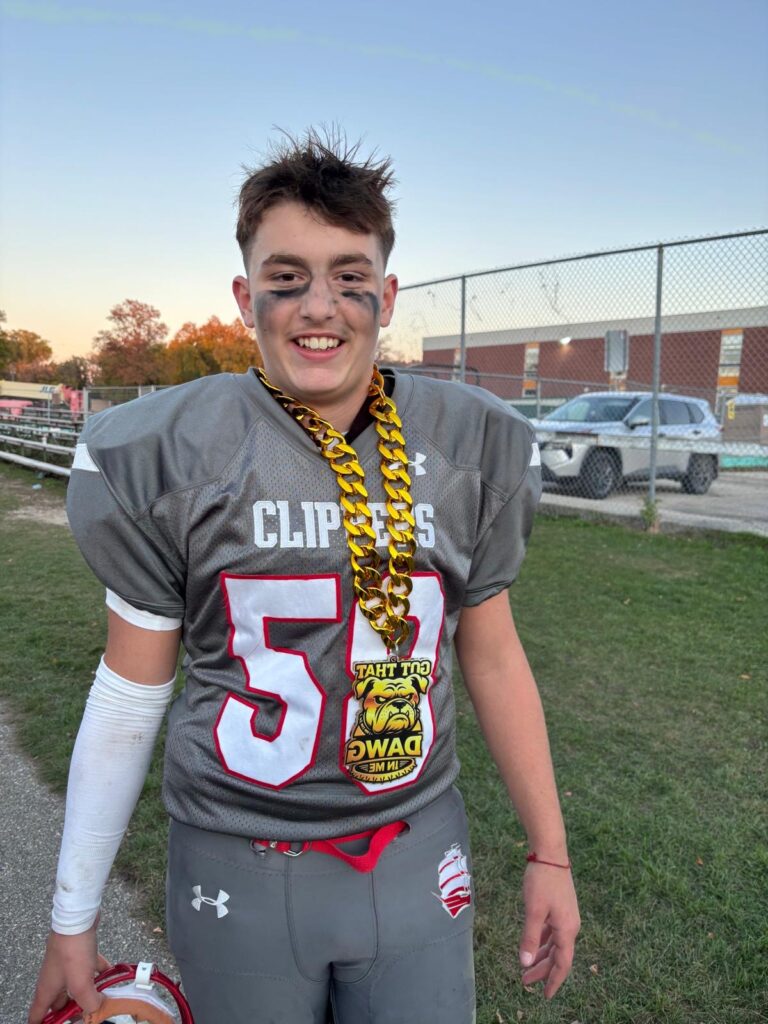
Regan responded that “they moved him to defensive tackle, so he’s right in the front line instead of at the back, but he’s breaking through the offense and helping the linebackers take down the tackles. He got two sacks yesterday and two running back tackles, which is not his job, but he’s breaking (through) kids larger than him and making his way through.”
At some point, as we follow Gavin’s football career, I hope to provide further updates as to his success on the “gridiron.” (By the way, the term “gridiron” – which refers to a football field and which used to be used quite often by sportswriters in the past “comes from the historical layout of the field, which was marked with intersecting lines every few yards that made it look like a metal cooking grate (or gridiron) used for broiling food over an open fire.”)
Enough about Gavin. Now, here’s the main point of why I wanted to do this story, which was to write about Regan.
I asked him how long he’s been involved with organized baseball?
He answered: “I’m in my 28th year.” As Regan observed, although he was born in Winnipeg, “when I was three, my dad decided he was allergic to snow and moved the family west (to Victoria). I came back in my late teens and joined up with the Winnipeg Goldeyes.”
Even before Regan moved back to Winnipeg, however, he had already embarked on a business career in his early teens, working for Westfair Foods (owners of Superstore and Wholesale Club) in British Columbia, helping to build grocery stores all over the province.
As he explained it, “So, when they would open up a new store, I would be the regional person who would go in and ensure that the setup and the staff was on plan.”
Regan was also responsible for training the staff and making “sure that everyone was ready” – traits that were to prove indispensable to what was to come during his current career in baseball. ”I was part of seven store openings in a two-year span, in that role” (with Westfair), Regan added.
He noted that when he left, he told them he was taking a “two-year sabbatical from the job.”
Regan added though, that “since I haven’t gone back, I assume they figured out I’m not returning.”
I asked: “Well, have they sent you a message saying, ‘Hey, the door’s still open?’ “
Regan answered: “No, but every year I get my superannuation for the time I served with them.”
He went on to note that he got married in 2010, “to a wonderful Manitoba woman, ” (Mandy, whose maiden name Gavin had told me, was Falk.)
Sam Katz actually revived the Winnipeg Goldeyes as a baseball franchise in 1994, when the team played out of the north end of what was then Winnipeg Stadium – in what was a very oddly shaped baseball field.
Regan, who came on board full-time with the Goldeyes in early 1999, says that he had spent some time with the team during a few previous summers spent in Winnipeg and had been able to see the Goldeyes play on that field which, he says, was affectionately known as “Deformity Field.”
(The left field fence was only 225 feet from home plate. It was a hitter’s dream – knocking easy home runs over that very short distance to the fence.)
Regan arrived in Winnipeg, however, just in time for what was to be the first season in what was to become the Goldeyes’ new home – what was then called CanwWest Park (now Blue Cross Park), in 1998.
His first title with the Goldeyes, he said, was “account executive, but I was truly a ‘gofer,” he observed.
“At the time construction was on full throttle at the new ballpark – downtown. And so, we were commuting from our offices on Maroons Road (where Winnipeg Stadium was located), and on McDermot – at Sam’s offices for Nite Out (Entertainment), as well as the ballpark trying to get things set up.
“So, when I wasn’t hauling or setting things up, I was making calls off a list to try and convince people to buy tickets.”
In those early years with the Goldeyes, as Regan noted, he was mostly involved in ticket sales, and in “2003, I moved to director of group sales and looked after all of our group sales, which are the outings where people are coming out (for things like) birthday parties, baseball teams, family gatherings, that kind of thing.”
In 2005, Regan moved up from director of group sales to assistant general manager, then in 2016 to vice president and chief operating officer – which are the positions he holds to this day.
In March 2020, however, Regan and his uncle Sam Katz took a trip to Ottawa – just as Covid was beginning to shut down things everywhere – including sporting venues.
There was a baseball park in Ottawa – called Ottawa Stadium, owned by the city, that was sitting empty.
As Regan explained, the city was “taking RFPs for an operator. (It had) sat empty for a year and a bit, and its previous occupant had left all kinds of turmoil and unpaid bills and whatnot.
“So they were looking for a team, trying to decide what to do with the venue. So we went out to tour – just as COVID shutdowns were starting in late March. We toured the venue, contemplated for a bit. And so, we went back and forth for a while, trying to decide if this was something we wanted to take on.
“In September of 2020, we agreed to terms with the city on a lease for the venue. We couldn’t travel across the border, so we started the team in 2022.”
The Ottawa team, known at the Titans, play in what is called the “Frontier League (which will be rebranding in 2027 to become the “National Association.” The Goldeyes, by the way, are in a league known as the “American Association.”)
There is a difference in the calibre of baseball players in the two leagues, as Regan explained to me: Players in the Frontier League would move up to Single A baseball, while players in the American Association would move up either to Double A or Triple A. (The level of baseball in the American Association is at a level wherein you can often see former major leaguers playing on teams.)
As vice-president and chief operating officer for both the Winnipeg Goldeyes and the Ottawa Titans, Regan said that he oversees general operations for both teams, but is not involved with the day to day management of players or coaches of the teams. That is the responsibility of the teams’ general managers and field managers, he clarified.
While there is no specific award for executive of the year in either the Frontier League or the American Association, when Scott Taylor wrote to me that Regan Katz is “the best baseball executive in Canada,” he didn’t say that he was referring only to minor league baseball.
As Regan noted, the Goldeyes received an award for “Game Presentation of the Year” this year, while the “Ottawa Titans received the Commissioner’s Award of Excellence.”
“When we started the (Ottawa) team five years ago,” he observed, “we were averaging about 1,200 fans. This year we were in excess of 2,600. We set attendance records, both for the ballpark in Ottawa, as well as for the league. We also sold 10,278 tickets to our opener, which is a record that will probably stand true for the rest of time.”
As far as the Winnipeg Goldeyes’ season went, not only did the team perform well on the field, making it to the first round of the playoffs, average attendance was the highest it’s been since before Covid, with games averaging over 4,000 fans.
Not only that, but the Goldeyes received a number of accolades for how they produce their games.
“Our broadcaster got Broadcaster of the Year,” Regan noted. (The games are broadcast on Nostalgia Radio Station CJNU. The play by play announcer is Trevor Curl.)
“We (also) received Game Presentation of the Year, which, you know is a big one because that’s what we work so hard on. What we’re selling – it’s all about fan experience.”
Regan continued: “Obviously, we try to put together a winning team, but to us, it’s all about having fun at the ballpark, win or lose – even if you don’t like baseball. So that one meant the most to us.
“We also won Social Media Team of the Year – for Winnipeg. All three of (those awards) are big ones to us because they’re pieces that we choose and work hard on.
“The essence of what I do (is) we’re trying to put on family entertainment that happens to have a baseball game in the background. ..and that’s what we built in Winnipeg.”
I asked Regan whether “in terms of, of how you rate in in Minor League Baseball – without trying to blow your own horn, I know the Goldeyes have always been considered a top-notch operation. Have the Goldeyes received any particular awards from organizations that look at all of minor league baseball and compare all teams?”
“ ‘Baseball Digest’ has acknowledged us a number of times over our 33 years for various pieces of what we do,” Regan answered, “whether it be attendance or game experience or most creative promotion. We’ve certainly received many, many mentions in ‘Baseball Digest,’ which is probably the most well-known for all of Minor League Baseball and independent leagues for sharing what’s out there.”
I asked Regan – and it was based on everything he had told me to that point: “Has anyone in a much more senior league tried to recruit you?”
He responded: “Are there headhunters out there who have called me? Absolutely, yes. Many, many teams call me to consult all the time, but I do keep my advice and recommendations to those within our league because I want to see the leagues that we’re in succeed.”
Regan added: “I have a young family. (In addition to Gavin, the Katz’s have a daughter, Brynlee, who is nine). I like where I’m at. I don’t think any other team is going to come to Winnipeg, so I’m well-planted here.”
My final question was about how difficult it is to run two separate teams that are so far apart?
He answered: “Anybody else who has overlap between two teams has a much shorter commute than I do – with a three-hour flight each way. It’s incredibly challenging. Fortunately, technology’s made it a lot easier with virtual meetings and things like that. I speak with my staff in Ottawa every single day. I’m in constant contact with at least some of them, if not all of them. All of our meetings are virtual so that I can be part of them.”
Only 47 years old, Regan Katz has been working full time since he was a young teenager. I didn’t even mention that, while he was working for the Goldeyes here after he had just moved to Winnipeg, he managed to finish university, where he studied business administration. If anyone would be interested in learning about business administration, with everything he has accomplished so far, Regan Katz could be the perfect teacher.
Uncategorized
Mamdani faces growing pressure over Jewish NYPD Commissioner Tisch and over Israel from left flank
(JTA) — New York City Mayor Zohran Mamdani is facing increasing pressure from some on the leftmost flank of his voting coalition, and an ICE shooting Thursday led democratic socialist allies to add their voices to a major demand: dump police commissioner Jessica Tisch.
“The NYPD’s Strategic Response Group must be disbanded as quickly as possible, and Commissioner Tisch must step down,” said Darializa Avila Chevalier, who won her Democratic primary with Mamdani’s endorsement. The democratic socialist, who is expected to join Congress next year representing Upper Manhattan and parts of the Bronx, was referring to the heavily armed police department unit that often responds to protests.
The calls for Tisch’s removal follow strident criticism of the mayor from pro-Palestinian activists on Wednesday night who called him names, including “traitor” and “Ziohran,” when he showed up at an Oct. 7 Israeli peace vigil mourning the loss of both Jewish and Palestinian lives. The demonstrators assailed him for not doing more to advance the pro-Palestinian agenda that has long been central to his political beliefs, raising questions over whether he could lose parts of his base as he pledges to be a mayor for all New Yorkers.
The demand for Tisch’s removal came after an ICE agent shot and wounded a Dominican man in his car on Thursday afternoon while his 5-year-old son was in the back seat. Avila Chevalier, who joined protests against ICE on Thursday, wrote on X that the NYPD “spent more time protecting a militia that just shot someone than protecting New Yorkers.”
Mamdani’s decision last year to retain Tisch — a self-described “proud Zionist” who comes from a prominent Jewish family — was seen as a reassuring move by moderates and establishment Jewish organizations including UJA-Federation of New York and the Jewish Community Relations Council. (70 Faces Media, the parent company of the Jewish Telegraphic Agency and New York Jewish Week, receives UJA funding.)
A number of progressives were skeptical of the decision at the time, citing her background as an appointee of Mamdani’s predecessor, Eric Adams, and her past criticism of campus pro-Palestinian protests. Some viewed her as an impediment to criminal justice reform.
Meanwhile, some on the left have dinged him for not yet following through on campaign promises 10 months into his term, including dissolving the Strategic Response Group, or backing down from his vow to arrest Israeli Prime Minister Benjamin Netanyahu, a plan which he later said he did not have the power to execute.
Anti-Zionist groups including Pal-Awda, Within Our Lifetime and a number of student organizations who rallied against Mamdani at the Oct. 7 vigil accused him of succumbing “to Zionist pressure.” Protesters called him a “traitor” and a number of chants rang out including, “Mayor Mamdani you can’t hide, we charge you with genocide,” drowning out speakers at the vigil and forcing the organizers to move it behind police barricades to keep the protesters from overrunning the event.
Among those protesters’ many gripes with the mayor was his decision to retain Tisch. One sign at the demonstration depicted Mamdani with the text, “Chief Executive of the NYPD SRG” with a Star of David in the middle, and a name tag on the mayor’s chest reading, “Ziohran.”
Criticism was also directed at Mamdani for not stopping Israeli real estate events at synagogues, and for his strategy to combat antisemitism, released last week, which allocates funds to a number of community-based organizations aimed at preventing hate crimes. Some critics have charged that some of the funding will aid Zionist organizations.
“The Jewish community is a large part of New York and it should be cherished. But you cannot fund these Anti-Defamation Leagues that prioritize Zionism over Judaism,” a John Jay College student protester, who declined to be named, told JTA during the demonstration.
On Thursday, the Democratic Socialists of America’s New York City chapter — which Mamdani has called his “political home” — wrote that Tisch “must end NYPD complicity with ICE” and that if she “cannot put a stop to these injustices, she must be fired.”
“Abolish ICE. Disband the SRG. Fire Tisch,” wrote Illapa Sairitupac, a fellow democratic socialist who won the Democratic nomination for a Lower Manhattan State Assembly district. Mamdani endorsed both Sairitupac and Avila Chevalier this past year.
While some protesters at the vigil said they were Mamdani voters — and one speaker even identified herself as a former intern for the now-mayor — some of the mayor’s allies have stressed that the crowd protesting him was not representative of his base.
“If I had to gamble, I would gamble that the vast majority of them were people who never supported him,” activist Abby Stein told JTA on Thursday night, during the Mazals gala held by left-wing group Jews for Racial & Economic Justice. Mamdani was due to attend the JFREJ event, but because of the ICE shooting was instead in the Bronx, where he denounced the federal agency and demanded that it cease its operations in New York City.
Many of the signs excoriating Mamdani at Wednesday’s protest outside of City Hall were signed with the name of the Maoist Communist Union, an organization that opposed Mamdani before he took office. Some protesters were handing out copies of Spartacist, the Trotskyist International Communist League’s journal.
“We certainly didn’t support Mamdani or vote for him,” said Erica Jones, among the Trotskyist protesters. “We knew he was running as a Democrat and he would be as big of a sellout as AOC and Bernie Sanders and all the rest of those who claim to have, at one time, stood for socialism but in reality, stand for the capitalist masters who are oppressing us all.”
Stein, a member of the DSA in addition to JFREJ, called out some of the protesters’ rhetoric and the choice to crash the Israelis for Peace Oct. 7 vigil. But she also acknowledged that there was overlap between their demands and her views, including over the police commissioner.
“There are things that people are upset over that I think are legit — like keeping Jessica Tisch on, for example,” Stein said. “A lot of us were not very happy about it.”
Ultimately, Stein said there is “always going to be something to protest” with any politician, and pointed to a quote from New York’s mayor in the 1970s and ‘80s, Ed Koch: “If you agree with me on 9 out of 12 issues, vote for me. If you agree with me on 12 out of 12 issues, see a psychiatrist.”
This article originally appeared on JTA.org.
The post Mamdani faces growing pressure over Jewish NYPD Commissioner Tisch and over Israel from left flank appeared first on The Forward.
